www.atmos-meas-tech.net/4/975/2011/ doi:10.5194/amt-4-975-2011
© Author(s) 2011. CC Attribution 3.0 License.
Atmospheric
Measurement
Techniques
Statistically optimized inversion algorithm for enhanced retrieval
of aerosol properties from spectral multi-angle polarimetric satellite
observations
O. Dubovik1, M. Herman1, A. Holdak1, T. Lapyonok1, D. Tanr´e1, J. L. Deuz´e1, F. Ducos1, A. Sinyuk3, and A. Lopatin1,2
1Laboratoire d’Optique Atmosph´erique, UMR8518, CNRS – Universit´e de Lille 1, Villeneuve d’Ascq, France 2Institute of Physics, Laboratory of Scattering Media, 68 Nezavisimosti avenue, Minsk, 220072, Belarus 3NASA/GSFC, Greenbelt, MD, USA
Received: 7 August 2010 – Published in Atmos. Meas. Tech. Discuss.: 16 November 2010 Revised: 29 April 2011 – Accepted: 7 May 2011 – Published: 31 May 2011
Abstract. The proposed development is an attempt to en-hance aerosol retrieval by emphasizing statistical optimiza-tion in inversion of advanced satellite observaoptimiza-tions. This op-timization concept improves retrieval accuracy relying on the knowledge of measurement error distribution. Efficient ap-plication of such optimization requires pronounced data re-dundancy (excess of the measurements number over num-ber of unknowns) that is not common in satellite observa-tions. The POLDER imager on board the PARASOL micro-satellite registers spectral polarimetric characteristics of the reflected atmospheric radiation at up to 16 viewing directions over each observed pixel. The completeness of such observa-tions is notably higher than for most currently operating pas-sive satellite aerosol sensors. This provides an opportunity for profound utilization of statistical optimization principles in satellite data inversion. The proposed retrieval scheme is designed as statistically optimized multi-variable fitting of all available angular observations obtained by the POLDER sensor in the window spectral channels where absorption by gas is minimal. The total number of such observations by PARASOL always exceeds a hundred over each pixel and the statistical optimization concept promises to be efficient even if the algorithm retrieves several tens of aerosol param-eters. Based on this idea, the proposed algorithm uses a large number of unknowns and is aimed at retrieval of extended set of parameters affecting measured radiation.
Correspondence to: O. Dubovik
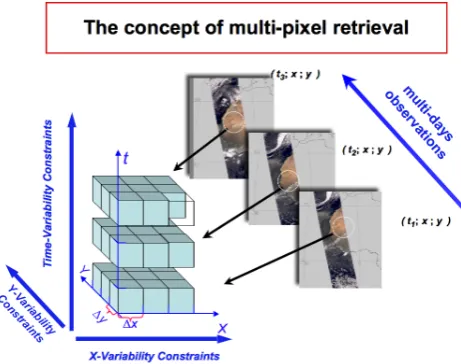
The algorithm is designed to retrieve complete aerosol properties globally. Over land, the algorithm retrieves the pa-rameters of underlying surface simultaneously with aerosol. In all situations, the approach is anticipated to achieve a ro-bust retrieval of complete aerosol properties including infor-mation about aerosol particle sizes, shape, absorption and composition (refractive index). In order to achieve reliable retrieval from PARASOL observations even over very reflec-tive desert surfaces, the algorithm was designed as simultane-ous inversion of a large group of pixels within one or several images. Such multi-pixel retrieval regime takes advantage of known limitations on spatial and temporal variability in both aerosol and surface properties. Specifically the variations of the retrieved parameters horizontally from pixel-to-pixel and/or temporary from day-to-day are enforced to be smooth by additional a priori constraints. This concept is expected to provide satellite retrieval of higher consistency, because the retrieval over each single pixel will be benefiting from coin-cident aerosol information from neighboring pixels, as well, from the information about surface reflectance (over land) obtained in preceding and consequent observations over the same pixel.
1 Introduction
The research presented in this paper aims to develop a new retrieval algorithm optimized for deriving maximum information content using the data redundancy available from advanced satellite observations, such as those from POLDER/PARASOL observations. The design of the POLDER imager allows collecting rather comprehensive characterization of angular distribution of both total and po-larized components of solar radiation reflected to space. The observations in window channels where the effect of absorp-tion by atmospheric gases are minimal are usually used for aerosol retrievals. The complete set of such observations collected operationally by POLDER/PARASOL over each pixel includes angular measurements of both total radiances and linear polarization at 0.49, 0.675 and 0.87 µm and angu-lar measurements of only total radiances at 0.44, 0.565 and 1.02 µm. The number of viewing directions is similar for all spectral channels and varies from 14 to 16 depending on observed geographical location. The completeness of such observations is significantly higher comparing to any cur-rently operating passive satellite aerosol sensors. In addition PARASOL provides nearly global coverage every 2 days. Therefore, such complete set of PARASOL observations po-tentially provides very valuable basis for enhanced charac-terization of global aerosol.
However, rigorous interpretation of redundant satellite ob-servation is a very challenging task. Indeed, the optimized inversion requires applying complex multi-variable inversion algorithms. Such methods are time-consuming and challeng-ing for implementation. This is why the rigorous methods of inversion optimization are not generally used for processing very large data sets provided by satellite aerosol imagers. In-stead, most satellite aerosol retrievals use look-up tables of simulated satellite signals pre-computed for some limited se-lected scenarios of aerosol and underlying surface combina-tions. The modeled scenario that provides the best match of the observed radiances is accepted as the retrieved solution. With some modification, this strategy is adopted in most of aerosol satellite retrievals because it allows rapid operational processing of satellite images. For example, it is success-fully employed in retrievals of single-view AVHHR (Stowe et al., 1997; Mishchenko et al., 1999; Higurashi and Naka-jima, 1999), TOMS (Torres et al., 1998), MODIS (Kaufman et al., 1997; Tanr´e et al., 1997; Remer et al., 2005), etc. At the same time, applying the same methodology for processing observations from imagers with multi-viewing capabilities, such as MISR (Diner et al., 1998; Martonchik et al., 1998; Kahn et al., 2007, 2009), SEVIRI (Govaerts et al., 2010; Wagner et al., 2010; Carrer et al., 2010), or POLDER (Deuz´e et al., 2001; Herman et al., 2005; Tanr´e et al., 2011), reveals some deficiencies of the look-up table retrievals. The multi-directional observations have notably higher sensitivity to the details of aerosol and surface properties, and the retrieval of larger number of parameters is expected. Correspondingly,
the required comprehensive look-up tables of such obser-vations may have larger dimensions and thus be less suit-able for operational use. As a result, most look-up tsuit-able based algorithms rely only on the selected sub-sets of the ob-servations with highest sensitivity to the aerosol parameters and retrieve reduced set of characteristics. For example, the current POLDER/PARASOL operational retrieval algorithm over ocean (Herman et al., 2005) uses measurements of to-tal and polarized reflectances only at two spectral channels (0.67 and 0.87 µm) . The look-up table algorithm works ef-ficiently for these two channels because they are sensitive to the scattering of both fine and coarse mode aerosols. At the same time, observations at these two channels are insensitive to vertical variability of aerosol and not strongly affected by water-leaving radiation. The POLDER/PARASOL retrieval over land (Deuz´e et al., 2001) uses only polarized measure-ments of reflected light at the same two channels. Such strat-egy is used because the contribution of aerosol into polarized reflectance generally dominates over the contribution of the land reflectance, while contribution of land surface into total reflected radiation is usually comparable or stronger than that of aerosol. Therefore, as discussed by Deuz´e et al. (2001), utilization of only polarized observations allows one to de-rive aerosol properties and to avoid challenging issue of sep-aration of surface and aerosol contributions into the total re-flectance. Although this algorithm has successfully provided valuable aerosol retrievals from POLDER observations, sev-eral shortcomings were identified in the POLDER aerosol products. First, PARASOL retrieval over land provides in-formation only about fine aerosol particles, because the con-tribution of large aerosol (predominantly non-spherical dust) over land to the polarized reflectances often is small. In ad-dition, the correct interpretation of PARASOL observations of desert dust even over ocean surface is challenging due to difficulties to model appropriately the light scattering by non-spherical particles of desert dust (G´erard et al., 2005). Second, since the PARASOL algorithm, both over land and ocean, relies on the observations of only two spectral chan-nels, the retrieved aerosol spectral properties are not always fully consistent with the observations at other channels.
aerosol particle shape and vertical distribution. This setup of the aerosol retrieval algorithm is based on accumulated ex-perience and current understanding of the high potential of using spectral multi-angular polarimetric observations from space for improving global aerosol monitoring. Diverse as-pects of aerosol retrieval improvements by using advanced satellite observations have been already demonstrated and outlined in numerous previous studies (e.g. see Kokhanovsky and de Leeuw, 2009). For example, the studies by Kahn et al. (2007, 2009), Kalashnikova et al. (2005), Kalashnikova and Kahn (2006) demonstrated the possibility of deriving not only aerosol loading but also some information about aerosol particle size, morphology and shape from observations from the MISR imager that provides multiple view observations of total reflectance in 9 directions in 4 spectral channels (0.44, 0.55, 0.67 and 0.87 µm). These studies have suggested a high importance of using multi-angular observation geometry for deriving more detailed aerosol information. However, most of the known comparisons of the aerosol parameters derived from multi-viewing images (such as MISR and POLDER) with the aerosol products of single view satellite sensors do not indicate clear advantage of multi-viewing observation for aerosol monitoring. For example, Kokhanovsky et al. (2007) compared the aerosol retrievals obtained from different satel-lite platforms over land with ground-based AERONET ob-servations and indicated significant differences in currently available satellite products and did not reveal any notable advantage of one particular satellite sensor. The study sug-gested that retrieval indeterminacies are likely part of the observed discrepancies, and their reduction will likely be aided by new missions incorporating spectral multi-angular polarimeters. Indeed, sensitivity analysis of Mishchenko and Travis (1997a,b) related the possibility of potential important improvements of satellite aerosol retrievals with use of spec-tral multi-angular polarization as well as intensity of reflected sunlight. Later studies by Chowdhary et al. (2002, 2005) demonstrated the possibility of retrieving the detailed aerosol properties from spectral multi-angular Research Scanning airborne Polarimeter (RSP) over water. This polarimeter is an aircraft-based prototype of the APS instrument projected to be part of the future NASA Glory mission (Mishchenko et al., 2004, 2007). The analysis of RSP observations over land by Waquet et al. (2007, 2009a,b) illustrated the possi-bility of reliable aerosol retrievals over reflective land sur-faces. It should be noted here that Kokhanovsky et al. (2007) did not identify any superiority of POLDER results (in-cluded into the comparisons) over other satellite imagers. This fact has several probable explanations. First, although POLDER sensor has multi-viewing polarimetric capabilities, the spectral range of POLDER observation is notably nar-rower that spectral coverage of some single viewing sen-sors, such as a MODIS. Similar remark is valid for com-parisons on multi-viewing MISR satellite instrument. Sec-ond, the algorithm processing POLDER observations was not designed to take full advantage of positive redundancy of
spectral multi-angle polarimetric observations. Indeed, the POLDER retrieval algorithm by Deuz´e et al. (2001) oriented on rapid operational processing uses polarized reflectance at two visible spectral channels. Therefore, the positive po-larimetric information from other spectral channels, as well as any information from total reflectance observation, was not used. Waquet et al. (2007) demonstrated that using po-larimetric observations over a wider spectral range is essen-tial for aerosol retrieval over land from polarimetry obser-vations. Waquet et al. (2007, 2009a,b) followed Deuz´e et al. (2001) approach and used only polarized reflectances. At the same time, the Waquet et al. (2007, 2009a,b) algorithm was driven by a large number of unknowns and was of sig-nificantly higher complexity than the POLDER algorithm. An algorithm of such level of complexity has never been ap-plied to POLDER/PARASOL observations. In addition, one could expect that including total reflectance into such an en-hanced retrieval scheme could result in additional improve-ments of the aerosol retrieval. Indeed, the spectral angular measurements of total reflectance are shown to provide valu-able aerosol information even over land surfaces (e.g. Mar-tonchik et al., 2004; Liu et al., 2004; Kahn et al., 2005; Diner et al., 2005; etc.). In addition, rigorous sensitivity studies suggest high importance of using observations of both to-tal and polarized reflectances for reliable aerosol retrieval (Mishchenko and Travis, 1997a,b; Hasekamp and Landgraf, 2005b, 2007). That is why the retrieval concept described in this paper pursues inversion of both total radiances and lin-ear polarization measurments and includes implementations of several important algorithm refinements. The realization of this concept is expected to result in enhancement of com-pleteness and accuracy of POLDER aerosol retrieval.
combination of AERONET data and airborne measurements by NASA’s Cloud-Absorption Radiometer. The main details of the resulting fine-tuned numerical inversion scheme are discussed by Dubovik (2004) and below in Sect. 3 of the current paper. The modeling of PARASOL observed re-flectances is implemented using approaches and computer codes developed previously for accurate radiative transfer equation solutions and for modeling aerosol single scattering and surface reflectance properties. Specifically, the multiple solar light interactions with the atmosphere and underlying surface are accounted for using the successive order of scat-tering radiative transfer code by Lenoble et al. (2007). This approach and actual computer code have been used and re-fined in POLDER-1, POLDER-2 and POLDER/PARASOL data analysis. The land surface reflectance of total solar radi-ance is approximated by the model of Rahman et al. (1993) that has already been successfully used for interpretation of MISR (e.g. Martonchik et al., 1998), SEVIRI (e.g. Govaerts et al., 2010) and RSP (e.g. Litvinov et al., 2010) observa-tions. The reflectance of polarized radiation by land surface is approximated by using the models developed by Nadal and Br´eon (1999) and Maignan et al. (2009) from the observa-tions by POLDER. These models were also validated by RSP observations (Litvinov et al., 2011). The modeling of aerosol single scattering properties is adopted from AERONET de-velopments. This scattering model seems rather suitable for applying to multi-angular polarimetric observations, since this model was demonstrated to accurately reproduce the ob-servations by ground-based radiometers that have high sensi-tivity to the fine features of angular and spectral aerosol scat-tering. For example, the software developed by Dubovik et al. (2006) for AERONET allows for very fast simulations of scattering by non-spherical aerosol particles. As discussed by Herman et al. (2005) and G´erard et al. (2005), the ade-quate modeling of scattering by non-spherical aerosol parti-cles is critical for analysis of PARASOL observations.
In addition, as a part of the PARASOL aerosol algorithm improvement, a new aspect has been introduced into the con-cept of satellite data inversion. Specifically, in order to over-come some difficulties related to the limited information of the PARASOL observations over a single pixel, the retrieval is organized as a simultaneous inversion of a large group of pixels within one or several images. For example, derivation of aerosol properties over bright land is known to be an ex-tremely difficult task. The multi-pixel retrieval regime takes advantages from known limitations on spatial and temporal variability in both aerosol and surfaces properties. Similar ideas have already been used in different forms for improving satellite retrievals. For example, Martonchik et al. (1998) de-rive the surface reflectance properties from a group of near-by MISR pixels in a 16×16 km region by relying on the similarity of aerosol properties over this area. Govaerts et al. (2010) have built the SEVIRI aerosol and surface retrieval concept assuming rather limited time variability of the land surface reflectance properties. Even more explicitly the idea
was used in studies by Lyapustin et al. (2008) and Lyapustin and Wang (2009), who used the limited time variability of land surface for screening cloud-contaminated data or the limited space variability of aerosol properties for constrain-ing aerosol retrieval from MODIS observations. Tempo-ral smoothness constraints on surface reflectance variability were used by Quaife and Lewis (2010) in the method for in-verting linear bi-directional surface reflectance models from MODIS observations. Here, the satellite retrieval is designed as a statistically optimized simultaneous fitting of the obser-vations over a group of pixels implemented under additional inter-pixel constraints. Specifically, the variations of the re-trieved parameters horizontally from pixel-to-pixel or tem-porary from day-to-day over the same pixel are limited by the additional a priori constraints, in a similar manner to how it is applied in inverse modeling by Dubovik et al. (2008). The inclusion of these additional constraints is expected to provide retrieval of higher consistency for aerosol retrievals from satellites, because the retrieval over each single pixel will be benefiting from coincident aerosol information from neighboring pixels, in addition to the information about sur-face reflectance (over land) obtained in preceding and conse-quent observations over the same pixel.
It should be noted that this paper focuses on detailed im-plementation of core ideas for a new PARASOL retrieval al-gorithm, however it does not address many aspects of an op-erational implementation of the algorithm. For example, is-sues such as cloud-screening, retrieval time requirements and other important aspects of algorithm implementation for op-erational processing are to be addressed in follow-on studies.
2 General structure of the algorithm
O. Dubovik et al.: Statistically optimized inversion algorithm for enhanced retrieval of aerosol properties 979
3
Fig. 1
1
2
3
4
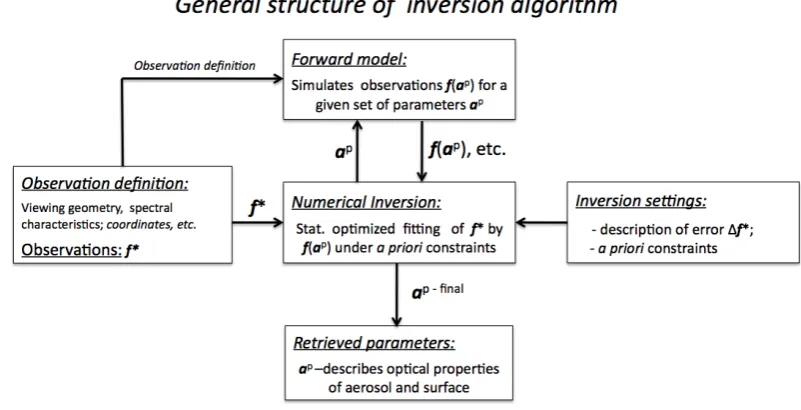
Fig. 1. The general structure of the retrieval algorithm.
other satellite sensors or from the ground. In addition, such an algorithm structure was helpful in adapting physical mod-els and computer routine fragments inherited from previous AERONET and POLDER developments.
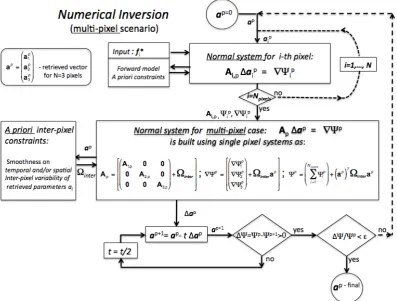
The following several Sections of the paper provide a full description of the “Forward Model” and “Numerical Inver-sion” algorithm modules. A number of optional adjustments are suggested for setting both aerosol physical model and re-trieval scheme. Although the algorithm is tuned for inverting PARASOL observations, some aspects of aerosol parameter-ization and inversion implementation (in particular a priori constraint settings) can be modified and adjusted for optimiz-ing the algorithm performance if it is applied to other remote sensing observations. For example, two alternative strate-gies are suggested for implementing numerical inversion of satellite image observations: conventional pixel-by-pixel in-version and a new multi-pixel inin-version strategy. According to this new multi-pixel approach, the retrieval developed as simultaneous inversion of a large group of pixels within one or several images. Such a retrieval regime takes advantage of known limitations of spatial and temporal variability in both aerosol and surface properties.
3 Forward model of POLDER/PARASOL observations
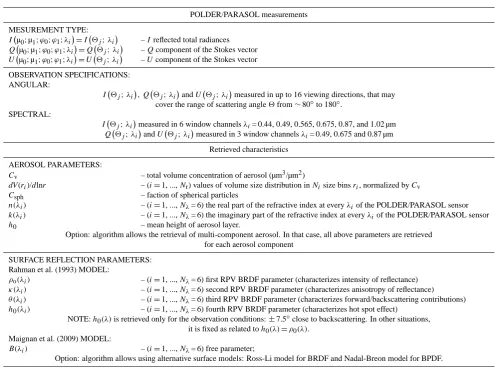
The aerosol retrieval algorithm is designed to invert the POLDER/PARASOL observations acquired in window channels shown in Table 1, that is: the total radiance in 6 win-dow channels: 0.44, 0.49, 0.565, 0.675, 0.87 and 1.02 µm, and the linear polarization in 3 of these channels: 0.49, 0.675 and 0.87 µm, reflected by a ground pixel. In each chan-nel, observations of the same pixel are performed nearly si-multaneously in up to 16 viewing directions (Deschamps et
4 Fig. 2
1 2
3
Fig. 2. The illustration of the angular convention used for POLDER observation modeling.
al., 1994). It is assumed that the light observed at the top of the atmosphere is only linearly polarized. In the polarized channels, besides the total reflected radiance,I, the measure-ments provide the Stokes parameters Qand U referred to axes perpendicular and parallel to the local meridian plane, i.e. Q=Ipcos(2α) and U=Ipsin(2α) where Ip is the po-larized component of reflected radiance andα is the angle between the meridian plane and the polarization direction.
Let I=(I, Q, U, V )T and E0=(E0, 0, 0, 0)T stand, respectively, for the Stokes’ vectors of the observed elec-tromagnetic radiation and of the incident unpolarized so-lar radiation; the subscript “T” denotes transposition and V is assumed to be negligible. The Stokes’ vector
Table 1. List of measured and retrieved characteristics considered in POLDER/PARASOL algorithm.
POLDER/PARASOL measurements
MESUREMENT TYPE:
I µ0;µ1;ϕ0;ϕ1;λi=I 2j;λi –Ireflected total radiances
Q µ0;µ1;ϕ0;ϕ1;λi
=Q 2j;λi –Qcomponent of the Stokes vector
U µ0;µ1;ϕ0;ϕ1;λi
=U 2j;λi
–Ucomponent of the Stokes vector
OBSERVATION SPECIFICATIONS: ANGULAR:
I 2j;λi
, Q 2j;λi
andU 2j;λi
measured in up to 16 viewing directions, that may cover the range of scattering angle2from∼80◦to 180◦.
SPECTRAL:
I 2j;λi
measured in 6 window channelsλi= 0.44, 0.49, 0.565, 0.675, 0.87, and 1.02 µm
Q 2j;λi
andU 2j;λi
measured in 3 window channelsλi= 0.49, 0.675 and 0.87 µm
Retrieved characteristics
AEROSOL PARAMETERS:
Cv – total volume concentration of aerosol (µm3/µm2)
dV(ri)/dlnr – (i=1, ...,Nr) values of volume size distribution inNisize binsri, normalized byCv
Csph – faction of spherical particles
n(λi) – (i=1, ...,Nλ= 6) the real part of the refractive index at everyλiof the POLDER/PARASOL sensor
k(λi) – (i=1, ...,Nλ= 6) the imaginary part of the refractive index at everyλiof the POLDER/PARASOL sensor
h0 – mean height of aerosol layer.
Option: algorithm allows the retrieval of multi-component aerosol. In that case, all above parameters are retrieved for each aerosol component
SURFACE REFLECTION PARAMETERS: Rahman et al. (1993) MODEL:
ρo(λi) – (i=1, ...,Nλ= 6) first RPV BRDF parameter (characterizes intensity of reflectance)
κ(λi) – (i=1, ...,Nλ= 6) second RPV BRDF parameter (characterizes anisotropy of reflectance)
θ (λi) – (i=1, ...,Nλ= 6) third RPV BRDF parameter (characterizes forward/backscattering contributions)
h0(λi) – (i=1, ...,Nλ= 6) fourth RPV BRDF parameter (characterizes hot spot effect)
NOTE:h0(λ)is retrieved only for the observation conditions:±7.5◦close to backscattering. In other situations,
it is fixed as related toh0(λ)=ρ0(λ).
Maignan et al. (2009) MODEL:
B(λi) – (i=1, ...,Nλ= 6) free parameter;
Option: algorithm allows using alternative surface models: Ross-Li model for BRDF and Nadal-Breon model for BPDF.
the angular convention adapted for storage and processing POLDER data. This convention is used in present algorithm.
The reflected radiance may be written:
I µ0;µ1;ϕ0;ϕ1;λ = (1)
=LMscat(2;λ)+Mreflec µ0;µ1;ϕ0;ϕ1;λE0+mult.scat.,
where the terms Mscatand Mrefleccorrespond to the light re-flected as a result of single interaction of incident solar light, respectively, with the atmosphere and surface. In Eq. (1) it is assumed that polarized light is referred to axes perpendicular and parallel to the scattering and reflection planes (here, both formed by the solar and viewing directions); and the matrix L transforms the Stokes’ vector into the plane of observations (details are given in Lenoble et al., 2007).
Under assumption of plane parallel multi-layered atmo-sphere, the single scattering term, Mscat, at the top of the atmosphere can be expressed as:
Mscat(2;λ) = (2)
= µ0
µ0+µ1
X
i=1, ..., N
e−mτi−1 1−e−m1τi ω i
0
4π Pi(2;λ)
!
,
where1τi is the optical thickness of the i-th atmospheric layer (i= 1, ...,N numbered from the top to the bottom of the atmosphere) andτi is the optical depth of the bottom of layeri(i.e.τi=Pk=1,...,j1τk); Pi(2;λ)andω0i denote the phase matrix and single scattering albedo of thei-th atmo-spheric layer,m= 1/µ0+1/µ1.
The optical propertiesτi, Pi (2;λ)andωi0of each atmo-spheric layer include the contributions of aerosol (character-ized ini-th layer by1τi,a,ωa0,i and Pai (2;λ)), molecular scattering (characterized in i-th layer by 1τi,mol, ωmol0,i = 1 and Pmoli (2;λ)) and atmospheric gases (characterized in i-th layer by 1τi,gas and ω
gas
scattering albedoω0i and phase matrix Pi (2;λ)of thei-th atmospheric layer are:
ωi0 = ω a
0,i 1 τi,a +1 τi,mol 1 τi,a +1 τi,mol +1 τi,gas
, (3)
and
Pi (2;λ) =
ω0a1 τi,aPai (2;λ) +1 τi,molPmoli (2;λ)
1 τi,a +1 τi,mol +1 τi,gas
,(4) and the extinction optical thicknessτ of the atmosphere is the sum of the corresponding components:
τ = τa +τmol +τgas. (5) The properties of atmospheric molecular scatteringτmoland Pmol(2;λ)are well known and can be calculated with suf-ficient accuracy. The absorption of atmospheric gasesτgas has rather minor contributions in the POLDER/PARASOL window channels and can be accounted for using known cli-matologies, as well as using available information from an-cillary observations. For example, the present development uses the same procedure as used in the operational algorithm by Deuz´e et al. (2001). That procedure corrects the water va-por absorption using PARASOL measurements in 0.910 µm spectral band. The minor absorption from ozone, NO2 and O2are accounted using the climatology data. Thus, the most challenging part in modeling single scattering properties of the atmosphere is the modeling of aerosol contribution, i.e. aerosol extinctionτa, single scattering albedoωa0and phase matrix Pa (2;λ). These properties depend on aerosol mi-crophysics: particle size, shape and composition (refractive index). All these characteristics are driven by the parameters included in the vector of unknowns and correspondingly they are retrieved from the observations.
The single reflection Mreflecat the top of atmosphere can be calculated as:
Mreflec µ0;µ1;ϕ0;ϕ1;λ
= µ0 π e
−mτ∗
R µ0;µ1;ϕ0;ϕ1;λ
(6) where reflection matrix R(µ0;µ1;ϕ0;ϕ1;λ)describes the surface reflection properties in the plane formed by the so-lar and viewing directions. For the ocean surface the re-flection R (µ0;µ1;ϕ0;ϕ1;λ) is mainly governed by the wind speed at sea level as suggested by the Cox-Munk model (Cox and Munk, 1954) employed in the currently operational POLDER algorithm (Deuz´e et al., 2001; Herman el al., 2005; Tanr´e et al., 2011). In contrast, the reflection matrix of the land surface may differ very strongly from location to loca-tion. Therefore, in the present algorithm, the key properties of the land surface reflectance are included in the set of un-knowns and retrieved from the observations.
As follows from Eq. (1), once the single scattering terms Mscatand Mreflecare defined one needs to account for multi-ple interactions of scattered light with atmosphere and sur-face. In the present algorithm these interactions are ac-counted for by rigorously solving vector radiative transfer
5 Fig. 3
1 2
3
Fig. 3
4
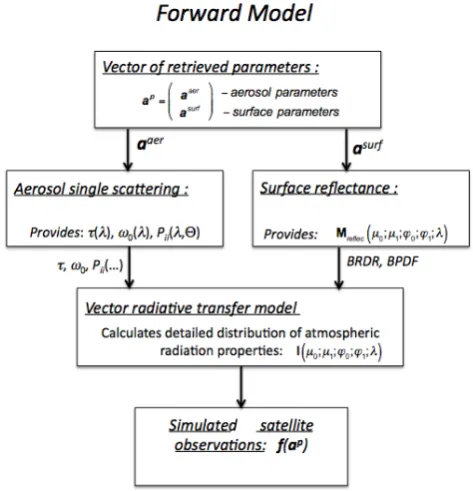
Fig. 3. The organization of the forward calculations of atmospheric radiance measured from a satellite.
equation. Thus, the forward model of reflected radiances measured by POLDER/PARASOL contains three main com-ponents: (i) aerosol single scattering, (ii) surface reflection and (iii) solving vector radiative transfer equation for ac-counting for multiple scattering. The following parts of this section will describe each of these components in detail.
It should be noted that the forward model for repro-ducing POLDER/PARASOL observations is designed by means of adapting the atmospheric modeling strategies and computer routines developed within previous POLDER and AERONET activities. At the same time, several important modifications required for optimizing the forward modeling performance have been implemented in the present PARA-SOL algorithm. Specifically, the models of land surface reflectance have been introduced into the radiative transfer calculations, the number of aerosol parameters driving the model has been reduced, the different regimes of the radia-tive transfer calculations have been designed for allowing faster but less accurate calculations. These and other forward model modification allowed the performance of the devel-oped “on-line” inversion procedure to attain the standards re-quired for operational processing (achieving sufficient speed of computations, etc.).
Figure 3 shows the data flow within the “Forward model” block of the algorithm. Three main complementary efforts are involved in modeling the atmospheric radiation field ob-served by the POLDER sensor:
– Modeling of the surface reflectance properties.
– Accounting for multiple scattering effects using full ra-diative transfer model.
These aspects are described in detail below. 3.1 Aerosol single scattering properties
The modeling of the aerosol scattering matrices has been im-plemented following the ideas employed in AERONET re-trieval algorithm by Dubovik and King (2000) and Dubovik et al. (2002b, 2006).
In order to account for aerosol non-sphericity, the atmo-spheric aerosol is modeled as an ensemble of randomly ori-ented spheroids. Specifically, AERONET operational re-trievals use the concept developed by Dubovik et al. (2006) and model the particles for each size bin as a mixture of spherical and spherical aerosol components. The non-spherical component was modeled by ensembles of ran-domly oriented spheroids (ellipsoids of revolution). Accord-ing to this concept, aerosol particles of non-spherical com-ponent have size-independent distribution of shapes and the modeling of the total aerosol optical thickness τ of non-spherical aerosol can be written as the following:
τ (λ) = (7)
= rmax
Z
rmin
εmax
Z
εmin
cετ(λ;k;n;r;ε)dN (ε) dlnε
dN (r)
dlnr dlnε dlnr,
wherecετ(λ;k;n;r;ε)denotes the extinction cross-sections of spherical particle and randomly oriented spheroid, λ – wavelength, n andk – real and imaginary parts of the re-fractive index, ε spheroid axis ratio (ε=a/b, a – axis of spheroid rotational symmetry,b– axis perpendicular to the axis of spheroid rotational symmetry),r– radius of volume-equivalent sphere. Correspondingly the mixture of spheroid includes the flattened oblate spheroids (ε <1), spheres (ε= 1) and elongated prolate spheroids (ε >1). The characteristics r andε are used here for describing size and shape of the ensemble of spheroids. Analogously to the combination of a andb, the combination of r andε allows unique defini-tion of the spheroid shape. As discussed by Mishchenko et al. (1997), the usage of r and ε is convenient for sep-arating the effect of particle shape and size in analysis of aerosol mixture light scattering. Then the functions dN (r)dlnr and dN (ε)dlnε denote the number particle size and the number particle shape (axis ratio) distributions accordingly.
For performing fast and accurate calculations of aerosol extinction by polydisperse non-spherical aerosols, the size and shape integration can be approximated by the double sum, e.g.
rmax
Z
rmin εmax
Z
εmin
cετ(λ;k;n;r;ε) dN (ε) d lnε
dN (r)
d lnr d lnε d lnr (8)
= X
i=1, ..., Nε
X
k=1, ..., Nε
Kετ (λ;k;n;ri;εk)
dN (εk)
dlnε
dV (ri)
dlnr ,
where
Kεext(λ;k;n;ri;εk) = (9)
=
lnri+1lnr Z
lnri−1lnr
lnεk+1lnε Z
lnεk−1lnε
cε
τ(λ;k;n;r;ε)
v(r) Ak (ε) Bi(r) dlnε dlnr.
where v(r) is the volume of particle, dV (r)dlnr =v(r)dN (r)dlnr is the volume particle size distribution, Ak (ε) andBi(r)are the functions providing correspondingly the interpolation of shape distribution between the selected pointsεk and the in-terpolation of size distribution over selected points ri. In studies by Dubovik et al. (2002b, 2006), the coefficients Ak(ε)for integrating over axis ratio were assumed as rectan-gular functionsAk (ε)= const. For approximating size distri-bution between the used size binsri, the trapezoidal approxi-mation was chosen by Dubovik and King (2000). Such kinds of interpolation are traditionally applied in aerosol applica-tions (e.g. see Twomey, 1977), where the funcapplica-tionsBi (r) are defined as isosceles triangles.
It should be noted that in Eq. (8) the integral over size is approximated by a sum using values of volume size distri-bution dV(r)/dlnr (in place of the number size distribution
dN(r)/dlnr)defined in logarithmically equidistant pointsri. Utilization of both the volume size distribution and logarithm of radius was chosen for the convenience of the algorithm implementation. In principle, the particle number distribu-tions dN(r)/dlnror dN(r)/dr could be equally used in Eq. (8) (e.g. see King et al., 1978; King, 1982). At the same time, the usage of both the volume of the particle (instead of num-ber) and logarithmic scale in binning of the size distribution helps to optimize the approximation given by Eq. (8). First, these choices help to improve the accuracy of this approx-imation (a smaller number of pointsNr provides appropri-ate accuracy). Second, under this representation, the ker-nels Kεext (λ; k; n; ri; εk)for different pointsri are closer in values. This is one of the favorable conditions for im-plementing inversion. Therefore, volume size distribution
from 0.05 to 15 µm. This size range was chosen following the sensitivity analysis by Dubovik et al. (2000), which showed that the aerosol particles of smaller and larger sizes produce negligible contribution to AERONET radiometer observa-tions. This range of aerosol particle sizes is slightly wider than the one used in earlier studies by Nakajima et al. (1996). As discussed later in this paper, the size range of aerosol is modified for retrieving aerosol from PARASOL observa-tions.
Using the approximation given by Eqs. (8)–(9), Dubovik et al. (2006) developed a numerical tool for fast calculations of scattering properties of spheroid mixture. The quadrature coefficients Kεext(λ;k; n;ri; εk) for the extinction, as well as for absorption cross-sections and scattering matrices have been calculated and stored into the look-up tables for a wide range ofnandk(1.3≤n≤1.7; 0.0005≤k≤0.5). The cal-culations were done for spheroids with axis ratioεranging from ∼0.3 (flattened oblate spheroids) to ∼3.0 (elongated prolate spheroids) and for 41 narrow size bins covering the size-parameter range from ∼0.012 to ∼625. The look-up tables were arranged into a software package allowing fast, accurate, and flexible modeling of scattering by randomly oriented spheroids with different size and shape distribu-tions. In addition, Dubovik et al. (2006) used the developed software and showed that spheroids can closely reproduce single-scattering matrices of mineral dust measured in the laboratory by Volten et al. (2001). It was shown that scatter-ing matrices have rather limited sensitivity to the minor de-tails of axis ratio distribution dN (εk)
dlnε . Therefore, Dubovik et al. (2006) have suggested and demonstrated that AERONET retrieval may rely on rather simple assumption that shape (axis ratio) distribution dN (εk)
dlnε in the non-spherical fraction of any tropospheric aerosol is the same. Based on this con-clusion the aerosol scattering model was set in AERONET retrieval as a mixture of spherical and non-spherical frac-tions, and dN (εk)
dlnε obtained by Dubovik et al. (2006) from fitting Volten et al. (2001) observations was employed as shape distribution for non-spherical fraction. Based on this assumption, the integration over ε in Eq. (7) can be done once and for all for each size bin, and, therefore, modeling of aerosol optical properties (τa (λ),ω0a and Pa (2;λ)) in AERONET retrieval is implemented in a particularly conve-nient form. For example, for modelingτa(λ)one can write:
τa (λ) = τsph(λ) +τnons (λ) (10a)
= X
i=1, ..., Nr
CsphKsphext(λ;k;n;ri)+ 1−CsphKnonsext (λ;k;n;ri)
dV (ri)
dlnr ,
where
Ksphext (λ;k;n;ri) = (10b)
=
lnri+1lnr
Z
lnri−1lnr
csphext (λ;k;n;r)
v(r) Bk (r) d lnr,
Knonsext (λ;k;n;ri) = (10c)
=
lnri+1lnr Z
lnri−1lnr
Bi(r)
εmax Z
εmin
cεext(λ;k;n;r;ε) v(r)
dN (ε)
dlnε dlnε
dlnr,
6 2
0 5 10 15
0.1 1 10
Trapezium Approximation
Particle Radius, µm
dV/dln
(
r
),
µ
m
3 /µ
m
2
.
.
.
.
.
.
.
3 4 5 6
7 0
5 10 15 20
0.1 1 10
Approximation by Log-Normals
Particle Radius, µm
dV/dln
(r
),
µ
m
3 /µ
m
2
2
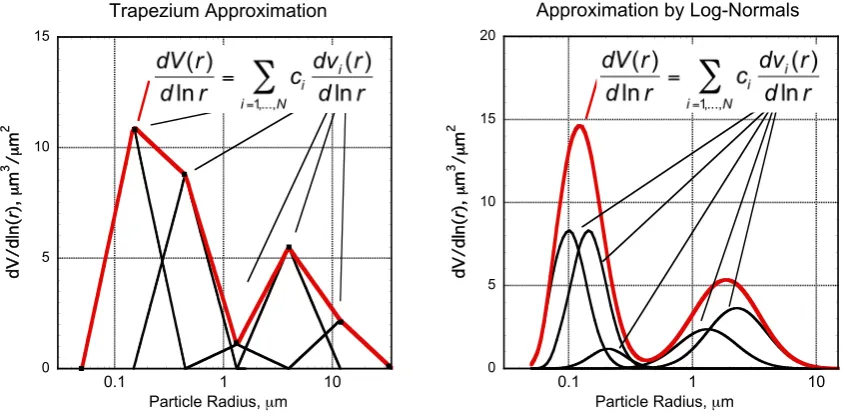
Fig. 4. The illustration of modeling aerosol size distribution by five (Nr= 5) triangular (left) or log-normal (right) size bins.
used for making accurate calculations of atmospheric broad-band fluxes and aerosol radiative forcing. These calculations were shown to agree very reasonably with available coinci-dent ground-based flux observations in desert regions (Der-imian et al., 2008) and globally (Garcia et al., 2008). De-rimian et al. (2008) demonstrated that the neglect of desert dust non-sphericity in climatic assessment leads to ∼10 % systematic overestimation of cooling of the atmosphere by desert dust aerosol on the top of the atmosphere.
The retrieval algorithm developed here for POLDER/ PARASOL uses the same modeling strategy as described above. Correspondingly, a solution is sought in continuous space of aerosol size distribution parameters, aerosol parti-cle shape and complex refractive indices (see Table 1). How-ever, due to differences in information content of AERONET and POLDER measurements, the retrieved size distribution is represented by a smaller number of binsNr. Instead of Nr= 22, retrieved by AERONET, hereNr is reduced to 16 and even significantly smaller numbers. In order to assure that the aerosol model remains adequate and its accuracy is acceptable even if number of aerosol bins is small, the performance of Dubovik et al. (2006) software was ana-lyzed for situations corresponding to POLDER/PARASOL measurements with reduced number of aerosol bins. It was found that the accuracy of the calculations remains practically unchanged if the aerosol size bins correspond-ing to very small and very large particles have been elim-inated, i.e. Nr= 16 covers size range from rmin= 0.07 µm to rmax= 10 µm. The contribution of smaller and larger particles into POLDER/PARASOL observations is negligi-ble. Nonetheless, the need for optimizing the software of Dubovik et al. (2006) by using even smaller number of aerosol bins Nr≤10, was identified. It was found that sufficiently accurate modeling of POLDER/PARASOL
observations can be achieved if the shape of each single bin is optimized. Specifically, utilizations of log-normally shaped bins provided notable improvements if Nr≤10. The con-ducted small series of calculations suggested some advan-tages of modeling aerosol size distribution as superposition of the log-normal functions with fixed parameters:
dV (r) d lnr =
X
i=1, ..., N
cV,i
√ 2π σi
exp
"
− lnr − lnrV,i
2
2σi2
#
(11a)
= X
i=1, ..., N ci
dvi(r) d lnr , i.e.
ci = cV,i and (11b)
dvi (r) d lnr =
1 √
2π σi exp
"
− lnr − lnrV,i
2
2σi2
#
.
For example, Fig. 4 illustrates that a small number of log-normal bins retains the realistically smooth shape of atmo-spheric aerosol size distribution, while applying triangular or trapezium approximation leads to appearance of inade-quate features (apparent triangle tops) in the size distribution. Thus, the new option allowing the usage of log-normally shaped bins was included in Dubovik et al. (2006).
3.2 Modeling surface reflectance
into account using the Cox and Munk model (Cox and Munk, 1954). The water leaving radiance is nearly isotropic (Voss et al., 2007) and modeling shows that its polarization is neg-ligible (e.g. Chami et al., 2001; Chowdhary et al., 2006; Ota et al., 2010). This term and the white cap reflection are taken into account by Lambertian unpolarized reflectances. The whitecap reflectance is driven by the wind speed at sea sur-face according to the Koepke (1984) model. The seawater re-flectance at short wavelengths is not negligible and depends on the properties of oceanic waters. Thus, in present model, the wind speed and the magnitude of seawater reflectance at short wavelengths need to be known a priori or retrieved to-gether with aerosol.
The modeling of the reflectance by the land sur-faces has been adjusted to the needs of newly developed POLDER/PARASOL retrieval. The aerosol retrieval algo-rithm by Deuz´e et al. (2001) over land relies only on the PARASOL measurements of polarized reflectance and, cor-respondingly, it does not consider the detailed directional scattering properties of total reflectance by land surface. Therefore, the “forward model” was modified to account ad-equately for both total and polarized properties of surface re-flectance.
In remote sensing applications the effects of directional-ity of land surface reflectance are often accounted for by semi-empirical models driven by a small number of internal parameters. For example, the Ross-Li model (Ross, 1981; Li and Strahler, 1992; Wanner et al., 1995) is employed for characterization of directional properties of land surface re-flectance derived from MODIS observation (Justice et al., 1998). The Rahman-Pinty-Verstraete (RPV) model (Rahman et al., 1993) is successfully used for the analysis of MISR ob-servations by Martonchik et al. (1998) and SEVIRI by Gov-aerts et al. (2010) and Wagner et al. (2010). The comparisons of the models with satellite (Maignan et al., 2004, 2009) and aircraft (Litvinov et al., 2010, 2011) data showed that, gener-ally, both Ross-Li and RPV models are comparably capable of reproducing the multi-angle observations of land surfaces. Since the RPV model was applied more extensively to inter-pretation of multi-directional images (e.g. MISR, SEVIRI), it has been retained in the present POLDER/PARASOL al-gorithm as a primary formulation for modeling Bidirec-tional Reflectance Distribution Function (BRDF). Rahman et al. (1993) describe BRDF as:
ρRPV(ϑ1;ϕ1;ϑ2;ϕ2) = (12a)
= ρ0
cosk−1ϑ1cosk−1ϑ2 (cosϑ1 + cosϑ2)k−1
F (g)
1 + 1−h0 1 +G
,
F (g) = 1 −θ 2
1 +θ2 −2θ cos(π −α i)
1.5 (12b)
cosαi = cosϑ1cosϑ2 − sinϑ1sinϑ2cos(ϕ1 −ϕ2), (12c)
G= htan2ϑ1+tan2ϑ2−2 tanϑ1tanϑ2cos(ϕ1−ϕ2)
i1/2
.(12d) This model provides bi-directional reflectance as a function of four empirical parameters: ρo(λ) characterizes intensity of reflectance. κ (λ) characterizes anisotropy of reflectance, θ (λ) characterizes forward/backscattering contributions in total reflectance,h0(λ) is a “hot spot” parameter. All these parameters are considered as unknowns and included in the set of retrieved parameters (see Table 1).
The available airborne and satellite polarimetric observa-tions in the visible and infrared showed that the Bidirectional Polarization Distribution Function (BPDF) of land surface tends to have rather small values (compared to BPDF) with no spectral dependence (e.g., Rondeaux and Herman, 1991; Nadal and Br´eon, 1999; Maignan et al., 2004, 2009; Wa-quet et al., 2009a,b; Litvinov et al., 2010, 2011). Most theo-retical models developed for approximating observed BPDF are based on the Fresnel equations of light reflection from the surface. For example, Nadal and Br´eon (1999) have proposed simple two-parameter non-linear function of the Fresnel reflection for characterization of atmospheric aerosol over land surfaces based on POLDER observations of land surface reflectance. Recently, Maignan et al. (2009) have in-troduced a new linear BPDF model with only one free pa-rameter and demonstrated that this simple model allows a similar fit to the POLDER measurements as more complex non-linear model by Nadal and Br´eon (1999). This model has been used in the present POLDER/PARASOL retrieval algorithm as a primary model of polarized reflectance of land surface.
The model by Maignan et al. (2009) describes the polar-ized reflectance as:
ρs (ϑ1;ϕ1;ϑ2;ϕ2) = ρMaignanF12 (αi, n), (13a) where BPDF is given as a linear function of polarized com-ponentF12 (αi, n) of the Fresnel reflection matrix (depen-dent on inci(depen-dent angleαi and refractive indexn) multiplied by an empirical coefficient:
ρMaignan(ϑ1;ϕ1;ϑ2;ϕ2) = B exp(−tan(αi))exp(−v)
4 µ0+µ1 .(13b)
The attenuation term exp(−z)reflects the observed tendency of decreasing polarized reflectance with increasing vegeta-tion cover, wherezis the Normalized Difference Vegetation Index (NDVI). The NDVI value z was obtained from the reflectance measurements concomitant with the polarization observations,B is a free parameter that should be chosen to fit the observed BPDF angular dependence.
that the surface reflectance of polarized radiation in any ge-ometry does not exceed the reflectance of total radiation, the reflectance matrix R(µ0;µ1;ϕ0;ϕ1;λ)of the land surface is represented as a sum of two surface reflection phenomena: R µ0;µ1;ϕ0;ϕ1;λ = Rdiff +Rspec, (14a) where the matrix for diffuse unpolarized reflectance Rdiffis modeled using Eq. (12):
Rdiff µ0;µ1;ϕ0;ϕ1;λ
= ρRPV
1 0 0 0 0 0 0 0 0 0 0 0 0 0 0 0
, (14b)
and the matrix for specular reflectance Rspec is mod-eled as matrix of Fresnel reflectance F (αi, n) scaled by ρMaignan (ϑ1;ϕ1;ϑ2;ϕ2)empirical coefficient:
Rspec(ϑ1;ϕ1;ϑ2;ϕ2;λ) = ρMaignanF(αi, n), (14c) where the Fresnel matrix F (αi, n) defined for Stokes pa-rameters referred to directions parallel and perpendicular to the reflection plane can be written as (e.g. see Lenoble et al., 2007):
F(αi, n) = 1 2
rl2 +rr2rl2 −rr2 0 0 rl2 −rr2rl2 +rr2 0 0 0 0 2rlrr 0
0 0 0 2rlrr
. (15a)
The Fresnel matrix F (αi, n)depends on incident angle αi and refractive indexn. The coefficientsrrandrlare defined as
rr =
sin (αr −αi) sin (αr +αi)
andrl =
tan (αr −αi) tan (αr +αi)
, (15b)
where the refraction angle αr is related to αl through the Snell-Descartes refraction law given as:
sin(αi) = nsin(αr). (15c)
The straightforward analysis of the above equations shows that the definition of R(µ0;µ1;ϕ0;ϕ1;λ)given by Eq. (14) secures the physically correct ratio between polarized and to-tal radiation components (Rij≤R11) for any combination of ρRPVandρMaignan.
Thus, in the present algorithm, the BRDF and BPDF prop-erties are driven by four free spectral parameters of RPV model (ρo(λ),κ (λ),θ (λ),h0(λ)) and one free (generally spectrally dependent) parameterB (λ). All these parame-ters have been added into the retrieved vector of unknowns as shown in Table 1.
It should be noted, however, that the Rahman et al. (1993) and Maignan et al. (2009) formulations, chosen as primary models for BRDF and BPDF in the present algorithm, have limited accuracy (e.g. see Litvinov et al.,2010, 2011). There-fore both the forward model and inversion module of the present algorithm have an assumed option of changing both
or either BRDF or BPDF models. For example, in the present algorithm version, the BRDF can be simulated using the Ross-Li model and BPDF can be modeled using Nadal-Br´eon (1999) formulation. Nonetheless, the utilizations of these secondary BRDF or BPDF models will not be dis-cussed in detail.
3.3 Full forward radiative model
Accounting for multiple scattering effects in the atmosphere is implemented by the successive order of scattering radiative transfer code (Lenoble et al., 2007) that was used in PARA-SOL operational retrievals (Deuz´e et al., 2001; Herman el al., 2005; Tanr´e et al., 2011). The code provides full information about the atmospheric radiation field under the assumption of the plane parallel atmosphere. In order to reduce calculation time for inverting PARASOL observations, theV component in the Stokes vector has been neglected. Hansen (1971) has demonstrated that the radiation properties measured by pas-sive remote sensing exhibit negligible circular polarization of the electromagnetic field. The developed version of succes-sive order of scattering radiative transfer code allows calcula-tions of atmospheric radiances for severalNkaerosol compo-nents. Each aerosol component can be described by defined vertical profile of spectral extinctionkext,k(h, λ)and altitude independent phase matrix Pk (2, λ) and single scattering albedoωk0 (λ). In the present set up of the aerosol retrieval code these optical properties are detremined based on mi-crophysical model of atmospheric aerosol. Correspondingly, only parameters describing aerosol microphysics are directly included in the set of retrieved parameters listed in Table 1. Specifically, the vertically invariant Pk(2, λ)andω0k(λ)are driven by: the shape of the size distribution dVk(ri)/dlnr giv-ing the aerosol particle volume in the total atmospheric col-umn per unit of surface area (in the unites of µm3/µm2); the realnk (λ)and imaginarykk (λ)parts of the complex refrac-tive index; and the fraction of the spherical particlesCk,sph. The spectral dependence of optical thicknessτk (λ)/τk(λi) is also vertically invariant and defined by these parameters, while the absolute value ofτk (λ) additionally depends on the total volume of the aerosol in the atmospheric column: Ck,V=Pi=1,...,Ni
dVk(r)i dlnr
. In order to account for vertical variability of the aerosol extinctionkext,k (h, λ), the addi-tional characteristicck (h)was added. The functionck (h) defines the vertical distribution of aerosol concentration and the optical thickness of k-th aerosol component in each of i-th atmospheric layer is defined as:
1 τi,k(λ) = τk (λ) hi
Z
hi+1
ck (h) dh. (16a)
ck(h) ∼ exp −
h−hk,0
2
σk2
!
and
hTOA
Z
hBOA
ck(h) dh = 1, (16b)
wherehBOA– Bottom Of the Atmosphere (BOA) height and hTOA – Top Of the Atmosphere (TOA) height. In the re-trieval, the standard deviation characterizing the width of the aerosol layer is fixed toσk= 0.75 km. Therefore, only one parameter characterizing aerosol vertical distribution is in-cluded into the retrieval: hk,0 – the mean altitude of the k-th aerosol component layer. The present version of the POLDER/PARASOL retrieval code is set to retrieve only one aerosol component. The algorithm derives single values of complex refractive index and fraction of spherical particles for particles of all sizes. Such retrieval assumption is based on the earlier AERONET sensitivity studies by Dubovik et al. (2000, 2006) that indicated major limitations in discrimi-nating between refractive indices and shapes of aerosol par-ticles of fine and coarse modes. At the same time, the possi-bility of retrieving several aerosol components with different complex refractive indices and vertical distributions is also assumed (see Table 1) and sensitivity of polarimetric obser-vations to multi-component aerosols is planned to be verified in future studes.
In addition, in order to harmonize the radiative trans-fer code with the structure and needs of general inver-sion approach, several modifications have been implemented. Specifically, the modifications were aimed to increase the speed of calculations by allowing admissible decrease of the accuracy of modeling. The three possible tradeoffs permit-ting reduction of computation time without any significant loss of retrieval accuracy were identified and implemented. 3.3.1 Adjustable number of terms in the expansion of
the phase matrix and in the quadrature of directional integration
The accuracy of radiative transfer calculations strongly de-pends on the number of termsM used in the expansion of the phase matrix into Legendre polynomials and number of terms N used in Gaussian quadrature for zenithal integra-tion. The values should satisfy the inequality 4N−1>2M to retain conservation of energy in the successive order of scattering integration. The valuesM andN should be suf-ficiently large to provide accurate calculation. However, the largerMandN the longer the calculation time. At the same time, the high accuracy of the modeling is not always re-quired during the retrieval. For example, studies by Dubovik and King (2000) showed that when observations of ground-based radiometers are inverted, the successful retrieval can be achieved using the approximate and quick calculations of the first derivatives. Correspondingly, the retrieval time can be significantly decreased because the calculations of the first derivatives is the most time consuming component of Newtonian’s retrieval algorithms. Following this strat-egy, the operational retrieval of aerosol from AERONET data
relies on analytical single scattering approximation for cal-culations of derivatives. The possibility of using this trade-off in POLDER retrieval algorithm was tested. It has been concluded that using single scattering approximation is not sufficient for conducting retrieval from satellite observations. Nonetheless, it has been found that the Jacobians estimated numerically as finite differences on basis of the full radiative transfer calculations implemented with significantly reduced values ofMandNprovide fast and accurate retrievals. This approach is used in the present algorithm.
The utilization of linearized radiative transfer code (e.g. see Hasekamp and Landgraf, 2005a) that provides all derivatives with respect to aerosol and surface properties in a single run would be alternative and promising strategy of ac-celerating satellite observation inversion. This strategy was not used in the present study because the linearization of ra-diative transfer code is a rather complex effort that requires significant time investments. The possibility of using this ap-proach will be considered in future studies. At the same time, a retrieval algorithm relying on the numerical calculation of the first derivatives is probably more flexible in practical ap-plications. Indeed, in the present POLDER/PARASOL algo-rithm the set of retrieved aerosol or/and surface parameters can be changed with no modifications in the calculations of the first derivatives. If the derivatives are calculated analyti-cally, achieving such flexibility could be more difficult. 3.3.2 Truncation of the phase matrix
The truncation of the phase function is a technique whereby the scattering effects from the sharply increasing forward peak of the phase function are calculated separately from those of the rest of the phase function, which permits the accurate but much faster modeling of diffuse radiation. For example, the AERONET aerosol operational retrieval by Dubovik and King (2000) employs the discrete ordinate ra-diative transfer code by Nakajima and Tanaka (1988) that uses the efficient procedure of the phase function trunca-tion and provides very fast and accurate calculatrunca-tion of down-welling diffuse radiation in moderately thick atmospheres. The detailed discussion of different methods of implement-ing the phase matrix truncation and their comparison are given in the recent paper by Rozanov and Lyapustin (2010).
the fit to PARASOL observations; M= 15 and N= 7 – for calculating Jacobian matrices.
3.3.3 Flexible angular representation in the phase function
The successive order of scattering radiative transfer code uses the phase function values atNang angles correspond-ing to the points of Gaussian quadrature. These values are provided to the radiative transfer code from the Dubovik et al. (2006) software generating aerosol single scattering prop-erties. The software provides the phase function for the set of fixed scattering angles allowing sufficiently accurate modeling of angular variability of scattering. For example, in AERONET retrieval the phase function is calculated at 83 Gaussian points. At the same time, the speed of aerosol single scattering modeling depends on the number of the scattering angles used. In order to enhance the flexibility of the retrieval code the possibility of using the phase function at nearly arbitrary set of scattering angels has been imple-mented, with the values of the phase function at the required Gaussian points derived from the software data by conve-nient interpolation. The results of the series of the numerical tests have shown that POLDER/PARASOL observations can be adequately modeled using set ofNang= 35 selected scat-tering angles.
4 Numerical inversion
In contrast to the majority of existing satellite retrieval algo-rithms, this effort is one of the first attempts to develop an aerosol satellite retrieval using statistically optimized multi-variable fitting. Such strategy does not rely on the pre-assumed classes of potential solutions. Instead the solution is sought in a continuous space of solutions under statisti-cally formulated criteria optimizing the error distribution of the retrieved parameters. The implementation of some ele-ments of such a strategy was pursued in the earlier develop-ments of satellite retrieval algorithms. For example, the sta-tistical optimization of the retrieval solutions was used for in-version of MISR observations by Martonchik et al. (1998), in the retrieval algorithms proposed by Chowdhary et al. (2002, 2005) and by Waquet et al. (2007, 2009a) for inverting antic-ipated GLORY/APS observations and applied to RSP data, in the retrieval approach suggested by Hasekamp and Land-graf (2005b, 2007) for applying to multiple-viewing-angle intensity and polarization measurements and the retrieval al-gorithm developed by Govaerts et al. (2010) for processing SEVIRI/ MSG observations.
Detailed descriptions of inversion methods can be found in various textbooks (Tikhonov and Arsenin, 1977; Twomey, 1977; Tarantola, 1987; Press et al., 1992; Rodgers, 2000; Doicu, 2010). However, the textbooks generally provide the reviews of well-established inversion procedures and do
not suggest the reader sufficient explanations as to which method and why should be chosen for a particular applica-tion. The approach used here is focused on clarifying the connection between different inversion methods established in atmospheric optics and unifying the key ideas of these methods into a single inversion procedure. It follows the de-velopments by Dubovik and King (2000), Dubovik (2004), Dubovik et al. (2008). The methodology has several orig-inal (compare to standard inverse methods) features opti-mized for remote sensing applications. As shown in de-tailed description by Dubovik (2004), the methodology ad-dresses such important aspects of inversion optimization as accounting for errors in the satellite observations, in-version of multi-source data with different levels of ac-curacy, accounting for a priori and ancillary information, estimating retrieval errors, clarifying potential of employ-ing different mathematical inverse operations (e.g. com-paring iterative versus matrix inversion methods), accel-erating iterative convergence, etc. The concept uses the principles of statistical estimation and suggests a general-ized multi-term Least Square type formulation that com-plementarily unites advantages of a variety of practical in-version approaches, such as Phillips-Tikhonov-Twomey con-strained inversion (Phillips, 1962; Tikhonov, 1963; Twomey, 1963), Kalman filter (Kalman, 1960), Newton-Gauss and
Levenberg-Marquardt iterations, etc. This approach pro-vides significant transparency and flexibility in development of remote sensing algorithms for deriving such continuous characteristics as vertical profiles, size distributions, spec-tral dependencies of some parameters, etc. For example, compared to the popular “Optimal Estimation” equations (Rodgers, 2000), the multi-term Least Square type formu-lation allows harmonious utilization of not only a priori esti-mate term but instead, or in addition, using a priori terms lim-iting derivatives of the solution (see discussion by Dubovik, 2004 and Dubovik et al., 2008). This methodology has re-sulted from the multi-year efforts on developing inversion algorithms for retrieving comprehensive aerosol properties from AERONET ground-based observations.
4.1 Single-pixel retrieval
This part of the inverse procedure is adopted, with some modifications, from the AERONET (Dubovik and King, 2000) inversion algorithm. There are two key aspects in the algorithm organization: the general organization of
observa-tion fitting and the a priori data representaobserva-tion.
4.1.1 Single-pixel observation fitting
Formally, the retrieval algorithm is designed as a multi-term LSM that implements statistically optimum fitting of several sets of observations and a priori constraints under assump-tion of normally distributed uncertainties (detailed discussion is given by Dubovik, 2004). It provides the solution of the following system of equations:
f∗ = f (a)+1f
0∗ = (1a)∗ = Sa +1 (1a)
a∗ = a +1a∗
. (17)
Here,f∗is a vector of the PARASOL measurements,1f is a vector of measurement uncertainties,a is a vector of un-knowns. The second line in Eq. (17) represents the a pri-ori smoothness assumptions used to constrain variability of size distribution and spectral dependencies of the real and imaginary parts of the refractive index as well as the spec-tral dependencies of parameters of surface reflectance model. The matrix S includes the coefficients for calculating m-th differences (numerical equivalent of m-the derivatives) of dV (rj)/dlnr,n(λj),k(λj),ρo(λj),κ(λj),θ(λj); 0∗– vec-tor of zeros and1 (1a)– vector of the uncertainties char-acterizing the deviations of the differences from the zeros. Formally, this equation states that all thesem-th differences are equal to zeros within the uncertainties1 (1a). The third line in Eq. (17) includes the vector of a priori estimatesa∗
and1a∗ is the vector of the uncertainties in a priori esti-mates.
In order to account for the non-negative character of the observed radiances and retrieved aerosol (dV (rj)/dlnr, n(λj),k(λj)) and surface reflectance (ρo(λj)) parameters, the assumption of log-normal error distribution was used. The noise distribution is apparently the most appropriate for the positively defined values. The log-normal noise distribu-tion implies that the logarithms of the observed positively de-fined values are normally distributed. Thus, for convenience of formulating the statistically optimized solution of Eq. (17) the logarithmic transformation is used for both measuredfj and retrievedai parameters (see detailed discussions on va-lidity of applying this transformation in the publications by Dubovik and King, 2000, Dubovik, 2004). Correspondingly, the errors1f,1 (1a), and1a∗are assumed normally dis-tributed. Table 2 shows the exact definitions of each element of the vectorsf∗anda. In addition, Table 2 shows the vari-ability ranges allowed for each retrieved parameter.
The statistically optimized solution of Eq. (17) defined on the base of Maximum Likelihood Method corresponds to the minimum of the following quadratic form:
9 ap =
9f ap + 91 ap +9a ap (18a)
= 1 2
1fpT Wf
−1
1fp+γ1(ap)T ap
+ γa ap −a∗ T
W−1a ap −a∗
.
In generally non-linear case the minimum can be obtained by the following iterative procedure:
ap+1 =ap −tp1ap, (18b)
where1ap is a solution of the p-th so-called, in statistical estimation formalism, Normal System
Ap1ap = ∇9 ap. (18c)
The matrix in the left side of Eq. (18c) is also known as
Fisher Matrix Ap and the right side of Eq. (18c) represents the gradient∇9 (ap) of quadratic form9 (ap)in vicinity of
ap:
Ap = KTp W−1f Kp +γ1+γaW−1a , (18d)
∇9 ap = (18e)
= KTp W−11fp+ γ1 ap +γaW−1a ap−a ∗
,
where1fp=f (ap)−f∗, Kp – Jacobi matrix of the first derivatives ∂fj(ap)
∂ai . It should be noted that Fisher Ma-trix Ap can be considered as so-called Hessian matrix of second-order partial derivatives of the quadratic form9 (ap) (e.g. see Bevington, 1969; Tarantola, 1987). Correspond-ingly, Eq. (18c) can be also written as follows:
∇∇9 ap1ap = ∇9 ap. (18f)
where ∇∇T9 (ap) is the matrix with the elements
∇∇T9 (ap) j i=
∂29 (a) ∂aj∂ai
a=ap.
In the present inversion strategy, all equations are ex-pressed via W – weighting matrices that defined by dividing the corresponding covariance matrix C by its first diagonal elementε2, i.e. W =(1/ε2)C. This formal transformation of the inversion equations allows rather transparent interpreta-tion of Lagrange multipliersγ – parameters determining the contributions of a priori terms into solution. Following the concept proposed by Dubovik and King (2000) the Lagrange multipliersγaandγ1are defined as:
Table 2. Definition of the measurement vectorf∗and the vector of unknownsa.
f∗– vector of measurements:
f∗I i=ln I 2j;λi, whereI 2j;λiis total radiance observed by POLDER/PARASOL
f∗P i=ln P 2j;λi, whereP 2j;λi=
q
Q 2j;λi2+U 2j;λi2
I 2j;λi is degree of linear polarization obtained from POLDER/PARASOL observations
a– vector of unknowns
Notation Definition Variability limits
AEROSOL parameters:
av {av}i=ln
dV (ri) dlnr
,i=1, ...,Nr 0.00001≤dV (ri) dlnr aVc aVc=ln(Cv) 0.001≤Cv≤5.0
µm3/µm2 asph asph=ln(Csph) 0.001≤Csph≤1.0
an {an}i=ln(n(λi)),i=1, ...,Nλ 1.33≤n(λi)≤1.6 ak {ak}i=ln(k(λi)),i=1, ...,Nλ 0.0005≤k(λi)≤0.1
Surface BRDF and BPDF parameters:
abrdf,1
abrdf,1 i=ln(ρ0(λi)),i=1, ...,Nλ 0.001≤ρ0(λi)≤0.7 abrdf,2
abrdf,2 i=ln(κ(λi)),i=1, ...,Nλ 0.1≤κ(λi)≤1.0 abrdf,3
abrdf,3 i=ln(1+θ (λi)),i=1, ...,Nλ −0.5≤θ (λi)≤0.5 abrdf,4
abrdf,4 i=ln(h0(λi)),i=1, ...,Nλ 0.001≤h0(λi)≤0.7 abpdf abpdf i=ln(B (λi)),i=1, ...,Nλ 0.01≤B(λi)≤10.0
one can assume a simplified situation when the POLDER ob-servationsf∗, a priori estimates of differences(1a)∗and a priori estimates of parametersa∗ are independent and have the same accuracy, i.e. Cf=ε2fI(Nf×Nf), C1=ε12I(N1×N1) and Ca=ε2aI(Na×Na), then corresponding weighting matri-ces are simply equal to the unity matrimatri-ces: Wf= I(Nf×Nf), W1= I(N1×N1)and Wa= I(Na×Na).
In addition, as discussed by Dubovik (2004), straightfor-ward increasing ofNfby adding redundant very similar ob-servations is not necessarily beneficial for the retrieval. For example, from a practical viewpoint, adding many observa-tions with identical or nearly identical observation condiobserva-tions does not bring new information and does not improve the ac-curacy of the solution. However, formally even such addition of observations artificially increases the impact of the mea-surement term on the solution compare to a priori second and third terms in Eq. (18). Therefore, the Lagrange multipliers γare scaled as:
γ1 = Nfεf2 N1ε21
andγa = Nfεf2 Naε2a
. (19b)
As suggested by Dubovik (2004) such scaling reflects the in-evitable decrease of accuracy of single observationεf2if the number of observationNfincreases excessively. The above equation is written under an assumption that increasing the number of measurements in the coordinated set of remote
sensing observations inevitably results in a decrease of the accuracy of each single measurement in this observation set. For example, if a satellite sensor takes one single observa-tion, the expected variance of measurement error isε2f,N. If the same sensor makes Nf space- and/or time-coordinated observations the variance of the error in each single obser-vation increases by the factorNf, i.e.εf2,N∼Nfεf2,1. This in-crease can be explained by the fact that the consistency of theNfcoordinated observations should be assured by con-trollingNfrelations between theNfobservations. The con-trol of each of those relationships introduces a random error ε2f,N, correspondingly the error variance of a single measure-ment inNfdimensional observation increases inNftimes.
The coefficienttp≤1 in Eq. (18b) is adjusted to provide monotonic decrease of9 (ap), i.e.
9 ap+1 < 9 ap. (20a) If all assumptions are correct, the minimum value of the above quadratic form can be theoretically estimated as fol-lows:
9 (a) ≈ (Nf +N1 +Na∗ − Na) ε2
f. (20b)