R E S E A R C H
Open Access
Counter-forensics of SIFT-based copy-move
detection by means of keypoint classification
Irene Amerini
1, Mauro Barni
2, Roberto Caldelli
1and Andrea Costanzo
2*Abstract
Copy-move forgeries are very common image manipulations that are often carried out with malicious intents. Among the techniques devised by the ‘Image Forensic’ community, those relying on scale invariant feature transform (SIFT) features are the most effective ones. In this paper, we approach the copy-move scenario from the perspective of an attacker whose goal is to remove such features. The attacks conceived so far against SIFT-based forensic techniques implicitly assume that all SIFT keypoints have similar properties. On the contrary, we base our attacking strategy on the observation that it is possible to classify them in different typologies. Also, one may devise attacks tailored to each specific SIFT class, thus improving the performance in terms of removal rate and visual quality. To validate our ideas, we propose to use a SIFT classification scheme based on the gray scale histogram of the neighborhood of SIFT keypoints. Once the classification is performed, we then attack the different classes by means of class-specific methods. Our experiments lead to three interesting results: (1) there is a significant advantage in using SIFT
classification, (2) the classification-based attack is robust against different SIFT implementations, and (3) we are able to impair a state-of-the-art SIFT-based copy-move detector in realistic cases.
1 Introduction
Counter-forensics, the study of methods to mislead foren-sic techniques by concealing traces of manipulations, is becoming a hot research topic [1]. As a matter of fact, this discipline rapidly became a benchmark for the security of image forensic techniques, whose correct behaviors may be intentionally obstructed by an adversary (or attacker) interested on covering traces of malicious tampering. Nowadays, for example, it is possible to conceal traces of contrast enhancement, compression, or resampling [2-4]. In [1], two categorizations of counter-forensic schemes (or attacks) are proposed: according to when, in the image acquisition chain, an attack takes place (integrated or post-processing, i.e., during or after the acquisition) and according to whether the countered forensic algorithm is known or unknown to the attacker (targetedoruniversal attack, respectively). Regardless of its category, an attack should respect some constraints while attempting to mis-lead a certain forensic technique, such as preserving the
*Correspondence: [email protected]
2Department of Information Engineering and Mathematical Sciences, University of Siena, Siena 53100, Italy
Full list of author information is available at the end of the article
visual quality of the forged image and the integrity of the semantic message conveyed by the content.
Copy-move forgery, whereby a portion of the image is copied and pasted once or more times elsewhere into the same image, is one of the most common ways of manip-ulating the semantic content of a picture. Usually, the original and the forged portions share similar statistical and semantic properties. As a consequence, it is possible to exploit such similarities to detect the presence of the manipulation. In the past years, literature has proposed several copy-move detectors [5], which often are conven-tionally summarized into two categories: methods based on blocks and methods based on keypoints. The former methods first divide the image into overlapping blocks and then extract some features which are ordered and used to match similar blocks, according to certain criteria of sim-ilarity [6,7]. The latter methods extract highly descriptive robust points of an image, to each of which a univocal features vector is assigned. Such vectors are then used to match similar points across images (or regions within them). Among such methods, the most recent and effec-tive ones [8,9] are those based on scale invariant feature transform (SIFT) [10]. The capability of SIFT to discover correspondences between similar visual contents, in fact,
allows the forensic analysis to detect even very accurate and realistic copy-move forgeries.
The research community has recently started to approach copy-move detection from the perspective of the attacker, whose goal is to hide the features caus-ing similar blocks or keypoints to match. Chrislein et al. [11] studied the robustness of several detectors against common image processing and observed that block-based methods are not robust against geometric manipulations (e.g., resampling, cropping), lossy compression, and noise addition. Nguyen et al. [12] successfully impaired three well-known block-based detectors by combining some of these manipulations into a simple yet effective counter-forensic scheme (see [12]). The same results, however, cannot be replicated with SIFT-based detectors inheriting the intrinsic robustness against geometric transforma-tions from Lowe’s algorithm. To devise more sophisticated schemes, it is necessary to understand the security of SIFT algorithm. The first study in this direction is the one by Hsu et al. [13], in which, initially, the impact of sim-ple attacks is analyzed, and then a method to strengthen SIFT keypoints is proposed. Following this work, Do et al. [14-16] focused on a SIFT-based content-based image retrieval (CBIR) [17] scenario and devised a number of interesting attacks.
The aim of the previous works is to modify the SIFT feature descriptor of keypoints, but they do not consider the complete removal of the keypoints. To the best of our knowledge, the only work in this sense is [18], where an attack based on local warping techniques derived from image watermarking was proposed. All the studies car-ried out so far have demonstrated that devising methods to attack SIFT features is not a trivial task. SIFT features are robust not only against several nonmalicious process-ing, but also against tampering attempts. Most attacks, in fact, pay a high cost in terms of visual quality degradation. Moreover, the attempt to remove SIFT keypoints can alter the content in such a way that new keypoints are created, thus complicating even more the problem.
The methods for countering SIFT-based forensic anal-ysis proposed so far have been applied indifferently to all the keypoints of an image. In this paper, we present a new counter-forensic strategy (targeted and post-processing, according to the terminology of [1]) that permits to improve the performance of the existing approaches. We demonstrate that it is possible to discriminate between SIFT keypoints and to devise attacks that are tailored to the characteristics of the keypoints.
Specifically, we have chosen a classification criterion based on first-order statistics, which is the pixel histogram of the gray scale neighborhoods centered in the SIFT key-points. On top of such classification, we have built an iterative attacking algorithm. At each step, our algorithm classifies the keypoints and then attempts to delete them
with class-tailored attacks, ideally until their complete removal.
We compared the proposed method against other attacks [13-16] and demonstrated the benefits brought by SIFT classification in terms of keypoint removal and visual quality. We also demonstrated that the proposed method is also capable of impairing SIFT detectors dif-ferent than the one used during the attack. We then applied our method to a realistic scenario of copy-move forgery detection with the goal to disable the detector described in [9]. We have successfully completed this task by eliminating only the keypoints having matches across the copy-moved regions that were used to detect the manipulation. Finally, we have explored the possible inter-actions between the proposed method and the existing block-based copy-move countermeasures.
The paper is organized as follows: section 2 briefly reviews the SIFT algorithm and the copy-move detectors based on it. Section 3 describes the rationale underly-ing the SIFT classification and the algorithm which has been used to perform it. Section 4 introduces the frame-work, putting in practice the principles previously intro-duced. Section 5 experimentally validates the framework by means of three important results of the proposed method: (1) the advantage of SIFT classification with respect to blind attacks, (2) the robustness against differ-ent implemdiffer-entations of the SIFT algorithm, and (3) the effectiveness in a copy-move detection scenario. Section 6 concludes the paper.
2 SIFT-based copy-move forgery detection In this section, we briefly review the SIFT technique and describe the copy-move detectors based on the technique.
2.1 Scale invariant feature transform
SIFT features have become extremely popular in pat-tern recognition applications due to their robustness with respect to partial occlusion, clutter, and geometric trans-formations [10]. The idea behind this kind of visual local features is to model a complex object or a scene by a collection of salient points.
In a nutshell, SIFT features of an image are detected at different scales using a scale-space representation imple-mented as an image pyramid. The pyramid levels are obtained by Gaussian smoothing and sub-sampling of the image resolution, while interest points are selected as local extrema (min/max) in the scale space.
verifies whether the contrast value of the keypoint’s neigh-borhood is sufficiently large. The second check verifies whether a keypoint is distant enough from an image edge (edges are considered unstable). If either of the checks fails, the candidate keypoint is rejected. It is worth noting that such thresholds represent the principal vulnerability of the SIFT algorithm, as we will see in section 4. Attacks against SIFT, in fact, locally alter the image in such a way that either a real keypoint falls below one of the thresholds (false negative) or a fake keypoint raises above one of the thresholds (false positive).
The keypoints that passed both the previous tests guar-antee invariance to scaling and affine transformations. At this point, the algorithm assigns to each of them a canon-ical orientation in order to also guarantee rotation invari-ance. This task is performed by means of a histogram of gradient orientations computed in the neighborhood of the keypoint (defined by a specific window). Finally, a unique fingerprint, called descriptor, is computed in order to identify univocally a keypoint. Therefore, a SIFT keypoint is completely described by the following infor-mation:xi= {x,y,σ,o,f}, where(x,y)are the coordinates in the image plane,σ is the scale of the keypoint,ois the canonical orientation, andfis the final SIFT descriptor.
2.2 Copy-move detection
In pattern recognition, the SIFT operator usually is applied to two images: a target and a test image. In the case of copy-move forgery detection, the SIFT operator is applied to one image only. In fact, in a copy-move forgery, the copied part is within the same image (see images of Figure 1). For this reason, the keypoints extracted in that region will be quite similar to the original ones; there-fore, a matching between SIFT features can be used to discover which part was copied and which geometric transformation was applied.
In the past years, different techniques have been pro-posed by the scientific community to address the problem of copy-move forgery detection in digital images. Most of the methods divide the image into overlapping blocks and then extract some peculiar features that can reveal whether some of the blocks have been duplicated or not [5]. Depending on the amount and on the characteristics
of the paired blocks, a decision about forgery is then made. Unfortunately, such methods are hardly robust against rotation and scaling operations, which are very common in copy-move forgeries. The SIFT features allow to overcome such limitations, thanks to their intrinsic robustness against geometric transformations. Among the most recent SIFT-based copy-move detection techniques, we are interested in the one proposed by Amerini et al. [9], which is able to detect and estimate the geometric transformation applied in a copy-move forgery attack also dealing with the case of multiple copy-move forgeries.
In a nutshell, the technique in [9] works as follows (see Figure 1). Given an imageI, the method extracts the key-pointsX = {x1,. . .,xn}and their SIFT descriptorsD =
f1,. . .,fn. The best candidate match for each keypoint
xi is found by identifying its nearest neighbor among the othern−1 keypoints, i.e., the keypoint with the minimum Euclidean distance descriptors.
For the sake of clarity, given a keypoint, a similarity vector S = {d1,d2,. . .,dn−1} is defined with the sorted Euclidean distances with respect to the other descriptors. The keypoint is matched only ifd1/d2 < T (fixed empir-ically to 0.6). By iterating on each keypoint inX, a set of matched points is obtained.
Although this set already provides a draft idea of the presence of cloned areas, a clustering procedure is run in order to improve accuracy. To understand whether an area has been cloned or not, anagglomerative hierarchi-cal clusteringis performed on spatial locations, i.e.,(x,y)
coordinates, of the matched points. Such method creates a hierarchy of clusters which can be represented by means of a tree structure. Briefly, the clustering algorithm works as follows: (1) each keypoint is assigned to a cluster, (2) the reciprocal spatial distances among clusters are com-puted, (3) the closest pair of clusters is found, and (4) the obtained pair is merged into a single cluster. Conse-quently, if two (or more) clusters are detected with at least 4 pairs of matched points linking a cluster to another, then the corresponding regions are considered cloned. When an image has been classified as non-authentic, the method can also determine which geometric transformation was applied between the original area and its copy-moved version by employing an affine homography.
Hierarchical Clustering Features
Extraction and Matching
Image
Geometric Transformation
Estimation
Output
3 Classification of SIFT keypoints
In this section, we first describe the classification method, then we introduce the classes that we have defined, and finally, we provide some visual examples of each class.
3.1 The rationale behind the classification
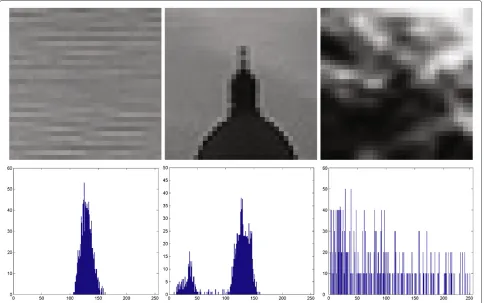
In principle, we would imagine that the classification relies on the visual content surrounding the keypoints. Although this task could be performed in more than one way (e.g., textures, edges, shapes), we chose to analyze the gray scale histogram of a relatively small region sur-rounding the keypoint. More specifically, among all the characteristics of an image histogram, we chose the num-ber of modes since they provide valuable information about the local image content. The idea is that, in gen-eral, the effectiveness of an attack may be strictly related to the properties of the keypoint we attempt to remove. As an example, suppose that the neighborhood of a keypoint contains a straight vertical edge; a local warping attack, such as the one in [18], would probably succeed in deleting it. Unfortunately, after the attack, the edge would not be straight anymore and the bending effect would be clearly visible. Perhaps a Gaussian smoothing attack may delete the keypoint as well, arguably with a significantly lower impact on quality.
For the rest of the paper, we will make two assump-tions: we will work on gray scale images and will consider only the SIFT keypoints originated by the first scale of the image (s = 0). The reasons behind the latter assumption are the following: (1) the keypoints of the first octave are the most difficult to remove, and (2) for the sake of clar-ity, we work with a significant yet not excessive amount of keypoints.
3.2 SIFT keypoint classification algorithm
In order to classify the keypoints, we have adapted the his-togram analysis method proposed by Chang et al. in [19], which was originally designed for image segmentation based on histogram thresholding. The original algorithm relies on the assumption that the histogram of large nat-ural gray scale images can be modeled as a mixture of Gaussiansf as follows:
f(k)=
n+1
i=1 Pi √
2π σie −1 2 k− mi σi 2 (1)
wherek=1. . .256 are the samples of the mixture,n+1 is the number of histogram segments, and (Pi, mi, σi2) are respectively the weight, the mean, and the variance of the i-th Gaussian. The classifier is designed to esti-mate the model parameters in order to minimize|f −H|, whereHcorresponds to the original histogram. In a nut-shell, it proceeds as follows. First,His smoothed to reduce the number of unstable local extrema. Then, the local
minima are determined and the segments between con-secutive pairs of minima are initialized. For each segment i, the calculation of the parameters (Pi,mi,σi2) consists of two steps: the estimation of a unique optimal window w∗ with minimum skewness near the center of the seg-ment and the estimation of the Gaussian parameters inw∗, which are then refined by means of a maximum likelihood criterion. Finally, the thresholds used to segment the his-togram are computed by relying on the refined Gaussian parameters.
Here, we are interested more in the number of modes rather than in the thresholds for segmentingH. We can-not rely directly on the number of Gaussians compos-ing the mixture since Chang et al.’s algorithm tends to over-segment the histograms, thus creating rather flat segments with very small weight. Therefore, the original technique required some adjustments in order to fit our application. Given a keypoint, the classification was modi-fied as follows: (1) we initialize the number of modes equal to then+1 contributes of the mixture (wherenhas been computed by means of Chang’s method), (2) we estimate all the Gaussian parameters and determine the weight of the largest contribution, namelyPmax, and (3) we suppress all the contributions 1≤i≤n+1 such thatPi≤0.2·Pmax, thus obtaining the number of histogram modesM. It goes without saying that ifM=1, the histogram is considered unimodal, ifM=2 bimodal and ifM>2 multimodal.
The choice of the size N of the neighborhood used for the classification is closely related to Chang et al.’s algorithm. N should be large enough in such a way that the hypothesis of Gaussianity holds. At the same time, it should not be so large to include the statistics of content that is too far from the support of the keypoint. According to our experiments, a good trade-off is obtained by letting N=32.
3.3 Classes of keypoints
Figure 2Example of visual contents (first row) and histograms (second row) for the three classes of keypoints.From left to right: unimodal, bimodal, and multimodal.
The unimodal, bimodal, and multimodal contents repre-sent respectively a water surface, the top of a building, and some foliage.
4 The attack
In this section, we first describe the various attacks and then explain how they have been combined to remove SIFT keypoints and to invalidate the copy-move detec-tion algorithm. Even if the classifier works on a fairly large neighborhood of the keypoint, the attacks are carried out on an 8 ×8 region (still centered on the keypoint), in order to reduce the visual impact of each attack. In the following, we will refer to this region with the term ‘patch’.
4.1 The proposed framework
Before discussing in depth the attacks, it may be useful to briefly introduce our framework (see Figure 3). It relies on an iterative procedure. At the beginning (first iteration), an original gray scale imageG(or a region within it) is fed to the system, which starts by detecting the SIFT key-points, and then, for each keypoint, the neighborhood of size 32× 32 centered on the keypoint is extracted and classified accordingly to its gray scale histogram. Depend-ing on the class of each keypoint, the correspondDepend-ing 8×8 patch is manipulated by means of a class-tailored
attack. Finally, the manipulated patches are inserted back into the image in their original positions. The procedure moves to the next iteration and halts only when particular requirements are met (e.g., percent of deleted keypoints, maximum iterations, minimum allowed visual quality).
4.2 Single attacks
The first attack is thesmoothing attack. A light Gaussian smoothing flattens the pixel values of an image in such a way that its potential keypoints at the level of difference of Gaussians (DoG) are reduced. On the other hand, an excessive smoothing has a very noticeable impact on the visual quality. The intensity of the attack can be controlled with the parameters(h,σ ), i.e., the size and the standard deviation of the Gaussian kernel. In our experiments, we have found out that h = 3 and σ = 0.7 represent a good compromise between the amount of deleted key-points and the overall visual quality following the attack. This attack has also been used in [15].
Figure 3Proposed attack scheme.SIFT keypoints are detected and classified; the neighborhood of each keypoint is attacked with a specific class-tailored attack and then inserted back into the image. The procedure continues until the specified conditions are met.
the attack, we created a database of about 120,000 patches not containing keypoints, extracted from a data set of 80 images characterized by very heterogeneous visual con-tents. We chose to measure the similarity by means of the histogram intersection distance, which has been widely used in the past in image retrieval applications [20]. Let HorigandHdbbe, respectively, the histograms of the orig-inal patch and of a patch stored in the database; the intersection distancedintis evaluated as follows:
dint(Horig,Hdb)= L
j=1min
Horig(j),Hdb(j) L
j=1Hdb(j)
, (2)
where jindicates thej-th bin of the histogram andL = 256 indicates the number of bins. Now, let patchorigand patchminbe respectively the original patch and the most similar counterpart stored in the database (i.e., the patch whose histogram is at minimum dint); to avoid visible artifacts along the borders, we do not reinsert patchmin directly into the original image. Instead, we reinsert the following linear combination:
patchnew=W·patchorig+(1−W)·patchmin (3)
whereW is an empirical 8×8 weighting matrix, whose elementswi,j ∈[ 0, 1] are set to 1 along the patch borders and progressively decrease to 0 near the center, as shown in Figure 4.
The third attack is the removal with minimum distor-tion (RMD) attack proposed by Do et al. in [15]. The idea behind this technique is to calculate a small patch
that, added to the neighborhood of a keypoint, allows its removal. The coefficients of are chosen in such a way that the contrast around the keypoint (at DoG
level) is reduced, thus invalidating the check performed by SIFT algorithm on all potential keypoints. Moreover, it is requested that the coefficients locally introduce the minimum visual distortion.
In a nutshell, theRMDattack works as follows. Letx= (x,y,σ )be a keypoint and letD(x)be the DoG inx; the patchis obtained by resolving the following optimization problem:
=arg min:D(x)=D(x)+δ||||2 , (4)
whereδis a parameter that allows to control the intensity of the attack. LetCbe the contrast threshold set by the SIFT algorithm (usually by defaultC = 0.03); the attack reduces|D(x)|by|δ|in such a way that the altered value drops belowC.
The size of depends on the spatial support of the targeted keypoint: the larger the support, the stronger the attack. The final altered DoG region is then D(x+ u,y+v,σ ), with bothuandvbelonging to the interval [−6√2hσ, 6√2hσ] andh=213. To be compliant with our system, we introduced two small variants into the original method: first, we limited the size of to a maximum of 8×8 also for those keypoints with larger spatial support; second, we used the same weighting window of Equation 3 to replace the original neighborhoods.
4.3 Combined attack
Sometimes, an attack may introduce new keypoints in its attempt to delete those already present (see [14]). In such cases, a single iteration of the attack is not enough since, now, one needs to deal also with the newly introduced keypoints. For this reason, we arranged our attacks into an iterative procedure with a pseudocode illustrated in the following (see Algorithm 1). The purpose of the attack is to iteratively remove SIFT keypoints until one of the following requirements is met: the algorithm reaches the maximum number of allowed iterations (max-Iter); the desired number of keypoints has been removed from the image (minRemoval, ideally 100%). Practically, at each iteration, we compute the keypoints and clas-sify them. For the first part of the iterations (1 toK = 10 by default), we attack all the classes with smoothing attack, while in the second part (K +1 to maxIter), we
attack the unimodal and multimodal keypoints by means ofcollageattack and the bimodal ones by means ofRMD attack. From now on, to measure the effectiveness of an attack (or of a single iteration of it), we will use the term removal rate, that is, the percent of keypoints that have been removed from an image with respect to their original number before the attack.
The rationale behind the algorithm is the following. The smoothingattack can be effective on all the classes, regard-less of their content, since it reduces the population of keypoints without a significant loss of quality. The key-points that survive to this first round of the attack are somehow ‘harder’ to remove and require more power-ful countermeasures (i.e., collage and RMD), and here, the keypoint classification plays its basic role. Thecollage is not suitable for those patches that contain geometric edges (i.e., the bimodal ones) since the histogram sim-ilarity does not take into account the shapes contained in the keypoint neighborhood. Therefore, we manipulate the bimodal keypoints withRMD, which does not present this problem. On the contrary, thecollage attack can be applied both to uniform patches, such as the unimodal, and to noisy patches, such as multimodal, without an excessive visual quality degradation.
Before we move to the next section, it is important to point out that, in the attempt to remove a keypoint, an attack could obtain the opposite result, that is, to alter the image in such a way that a new keypoint is generated. In our implementation, we chose not to keep track of this dif-ferent category of keypoints but rather to deal with them in the same way as the original ones. This means that the keypoints introduced during an iterationi are classified and attacked again at the following iterationi+1.
Algorithm 1
1: procedureCL ASSIFICATION BASED ATTACK(originalImage,maxIter,minRemoval) 2: j←1
3: K←10
4: removal rate←0
5: attackedImage←originalImage
6: while (j≤maxIterandremoval rate<minRemoval) do 7: keypoints=calculateSIFT( attackedImage ) 8: kp classes=classifySIFT(keypoints) 9: if (j≤K) then
10: attackedImage←smoothingAttack(kp classes)
11: else
12: attackedImage←collageAttack(unimodal,multimodal) 13: attackedImage←RmdAttack(bimodal)
14: end if
15: removal rate←calculate removal rate( originalImage, attackedImage ) 16: j←j+1
17: end while
5 Experimental analysis
The goal of this section is twofold: first, to highlight the benefits introduced by the classification step with respect to a class-unaware attack; while performing such task, we also demonstrate the effectiveness of the attack pro-cedure against various SIFT software; second, to address a specific forensic scenario by countering the copy-move detection technique described in [9].
5.1 Image data sets
The experimental analysis has been carried out on two distinct sets of images. To demonstrate the effective-ness of our technique and its robusteffective-ness against different SIFT implementations, we have used the UCID database [21]. Such data set, which is a well-known benchmark amongst the image retrieval research communitya, con-sists of 1, 338 uncompressed (TIFF) color images, with contents depicting landscapes, cityscapes, people, and man-made objects. The rather large size of this collection allowed us to make conclusive statements on the perfor-mance of the proposed technique. Finally, to demonstrate the capability of our method to impair a SIFT-based copy-move detector, we have used a set of 10 images containing a realistic copy-move forgery.
5.2 Classification-based SIFT keypoints removal
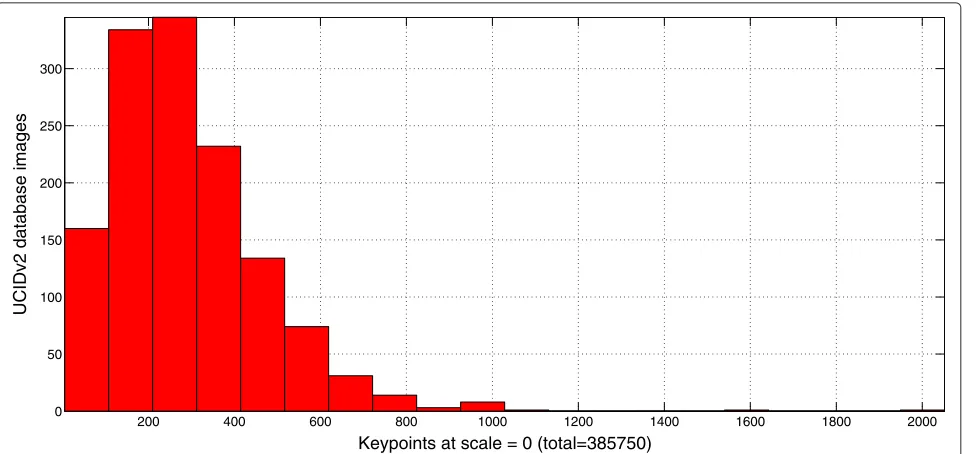
In the following tests, the keypoints have been computed by means ofVLFeat, the Vedaldi, and Fulkerson’s imple-mentation of SIFT [22] (DoG peak and edge thresholds set respectively to 4 and 10). The 1, 338 images composing the UCID database, which we used for our experiment,
contain a total of 385, 750 keypoints at the first octave, distributed as shown in the histogram of Figure 5.
We organized the experimental procedure as follows. We set a target removal rate of 100% (i.e., perfect removal) and a maximum number of iterations (i.e., maxIter=40). We then separately attacked each image by means of four methods: the classification-based attack of section 4.3, the iteration of RMD (δ = 2), the iteration of smoothing (σ =0.7,h=3), and the iteration ofcollage. We iterated each attack until we reached either 100% removal rate or the 40-th iteration. Once the algorithm halted, we evalu-ated the removal rates actually achieved on each image. We organized these values in four histograms, whose envelopes are shown in Figure 6 (results for removal rates below 50% are omitted for the sake of clarity).
Two observations can highlight the superior perfor-mance of the classification-based method: (1) it grants a minimum removal rate of 80% practically on the whole data set; (2) in general, it provides the highest removal rate. As an example, let us focus our attention on removal rates greater than 90%: the classification-based method achieved such goal on 1, 149 images out of 1, 338 (cor-responding to 86% of the data set), followed bycollage, which achieved the same results on 468 images (35% of the data set).RMD andsmoothing proved to be the less effective attacks, with 147 (11% of data set) and 12 (0.9% of data set), respectively. It is also worth noting that only the classification-based approach was able to reach the per-fect removal, although only on a limited number of images (32, corresponding to 2.7% of the data set).
The number of deleted keypoints is not the only impor-tant metric for evaluating the performance of the attacks.
200 400 600 800 1000 1200 1400 1600 1800 2000
0 50 100 150 200 250 300
Keypoints at scale = 0 (total=385750)
UCIDv2 database images
50 55 60 65 70 75 80 85 90 95 100 0
20 40 60 80 100 120 140 160 180 200
Removal rate (%)
Number of images
Classification Smoothing Rmd Collage
Figure 6Effectiveness of classification-based attack with respect to the state of the art ofclass-unawaretechniques (UCID database).
To be really effective, in fact, an attack also needs to pre-serve the image quality. Therefore, to evaluate the impact on visual quality, we selected the images belonging to each bin of the histograms that led to Figure 6, and we have averaged the peak signal-to-noise ratio (PSNR) over all the attacked patches. The results for high removal rates are summarized in Table 1, where we omitted rates greater than 90% since averaging on a small number of images did not produce significant results. Clearly, smoothing is the attack with the lowest impact on image quality, but such an advantage comes at the price of the low-est removal rates. Amongst the remaining techniques, the classification-based method provides the best quality. One may wonder about the causes behind the poor perfor-mance ofcollageandRMD: for the former, they may be related to the size or the quality of the database or to the similarity criterion; as for the latter, they are undoubtedly related to the nature of the attack itself. RMD, in fact, although very powerful, covers the original patches with very unpleasant ‘dots’ rather than replacing them with something more similar content-wise. Consequently, this effect quickly deteriorates the local quality, specially for those keypoints with large spatial support.
Figure 7 provides a visual comparison of the three most effective methods. The artifacts introduced byRMD(third
from left) andcollage(fourth from left) are more notice-able than those inserted in the picture by the classification-based attack (second from left). Such phenomena are particularly visible between the ears of the dog.
Finally, it is also interesting to evaluate the computa-tional burden of each technique. Within a single iteration of an attack, the main contribution to the time complex-ity comes from cycling through all the keypoints, while the detection of the SIFT features generally has a neg-ligible impact. In Figure 8, the average execution time for a single image is shown: the higher complexity of thecollageattack (triangular marker) is the consequence of several comparisons with the database of patches not containing keypoints and becomes evident for removal rates above 75%. The comparisons are still required by the classification-based attack (star marker) but limited in terms of iterations (25 instead of 40) and of classes of key-points (2 instead of 3). All the tests have been performed on Matlab on a desktop configuration with 2 GHz dual-core processor, 4 GB RAM, 32-bit Windows OS.
5.3 Robustness against different SIFT implementations
There exist a number of different implementations of the algorithm, often performing differently in terms of results such as the number or the spatial location of keypoints.
Table 1 Average patch PSNR (dB) vs removal rate for the four attacks
60% 65% 70% 75% 80% 85% 90%
Classification 36.66 36.60 36.59 36.57 36.56 36.55 36.40
Smoothing 41.83 41.79 41.87 41.98 41.85 41.28 40.55
RMD 29.57 29.46 29.31 29.01 28.77 28.40 27.99
Figure 7Detail of an attacked region.From left to right: original,proposed(98% removed with average patch PSNR of 37.8 dB),RMD(94%, 25.6 dB), andcollage(91%, 35.1 dB). Results refer to the whole image.
Although it is not the aim of this work to assess the fidelity to Lowe’s original code of the various imple-mentations, these software should not be ignored when evaluating the robustness of our attack. In fact, one may rightly wonder whether the proposed approach is only capable of impairing the adopted implementation of SIFT by exploiting its weaknesses (and its specific parameters). This should not happen in a realistic counter-forensic sce-nario, where the attacker typically does not know which SIFT implementation the forensic analyst will be using.
Consequently, to evaluate the robustness of the classification-based attack, we have selected the following four SIFT implementations:
• VLFeat[22]. To the best of our knowledge, this is
the ‘reference library’ for the SIFT-based forensic and counter-forensic related works. Other than the present work, [9,14-16] are also based on it. This software is written in C language and can be downloaded from http://www.vlfeat.org.
• SIFT Legacy[23] (also known as MATLAB/C and
SIFTC++). Although this is basically the predecessor
ofVLFeatand has been superseded by it, such
software is still used (see [18]). It can be downloaded from http://www.vlfeat.org/∼vedaldi/code/sift.html.
• Rob Hess SIFT library[24]. It is written in C
and uses the well-established OpenCV computer vision library. It can be downloaded from http:// blogs.oregonstate.edu/hess/code/sift/. There also exists a Java porting of this code.
• Jift(by Jun Liu). Arguably the less famous implementation, it is written in C++ and uses the VXL computer vision library. It can be downloaded from http://www.cs.man.ac.uk/∼liuja/#downloads. There also exists an OpenCV porting of this code.
5.4 Test of robustness
In the next experiments, we attacked again the 1, 338 images of the UCID database but only by means of the classification-based attack (maxIter = 40, minRemoval = 100). Our goal now is to evaluate the behavior of the proposed method in those cases where the attacker and the forensic analyst may be relying on different versions
0 5 10 15 20 25 30 35 40 45 50 55 60 65 70 75 80 85 90 95 100 20
40 60 80 100 120 140 160 180 200 220 240 260 280 300
Average execution time (sec)
Removal rate (%) Classification
Smoothing Rmd Collage
Table 2 Main parameters of the employed SIFT implementations
Octaves Thresholds
Number Initial Intervals Contrast Edge Peak
VLFeat 1 0 3 × 10 4
SiftLegacy 1 0 3 0.03 10 4
RobHess 1 0 3 0.04 10 0.8
Jift 1 0 3 0.03 10 0.8
In Vedaldi and Fulkerson’sVLFeatthe minimum amount of contrast to accept a keypoint is controlled by the peak threshold (hence the×symbol in the table).
of SIFT. In order to obtain fair results, the attack proce-dure was not tweaked to the characteristics of the various detectors: the only constraint we imposed to the tools at our disposal is to work on the first octave, in compli-ance with our starting assumptions. We left unchanged all the other parameters (see Table 2) with values that cor-respond most of the times to those suggested by Lowe in [10].
For each image, we proceeded as follows: (1) we com-puted the original keypoints with all the SIFT imple-mentations, (2) manipulated the image with theVLFeat classification-based attack, and (3) evaluated the removal rate according to the number of final keypoints detected by each version of SIFT. Similarly to the procedure that led to plots of Figure 6, we organized all the values into histograms, whose envelopes are shown in Figure 9.
As one may expect, the best results were achieved against the VLFeat-based detector (91.8% average removal), followed by SiftLegacy (80%) and Jift (75%). Unfortunately, our method did not seem to be effective against RobHess: averagely, only 9.5% of the
detected keypoints were removed. Furthermore, on 216 images out of 1, 338 (about 16% of data set) new key-points were introduced by the attack’s iterations (see negative removal rates of Figure 9). A more accurate anal-ysis revealed that this specific implementation of SIFT often tends to calculate several keypoints in spatial loca-tions different from those detected by the remaining tools. Therefore, the classification-based attack was not actually carried out on the keypoints thatRobHessis calculating, whose neighborhoods remained unaltered.
By relying on such new information, we improved the base framework of section 4.1: rather than employing just one SIFT detector, we tried to combine both VLFeat
and RobHessdetectors during the classification-based
attack. As a consequence, at each iteration we classi-fied and attacked the union of the keypoints provided by the two tools. The curves of Figure 10 were obtained by following the same procedure of the previous case.
Not only the attack is now dramatically more effec-tive against the RobHessimplementation (76.7% aver-age removal), but the performance remained basically the
Figure 10Robustness of theVLFeat+RobHess-based proposed method.Curves correspond to the envelopes of removal rate’s histograms, obtained by analyzing the manipulated UCID database by means of 4 different SIFT versions.
same againstVLFeat(91.5%),SiftLegacy(79.8%) and Jift(71%). From the latter test, we can conclude that it may be worth investigating the case in which an attacker can select a combination of more than one SIFT detector before removing the keypoints since this would bring the attacker and the analyst on the same level, thus opening new interesting scenarios.
As an example, let us consider theface2.jpg test image shown in Figure 11 (left). On the original image,VLFeat
andRobHessdetect respectively 58 and 24 keypoints. If
we attack the image with the classification-based method relying only onVLFeat, we obtain the results of Figure 12 (top), where we omitted iterations 26 to 40 because the number of keypoints remained constant. We can see that, according toVLFeat, there is only 1 keypoint left in the attacked image. However, if we letRobHessanalyze the same image, 15 keypoints are detected. Let us now carry out again the attack, this time relying on bothVLFeat
andRobHess(Figure 12 bottom). Clearly, the number of
keypoints is higher now (82), as they are the union of the
keypoints detected by the two implementations. However, the attack shows the same trend as before, but this time, it is also effective againstRobHess.
It is interesting to point out that this improvement did not come at the cost of visual perceptivity. As Figure 11 can confirm, the quality loss of the combination of
VLFeat andRobHess with respect toVLFeat alone,
in terms of PSNR of the final image, is barely noticeable: 44.12 vs 45.84 dB for the full image and 36.56 vs 37.75 dB for the average over all the patches.
5.5 Copy-move counter-forensics
In a copy-move scenario, the aim of an attacker is to avoid the detection of matched SIFT keypoints link-ing the cloned patches. For the sake of simplicity, we can assume to deal with two copy-moved patches with-out loss of generality. Therefore, our objective is now to hide the traces of the manipulation by altering only the source and destination patches. As a consequence, we will now deal with a significantly lower number of
1 2 3 4 5 6 7 8 9 10 11 12 13 14 15 16 17 18 19 20 21 22 23 24 25 0
5 10 15 20 25 30 35 40 45 50 55 60 65
55.41 50.55 48.90
Attack iteration
Number of keypoints of each class
modes=1 modes=2 modes>2 total
1 2 3 4 5 6 7 8 9 10 11 12 13 14 15 16 17 18 19 20 21 22 23 24 25 0
5 10 15 20 25 30 35 40 45 50 55 60 65 70 75 80 85 90
47.92 47.39 46.81 46.36 46.26 46.16 45.90
54.18 49.68 48.14 47.33 47.03 46.47 45.48 44.73 44.71 44.52
Attack iteration
Number of keypoints of each class
modes=1 modes=2 modes>2 total
Figure 12Number and classes of keypoints for each iteration of the attack on test imageface2.jpg.VLFeatonly (top) and
VLFeat+RobHess(down). In the latter case, the total amount of keypoints is the union of the keypoints detected by the two techniques. The values in the upper portion of each plot correspond to the PSNR (full image) of even iterations.
keypoints with respect to the attack carried out on the whole image. As a matter of fact, if the manipulation is wisely distributed over the two patches in such a way that a mismatch in their SIFT descriptions is introduced, one does not even need to delete all the keypoints of the patches.
To this aim, we have slightly modified the procedure of section 4.3 in such a way that, at each iteration, only one keypoint of each match at a time is manipulated. LetN be the number of matches revealed by the
copy-move detector; first, we randomly choose N2 matches and try to erase them by attacking the corresponding key-points in the source patch; we then select the remaining
N
Table 3 Tests on 10 copy-move manipulated images
Attack
Image(matches) Classification-based Smoothing RMD Collage
After (%) Iter PSNR After (%) Iter PSNR After (%) Iter PSNR After (%) Iter PSNR
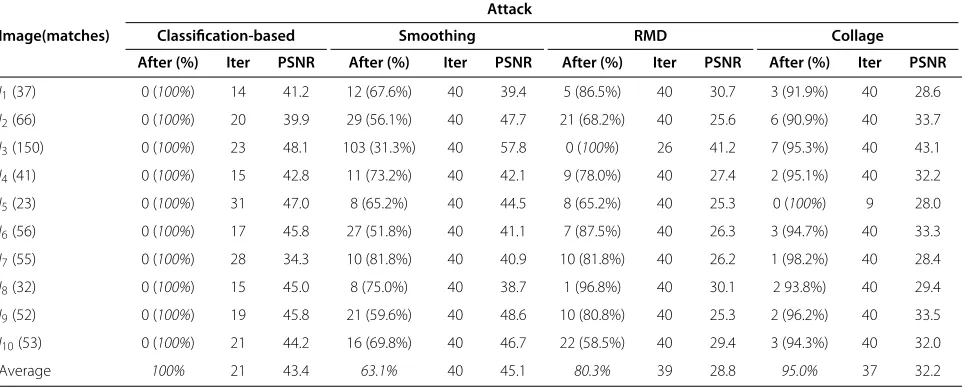
I1(37) 0 (100%) 14 41.2 12 (67.6%) 40 39.4 5 (86.5%) 40 30.7 3 (91.9%) 40 28.6
I2(66) 0 (100%) 20 39.9 29 (56.1%) 40 47.7 21 (68.2%) 40 25.6 6 (90.9%) 40 33.7
I3(150) 0 (100%) 23 48.1 103 (31.3%) 40 57.8 0 (100%) 26 41.2 7 (95.3%) 40 43.1
I4(41) 0 (100%) 15 42.8 11 (73.2%) 40 42.1 9 (78.0%) 40 27.4 2 (95.1%) 40 32.2
I5(23) 0 (100%) 31 47.0 8 (65.2%) 40 44.5 8 (65.2%) 40 25.3 0 (100%) 9 28.0
I6(56) 0 (100%) 17 45.8 27 (51.8%) 40 41.1 7 (87.5%) 40 26.3 3 (94.7%) 40 33.3
I7(55) 0 (100%) 28 34.3 10 (81.8%) 40 40.9 10 (81.8%) 40 26.2 1 (98.2%) 40 28.4
I8(32) 0 (100%) 15 45.0 8 (75.0%) 40 38.7 1 (96.8%) 40 30.1 2 93.8%) 40 29.4
I9(52) 0 (100%) 19 45.8 21 (59.6%) 40 48.6 10 (80.8%) 40 25.3 2 (96.2%) 40 33.5
I10(53) 0 (100%) 21 44.2 16 (69.8%) 40 46.7 22 (58.5%) 40 29.4 3 (94.3%) 40 32.0
Average 100% 21 43.4 63.1% 40 45.1 80.3% 39 28.8 95.0% 37 32.2
Iter, iteration. Left matches are listed according to the relative iteration.
Table 3 confirms that the conclusions drawn for the general case of section 5.2 still hold for the copy-move sce-nario. The classification-based method represents again the best trade-off between the rate of removal (all matches deleted with the lowest number of iterations) and the per-ceptual quality (average PSNR of 35.2 dB which is second only to thesmoothingattack).
Figure 13 shows imageI7’s copy-moved regions follow-ing the four attacks. It can be observed that the detector is fooled by the classificationbased attack (see Figure 13
-bottom right image) because the duplication of the skyscraper is not recognized. On the contrary, the detec-tor is still able to reveal the forgery in the other three cases:smoothing(10 matches, 40.9 dB),collage(1 match, 28.4 dB), andRMD(10 matches, 26.2 dB).
5.6 Block-based and SIFT-based copy-move detection
Copy-move forgery detection is not carried out only by means of SIFT-based methods. For this reason, in this
Figure 13Matches of the copy-moved regions of imageI7after the four attacks.Top left:smoothing; top right:collage; bottom left:RMD;
section we propose a brief qualitative analysis of the per-formance of the classification-based attack in the presence of a block-based approach. More specifically, we have employed the following two detectors: the block-based one devised by Fridrich et al. in [6], which relies on the similarity of low frequency DCT coefficients, and the SIFT-based one of [9]. We selected the forged image of Figure 14a, where a person has been removed from the picture by duplicating a portion of the sandy region. Start-ing from it, we hid the copy-move forgery by means of the following counter-forensic techniques: the classification-based attack and the geometric attack proposed in [12]. According to the authors, the attack of [12] proved to be effective against a number of block-based detectors (including [6]). It consists of a crop of 3 pixels (column-wise and row-(column-wise), followed by two JPEG compressions
(qualities 70 and 60), and a final resampling (bicubic interpolation) back to the size of the original image.
We ran the two detectors on the manipulated images, and the results we obtained are show in Figure 14: the first image of each row represents a manipulation, while the second and third images represent the detection performance of the block-based and SIFT-based tools, respectively. Both techniques succeeded in revealing the presence of tampering before the attacks were carried out. Following the geometric attack (Figure 14d), only the block-based detector was successfully impaired. Vice versa, the classification-based attack (Figure 14g) hid the manipulation only to the SIFT-based detector. Unlike the single application of either of the two countermeasures, their cascade (Figure 14l) was effective against both detec-tors, regardless of the order of the attacks.
(a) Copy-moved (b) Block-based detection [6] (c) SIFT-based detection [9]
(d) geometric attack [12] on (a) (e) Block-based detection (f) SIFT-based detection
(g) Classification attack on (a) (h) Block-based detection (i) SIFT-based detection
(j) Cascade of (d)–(g) on (a) (k) Block-based detection (l) SIFT-based detection
The interpretation of such results is straightforward: SIFT features have been devised in such a way to be robust against geometric manipulations, which obviously fail at impairing a SIFT-based copy-move detector. On the other hand, the classification-based attack is designed to preserve the local visual quality of the image. There-fore, the artifacts introduced into the image do not alter the features analyzed by the block-based detector. As a consequence, the two different counter-forensic schemes (and possibly others) should cooperate with each other in order to be effective against a wider spectrum of detection techniques.
6 Conclusions
In this paper, we presented a counter-forensic scheme to counter a SIFT-based copy-move detector. The goal is to remove SIFT keypoints with the lowest possible impact on visual quality. To do so, we first classified SIFT keypoints depending on the histogram of their neigh-borhood. We then used attacks specifically tailored to each class. Results were better than those obtained by always using the same attack regardless of keypoint’s prop-erties. The proposed scheme was applied to a realistic copy-move scenario and succeeded in disabling a state-of-the-art SIFT-based detector. Several aspects could be further investigated, the most interesting of which is the injection of fake keypoints into the cleaned image. In fact, an image that does not contain SIFT keypoints (or very few of them) is suspicious: such absence could be taken as a clue of tampering, thus leading to a counter detector with a very straightforward implementation. As a matter of fact, in a copy-move scenario, the side effect of the classification-based attack tends to be less notice-able, mainly for two reasons: (1) only half of the keypoints are removed from each patch, and (2) some keypoints are actually not removed but altered in such a way that their previous match is canceled. Nonetheless, our attack could greatly benefit from an additional module introduc-ing plausible fake keypoints and triggerintroduc-ing false positives during the SIFT detection. Moreover, it could be useful to study more in depth the interactions between the counter-measures against SIFT-based and block-based copy-move detectors. Finally, it would also be interesting to apply our attack to a content-based image retrieval scenario in order to assess its effectiveness against SIFT-based search engines.
Endnote
aThe UCID database can be freely downloaded from
http://homepages.lboro.ac.uk/∼cogs/datasets/ucid/ucid. html
Competing interests
The authors declare that they have no competing interests.
Authors’ information
IA received the Laurea degree in Computer Engineering in 2006 and the PhD degree in Computer Engineering, Multimedia and Telecommunication in 2011, both from the University of Florence, Italy. She was a visiting scholar at Binghamton University, Binghamton, NY, USA in 2010. Currently, she is a postdoctoral researcher at the Image and Communication Lab at the Media Integration and Communication Center, University of Florence. Her main research interests focus on multimedia forensics and image processing. MB graduated in Electronic Engineering at the University of Florence in 1991, where he received the PhD in Informatics and Telecommunications in 1995. He is currently working as associate professor at the University of Siena. During the last decade, his activity has focused on digital image processing and information security, with particular reference to the application of image processing techniques to copyright protection (digital watermarking) and multimedia forensics. Lately, he has been studying the possibility of processing signals that has been previously encrypted without decrypting them. He led several national and international research projects on these subjects. He is author of about 270 papers and holds four patents in the field of digital watermarking and document protection. He is co-author of the book Watermarking Systems Engineering(Dekker, 2004). In 2008, he was the recipient of theIEEE Signal Processing Magazinebest column award. In 2011, he was the recipient of the IEEE Geoscience and Remote Sensing Society Transactions Prize Paper award. He has been the chairman of the IEEE Multimedia Signal Processing Workshop (Siena, 2004) and the chairman of the International Workshop on Digital Watermarking (Siena, 2005). He has been the founding editor in chief of theEURASIP Journal on Information Security. He currently serves as associate editor of theIEEE Transactions on Circuits and System for Video Technologyand theIEEE Transactions on Information Forensics and Security. From 2010 to 2011, MB was the chairman of the IEEE Information Forensic and Security Technical Committee of the Signal Processing Society. He has been a member of the IEEE Multimedia Signal Processing Technical Committee and the conference board of the IEEE Signal Processing Society. He has been appointed distinguished lecturer of the IEEE Signal Processing Society for the years 2012-2013. MB is a fellow of the IEEE.
RC received the Laurea degree in Electronic Engineering in 1997 and the PhD degree in Computer Science and Telecommunication in 2001, both from the University of Florence, Italy. Currently, he is an assistant professor at the Media Integration and Communication Center of the University of Florence. His main research activities, witnessed by several publications, include digital image processing, image and video digital watermarking, multimedia forensics. AC graduated in Telecommunications at the University of Siena in 2008. Currently, he is a PhD student at the Department of Information Engineering and Mathematical Science of the University of Siena. His research activity is focused on both image forensics and counter-forensics.
Acknowledgements
This work was partially supported by the REWIND Project, funded by the Future and Emerging Technologies (FET) programme within the 7FP of the EC under grant 268478.
Author details
Media Integration and Communication Center, University of Florence, Florence 50121, Italy.2Department of Information Engineering and Mathematical Sciences, University of Siena, Siena 53100, Italy.
Received: 29 October 2012 Accepted: 27 March 2013 Published: 15 April 2013
References
1. R B ¨ohme, M Kirchner, inDigital Image Forensics, ed. by HT Sencar, N Memon. Counter-forensics attacking image forensics (Springer, New York, 2013), pp. 327–366
2. G Cao, Y Zhao, R Ni, H Tian, inProceedings of the 12th ACM Workshop on Multimedia and Security. Anti-forensics of contrast enhancement in digital images (ACM, New York, 2010), pp. 25–34
3. M Stamm, S Tjoa, W Lin, K Liu, in2010 17th IEEE International Conference on Image Processing (ICIP). Undetectable image tampering through JPEG compression anti-forensics (IEEE, New York, 2010), pp. 2109–2112 4. M Kirchner, R Bohme, Hiding traces of resampling in digital images. IEEE.
5. S Bayram, H Sencar, N Memon, inIEEE Western New York Image Processing Workshop. A survey of copy-move forgery detection techniques (IEEE, New York, 2008), pp. 538–542
6. A Fridrich, B Soukal, A Luk´a˙s, inProceedings of Digital Forensic Research Workshop. Detection of copy-move forgery in digital images (Citeseer, PSU, Centre County, 2003)
7. H Popescu, AC Farid, Exposing digital forgeries by detecting traces of resampling. IEEE. Trans. Signal Process.53(2), 758–767 (2005)
8. X Pan, S Lyu, Region duplication detection using image feature matching. IEEE. Trans. Inf. Forensics Secur.5(4), 857–867 (2010)
9. I Amerini, L Ballan, R Caldelli, A Del Bimbo, G Serra, A SIFT-based forensic method for copy move attack and transformation recovery. IEEE. Trans. Inf. Forensics Secur.6(3), 1099 –1110 (2011)
10. DG Lowe, Distinctive image features from scale-invariant keypoints. Int. J. Comput. Vis.60(2), 91–110 (2004)
11. V Christlein, C Riess, J Jordan, C Riess, E Angelopoulou, An evaluation of popular copy-move forgery detection approaches. IEEE. Trans. Signal Process.7(6), 1841–1854 (2012)
12. S Nguyen, HC Katzenbeisser, in2011 IEEE International Conference on Acoustics, Speech and Signal Processing (ICASSP). Security of copy-move forgery detection techniques (IEEE, New York, 2011), pp. 1864 –1867 13. SC Hsu, CY Lu, CS Pei, inProceedings of the 17th ACM International
Conference on Multimedia. Secure and robust SIFT (ACM, New York, 2009), pp. 637–640
14. E Do, TT Kijak, T Furon, L Amsaleg, inProceedings of the International Conference on Multimedia. Understanding the security and robustness of SIFT (ACM, New York, 2010), pp. 1195–1198
15. E Do, TT Kijak, T Furon, L Amsaleg, inProceedings of the 2nd ACM Workshop on Multimedia in forensics, Security and Intelligence. Deluding image recognition in sift-based cbir systems (ACM, New York, 2010), pp. 7–12 16. E Do, TT Kijak, L Amsaleg, T Furon, in37th International Conference on
Acoustics, Speech, and Signal Processing, ICASSP’12. Enlarging hacker’s toolbox: deluding image recognition by attacking keypoint orientations (IEEE, New York, 2011)
17. Y Liu, D Zhang, G Lu, W Ma, A survey of content-based image retrieval with high-level semantics. Pattern Recognit.40, 262–282 (2007) 18. R Caldelli, I Amerini, L Ballan, G Serra, M Barni, A Costanzo, inProceedings
of International Symposium on Communications, Control and Signal Processing (ISCCSP). On the effectiveness of local warping against SIFT-based copy-move detection (IEEE, New York, 2012)
19. YL Chang, JH Fan, KC Chang, Multi-modal gray-level histogram modeling and decomposition. Image Vis. Comput.20(3), 203–216 (2002) 20. D Zhang, G Lu, inProceedings of the International Conference on Neural
Networks and Signal Processing, 2003, vol. 2. Evaluation of similarity measurement for image retrieval (IEEE, New York, 2003), pp. 928–931 21. G Schaefer, M Stich, inStorage and Retrieval Methods and Applications for
Multimedia 2004, volume 5307 of Proceedings of SPIE. UCID - An uncompressed colour image database (SPIE, Bellingham, 2004), pp. 472–480
22. A Vedaldi, B Fulkerson, VLFeat: an open and portable library of computer vision algorithms (2008). http://www.vlfeat.org/. Accessed 09 April 2013 23. A Vedaldi, An open implementation of the SIFT detector and descriptor
(2007). Technical report 070012, UCLA CSD
24. R Hess, inProceedings of the International Conference on Multimedia. An open-source SIFTLibrary (ACM, New York, 2010), pp. 1493–1496
doi:10.1186/1687-5281-2013-18
Cite this article as:Ameriniet al.:Counter-forensics of SIFT-based copy-move detection by means of keypoint classification.EURASIP Journal on Image and Video Processing20132013:18.
Submit your manuscript to a
journal and benefi t from:
7 Convenient online submission 7 Rigorous peer review
7 Immediate publication on acceptance 7 Open access: articles freely available online 7 High visibility within the fi eld
7 Retaining the copyright to your article
![Figure 1 Overview of the method proposed in [9]. SIFT matched pairs and clustering.](https://thumb-us.123doks.com/thumbv2/123dok_us/914357.1589280/3.595.57.541.624.716/figure-overview-method-proposed-sift-matched-pairs-clustering.webp)