• No results found

Continuous tenor extension of affine LIBOR models with multiple curves and applications to XVA

N/A
N/A
Protected

Academic year: 2020

Share "Continuous tenor extension of affine LIBOR models with multiple curves and applications to XVA"

Copied!
28
0
0

Loading.... (view fulltext now)

Full text

(1)

R E S E A R C H Open Access

Continuous tenor extension of affine LIBOR

models with multiple curves and applications to XVA

Antonis Papapantoleon · Robert Wardenga

Received: 31 January 2017 / Accepted: 26 November 2017 /

© The Author(s). 2018Open AccessThis article is distributed under the terms of the Creative Commons Attribution 4.0 International License (http://creativecommons.org/licenses/by/4.0/), which permits unrestricted use, distribution, and reproduction in any medium, provided you give appropriate credit to the original author(s) and the source, provide a link to the Creative Commons license, and indicate if changes were made.

Abstract We consider the class of affine LIBOR models with multiple curves, which is an analytically tractable class of discrete tenor models that easily accommodates positive or negative interest rates and positive spreads. By introducing an interpolat-ing function, we extend the affine LIBOR models to a continuous tenor and derive expressions for the instantaneous forward rate and the short rate. We show that the continuous tenor model is arbitrage-free, that the analytical tractability is retained under the spot martingale measure, and that under mild conditions an interpolating function can be found such that the extended model fits any initial forward curve. This allows us to compute value adjustments (i.e. XVAs) consistently, by solving the corresponding ‘pre-default’ BSDE. As an application, we compute the price and value adjustments for a basis swap, and study the model risk associated to different interpolating functions.

Keywords Affine LIBOR models·Multiple curves·Discrete tenor·Continuous tenor·Interpolation·XVA·Model risk

2010 Mathematics Subject Classification 91G30·91G20·60G44

A. Papapantoleon ()

Department of Mathematics, National Technical University of Athens, Zografou Campus, 15780 Athens, Greece

e-mail: [email protected] R. Wardenga

(2)

Introduction

In the aftermath of the credit crisis and the European sovereign debt crisis, several of the classical paradigms in finance were no longer able to describe the new real-ity and needed to be designed afresh. On the one hand, significant spreads have appeared between rates of different tenors, which led to the development of multiple curve interest rate models. On the other hand, counterparty credit risk has emerged as the native form of default risk, along with liquidity risk, funding constraints and the collateralization of trades. Therefore, in post-crisis markets the quoted price of a derivative product (or, better, the cost of its hedging portfolio) is computed as the “clean” price of the product together with several value adjustments that reflect coun-terparty credit risk, liquidity risk, funding constraints, etc. In the context of interest rate derivatives, the “clean” price is typically computed as the discounted expected payoff under a martingale measure using a (discrete tenor) LIBOR market model, while the value adjustments are provided via the solution of a BSDE, which requires the existence of a short rate to discount the cash flows.

The aim of this work is to compute prices and value adjustments consistently, in the sense that we only calibrate a discrete tenor LIBOR model and then infer the dynamics of the short rate from it, instead of resorting to an additional, external short rate model. In the sequel, we will work with the class of affine LIBOR models with multiple curves. This class of models easily produces positive interest rates and pos-itive spreads, as well as negative interest rates alongside pospos-itive spreads. Moreover, the models are analytically tractable in the sense that the driving process remains affine under all forward measures, which allows deriving of explicit expressions for the prices of caplets and semi-analytic expressions for swaptions. Thus, these models can be efficiently calibrated to market data; cf. Grbac et al. (2015) for more details.

Once the affine LIBOR model has been set up, we introduce an interpolating func-tion that allows extending the model from a discrete to a continuous tenor, and derive explicit expressions for the dynamics of the instantaneous forward rate and of the short rate. This part follows and extends Keller-Ressel (2009), while a similar inter-polation for affine LIBOR models has been recently introduced by Cuchiero et al. (2016). Moreover, we show that the resulting continuous tenor model is arbitrage-free and belongs to the class of affine term structure models. Let us mention that, on the contrary, the arbitrage-free interpolation of “classical” LIBOR market mod-els is a challenging task; see e.g., Beveridge and Joshi (2012). In addition, we show that the driving process remains an affine process under the spot martingale mea-sure, hence also the short rate is analytically tractable under this measure. The choice of the interpolating function is not innocuous though, as it may lead to undesirable behavior of the short rate; e.g., it may induce jumps at fixed times. Thus, we inves-tigate what properties the (discrete tenor) affine LIBOR model and the interpolating function should have in order to avoid such situations. In particular, we show that under mild assumptions there exists an interpolating function such that the extended model can fit any initial forward curve.

(3)

namely a basis swap. Using the methodology outlined above, we derive the dynamics of the short rate and of the basis swap using an interpolating function, and compute the value adjustments for different specifications of the contract. As the choice of an interpolating function is still arbitrary, we study the model risk associated to different choices.

This paper is organized as follows: Section “Affine processes onRd0” reviews affine processes and Section “Affine LIBOR models with multiple curves” presents an overview of multiple curve markets and affine LIBOR models. Section “Continuous tenor extension of affine LIBOR models” focuses on the continuous tenor extension of affine LIBOR models and studies the properties of interpolating functions. The final Section “Computation of XVA in affine LIBOR models” out-lines the computation of value adjustments in affine LIBOR models, and discusses the model risk associated with the choice of interpolating functions. The Appendix contains a useful result on the time integration of affine processes.

Affine processes onRd0

This section provides a brief overview of the basic notions and properties of affine processes. Proofs and further details can be found in Duffie et al. (2003), in Keller-Ressel (2008), and in Filipovi´c (2005) for the time-inhomogeneous case.

Let(,F,F,P) denote a complete stochastic basis in the sense of Jacod and Shiryaev (2003, Def. I.1.3), whereF=(Ft)t∈[0,T]andT ∈ [0,)denotes the time

horizon. In the sequel, we will consider a processXthat satisfies the following:

Assumption (A) Let(X, (Px)x∈D)be a conservative, time-homogeneous,

stocha-stically continuous Markov process taking values inD = Rd0, i.e.,(Px)x∈D is a

family of probability measures on(,F)andX=(Xt)t∈[0,T]is a Markov process

such that for everyx ∈ D it holds X0 = x, Px-almost surely. Denote byEx the

expectation w.r.t. the measurePxand by·,·the inner product inRd. Setting

IT =u∈Rd:Ex

eu,XT<, for allxD,

we assume that

(i) 0∈IT, whereITdenotes the interior ofIT;

(ii) The conditional moment generating function ofXtunderPxhas

exponentially-affine dependence onx; that is, there exist functionsφ: [0, T] ×IT →Rand ψ: [0, T] ×IT →Rdsuch that

Exexpu, Xt=exp(φt(u)+ ψt(u),x) , (1)

for all(t, u, x)∈ [0, T] ×IT ×D.

(4)

φt+s(u)=φt(u)+φs(ψt(u)),

ψt+s(u)=ψs(ψt(u)),

(2)

with initial conditions

φ0(u)=0 and ψ0(u)=u.

Using the semi-flow equations we can derive thegeneralized Riccati equations

∂tφt(u)=F (ψt(u)), φ0(u)=0,

∂tψt(u)=R(ψt(u)), ψ0(u)=u,

(3)

for(t, u) ∈ [0, T] ×IT, whereFandR = (R1, . . . , Rd)are functions of L´evy–

Khintchine form:

F (u)= b, u +

D

eξ,u−1m(dξ ),

Ri(u)= βi, u +

αi

2u, u

+

D

eξ,u−1− u, hi(ξ )

μi(dξ ),

(4)

while (b, m, αi, βi, μi)1≤id are admissible parameters—see Definition 2.6 in

Duffie et al. (2003) for details—andhi:R0d → Rdare suitable truncation

func-tions. The infinitesimal generator of a process satisfying Assumption (A) is provided by

Af (x)=

b+

d

i=1

βixi,f (x)

+1

2

d

i=1

αi,klxi

2 ∂xk∂xl

f (x)

+

D

(f (x+ξ )f (x)) m(dξ )

+

d

i=1

D

(f (x+ξ )f (x)hi(ξ ),f (x)) xiμi(dξ ),

(5)

for allfC02(D)andxD.

Additional results are summarized in the following lemma. In the sequel, inequal-ities have to be understood componentwise, in the sense that(a1, a2)(b1, b2)if

and only ifa1≤b1anda2≤b2.

Lemma 1The functionsφandψsatisfy the following: 1. φt(0)=ψt(0)=0for allt ∈ [0, T].

2. IT is a convex set; moreover, for eacht ∈ [0, T], the functionsuφt(u)and

uψt(u), foruIT, are (componentwise) convex.

3. φt(·)andψt(·)are order preserving: let(t, u), (t, v)∈ [0, T] ×IT, withuv.

Then

φt(u)φt(v) and ψt(u)ψt(v). (6)

4. ψt(·)is strictly order-preserving: let(t, u), (t, v) ∈ [0, T] ×IT, with u < v.

(5)

5. φandψare jointly continuous on[0, T] ×IT. 6. The partial derivatives

∂ui

φt(u) and

∂ui

ψt(u), i=1, . . . , d

exist and are continuous for(t, u)∈ [0, T] ×IT.

ProofSee Ressel et al. (2013, Lem. 4.2) for statements (1)–(4) and Keller-Ressel (2008, Prop. 3.16 and Lem. 3.17) for the last two.

Affine processes have rich structural properties which have been proved particu-larly useful when it comes to financial modeling. However, there are situations where the condition of time-homogeneity cannot be met; for example, time-inhomogeneity may be introduced through an equivalent change of measure. Filipovi´c (2005) intro-duced time-inhomogeneous affine processes, whose conditional moment generating function takes the form

Ex

expu, XtFs

=expφs,t(u)+ ψs,t(u), Xs

,

for all 0≤ stT anduIT. Theorem 2.7 in Filipovi´c (2005) yields that the infinitesimal generator is provided by

Ateu,x= − ∂s−E

eu,XtX

s =x

s=t =(F (t, u)+ R(t, u),x)eu,x,

(7)

where the functionsFandRretain the same form as in the time-homogeneous case, however, the (admissible) parameters are now time-dependent. If the processX is strongly regular affine—that is, the parameters satisfy some continuity conditions, see Definition 2.9 in Filipovi´c (2005) for more details—then φs,t(u) and ψs,t(u)

satisfy generalized Riccati equations with time-dependent functional characteristics F (s, u)andR(s, u), i.e., for all 0≤stT

∂sφs,t(u)=F

s, ψs,t(u)

, φt,t(u)=0,

∂sψs,t(u)=R

s, ψs,t(u), ψt,t(u)=u.

(8)

Affine LIBOR models with multiple curves

A multiple curve setting

We start by introducing some basic notation and the main concepts used in multiple curve LIBOR models, following the approach introduced by Mercurio (2010); see also Grbac et al. (2015) for an overview and more details.

(6)

denote a discrete, equidistant time structure where Tk, for kK = {1, . . . , N},

denote the relevant market dates, e.g., payment dates and maturities of traded instru-ments. The set of tenors is denoted byX = {x1, . . . , xn}, where we typically have X = {1,3,6,12}months. Then, for every xX we consider the correspond-ing tenor structureTx = {0 = T0x < T1x < · · · < TNxx = TN}with constant

tenor length δx = TkxTkx1. We denote by Kx = {1, . . . , Nx} the collection

of all subscripts related to the tenor structureTx, and assume that Tx T for

allxX.

The Overnight Indexed Swap (OIS) rate is regarded as the best market proxy for the risk-free interest rate. Moreover, the majority of traded interest rate derivatives are nowadays collateralized and the remuneration of the collat-eral is based on the overnight rate. Therefore, the discount factors B(0, T ) are assumed to be stripped from OIS rates and defined for every possible matu-rity TT; see also Grbac and Runggaldier (2015, §1.3.1). B(t, T ) denotes the discount factor, i.e., the time-t price of a zero coupon bond with matu-rity T, which is assumed to coincide with the corresponding OIS-based zero coupon bond.

Let (,F,F,PN) be a complete stochastic basis, where PN denotes the

ter-minal forward measure, i.e., the martingale measure associated to the numeraire B (·, TN). We consider the forward measuresPxkx,k associated to the numeraires

{B(·, Tkx)}x,k for every pair(x, k)withxX andkKx. Assuming that the

pro-cessesB(·, Tkx)/B(·, TN)are truePN-martingales for every pair(x, k), the forward

measuresPxk are absolutely continuous with respect toPN and defined in the usual

way, i.e., via the Radon–Nikodym density

dPxk dPN =

B(0, TN)

B(0, Tkx)· 1 B(Tkx, TN)

.

Therefore, the forward measures are associated to each other via

dPxk dPxk+1

Ft =

B0, Tkx+1

B0, Tkx ·

Bt, Tkx

Bt, Tkx+1, (9)

hence they are related to the terminal measure via

dPxk dPN

Ft =

B(0, TN)

B0, Tkx·

Bt, Tkx B(t, TN)

. (10)

The expectations with respect to the forward measures Pxk and the terminal measurePN are denoted byExkandEN, respectively.

Next, we define the main modeling objects in the multiple curve LIBOR setting: the OIS forward rate, the forward LIBOR rate and the corresponding spread.

Definition 1The time-t OIS forward rate for the time interval [Tkx1, Tkx] is defined by

Fkx(t):= 1 δx

Bt, Tkx1

Bt, Tkx −1

(7)

Definition 2The time-t forward LIBOR rate for the time interval[Tkx1, Tkx] is defined by

Lxk(t):=ExkL(Tkx1, Tkx)|Ft, (12)

whereLTkx1, Tkxdenotes the spot LIBOR rate at timeTkx1for the time interval

Tkx1, Tkx.

The forward LIBOR rate is the rate implied by a forward rate agreement where the future spot LIBOR rate is exchanged for a fixed rate; cf. Mercurio (2009, pp. 12–13). The spot LIBOR rateLTkx1, Tkxis set in advance, hence it isFTx

k−1-measurable,

therefore we have that the forward LIBOR rate coincides with the spot LIBOR rate at the corresponding tenor dates, i.e.,

Lxk

Tkx1=Exk

L(Tkx1, Tkx)|FTkx−1

=LTkx1, Tkx

.

Definition 3The (additive) spread between the forward LIBOR rate and the OIS forward rate is defined by

Skx(t):=Lxk(t)Fkx(t).

Remark 1In a single curve setup, the forward LIBOR rate is defined via (11) and the spread equals zero for all times. However, in a multiple curve model these rates are not equal any more and we typically have thatLxkFkx.Fkx andLxk can also be interpreted as forward rates corresponding to a riskless and a risky bond, respectively; see e.g., Cr´epey et al. (2012).

Affine LIBOR models with multiple curves

We now turn our attention to the affine LIBOR models developed by Keller-Ressel et al. (2013) and extended to the multiple curve setting by Grbac et al. (2015). An important ingredient are martingales that are greater than, or equal to, one. Con-sider a process X satisfying Assumption (A) and starting at the canonical value

1=(1,1, . . . ,1), and letuIT. Then, the processMu =(Mtu)t∈[0,T]defined by

Mtu:=E1

eu,XTFt=exp

Tt(u)+ ψTt(u), Xt) (13)

is a martingale. Moreover, ifuIT ∩Rd0the mapping uMtu is increasing

andMu

t ≥ 1 for everyt ∈ [0, T]; see Keller-Ressel et al. (2013, Thm. 5.1) and

Papapantoleon (2010).

The multiple curve affine LIBOR models are defined as follows:

Definition 4A multiple curve affine LIBOR model(X,X, TN, u, v)consists of

the following elements:

An affine process X under PN satisfying Assumption (A) and starting at the

(8)

A sequence of vectorsu = (u1, . . . , uN)withul =: uxkIT ∩Rd0, for all

l=kT1x/T1andxX, such that

u1≥u2≥ · · · ≥uN =0. (14)

A collection of sequences of vectorsv =(v1x, . . . , vNxx)

xX withv x

kIT

Rd

0, such that

vkxuxk for allkKx, xX. (15)

The dynamics of the OIS forward rates and the forward LIBOR rates in the model evolve according to

1+δxFkx(t)=

Mu x k−1 t

Mu x k

t

and 1+δxLxk(t)=

Mv x k−1 t

Mu x k

t

, (16)

for allt ∈ [0, Tkx],kKxandxX.

The definition of multiple curve affine LIBOR models implies that the dynam-ics of OIS forward rates and forward LIBOR rates, more precisely of 1+δxFkx

and 1+δxLxk, exhibit an exponential-affine dependence in the driving process X;

see (13) and (16). Glau et al. (2016) recently showed that models that exhibit this exponential-affine dependence are the only ones that produce structure preserving LIBOR models; cf. Proposition 3.11 therein. The denominators in (16) are the same in both cases, since both rates have to bePxk-martingales by definition. On the other hand, different sequences(ul)lKand

vkxkKx are used in the numerators in (16)

producing different dynamics for OIS and LIBOR rates. These sequences are used to fit the multiple curve affine LIBOR model to a given initial term structure of OIS and LIBOR rates. In particular, the subsequent propositions show that by fitting the model to the initial term structure we automatically obtain sequences(ul)lK and

(vkx)kKx that satisfy (14) and (15), respectively; see also Grbac et al. (2015, Rem.

4.4 and 4.5) for further comments on these sequences.

The following quantity measures the ability of a multiple curve affine LIBOR model to fit a given initial term structure

γX:= sup uIT∩Rd>0

E1

expu, XT

. (17)

In several models commonly used in mathematical finance, such as the Cox– Ingersoll–Ross model and Ornstein–Uhlenbeck processes driven by subordinators, this quantity equals infinity. The following propositions show that the affine LIBOR models are well-defined and can fit any initial term structure under mild conditions.

Proposition 1Consider the time structureT, letB(0, Tl),lK, be the initial

(9)

B(0, T1)≥ · · · ≥B(0, TN) >0. (18)

Then, the following hold:

1. If γX > B(0, T1)/B(0, TN), there exists a sequence (ul)lK in IT ∩ Rd0

satisfying (14) such that

Mul

0 =

B(0, Tl)

B(0, TN)

for alllK.

In particular, ifγX= ∞, then the multiple curve affine LIBOR model can fit any

initial term structure of OIS rates.

2. If X is one-dimensional, the sequence(ul)lKis unique.

3. If all initial OIS rates are positive, the sequence(ul)lKis strictly decreasing.

ProofSee Proposition 6.1 in Keller-Ressel et al. (2013).

Proposition 2Consider the setting of the previous proposition, fixxX and the corresponding tenor structureTx. LetLxk(0),kKx, be the initial term structure of non-negative forward LIBOR rates and assume that for everykKx

Lxk(0)≥ 1 δx

B0, Tkx1 B0, Tkx −1

=Fkx(0). (19)

Then, the following hold:

1. IfγX > (1+δxLxk(0))B(0, Tkx)/B(0, TN)for allkKx, then there exists a

sequence(vkx)kKx inIT ∩R0dsatisfying (15) such that

Mv x k

0 =

1+δxLxk+1(0)

Mu

x k+1

0 , for allkK x\ {

Nx}.

In particular, ifγX= ∞, then the multiple curve affine LIBOR model can fit any

initial term structure of forward LIBOR rates.

2. If X is one-dimensional, the sequence(vxk)kKxis unique.

3. If all initial LIBOR-OIS spreads are positive (i.e., (19) becomes strict), thenvkx> uxk, for allkKx\ {Nx}.

ProofSee Proposition 4.2 in Grbac et al. (2015).

Remark 2The proofs of these propositions are constructive and provide an easy algorithm for fitting an affine LIBOR model to a given initial term structure of OIS and LIBOR rates. However, for d > 1 the sequences u and vx are not unique, hence questions about optimality arise; see the discussion in Subsections “On the choice of the interpolating function” and “Discussion”. In the proof of Proposition1, the sequence(ul)lKis chosen along a straight line inIT ∩Rd0from

someuIT to 0, such that u satisfies

M0u=E1expu, XT> γXε >

B (0, T1)

B (0, TN)

(10)

However, any other continuous path from anotheruto 0, that satisfies (20) and is componentwise decreasing, would have worked as well.

The next proposition shows that multiple curve affine LIBOR models are analyt-ically tractable, in the sense that the affine structure is preserved under any forward measure.

Proposition 3The underlying process X is a time-inhomogeneous affine process under the measurePxk, for everyxXandkKx. The moment generating function is provided by

Ek x,x

expw, Xt

=exp

φtx,k(w)+

ψtx,k(w),x

,

for every w such thatw+ψTNt(u

x

k)IT, where

φtx,k(w) =φtψTNt(u

x k)+w

φtψTNt(u

x k)

,

ψtx,k(w) =ψtψTNt(u

x k)+w

ψtψTNt(u

x k)

.

ProofSee Proposition 4.6 in Grbac et al. (2015).

The multiple curve affine LIBOR models defined above and satisfying the prereq-uisites of Propositions 1 and 2 are arbitrage-free discrete tenor models, in the sense thatFkxandLxk arePkx-martingales for everykKx,xX, while the interest rates and the spread are positive, i.e.,Fkx(t)≥0 andSkx(t)=Lxk(t)Fkx(t)≥0 for every t∈ [0, Tkx1], kKx,xX; cf. Proposition 4.3 in Grbac et al. (2015).

Remark 3The class of affine LIBOR models with multiple curves can be extended to accommodate negative interest rates alongside positive spreads; see Grbac et al. (2015, §4.1) for the details.

Remark 4We could use time-dependent parameters, i.e., time-inhomogeneous affine processes, in the construction of affine LIBOR models, in particular since the dynamics of X are time-dependent under forward measures; see Proposition3. We use affine processes instead, in order to ease the presentation of the model and its properties, and to be consistent with the relevant literature (cf. Keller-Ressel et al. 2013and Grbac et al.2015).

Continuous tenor extension of affine LIBOR models

Discrete to continuous tenor

(11)

U, which is a function defined on[0, TN]that matchesulat each tenor dateTl. This

subsection follows and extends Keller-Ressel (2009).

Definition 5An interpolating function for the multiple curve affine LIBOR model (X,X, TN, u, v)is a continuous, componentwise decreasing functionU: [0, TN] →

Rd

0withU(t)IT for allt ∈ [0, TN]and bounded right-hand derivatives, such

thatU(Tl)=ulfor allTlT.

Remark 5SinceU is a mapping from [0, TN], it makes sense to define a U0

element. This can be chosen such thatM0U(0) = B(01,T

N), which is consistent with Proposition1.

The interpolating function allows deriving of an explicit expression for the dynamics of zero coupon bond prices in the multiple curve affine LIBOR model. In particular, they belong to the class of affine term structure models; see e.g., Bj¨ork (2009, §24.3).

Lemma 2LetUbe an interpolating function for the multiple curve affine LIBOR model(X,X, TN, u, v)and define the (OIS zero coupon) bond priceB(t, T )by

B(t,T) B(t, TN) =

MtU(T), (21)

for0≤ tTTN, whereMU(T)is the martingale defined by (13). Then, bond

prices satisfy

B(t,T)=expα(t,T)+ β(t,T), Xt

, (22)

where

α(t,T)=φTNt(U(T))φTNt(U(t)), β(t,T)=ψTNt(U(T))ψTNt(U(t)).

(23)

ProofUsing the definition of the OIS forward rate, (16), and the positivity of bond prices, we get in the discrete tenor case,

B(Tk, Ti)= i−1

l=k

B (Tk, Tl+1)

B(Tk, Tl) = i−1

l=k

Mul+1

Tk Mul

Tk

= M

ui

Tk Muk

Tk

for everyTk, TiT such thatTkTiTN. Similarly in the continuous tenor case,

using (21) we get for 0≤tTTNthat

B(t,T)=B

t, Tt+1

B (t, t) ⎛ ⎝T−1

l=t+1

B(t, Tl+1)

B(t, Tl)

B(t,T) Bt, TT

=M

ut+1 t

MtU(t )

⎛ ⎝T

1

l=t+1

Mul+1 t

Mul

t

⎞ ⎠ MtU (T )

MtuT−1

=MU

(T ) t

MtU(t )

,

(12)

wheretis such that Tt is the largest element in the time structureT less than

or equal tot. Hence, sinceMtU(T )depends exponentially-affine onXt, we arrive at

(22)–(23).

Next, we will show that the extension of an affine LIBOR model from a dis-crete to a continuous tenor is an arbitrage-free term structure model. Following Musiela and Rutkowski (1997, Def. 2.3), we say that a family of bond prices (B(t,T))0≤tTTN satisfies a no-arbitrage conditionif there exists a measure Q

such that B (·,T) /B (·, TN) is a Q-local martingale and B (t,T) ≤ 1, for any

0≤tTTN.

Theorem 1LetUbe an interpolating function for the multiple curve affine LIBOR model(X,X, TN, u, v). Then,(B(t,T))0≤tTTN is a continuous tenor extension of the affine LIBOR model, i.e., an arbitrage-free model for all maturitiesT ∈ [0, TN],

such that for all maturitiesTT the bond prices coincide with those of the (discrete tenor) affine LIBOR model.

ProofThe definition of the interpolating function yields immediately that bond prices in the continuous tenor extension coincide with those of the discrete tenor affine LIBOR model for all maturities.

According to Musiela and Rutkowski (1997, §2.3), in order to show that the model is arbitrage-free it suffices to verify the following conditions on the family (B(t,T))0≤tTTN of bond prices:

(i) B(·,T) is a strictly positive special semimartingale and the left-hand limit processB (·−,T)is also strictly positive, for everyT ∈[0, TN].

(ii) The bond price quotientsB(·,T)/B(·, TN)arePN-martingales.

(iii) B(t, S)B(t, U )for all 0≤tSUTN.

The second condition follows immediately from (21) and the construction ofMu as aPN-martingale. In order to check the first and the third conditions, we shall use

the representation for the bond prices from Lemma 2. Indeed, the last condition fol-lows directly from representation (22)–(23), using the monotonicity of the functionU and the order preserving property ofφandψ; cf. Lemma 1. Moreover, the continuity ofφandψtogether with (22) imply thatB(t,T)=exp(α(t,T)+β(t,T), Xt),

which ensures the positivity ofB(·−,T).

Finally,B(·,T)is a smooth function ofXhence it is also a semimartingale, which is special if its associated jump processB(t,T)= B(t,T)B (t,T)is abso-lutely bounded; cf. Jacod and Shiryaev (2003, Lem. I.4.24). The processesXandX are non-negative a.s. and the same is true forX, since the compensator of the jump measure ofXis entirely supported on the positive half-space; cf. Duffie et al. (2003, Def. 2.6). Using again Lemma 1 (4) and the monotonicity ofU, we get thatα(t,T) andβ(t,T)take values in the negative half space. Thus, we can estimate the jump processB(t,T)as follows:

(13)

Having bond prices for all maturitiesT ∈ [0, TN]at hand, we can now calculate

the dynamics of the instantaneous forward ratef (t,T)with maturityT prevailing at timetand of the short ratert prevailing at timet. These quantities are commonly

defined as

f (t,T)= −+logB(t,T)

∂T and rt =f (t, t).

Together with the requirement that B(T,T) = 1, we get that the former is equivalent to

B(t,T)=exp

T

t

f (t, s)ds

. (25)

Lemma 3LetUbe an interpolating function and consider the continuous tenor extension of the affine LIBOR model (X,X, TN, u, v). Then, the instantaneous

forward rate and the short rate are provided by

f (t,T)=p(t,T)+ q(t,T), Xt and rt =pt+ qt, Xt, (26)

where

p(t,T)= − ∇uφTNt(u)u=U(T),

dU(t) dt+

t=T !

, pt =p(t, t),

q(t,T)= − ∇uψTNt(u)u=U(T)

dU(t) dt+

t=T

, qt =q(t, t),

(27)

for all0≤ tTTN. Here,abdenotes the componentwise multiplication of

two vectors a and b having the same dimension.

ProofWe know from Lemma 2 that bond prices are log-affine functions ofX, in particular they are provided by (22)–(23). The result now follows by taking the right-hand derivative ofα(t,T)+ β(t,T), Xtw.r.t.T, which exists by Definition 5 and

Lemma 1(6). Note also thatp(t,T)andq(t,T)are positive, for allt∈ [0,T].

Moreover, the continuously compounded bank accountBis defined as usual:

B=exp

·

0

rsds

, (28)

while the associated spot measureP, under which bond prices are provided by

B(t,T)=E

" Bt

BT Ft

# ,

is calculated next.

Lemma 4LetUbe an interpolating function and consider the continuous tenor extension of the affine LIBOR model(X,X, TN, u, v). Then, the spot measureP is

determined by the density process

dP

dPN

Ft

= 1

M0U(0)exp

Pt + Qt, Xt +

t

0

rsds

(14)

wherePt :=φTNt(U(t))andQt :=ψTNt(U(t)).

ProofThe spot measure and the terminal forward measure are related via

dP

dPN

Ft

= BtB (0, TN)

B(t, TN) ;

cf. Musiela and Rutkowski (2005, §13.2.2). Then, the representation above follows easily from (28), (22)–(23), Lemma 1(1), and Remark 5, using the fact thatU(TN)=

0, henceB(t, TN)=1/MtU(t ).

The next result resembles Proposition 3 and shows that the driving processX remains an affine process under the spot measureP. In other words, the multiple

curve affine LIBOR model remains analytically tractable under the spot measure as well.

Theorem 2LetUbe an interpolating function and consider the continuous tenor extension of the affine LIBOR model(X,X, TN, u, v). Then the underlying process X

is a time-inhomogeneous affine process under the spot measureP. In particular, X

is strongly regular affine and the functional characteristics underPare provided by

F(t, w)=F (w+Qt)F (Qt) and R(t, w)=R (w+Qt)R (Qt) ,

for every w such thatw+QtIT.

ProofWe will first show that the moment generating function of X has an exponential-affine form underP. Starting from the moment generating function of

XunderP, and using the conditional density process in Lemma 4 and the dynamics

of the short rate process in (26)–(27), we arrive at

E,x

ew,XtFs=E

N,x

"

ew,XtB

t B(s, TN)

B

s B(t, TN)

Fs

#

=exp

PtPsQs, Xs +

t

s

pudu

s

0

qu, Xudu

×EN,x

" exp

w+Qt, Xt +

t

0

qu, Xudu

Fs

#

=:A×B.

(29) Theorem 4.10 in Keller-Ressel (2008) provides an elegant way to calculate the functional characteristics of a time integrated affine process. This result is proved for Y· = $0·Xudu and is extended to Y%· =

0θuiXiudu

1≤id for a

determinis-tic, bounded and positiveθ in Theorem 3 of the appendix. Then, we have that the functional characteristics of the joint processXt,%Ytare provided by

%

F (t, wx, wy)=F (wx) and R(t, w% x, wy)=

R (wx)+θtwy

0

(15)

The definition of the interpolating function together with Lemma 1 (6) yield that qin (27) is bounded. Hence, applying Theorem 3 yields thatBin (29) takes the form

B=exp%φts(w+Qt,1)+%ψts(w+Qt,1), (Xs,%Ys)

,

where%φandψ%are the solutions of the generalized Riccati equations defined byF% andR%; cf. (3). The form ofR%implies that the components ofψ%corresponding to%Y satisfyψ%ts(wx, wy)y=wy. Hence, we get from (29) that

E,x

ew,XtFs=exp

PtPsQs, Xs+

t

s

pudu+%φts(w+Qt,1)

+%ψts(w+Qt,1)x, Xs .

Now, conditioning onXs = x and taking the right-hand derivatives with respect

tosatt =s, we arrive at the generator ofXunderP:

Atew,x=(F (w+Qt)F (Qt)+ R(w+Qt)R(Qt), x)ew,x; (30)

compare with (7). The semigroup of the affine processX underP is weakly

reg-ular in the sense of Filipovi´c (2005, Def. 2.3), since the processXis stochastically continuous underP and the generator exists and is continuous atw = 0 for all

(t, x) ∈ [0, T] ×D. Moreover, X is strongly regular affine under P since the

weakly admissible parameters(α(t), b(t), β(t), m(t), μ(t))implied by (30) are continuous transformations of(α, b, β, m, μ).

Using the last proposition, we get that the conditional moment generating function ofXunderPis given by

E,xexpw, XtFs=expφs,t(w)+

ψs,t (w), Xs, (31)

whereφs,t andψs,t are the solutions of the generalized Riccati equations with

func-tional characteristicsF andR; cf. (8). Since both the instantaneous forward rate and the short rate are time-dependent affine transformations of the driving processX, they will inherit many (distributional) properties fromX. In fact, once we have com-puted the characteristics of the driving processX under the spot measure P, it is

easy to see that also the short raterhas time-inhomogeneous characteristics, that are affine w.r.t.X. Indeed, from (26) and (31) we get

E,x

exp(wrt)|Fs

=expwpt+φs,t (wqt)+

ψs,t (wqt) , Xs

=:expφrs,t(w)+

ψs,tr (w), Xs

. (32)

On the choice of the interpolating function

The requirements on the interpolating functionUare rather weak, such that even a linear interpolation between theuk’s corresponding to the maturitiesTk,kK, can

be used. However, looking at Eqs. (26)–(27) for the dynamics of the short rate process r, we can immediately observe that jumps will occur at fixed times, the maturitiesTk,

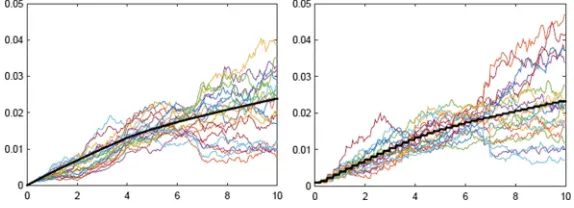
(16)

three, which are continuously differentiable and thus do not lead to deterministic discontinuities; see Fig. 1 for an illustration.

The next corollary is an immediate consequence of Lemma 3 and the fact thatX is stochastically continuous.

Corollary 1Let U be a continuously differentiable interpolating function, i.e., UC1R,Rd0, and consider the continuous tenor extension of the affine LIBOR model(X,X, TN, u, v). Then the short rate process r is stochastically continuous.

However, even when the interpolating function is continuously differentiable there can be sources of undesirable behavior of the short rate inherited from the sequence (uk)itself (which is not unique unlessd =1; cf. Remark 2). Consider, for example,

the following “diagonal” structure for(uk), which is similar to the one employed by

Grbac et al. (2015) to model independence between rates of different maturities:

uN = (0 · · · 0 0)

uN−1 = (0 . .

.

0 u¯N)

uN−2 = (0 . .

. ¯

uN−1 u¯N)

..

. . .. ... ... u1 =(u¯1 · · · ¯uN−1 u¯N)

u0 =(u¯0 · · · ¯uN−1 u¯N)

withu¯i ∈ R0, for 1 ≤ iN. The only paths that can be used to interpolate

in this case are the ones connecting the elementsuk anduk+1of the sequence(uk)

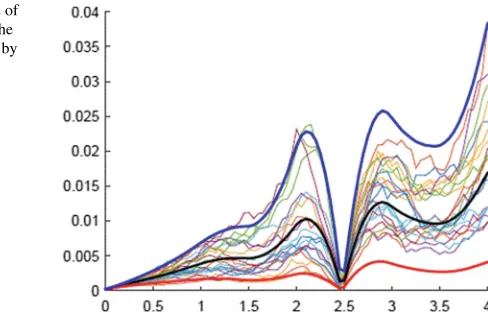
via straight lines, otherwise the interpolating function will not be component-wise decreasing. Hence, any interpolating function maps onto a non-smooth manifold. Then, requiring that the interpolating function is continuously differentiability (in time) will lead to a short rate that drops to zero at everyTk,kK, since the derivative

of the interpolating function will equal zero at eachTk; see again (26) and (27), and

the illustration in Fig. 2.

We would like in the sequel to provide conditions such that the short rate resulting from a continuous tenor extension of an affine LIBOR model exhibits “reasonable”

Fig. 1 Twenty sample paths of the short rate whenXis the 1D CIR process, together with the mean as a function of time (computed over 105paths).Left panel:using a cubic spline interpolation of(u

k)to obtain

(17)

Fig. 2 Twenty sample paths of the short rate together with the 2.5/97.5 percentiles induced by a diagonal structure and a continuously differentiable interpolating function

behavior, in the sense that it neither jumps at fixed times, nor drops to zero at each maturity date. Moreover, we would like to identify a method for choosing an inter-polating function that removes the arbitrariness from this choice. A condition for the former is that the sequence(uk)kKlies on a smooth manifold. Regarding the latter,

we could require that a continuum of bond prices are fitted as well. These together lead to a uniquely defined, continuously differentiable interpolating function.

Example 1Let(X,X, TN, u, v)be an affine LIBOR model and assume that the

sequence (uk)kK admits an interpolating function Uˆ that maps onto a smooth

manifoldM =Uˆ(t);t ∈[0, TN]. Moreover, letf (˜0,·): [0, TN] →R0be an

ini-tial forward curve—belonging, e.g., to the Nelson–Siegel or Svensson family—that is consistent with the initial bond prices, i.e.,

B(0, Tk)=exp

Tk

0

˜ f (0, s)ds

. (33)

Then, we can find an interpolating function U such that the continuous-tenor extended affine LIBOR model fits the given initial forward curve f˜. In order to achieve this, the interpolating functionUshould satisfy the following:

φTN(U(T ))+

ψTN(U(T )) , X0

=

TN

T

˜

f (0, s)ds and U(T )M (34)

for allT ∈ [0, TN]. This equation follows directly from the requirement that (33)

holds for all T ∈ [0, TN], together with (22)–(23) and Remark 5. Moreover, the

dynamics of the instantaneous forward rate are provided by (26)–(27) for all T ∈ [0, TN], and satisfy the initial conditionf (0,T)= ˜f (0,T).

The curve fitting problem in (34) can be solved analogously to the problem of fitting the sequence(uk)to an initial term structure of bond prices; compare with

(18)

Proposition 4Let (X,X, TN, u, v) be a multiple curve affine LIBOR model,

assume thatf (˜ 0,·): [0, TN] →R0is continuous and that(uk)kKallows for an

interpolating function that maps onto aC1-manifoldMIT ∩Rd0. Then, there

exists a unique continuously differentiable interpolating functionU: [0, TN] →M

satisfying (34).

ProofThis statement is an easy consequence of the implicit function theorem, where the differentiability of φ and ψ in space and time as well as their order preserving property (cf. Lemma 1) are used. Indeed, the function

G(t, u)=φTN(u)+

ψTN(u), X0

TN

t

˜ f (0, s)ds

is continuously differentiable int ∈ [0, TN]anduIT. Let(Uα, gα)αA be an atlas for theC1-manifoldM, whereA is a finite index set,(Uα)αA is an open covering ofM and:⊆Ris aC1-homeomorphism. DefineG: [0, TN] ×

Rby(t, x)G

t, gα(x)1

. By the (strict) order preserving property of φ andψ

we know that the partial derivative ∂x G(t,x) is not zero, hence by a compactness

argument there exists a unique continuously differentiable functionx: [0, TN] →R

such thatG(t, x(t))=0 for allt ∈ [0, TN]. The interpolating function is then given

byU(t) := gα1(x(t)).

Remark 6Figure1reveals another interesting behavior of the short rate implied by an affine LIBOR model. In particular, there exists a lower bound for the short rate that is greater than zero. Indeed, since the state space of our driving affine process is Rd

0, we have thatrtpt, which is greater than zero asφis strictly order preserving

and u is decreasing. A similar phenomenon was already observed in the discrete tenor model for the LIBOR rate, compare with Keller-Ressel et al. (2013, Rem. 6.4).

Computation of XVA in affine LIBOR models

(19)

Clean valuation

This section reviews basis swaps and provides formulas for their clean price in affine LIBOR models with multiple curves. The clean valuation of caps, swaptions, and basis swaptions in these models is extensively studied in Grbac et al. (2015).

The typical example of an interest rate swap is where a floating rate is exchanged for a fixed rate; see, e.g., Musiela and Rutkowski (2005, §9.4). The appearance of significant spreads between rates of different tenors has given rise to a new kind of interest rate swap, called basis swap, where two streams of floating payments linked to underlying rates of different tenors are exchanged. As an example, in a 3M-6M basis swap linked to the LIBOR, the 3-month LIBOR is paid quarterly and the 6-month LIBOR is received semiannually.

LetTx1 p1q1 =

Tx1

p1, . . . , T x1 q1

andTx2 p2q2 =

Tx2

p2, . . . , T x2 q2

denote two tenor struc-tures, whereTx1

p1 =T x2 p2,T

x1 q1 =T

x2 q2, andT

x2 p2q2⊂T

x1

p1q1. Consider a basis swap that is initiated atTx1

p1 =T x2

p2, with the first payments due atT x1

p1+1andT x2

p2+1, respectively. In order to reflect the possible discrepancy between the floating rates at initiation, the interest rateLTx1

i−1, T x1 i

corresponding to the shorter tenor lengthx1is replaced by

LTx1 i−1, T

x1 i

+S for a fixedS, which is called the basis swap spread. The time-r value of a basis swap with notional amount normalized to 1, for 0 ≤ rTx1

p1, is given by

BSr

S,Tx1 p1q1,T

x2 p2q2

=

q2

i=p2+1

δx2B

r, Tx2 i

Ex2

i

LTx2 i−1, T

x2 i Fr

q1

i=p1+1

δx1B

r, Tx1 i

Ex1

i

LTx1 i−1, T

x1 i

+SFr

= q2

i=p2+1

δx2B(r, T x2 i )L

x2 i (r)

q1

i=p1+1

δx1B(r, T x1 i )

Lx1

i (r)+S

.

The fair basis swap spreadSr

Tx1 p1q1,T

x2 p2q2

is then computed so that the value of the swap at inception is zero, i.e.,BSrS,Tpx11q1,T

x2 p2q2

=0 for 0≤rTx1 p1. Hence, the fair spread is given by

Sr

Tx1 p1q1,T

x2 p2q2

=

&q2

i=p2+1δx2B

r, Tx2 i

Lx2

i (r)

&q1

i=p1+1δx1B

r, Tx1 i

Lx1

i (r)

&q1

i=p1+1δx1B(r, T x1 i )

.

Moreover, the time-tvalue of the basis swap, fortTx1 p1, T

x2 q2

, using (16) and (24), takes the form:

BSt

Sr,Tpx11q1,T x2 p2q2

= 1

MtU(t ) q2

i=t2

Mv x2 i−1 tM

ux2

i

t

− 1

MtU(t ) q1

i=t1

Mv x1 i−1 tM

ux1

i

t

1−δx1Sr

(20)

whereSr = Sr

Tx1 p1q1,T

x2 p2q2

, for r ∈ 0, Tx1 p1

being the date of inception, while ti=minkKxi :t < Tkxi.

Remark 7Basis swaps are post-crisis financial products, which can only be priced in models accounting for the multiple curve nature of interest rates. In a single curve model, the price of a basis swap is zero; cf. Cr´epey et al. (2012, p. 181)

XVA equations

The pricing formulas in the previous subsection reflect valuation in an environment without counterparty credit risk, funding constraints, and other market frictions. In order to include the latter into the pricing framework, several value adjustments have been introduced: credit and debt valuation adjustment (CVA and DVA), funding val-uation adjustment (FVA), as well as replacement cost (RC), among others. However, we disregard the capital valuation adjustment (KVA), that was introduced due to increasing capital requirements and the cost associated to them, and the margin val-uation adjustment (MVA), arising when an initial margin is required, by assuming perfect hedging by the bank and the absence of initial margins. The various valuation adjustments are typically abbreviated by XVA, while we will refer to their sum as the valuation adjustment(VA), i.e.,

VA:=CVA+DVA+FVA+RC.

Our approach to the computation of VA closely follows the work of Cr´epey (2015a,b), while our exposition and numerical examples are based on Cr´epey et al. (2013), and Cr´epey et al. (2015, §5.1).

We consider two counterparties, called a bank and an investor in the sequel, that are both defaultable, and denote byτbthe default time of the bank, byτithe default

time of the investor, while we setτ =τbτiT. The default intensities ofτb, τi, and

τare denotedγb, γi, andγ, respectively. We also consider the “full model” filtration

G, which is given byF enlarged by the natural filtrations of the default timesτb

andτi, and assume that the immersion hypothesis holds, that is, everyF-martingale

stopped atτ is aG-martingale.

The VA can be viewed as the price of a dividend paying option on the debt of the bank to the investor, paying off at the first-to-default timeτ. Here, we have implicitly adopted the point of view of the bank. The VA from the point of view of the investor is similar, but not identical, due to, e.g., different funding conditions. The effective conclusion of Cr´epey (2015b) is that the VA in the setting described above can be computed in a “pre-default” framework, where the default risk of the counterparties appears only through the default intensities; see, in particular, Section 3 therein. More specifically, the VA is the solution of the following BSDE under a martingale measureP:

t =Et

T

t

gs(rs, Ps, s)ds

, t ∈ [0, T], (36)

(21)

clean price and the VA:

t =Ptt, t∈ [0, T].

The VA coefficientghas the following form:

gt(rt, Pt, t)+rtt =

γti1−ρi(Qtt)− CVA

+γtb

1−ρb(Qtt)+ DVA

+bt+t − ¯btt−+λt(Pttt)+− ˜λt(Pttt)− FVA

+γt(PttQt) , RC

whereλ˜t = ¯λtγtb(1−r), while each line on the right side corresponds to one of the

four components of the VA. The parameters in the above equation have the following financial interpretation:

γi

t, γtb, andγt are the default intensities of the investor, the bank, and the first to

default intensity, respectively.

ρi, ρbare the recovery rates of the investor and the bank to each other, andris the recovery rate of the bank to its unsecured funder (which is a third party that jumps in when the banks’ internal sources of funding have been depleted; this funder is assumed to be risk free).

Qt is the value of the contract according to some valuation scheme specified in

the credit support annex (CSA), which is a common part in an over-the-counter contract.

t =t+−t−is the value of the collateral posted by the bank to the investor.

bt,b¯t and λt,λ¯t are the spreads over the risk free rate rt corresponding to

the remuneration of collateral and external lending and borrowing (from the unsecured funder).

The value of the contractQand of the collateral, as well as the funding coef-ficientsbandb¯ are specified in the CSA of the contract, which is used to mitigate counterparty risk. Different CSA specifications will result in different behavior of the VA; see Cr´epey et al. (2013, Sec. 3) and the next subsection for more details.

Remark 8The immersion hypothesis implies weak or indirect dependence between the contract and the default times of the involved parties. Therefore, not every contract can be priced within the pre-default VA framework. As interest rate contracts exhibit weak dependence on the default times, this approach is appropriate for our setting; see also Cr´epey (2015b, Rem.2.3).

XVA computation in affine LIBOR models

(22)

forward rate and the forward LIBOR rate for each tenor are modeled according to the affine LIBOR models with multiple curves, and the model is calibrated to caplet data; see Grbac et al. (2015, §8) for details on the calibration of affine LIBOR mod-els. An interpolating function is subsequently chosen and the dynamics of the short rate process are derived. Afterwards, the computation of the value adjustments is a straightforward application of the VA BSDE in (36).

This methodology allows us to compute option prices and value adjustments con-sistently since we only have to calibrate the discrete-tenor affine LIBOR model, while the dynamics of the short rate process, which is essential in the computation of the VA, follows from the interpolation. In particular, we do not need to introduce and calibrate (or estimate) an “exogenous” model for the short rate, as is done in other approaches. The interpolating function thus plays a crucial role in our methodology, since this is the only “free‘” ingredient once the affine LIBOR model has been cali-brated. At the same time, it introduces an element of model risk, through the different possible choices of interpolating functions. In the sequel, we are going to examine the impact of different interpolating functions on the value adjustments.

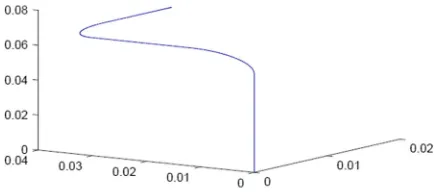
The data we use for our numerical experiments correspond to the EUR market on 27 May 2013 and were collected from Bloomberg; see also Grbac et al. (2015, §8.4) for more details. The affne LIBOR model with multiple curves was cali-brated to caplet data on a 10-year horizon, where the tenor lengths were 3 and 6 months. The driving affine process consists of three independent CIR processes. The sequences(uk)and(vk)were constructed so that they lie on a smooth manifold on IT ∩R3

0; see Fig. 3. In particular,uk lies on straight lines for k ∈ {0, . . . , k1} ∪

{k2, . . . , k3} ∪ {k4, . . . , N}and on elliptical segments fork∈ {k1+1, . . . , k2−1} ∪

{k3+1, . . . , k4−1}. The sequenceulooks as follows:

uN1 = (0 0 u¯N1)

.. .

uk4 = (0 0 u¯k4 )

uk4−1 = (0u˜k4−1 u¯k4−1)

uk4−2 = (0u˜k4−2 u¯k4−2)

.. .

whereu¯j,u˜j ∈R0and satisfyu¯j ≥ ¯uj+1andu˜j ≥ ˜uj+1for all relevantjK; see

(14) again. The structure of the sequencevxfor each tenorxis analogous. In other words, short-term forward LIBOR rates are driven by all three components of the

Fig. 3 The smooth manifold used for fitting the sequences

(23)

driving processX, medium term rates by two components, while long-term rates are only driven by the last component ofX. Once the manifolds have been constructed, the sequences(uk)and(vk)were obtained by fitting the model to OIS and EURIBOR

data from the same date. (Note that in this example we haveN =40 and we chose k1=9, k2=16, k3=21, andk4=28.)

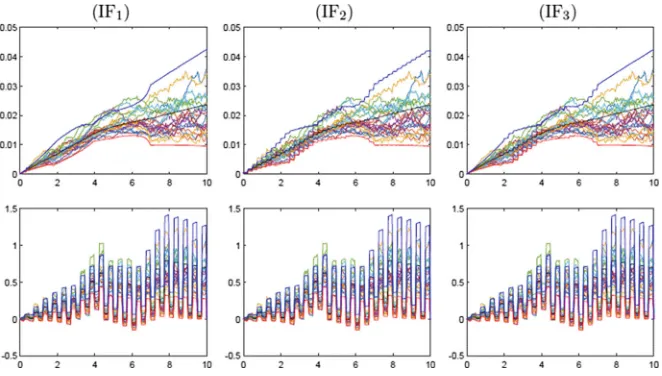
In order to illustrate the effect of different interpolating functions on the value adjustments, we consider three different specifications for the interpolating functionU:

(IF1): Interpolation by fitting an entire forward curve (see Example 1);

(IF2): Linear interpolation between theuk’s;

(IF3): Spline interpolation on sectors where all but one component of the vector

uk are constant ink, and linear interpolation in between these sectors (i.e.,

when theuk’s lie on curved segments of the manifold).

Let us now turn our attention to the computation of value adjustments. We consider a 3M-6M basis swap on the LIBOR, with inception att = 0 and maturity in 10 years. We follow Cr´epey et al. (2013) and consider five different CSA specifications, provided by

(CSA1): r, ρb, ρi=(0.4,0.4,0.4) , Q=P , =0,

(CSA2):

r, ρb, ρi=(1,0.4,0.4) , Q=P , =0, (CSA3): r, ρb, ρi=(1,1,0.4) , Q=P , =0,

(CSA4):

r, ρb, ρi=(1,1,0.4) , Q=, =0, (CSA5):

r, ρb, ρi=(1,0.4,0.4) , Q=P , =Q=P ,

while the default intensities and spreads equal

γb=5%, γi=7%, γ =10%, b= ¯b=λ=1.5%, and λ¯ =4.5%.

The first three CSA specifications correspond to a “clean” recovery scheme with-out collateralization, since the value of the contractQequals the clean price and there is no collateral posted. The fourth specification corresponds to a “pre-default” recovery scheme without collateralization, while the last one corresponds to a fully collateralized contract. Moreover, the first specification yields a linear BSDE in the VA, which allows to use (forward) Monte Carlo simulations for the computation of the VA.

The pricePt of the basis swap is provided by (35) for eacht ∈ [Tpx11, T x2 q2], and we can observe thatPt is a deterministic transformation ofXt. Moreover, the short

ratert is a deterministic, affine, transformation ofXt; cf. (26). Therefore, the VA

coefficientgt(rt, Pt, t)is also a deterministic transformation ofXt, and we can

define a deterministic functiongˆsuch that ˆ

g(t, Xt, t):=gt(rt, Pt, t).

In other words, the VA BSDE is Markovian in this case, and the VA is also pro-vided by the solution of a semi-linear PDE. In order to compute the VA for the basis swap numerically, we worked under the spot martingale measureP, using a space

(24)

ntl =E

ntl+1+hgˆtl+1, Xtnl+1, n tl+1

Xn tl

and ntn =0,

and approximated the conditional expectation using anm-nearest neighbors estimator withm=3. This choice turned out to be optimal when compared to (forward) Monte Carlo simulations in the case of a linear VA coefficient.

Discussion

The outcome of the numerical experiments is summarized in Figs. 4, 5 and 6. Starting with the top panel in Fig. 4, we observe that there are significant structural differ-ences in the dynamics of the short rate due to the different interpolating functions; this is mostly visible when looking at the averages and the percentile lines. The bot-tom panel in the same figure displays the price process of the 3M-6M basis swap for the different interpolating functions. As the differences are not as clearly visible as before, we have plotted the absolute differences in prices due to the different inter-polating functions in Fig. 5. There we see that notable differences in prices appear when using different interpolating functions (keep in mind, that the notional amount of the swap equals one, thus the deviations in prices are not negligible). As expected, the largest discrepancies between prices stemming from the first vs. second and the first vs. third interpolating functions occur on the curved section of the manifold used to construct(uk)and(vk). On the contrary, the discrepancies between prices from

the second vs. third interpolating functions on the curved section of the manifold are zero, since both functions interpolate linearly in that segment.

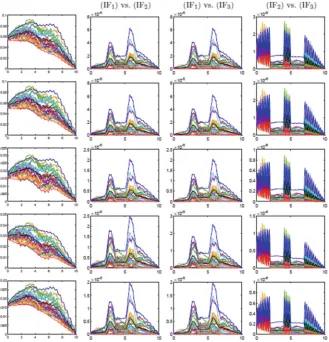
Figure 6 depicts the sample path of the VA process using the first interpolat-ing function (left panels) for the five different CSA specifications (top to bottom),

(25)

Fig. 5 Absolute difference between the basis swap price processes for different interpolating functions

Figure

Fig. 1 Twenty sample paths of the short rate whenfunction of time (computed over 10 X is the 1D CIR process, together with the mean as a5 paths)
Fig. 2 Twenty sample paths ofthe short rate together with the2.5/97.5 percentiles induced bya diagonal structure and acontinuously differentiableinterpolating function
Fig. 3 The smooth manifoldused for fitting the sequences(uk) and (vk)
Figure 6 depicts the sample path of the VA process using the first interpolat-ing function (left panels) for the five different CSA specifications (top to bottom),
+2

References

Related documents