https://doi.org/10.5194/jsss-8-171-2019
© Author(s) 2019. This work is distributed under the Creative Commons Attribution 4.0 License.
Inductive localization accuracy of a passive 3-D coil in an
Industry 4.0 environment
Rafael Psiuk1, Alfred Müller2, Daniel Cichon2, Albert Heuberger1, Hartmut Brauer3, and Hannes Töpfer3
1Information Technology with a focus on Communications Electronics (LIKE),
Friedrich-Alexander-Universität Erlangen-Nürnberg (FAU), Am Wolfsmantel 33, 91058 Erlangen, Germany
2Fraunhofer Institute for Integrated Circuits, Nordostpark 84, 90411 Nürnberg, Germany
3Advanced Electromagnetics, Technische Universität Ilmenau, Helmholtzplatz 2, 98693 Ilmenau, Germany
Correspondence:Rafael Psiuk ([email protected])
Received: 8 January 2019 – Accepted: 21 March 2019 – Published: 24 April 2019
Abstract. In this paper a localization system of a passive 3-D coil is proposed and signal uncertainties due to the 3-D coil’s arbitrary orientation are analyzed. The 3-D coil is excited by an alternating primary magnetic field. Geometrically distributed pick-up coils measure the 3-D coil’s secondary field. By means of a simulated look-up table that assigns expected voltages from the pick-up coils to the positions of the 3-D coil, the position of the 3-D coil is deduced by a least-squares approach. A basic assumption is that the secondary field is invariant to the orientation of the 3-D coil. This allows a reduction of the computational effort for the look-up table generation and the table search during the localization phase since for each position the field distribution for only one orientation has to be calculated. However, the assumption of invariance to rotation is only valid for a dipole model. In this paper we investigate the localization error introduced by this assumption when using 3-D coils with a geometric extent in an inhomogeneous primary field. Optimized localization methods that decrease the statistical error are proposed. The theoretical results are verified with measurements conducted on a laboratory system.
1 Introduction
Nearly every modern producing industry has a storage so-lution within their logistics process. The most flexible way for picking items from a shelf is still by human interaction. However, cost-intensive errors can occur when a storekeeper picks an item from the wrong shelf. It is important to pro-vide a technology that gives the operator feedback in case of a wrong pick. Several technologies already exist to sup-port the operator. In pick-by-light systems the shelf or con-tainer from which an item has to be picked is illuminated (Baechler et al., 2016). The pick-by-vision approach pro-vides the user with an augmented reality view of the storage using a head-mounted display (Schwerdtfeger et al., 2009; Guo et al., 2015). Solutions with scales below each container are proposed in KBS (2018a). Audio systems that guide the operator are described in Starner (2002). As an alternative or extension, camera-based systems can provide important
feedback to the operator in case of a wrongly picked item (KBS, 2018b). Such solutions, however, require a line of sight. Also, dirt, fog or bad lighting conditions from the harsh industrial environment can degrade the performance. The in-dustry needs a solution that can localize the hand of the op-erator in a robust and reliable way.
mul-tiple solutions or that the solution can be very sensitive to noisy data. In order to account for that, regularization tech-niques are used (Vogel, 2002).
Several methods exist for the estimation of the position and the orientation of a magnetic field source. The straight-forward approach to estimate the position of a field source is to compare a measured magnetic field distribution at several points in space to a theoretical field distribution that is calcu-lated by means of a mathematical model for a certain position and orientation of the field source. Analytical approaches as described in Nara et al. (2006) can estimate the position of a magnetic dipole with a magnetic moment whose norm is con-stant. This method is obviously based on a simple magnetic dipole model. Also, it is very sensitive to noise. In Neudeck et al. (2016) the position and orientation of a rectangular mag-net are estimated. Due to the rectangular shape of the magmag-net the model is more sophisticated and two additional degrees of freedom for the orientation can be estimated. A Levenberg– Marquardt optimization algorithm is used to optimize the fit between the theoretical field distribution from the model and the measured fields. An advantage of using an optimization-based approach is that not all possible combinations of po-sitions and orientations of the magnet need to be calculated. This comes with the risk of sticking to local solutions or even divergence of the estimate (Brauer et al., 2006). Of course, as proposed by Moreno and Skarmeta (2015) and Heinig et al. (2010) a set of measurements of a real field distribution can be used instead of a theoretical model. Such fingerprinting methods have their advantage when the field distribution is too complicated to be modeled mathematically, e.g., when too many constant disturbances are located in the area of in-terest. The disadvantage is that the method degrades as the environment changes. To still be able to localize the object, a new time-consuming measurement of the field distribution must be performed. Localizing an active coil over a distance in the meter range is presented in Arumugam et al. (2013). The applied model is again a dipole model but extended by a term that utilizes the influence of the soil on the magnetic field. The authors use a least-squares optimization algorithm to find the global solution.
All of the above methods need an active magnetic field source which they mostly approximate by a simple dipole model. In contrast, we utilize a passive field source, whose equivalent magnetic dipole moment is additionally position dependent. Furthermore the model we utilize is more so-phisticated and takes the geometry of the current paths into account. The approach we present in this paper is based on the GoalRef technology (Psiuk et al., 2014), which is a magnetic-field-based goal detection system for professional football. The FIFA (Fédération Internationale de Football Association)-certified technology measures the disturbance of an artificial magnetic field that occurs due to resonantly tuned coils built into the football. The traditional GoalRef system has been able to only detect transitions through the
goal plane without providing further information about the ball’s position.
For the adaption of that technology to our localization ap-proach for logistics, the new proposed system is extended with the ability to localize a passive 3-D coil in three space dimensions in the proximity of a shelf. Therefore a primary current loop is positioned around that shelf, which generates a primary magnetic field. The field induces a current in a pas-sive resonantly tuned 3-D coil that is mounted on the hand of the operator. That current flow in turn generates a secondary magnetic field that is measured by pick-up coils around the shelf. From voltage measurements at these pick-up coils the position of the 3-D coil is deduced by utilizing a look-up ta-ble that is generated by the forward model presented in Psiuk et al. (2017a). Since only the position of the hand and not its orientation is of interest, three perpendicular passive coils are used as a localization object instead of a single coil. By doing this the dependence of the secondary field on the orientation of the hand is reduced drastically. However, the dependence is not completely removed and still influences the localiza-tion result. Neither to what extent the measured fields are in-fluenced by the arbitrary orientation nor how in a subsequent step that uncertainty in the measured signals affects the local-ization has been investigated yet. In this paper we investigate the remaining localization error due to the orientation depen-dence of the measured field. First we identify the sources of signal uncertainty. Then we quantify their contribution to the overall signal variation analytically. Afterwards the localiza-tion error due to those signal uncertainties is compared for different localization methods. For reduced complexity the investigations are carried out on a simplified setup for a 1-D position estimation.
The paper is structured as follows. In Sect. 2 the system and the general localization method are presented. The un-certainty of the measured magnetic field due to the orienta-tion of the hand is derived in Sect. 3. In Sect. 4 several local-ization methods are introduced. The theoretical accuracy of different localization approaches is compared through simu-lations in Sect. 5. Measurements that verify the simusimu-lations are shown in Sect. 6. The results are discussed in Sect. 7, and Sect. 8 concludes the paper.
2 Employed methods
In this section the experimental system setup and the basic localization method are explained.
2.1 Experimental setup
Figure 1.Shelf with the exciter wire, eight pick-up coils around the shelf and a 3-D coil in one compartment.
Figure 2.3-D coil with three passive resonantly tuned individual windings.
passive coils as shown in Fig. 2. The passive coils are tuned by means of capacitors to form a resonant circuit whose reso-nance frequency coincides with the excitation frequency. Due to Faraday’s law a voltage and hence a current flow are in-duced in the three coils. That current leads to a secondary magnetic field that is measured with pick-up coils mounted around the shelf. The measured field from the pick-up coils is then led back to the reader, where analog and digital sig-nal processing is performed. The processed sigsig-nals are for-warded to a personal computer where the position estimation algorithms are running in the Python programming language (Psiuk et al., 2017b).
2.2 Proposed localization method
Different optimization algorithms as described in Sect. 1 might show varying behavior concerning convergence
to-wards the global solution. Therefore the localization accu-racy would depend on the particular method being used. In our investigations we are interested in the accuracy indepen-dent of the specific algorithm in use. As a basis localization method we therefore localize by means of a global search in a look-up table containing simulated field values. Measured field values are compared to the entries in the table. That par-ticular position and orientation entry in the table is selected as an estimate whose corresponding field values show the best agreement with the measured field values using a least-squares approach as proposed by Arumugam et al. (2013). The table is created to contain field values for positions of the localization object in a regular grid with a sufficiently high resolution not to influence the results of our analyses.
In our system the magnetic field strength of the localiza-tion object depends on the object’s posilocaliza-tion and orientalocaliza-tion. Thus, a sophisticated mathematical system model is needed to address that behavior. Such a model has been presented in Psiuk et al. (2017a). Using the law of Biot–Savart, the model is capable of calculating the magnetic flux density vector field and the magnetic vector potential of arbitrarily shaped current-carrying wire constellations. The model can also calculate induced voltages in closed loops and hence the induced current in arbitrarily shaped coils, based on the law of Faraday and the previously calculated vector fields. On the basis of these operations the induced voltages in pick-up coils around the shelf can be calculated for a series of posi-tions and orientaposi-tions of the localization object and hence the localization look-up table described above can be generated. If only a single coil was mounted on the localization ob-ject, a look-up table would need to include three entries for three dimensions of position and two dimensions of orienta-tion. The third rotational degree of freedom is omitted due to rotation symmetry of a circular coil. Such a table with a fine enough grid to provide a good estimation accuracy to be gen-erated in practice would require a high computational effort. Also, searching the whole table for the globally best solution with each localization step would take a long time, which makes real-time applications difficult. Another disadvantage of localizing only one passive coil in a primary magnetic field is that for any coil position there are orientations at which the coil is orthogonal to the primary field and hence cannot de-velop a secondary field. A localization would not be possible in such a case.
ef-fort in searching in it. Another advantage is that at least one of the three coils always produces a secondary magnetic field at any position independent of the orientation.
3 Orientation-induced uncertainty of the secondary magnetic field
The reduced-complexity method described in Sect. 2.2 relies on the assumption that the secondary field of the 3-D coil system does not depend on its orientation. However, this is only approximately true. In this section we investigate the theoretical accuracy degradation due to this model simplifi-cation. First, the basic assumption of the theoretical rotation invariance of the secondary field is proven for three orthog-onal dipoles in a homogeneous primary field. Then the con-tributions of the 3-D coil’s geometry and the primary field’s inhomogeneity to the voltage distribution in a pick-up coil are investigated.
3.1 Orientation-independent secondary magnetic field This section verifies analytically the assumption of the rotation-invariant secondary equivalent magnetic dipole field of a 3-D coil in a homogeneous primary magnetic field. In the following, complex values are underlined, the hat super-script stands for a peak value and the supersuper-scripts l and g on variables indicate the coordinate system in which they are ex-pressed, where l stands for the local coordinate system of the moving 3-D coil and g for the fixed global coordinate system. Let us assume a system comprising three orthogonal cir-cular coils, all with the same radiusa andN windings. The center of each coil is in the global coordinate system’s origin. In the initial state the local and global coordinate systems co-incide. The equivalent area normal vectorsSi of the planes spanned by each coil are
Sli=N π a2eli with i∈ {1,2,3}, (1)
whereel
i are the unity direction vectors of each of the three area normal vectors. The area normal vectors of the coils point each to one of the three positive local Cartesian co-ordinatesx,y andz. The area normal vector of coil 1 points in thex direction, the one of coil 2 points in they direction and the one of coil 3 points in the z direction of the local coordinate system:
el1= 1 0 0T, el2= 0 1 0T, el3= 0 0 1T.
(2)
We assume a homogeneous primary magnetic flux density Bgpwith a peak value ofBˆ
g
p, which, without loss of
general-ity, points in the globalzdirection:
ˆ
Bgp= 0 0 Bˆ z
T
. (3)
With the three rotation matrices
Rx(8)=
1 0 0
0 cos(8) sin(8) 0 −sin(8) cos(8)
,
Ry(2)=
cos(2) 0 −sin(2)
0 1 0
sin(2) 0 cos(2)
,
Rz(9)=
cos(9) sin(9) 0 −sin(9) cos(9) 0
0 0 1
, (4)
and their combination
R(9, 2, 8)=Rx(8)·Ry(2)·Rz(9), (5)
the 3-D coil’s local coordinate system can be rotated in space against the global coordinate system. First the local coordi-nate system is rotated around the globalzaxis by the angle9
(yaw), and then it is rotated around theyaxis of the new local coordinate system by the angle2(pitch) and finally around thexaxis of the new local coordinate system by the angle8
(roll). Applying Eq. (5) to Eq. (3), the primary magnetic flux density vector field can be expressed in local coordinates as
ˆ
Blp(9, 2, 8)=R(9, 2, 8)· ˆBgp. (6)
The primary magnetic flux8ˆi through each of the three coils can be calculated by
ˆ
8i(9, 2, 8)= ˆBlp(9, 2, 8)·Sli. (7)
According to Faraday’s law of induction, the resulting in-duced current flowˆiiin each of the coils is
ˆ
ii(9, 2, 8)=−j2πf ˆ
8i(9, 2, 8)
Z , (8)
wherej is the imaginary number,f is the frequency of the time-varying fieldBgp andZ is the complex impedance of the coil (Lehner, 2010). With the currentsˆii the equivalent magnetic dipole momentmˆgof the 3-D coil can be calculated by
ˆ
mg=R−1
3 X
i=1 ˆ mli=RT
3 X
i=1 ˆ
mli with mˆli = ˆiiSli. (9)
Since rotation matrices are orthogonal matrices, their inverse R−1 is also their transpose RT (Bronshtein et al., 2004).
Solving Eq. (9) shows that the magnetic dipole momentmˆg does not depend on any of the orientation angles9,2and
8:
ˆ mg=
0 0 −j2π3fBˆzN2a4
Z
T
The secondary magnetic flux density Bˆgd of the 3-D coil modeled as a dipole can be calculated at the position rg= (x, y, z)Tby
ˆ
Bgd(mˆg,rg)=µ0 3( ˆ
mg·n)n− ˆmg
4π r3 , (11)
whereµ0is the vacuum permeability,r= |rg|andn=rg/r
(Nara et al., 2006). Inserting Eq. (10) into Eq. (11) results in the orientation-invariant secondary magnetic flux density
ˆ Bgd=j a
4Bˆ
zf N2µ0π2
2Z
−3xz r5
−3yz r5
x2+y2−2z2
r5
. (12)
Equation (12) shows that, assuming a homogeneous primary magnetic field and a magnetic dipole model for the individual coils, the orientation of the 3-D coil has no influence on the secondary magnetic field distribution.
3.2 Coil-geometry-induced secondary field uncertainty In the practical case two assumptions made in Sect. 3.1 do not apply; on the one hand coils do have a certain physical extent in contrast to theoretical magnetic dipoles and on the other hand the primary field is not necessarily homogeneous. In order to analyze both assumptions separately we first keep the assumption of a homogeneous primary magnetic field but replace the dipole model with a circular coil model. For the calculation of the induced currentsˆii, Eq. (8) can still be ap-plied. The secondary magnetic flux densityBˆlcof a circular loop that is centered and aligned with the coordinate system axes differs from the field of a dipole as described by Simp-son et al. (2001):
ˆ Blc=
ˆ
Blc,x
ˆ
Blc,y
ˆ
Blc,z
, (13) with ˆ
Blc,x= µ0 ˆ
iixz
2π α2βρ2 h
a2+r2Ek2−α2Kk2i, (14)
ˆ
Blc,y=y ˆ
Blc,x
x , (15)
ˆ
Blc,z= µ0 ˆ
ii
2π α2β h
a2−r2Ek2+α2Kk2i, (16)
and
ρ2=x2+y2, (17)
r2=x2+y2+z2, (18)
α2=a2+r2−2aρ, (19)
β2=a2+r2+2aρ, (20)
k2=1−α2/β2, (21) including the complete elliptical integrals of the first and sec-ond kindsK(·) and E(·), respectively. The secondary field
ˆ
Bgci of each rotated coilci at the global position r can be calculated by
ˆ Bgc
1= Ry(π/2)·R
TT · ˆBlc
1 Ry(π/2)·R
T·r
, (22) ˆ
Bgc
2= Rx(−π/2)·R
TT · ˆBlc
2 Rx(−π/2)·R
T·r
, (23) ˆ
Bgc
3=R· ˆB
l c3 R
T·r
. (24)
For the secondary magnetic flux density of a circular 3-D coil follows
ˆ Bgc= ˆBgc
1+ ˆB
g c2+ ˆB
g
c3. (25)
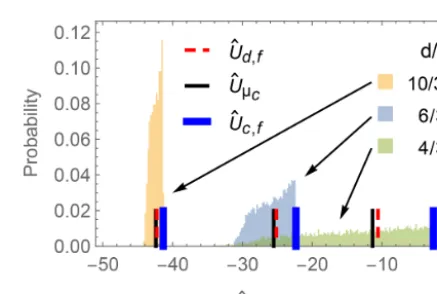
Inserting Eq. (8) into Eq. (25) results in a generally rotation-dependent secondary magnetic flux density. With 10 000 ran-domly generated rotation angles as described in Appendix A, the induced voltages in a z-oriented pick-up coil with an equivalent area ofA=0.4×0.02 m2andNA=20 windings
at the positiond=(0, d,0)Tm can be calculated using the model from Psiuk et al. (2017a). Since the geometry of the pick-up coil is not of interest in this investigation, the induced voltages| ˆUz|are calculated by multiplying thezcomponent of the magnetic flux densityBˆgcby the equivalent areaA. The statistical distributions of the logarithmically scaled induced voltages| ˆUz|are shown in Fig. 3 for a 3-D coil with radius
a=0.03 m in a homogeneous primary field| ˆBgp| =1 µT for three distancesd. Additionally, three special voltage values are noted for each distribution: the expected valueUˆµcusing
the random rotation angles and a circular 3-D coil model, the value of the voltageUˆdfor a dipole model and the voltage
ˆ
Uc,ffor the model of a circular 3-D coil with a fixed
orienta-tion that is aligned with the global coordinate axes. It can be seen that the induced voltage from the dipole modelUˆdand
the expected value from the circular coil modelUˆµccoincide.
The voltage value for the circular coil model in fixed orien-tationUˆc,fcorresponds to the maximum pick-up coil voltage
possible at a given positiond.
Figure 3.Simulated distributions of the induced voltage| ˆUz|in a pick-up coil for arbitrary 3-D coil orientations with radiusaat three selected ypositions at a distancedbetween the 3-D coil and the pick-up coil, in a homogeneous primary fieldBˆgp.
As a primary field source the rectangular exciting loop from the shelf described in Sect. 2.1, with side lengths of 79 cm and a peak current ofˆip=1 A, is defined. The origin
of the coordinate system is in the middle of the upper ex-citer wire where thez-oriented pick-up coil position is also defined. Again, the pick-up coil is modeled as an infinitely small pick-up coil with the same equivalent area A from Sect. 3.2. For various positions d=(0,−d,0)T of the 3-D coil the current in each of the three coils is simulated with the Python model. Those currents are utilized for the further analytical calculation of the equivalent magnetic dipole mo-ment and afterwards of the secondary magnetic flux density based on the dipole model Eq. (11). Finally the induced volt-ages in the pick-up coil are evaluated at each position for 1000 random orientations in order to obtain a realistic distri-bution. The simulated distribution of the induced voltage in the presence of an inhomogeneous primary field can be seen in Fig. 4.
Comparing Fig. 4 with Fig. 3 shows the rotation-induced voltage variance due to an inhomogeneous primary field is smaller than due to the geometrical extent of a 3-D coil.
3.4 Combined uncertainty of the secondary field The overall effect that takes both the inhomogeneity of the primary field as well as the geometric extent of the 3-D coil into account is again investigated using the Python simula-tion model. The calculasimula-tions from Sect. 3.3 are repeated with a circular 3-D coil model as the secondary field source. The resulting voltage distribution at three selected distancesd is shown in Fig. 5. The behavior is very similar in both the in-homogeneous and in-homogeneous primary field cases, as long as a 3-D coil with geometric extent is assumed. This implies that the effect of the coil geometry impacts the voltage vari-ance more strongly than the effect of the primary field in-homogeneity. In addition to the valuesUˆµc andUˆc,f, which
Figure 4.Simulated distributions of the induced voltage| ˆUz|in a pick-up coil for arbitrary orientations of a 3-D dipole at three se-lected distancesdbetween the dipole and the pick-up coil, in the presence of an inhomogeneous primary field generated by the ex-citer wire.
Figure 5.Simulated distributions of the induced voltage| ˆUz|in a pick-up coil for a circularly modeled 3-D coil with radiusain ran-dom orientations at three selected distancesdbetween the 3-D coil and the pick-up coil in an inhomogeneous primary field generated by the exciter wire.
have already been introduced in Sect. 3.2, the valueUˆd,ffor a
dipole model with a fixed orientation, which is aligned with the global coordinate axes, is noted in the figure.
In order to be able to compare the contribution of the two individual effects to the overall voltage variances, the vari-ance coefficientcintroduced by Nelson (2012) is chosen as a figure of merit:
c=σ
µ, (26)
Figure 6. Simulated variance coefficient of the induced voltage
| ˆUz|in a pick-up coil for a randomly oriented 3-D coil and a 3-D dipole over the relative positiond/ain a homogeneous primary field and an inhomogeneous primary field.
shown in Fig. 6 incomparable, since they are based on differ-ent primary field strengths.
In Fig. 6 the logarithmically scaled variance coefficient is shown at each distancedof each of the previously calculated combinations of the primary field and coil model. The dis-tance of the 3-D coil to the pick-up coil is written in a ratio of distancedto coil radiusa=0.03 m. At the distancesd/a=0 andd/a=25 the exciter wire is positioned. The figure shows an increased effect of the inhomogeneous primary field near the exciter wires as it affects the induced currents in the 3-D coil. With increasing distance to the pick-up coil the effect of the coil geometry decreases as the circular coil field from Eq. (13) converges towards a dipole field as in Eq. (11) with growing distanced/a. Finally, the combined effect is shown for a circular 3-D coil in an inhomogeneous primary field. Only far from the pick-up coil when the 3-D coil approaches the other side of the shelf, and hence the exciter wire, does the inhomogeneous primary field dominate the variance co-efficientc. For values ofd/a <15,cis only slightly higher for the 3-D coil in the inhomogeneous primary field than in the homogeneous case.
4 Comparison of localization methods
In this section six localization approaches are introduced, which are later compared by means of simulations and mea-surements in Sects. 5 and 6, respectively. The goal is to es-timate the distanced between a 3-D coil and a pick-up coil based on the measured voltage U0 induced in the pick-up
coil. The primary magnetic field is assumed to be generated by the exciter wire as described in Sect. 2.1 and thus to be inhomogeneous.
The estimators presented in the following can be divided into two categories. Stochastic estimators are built upon the statistical distribution of pick-up coil voltages at each
dis-Figure 7.ProbabilityP(U|d) of the pick-up coil voltage| ˆUz|due to a 3-D coil in an inhomogeneous primary field.
tanced, while table-based estimators only assign a single voltage for each distance.
4.1 Stochastic estimators
Figure 7 shows the probabilityP(U|d) of the induced pick-up coil voltage| ˆUz|, abbreviated as U in the following, for each relative distanced/a. This distribution is based on the calculations in Sect. 3.4, where a 3-D coil is positioned in the inhomogeneous primary field of the shelf from Fig. 1. Areas with darker colors in the figure indicate a higher probability of occurrence of a particular voltageUat the corresponding distanced/a.
The estimators described in this subsection are based on this distribution, which is computationally very expensive to acquire. For each position (or distance in the 1-D case) a large numberNRof random orientations must be considered
to obtain a probability density function of satisfying accu-racy. In our case NR=900 orientations per distance were
chosen.
4.1.1 Maximum likelihood estimator
When choosing a fixed voltageU0, the probability function
from Fig. 7 can also be regarded as a likelihood function
L(U0|d):=P(U=U0|d) slicing horizontally through the
graph withd as a parameter. The maximum likelihood esti-mate (MLE) selects that distancedˆMLEas an estimate, which
maximizes the likelihood functionL(U0|d) as described by ˆ
dMLE(U0)=arg max
d
{L(U0|d)}. (27)
Having exact knowledge of the probability distributions, using an MLE is a common approach. However, if the dis-tributions do not reflect the reality, the MLE will not provide optimal results.
4.1.2 A posteriori mean estimator
Another possible estimator is the a posteriori mean (APM) ˆ
derived by means of Bayes’ law combining the likelihood functionL(U0|d) with some prior knowledgeP(d) about the
distribution ofdaccording to
h(d|U0)=
L(U0|d)P(d)
R∞
−∞L(U0|d0)P(d0)dd0
. (28)
The prior knowledge term P(d) can be used to exclude certain unrealistic positionsd; e.g., if the space around a spe-cific position is obstructed by obstacles, the localization ob-ject cannot be placed there. Also, previous knowledge of the 3-D coil’s position can be included in the prior to implement a stochastic filter (e.g., a Kalman filter or a particle filter) tracking the 3-D coil (Simon, 2006). Finally, the APM esti-mator is the statistical mean ofh(d|U0) obtained by
ˆ
dAPM(U0)=
∞ Z
−∞
d0h(d0|U0)dd0. (29)
This estimator is expected to have the smallest mean squared error.
4.1.3 A posteriori median estimator
The third estimator is the median of the a posteriori distri-bution from Eq. (28). It is obtained by solving the following equation:
h(d|U0)=
ˆ dMED
Z
−∞
h(d|U0)dd0=0.5. (30)
This estimator is expected to have the least absolute error in the estimate. Besides the mean and the median of the a posteriori distribution from Eq. (28), the mode of it forms the maximum a posteriori estimator (MAP). It is neglected here, since for a uniformly distributed a priori probabilityp(d), as in case of this paper, the MLE and the MAP are identical.
4.2 Table-based estimators
The precomputation of the distributionsP(U|d), required for the estimatorsdˆAPManddˆMLE, can be avoided by only
cal-culating one single forward solution for the induced voltage in the pick-up coilUiat each distancedi. The resulting pairs can be stored in the look-up table described in Sect. 2.2. The table is organized in rows i, each containing a value for di and the corresponding theoretical value for the voltage Ui. When localizing, the measured voltage valueU0can then be
compared to all voltage entriesUi in the look-up table. The distance di0 in the rowi0 is selected as the estimate dˆ, for which the squared difference between the measured voltage
U0and the table entryUi0is smallest: ˆ
d(U0)=di with i=arg min i0
(Ui0−U0)2. (31)
In the precomputation phase only one instead ofNRmodel
evaluations is required, obviously reducing time complexity by a factor ofNRat the same distance resolution.
For practical setups with more than one pick-up coil a suit-able metric needs to be selected for the comparison opera-tion. A simple choice is the sum of the squared differences, i.e., the square of the Euclidean distance. However, as the in-duced voltage in the pick-up coils is a highly nonlinear func-tion of the 3-D coil’s posifunc-tion, the Euclidean distance is of-ten a suboptimal choice. It of-tends to put the highest weight on the largest pick-up coil voltages, which unfortunately are the ones with the largest coefficients of variation, as shown in Sect. 3. Investigation of that topic is reserved for future work.
In the following several possibilities for the forward solu-tionUi are described.
4.2.1 Fixed-orientation dipole model
A simple approach to a forward solution for Ui is based on the dipole model (Eq. 11). For each distancedi the cor-responding induced voltage Ui= ˆUd,f is calculated via the
dipole model with fixed orientation in the z direction, as also described in Sect. 3.4 and shown in Fig. 5. We call the corresponding distance estimatedˆd,f. The advantages of this
model are its simplicity and therefore small calculation time.
4.2.2 Fixed-orientation coil model
A second possible forward solution approach is to calculate the induced voltageUi= ˆUc,ffrom a circular 3-D coil with
a fixed orientation in thezdirection, as also shown in Fig. 5. We call the corresponding distance estimate dˆc,f. This
ap-proach is slightly more expensive in terms of calculation time as we need to use the model described in Sect. 3.2 for the magnetic field of a circular loop instead of the closed-form dipole model.
4.2.3 Mean voltage coil model
Accepting a higher computational effort, we can also cal-culate the induced voltages for many different orientations of the 3-D coil for each position di and take the mean of the attained voltage distribution. This corresponds to using
Ui =µcfrom Fig. 5 for each table entry. We call the
corre-sponding distance estimatedˆµc.
5 Simulation of the localization error
Figure 8.Simulated mean localization error at different positionsd of six localization methods.
again. We select the simulated positionsdtalong a linear tra-jectory in thex–yplane running from the middle of a pick-up coil perpendicular to the exciter wire at that point towards the inside of the shelf. In this case, because of the symmetry of the shelf setup, all pick-up coils behave the same. Hence, the selection of a specific one can be done arbitrarily. The step size between the individual positionsdt is set to 1 mm. For the statistical analysis, m=100 orientations are randomly selected at each position dt. At each orientation of the 3-D coil the induced voltage in the pick-up coil is calculated and Gaussian noise with a standard deviation of 325 nV is added. This is the noise level we see in our practical shelf setup. The mapping of the noisy calculated voltages Ucalc to the
esti-mated distancesdˆis done with each localization method de-scribed in Sect. 4 according to Eqs. (27), (29), (30) and (31). For the APM estimator a uniform prior knowledge of P(d) is used. At each actual position dt the mean absolute error err(dt) of the particular localizers’ estimates is calculated as
err(dt)= 1
m
m X
n=1
| ˆdt,n−dt|. (32)
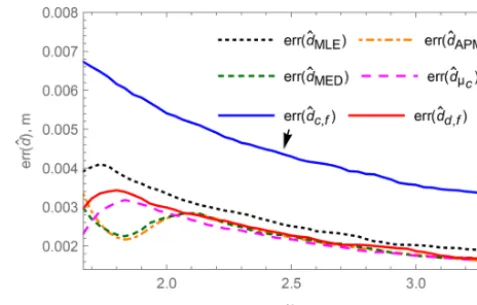
The results of the simulation are shown in Fig. 8 and are zoomed in for small distancesdin Fig. 9. It can be observed that at positions of the 3-D coil close to the pick-up coil, the estimators dˆµc,dˆd,f,dˆMED anddˆAPM provide smaller
local-ization errors than thedˆMLEanddˆc,festimators. At relative
distances of approximately d/a=15 and more the estima-tors generate similar localization errors. At these distances the simulated noise in the pick-up coil voltage starts to be the dominant contributor to the estimation error. The influence of the primary field’s inhomogeneity as well as the geometrical extent of the 3-D coil become negligible.
Especially in Fig. 9 the estimation errors around the rela-tive distancesd/a=1.7 show contradictory tendencies. The table-based methods dˆµc,dˆd,f as well asdˆMLE start with a
lower localization error which first rises with increasing dis-tancesd but then falls again, whereasdˆMED anddˆAPMhave
Figure 9.Simulated mean localization error at different positionsd of six localization methods for small relative distancesd/a.
a valley of decreasing error around a relative distance of
d/a=1.85.
The explanation of those effects can be found when look-ing at the individual estimators’ mapplook-ing functions of mea-sured voltages| ˆUZ|to estimated distancesdˆ. In Fig. 10 the mapping of the stochastic estimators and in Fig. 11 the map-ping of the table-based estimators are shown. In both figures the probability distributionP(U|d) of the voltage | ˆUz| at a given distancedis overlaid.
Except for the dˆAPM estimator, which has a continuous
mapping, the estimators map ranges of voltages to distinct distances in the previously calculated 1 mm grid. The volt-age ranges of the estimators at a particular distance provide an indication of the expected localization error. The broader the voltage range, the lower the position estimation error at that particular distance. However, that comes with the cost of a less broad voltage range, and therefore with a higher local-ization error, at other distances. Not only the voltage range at the particular distance influences the localization error, but also the position and the steepness of the mapping function. As can be seen in Fig. 11, thedˆc,festimator provides a biased
estimate. The influence of the steepness can be seen between thedˆMED and the dˆMLE estimator: although the dˆMLE
esti-mator has a broader voltage range at the lowest distance, its mapping function is steeper and therefore its localization er-ror is higher than the one from thedˆMEDestimator.
6 Measurements
Figure 10. Mapping of the measured voltage | ˆUZ| to the esti-mated distance dˆ for the stochastic estimators dˆAPM,dˆMED and
ˆ
dMLEoverlaid with the normalized voltage probability distribution
P(U|d) at any given distanced.
Figure 11.Mapping of the measured voltage| ˆUZ|to the estimated distancedˆfor the table-based estimatorsdˆc,f,dˆd,fanddˆµcoverlaid
with the normalized voltage probability distributionP(U|d) at any given distanced.
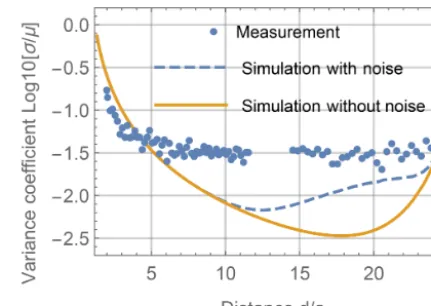
coefficient, as defined in Eq. (26), has been calculated and is compared to a simulated variation coefficient in Fig. 12. One simulation is made without noise and the other is cal-culated with an additive Gaussian noise of 325 nV, which has been measured in the reader. As expected, the measured voltage variation decreases with the distancedbut increases slightly from a distance of approximately d/a=20 again due to the inhomogeneity of the primary field due to the opposite exciter wire. In the middle of the shelf the varia-tion coefficient based on the measured voltages shows a con-stant plateau which is induced by the dominating effect of the Gaussian noise and positioning errors of the manually con-ducted measurements. At the normalized distance between
d/a=12 andd/a=14 no measurements could be taken, since a shelf plank was in the way.
In a second analysis the estimators defined in Sect. 4 have been applied to the measurement data. For each estimator the localization error has been calculated and is shown in Fig. 13. Comparing Fig. 13 with the simulated localization error in Fig. 8 shows that close to the pick-up coil all estima-tors perform worse and the localization errors decrease with increasing distance d. From a relative distance ofd/a=6 in the measurement and a relative distanced/a=10 in the
Figure 12.Measured logarithmic variation coefficientcof induced voltageUˆzin a pick-up coil for an arbitrarily oriented 3-D coil at different positionsd.
Figure 13.Measured mean localization error at different positions dof five localization methods.
simulation, the localization errors increase due to noise. Po-sitions farther than d/a=16 are not analyzed since ambi-guity arises due to the increasing measured voltage closer to the opposite exciter wire. Measurements show that close to the pick-up coil the estimator based on the 3-D coil with fixed orientationdˆc,ffrom Sect. 4.2.2 shows the highest error
and the maximum likelihood estimatordˆMLEfrom Eq. (27)
shows the second worst performance, which is in accordance with the simulation results in Fig. 9. The remaining estima-tors show similar results. At positions farther thand/a=7, where the Gaussian noise and the positioning error of the measurement setup are dominant, all estimators show equal behavior.
7 Discussion
all estimators. Close to the pick-up coil the maximum likeli-hood estimatordˆ
MLEand the estimator based on the forward
model with the fixed coil positiondˆc,fare not recommended.
Throughout the analyzed region the a posteriori mean esti-matordˆAPM, the a posteriori median estimatordˆMED, the
es-timator based on the fixed oriented dipole modeldˆd,fand the
estimator based on the mean voltage of the arbitrarily rotated 3-D coildˆµcshow equally low localization errors. However,
from those four estimators the fixed oriented dipole model has the least computational effort due to the simple model and is therefore recommended.
Using more distributed pick-up coils and extending the 1-D localization to a 2-D or 3-D localization may have in-fluence on the performance of the individual estimators. In contrast to the other estimators the stochastic estimators can include a priori knowledge, like not accessible positions due to the geometry of the shelf or due to the last known position combined with a movement model of the localization object. A weighting of the pick-up coil signals based on the signal-to-noise ratio may also be applied in the future.
The differences between the simulation and the measure-ments arise from the sensitive manual measurement setup, where the exact positioning of the 3-D coil is difficult. A big influence on the results may arise from different electrical and geometrical characteristics of the 3-D coils. In the sim-ulations geometrically and electrically identical coils were assumed. However, in reality different coil areas, different qualities of the resonance as well as the exact resonance fre-quency itself have a huge influence on the amplitude of the secondary field strength of each of the three coils of the 3-D coil. On the one hand using high quality for the resonant cir-cuit of the coil provides a higher current and hence a stronger secondary field. On the other hand a high-quality resonant circuit is very sensitive to the surrounding and may be de-tuned easily. A detuning of the resonance frequency leads to a drop in the field strength of that coil. It is assumed that this effect has a big influence on the localization accuracy and will therefore be investigated in the future.
8 Conclusion
In this paper the uncertainty of the field distribution from an arbitrarily oriented 3-D coil in a primary magnetic field is investigated analytically. The sensitivity of the field distribu-tion against two effects, the inhomogeneity of the primary field and the geometrical extent of the 3-D coil, is presented. Three stochastic and three non-stochastic position estimators are proposed. Their theoretical absolute mean estimation er-rors are compared by simulations. Finally measurements on a laboratory setup for inductive localization are conducted to verify the field variation as well as the localization errors of the individual estimators. It is shown that from a certain dis-tance between the field sensor and the 3-D coil, the effects of the field distribution on the localization error can be ne-glected. Future work will comprise analyses of the influence of the characteristics of the individual coils from the 3-D coil on the field distribution as well as the influence of the geo-metrical extent of the field sensors.
Appendix A: Generation of random orientations
For an uncertainty analysis of the rotation effect on the in-duced voltages in the system’s pick-up coils, arbitrary orien-tations of the 3-D coil have to be calculated. It is convenient to regard the two rotation angles9 and2as azimuth angle
φ and zenith angle θ of the spherical coordinates with the defined ranges of 0≤φ <2π and 0≤θ < π, respectively. In order to get equally distributed arbitrary orientations, one can think of equally distributed points on the surface of a unit sphere, based on variations of the two spherical angu-lar coordinatesφandθ. The third rotation angle8can then be uniformly distributed between 0 and 2π. Selecting the two spherical angles from a uniform distribution results in an aggregation of surface points at the poles of the sphere around thezaxis (Weisstein, 2018). Therefore a combination of methods described in Marsiagla (1972) and Arvo (1992) is applied to receive arbitrary orientations. Thereby firstly a set of random points
PC=(xj, yj, zj)T | j=1. . .N ⊆[−1,1]3 (A1)
from a uniform distribution within the volume of a cube is generated. The values of x,y andz lie within the interval of [−1;1] each. From that set of points those are selected that lie within the volume of a unit sphere and are further projected onto the sphere’s surface by
Psph=
(x, y, z)T
d | (x, y, z)
T∈P C
with d= q
x2+y2+z2<1
. (A2)
The resulting set of Cartesian position vectorsPsphis equally
distributed on the sphere surface. Those points can be trans-formed into spherical coordinatesθandφby
θ=arctany
x, (A3)
φ=π
2 −arccosz, (A4)
and can be interpreted further as the rotation angles 9 and
Author contributions. RP, AM and DC generated the main out-comes presented in this article. HB checked the structure and con-tent of the article. HT and AH are supervising the corresponding field of research.
Competing interests. The authors declare that they have no con-flict of interest.
Acknowledgements. The authors would like to thank
Jörg Robert for his scientific advice, Ibrahim Ibrahim for fruitful discussions and Carina Schmitz for the support during the measurements.
Review statement. This paper was edited by Rosario Morello and reviewed by two anonymous referees.
References
Arumugam, D., Griffin, J., and Stancil, D.: Magneto-Quasistatic Tracking of an American Football: A Goal-Line Measurement, IEEE Antenn. Propag. M, 55, 137–146, 2013.
Arvo, J.: Fast random rotation matrices, in: Graphics Gems III (IBM Version), Academic Press, Cambridge, USA, 117–120, 1992. Baechler, A., Baechler, L., Autenrieth, S., Kurtz, P., Hoerz, T.,
Hei-denreich, T., and Kruell, G.: A Comparative Study of an As-sistance System for Manual Order Picking – Called Projection – with the Guiding Systems Paper, Pick-by-Light and Pick-by-Display, 2016 49th Hawaii International Con-ference on System Sciences (HICSS), Koloa, USA, 5–8 January, 523–531, 2016.
Brauer, H., Haueisen, J., and Ziolkowski, M.: Verification of mag-netic field tomography inverse problem solutions using physical phantoms, 6th International Conference on Computational Elec-tromagnetics, Aachen, Germany, 4–6 April, 225–226, 2006. Bronshtein, I., Semendyayev, K., Musiol, G., and Mühlig, H.:
Hand-book of Mathematics, 4. edn., Springer, Berlin Heidelberg, Ger-many, 2004.
Guo, A., Wu, X., Shen, Z., Starner, T., Baumann, H., and Gilliland, S.: Order Picking with Head-Up Displays, Computer, 48, 16–24, https://doi.org/10.1109/MC.2015.166, 2015.
Heinig, M., Bruder, R., Schlaefer, A., and Schweikard, A.: 3-D Lo-calization of a Thin Steel Rod Using Magnetic Field Sensors: Feasibility and Preliminary Results, 4th International Confer-ence on Bioinformatics and Biomedical Engineering (iCBBE), Chengdu, China, 18–20 June, 11510040, 2010.
KBS Industrieelektronik GmbH: Pick by Balance, For even faster and more accurate picking performance, available at: https:// www.kbs-gmbh.de/en/systems/pick-by-balance (last access: 14 June 2018), 2018a.
KBS Industrieelektronik GmbH: Intervention monitoring with PickTerm Sentinel, For zero error picking, available at: https:// www.kbs-gmbh.de/en/systems/pickterm-sentinel (last access: 14 June 2018), 2018b.
Lehner, G.: Electromagnetic field theory for engineers and physi-cists, Springer-Verlag, Berlin Heidelberg, 659 pp., 2010. Marsaglia, G.: Choosing a Point from the Surface of a Sphere, Ann.
Math. Statist., 43, 645–646, 1972.
Moreno, M. and Skarmeta, A.: An indoor localization system based on 3-D magnetic fingerprints for smart buildings, The 2015 IEEE RIVF International Conference on Computing Communi-cation Technologies – Research, Innovation, and Vision for Fu-ture (RIVF), Can Tho, Vietnam, 25–28 January, 186–191, 2015. Nara, T., Suzuki, S., and Ando, S.: A Closed-Form Formula for Magnetic Dipole Localization by Measurement of Its Magnetic Field and Spatial Gradients, IEEE T. Magnetics, 42, 3291–3293, 2006.
Nelson, B. L.: Stochastic modeling: analysis and simulation, Dover Books on Mathematics, Mineola, USA, 321 pp., 2012.
Neudeck, W., Bretschneider, J., Cichon, D., and Hohe, H.: Perfor-manz mehrachsiger magnetischer Positionsmessung als einge-bettetes Smart System, 18. GMA/ITG-Fachtagung Sensoren und Messsysteme, Nürnberg, Germany, 10–11 May, 203–209, 2016. Psiuk, R., Seidl, T., Strauß, W., and Bernhard, J.: Analysis of goal line technology from the perspective of an electromagnetic field based approach, Procedia Engineering, 72, The 2014 conference of the International Sports Engineering Association, Sheffield, UK, 14–17 July, 279–284, 2014.
Psiuk, R., Artizada, A., Cichon, D., Brauer, H., Toepfer, H., and Heuberger, A.: Modeling of an inductively coupled system, Compel, 37, 1500–1514, https://doi.org/10.1108/COMPEL-08-2017-0351, 2017a.
Psiuk, R., Mueller, A., Draeger, T., Ibrahim, I., Brauer, H., Toepfer, H., and Heuberger, A.: Simultaneous 2D localization of multiple coils in an LF magnetic field using orthogonal codes, 2017 IEEE Sensors, Glasgow, UK, 29 October–1 November, 17467246, 2017b.
Schwerdtfeger, B., Reif, R., Gunthner, W., Klinker, G., Hamacher, D., Schega, L., Bockelmann, I., Doil, F., and Tumler, J.: Pickby-Vision: A first stress test, 2009 8th IEEE International Sympo-sium on Mixed and Augmented Reality, Orlando, USA, 19–22 October, 115–124, 2009.
Simon, D.: Optimal State Estimation: Kalman, H infinity, and non-linear approaches, John Wiley & Sons, Hoboken, USA, 526, 2006.
Simpson, J., Lane, J., Immer, C., and Youngquist, R.: Simple ana-lytic expressions for the magnetic field of a circular current loop, Technical Memorandum, NASA Center for AeroSpace Informa-tion, Hanover, USA, 7, 2001.
Starner, T.: Wearable computers: no longer science fiction, IEEE Pervas. Comput., 1, 86–88, 2002.
Vogel, C.: Computational Methods for Inverse Problems, Society for Industrial and Applied Mathematics, Philadelphia, USA, 179, 2002.