A Programmable Mechanical Maxwell’s Demon
Zhiyue Lu1,‡,∗and Christopher Jarzynski2,3,4,‡,∗
1 James Franck Institute, University of Chicago, Illinois 60637
2 Institute for Physical Science and Technology, University of Maryland, College Park 20742 3 Department of Chemistry and Biochemistry, University of Maryland, College Park 20742 4 Department of Physics, University of Maryland, College Park 20742
* Correspondence: [email protected], [email protected] ‡ These authors contributed equally to this work.
Version November 26, 2018 submitted to
Abstract: We introduce and investigate a simple and explicitly mechanical model of Maxwell’s
1
demon – a device that interacts with a memory register (a stream of bits), a thermal reservoir (an ideal
2
gas) and a work reservoir (a mass that can be lifted or lowered). Our device is similar to one that
3
we have briefly described elsewhere [1], but it has the additional feature that it can be programmed
4
to recognize a chosen reference sequence, for instance, the binary representation ofπ. If the bits in
5
the memory register match those of the reference sequence, then the device extracts heat from the
6
thermal reservoir and converts it into work to lift a small mass. Conversely, the device can operate as
7
a generalized Landauer’s eraser (or copier), harnessing the energy of a dropping mass to write the
8
chosen reference sequence onto the memory register, replacing whatever information may previously
9
have been stored there. Our model can be interpreted either as a machine that autonomously performs
10
a conversion between information and energy, or else as a feedback-controlled device that is operated
11
by an external agent. We derive generalized second laws of thermodynamics for both pictures. We
12
illustrate our model with numerical simulations, as well as analytical calculations in a particular,
13
exactly solvable limit.
14
Keywords:Maxwell’s demon; Shannon entropy; information engine; Landauer’s principle; Szilard
15
engine; second law of thermodynamics.
16
1. Introduction 17
The field of information thermodynamics traces its origins to a whimsical, 150-year-old thought
18
experiment. In a letter to a friend [2], James Clerk Maxwell introduced a hypothetical “neat-fingered
19
being”, now universally known asMaxwell’s demon, who brings about an apparent violation of the
20
second law of thermodynamics, simply by observing the motions of gas molecules and manipulating
21
a trapdoor to segregate faster from slower molecules. While Maxwell emphasized the role of the
22
demon’s intelligence, subsequent researchers – notably including Marian Smoluchowski [3] and
23
Richard Feynman [4] – have considered whether a dumb device might be able to accomplish similar
24
results, and if so, what the existence of such a device would imply about the status of the second law.
25
In recent decades a consensus has formed around a perspective developed largely by Rolf Landauer,
26
Oliver Penrose and Charles Bennett.[5–7] At the heart of this perspective is the notion that if Maxwell’s
27
demon were a purely physical machine, then the information it gathers must be stored in a physical
28
memory register, commonly represented as a sequence of classical bits. The writing of this information
29
increases the entropy of the bits, thereby (so the argument goes) compensating for the decrease of
30
entropy that occurs elsewhere as the machine “violates” the second law. Bennett’s analysis of chemical
31
proofreading [8] provides an early model system illustrating this idea.
32
The past decade has seen renewed interest in this topic, motivated in part by its connections with
33
fluctuation theorems and related advances in nonequilibrium statistical physics [9–11], as well as by
34
improved experimental capabilities for manipulating small systems [12–23]. Progress has included
35
sharpened relationships between thermodynamic and information-theoretic quantities [24–32] as well
36
as a variety of simple model systems more explicit than those explored in the past [1,18–21,33–46].
37
Two broad paradigms have emerged in these investigations –autonomousandnon-autonomous 38
demons. The non-autonomous paradigm echoes Maxwell’s original idea: an external agent that is
39
in a sense “outside of Physics” (the demon) performs feedback control on a material object (e.g. a
40
trapdoor) to accomplish a task apparently prohibited by the second law. This task may be the creation
41
of a temperature gradient as in Maxwell’s scenario, or the conversion of heat into work as in many
42
later models such as the Szilard engine[33]. The key idea is that the agent rectifies thermal fluctuations,
43
using the information it gains by observing nanoscale motions. In this paradigm, the thermodynamic
44
benefits delivered by the agent – such as work generated to lift a mass against gravity – are related to
45
the amount of information it gathers about its surroundings.
46
By contrast, the autonomous paradigm is all-inclusive, in that the demon and, importantly, its
47
memory are explicitly modeled as physical systems.[1,37,40,41,43–46] In this paradigm the goal is often
48
to illustrate how a physical machine might actually accomplish results similar to those of Maxwell’s
49
imagined neat-fingered being, and to explore quantitatively how the thermodynamic benefits that the
50
machine delivers are related to changes in the information content of its memory.
51
In the present paper we introduce and analyze a model of Maxwell’s demon that can be interpreted
52
within either the autonomous or the non-autonomous paradigm. Our model builds on one that we
53
briefly described, with our colleague Dibyendu Mandal, in 2014.[1] Unlike earlier models involving
54
systems making stochastic transitions among a discrete set of states[37,38,40–43,45,46], our model is
55
entirely mechanistic – the demon and its memory consist of frictionless, moving components immersed
56
in a dilute gas, evolving under Newtonian dynamics. Specifically, the demon is a rotational ring
57
equipped with two blades and the memory is represented by a sequence of rotating paddles, as shown
58
in Fig.3and discussed in greater detail in Sec.2. We showed in Ref. [1] that if the system’s memory
59
is initialized in a “clean” state corresponding to the bit sequence “...00000...”, then the mechanistic
60
interplay between the ring, the paddles and the dilute gas produces rotational motion that lifts a
61
small mass against gravity. In this mode of operation the entire contraption is aninformation engine,
62
rectifying thermal fluctuations to convert heat into work – the fuel for this process is provided by the
63
randomization of the memory, as the clean bit stream is converted to a “polluted” mixture of 0’s and
64
1’s. Conversely, if the memory begins in a random mixture “...01101...”, then a large mass that drops
65
with gravity can be harnessed to reset all the bits to 0’s, illustrating Landauer’s principle [5] that work
66
is required to erase information.
67
In Ref. [1] a clean memory register was equated with the uniform bit sequence “...00000...”. In
68
principle, however, what matters is not uniformity but rather lack of randomness, as quantified
69
by Shannon entropy. Let us use the termgeneralized clean memoryto denote an arbitrary butfully 70
determinedbit sequence, for instance the binary representation ofπ. Since a fully determined sequence
71
is entropically equivalent to the sequence “...00000...”, a generalized clean memory should be able
72
to serve as a thermodynamic resource to drive an information engine. This consideration motivates
73
us to design a mechanical information engine that operates on a generalized clean memory. Our
74
model is programmable, in the following sense: for any choice of pre-determinedreference sequence 75
– be it the binary representation ofπ, or the repeating sequence “...010101...”, or for that matter the
76
uniform sequence “...000000...” – we can program the system so that if the memory bits are initialized
77
in this reference sequence then the machine operates as an information engine, lifting a small mass
78
against gravity, as illustrated schematically in Fig.1. Conversely, if the bits are initialized in a different
79
sequence, then the energy from a falling large mass can be used to write the reference sequence onto
80
the bits (rather than resetting them all to the 0 state as in Ref. [1]).
81
As we will describe in further detail, our system is programmed using a sequence of binary
82
programmable gates. If these gates are fixed, prior to the start of the process, to match the chosen
83
reference sequence, then the machine operates as an autonomous Maxwell demon. However, we can
84
alternatively imagine that an external agent arranges the gates on the fly, one by one, using information
based on real-time observations. By thus reinterpreting each programmable gate as a binary switch
86
that is feedback controlled by the agent, our model becomes an illustration of a non-autonomous
87
Maxwell demon. Analogous to the autonomous picture, where the system can operate in either an
88
engine mode or an information copier mode, the agent-involved feedback control picture operates
89
either as an engine or information recorder. (See Fig.2.)
90
T
demon heat
work information
1 0 0 1 1
0 0 1 0 1
0 0 1 0 1
0 0 1 0 1 Incoming bits:
Programmable gates:
Figure 1.In our schematic conception of a programmable, autonomous Maxwell’s demon, a fixed set of binary gates defines areference sequence. As the demon interacts one bit at a time with an incoming sequence of memory bits, it is able to lift a small mass against gravity if the incoming bit sequence matches the reference sequence. As the demon writes information onto the memory bits, the outgoing sequence becomes less correlated with the reference sequence. Conversely, if the mass is large and falls against gravity, then this energy can be used to copy the reference sequence to the memory bits.
T
demon heat
work
? ? ? ? ? ? ? ? ? 1
Incoming random bits 1
Outgoing random bits
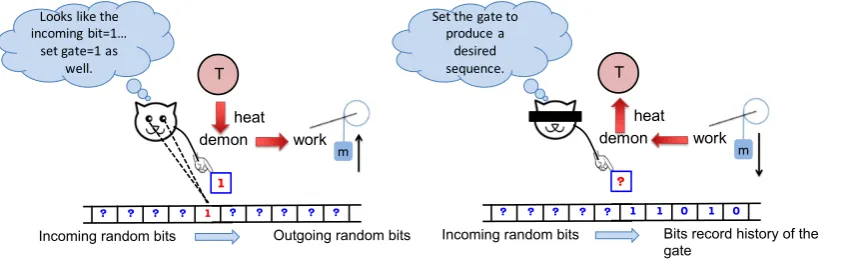
a. Feedback control engine powered by correct measurement b. Information eraser and recorder powered by mechanical work. Looks like the
incoming bit=1… set gate=1 as
well. T
demon heat
work
1 1 0 1 0 ? ? ? ? ?
Incoming random bits ?
Bits record history of the gate
Set the gate to produce a
desired sequence.
m m
Figure 2. Alternatively, our model can illustrate a non-autonomous device operated via feedback control by an external agent. (a) In the engine mode, which resembles Szilard’s thought experiment [33], the agent measures each incoming memory bit and switches a gate accordingly. When these measurements are accurate, the procedure induces a bias toward counter-clockwise rotation that can be harnessed to lift a small mass against gravity. (b) If the mass is large and falls against gravity, the energy that is released can be used to write a sequence chosen by the agent, onto the outgoing bit stream. In this mode the agent does not measure the incoming bits, but rather manipulates the gate to encode the desired sequence.
The paper is structured as follows. In Sec.2we describe the various components of our device,
91
and we sketch how it can operate as an autonomous information engine. In Sec.3we describe in
92
detail the three possible modes of operation of our autonomous device: as an engine, an eraser (or
93
copier) and a “dud”. In Sec.4we illustrate these modes of operation using numerical simulations, we
94
solve explicitly for the behavior of the model in a particular “slow-moving” limit, and we consider
95
its thermodynamic description, including its efficiency. In Sec.5we discuss how our model can be
96
used to illustrate a non-autonomous machine, operated by an external agent using measurement and
feedback – as in Maxwell’s original thought experiment – and we obtain a bound on the amount of
98
work that this machine can deliver. We end in Sec.6with a brief summary and discussion.
99
2. Programmable Maxwell’s Demon 100
2.1. Components and basic design 101
As mentioned, the machine described in this paper is equipped with a binary reference sequence
102
that can be preprogrammed to any desired pattern of 0’s and 1’s – for instance, the binary representation
103
ofπ. Thisreference sequenceis fixed, and is distinct from the sequence ofmemory bitsthat interact
104
dynamically with the rotational ring. As we will argue, if the incoming memory bits match the
105
reference sequence then the ring favors counter-clockwise (CCW) rotation that can be used to perform
106
work against an external load.
107
Device
Gap
Programmed Gates
( & )
Gap
0 1
⇡ 0
✓D
✓B
2⇡
¯ 0
¯1
¯
0
¯
0
¯
0
¯
0
¯1
¯
0 ¯1
Figure 3.Snapshot of our programmable demon. A series of green paddles move down frictionlessly along the central axle. The paddles are separated by the red bars into binary states, left (0) and right (1) – see inset. Each bit passes by the rotational ring (the blue ring with two inward blades) for the same finite amount of time, during which it can change states. We claim that if the incoming bits (000101· · ·) are in agreement with the programmed gates (¯0¯0¯0¯1¯0¯1· · ·), then the ring favors CCW motion, which can be used to lift an external load. A top view of the system is shown in the inset. A video clip illustrating the dynamics of our demon is found athttps://youtu.be/LkYljJ__-Cs
As illustrated in Figure 3, the entire machine consists of three components – a sequence of
108
paddles acting as the bits of a memory register, a set of fixed gates that encode a preprogrammed
109
binary reference sequence, and the demon that is realized by a rotational ring: a ring that interacts
110
with the memory register via blade-paddle collision and can perform work via rotation against a
111
constant external force. We now describe these components in detail, beginning with the paddles that
112
constitute the bits of the memory register. These paddles rotate frictionlessly around a central axle.
113
The orientation of a paddle is given by an angleθB. WhenθB∈(0,π)the paddle represents a bit in the
114
0 state, and whenθB∈(π, 2π)it represents a bit in the 1 state. Two blocking bars (shown as vertical
red bars) located at angles 0 andπprevent each bit from spontaneously flipping between the 0 and 1
116
states. Each blocking bar contains a gap, as shown in Fig.3. The central axle moves downward at a
117
constant speed, carrying the bits and gates past the demon. The entire machine is immersed in an ideal
118
gas in thermal equilibrium at temperatureT. The gas particles collide elastically with the paddles,
119
causing them to undergo Brownian-like rotation around the axle. For clarity the gas particles are not
120
shown in the figure.
121
The preprogrammed reference sequence is encoded in a set of rigid gates attached to the central
122
axle, which accompany the paddles as they move downward past the demon. These gates are shown
123
as L-shaped blue bars extending perpendicularly from the axle. The orientation of a gate is fixed at
124
eitherθ=0 (representing state ¯0) orθ=π(state ¯1). When a paddle and its gate arrive at the vertical
125
location of the gaps on the red bars, the paddle is able to switch its state by passing through the gap
126
that is not blocked by the gate. For example, if the gate is in state ¯0, the gap atθ=0 is blocked, and the
127
bit paddle can switch its state by passing through the gap atθ=π.
128
The rigid ring is equipped with two inward-pointing blades, attached at opposite locations. The
129
ring rotates freely around the central axle but does not translate or wobble. The angular orientation of
130
the ring is specified byθD; see inset of Figure3. Like the paddles, the ring undergoes Brownian-like
131
rotation due to elastic collisions between its blades and the gas particles. Additionally, the ring’s blades
132
can collide elastically with the paddles as they move past it. The ring is situated at the vertical height
133
of the gaps in the blocking bars. The spacing between bits, the size of the gaps, and the vertical widths
134
of the paddles and the ring’s blades are set so that, at any time, there is exactly one paddle within the
135
vertical range of the gap, and that paddle is simultaneously within the vertical collision range of the
136
ring’s blades. This paddle is called theinteracting bit, and its gate is called theengaged gate. We will
137
use the terminteraction intervalto denote the interval of time during which a given paddle acts as an
138
interacting bit, and its gate acts as the engaged gate. The duration of the interaction interval,τint, is
139
the same for each paddle and gate.
140
The life cycle of a given paddle (memory bit) then proceeds as follows. Prior to arriving at the
141
vertical level of the ring, the orientation of the paddle,θB, performs Brownian-like motion but the
142
binary state of the bit (0 or 1) is frozen due to the presence of the blocking bars. This binary state
143
represent anincomingmemory bit. Then, over the course of an interaction interval of durationτint, the
144
paddle can switch between the 0 and 1 states, by passing through the gap that is not blocked by the
145
reference gate; during this interval the paddle also interacts with the blades of the ring. Finally, after
146
the interaction interval, as the paddle passes below the vertical level of the ring, the binary state of the
147
paddle is once again frozen due to the blocking bars – at this point the paddle represents anoutgoing 148
memory bit.
149
2.2. Memory register – a sequence of bits 150
The binary state of an incoming memory bit (paddle),b ∈ {0, 1}, might or might not be the
151
same as the binary state of the corresponding reference bit (gate),g ∈ {¯0, ¯1}. We will characterize
152
the cleanness of the incoming bit sequence(· · ·bn−1,bn,bn+1· · ·)by the degree to which it matches 153
the fixed reference sequence(· · ·gn−1,gn,gn+1· · ·). If the binary state of each incoming memory bit 154
matches that of the accompanying gate, i.e. ifbn =gn∀n, then the memory is considered to be perfectly
155
clean. If the incoming sequence contains mismatches between memory and reference bits, then these
156
mismatches are considered to be impurities that pollute the memory sequence.
157
LetPin(same)denote the fraction of incoming bits that are correctly matched with their reference bits (0¯0 or 1¯1), andPin(diff)the fraction that are mismatched (0¯1 or 1¯0). We assume that the probability of a mismatch is independent of the state of the reference bit, and the mismatches are statistically uncorrelated with one another. We quantify the cleanness of the incoming memory by the excess ratio of clean bits:
It is useful at this point to introduce a logical variableLthat is theBoolean equalitybetween the states of the bit and the gate:L=BExyG[47]. That is, the value ofLis given by
l=true≡same if b=g
l=false≡diff if b6=g (2)
Here and below, we use the capital lettersB,GandLto refer to binary variables, and lower caseb,g
andlto denote the values of these variables. The sequences of incoming memory and reference bits together specify a sequence(· · ·ln−1,ln,ln+1· · ·), whose Shannon entropy, per bit, is given by
SL,in=−Pin(same)log Pin(same) +Pin(diff)log Pin(diff)∈[0, log 2] (3) For the outgoing bits(· · ·b0n−1,bn0,b0n+1· · ·)we can similarly definePout(same),Pout(diff)and
SL,out=−
Pout(same)log Pout(same) +Pout(diff)log Pout(diff) (4) The difference∆SL=SL,out−SL,inquantifies the cleanness of the memory sequence, per bit, due to 158
the interactions between the memory bits and ring. While the interaction between the memory bits
159
and the demon might in principle induce correlations among the outgoing bits, in our analysis we will
160
ignore these correlations.
161
2.3. Work reservoir – a mass that can be raised or lowered 162
In addition to the elements described above, an external load,Γ, acts on the ring in the clockwise
163
(CW) direction. This load is generated by a mass that hangs from a string wrapped around the ring
164
– the gravitational force on the mass produces a CW torque on the ring. If the ring rotates in the
165
counter-clockwise (CCW) direction the mass is lifted upwards. This mass is not shown in Figure3.
166
0
1
⇡
2
⇡
0
0
1
⇡
2
⇡
0
Biased Rotation
Biased Rotation
¯0
¯
1
(a) Gate=Bit=0 (b) Gate=Bit=1
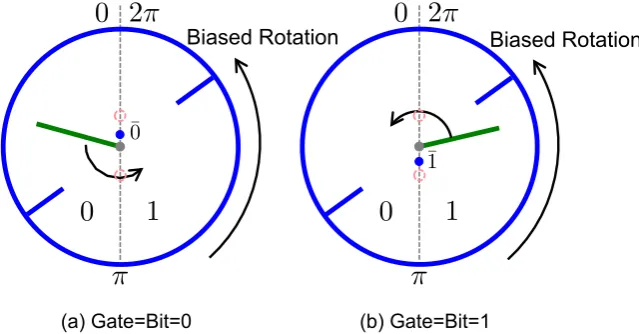
Figure 4.Engine Mode. The ring prefers CCW rotation when the bit starts with the state that is in agreement with its corresponding gate. The blue dots represent the programmed gates.
It is useful to understand the operation of our machine in the absence of this load, i.e. whenΓ=0.
167
To that end, let us first assume that the incoming bit sequence is perfectly clean: the binary state of
168
each memory bit matches that of its reference bit (δ= +1). There are then two possible combinations
169
for an incoming memory and reference bit,(0¯0)and(1¯1), illustrated in Figure4. In the former case
170
(Fig.4a), the paddle is initially confined (by the blocking bars) within the angular rangeθB ∈(0,π).
171
During the interaction interval, this paddle has the opportunity to “expand” into the full circular range
172
(0, 2π), by swinging through the gap located atθ=π. This opportunity produces a statistical bias that
173
favors CCW rotation, which in turn induces a CCW rotational bias for the ring, due to the possibility of
collisions between the paddle and the ring’s blades. For the incoming combination(1¯1), the expansion
175
of the memory bit during the interaction again interval favors CCW rotation as the reference gate
176
blocks the gap atθ=π(Fig.4b). In this manner, over the course of many interaction intervals the ring
177
settles into a steady state in which the ring rotates systematically in the counterclockwise direction –
178
the thermal fluctuations generated by collisions with the gas particles are rectified to produce directed
179
rotation. In this steady state there is a continual exchange of energy (due to collisions) between the
180
ring’s blades and the gas, but this exchange does not lead to a net flow of energy in one direction.
181
By similar arguments, the maximally unclean situation (δ= −1) produces an identical bias in
182
the clockwise direction. More generally, each correctly matched pair of memory and reference bits
183
generates a bias toward CCW rotation, while each mismatched pair generates a bias toward CW
184
rotation. Hence, over many interaction intervals, our ring (in the absence of an external load) produces
185
a rotational bias whose direction is CCW forδ > 0 and CW forδ < 0. The strength of the bias is
186
quantified by|δ|.
187
Let us now assumeδ > 0 and imagine that we add an external load, Γ > 0. If the load is
188
sufficiently small then the bias generated by the ring will continue to produce CCW rotation (albeit at
189
a lower rate than if the load were absent) thereby lifting the mass against gravity. In this situation the
190
ring settles into a steady state in which energy is systematically withdrawn from the heat bath (gas)
191
and delivered to perform mechanical work.
192
3. Operational Modes of the Programmable Demon 193
More generally, the behavior of our ring depends on four parameters that we consider to be
194
tunable: the memory cleannessδ, the bath temperatureT, the external loadΓ, and the duration of the
195
interaction intervalτint.1Depending on the values of these four parameters, the machine operates in
196
one of three different modes – as an information engine, an information eraser or a dud. In the limit
197
τint→∞the model becomes analytically solvable (see Sec.4.2), and its behavior is determined by the
198
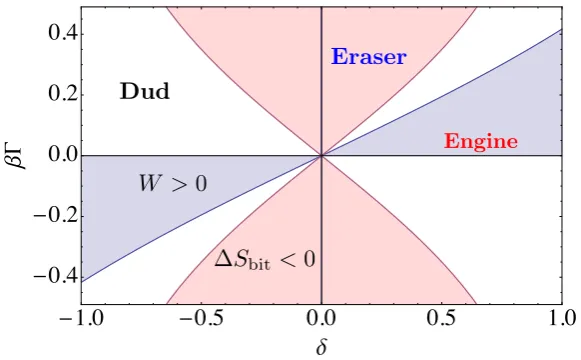
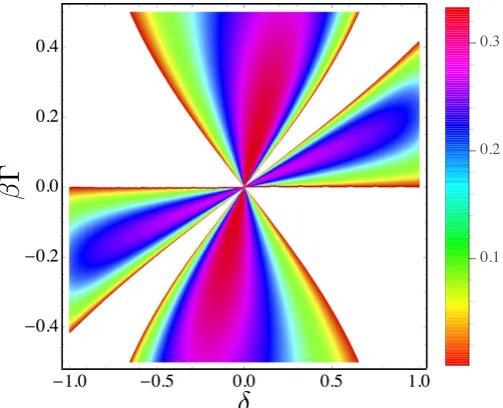
dimensionless parametersδandβΓ, whereβ= (kBT)−1, as illustrated by the phase diagram shown in
199
Figure10. We now discuss each mode separately.
200
3.1. Engine mode 201
As mentioned in Sec.2.3, forδ>0 and sufficiently smallΓ>0, the ring is able to convert energy drawn from the heat bath into work against the external load, thereby operating as an engine. In the limiting caseδ=1, each incoming bit is matched perfectly to its reference bit, but this is no longer the case with the outgoing bits:
δ0≡Pout(same)−Pout(diff)<1 (5)
More generally, whenδ>0 and the ring operates in the engine mode we have
δ>δ0>0 (6)
as CCW rotation tends to generate mismatches between memory bits and reference bits. Eq.6indicates
202
that there is greater uncertainty – less correlation with the reference bits – in the outgoing memory
203
sequence than in the incoming sequence:∆SL>0. In effect, the decrease of thermodynamic entropy
204
associated with the continual withdrawal of energy from the heat bath, is compensated by the increase
205
of the Shannon entropy of the memory register. Our ring thus operates as aninformation engine, with a
206
clean sequence of incoming bits serving as a thermodynamic resource that allows the system to convert
207
heat from the bath into work against the load, without violating the second law of thermodynamics.
208
In the non-programmable engine of Ref. [1], an incoming sequence of 0’s is converted into a
209
mixture of 0’s and 1’s. It is natural to view this conversion as a process ofwritinginformation to the bit
210
sequence. The outgoing pattern encodes information about the history of the ring, as outgoing 1’s are
211
correlated with CCW rotation during the corresponding interaction intervals. In the present model, by
212
contrast, both the incoming and the outgoing sequences are mixtures of 0’s and 1’s. We can still view
213
this as a process of writing information, provided this information is defined relative to the reference
214
bits: a mismatch between an outgoing memory bit and its reference bit indicates a likelihood that CCW
215
rotation occurred during that bit’s interaction interval. Alternatively, for the present model we might
216
view the incoming sequence as containing information (e.g. the binary digits ofπ), which is “digested”
217
by the ring as it rectifies thermal fluctuations to generate work. Regardless of whether we interpret the
218
ring as writing information onto a clean memory sequence, or digesting information contained in that
219
sequence, the net result is the same: when the ring acts as an engine, the outgoing bit sequence is more
220
disordered than the incoming one,∆SL >0.
221
3.2. Eraser mode 222
Now let us consider what happens when (1) the incoming bit sequence is maximally unclean
223
(δ=0) i.e. the incoming bits are uncorrelated with the reference bits, and (2) a large mass produces a
224
strong external load in the CW direction,Γ>0. During a given interaction interval the mass drops as
225
far as it can, producing CW rotation of the ring until the interacting paddle (bit) is pinched between
226
one of the blades of the ring and the rigid engaging gate associated with that paddle, as illustrated
227
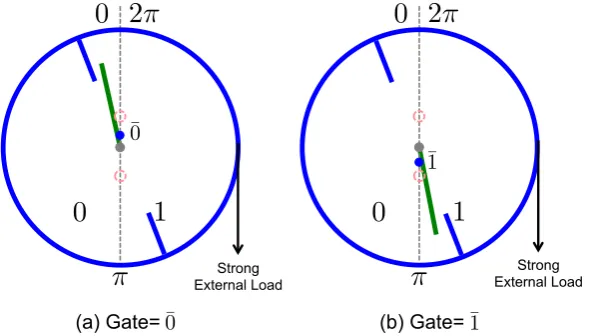
in Figure5. If the reference bit is in state ¯0, then the engaging gate is located atθ=0 and the paddle
228
that encodes the memory bit is forced by the CW rotation into a state 0<θBπ, corresponding to
229
the binary state 0 (Figure5a). Conversely, if the reference bit is in state ¯1, then the engaging gate is
230
situated atθ=πand the paddle is forced into a stateπ<θB2π, corresponding to the binary state
231
1 (Figure5b). In either case, at the end of the interaction interval the memory bit matches the reference
232
bit (0¯0 or 1¯1).
233
In this mode of operation, the ring harnesses the gravitational energy of the falling mass to
234
decrease the randomness in the bit sequence. Specifically,∆SL=−log 2<0, since the outgoing bits
235
are perfectly matched to the reference bits; see Eqs.3and4. This decrease in the Shannon entropy of
236
the memory bit stream is compensated by an increase in the thermodynamic entropy of the heat bath,
237
as the energy from the falling mass is ultimately dissipated into the bath.
238
The model developed in Ref. [1] displayed a similar mode of operation, with a falling mass
239
converting an incoming sequence of 0’s and 1’s into an outgoing sequence of 0’s. We referred to this
240
mode asLandauer’s eraser, as it illustrated Landauer’s principle that heat must be dissipated in order to
241
erase information. We will use the same terminology to refer to the mode of operation just described
242
for the present model, althoughLandauer’s copiermight be more apt in this context, since the net effect
243
is that the preprogrammed reference sequence is copied onto the memory bits.
244
3.3. Dud mode 245
It is useful to think of a clean memory (δ=1) as a thermodynamic resource, just as a mass that
246
has been lifted against gravity is a thermodynamic resource. The engine and eraser modes represent
247
an interplay between these two resources, in which one resource is depleted in order to increase the
248
other. Thus in the engine mode, the cleanness of the memory bit stream is diminished in order to
249
raise the mass against gravity, while in the eraser mode the gravitational potential energy of the mass
250
is spent in order to obtain a clean memory. When the incoming bit stream is sufficiently clean and
251
the external load (mass) is sufficiently small, the ring acts as an engine, whereas when the incoming
252
bits are disordered and the mass is large, it acts as an eraser. For intermediate values ofδandΓ, the
253
ring might act either in the engine mode or in the eraser mode, depending on the values of other
254
parameters such as the interaction timeτintand the temperature and density of the surrounding gas.
0
1
⇡
2
⇡
0
0
1
⇡
2
⇡
0
¯0
¯
1
Strong External Load
Strong External Load
(a) Gate=
¯0
(b) Gate=¯
1
Figure 5.Eraser (Copier) Mode. Under a strong external load, CW rotation occurs until the bit becomes pinched between the engaging gate (shown as a blue dot situated on the gray dashed line) and a blade of the ring. The binary state of the memory bit then matches that of the reference bit.
There is also a third possibility: the mass drops while the disorder of the memory increases,
256
∆SL >0. We call this thedudmode, since it represents a wasteful depletion of both thermodynamic
257
resources. This mode arises either if the incoming memory sequence contains a surplus of mismatches
258
over correct matches,δ<0, and the loadΓ>0 is not sufficiently strong to produce an even greater
259
surplus of correct matches in the outgoing sequence – this is illustrated by the white area region
260
appearing in the second quadrant in Fig.10 – or if a surplus of correct matches in the incoming
261
sequence is not sufficient to raise the mass against gravity, while simultaneously the loadΓ>0 is not
262
sufficient to counter the tendency of the bits to randomize – this is illustrated by the narrow white
263
tongue appearing in the first quadrant in Fig.10.
264
In the dud mode, the Shannon entropy of the memory sequence increases,∆SL > 0, and the
265
thermodynamic entropy of the surrounding gas increases, as it absorbs the energy of the falling mass.
266
4. Numerical and analytical results 267
4.1. Numerical simulations 268
We performed numerical simulations of our contraption immersed in a dilute gas, modeling the
269
collisions between the gas particles and the paddles and blades as Poisson processes. The probability
270
per unit time that a gas particle strikes a particular location of a given paddle or blade is determined
271
by the temperatureT and density of the gas, the angular velocity of the paddle or blade, and the
272
radial location of the point of collision. During a given interaction interval we simulate the dynamics
273
of the ring and the interacting bit as a sequence of events. Each event is a blade-paddle collision, a
274
paddle-gate collision, or a collision of a gas particle with either the paddle or the blade. After each
275
event the angular velocity of the blade and/or paddle is appropriately updated, and the next event is
276
generated stochastically using the Gillespie algorithm [48]. At the end of the interaction interval the
277
machine undergoes a bit renewal, in which the old interacting bit is replaced by a new one, whose
278
angular locationθBand velocity ˙θBare assigned randomly according to the values ofδandT.
279
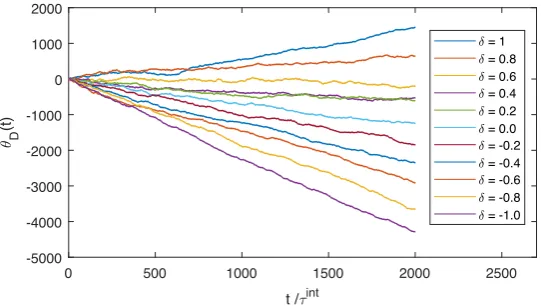
Fig.6shows eleven angular trajectories of the angular rotation of the ring,θD(t), illustrating
280
the engine mode and the dud mode. The simulations were performed at temperaturekBT=1 and
281
loadΓ=0.05kBT, for eleven different values of the cleanness of the incoming memory bits,δ. Each
282
simulation lasted for 2000 interaction intervals, representing 2000 incoming bits, with τint = 20.
283
The gates were prepared in the repeating binary sequence “...0101101011...00. In agreement with the
284
arguments of Sec.3, whenδis close to 1, the ring undergoes systematic counterclockwise rotation
and the ring performs work against the external load, lifting the mass against gravity (engine mode).
286
For less clean incoming sequences, with valuesδ≤0.6, the ring can no longer overcome the external
287
torque and rotates clockwise (dud mode).
288
0 500 1000 1500 2000 2500
t /int -5000
-4000 -3000 -2000 -1000 0 1000 2000
D
(t)
= 1 = 0.8 = 0.6 = 0.4 = 0.2 = 0.0 = -0.2 = -0.4 = -0.6 = -0.8 = -1.0
Figure 6.Trajectories of the ring’s angular orientation for different values ofδat fixed loadΓ=0.05kBT,
with a bit renewal rate of 1 bit per 20 seconds (τint=20). Forδ=1 andδ=0.8 the ring performs work
against the clockwise external torque, while for the other values ofδ, the external load dominates and
work is dissipated into the heat bath.
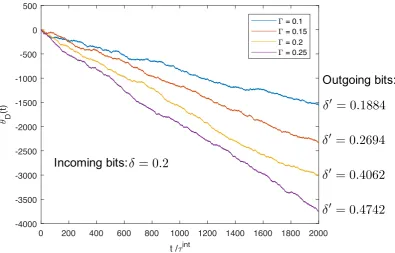
To illustrate the eraser mode, Fig7shows four trajectories simulated as in Fig.6, except that we
289
fixδ=0.2 and vary the external torque:Γ[kBT] =0.1, 0.15, 0.2, 0.25. As expected, the stronger the
290
load, the faster the ring rotates in the CW direction, leading to more energy dissipated into the heat
291
bath. We find that forΓ≥0.15kBT, the outgoing sequence is cleaner than the incoming sequence of
292
bits hence the ring functions as an eraser.
293
4.2. Analytical results for the slow-moving limit 294
Let us now consider the limit of long interaction timeτint→∞. In this limit the behavior of the
295
ring during one interaction interval becomes uncorrelated with its behavior in the next interval. The
296
average work performed by the ring,W, and the Shannon entropy change of the memory tape,∆SL,
297
can then be computed analytically and are given by Eqs.7and11below. We now sketch the approach
298
that is taken to obtain these results, leaving the technical details to the Appendix.
299
Letting (θB,θD) denote the instantaneous configuration of the composite system – the interacting
300
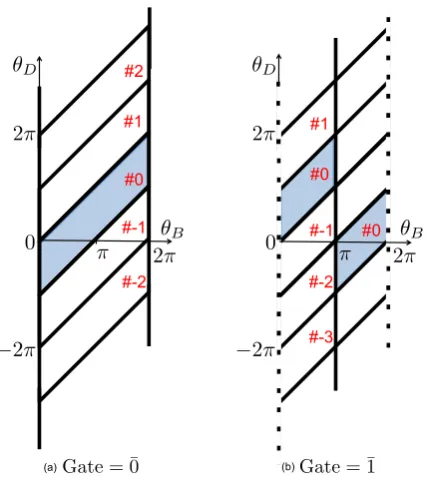
bit and the ring – we depict the relevant features of configuration space in Figure8, with bold solid
301
lines representing hard wall boundaries. Note that the boundary conditions depend on the state of the
302
reference bit, ¯0 or ¯1, through the placement of the engaging gate atθ=0 orθ=π.
303
During a given interaction interval, the ring and interacting bit undergo random collisions with
304
the surrounding bath particles, while the external load imposes a potential energy contributionΓθDthat
305
generates a CW torque on the ring. The ring and bit are confined within a single parallelogram-shaped
306
cell in configuration space (see Fig.8), and the composite system(θB,θD)has sufficient time to relax to
307
equilibrium within this cell. Hence, if the composite system begins within a particular cell at the start
308
of an interaction interval, then at the end of the interval its statistical state is given by a Boltzmann
309
distribution restricted to that cell.
310
Let us suppose that during the initial interaction interval the composite system is found in one
311
of the two shaded cells depicted in Fig.8, depending on the state of the reference bit. Letpeq¯0 (θB,θD)
312
andpeq¯1 (θB,θD)denote the equilibrium distributions restricted to these two cells. The correlations
313
betweenθBandθDdiffer in these two distributions, but if we integrate either distribution overθB, then
314
the resulting marginal equilibrium distributions forθDare identical:peqD(θD) = R
dθBpeq¯0 = R
dθBpeq¯1 .
0 200 400 600 800 1000 1200 1400 1600 1800 2000
t / int
-4000 -3500 -3000 -2500 -2000 -1500 -1000 -500 0 500
D
(t)
= 0.1 = 0.15 = 0.2 = 0.25
Incoming bits:
Outgoing bits:
= 0
.
2
0
= 0
.
1884
0
= 0
.
2694
0
= 0
.
4062
0
= 0
.
4742
Figure 7. Trajectories of the ring’s angular orientation for different values of CW external torque
Γ, at fixed δ = 0.2. For each trajectory, the ring rotates in the CW direction and thus the
energy of the falling mass is dissipated into the heat bath. With increasing external torque (Γ =
0.1kBT, 0.15kBT, 0.2kBT, 0.25kBT), the cleanness of the outgoing sequence of bits increases as well:
δ0=0.1884, 0.2694, 0.4062, 0.4742. ForΓ≥0.15kBTwe obtainδ0>0.2 hence the ring acts as an eraser,
0
2
⇡
2
⇡
✓
B✓
D⇡
2
⇡
0
2
⇡
2
⇡
✓
B✓
D⇡
2
⇡
Gate = ¯0 Gate = ¯1
#0 #1 #2
#-2 #-1
#1
#0
#-1
#-2
#-3 #0
(a) (b)
Figure 8. The configuration space of the ring and interacting bit. The tilted lines atθD−θB = nπ
depict hard boundaries associated with a collision between the interacting bit paddle and either blade of the ring. The vertical solid lines correspond to the location of the engaging gate that blocks the paddle. This gate is located atθ=0=2πwhen the reference bit is set to ¯0, panel (a), or atθ=πwhen
the reference bit is set to ¯1, panel (b). The dashed lines in (b) represent periodic boundary conditions. The hard wall boundaries partition the configuration space into parallelogram-shapedcells, which are numbered as shown, with cell #0 shaded in each panel.
The distribution peqD has support in the region−π ≤ θD ≤ 2π. In the absence of an external load,
316
bothpeq¯0 andpeq¯1 are uniform distributions within the shaded regions, andpeqD(θD)has the shape of
317
an isosceles trapezoid. In the opposite limit of a strong external loadΓ kBT,peqD(θD)is strongly
318
concentrated nearθD=−π(due to the Boltzmann factore−βΓθD), as the memory bit paddle becomes
319
pinched between one of the ring’s blades and the engaging gate.
320
At the start of the next interaction interval, the memory and reference bits are replaced, orrenewed,
321
by the arrival of a new paddle and engaging gate. The location of the engaging gate now reflects
322
the new reference bit, ¯0 or ¯1. The state of the new memory bit,b, either matches or mismatches the
323
reference bit, with a probability determined by the value ofδ. We can treat the configuration of the
324
incoming memory bit as a random, uniform sample either from the range 0 ≤ θB < πifb =0, or
325
fromπ ≤θB<2πifb=1. This renewal process instantaneously maps the final distribution of the
326
composite system at the end of one interaction interval, into a new initial distribution at the beginning
327
of the next interval, as the variableθBnow refers to the new memory bit rather than the old one. This
328
mapping depends on the state of the new bit, as illustrated in Figure9. At the start of a new interaction
329
interval, the bit and ring configurations,θBandθD, are uncorrelated.
330
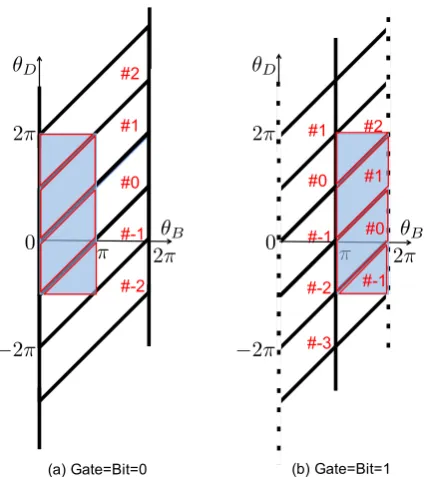
If the machine (bit + ring) is found in cell #kduring one interaction interval, and if the new,
331
incoming memory and reference bits are correctly matched, then during the next interval it will be
332
found in one of four possible cells, corresponding to a displacement∆k=−1, 0, 1 or 2, as illustrated
333
in Figs.8and9fork=0. The probability distribution for∆kis determined by considering how the
334
equilibrium distribution restricted to the initial cell (#k) is redistributed by the mapping that occurs
335
upon bit renewal. By similar arguments, if the incoming memory and reference bits are mismatched,
336
then the displacement is∆k=−2,−1, 0 or 1.
337
The process then repeats itself over the next interaction interval: the probability distribution
338
relaxes to equilibrium within each cell, and then renewal occurs when the new memory and reference
0
2
⇡
2
⇡
✓
B✓
D⇡
2
⇡
0
2
⇡
2
⇡
✓
B✓
D⇡
2
⇡
#0 #1 #2
#-2 #-1
#1
#0
#-1
#-2
#-3
(a) Gate=Bit=0 (b) Gate=Bit=1
#2
#1
#0
#-1
Figure 9.The shaded regions indicate the distribution of the composite system right after renewal, for the case when the memory bit is correctly matched with the reference bit. For purpose of illustration, we assume that just before the renewal the system was found in either one of the shaded cells shown in Fig.8, both corresponding to #0. In (a), the new memory and reference bits are in the combined state
(0¯0), whereas (b) corresponds to the combination(1¯1). The marginal probability distribution of the ring’s angle,peqD(θD), is unaffected by the renewal mapping.
bits arrive. Thus, from one interaction interval to the next, we can treat the dynamics of the ring
340
as a discrete time random walk along a lattice of cells, with each step∆ksampled randomly from
341
a distribution that depends on whether the incoming memory and reference bits are matched or
342
mismatched. The net result is that∆kcan range from−2 to+2, with probabilities determined by the
343
values ofδandΓ. On average, each positive (negative) unit increment inkcorresponds to CCW (CW)
344
rotation of the ring by half a circle.
345
Following the considerations discussed above, we have computed the probability distribution for
∆kanalytically, and from these results we have determined the average work performed by the ring, per interaction interval (see AppendixAfor details):
W= πβΓδ−πβΓ[3 coth(πβΓ) +csch(πβΓ)] +4
2β (7)
In the limit of a weak external load, Eq.7gives
W≈δπΓ/2 (0<ΓkBT) (8)
and the ring acts as an engine whenδ>0, in agreement with the discussion in Sec.2.3. In the opposite limit of strong external load we get
W≈(δ−3)πΓ/2 (ΓkBT) (9)
henceW<0, as expected. As a consistency check on Eq.7, both of the limiting cases represented by
346
Eqs.8and9can be verified by directly calculating the average displacement ofθDper period, resulting
347
from the renewal mapping illustrated in Figs.8and9.
-
1.0
-
0.5
0.0
0.5
1.0
-
0.4
-
0.2
0.0
0.2
0.4
d
bG
Engine
Eraser
Dud
W >
0
Sbit
<
0
Figure 10. The phase diagram of the programmable Maxwell’s demon in the limitτint→∞. Here
the behavior of the ring depends only on the sequence cleanness,δ, and the external torque scaled by
bath temperature,βΓ. For finite values ofτint, the behavior of the ring depends separately on three
quantitiesβ,Γandδ.
Additionally, we can compute the fractions of bit-gate agreement and disagreement in the outgoing tape:
Pout(same) = e
Γπβ
eΓπβ+1 , Pout(diff) = 1
eΓπβ+1. (10)
In the limit of a strong external load (ΓkBT) virtually all outgoing bits will be forced to match the reference bits, as each bit paddle becomes pinched between then ring’s blade and the engaging gate; see Sec.3.2. Per interaction period, the change of the Shannon entropy of the memory tape with respect to the gate is
∆SL = 1− δ
2 log
1−δ
2
+1+δ
2 log
1+δ
2
− eπβΓ
eπβΓ+1log
eπβΓ eπβΓ+1
− 1
eπβΓ+1log
1
eπβΓ+1
(11)
where recall that the variableL=BExyGis the Boolean equality between the state of the bit and the
349
state of the gate (see Sec.2.2).
350
Combining Eqs.7and11, we obtain (see AppendixBfor details)
∆SL− W
kBT = DKL[Pin|Pout] +
πβΓ
tanh(πβΓ/2)−2 (12)
where DKL ≥ 0 is the Kullback-Leibler divergence [49] between the incoming and outgoing bit distributions. Sincex/ tanh(x)>1 for allx6=0, Eq.12implies
kB∆SL−W
T ≥0 (13)
which is a strict inequality whenΓ6=0. Because the workWis equal to the average energy extracted
351
from the heat bath, per bit, the term−W/Trepresents the net change in the thermodynamic entropy
352
of bath. As a result, Eq.13can be viewed as a statement of the second law of thermodynamics: the
353
sum of the entropy changes of the bit stream and heat bath must be non-negative. Notice that this
354
interpretation relies on treating the information content of the bit stream (multiplied bykB) as a genuine
355
thermodynamic entropy, on par with the Clausius entropy.
Eq.13suggests natural definitions of the machine’s thermodynamic efficiency in both the engine and the eraser mode. When the ring functions as an eraser, we have
W <kBT∆SL <0 (14)
and the efficiency is defined as
ηeraser= kBT∆SL
W <1 (15)
When the ring functions as an engine,
kBT∆SL >W >0 (16)
and the efficiency is defined as
ηengine= W
kBT∆SL <1 (17)
When the ring functions in the dud mode,W <0<kBT∆SL.
357
In Fig.11we plot the thermodynamic efficiency over the phase diagram of the machine. By
358
definitionη > 0 within the regions corresponding to the engine and eraser modes, butηdrops to
359
zero at the boundaries of these regions, where the ring becomes a dud. For example, a point on the
360
boundary of the engine mode, withδ,βΓ>0, represents a stalled state. Here the ring generates just
361
enough CCW torque to match the CW torque exerted by the external load (henceW=0), nevertheless
362
there is a positive rate of entropy generation in the bit stream (∆SL>0). If the loadΓis decreased by a
363
small amount, then the ring will produce a slight CCW rotation, resulting in an engine with very low
364
efficiency.
365
0.1 0.2 0.3
Figure 11. Efficiency plot of the programmable demon, obtained analytically in the limitτint →∞.
Since efficiency is defined only for the eraser and engine modes, the dud region is left blank.
4.3. Second law of thermodynamics in the slow moving limit 366
We have obtained Eq.13from our exact solution of the dynamics in the slow-moving limit, but
367
the result has the character of a generalized, information-theoretic second law of thermodynamics (as
368
already mentioned), and its validity may extend to finite values ofτint. While it is difficult to establish
369
this validity from first principles, we can make some progress by ignoring correlations (of any sort)
from one interval to the next, as we do in the following statistical treatment in which the variablesB 371
andGare treated asinformation-bearing degrees of freedom[50].
372
At the start of an interaction interval, letPBGin(b,g)denote the joint probability to find the memory
373
bit in stateb∈ {0, 1}and the reference gate in stateg∈ {¯0, ¯1}, and letPBin(b)andPGin(g)denote the
374
corresponding marginal distributions. LetSBG,SBandSG denote the Shannon entropies of these
375
distributions.
376
Then
SinBG=SinB +SinG −IBGin (18) where
IBGin =
∑
b,gPBGin log P in BG Pin
BPGin
≥0 (19)
is themutual information [51] between the bit and gate states. Defining similar quantities for the outgoing states, the net change in the combined entropy over one interaction interval is
∆SBG=∆SB+∆SG−∆IBG =∆SB−∆IBG
(20)
where∆SBG=SoutBG−SinBG, etc. Since the state of the gate remains fixed we have∆SG =0, whereas
377
bothSBandIBGtypically change during the interaction interval.
378
We have used the variablesBandGto specify the combined state of a memory and reference bit, but we could equally well specify this state using the variablesLandG, leading to
∆SBG=∆SLG =∆SL−∆ILG (21)
where∆SLG,∆SLandILGare defined as above, but withLin place ofB.
379
The Hamiltonian analysis of Ref. [28] (see in particular Eq. 47 therein) suggests that the change in the Shannon entropy of the information-bearing degrees of freedomBandGobeys a generalized second law of thermodynamics:W/kBT≤∆SBG. Combining with Eq.21gives us
W kBT ≤∆
SL−∆ILG=∆SL−ILGout (22)
Here we have used our assumption that incoming mismatches are statistical uncorrelated with the
380
state of the gate (Sec.2.2) to setILGin =0. Since mutual information is non-negative, Eq.22immediately
381
implies Eq.13, but note that Eq.22provides a stronger bound than Eq.13. In effect, if correlations
382
develop between the reference gateGand the logical stateL, then these correlations represent an
383
“unused” information-thermodynamic resource. In the slow-moving limit, these correlations vanish
384
since the demon and bit fully equilibrate, hence Eq.22reduces to Eq.13in that limit.
385
5. Our machine as a feedback controlled device 386
In previous sections we have presented our model as an autonomous system, whose various
387
components (paddles, gas particles, etc.) evolve without external interference. With a slight
388
modification our model can serve to illustrate anon-autonomousdevice: a machine that is manipulated
389
via measurement and feedback. In this non-autonomous interpretation, the ring can again operate
390
as an engine that lifts a mass against gravity, as we describe in Sec.5.1. We then show how the
391
inequality given by Eq.22for the autnomous case, can be translated into an inequality that applies
392
to non-autonomous measurement and feedback, Eq.26below. Finally, in Sec.5.3we show how our
393
model can be modified to act as a non-autonomous device that uses the energy of a dropping mass to
394
write a desired target sequence to a stream of bits.
1
0
Gate 1
Gate 0
In
co
mi
ng
ra
nd
om
se
qu
en
ce
Device
Figure 12. A non-autonomous version of our model. The snapshot is taken right at the time of bit renewal. The agent observes the state of the new bit (state 1) and simultaneously sets the gate ¯1 to be effective. Thus the new bit can switch state only through the unblocked gate ¯0. In this illustration, the agent’s measurement is faithful and thus the ring is able to work in the engine mode.
5.1. Feedback controlled engine 396
Consider a setup that is essentially the same as that described in Sec.2, but without the sequence
397
of rigid reference gates (the blue L-shaped bars in Fig.3). In their place is a single, switchable gate
398
that can be set to block either one of the two gaps (in the red blocking bars) positioned at the vertical
399
location of the ring. We will say that the gate is in the ¯0 state when it blocks the gap atθ=0, and in
400
the ¯1 state when it blocks the gap atθ=π; the latter case is depicted in Fig.12.
401
Throughout this section we assume that the incoming bits arrive in a fully randomized sequence,
402
with 0’s and 1’s distributed equally. We introduce an external agent who performs measurement and
403
feedback on these bits; see Fig.12. The agent observes each new bit as it arrives, and at the moment
404
of bit renewal (when the incoming bit becomes the interacting bit) the agent sets the switchable gate
405
accordingly: if it observes the incoming bit to be in state 0 (or 1), it sets the switchable gate to state ¯0
406
(or ¯1).
407
If the agent performs error-free measurements, faithfully identifying the state of each incoming
408
bit, then from the perspective of the ring the situation is equivalent to the caseδ=1 analyzed in Sec.2.
409
Namely, the blocked gate is matched with the state of the incoming bit so as to produce, during each
410
interaction interval, a statistical bias in favor of CCW rotation. In the long run, this bias can cause a
411
small mass to be lifted against gravity, systematically extracting energy from the heat bath and thereby
412
reducing its entropy. Since (by assumption) the incoming bits arrive in a fully randomized sequence,
413
the decrease in the entropy of the bath cannot be “paid for” by increasing the Shannon entropy of the
414
bits. Rather, the model illustrates how an external agent, by performing measurement and feedback,
415
can rectify fluctuations to produce an apparent violation of the second law of thermodynamics. Of
416
course there is no real violation, as the physical nature of the agent is not being taken into account –
417
like Maxwell, we have effectively inserted a “magical creature” into our model.
418
We further generalize this scenario to include the possibility of measurement errors. For each
419
incoming bit, letedenote the probability that the agent misidentifies the bit state and therefore blocks
420
the “wrong” gate. This situation is equivalent to the one analyzed in Sec.3.1, withδ =1−2e. For
421
sufficiently small error rateeand loadΓ, the machine may still lift the mass against gravity, despite the
422
measurement errors.
The non-autonomous model described in this section is similar to Maxwell’s original thought
424
experiment, and even more so to the Szilard engine [33], in which an agent determines whether a
425
gas particle is within the left or right half of a box, then appropriately attaches a mass that can be
426
lifted by the expansion of the single-particle gas. In our model, the “expansion” of a bit paddle from
427
the half-circle to the full circle during each interaction interval plays the role of the expansion of the
428
single-particle gas in the Szilard model. Note, however, that in the case of the Szilard engine the
429
same gas particle is recycled from one iteration of the measurement-and-feedback process to the next,
430
whereas our model uses a sequence of “gas particles” (incoming bits) that can act as a memory register.
431
This allows our model to act not only as an engine but also as a device that writes information, as we
432
discuss in Sec.5.3.
433
5.2. The second law of thermodynamics with feedback control 434
We have noted the equivalence between the measurement-and-feedback scenario described in
435
Sec.5.1(with error ratee) and the autonomous engine of Sec.3.1(withδ=1−2e). Let us use this
436
equivalence to obtain a second law inequality for the measurement-and-feedback process.
437
As before, letPBGin (b,g)denote the joint probability distribution describing the initial state of the bit and blocked gate – just after the agent has measured the bit and set the gate accordingly. During the interaction interval, 0<t<τint, the machine operates autonomously, hence (see Sec.4.3)
W kBT ≤∆
SBG=∆SG+∆SB−∆IBG (23)
Since the gate stateGdoes not change during the interaction interval,∆SG =0. Also, since the fully randomized incoming bit stream contains equal populations of 0’s and 1’s, the same will be true (by symmetry) of the outgoing bit stream, henceSinB =SoutB =log 2, and∆SB =0. We thus get
W
kBT ≤ −∆IBG=I in
BG−IBGout (24)
The initial mutual information is simply the information gained by the measurement process:
IinBG=Imeas=log 2+ (1−e)log(1−e) +eloge (25)
The final mutual information quantifies the degree to whichBandGremain correlated at the end of the interval; we will refer to this value as theresidualinformation:Ires=IBGout. We thus have
W
kBT ≤ Imeas−Ires, (26)
i.e. the extracted workWis bounded by the amount of information gathered during the measurement, minus the amount “left over” at the end of the interval. Hence the gathered information is a thermodynamic resource, and the differenceImeas−Iresrepresents the amount of that resource that is consumed, per interaction interval. SinceIres≥0, Eq.26immediately implies the weaker bound
W kBT ≤
Imeas. (27)
Eq.27was originally derived within the framework of stochastic thermodynamics by Sagawa
438
and Ueda in Refs. [26,27], and Eq.26was subsequently obtained by the same authors in Refs. [29,52].
439
We also note that the net change in the mutual information between the bit and the gate,∆IBG, can be
440
interpreted as the integratedinformation flow, within the bipartite approach developed by Horowitz and
441
Esposito [30]. This information flow is negative (henceImeas−Ires>0 ), as information is consumed
442
to extract energy to lift the mass.
5.3. Feedback controlled information recorder 444
In the eraser mode discussed in Sec.3.2, our autonomous machine removes randomness from
445
the incoming bit stream, replacing it with a preprogrammed sequence encoded in the reference gates.
446
In the present context of an externally manipulated machine, let us imagine that the agent desires
447
to write a particular target sequence, e.g. 011010· · ·, to the bit stream. The agent does not perform
448
measurements on the incoming bits, but as each bit arrives the agent sets the switchable gate to match
449
the corresponding element of the target sequence. Then, as in Sec.3.2, the CW torque produced by the
450
gravitational pull of the mass produces a tendency to set the state of the interacting bit to match the
451
desired target value, through the “pinching” mechanism illustrate in Fig.5. The fidelity of the writing
452
process increases with the torqueΓgenerated by the gravitational force on the mass, and the energy of
453
the dropping mass is dissipated into the heat bath.
454
6. Concluding remarks 455
In this paper we have presented a model of a programmable, mechanical Maxwell’s demon,
456
that can be interpreted either as an autonomous device, as described in Sections 2 - 4, or as a
457
non-autonomous device manipulated by external measurement and feedback control, as in Section5.
458
For these distinct interpretations, we have obtained distinct forms of the second law of thermodynamics,
459
represented by Eqs.22and26. While these results have been obtained within the specific context of
460
our model, it would be useful to investigate whether they point to more general thermodynamic laws,
461
in situations involving both autonomous and non-autonomous (i.e. feedback-controlled) devices. For
462
instance, as indicated in Sec.5.2, the inequalities given by Eqs.26and27have been obtained previously
463
under assumptions of bipartite, Markovian dynamics [26,27,29,30,52]. By contrast, we have obtained
464
these results within a Newtonian model of colliding particles and paddles, which suggests that they
465
might be derived more generally within a classical, Hamiltonian framework.
466
Additionally, we have obtained analytical results for the work delivered by our device, Eq.7,
467
and the change in the Shannon entropy of the bits, Eq.11, in the limit of a slowly-moving stream
468
of bits, τint → ∞. For finite τint, the interactions between the bits and the demon may induce
469
statistical correlations among the outgoing bits. Such correlations, which could in principle act as
470
a thermodynamic resource, have not been considered in our analysis. It would be interesting to
471
investigate how these correlations might affect the inequalities that we have derived.
472
Acknowledgments: We gratefully acknowledge financial support from the U.S. Army Research Office under 473
contract number W911NF-13-1-0390 (CJ). ZL acknowledge useful discussions with Zhixin Lu, Dibyendu Mandal, 474
Sebastian Deffner, and David Sivak. 475
Appendix Work delivered per interaction interval. 476
To compute the mean work that our device delivers to life a mass against gravity, we must
477
compute the mean angular displacement of the ring per interaction interval. This displacement can
478
be determined by considering the transition from the end of an interaction interval (see Fig.8) to
479
the beginning of the next interaction interval (see Fig.9). Recall that during a particular interaction
480
interval, the composite system is confined within a single cell in(θB,θD)-space, as illustrated by the
481
shaded region in Fig.8(a). At the moment of bit renewal the value ofθBchanges suddenly, hence the
482
system may find itself in a different cell immediately after bit renewal, as illustrated in Fig.9(a). We
483
characterize this transition by the change∆kin the cell index. At a coarse-grained level the evolution
484
of the system from one interval to the next becomes a random walk of discrete jumps ink-space.
485
Here we compute the probability of the jumps conditioned on the agreement or disagreement
486
between the state of the bit and its corresponding gate. At the moment of bit renewal, the state of the
487
system can either remain in the same cell (∆k=0), it can jump up or down by one cell (∆k=±1), or up
488
or down by two cells (∆k=±2). Note however that the value∆k= +2 is possible only if the incoming
489
bit matches the incoming gate (as in Fig.9), and the value∆k=−2 can occur only if the bit and gate
490
are mismatched. To illustrate how to compute the probabilities of these various events, let us imagine
that immediately after renewal, both the incoming bit and its reference gate are in the 0 state. Then
492
the probability distribution for the system is partitioned among the four shaded regions appearing in
493
Fig.9(a), each of which corresponds to a particular value of∆k, and the distribution within each of
494
these cells is inherited from the equilibrium distribution just prior to bit renewal (Fig.8). By integrating
495
over the distribution within each region, and then summing over all possible combinations of incoming
496
bit and gate, we obtain the following results.
497
When the incoming bit agrees with its gate (e.g. bit=1 and gate=¯1 or bit=0 and gate=¯0), we have
P+same2 ≡P+0,¯02=P+1,¯12 = πβΓ+eπβΓ(πβΓ−2) +2 πβΓ eπβΓ−12 eπβΓ+1
(A1)
P+same1 ≡P+0,¯01=P 1,¯1
+1 = eπβΓ
πβΓ eπβΓ−3+2−2 πβΓ eπβΓ−12 eπβΓ+1
(A2)
Pstaysame≡Pstay0,¯0 =Pstay1,¯1 = e πβΓ
πβΓ+eπβΓ −3πβΓ+2eπβΓ−2 πβΓ eπβΓ−12 eπβΓ+1
(A3)
P−same1 ≡P−0,¯01=P−1,¯11= e 2πβΓ
πβΓ+eπβΓ(πβΓ−2) +2 πβΓ eπβΓ−12 eπβΓ+1
(A4)
P−same2 ≡P−0,¯02=P−1,¯12=0 (A5) If the incoming bit mismatches its gate, we find
P+diff2 ≡P+0,¯12 =P+1,¯02=0 (A6)
P+diff1 ≡P+0,¯11=P+1,¯01 = πβΓ+eπβΓ(πβΓ−2) +2 πβΓ eπβΓ−12 eπβΓ+1
(A7)
Pstaydiff ≡Pstay0,¯1 =Pstay1,¯0 = e πβΓ
πβΓ eπβΓ−3+2−2 πβΓ eπβΓ−12 eπβΓ+1
(A8)
P−diff1 ≡P−0,¯11=P−1,¯01= e πβΓ
πβΓ+eπβΓ −3πβΓ+2eπβΓ−2 πβΓ eπβΓ−12 eπβΓ+1
(A9)
P−diff2 ≡P−0,¯12 =P−1,¯02= e 2πβΓ
πβΓ+eπβΓ(πβΓ−2) +2 πβΓ eπβΓ−12 eπβΓ+1
(A10)
The net probability to take a step∆kat the moment of bit renewal is then given by
R∆k=Pin(same)·P∆samek +Pin(diff)·P∆diffk = 1+δ
2 P
same
∆k + 1−δ
2 P
diff
∆k (A11)
Over a long observation time, i.e. many interaction intervals, these discrete jumps ink-space produce average rotations by amounts∆θD=−2π, −π, 0, π, 2π, per time intervalτbit. The average work delivered per interval is simply the average rotation of the demon per interval multiplied, by the external torque:
W =2πΓ·R+2+πΓ·R+1−πΓ·R−1−2πΓ·R−2 = πβΓδ−πβΓ[3 coth(πβΓ) +csch(πβΓ)] +4
2β
Appendix Compatibility with the second law of thermodynamics. 498
Here we show that our analytical solution of the programmable demon in the slow-moving limit
499
obeys the second law of thermodynamics.
500
For convenience, definex ≡δandy≡(eλ−1)/(eλ+1), whereλ≡πβΓ. Then Eq.11becomes
∆SL= 1−x
2 ln
1−x
2 +
1+x
2 ln
1+x
2 −
1−y
2 ln
1−y
2 +
1+y
2 ln