Proto-Tibeto-Burman Grain Crops
David Bradley
Received: 09 October 2011 / Accepted: 06 December 2011 / Published online: 14 January 2012 #Springer Science+Business Media, LLC 2012
Introduction
The Tibeto-Burman (TB) languages are spread over the entire Himalayan region, from Kashmir in the west, across northern South Asia, southwestern China and northern mainland Southeast Asia, in a wide variety of ecological zones from very high altitude to tropical. They include over 200 languages falling into four major subgroups (Western, Central, Sal, Eastern), with various additional smaller sub-groups (Bradley 2002). Much ink has been spilled in the linguistic literature about the original homeland of the early Tibeto-Burman groups, but it is clear that this must have been somewhere south and west of the early Chinese civi-lization in the upper Yellow River valley. One frequent hypothesis is that the area of greatest genetic linguistic diversity within a language group is the point of origin; on this criterion, this would be in the mountains of northeastern India, southeastern Tibet and northern Burma, where the four major subgroups meet and there are some additional smaller subgroups as well. If this is so, we would expect highland grain crops indigenous to this area to have been the staple, if agriculture was present before the breakup of Proto-TB or Proto-Sino-Tibetan (ST).
The TB languages with the longest literary history in-clude Tibetan (7th C. AD), Burmese and Newari (both early 12th C. AD). Tibetan tradition lists six main crops including five grains plus beans. Burmese tradition has seven main grain crops. Sagart (1999) has hypothesized that the Sinitic groups had five major crops: three grains, Setaria italica millet,Panicum miliaceum millet and rice, plus beans, and
later wheat, introduced about 4000 years BP. The location and date of rice domestication(s) is contested, as other speakers will certainly discuss.
Even for grains first domesticated elsewhere, it is not unreasonable for there to have been Proto-TB etyma (cog-nate words) if they were introduced early enough. This paper will explore some of the etyma that we would expect to find among TB groups for the grain crops domesticated in the area, including rice, millets includingSetaria, Panicum andEleusine coracanaas well as buckwheat, Job’s tears and older introduced crops such as sorghum, wheat and barley.
Results
The standard list of the five basic crops of the Chinese is seen in Table1; this includes four grain crops discussed in Sagart (1999:176–183).
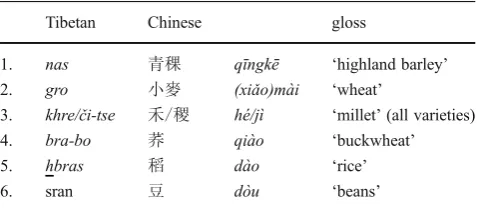
There are six traditional basic crops in Tibet, including five grains, as shown in Table 2. Tibetan forms are cited throughout in a transliteration of the Tibetan orthography; this presumably reflects pronunciation in the eighth to ninth century AD.
Tibetan agriculture has adapted itself to an extreme high altitude environment, in much of which rice cannot be grown; on the other hand, Tibetans grow a highland barley variety and other highland crops such as buckwheat which are not staples among Chinese groups.
The seven basic grains of early Burmese society are reported in Judson (1853/1966:357) as seen in Table3. Twelfth century forms reflect the likely pronunciation at that time.
The Burmans arrived in the hot plains of upper Burma in approximately 832 AD (Luce 1985:101–103) and would have adopted some lowland crops while abandoning upland crops not suitable for the new environment. Thus, unlike all D. Bradley (*)
Faculty of Humanities and Social Sciences, La Trobe University, Melbourne, Australia
closely related TB languages, Burmese has no cognate for ‘buckwheat’but rather uses a Jinghpaw loan. Burmese also uses an Indic loan for‘wheat’and possi-bly another for‘barley’.
The word for the first of the seven grains is said to be a loan from Pali sāli (Myanmar Language Commission 1993:491), which may imply that the Burmans were unfa-miliar withindica rice until they encountered it in cultiva-tion in the irrigacultiva-tion system they inherited from the TB groups of Upper Burma after 832 AD. The ‘barley’ term may also be borrowed from an Indic model,yáva. Five other grain terms are cognate with words in the most closely-related TB languages, as we will see in Table5below. The general word for ‘grain’ in Burmese, especially the rice varieties, is , which is a Mon (Austro-asiatic) loanword.
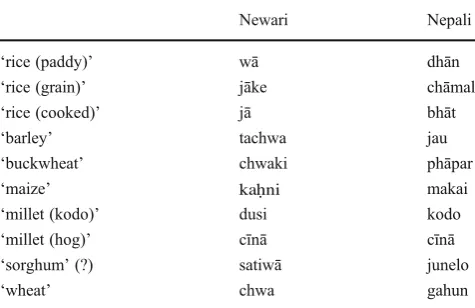
The third long-attested TB language is Newari, now known to its speakers as Nepala Bhasa. Coincidentally, the first dated Newari inscription and the first dated Burmee inscription both come from 1112 AD. The position of New-ari in TB is a matter of debate; it does not fit closely with the Kiranti languages to its east or with the West Bodish lan-guages around it and to its west. Long living in the fertile Kathmandu valley and with extremely strong Indosphere influences, the Newars have rice as their principal grain crop, but many of the usual TB crops are also cultivated. Table4 shows some of these, drawn from various sources (Jørgensen 1936; Bajracharya 1989/90; Kölver and Shreshthacharya 1994; Malla et al. 2000and Manandhar 1986) and repre-sented in transliteration.
As can be seen,‘barley’and‘buckwheat’are compounds containing thechwa‘wheat’etymon, and one millet type is an Indic Nepali loan. The identification of satiwā as ‘sor-ghum’ is not certain; some sources give this forPanicum crus-galli instead or as well. According to Newar history, dusimillet was an important early crop alongside rice.
Discussion
In general, there is a lot of semantic shifting among etyma for grains: general terms for unhusked, husked and cooked grains may shift their main grain referent when the main grain crop changes, as from millet to rice among the early Sinitic groups. As we will see, basic grain terms may also shift referents from one grain to another. Thus, care is needed in reconstructing the original referent of any term.
Rice (Oryza sativavarieties)
This grain is found in the Chinese, Tibetan and Burmese lists of basic grains and in Newari, even though it is not widely grown in upland Tibet. The Tibetan word for rice looks very similar to the Austronesian root*bəras, though direct contact is highly unlikely. The oldest Burmese form appears to be related to the Chinese form 穀 gǔ Karlgren 1226i‘grain’, Baxter (2011) *[k]‘ok. Of course it has also been suggested that this etymon may have an Austroasiatic origin, particularly by those who posit an Austroasiatic origin of indica rice cultivation in mainland Southeast or northeastern South Asia.
Millets
Sagart (1999) has suggested that Panicum miliaceum and Setaria italica cultivation was the basis of early Chinese agriculture in the upper Yellow River valley, before rice and later wheat. Some sources suggest domestication by as early as 7K BP in the likely Sinitic homeland. Both millets also appear in the list of basic Burmese grains, but are somewhat confused in Tibetan and Newari. Many western sources also Table 1 Five Chinese crops
Table 2 Six Tibetan crops
Tibetan Chinese gloss
1. nas 青稞 qīngkē ‘highland barley’
2. gro 小麥 (xiǎo)mài ‘wheat’
3. khre/či-tse 禾/稷 hé/jì ‘millet’(all varieties)
4. bra-bo 荞 qiào ‘buckwheat’
5. hbras 稻 dào ‘rice’
confuse theSetariaandPanicummillets.Eleusine coracana is also widely cultivated by TB groups in South Asia. As millet cultivation has greatly decreased with higher-yielding replacement crops, these terms may also be confounded or lost.
Buckwheat (Fagopyrumspecies)
Fagopyrum esculentum or sweet buckwheat and Fagopy-rum tataricum or bitter buckwheat are widely grown in upland areas where TB languages are spoken, and may have first been domesticated there. It is in the Tibetan basic list and widespread in Burmic languages other than Burmese. There are cognate forms within parts of TB as we will see, but the Chinese term荞 qiáois only attested for less than two millennia (Sagart p.c.) and may be a loan from some Eastern TB language. Pulleyblank (1991:252) reconstructs *giawfor early 7th century AD Chinese, this is suspiciously similar to Eastern TB forms as we will see.
Job’s tears (Coix lacryma-jobi)
Two varieties of this crop are grown as a food grain and for use as beads; in some languages, there are separate words for the grain in these two uses. It appears to be an early crop, possibly first domesticated in the TB-speaking area, and there is some similarity between the Chinese form薏苡yìyǐ(Baxter2011
) and the early Burmese formk-lit. However, this Chinese form is only attested from the Qin Dynasty (2.2K years BP), and may, like the buckwheat term, be a loan from some Eastern TB language.
Sorghum (Sorghum vulgare)
It is said that sorghum was first domesticated in Africa; the date of its introduction to this area is unclear, but the absence of an ST root and of a TB root means that it is fairly late. The Chinese term高粱gāoliang‘high grain’is obviously a compound, and this form is very frequently borrowed into a wide range of TB languages in the Sinosphere.
Wheat (Triticum aestivum), barley (Hordeum vulgare, including a highland variety) and oats (Avena sativa)
These three crops are clearly introduced, and some are less suitable for the probable highland habitat of the early TB speakers. Nevertheless, wheat and barley have become key crops for some TB groups. Given that the Chinese form麥 màiappears to be a loan from Indo-European, possibly via Turkic, there can be no ST etymon; even within TB, there are various forms, as discussed in3.2.6below.
Maize (Zea mays)
Obviously this new world crop can only have been intro-duced less than 500 years ago, so it is impossible for there to be a TB etymon, other than by semantic shift of an existing etymon or due to borrowing of an outside word which came with the crop. Most words for maize in TB languages and in Sinitic are compounds of existing words, such as Chinese玉米 yùmǐ‘jade rice’ and 包穀 bāogǔ ‘wrapped grain’, Bur-mese /pyaun42 bu42/ ‘sorghum-gourd’, Black L a h u ‘w h e a t - b i g’, Ye l l o w L a h u L i s u b o t h
‘rice-wheat’. If similar words are found across lan-guages, this implies that the languages separated less than 500 years ago (as in the case of the syllable /du33/ in Hani ceildu/tshe55 du33/‘paddy-maize’ and Akha av Table 3 Seven Burmese grain crops
Table 4 Newari grain crops
Newari Nepali
‘rice (paddy)’ wā dhān
‘rice (grain)’ jāke chāmal
‘rice (cooked)’ jā bhāt
‘barley’ tachwa jau
‘buckwheat’ chwaki phāpar
‘maize’ makai
‘millet (kodo)’ dusi kodo
‘millet (hog)’ cīnā cīnā
‘sorghum’(?) satiwā junelo
du ‘maize’, Bradley 1997), or had contact less than 500 years ago, even though they are not now in contact (as in the case of Yellow Lahu and Lisu); conversely, the difference between Black Lahu and Yellow Lahu may imply that these two languages separated more than 500 years ago, before the introduc-tion of maize in the area.
Other evidence for early agriculture includes cognate terms for agricultural activities such as planting, terms for stages of grain production such as unhusked grain/husked grain/cooked grain, terms for agricultural implements such as dibbling sticks, and terms for foods made from grains. Again, one must be cautious, as some such words would doubtless have existed in hunter-gatherer societies, such as tools and activities associated with gathering, processing and eating wild grains, and some words may have shifted their referents. However, that is the topic of another paper.
Proto-TB grains?
The best candidates for early TB agriculture are the millets SetariaandPanicum, which were also the basic grains in the earliest Chinese agriculture. Rice was also early, but perhaps not quite early enough. There are various etyma for other grain crops which are found in certain subgroups of TB, but not across all; such shared forms may allow us to date either the last contact or the earliest split date within the subgroups thus defined.
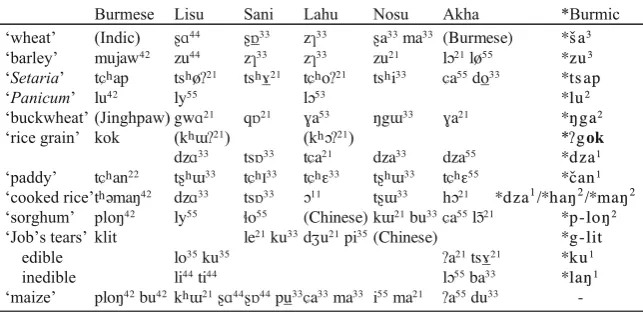
In my opinion it is much safer to reconstruct internally within each branch of Tibeto-Burman with solid and clear phonological correspondences, rather than launching direct-ly into broader comparison. Thus, for example, within Bur-mic we can reconstruct the etyma seen in Table5, revised from Bradley (1997).
The Burmic languages are one of the major components of the Eastern TB group. Burmese represents the Burmish subgroup, while Lisu, Sani and Lahu represent subparts of
the Central Ngwi (Loloish, Yi Branch, Yipho) subgroup, Nosu represents Northern Ngwi and Akha represents South-ern Ngwi. Since we know that the time depth of divergence among these Burmic languages is probably less than two millennia, this illustrates how substantially the system of an individual language can change. Using the reconstruction schema of Bradley (1979), we reconstruct the forms seen in the rightmost column.
Apart from various forms lost or replaced by loanwords, here we see some semantic shifts, such as the Lahu form ‘wheat’ generalized from the ‘barley’ etymon, the Akha form‘barley’from the Panicumetymon, the Akha‘edible Job’s tears’ from the Setaria etymon, and the Lahu form ‘Job’s tears’ from the ‘cowrie’ etymon; the hard-grained variety of this last crop is widely used for beads, as are cowrie shells. We also see the replaced Lahu cognate for ‘wheat’ as the first syllable of‘maize’, as well as the first syllable of Akha compound forms for Setaria and ‘sor-ghum’, and the etymon for‘rice grain’preserved as the first syllable of Lisu ‘maize’, where the second syllable is the ‘wheat’ etymon. Note also the innovative Burmese words for‘barley’and‘cooked rice’, and the variety of terms and combinations even for a relatively widespread and old crop such as‘Job’s tears’; the *g-litHetymon is seen in Burmese, the first syllable in Sani and the first syllable in Akha ‘inedible Job’s tears’; the *ku1 etymon is seen in second syllables in Lisu and Sani; and the*laŋ1etymon is seen as a first syllable in Lisu and Akha, but in forms with different meanings. Thus the semantics of some etyma is less than certain, and more comparison with forms in related lan-guages is required.
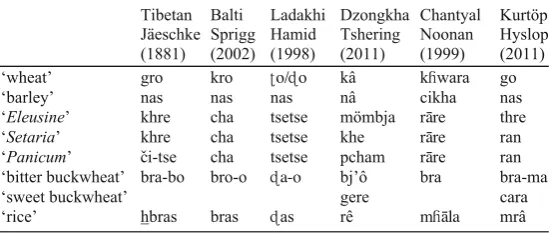
Similarly, if we compare within Tibetan and closely-related Bodish groups as a representative of Western TB, we find the range of forms seen in Table6.
Within Tibetan itself, Balti is the westernmost variety, spoken in northern Kashmir since 737 AD and isolated since conversion to Islam in 783 AD. Ladakhi and Dzongkha are spoken in separate political entities in northeastern Kashmir
and in Bhutan, but maintain contact with standard literary Tibetan. Chantyal is included as a typical West Bodish language of Nepal; Kurtöp is included as a typical Bum-thang/East Bodish language of Bhutan. As can be seen, West Bodish grain crop terminology is mainly distinct; East Bodish is much closer to Tibetan but replaces one of the ‘millet’ etyma with the Tibetan ‘bean’ etymon. It is of course likely that with direct contact between Tibetan and other Bodish languages, some Tibetan words may have been borrowed in place of the regular cognates. If the data is accurate, many Bodish languages have merged the‘millet’ etyma, eliminating one or the other. There are clear and widespread forms for ‘wheat’, ‘barley’, ‘buckwheat’ and ‘rice’, and two sporadically-maintained etyma for types of millet. Other than the Panicum form of Tibetan and the generalized millet form of Ladakhi, none of these is similar to the Burmic etyma discussed above. Various loanword sources have been proposed for the Tibetan‘rice’term.
Table7 compares Burmic, Bodish represented by Tibet-an, Newari and Sinitic.
In Bradley (1997) I speculated that there is a relationship between the BurmicSetariaand SiniticPanicumforms, and there are Tibetan and Newari candidates for cognacy as well. One could also speculate that the Sinitic‘rice’form, the Burmese Panicum form and the first syllable of the Newari Setaria form are related, with various semantic shifts and affixes. Matisoff (2003:163) proposed a Ngwi (Loloish) etymon *g-rafor‘buckwheat’, which might tempt one to reconstruct a TB etymon linking the Tibetan, Burmic and Newari forms, but this is based on an incorrect initial reconstruction for Ngwi; the resemblance is mainly in the rhyme, which is not enough. We have also seen that there is a likely link between the Sinitic ‘grain’ and the Burmic ‘japonica rice’ terms, perhaps with a general meaning ‘grain’.
Looking beyond Burmic, Bodish and Newari to see how grain crop terms are distributed within the major branches of TB, we find interesting patterns which tend to support the classification of TB proposed in Bradley (2002), but which also raise many questions requiring further research.
Rice
Firstly, it should be said that terms for grains at different stages of use (seed/unhusked grain, plant, husked grain, cooked grain) can readily shift referents from one grain to another, so it is unwise to attribute them uniquely to one grain. Secondly, in most modern TB societies rice is the principal grain, and so the semantic shift if any is likely to have been toward rice-related referents. Thirdly, if it is correct that rice was not first domesticated by speakers of Proto-ST or Proto-TB, one would not expect to find a universal reconstructable term. Finally, such words are sub-ject to sociolinguistic change, whereby culturally-important words may have a series of honorific replacements through time, and there may be informal and baby-talk alternatives as well.
If we take the Burmic terms in Table5above as a starting point, unhusked japonica paddy was , husked rice was *čan1, and cooked rice was more variable, *dza1, *haŋ2
or *maŋ2. We can probably dismiss *haŋ2, as in Burmese the cognate haŋ42/hĩ42/ actually refers not to cooked rice but rather to cooked dishes eaten with rice; the Ngwi cognates are restricted to Southern and some Central Ngwi languages in any case. However, there is also a possible Na (transitional between Qiangic and Burmic) cognate form seen in Shixing and Naxi and meaning‘cooked rice’. The*maŋ2form is clearly second-ary; it is seen with a prefixed syllable in Burmese thamaŋ42/thəmĩ42/ and also in Gong /maŋ33/, but not else-where. It is likely that the*dza1etymon is a doublet form of the near-universal Proto-TB verb form *dza ‘eat’, though the latter comes out with a different tone in Burmic:*dza2. This leaves us with no candidate term for cooked rice to trace further back from Eastern TB toward Proto-TB.
Cognates of the ‘grain’term are fairly widespread, not just in Burmese but also in many other Burmish and other TB languages as well as in Sinitic. If this term has the Austroasiatic origin sometimes proposed (Diffloth2005:78 ‘rice’for example), it must be an extremely early loan. Its distribution within ST is not restricted to Sinitic and
Eastern TB, which would have been closest to the early Austroasiatic area; in addition to Qiangic languages such as Tangut/Xixia, Qiang, Guiqiong, Zhaba, Daofu, Luzu and rGyalrung, possible cognates are also found in Bai, Digarish and Mijuish Mishmi and in Tshangla. This puts it also in parts of Central and Western TB, though not in the Sal branch. One might relate various Western TB‘cooked rice’ forms such as West Bodish forms reflecting *kanand Ban-tawa (Kiranti) kok in addition to the apparent East Bodic Tshangla cognate.
The*čan1etymon is found throughout Burmic, also in a nasal-prefixed form in Na languages and in many Qiangic languages. One also finds similar forms with a final velar nasal in some Kuki-Chin languages, from Ao in the north to Mkaang, Thadou and Meithei in the south.
We may also consider the widely-proposed Proto-TB ‘cooked rice’etymon *maior *ma, seen in Sal languages such as Bodo-Garo and Karenic *mai, also *ma in Tani languages, Baime, Karenic *me3 and metathesised forms such as Nungish *am, Sak (Luish) aŋ and so on; we also find forms reflecting *mamaas a baby talk alternative in a number of Ngwi languages and in Qiang, as well as the general Jinghpaw term mam for ‘grain’. There may be a connection here with the Sinitic米 etymon‘(rice) grain’, and a Tani *mietymon with the meaning‘millet’there, noting the semantic shifts and the rhyme problem.
Millets
As we have seen, Burmic has two solid millet etyma,Setaria millet *tsap and Panicum millet *lu2. The former is near-universal among Burmish and Ngwi languages, the latter is less widely attested. As is often the case for Burmic etyma, we find likely cognates for *tsapin a variety of Na and Qiangic languages, including Shixing, Guqiong and Qiang, and in Nungish languages such as Dulong, Anong and Rawang, so this is clearly an Eastern TB etymon. It is tempting to relate this to Tibetantse, Newaridusiand further to Sinitic (Baxter/ Sagart 2011) *tsa[t]s with a semantic shift. Blench (2009) proposes a Proto-STSetariaetymon *tsɔkbased on a differ-ent Chinese form (GSR 0337c in Table1above).
ThePanicummillet etymon *lu is less widespread out-side Eastern TB, but in Western TB we find forms likelis, likorrikin some Kiranti languages (Dumi, Hayu, Thulung,
Limbu) and in Chepang. This may also be where the Tibetan forms derived fromkhrefit, along with West Bodish forms such as Gurung and the second syllable of Thakali raŋre. More commonly encountered are forms reflecting *siseen in various Sal languages including North-ern Naga (Konyak, Phom) and Bodo-Garo *maisi. In West-ern TB, some possible cognates are seen in Kiranti languages such as Thulung sər, not to mention the second syllable of Newari dusi; also in Baise21, Tangut/Xixiaso, and in Karen languages such as Kayan swì. Possible cog-nates related to *siare thus represented in Western, Sal and various smaller subgroups of TB, but not in Central or core Eastern TB. Some Central TB languages support a form *yaŋ as seen in Digarish Mishmi, Mijuish Mishmi and Tshangla; this is possibly related to Tani *yak, Chin *θaaŋ, Jinghpawyaand the first syllable of Thakaliraŋre. Tangkhul hashanshiandrəŋ, the former reflecting *siand the latter perhaps indicating a link between *yaŋ and *lu. Note also the Sinitic‘rice’form and the first syllable of the NewariSetariaform as possible cognates.
In general, much more work is needed to distinguish types of millet in many TB languages. Additional internal reconstruction within branches of TB other than Burmic is also necessary before making further advances in recon-structing back to the Proto-TB stage.
Buckwheat
non-Burmese Burmish languages and so on. More work within various subgroups of TB is required to solidify these very tentative etyma. One should not be misled by the frequent inclusion of the near-universal Proto-TB etymon *ka‘bitter’in many compounds for buckwheat, especially Fagopyrum tataricum which may have been the earlier cultivar in this area.
Job’s tears
Relatively few sources contain this word at all, so the Burmic reconstructions *g-litH,*ku1and*laŋ1can hardly be documented elsewhere, other than the possible loan in Chinese noted above. Post (2011) suggests a Tani group etymon , but cognates are not found outside this group. There appears also to be a Karenic etymon with an initial voiced bilabial stop. It is likely that with better information, a clearer picture would emerge.
Sorghum
As we have seen, Burmic suggests a reconstructed form *p-loŋ2 for this etymon, but it is hardly represented in TB outside Burmish and Ngwi. We might compare the prefix to the etymon *bri found in Kiranti and parts of Northern Qiangic. Thus this crop must be relatively recent, and no TB etymon is reconstructable.
Wheat and barley
There are three main‘wheat’etyma suggested from TB data, including the Burmic*ša3form, forms related to the Tibetan gro form, and some Western and Sal forms suggesting *gom/goŋ: *gom in Bodo-Garo, *g-hoŋ in Chepang, Baram and Luish. The most widespread is the*ša3form, seen in many Qiangic languages (Ersu, Luzu, Pumi, Zhaba etc.), in Namuyi, in Nungish and throughout Ngwi and Burmish. Thus, this appears to be an Eastern TB etymon with diffusion into Nungish.
The Burmic‘barley’etymon *zu3is widely represented in some Qiangic languages (Ersu, Luzu, Pumi, Choyo, Daofu, Ergong, rGyalrung, etc.) with a voiceless initial, and in others (Muya, Qiang) with a voiced initial. In Na languages (Shixing, Na, Naxi) and in Bai, forms have a voiced initial, and in Nungish languages it varies. Cognates are widespread in Northern and Central Ngwi but less so in Southern Ngwi. The Burmese form may be a loan from an Indic source,yáva. As in the case of*ša3‘wheat’, the *zu3 ‘barley’etymon appears to be restricted to Eastern TB. The Tibetannasform is restricted to Bodic, including East Bodic Tshangla, and is occasionally borrowed into other TB languages.
Conclusion
Grain-growing agriculture was the basis of early Sinitic and every large early TB society; however, the actual words for these grain crops do not show clear and regular cognates across the full range of ST and TB languages. The best hypothesis appears to be that gathering and then cultivation of two millets *lu Panicum and *tsap Setaria was very early, but with full etymological evidence obscured by se-mantic shifts as Sinitic and TB groups acquired alternative grain crops and moved into new ecological zones. Rice was later but also early, however the etymological evidence for the cognacy of rice-related lexicon in some branches of TB is less clear; the etymon may have been used for grain in general and later for rice in some languages, and the etymon *mai may have originally been used for cooked grain, later shifting to cooked rice in some TB languages. Van Driem (2009,2011) suggests that the first domesticators of rice were speakers of Hmong-Mien languages in south-eastern China. Other locally-domesticated crops such as buckwheat and Job’s tears appear to have developed much later, possibly spreading from the Eastern TB area into Sinitic. Introduced crops, some of them quite early such as wheat and barley, have also played an important role, and etyma for the earliest of these can be reconstructed back to various intermediate stages, especially for Eastern TB where available data is most detailed, but not to Proto-TB. Even more recently-introduced crops like maize or others such as chillies, tomato, eggplant and potato can be revealing about recent contact and split phenomena. Genetic and contact linguistic relationships of more recent date can be traced through the distribution of words for these secondary crops as well as some primary crops in some languages.
Methods
The comparative method in linguistics has been developed over the last two centuries. It was initially applied to Indo-European languages and subsequently to many other lan-guage families. It involves identifying and comparing basic vocabulary to determine regular patterns of sound similarity and thus identifying cognates (historically related words). These similarities are not necessarily identity. For example, when comparing the number‘2’in various Indo-European languages, we find initialtin English,z(pronounced [ts]) in German,din Latin, Greek, Sanskrit and so on; such patterns are repeated in many cognates; see for example‘10’,‘tooth’ and so on.
which do not follow the regular patterns of sound similarity, but rather reflect the word as it enters from another lan-guage; for example, all the English words with meanings related to‘2’which contain borrowedduo-with initiald.
In applying the comparative method, we may find some false negative results, cases in which the cognate word has disappeared from some or most related languages. If loanwords are not properly identified, there may also initially be some false positive results, similar words which have been borrowed. The cognate words and their meanings allow the recon-struction of a great deal of information about the earlier culture of the speakers of the languages within the family; so, for example, if all words for‘rice’are cognate across a family and the word is not borrowed, we can infer that the ancestral group had rice or some similar plant.
Even the borrowed words are interesting in several ways; firstly, they show the direction of cultural diffusion, for example the word for‘wheat’in Chinese as discussed above. They also reflect changes within the borrowing language after the borrow-ing. To give an English example again, the Latin plural ending–i in words such asalumniis now normally pronounced with the sound [ai] according to a sound change which took place in English around 1600 AD. This means that we can approximate-ly date both the time of borrowing and the various sound changes within a language prior to and after the borrowing.
While all work within the comparative method is necessarily hypothetical, in a large language family like Sino-Tibetan or its component parts Sinitic and Tibeto-Burman we can discover a great deal about earlier stages of human society through its use. This includes its agricultural practices and crops.
Acknowledgements I am very pleased to acknowledge data and sug-gestions from William A. Baxter, Franklin Southworth, Gwen Hyslop, Ken Manson, Mark Post, Laurent Sagart, Karma Tshering and various participants in the Cornell symposium; of course they are not responsible for any conclusions I have drawn. Data not otherwise attributed is from my field notes and/or the STEDT database.
References
Bajracharya AR. N.S. 2046. Namaste Word-book (Nepali, Newari, Hindi, English). Kathmandu: author 1989–90.
Baxter WA. Personal communication. 2011.
Baxter WA, Sagart L. Baxter-Sagart Old Chinese Reconstruction (version 1.00). http://www.crlao.ehess.fr/document.php?id01217 Accessed 1 September 2011. (n.d.).
Blench R. If agriculture cannot be reconstructed for Proto-Sino-Tibetan what are the consequences? Paper presented at the 42nd Interna-tional Conference on Sino-Tibetan Languages and Linguistics, Chiangmai, Thailand, 2–4 November 2009. 2009.
Bradley D. Proto-Loloish. London: Curzon Press; 1979.
Bradley D. What did they eat? Grain crops of the Burmic groups. Mon-Khmer Stud. 1997;27:161–70.
Bradley D. The subgrouping of Tibeto-Burman. In: Beckwith CI, editor. Medieval Tibeto-Burman languages. Leiden: Brill; 2002. p. 73–112.
Diffloth G. The contribution of linguistic paleontology to the homeland of Proto-Austroastiatic. In: Sagart L, Blench R, Sanchez-Mazas A, editors. The Peopling of East Asia: putting together the ar-chaeology. London: RoutledgeCurzon; 2005. p. 77–80.
Hamid A. Ladakhi-English-Urdu Dictionary. Leh: Melong Publica-tions; 1998.
Hyslop G. Personal communication. 2011.
Jäschke HÄ. A Tibetan-English Dictionary. London: Routledge & Kegan Paul; 1881.
Jørgensen H. A Dictionary of Classical Newari. Copenhagen: Levin and Munksgaard; 1936.
Judson, A. Judson’s Burmese-English Dictionary, revised and enlarged by Robert C. Stevenson and F. H. Eveleth. Rangoon: Baptist Board of Publications. 1853/1966.
Kölver U, Shreshtacharya I. A Dictionary of Contemporary Newari, Newari-English. Bonn: VGH Wissenschaftsverlag; 1994. Luce GH. Phases of pre-Pagan Burma, languages and history. Oxford:
Oxford University Press; 1985.
Malla KP, et al. A Dictionary of Classical Newari, compiled from manuscript sources. Kathmandu: CwāsāPāsā. 2000.
Manandhar TL. Newari-English Dictionary, modern language of Kathmandu valley. Delhi: Agam Kala Prakashan. A Vergati (editor); 1986.
Matisoff JA. Handbook of Proto-Tibeto-Burman. University of Cali-fornia Publications in Linguistics 135. Berkeley: University of California Press; 2003.
Myanmar Language Commission. [Myanmar-English Dictionary]. Yangon: Myanmar Language Commission, Ministry of Education; 1993.
Noonan M. Chantyal Dictionary and Texts. Berlin: Mouton de Gruyter; 1999.
Post M. Personal communication. 2011.
Pulleyblank EG. Lexicon of reconstructed pronunciation in Early Mid-dle Chinese, Late MidMid-dle Chinese and Early Mandarin. Vancou-ver: UBC Press; 1991.
Sagart L. The roots of Old Chinese. Amsterdam: John Benjamins; 1999.
Sprigg RK. Balti-English English-Balti Dictionary. London: Routledg-eCurzon; 2002.
Tshering K. Personal communication. 2011.
van Driem G. Rice and the Austroasiatic and Hmong-Mien homelands. Paper presented at 4th International Conference on Austroasiatic Linguistics, Mahidol U; 2009.