R E V I E W A R T I C L E
Conversion of technical lignins to functional materials
with retained polymeric properties
Yasuyuki Matsushita
Received: 29 November 2014 / Accepted: 8 January 2015 / Published online: 4 April 2015 ÓThe Japan Wood Research Society 2015
Abstract A significant amount of technical lignins is produced in the pulp and paper industries. However, most technical lignins are burned for thermal recycling and a few percent are used as materials, such as lignosulfonate as a dispersant. Native lignin has a highly complex structure and is susceptible to structural variations depending on the pulping process, thus hindering the effective utilization of lignins. The procedures used to convert lignins into func-tional materials include depolymerization to monomeric fragments followed by re-building to functional materials, and chemical modifications to generate functional poly-mers with retained polymeric properties. In this paper, the latter is disserted. The characteristics of technical lignins, which include kraft lignin, lignosulfonate, and organosolv lignin, and their conversion to functional materials such as polyesters, polyethers, polyurethanes, etc. and the appli-cations of lignin-based materials in some fields are discussed.
Keywords Technical ligninFunctional material Lignin-based materials
Introduction
Almost 170 years ago, a French chemist named Anselme Payen treated wood with concentrated nitric acid and
caustic soda to yield two different products, namely ‘‘cel-lulose’’ and an ‘‘incrusting material’’. The latter possessed a high carbon content and was termed ‘‘lignin’’, which was derived from the Latin wordlignummeaning wood. After that, Kason studied the composition of lignosulfonates and postulated that lignin is a macromolecular substance composed of coniferyl alcohol. He also developed many valuable procedures for lignin analysis that are still widely used today. In 1930, Erdtman studied the oxidative dimerization of phenols and concluded that lignin must be formed from a,b-unsaturated coniferyl alcohols via enzy-matic dehydrogenation. Freudenberg and co-workers con-ducted comprehensive studies during 1940–1970 and stated that the polymerization of lignin precursors is indeed car-ried out in this manner and leads to carbon–carbon and alkyl-aryl ether linkages. The structure of lignin is highly complicated, and many researchers continue to investigate its structure today [1,2].
As mentioned above, the chemical structure of lignin consists of three basic phenylpropane units, which origi-nate from p-coumaryl, coniferyl, and sinapyl alcohols. During biological lignification, the phenylpropane units are connected via radical coupling reactions to form a complex three-dimensional macromolecule [3]. The major linkage types include b-O-4, b-5, b-b, and 5-5 linkages among others. The lignin composition and content vary according to species. For example, softwood lignin is primarily composed of coniferyl alcohol with trace amounts ofp-coumaryl alcohol, whereas hardwood lignin is made of coniferyl and sinapyl alcohols with trace amounts ofp-coumaryl alcohol. Furthermore, grass lignin is composed of p-coumaryl, coniferyl, and sinapyl alcohols.
A large amount of biomass is present on the earth, and biochemicals derived from biomass are expected to reduce This review article is published to coincide with the 60th anniversary
of the Japan Wood Research Society.
Y. Matsushita (&)
Graduate School of Bioagricultural Sciences, Nagoya University, Furo-cho Chikusa-ku, Nagoya, Aichi 464-8601, Japan
atmospheric carbon dioxide levels. Polysaccharides in biomass, such as cellulose, have been used in many fields including in the production of pulp, paper, fibers, and fil-ters, while only a small amount of lignin is utilized to produce commercial materials, even though they are the main component of biomass. It is estimated that there is about 391011metric tons of lignin and 291010 tons is biosynthesized per year [4]. As such, it is necessary to determine effective ways to utilize lignin.
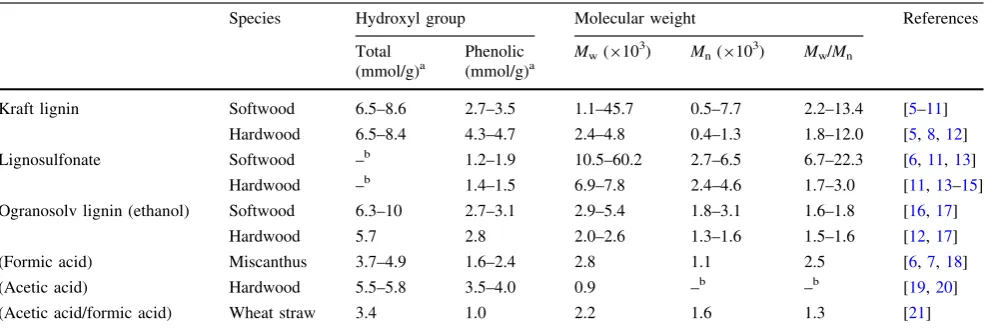
Nowadays, technical lignins can be generated as a by-product of the pulping process. The major commercial lignins include kraft lignin and lignosulfonate. Other lig-nins such as organosolv liglig-nins are obtained from the pulping process using organic solvents such as ethanol, acetic acid, and formic acid among others. The structure of lignin differs depending on the isolation process. The functional groups and molecular weight also vary among the different types of lignins. The functional groups, type of phenylpropane units, linkage between structural units, and molecular weight distributions restrict the applications of lignin as an industrial material. Table1 details the characterization of lignins.
The typical procedures carried out prior to the uti-lization of technical lignins can be categorized into two groups: (1) depolymerization to monomeric small frag-ments followed by re-building into functional materials, and (2) chemical modification to functional polymers with retained polymeric properties. While both approaches have advantages and disadvantages, energy consumption may be lower in the latter system than in the former system. In this paper, the latter method and applications of functionalized lignin-based polymers in a variety of fields as well as the characteristics of technical lignins are discussed.
Characterization of technical lignins
Kraft lignin
The sulfur (1–2 %) in kraft lignin occurs as elemental and organically bound sulfur [22,23] and some extractives may also exist in kraft lignin [24,25]. During the kraft pulping process, lignin is subjected to depolymerization. Simulta-neously, the depolymerized lignin fragments are re-poly-merized, thus resulting in a lower reactivity and thereby limiting their potential for further condensation without the use of a cross-linking agent. Some representative structures are shown in Fig.1 [26, 27]. The important reactions in kraft pulping have been investigated using model com-pounds (Fig.2) [28,29] and are described below.
Degradation reactions
– Formation of quinone methide intermediate by loss of anion from the Ca-position of the phenolate ion. – Addition of hydrogen sulfide ion in Ca-position leading
to re-aromatization.
– Sulfidolitic cleavage of phenolic b-aryl ether bond by hydrogen sulfide.
– Alkali-promoted elimination of terminal c -hydrox-ymethyl group of phenolic b-aryl ether resulting in the formation of alkali-stable vinyl ether.
– Sulfidolytic cleave of methyl-aryl ether bond leading to the generation of catechol structure and methanethiol.
Condensation reactions
– Reaction of quinone methide intermediate with other nuclei, involving the 5-position of ring.
Table 1 The characterization of technical lignins
Species Hydroxyl group Molecular weight References
Total Phenolic Mw(9103) Mn(9103) Mw/Mn (mmol/g)a (mmol/g)a
Kraft lignin Softwood 6.5–8.6 2.7–3.5 1.1–45.7 0.5–7.7 2.2–13.4 [5–11]
Hardwood 6.5–8.4 4.3–4.7 2.4–4.8 0.4–1.3 1.8–12.0 [5,8,12]
Lignosulfonate Softwood –b 1.2–1.9 10.5–60.2 2.7–6.5 6.7–22.3 [6,11,13]
Hardwood –b 1.4–1.5 6.9–7.8 2.4–4.6 1.7–3.0 [11,13–15]
Ogranosolv lignin (ethanol) Softwood 6.3–10 2.7–3.1 2.9–5.4 1.8–3.1 1.6–1.8 [16,17]
Hardwood 5.7 2.8 2.0–2.6 1.3–1.6 1.5–1.6 [12,17]
(Formic acid) Miscanthus 3.7–4.9 1.6–2.4 2.8 1.1 2.5 [6,7,18]
(Acetic acid) Hardwood 5.5–5.8 3.5–4.0 0.9 –b –b [19,20]
(Acetic acid/formic acid) Wheat straw 3.4 1.0 2.2 1.6 1.3 [21]
a Some data were modified unit from original references
– Reaction of formaldehyde, generated by elimination of terminalc-hydroxymethyl group, with aromatic nucle-us resulting in diphenylmethane structure.
Enol ethers are formed during the kraft pulping process via formaldehyde elimination from b-O-4-containing struc-tures in the reverse aldol reaction through the cleavage of the Cb-Cc bond. The structures of the enol ethers are de-tected in kraft lignin due to their stability under alkaline conditions. However, the number of enol ethers in kraft lignin is quite small as compared to the numbers observed in experiments using model compounds [25,30,31]. Using two-dimensional nuclear magnetic resonance spectroscopy (2D NMR), it was revealed that the possibility for the formation of diarylmethane structures is limited [25, 30]. The authors implied that this was due to the limited formaldehyde elimination. On the other hand, some reports have detailed the elimination of the c-hydroxymethyl group as one of the major reactions during kraft pulping. Terashima et al. [32] investigated kraft pulping using radio tracer experiments. Using c-14C labeled lignin, they con-cluded that a large portion of the eliminated c-carbon fragments were converted to water-soluble compounds
with a low molecular weight. As such, much of the eliminated c-carbon fragments may combine with low molecular weight compounds, which may lead to solubi-lization. A small portion of thec-carbon fragments formed formaldehyde may participate in the formation of insoluble diarylmethane in precipitated kraft lignin.
During kraft pulping, cellulose and hemicellulose are degraded and some of the degraded compounds are modified to carboxylic acids such as glycolic acid and lactic acid. The total amount of carboxylic acids corresponds to about 20 % of the wood weight in black liquor. To obtain kraft lignin, an acid precipitation or enzyme treatment is typically carried out. However, the complete removal of the carbohydrate derivatives is difficult, resulting in contamination [33]. The
a-hydroxy carboxylic acids formed by aldol condensation reactions between degraded aldehyde-containing lignin fragments and keto or aldol type carbohydrate-derived fragments, followed by benzylic acid rearrangement have been observed (Fig.3) [29, 33–36]. Lignin-carbohydrate (LC) ether bond formation between lignins and carbohy-drates at thebposition was suggested based on reactions with non-phenolic model compounds [37].
The possibility of the homolytic degradation of the
b-O-4 linkage of quinone methide moieties, especially
b-syringyl types, was proposed under alkaline cooking
conditions followed by the generation of coupling products such as resinols [38–41]. Coniferyl alcohol was observed in kraft black liquor [42]. Notably, coniferyl alcohol was polymerized with another degraded fragment of lignin [43]. Theb-O-4 linkage content in black liquor was reported to decrease with increased cooking times, but was still observed at the end of the cooking period. Taneda et al. [44] reported that non-phenolic b-O-4 structures with hy-droxyl groups in the a-position could be degraded easily via kraft cooking. However, structures with a benzyl ether bond between carbohydrates showed high resistance to degradation. Such structures cannot form quinone methide moieties during cooking, thus leading to the restricted cleavage of theb-O-4 linkage. The b-O-4 linkage can be cleaved via participation of c-hydroxyl groups, but the reaction rate is slow. Thus, the remaining b-O-4 linkages could be of the non-phenolic type with a benzyl ether bond [25].
In some studies, kraft lignin was subjected to frac-tionation prior to analysis. Lindberg et al. [45] fractionated kraft lignin by soxhlet extraction with organic solvents. Mo¨rck et al. [23] separated softwood kraft lignin into five fractions via successive extractions with organic solvents. They reported that the polydispersity in the high molecular weight fraction was higher than that in the low molecular Condensation reactions
Degradation reactions
Fig. 2 Typical reactions of lignin during kraft pulping process [28,29]
weight fraction. The high molecular weight fraction con-tained a considerable amount of carbohydrates (8.7 %). The methoxy and acidic group contents decreased with increased molecular weights. According to the 13C NMR analysis, a saturated side chain was present, which indi-cated that reductive reactions were likely occurring during the kraft cooking. The saturated moieties were prevalent in the low molecular weight fraction. The number ofb-O-4 linkages increased with increasing molecular weight. Phenylcoumaran (b-5) and pinoresinol (b-b), likely in their etherified forms, were also found in the high or low molecular weight fractions. a-ketones, a-aldehydes, and o-quinone structures were also detected via 13C NMR. Furthermore, c-ethers were proposed based on 2D NMR [25,46].
Lignosulfonate
Typically, delignification occurs under acidic or neutral conditions during sulfite cooking. The reaction mechanism and the structure of lignosulfonate have been studied using model compounds [47–51]. The delignification reaction mechanism during sulfite pulping is as follows (Fig.4): 1. Quinone methide intermediates are formed by loss of
the hydroxyl group or cleavage of thea-ether linkage. Under neutral conditions, the reaction proceeds with phenolic-type substrates, while under acidic conditions it proceeds with phenolic and non-phenolic-type substrates via a benzylic cation.
2. Sulfite ions add to the quinone methide intermediates at thea-position to produce benzyl sulfonic acid units. 3. When the sulfonation reaction proceeds under neutral conditions, the electron withdrawing effect of the a -sulfonic acid group of theb-O-4 moiety facilitates the nucleophilic attack by the sulfite on theb-carbon atom resulting in the sulfitolytic cleavage of theb-aryl ether bond.
4. Under acidic conditions, a condensation reaction occurs between the benzylic carbon and the carbon in the 6-position of another nuclei owing to the benzylic cation.
Upon introduction of the sulfonic acid groups, lignin becomes hydrophilic, and exhibits enhanced water solubi-lity. The number of sulfonated groups in lignosulfonate varies from 0.4 to 0.7 per phenyl propane unit [11,52].
Based on an investigation using radio isotope labeling, Araki et al. [53] concluded that the changes in lignin during the sulfite pulping process were smaller than those that occurred in the kraft pulping process.
According to the aforementioned reaction mechanism of sulfite pulping, the putative lignosulfonate structure based
on Sakakibara’s lignin model [54] is subjected to sulfite pulping as shown in Fig.5.
NMR analysis of lignosulfonate has been also reported. Lutnaes et al. [55] characterized fifteen monomeric and seven dimeric sulfonated model compounds by NMR. However, the NMR study of lignosulfonate is little [52].
The overall structure and shape of lignosulfonate is not well-established. Gardon and Mason [56] were the first to
Acidic condition
Sulfonation
Condensation reaction
Neutral condition Sulfonation
report that lignosulfonates behave as flexible polyelec-trolytes. They concluded that the degree of molecular branching in high molecular weight lignosulfonates was greater than that in the low molecular weight fractions. In neutral aqueous solutions, the sulfonate groups are ionized and lignosulfonates possess an overall negative charge. According to previous studies, lignosulfonate is believed to form microgels in solution [57, 58]. Recently, Kontturi et al. [59] showed that lignosulfonate exhibits a confor-mational change from a compact sphere to an unwinding coil under electric fields. This transformation does not occur if the lignosulfonate is in a gel with cross-links. To resolve this contradiction, Myrvold [60] proposed a ran-domly branched polyelectrolyte structure, in which the sulfonate groups were less prevalent in the backbone than in the side chains, suggesting that the backbone was more
hydrophobic. In aqueous solutions, polymeric lignosul-fonate molecules coil to form a spherical shape with the sulfonate groups on the surface. As such, the randomly branched polyelectrolyte model suitably explains the so-lution behavior of the macromolecule.
Organosolv lignin
Organosolv lignins can be obtained from the black liquor of biomass using organic solvents such as ethanol, acetic acid, and formic acid among others. Organosolv lignins can be recovered by precipitation by adjusting conditions such as temperature, pH, and concentration. Generally, organo-solv lignins have high purity and with solubility in organic solvents as well as a low molecular weight and a low polydispersity. They are insoluble in water due to their
hydrophobicity. Organosolv lignins do not contain sulfur, which is a significant advantage for environment applications.
The Alcell process is a typical organosolv process using aqueous ethanol, which was developed by Repap Enter-prises and was commercialized in 1989 [61]. The Alcell process involves organosolv pulping with delignification using aqueous ethanol as the cooking liquor. The pH of the cooking liquor is relatively low, owing to the generation of organic acids from hemicellulose. As such, the cooking process is carried out under acidic conditions. The pro-tolignin can be subjected to condensation reactions be-tween thea-position of the side chain and the 6-position of another aromatic ring [62,63]. Liu et al. studied the con-densed phenolic groups in solubilized and residual lignin during the Alcell process by 31P NMR. Accordingly, the condensed phenolic OH content of Alcell lignin (solubi-lized lignin) was lower than that of kraft lignin because some of the protolignin was condensed during the Alcell process, which led to issues with solubility and pulp re-tention [64].
Acetic acid has been employed to obtain acetosolv lig-nins from hardwood, softwood, and grass. In the presence of a catalytic amount of a strong acid such as sulfuric acid, extensive and selective delignification can be accomplished [20, 65–70]. The delignification mechanism and the structure of acetic acid lignin have been investigated using model compounds [71–73]. The reactions include acety-lation of hydroxyl groups, acidolysis, hydrolysis, and ho-molytic cleavage ofb-aryl ethers, as well as elimination of the hydroxyl group at thec-position as formaldehyde. In-ter- and intra-molecular condensations also occur during acetic acid pulping.
In the early 1900s, Pauly developed a delignification process using formic and acetic acid, and Freudenberg et al. used formic acid as a wood pulping solvent [74]. Recently, BioligninTMwas produced by the CIMV process from wheat straw by cooking it with a mixture of acetic acid, formic acid, and water on a pilot scale [21]. Bi-oligninTM was characterized by a low molecular weight, low polydispersity, and numerous free hydroxyl groups.
Functionalization of technical lignins
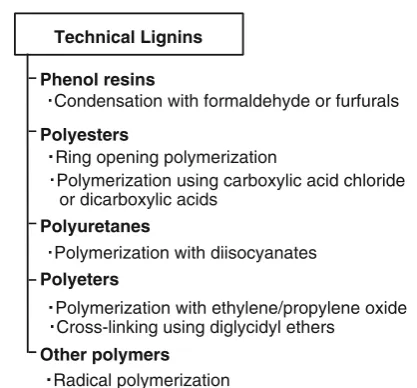
Major conversion reactions including phenolic resination, esterification, etherification, urethanization, and radical polymerization will be discussed in this section (Fig.6). Phenolic resination
Lignin contains phenolic OH, making it an interesting alter-native to phenol in the production of phenol–formaldehyde
(PF) resins [75]. In the 1970s, after 6 years of basic re-search and development, the Finnish Pulp and Paper Re-search Institute developed a lignin-based adhesive called Karatex. Accordingly, the high molecular weight fraction of lignosulfonate or kraft lignin could be used to displace at least 40 %, and on occasion as much as 70 %, of phenol in PF resin [75,76]. The commercial plant for the production of Karatex was established in Finland and had an annual capacity of 2000 tons of purified kraft lignin.
Formaldehyde reacts with lignins in the presence of alkali species, both by substitution at the free 5-position in the phenolic nuclei via a Lederer-Manasse reaction, and by the Tollens reaction on the side chains bearing carbonyl groups, which results in the introduction of a hydrox-ymethyl group. Kraft lignin has an extremely low reac-tivity, as it was estimated that there are only 0.5 mol per OCH3reactive sites on pine kraft lignin available for re-action with formaldehyde [77]. Studies conducted by Marton and co-workers revealed that about 30 and 10 hy-droxymethyl groups are introduced by the Lederer-Mana-sse reaction and by the Tollens reaction, respectively [77]. Zhao et al. reported a kinetic study regarding the hydrox-ymethylation of pine kraft lignin. They concluded that about 0.36 mol of CH2OH/C9 units was introduced under the optimal reaction conditions, of which about 0.33 mol was introduced on the C-5 of guaiacyl moieties via the Lederer-Manasse reaction [78].
The reactivity of kraft lignin towards formaldehyde depends on the wood species, owing to the difference in methoxy group substitution and the number of condensed linkages between the phenyl propane units. The use of softwood lignin is more advantageous in the production of PF resins containing lignin than that of hardwood lignin because hardwood lignin contains syringyl units, which results in a reduced number of free 5-position in the
Technical Lignins
Polyesters
Polyuretanes
Polyeters Phenol resins
Other polymers
Condensation with formaldehyde or furfurals
Ring opening polymerization
Polymerization with diisocyanates
Polymerization with ethylene/propylene oxide
Radical polymerization or dicarboxylic acids
Polymerization using carboxylic acid chloride
Cross-linking using diglycidyl ethers
phenolic moieties. However, some studies have reported the use of kraft lignin from Eucalyptus [79, 80], alkali bagasse lignin [81,82], kraft lignin from bamboo [79], and straw [83] for production PF resins that contained lignins. Lignosulfonate can be also used to produce lignin-con-taining PF resins. Alonso et al. [13] evaluated the reactivity of various lignosulfonates towards formaldehyde. Soft-wood lignosulfonates exhibited higher reactivity towards formaldehyde than hardwood lignosulfonates, and soft-wood ammonium lignosulfonate showed the highest reac-tivity. Peng et al. studied the kinetics of lignin hydroxymethylation. They reported that lignosulfonates could be hydroxymethylated at a lower temperature than phenol owing to the lower activation energy of lignosul-fonates [84]. Ultra-filtrated high molecular weight ligno-sulfonate (LS) can be used to manufacture insulation boards based on mineral wool, as it forms an adhesive when combined with phenol resin [85]. Notably, LS/PF resins with compositions ranging from 10/90 to 30/70 have appropriate technical and commercial properties.
Organosolv lignin can be used for PF resin. Ethanol lignin, which is obtained from ethanol–water pulping, can be applied in the production of adhesives. Ayla reported that a resin composed of 90 % ethanol lignin (isolated from beech or pine wood) and 10 % phenol led to boiling proof bond according to the German Standards [86]. Formacell and Acetocolv lignins fromEucalyptuscan be used in PF resins [19,87,88]. Sano and Ichikawa prepared PF resins containing cresol lignin, which was obtained from solvolytic pulping of hardwood chips with aqueous cresols. They showed that at least 90 % of the phenol resins could be replaced by the cresol lignin [89]. During solvolysis using a cresol-water system, a significant amount of cresol (10–30 % cresol) was introduced onto lignin, resulting in an improved reactivity towards formaldehyde. This system showed comparable performance to commercial PF resins, however, cresol lignin could not be commercially avail-able. Upon addition of resorcinol to cresol lignin-phenol resins, moderate-temperature setting adhesives (room temperature setting followed by hot press) could be pre-pared. Sano et al. [90] also reported moderate-temperature setting lignin-based adhesives based on resorcinol and cresol lignin.
In general, the adhesive bonding strength of PF resins containing lignin is comparable to that of commercial PF resins. However, unmodified lignin is not viable for com-mercial adhesive applications due to the requirement of a high hot-press temperature and long curing time [91].
To overcome this disadvantage, modifications to the chemical structure of lignin have been attempted. Numer-ous reports have been published regarding the preparation of modified lignins for applications as PF adhesives [91– 93].
Notably, phenolation has been shown to increase the reactivity of PF resins towards formaldehyde. Specifically, under acidic conditions, phenols were introduced at thea -position of lignin [94–100]. Phenolation can also occur under alkaline conditions, and the reaction mechanism is similar to that of condensation that occurs during kraft cooking [101, 102]. Kobayashi et al. [103–105] subjected kraft lignin to phenolation and observed a 2–2.5 times higher reactivity than that of unmodified kraft lignin.
Another potential modification is demethylation. Shashi et al. [106] used dichromate in the presence of acetic acid to decrease the amount of methoxy groups in kraft lignin from 11.9 to 2.8 % and to increase the amount of phenolic hydroxyl groups from 2.4 to 11.2 %. Hayashi et al. [107] reported the demethylation of lignosulfonate using K2Cr2O7. An adhesive can be manufactured using demethylated softwood kraft lignin with increased reac-tivity towards formaldehyde [108]. Through this pretreat-ment, the replacement of the demethylated lignin by phenol increased to 90 % [109]. Demethylation is an effective way to improve the qualities of lignin-containing PF resins. However, Cr is toxic. Lignin can be demethylated and degraded by treatment with alkali species at high tem-peratures [110–113]. Pine kraft lignin was subjected to pretreatment using a 10 % solution of sodium hydroxide at 125 °C for 1 h to demethylate the guaiacyl unit, resulting in the generation of a catechol unit. The pretreated kraft lignin was used to manufacture a PF resin. The bonding ability of the PF resin in which 40 % of the phenol moieties was replaced was comparable to that of commercial PF resins [114].
Partially depolymerization has also been reported as an effective route towards highly reactive lignin species. Pine ethanol lignin was degraded in aqueous ethanol with cat-alysts, Ru/c-Al2O3 and Ni/activated carbon, at[300°C under an H2atmosphere [115]. The molecular weight of the ethanol lignin decreased by about half during the treatment, and the phenol replacement in the PF resin was 75 %. According to1H-NMR analysis, hydrogenolytic/hydrolytic cleavage of the aryl–alkyl ether, i.e., the b-O-4 linkage, occurred to generate new phenolic and secondary hydroxyl groups during the degradation.
Phenolic foams are made from phenol and formaldehyde with appropriate combinations of flowing agents. They have excellent fire-resistant properties and do not produce harmful smoke upon exposure to flames, while rigid plastic insulation materials such as polystyrene, polyurethane, and polyethylene do produce smoke. Moreover, they also possess other outstanding characteristics such as thermal insulation, heat resistance, chemical resistance, weather-ability, and workability. Phenolic foams are widely used in a broad range of applications including as building mate-rials, in automobiles, and in aircraft [118]. For example, Hu et al. [119,120] utilized phenolated lignosufonate in phe-nolic foams as a replacement for phenol. They showed that the produced foams had a lower density, superior tough-ness, and excellent thermal insulation as compared to those of foams obtained from conventional resol resins, and thus were useful for practical applications. A 30 wt% reduction in the molecular weight was accomplished via replacement of phenol with oxidatively degraded lignosulfonate [120]. Several procedures have been developed for the pro-duction of phenolic adhesives and resins without the use of formaldehyde. It is well-known that starch can be hy-drolyzed into monosaccharides, which can be further de-hydrated into furfural derivatives. Thus, hydrolysates could be used in phenolic resins [121]. Zhang et al. reported the replacement of formaldehyde with hydrolyzed starch using liquefied phenolated lignosulfonate to produce a PF resin [122] with acceptable physicochemical specifications, thermal resistance, and mechanical properties as compared to the PF resin.
Esterification
Typically, three procedures are applied to produce lignin-based polyesters: ring opening reactions with cyclic esters, condensation polymerization using carboxylic acid chlo-ride, and dehydration polymerization with dicarboxylic acids.
Oliveira and Glasser [123] reacted e-caprolactone with hydroxypropylated softwood kraft lignin to yield lignin-based polyesters. This polyester formed a star-like shape with hydroxypropylated lignin as the core of the star and polycaprolactone as the hard arm segments. They estimated the average number of arms per core ranged between 2 and 7, and theTmincreased with the arm length as the degree of polymerization of e-caprolactone increased to 50. Hirose et al. [124] prepared alcoholysis lignin-based polyesters using e-caprolactone and investigated the thermal degra-dation behavior of the polyesters using thermogravimetry-Fourier transform infrared spectroscopy (TG-FTIR). The mass residue at 500°C decreased with increasing e -caprolactone/hydroxyl group ratios. The thermal degrada-tion of the polycaprolactone chain began at 430°C.
Matsushita et al. [125] prepared lignin-based polyesters using alkali hydrothermalized acid hydrolysis lignin with
e-caprolactone. Following the alkali hydrothermal reaction, acid hydrolysis lignin could be dissolved in water at a neutral pH owing to the introduction of carboxylic acid moieties [126]. Based on differential scanning calorimetry, swelling tests, and dynamic mechanical thermal analysis, the obtained polyester formed a three-dimensional network via interactions between the hydroxyl and carboxyl groups of the lignin and polycaprolactone chain, and did not dis-solve in organic dis-solvents or melt at high temperatures. In addition to e-caprolactone, lactide also has been used for copolymerization with lignin. Chung et al. [127] produced a lignin-polylactide polyester in a metal- and solvent-free system using triazabicyclodecene as a catalyst.
Guo et al. [128] prepared lignin-based polyesters from softwood kraft lignin and dicarboxylic acid chlorides, se-bacoyl chloride, and terephthaloyl chloride via condensa-tion polymerizacondensa-tion in organic solvents. The obtained polyesters were mostly cross-linked polyesters owing to participation of the aliphatic and phenolic hydroxyl groups as well as the dicarboxylic acid chlorides. Moreover, they were thermally stable up to 200 °C under a nitrogen at-mosphere. Guo et al. also investigated the use of poly-ethylene glycol as a co-monomer and solvent for kraft lignin. However, the obtained polyesters exhibited a lowTg and formed elastomers at room temperature. The lignin content was only 35 % [129]. Recently, Luong et al. [130] produced lignin-based polyesters using kraft lignin and sebacoyl chloride.
Several dehydration polymerization procedures using di-carboxylic acids have been proposed. Fang et al. [131] syn-thesized a dicarboxyl acid by the dimerization of unsaturated fatty acids derived from natural oils. The dimeric acid was applied in the coesterification with enzymatically hy-drolyzed, steam-exploded cornstalk lignin. This dicarboxylic acid had a long alkyl chain, which made the co-ester flexible. The lignin content reached approximately 60 %. Hardwood kraft lignin could be reacted with carboxytelechelic polybu-tadiene to produce lignin-based polyesters. The use of high molecular weight kraft lignin or pre-polymerized kraft lignin using formaldehyde facilitated the preparation of free standing films. An ionic linkage between the lignin and car-boxytelechelic polybutadiene was formed, in addition to covalent linkages, which had an effect on the properties of the polyesters [132]. To improve the thermal–mechanical prop-erties, dehydration copolymerization of lignin with hyper-branched prepolymers containing carboxylic acid moieties, which were synthesized from triethanolamine, tris(hydrox-ymethyl)aminomethane, and dicarbonic acid by melt poly-condensation, was proposed [133,134].
increase the reactivity for the production of lignin-based epoxy resins [135–137] and polyurethanes [138].
Etherification
The primary procedures utilized for the preparation of lignin-based polyethers include the following: (1) poly-merization using ethylene oxide and propylene oxide, (2) polymerization using epichlorohydrin, (3) cross-linking using diglycidyl ethers, and (4) solvolysis of wood chips with ethylene glycol to introduce ethylene glycol chains into lignin. In most cases, a combination of the afore-mentioned procedures is utilized.
The aromatic moieties within lignin improve the thermal and mechanical properties of epoxy resins. Hofmann and Glasser [139] prepared epoxy resins from steam explosion lignin by hydroxyalkylation using propylene oxide and ethylene oxide. Subsequently, the reaction mixture was treated with epichlorohydrin and was cured with m-phe-nylene diamine for cross-linking. The modulus and ulti-mate strength of the prepared epoxy resin increased with increasing lignin contents, while the ultimate strain de-creased. The strength of the resins was comparable to those of the diglycidyl ether of bisphenol A-based resins.
The phenolic hydroxyl groups in lignin allow for the partial substitution of bisphenols in epoxy resins. Lignin-epoxy resins were synthesized by the poly-addition reac-tion between epichorohydrine and lignosulfonate in an al-kali medium to obtain lignin-epoxy prepolymers, which were used in the cross-liking reaction with phthalic anhy-dride or diaminodiphenylmethane [140]. The resulting films absorbed atmospheric humidity to a small extent. The shear strengths of wood samples glued with the lignin-based epoxy resin were above 20 kgf/cm2, which was comparable to those of commercial epoxy adhesives.
To improve the reactivity of lignin, phenolation was applied. Lignosulfonate was submitted to phenolation us-ing phenol [141, 142], beta-naphtol [141], and bisphenol [141] to increase the phenolic hydroxyl group content and was then epoxidized using epichlorohydrin.
It is reported that organosolv lignin [143–146] and kraft lignin [147–149] could be modified upon reaction with several epoxylated polyethylene glycol (PEG) derivatives. To reduce the cost of preparation, the modification was also carried out using kraft cooking black liquors, since the alkali species were retained and acted as catalysts [149]. Uraki et al. [143] produced amphiphilic lignin derivatives from acetic acid lignin (AL) via reaction with polyethylene diglycidyl ethers (PE) and lignin-based gels by increasing the lignin concentration in the same reaction [144]. The gel with a PE/AL ratio of 0.57 exhibited unique swelling properties against aqueous ethanol. It swelled with in-creasing ethanol concentrations, and reached the maximal
swollen state at 50–60 %. Nonaka et al. [147] reported the viscoelastic properties of kraft lignin-based epoxy resins using PE cured with dialiphatic amines. The peak tem-perature of the loss modulus increased with increasing kraft lignin contents and decreasing ethylene oxide chains of the PEs. Those resins exhibited very broad relaxations due to the glass transition, thus they could be applied as adhesives or damping materials to reduce the emitted noise and vi-brations. Lin synthesized a non-ionic dispersant by grafting PEG on softwood kraft lignin using epichlorohydrin [150]. The direct grafting of ethylene glycol chains into lignin from woody biomass was carried out by solvolysis using ethylene glycol. Kubo et al. [151] proposed a biomass conversion system using ethylene carbonate/ethylene gly-col. Specifically, softwood meal was submitted to solvo-lysis at 150 °C to dissolve the starting materials. Following extraction with water, the lignin fraction was obtained as a water-insoluble solid. Ethylene glycol chains were intro-duced into the lignin primarily on the hydroxyl groups at the a andc-positions. The average degree of polymeriza-tion (DP) was approximately 3.0. Instead of ethylene gly-col, polyethylene glycol can be used. Lin et al. [152,153] produced PEG-lignin using polyethylene glycol 400 (PEG 400).
Urethanization
cardanol, which is a natural alkyl phenol from the liquid produced from cashew nut shells, produced flexible poly-urethane films with toluene diisocyanate as the long alkyl chain of cardanol can act as a plasticizer [161]. This treatment led to an increase in the lignin content in the polyurethane films up to more than 30 %.
Evtuguin et al. [162] used oxygen-organosolv lignins, which were obtained from oxygen pulping in organic sol-vent–water media, to manufacture lignin-based poly-urethanes. The oxygen-organosolv lignins were functionalized with numerous carboxyl and hydroxyl groups [163]; elastomeric polyurethanes could be prepared upon combination with oligoethyleneoxide diisocyanate (Mn=600) without the addition of any other polyols. The lignin content in polyurethane reached approximately 30 %. Chain-extended hydroxypropylated lignin, which was obtained by reaction with propylene oxide, can be also used to produce polyurethane films without any other polyols [164,165].
Hatakeyama et al. [166] investigated the relationship between lignin content, NCO/OH ratio, and mechanical properties in lignin-based polyurethanes. Using softwood kraft lignin, a commercial propylene oxide-based polyether triol, and polymeric methylene diphenyl diisocyanate, they concluded that a low NCO/OH ratio (\1) had specific ef-fects on the network formation and influenced the perfor-mance of the polyurethane. High kraft lignin contents led to hard and brittle polyurethanes, regardless of the NCO/ OH ratio.
Usually, polyurethane foams are prepared by the reac-tion between polyols and diisosyanates with the addireac-tion of a surfactant and water. Petroleum-based polyols can be replaced with lignins. Pan and Saddler used hardwood ethanol organosolv lignin and hardwood kraft lignin to replace almost 30 % commercial polyols with the lignins [12]. Addition of another biomass polyol to lignin was investigated. Lignin-based polyurethane foams could be prepared using kraft lignin or lignosulfonate, molasses, PEG with poly(phenylene methylene), or polyisocyanate in the presence of surfactants and a small amount of water [167]. The apparent density, compression strength, and elastic modulus of the polyurethane foams increased with increasing lignin contents. The obtained polyurethane foams exhibited thermal stability up to 300°C. The poly-urethane foams prepared using polyols derived from lignins and molasses displayed water absorbent properties. By adding microcrystalline cellulose, the water absorption rate increased initially and kept larger amount of water over long periods of time [168]. Polyols, except lignin, can af-fect the mechanical and thermal properties of polyurethane foams. Hatakeyama et al. [169,170] investigated the me-chanical and thermal properties of lignin-based poly-urethane foams derived from sodium lignosulfonate mixed
with diethylene glycol, triethylene glycol, and PEG. The glass transition temperatures and thermal stability in-creased with decreasing oxyethylene chain lengths, and the compression strength and compression modulus increased with increasing oxyethylene chain lengths.
To produce lignin-based polyurethanes, a two-step re-action system, similar to that used in industrial production, has been applied and involved the synthesis of the pre-polymer using isocyanate and a polyol followed by the polymerization of lignin and this pre-polymer. Sarkar and Adhikari [171, 172] prepared prepolymers with hydroxyl terminated polybutadiene and 2,4-toluene diisocyanate with an NCO/OH ratio[1. Then lignin was reacted with the pre-polymer to obtain lignin-based polyurethane.
In an effort to realize unique polymer properties, inter-penetrating polymer networks (IPNs) can be processed. IPNs usually consist of a flexible elastomer and rigid component with a high modulus. This combination may have synergistic effects. Kelley et al. [173] investigated IPNs prepared from lignin-based polyurethanes and poly(methyl methacrylates). The dynamic mechanical thermal analysis of these IPNs revealed two Tgs for both the lignin-based polyurethane and poly(methyl methacry-late). These Tgs were far from the Tgs of the pure com-ponents, which indicated partial interactions between the two components. The thermal and mechanical properties varied according to the composition. Huang and Zhang [158] also investigated IPNs using nitro lignin-based polyurethane.
Radical polymerization
graft. Softwood kraft lignin could be used for the radiation-induced radical polymerization of styrene. The obtained graft polymer possessed a starting lignin backbone with a low molecular weight and short polystyrene chains, and it could be dissolved in benzene [181].
The polymerization systems mentioned above produced homopolymers as well as graft polymers. In those systems, yields in the order of 25–40 wt% were common when more than half of the monomer was added to the grafting reac-tion using styrene [182]. Meister and Chen [183] developed a quantitative graft polymerization system in aprotic, polar organic solvents. They used softwood kraft lignin and dimethyl sulfoxide as the solvent. Hydrogen peroxide and chloride ions were used to prepare poly(lignin-g-styrene) in nearly a 100 % grafting efficiency in a high yield (ca. 90 %) even when the styrene contents were more than 90 %.
Solution radical graft polymerization of acrylamide onto softwood kraft lignin upon exposure to a xenon lamp and calcium chloride was carried out in dioxane using hy-droperoxidedioxanes prepared from dioxane. The addition of a trace amount of ceric ions promoted the polymeriza-tion owing to the producpolymeriza-tion of hydroperoxide radicals. The partially hydrolyzed lignin-acrylamide copolymer was used as an additive in drilling mud [182].
The functionalization of hydroxyl groups is an effective method to facilitate the radical copolymerization of lignin. Notably, to introduce polymerizable groups on the hy-droxyl groups, lignin was reacted with chloromethylstyrene or methacryloyl chloride. When up to five moieties were introduced per lignin fragment, a network copolymer was formed owing to the incorporation of the lignin units in the growing chains by means of the polymerizable groups. When the number of polymerizable groups per lignin moiety was as close as possible to one, a linear copolymer was obtained [184]. Other studies showed that lignosul-fonate could be used for radical polymerization [185–187]. Recently, atom transfer radical polymerization (ATRP) was applied in the grafting copolymerization of lignin. Kadla and Kim [188] prepared a thermo-responsive copolymer ofN-isopropylacrylamide (NIPAM) and hard-wood kraft lignin in a DMF/water system. The obtained copolymer possessed a high degree of polymerization of NIPAM ([40) and thermo-responsive characteristics, with a hydrophilic-to-hydrophobic transition at 32°C. His group also synthesized ionic-responsive lignin-based nanofibers via the ATRP of NIPAM. NIPAM was grafted on soft wood kraft lignin nanofiber prepared by electro-spinning with a small amount of polyethylene oxide. The number-average molecular weight and polydispersity of the PNIPAM brushes reached ca. 349105Da and 1.22, respectively. At low salt concentrations (0–0.5 M Na2SO4), the surface of the PNIPAM brushes assumed an extended
form. However, when the salt concentration was increased ([0.3 M Na2SO4) the brushes exhibited hydrophobic fea-tures, as the surface of the brushes formed a globular contracted chain [189]. Enzymatic ATRP was also devel-oped using catalase, peroxidase, and laccase with ascorbic acid as the reducing agent. When laccase from Trametes versicolor was used, the molecular weight and polydis-persity of the obtained PNIPAM brushes were more than 1 9105Da and less than 1.3, respectively [190].
Applications of lignin-based materials
Dispersants
Lignosulfonate [191–194] was discovered by Scripture and Mark [195]. It is generally used in the cement and concrete industry as a dispersing agent to improve the workability and reduce the water-cement ratio, which results in in-creased strength. Sulfonated melamine formaldehyde con-densate, naphthalene sulfonic acid derivatives, and polycarboxylates are also utilized [196]. Lignosulfonates have a hydrophobic, high molecular weight carbon back-bone and hydrophilic moieties, such as sulfonate groups, which result in surface activities. This characteristic property is related to the utilization as a super-plasticizer in concrete and gypsum with excellent dispersing properties. The efficiency can be explained by the hypothesis that the lignosulfonates adsorbed on the particles give rise to re-pulsive steric and electrostatic forces [197]. The two forces are dependent on the form of the lignosulfonate upon ad-sorption on the particles [198–200].
Mollah et al. [201, 202] investigated the adsorption mechanism and the effects of lignosulfonate on the hy-dration of cement by FTIR and X-ray diffraction (XRD). Accordingly, they proposed an adsorption model in which the inner layer forms between Ca2? and the negatively charged calcium–silica–hydrate (C–S–H) surface, while the outer layer, which is composed of lignosulfonate an-ions, forms concurrently. The adsorption leads to the in-hibition of the hydration reaction resulting in the reduction of the formation of Ca(OH)2. Zhang et al. [203] investi-gated adsorption using zeta potential measurements and proposed a similar model.
To improve the dispersibility of lignosulfonates, the potential to increase the molecular weight of lignosulfonate has been investigated. Zhou et al. [14] reported that the polymerization of lignosulfonates proceeded efficiently upon incubation with horseradish peroxidase/H2O2 under mild reaction conditions and the dispersion properties were significantly improved. Ji et al. [200] showed that the dispersive properties of lignosulfonate were improved upon grafting with sulfanilic acid-phenol-formaldehyde con-densates, likely because of the high charge density and large steric hindrance.
The relationship between the number of sulfonate groups in lignin and the dispersing efficiency is compli-cated. Stra´ne˘l and Sebo¨k [208, 209] suggested that the amount of adsorbed lignosulfonates increased with in-creasing numbers of sulfonate groups. However, with sul-fonated lignin prepared from acid hydrolysis lignin, the fluidity of gypsum slurry decreased upon introduction of sulfonate groups. Based on the analysis of the surface tension of an aqueous solution of the sulfonated lignin derived from acid hydrolysis lignin, it was suggested that the amount of the adsorbed sulfonated lignin on the gyp-sum particles decreased with increasing numbers of sul-fonate groups owing to the increased water solubility [198]. From these results, it was concluded that fluidity is de-pendent on the molecular structure of the lignin, in addition to the molecular weight and charge density [205,210].
The air content of cement slurry increased upon addition of lignosulfonate. Sebo¨k and Stra´ne˘l [209] implied that the compressive strength of cement increased upon addition of lignosulfonates. However, larger increases in the molecular weight of lignosulfonate led to smaller rises in the strength, possibly because the density decreased when high mole-cular weight lignosulfonates were added to the cement slurry.
Instead of sulfonate groups, carboxyl groups can be introduced to polymers to generate dispersants [208,209]. However, lignin with sulfonate groups performed better than that with carboxyl groups.
Polyetherified lignins can be used as non-sulfur con-taining and non-ionic dispersants. Acetic acid lignin [145] or kraft lignin [148,149] modified via reaction with several epoxylated PEG derivatives showed high dispersibility. The covalent attachment of amphiphilic polyoxyethylene ether led to a significant improvement in the hydrophilicity of kraft lignin. The prepared dispersant showed high dis-persibility and a lower apparent viscosity with 50 % dimethomorph suspension (a kind of agrichemical) as compared to lignosulfonate [150].
Recently, it was reported that soda-anthraquinone lig-nins from softwood exhibited about two times higher flu-idity in mortar than that of commercial lignosulfonate [211]. The high performance soda-anthraquinone lignins
had a molecular weight of approximately 4000–5000. Surprisingly, the lignin with a molecular weight of 9000 did not show a high performance. Based on the chemical analysis, the phenolic hydroxyl group content increased in the species with the low molecular weight, suggesting that the balance between the type and content of hydrophilic groups and molecular weight is critical for suitable dis-persing efficiencies.
Some grass soda lignins without any chemical modifi-cations were investigated as dispersants and exhibited as a water reducer in mortar [212].
Carbon fibers
Today, polyacrylonitrile (PAN) serves as a raw material for the manufacturing of carbon fibers (CFs). Coal- and pet-roleum-derived pitches and regenerated cellulose are also used. One of the characteristic properties of CFs is that they are light weight and strong. Plastics reinforced by CFs possess mechanical performances that are superior to those of plastics reinforced with steel or glass fiber. Moreover, they also have excellent properties with regard to fatigue resistance, dimensional stability and heat resistance, as well as electric conductivity, and electromagnetic inter-ference shielding, which surpass those of other structural materials.
However, the production cost of PAN as a precursor constitutes approximately half of the total production cost of CFs. Due to the high production cost, the use of CFs is limited to specific applications, such as in sporting goods and high-end automotives [213, 214]. Thus lignin is more suitable as a raw material for the production of CFs.
The process used to manufacture CFs using industrial lignin consists of several steps: purification, refining, fiber extrusion, oxidation for stabilization, carbonization, and graphitization. A small-scale pilot plant production of CFs, called Kayacarbon, was developed by Nippon Kayaku Co. during 1967–1973. The fibers were dryspun from an aqueous alkaline solution containing lignin with poly(vinyl alcohol) as a plasticizer. Although the high sodium con-tents create voids in Kayacarbon fibers as the sodium burned off, the fibers exhibited average performances [215, 216].
On the other hand, the use of softwood kraft lignin is difficult in the production of CFs because it does not soften during heating, but instead is subject to charring. It is well-known that softwood lignin has a more branched and cross-linked structure than hardwood lignin, which leads to a decreased thermal mobility [220]. Recently, Sjo¨holm et al. [221–223] manufactured CFs from softwood kraft lignin by blending fractionated hardwood kraft lignin. The fraction-ated lignin had a low molecular weight and low polydis-persity, which enhanced its role as a softening agent. To increase the mobility of the lignins, extracted lignin with organic solvents can be used. The extracted lignin could be spun at a high speed to form a species with a diameter of about 10lm [213].
Lin et al. produced a thermally fusible PEG-lignin, which was obtained directly by the solvolysis of woodchips with a mixture of PEG 400 and sulfuric acid. The PEG-lignin could be melt spun at 145–172°C without any modifications. The fusibility was found to be dependent on the number of polyethylene moieties. The lignin fiber could subsequently be converted to CFs [152]. To improve the strength of CFs, Lin et al. conducted chemical curing by immersing CF into a solution of hexamethylenetetramine and hydrochloric acid at 85°C for 1 h to form a methylene bridge between lignin molecules. Consequently, the strength increased 1.5 times [153].
The stabilization step in manufacturing CF involves the transformation of a spun fiber from a thermoplastic to a thermoset character through cross-linking, oxidation, and cyclization reactions. Lignin has a glass transition tem-perature (Tg) that is far below the temperatures required for carbonization. Therefore, it must be pretreated to prevent softening. A low heating rate is required to render the lignin fibers infusible. Increasing the thermostabilization temperature at a slow heating rate led to an increase in the Tg as the lignin fibers were maintained in the non-tacky glassy state. Based on kinetic data, Braun predicted that a heating rate of 0.06°C/min or lower was required to maintain Tg[T during thermostabilization in oxidations under air [224]. Using X-ray photoelectron spectroscopy analysis (XPS) of a cross-section of prepared fibers, Braun et al. [224] reported that the oxidative stabilization of hardwood kraft lignin fibers created a so-called skin–core structure on the fiber that prevented further oxygen penetration into the fiber. The skin–core structure pro-longed the stabilization time or hindered the full stabi-lization of the fibers [221].
The oxidative stabilization of softwood kraft lignin is more facile than that of hardwood kraft lignin. Norberg et al. [225] showed that under oxidative conditions, a heating rate of 15°C/min and 30 min holding time at 250°C was sufficient for the stabilization of softwood kraft lignin. Furthermore, when stabilization and carbonization
were conducted via a one-step process on softwood kraft lignin, the production time and costs could be reduced.
To enhance the mechanical properties of CF, copoly-merization of hardwood kraft lignin with polyacrylonitrile was attempted [226]. Moreover, to increase the resistance towards thermal degradation, the oxidative pretreatment of kraft lignin with air was proposed [227]. Similar to kraft lignin, acetic acid lignin can be used in the production of CFs. Acetic acid lignin from hardwood lends facilitates the preparation of CFs more so than that from softwood. Hardwood acetic acid lignin could be spun via fusion spinning without any chemical modifications [228], while softwood acetic acid was infusible. The condensed and aryl-ether structure of acetic acid could hinder the thermal mobility [220]. To convert softwood acetic acid lignin into a fusible material, the removal of the high molecular weight fraction or re-cooking with aqueous acetic acid was effective [220,229]. CFs from softwood acetic acid could be prepared by direct carbonization without thermal sta-bilization [229]. Thermal hydrogenolysis [230] or phe-nolysis [231] of steam-exploded lignin from birch was conducted to improve the softening and melting properties. Olganosolv lignin also can be used for the production of CF [232].
Bioactive agents
Lignosulfonate has been used for many years as an additive in animal feed. The acute and sub-acute oral toxicity of lignosulfonate had been evaluated in rats. Specifically, the acute oral lethal dose for 50 % (LD50) was found to be [40 g/kg. In sub-acute toxicity tests, no adverse effects on growth, organ weight, or hematology were observed [233]. Recently, the Food and Agricultural Organization of the United Nations (FAO) and the World Health Organization (WHO) reported the approved use of calcium lignosul-fonate as a carrier (encapsulating agent) for fat-soluble vitamins, carotenoids, and other functional ingredients in animal feed due to the low toxicity, as the acceptable daily intake is 20 mg/kg body weight based on a no-effect level of 2000 mg/kg body weight per day. This information was obtained from a 90-day toxicity study that revealed a safety factor of 100 [234].
immunodeficiency virus in vitro. Moreover, Suzuki et al. [238] showed that lignosulfonate could augment glycolysis of macrophages in addition to the proliferation of bone marrow cells. They also reported that water-soluble ba-gasse lignin extracted from the culture medium ofLentinus edodesmycelia exhibited immunological and antiviral ac-tivities. Water-soluble lignin has a highly condensed and polycarboxylated structure [239]. Using a dehydrogenated polymer composed of phenylpropanoids as a model com-pound, lignin with carboxylic acid moieties exhibited cer-tain biological activities in the studies of stimulating of polymorphonuclear cell iodination [240] and cy-topathogenicity of human immunodeficiency virus (HIV) infection [241].
Mitsuhashi et al. [242] reported that low molecular weight high-boiling solvent lignin, which was obtained from olganosolv pulping using aqueous 1,4-butanediol, inhibited human immunodeficiency virus type 1 replication through the suppression of HIV-1 transcription. Using lignin dimer-like models, it was found that compounds with ab-5 bond possessed more potent inhibitory activities. Lignosulfonates facilitate the enzymatic saccharification of lignocellulosic materials by the formation of lignosul-fonate-cellulase complexes that can mediate the cellulase adsorption between lignin and cellulose [243]. Lignosul-fonate fractions with a low molecular weight and a high degree of sulfonation can enhance enzymatic cellulose saccharification. However, an inhibitory effect on saccha-rification was observed upon using lignosulfonate with a large molecular weight and low degree of sulfonation [244, 245]. Lignosulfonate led to an increase in the phenol oxi-dase activity of a white-rot fungus, Polyporus dichrous, which is an intracellular tyrosinase-like species [246].
Premjet et al. [247–249] showed that the addition of high molecular weight lignosulfonate could affect the growth of Acetobacter xylinum, resulting in an enhanced bacterial cellulose production and an improvement in crystallinity of the bacterial cellulose. Lignosulfonate also acted as an antioxidant resulting in reduced concentration of gluconic acid [250].
It was also reported that acetic acid lignin derivatives, which react with several epoxylated polyethylene glycol analogs, could act as cellulase-aid agents [143,251].
Conclusions
Lignin is the second most abundant organic material on the earth and approximately 70 million tons of technical lig-nins are generated per year at pulp-making mills. However, nearly all technical lignins are burned to obtain electric power, and only a few percent are used as commercial products [2]. Many researchers have investigated the
conversion of lignin into functional materials, but several challenges lead to commercial level. Most of the difficul-ties regarding the conversion stem from the structural complexity of lignin. Lignin is a polyphenol-based polymer with non-repeating units and the structure varies in dif-ferent regions of plants such as in the cell wall [252], and is influenced by the environment, for instance the reaction wood, compression wood in softwood and tension wood in hardwood [253, 254]. Unfortunately, lignin cannot be treated in the same manner as homogeneous raw materials such as steel or dissolved pulp.
Technical lignins can be functionalized via various chemical reactions such as esterification, etherification, and urethanization. Such functionalizations may lead to various applications as dispersants, adhesives, plastics, resins, carbon fibers, and bioactive agents among others. How-ever, the production cost of lignin-based materials depends on the type of lignin that is used. Moreover, the quality of the produced materials must be equal to that of commercial products. Further research is required before lignin-based materials can replace commercial products. Towards that end, understanding the characteristics of technical lignins and the creation of new products based on their unique properties are critical for the development of lignin-based materials.
References
1. Sjo¨stro¨m E (1992) Lignin. Wood chemistry fundamentals and applications, 2nd edn. Academic press, San Diego, pp 71–89 2. Laurichesse S, Ave´rous L (2014) Chemical modification of
lignins: towards biobased polymers. Prog Polym Sci 39:1266–1290
3. Freudenberg K (1959) Biosynthesis and constitution of lignin. Nature 183:1152–1155
4. Hu L, Pan H, Zhou Y, Zhang M (2011) Methods to improve lignin’s reactivity as a phenol substitute and as replacement for other phenolic compounds: a brief review. Bioresour 6:1–11 5. Ma˚nsson P (1983) Quantitative determination of phenolic and
total hydroxy groups in lignins. Holzforschung 37:143–146 6. EI Mansouri NE, Salvado´ J (2007) Analytical methods for
de-termining functional groups in various technical lignins. Ind Crop Prod 26:116–124
7. EI Mansouri NE, Salvado´ J (2006) Structural characterization of technical lignins for the production of adhesives: application to lignosulfonate, kraft, soda-anthraquinone, organosolv and etha-nol process lignin. Ind Crop Prod 24:8–16
8. Ponomarenko J, Dizhbite T, Lauberts M, Viksna A, Dobele G, Bikovens O, Telysheva G (2014) Characterization of softwood and hardwood LignoBoost kraft lignins with emphasis on their antioxidant activity. Bioresources 9:2051–2068
9. West MA, Hickson AC, Mattinen ML, Lloyd-Jones G (2014) Evaluating lignins as enzyme substrates: insights and method-ological recommendations from a study of laccase-catalyzed lignin polymerization. Bioresources 9:2782–2796
11. Ekeberg D, Gretland KS, Gustafsson J, Bra˚ten SM, Fredheim GE (2006) Characterisation of lignosulphonates and kraft lignin by hydrophobic interaction chromatography. Anal Chim Acta 565:121–128
12. Pan X, Saddler JN (2013) Effect of replacing polyol by organosolv and kraft lignin on the property and structure of rigid polyurethane foam. Biotechnol Biofuel 6:12–21
13. Alonso MV, Rodrı´guez JJ, Oliet M, Rodrı´guez F, Garcı´a J, Gilarranz MA (2001) Characterization and structural modifica-tion of ammonic lignosulfonate by methylolamodifica-tion. J Appl Polym Sci 82:2661–2668
14. Zhou H, Yang D, Qiu X, Wu X, Li Y (2013) A novel and efficient polymerization of lignosulfonates by horseradish per-oxidase/H2O2 incubation. Appl Microbiol Biotechnol 97:10309–10320
15. Ye DZ, Zhang MH, Gan LL, Li QL, Zhang X (2013) The in-fluence of hydrogen peroxide initiator concentration on the structure of eucalyptus lignosulfonate. Int J Biol Macromole 60:77–82
16. Sannigrahi P, Ragauskas AJ, Miller SJ (2010) Lignin structural modifications resulting from ethanol organosolv treatment of loblolly pine. Energy Fuel 24:683–689
17. Pan X, Arato C, Gilkes N, Gregg D, Mabee W, Pye K, Xiao Z, Zhang X, Saddler J (2005) Biorefining of softwoods using ethanol organosolv pulping: preliminary evaluation of process streams for manufacture of fuel-grade ethanol and co-products. Biotech Bioeng 90:473–481
18. EI Mansouri NE, Vilaseca J F, Salvado´ J (2012) Structural changes in organosolv lignin during its reaction in an alkaline medium. J Appl Polym Sci 126:E213–E220
19. Benar P, Goncc¸alves AR, Mandelli D, Schuchardt U (1999) Eucalyptus organosolv lignins: study of the hydroxymethylation and use in resol. Bioresour Technol 68:11–16
20. Kin Z (1990) The acetolysis of beech wood. Tappi J 73:237–238 21. Delmas GH, Benjelloun-Mlayah B, Bigot YL, Delmas M (2011) Functionality of wheat straw lignin extracted in organic acid media. J Appl Polym Sci 121:491–501
22. Gellerstedt G, Lindfors EL (1984) Structural changes in lignin during kraft pulping. Holzforschung 38:151–158
23. Mo¨rck R, Yoshida H, Kringstad KP, Hatakeyama H (1986) Fraction of kraft lignin by successive extraction with organic solvents: functional groups, 13C-NMR-spectra and molecular weight distributions. Holzforschung 40(suppl):51–60
24. Nilvebrant NO, Ragauskas A, Dyer T, Kleen M (2001) Lignin-extractives-complexes may disturb analysis of isolated lignins by NMR. In: Proceedings of the 11th International Symposium on Wood and Pulping Chemistry, Nice, France, vol 1, pp 139–142
25. Balakshin MY, Capanema EA, Chen AL, Gracz HS (2003) Elucidation of the structures of residual and dissolved pine kraft lignins using an HMQC NMR technique. J Agric Food Chem 51:6116–6127
26. Gierer J, Lindeberg O (1980) Reactions of lignin during sulfate pulping. Part XIX. Isolation and identification of new dimers from a spent sulfate liquor. Acta Chem Scand B34:161–170 27. Berthold F, Gellerstedt G (1993) Reactive structures formed
during the initial phase of kraft cook. In: Proceedings of the 7th International Symposium on Wood and Pulping Chemistry, Beijing, China, vol 3, pp 160–163
28. Gierer J, Nore´n I, Wa¨nnstro¨m S (1987) Formation of conden-sation products on treatment of nom-phenolic lignin units of the b-aryl ether type with alkali. Model studies on a novel mode of alkaline lignin condensation. Holzforschung 41:79–82 29. Kringstad K, Mo¨rck R (1983)13C-NMR spectra of kraft lignins.
Holzforschung 37:237–244
30. Capanema EA, Balakshin MY, Chen CL, Gratzl JS, Gracz H (2001) Structural of residual and technical lignins by1H-13C correlation 2D NMR-spectroscopy. Holzforschung 54:302–308 31. Sipila¨ J, Wiik C, Koli K, Filpponen I, Karhunen P, Maunu SL, Liitia¨ T (2001) Mordan NMR techniques and model experiments in search for changes in the chemical structure of lignin during pulping. In: Proceedings of the 11th International Symposium on Wood and Pulping Chemistry, Nice, France, vol 1, pp 9–12 32. Terashima N, Araki H, Suganuma N (1977) Radiotracer ex-periments on lignin reactions II: the behavior of lignin in kraft pulping process (in Japanese). Mokuzai Gakkaishi 23:343–347 33. Niemela¨ K, Ale´n R, Sjo¨stro¨m E (1985) The formation of car-boxylic acids during kraft and kraft-anthraquinone pulping of birch wood. Holzforschung 39:167–172
34. Lo¨wendahl L, Peterson G, Sanuelson O (1978) Phenolic com-pounds in kraft black liquor. Svensk Papperstidn 81:392–396 35. Niemela¨ K, Sjo¨stro¨m E (1985) Identification ofa
-hydroxy-sy-ringylalkanoic acids in birch kraft black liquors. Holzforschung 39:365–366
36. Gierer J, Wa¨nnstro¨m S (1984) Formation of alkali-stable C-C bonds between lignin and carbohydrate fragments during kraft pulping. Holzforschung 38:181–184
37. Gierer J, Wa¨nnstro¨m S (1986) Formation of ether bonds be-tween lignin and carbohydrates during alkaline pulping process. Holzforschung 40:347–352
38. Westermark U, Samuelsson B, Lundquist K (1995) Homolytic cleavage of the b-ester bond in phenolic b-O-4 structures in wood lignin and in guaiacylglycerol-b-guaiacyl ether. Res Chem Intermed 21:343–352
39. Tsutsumi Y, Kondo R, Imamura H (1993) Reaction of sy-ringylglycerol-b-syringyl ether type of lignin model compounds in alkaline medium. J Wood Chem Technol 13:25–42 40. Sipila¨ J, Brunow G, A¨ mma¨lahti E, Kilpela¨inen I, Bujanovic B,
Hortling B (1999) On the chemical structure of lignins in situ and in pulps revealed by multidimensional NMR studies. In: Proceedings of the 10th international symposium on wood and pulping chemistry, Yokohama, Japan, vol 1, pp 364–367 41. Sipila¨ J, Brunow G, Tunninen P, Niemi T, A˚ hlgren A (1997)
Degradation of quinone methides via b-ether hemolysis—An important reaction the chemistry of hardwood lignins? In: Pro-ceedings of the 9th International Symposium on Wood and Pulping Chemistry, Montreal, Canada, Oral, pp B2-1–B2-4 42. Mortimer RD (1982) The formation of coniferyl alcohol during
alkaline delignification with anthraquinone. J Wood Chem Technol 2:383–415
43. Kondo R, McCarthy JL (1985) Condensation of lignins with coniferyl alcohol in alkaline aqueous solutions. J Wood Chem Technol 5:37–52
44. Taneda H, Nakano J, Hosoya S, Chang HM (1987) Stability of a-ether type model compounds during chemical pulping pro-cesses. J Wood Chem Technol 7:485–498
45. Lindberg JJ, Tylli H, Majani C (1964) Notes on the molecular weight and the fractionation of lignins with organic solvents. Paperi Puu 46:521–526
46. Helm RF, Toikka M, Li K, Brunow G (1997) Lignin model glycosides: preparation and optical resolution. J Chem Soc Perkin Trans 1(1997):533–537
47. Goliath M, Lindgren BO (1961) Reactions of thiosulphate dur-ing sulphite cookdur-ing. Part 2. Mechanism of thiosulfate sulphi-dation of vanillyl alcohol. Svensk Papperstidning 64:469–471 48. Gierer J (1970) The reactions of linin during pulping.
Ade-scription and comparison of conventional pulping process. Svensk Papperstidning 73:571–596
50. Glennie DW (1971) Reactions in sulfite pulping. In: Sarkanen KV, Ludwig CH (eds) Lignins occurrence, formation, structure and reactions. Wiley Interscience, New York, pp 597–694 51. Meshitsuka G, Nakano J (1972) Studies on double bonds in
lignosulphonate: existence of chalcone structure in ligno-sulphonate. Pulp Paper Mag Can 73:61–64
52. Brudin S, Schoenmakers P (2010) Analytical methodology for sulfonated lignins. J Sep Sci 33:439–452
53. Araki H, Kachi S, Terashima N (1977) Radiotracer experiments on lignin reactions III: the behavior of lignin in acidic sulfite pulping process (in Japanese). Mokuzai Gakkaishi 23:348–352 54. Sakakibara A (1980) A structure model of softwood lignin.
Wood Sci Technol 14:89–100
55. Lutnaes BF, Myrvold BO, Lauten RA, Endeshaw MM (2008) 1H and 13C NMR data of benzylsulfonic acids—model
com-pounds for lignosulfonate. Magn Reson Chem 46:299–305 56. Gardon JL, Mason SG (1955) Physicochemical studies of
lig-nosulphonates II: behavior as polyelectrolytes. Can J Chem 33:1491–1501
57. Rezanowich A, Goring DAI (1960) Polyelectrolyte expansion of a lignin sulfonate microgel. J Colloid Sci 15:452–471 58. Goring DAI (1971) Polymer properties of lignin and lignin
derivatives. In: Sakanen KV, Ludwig CH (eds) Lignins, occur-rence, formation, structure and reactions. Wiley Interscience, New York, pp 695–768
59. Kontturi AK, Kontturi A, Niinikoski P (1991) Transport of lignosulphonates under an external electric field. J Chem Soc Faraday Trans 87:1779–1783
60. Myrvold BO (2008) A new model for the structure of ligno-sulphonates. Part 1. Behaviour in dilute solutions. Ind Crop Prod 27:214–219
61. Pye EK, Lora JH (1991) The AlcellTMprocess. A proven al-ternative to kraft pulping. Tappi J 74:113–118
62. Sarkanen KV (1990) Chemistry of solvent pulping. Tappi J 73(10):215–219
63. Shimada K, Hosoya S, Ikeda T (1997) Condensation reactions of softwood and hardwood lignin model compounds under organic acid cooking conditions. J Wood Chem Technol 17:57–72 64. Liu Y, Carriero S, Pye K, Argyropoulos DS (2000) A
compar-ison of the structural changes occurring in lignin during Alcell and kraft pulping of hardwoods and softwoods. In: Grasser WG, Norhey RA, Schultz TP (eds) ACS Symposium Series 742 Lignin: historical, biological, and materials perspectives. American Chemical Society, Washington, DC, pp 447–464 65. Young RA, Davis JL (1986) Organic acid pulping of wood. Part
II. Acetic acid pulping of aspen. Holzforschung 40:99–108 66. Davis JL, Young RA, Deodhar SS (1986) Organic acid pulping
of wood III. Acetic acid pulping of spruce. Mokuzai Gakkaishi 32:905–914
67. Sano Y, Maeda H, Sakashita Y (1989) Pulping of wood at at-mospheric pressure I: pulping of hardwoods with aqueous acetic acid containing a small amount of organic sulfonic acid. Mokuzai Gakkaishi 35:991–995
68. Sano Y, Nakamura M, Shimamoto S (1990) Pulping of wood at atmospheric pressure II: pulping of birch of wood with aqueous acetic acid containing a small amount of sulfuric acid. Mokuzai Gakkaishi 36:207–211
69. Parajo´ JC, Alonso JL, Va´zquez D (1993) On the behavior of lignin and hemicelluloses during the acetosolv processing of wood. Bioresour Technol 46:233–240
70. Shukry N, Fadel SM, Agblevor FA, EI-Kalyoubi SF (2008) Some physical properties of acetosolv lignins from bagasse. J Appl Poly Sci 109:434–444
71. Davis JL, Nakatsubo F, Murakami K, Umezawa T (1987) Or-ganic acid pulping of wood IV: reactions of arylglycerol-b -guaiacyl ethers. Mokuzai Gakkaishi 33:478–486
72. Yasuda S, Ito N (1987) Behavior of lignin in organic acid pulping I: reaction of arylglycerol-b-aryl ethers with acetic acid. Mokuzai Gakkaishi 33:708–715
73. Yasuda S (1988) Behavior of lignin in organic acid pulping II: reaction of phenylcoumaran and 1,2-diaryl-1,3-propanediol with acetic acid. J Wood Chem Technol 8:155–164
74. Erismann NM, Freer J, Baeza J, Dura´n N (1994) Organosolv pulping VII: delignification selectivity of formic acid pulping of Eucalyptus grandis. Bioresour Technol 47:247–256
75. Forss KG, Fuhrmann A (1979) Finnish plywood, particleboard, and fireboard made with a lignin-base adhesive. Forest Prod J 29:39–43
76. Forss FG, Fuhrmann A (1976) KARATEX-the lignin-based adhesive for plywood, particle board and fibre board. Pap Puu 58:817–824
77. Marton J, Marton T, Falkchag SI, Adler E (1966) Alkali-cat-alyzed reactions of formaldehyde with lignins. In: Marton J (ed) Lignin structure and reactions., Advances in Chemistry Series 59American Chemical Society, Washington, DC, pp 125–144 78. Zhao LW, Griggs BF, Chen CL, Gratzl JS (1994) Utilization of
softwood kraft lignin as adhesive for the manufacture of re-constituted wood. J Wood Chem Technol 14:127–145 79. Gupta RC, Sehgal VC (1979) Effect of viscosity and molecular
weight of lignin-phenolformaldehyde resin on the glue adhesion strength of plywood. Holzforsch Holzverwert 31:7–9
80. Klasˇnja B, Kopitovicˇ S (1992) Lignin–phenol–formaldehyde resins as adhesives in the production of plywood. Holz Roh Werkst 50:282–285
81. Kazayawako JSM, Riedle B, Poiquin J, Barry AO, Matuana LM (1992) A lignin–phenol–formaldehyde binder for particle board. Part 1. Thermal characteristics. Holzforschung 46:257–262 82. Moubarik A, Grimi N, Boussetta N, Pizzi A (2013) Isolation and
characterization of lignin from Moroccan sugar cane bagasse: production of Phenol-formaldehyde wood adhesives. Ind Crop Prod 45:296–302
83. Hamidreza S, Fan GM (2014) Lignin in straw and its applica-tions as an adhesive. Int J Adhes Adhes 48:92–101
84. Peng W, Riedl B, Barry O (1993) Study on the kinetics of lignin methylolation. J Appl Polym Sci 48:1757–1763
85. Budin D, Susˇa L, Volcˇicˇ J (1990) Application of modified lig-nosulfonates ini adhesives for insulation board manufacture based mineral wool. J Wood Chem Technol 10:531–542 86. Ayla VC (1982) Properties and decomposition of lignins
iso-lated by means of an alcoholic-water-mixture VII: utilization of ethanol-water lignins as a glue for wood. Holzforschung 36:93–98
87. Va´zquez G, Antorrena G, Gonza´lez J, Mayor J (1995) Lignin– phenol–formaldehyde adhesives for exterior grade plywoods. Bioresour Technol 51:187–192
88. Va´zquez G, Gonza´lez J, Freire S, Antorrena G (1997) Effect of chemical modification of lignin on the glue bond performance of lignin-phenol resins. Bioresour Technol 60:191–198
89. Sano Y, Ichikawa A (1987) Preparation of lignin-based phenol resin adhesives from solvolysis lignins. Mokuzai Gakkaishi 33:42–46 90. Sano Y, Yamane N (1987) Preparation of lignin-based
resorci-nol resin adhesives from solvolysis lignins. Mokuzai Gakkaishi 33:47–52
91. Dolenko AJ, Clarke MR (1978) Resin binders from kraft lignin. For Prod J 28:41–47
92. Alonso MV, Oliet M, Rodrı´guez F, Astarloa G, Echeverrı´a JM (2004) Use of a methylolated softwood ammonium lignosul-fonate as partial substitute of phenolin resol resins manufacture. J Appl Polym Sci 94:643–650
![Fig. 1 Partial structures of kraft lignin [26, 27]](https://thumb-us.123doks.com/thumbv2/123dok_us/924770.1590573/3.595.55.543.60.387/fig-partial-structures-kraft-lignin.webp)
![Fig. 2 Typical reactions of lignin during kraft pulping process [28, 29]](https://thumb-us.123doks.com/thumbv2/123dok_us/924770.1590573/4.595.57.293.60.634/fig-typical-reactions-lignin-kraft-pulping-process.webp)
![Fig. 4 Typical reactions of lignin during sulfite pulping process[47–51]](https://thumb-us.123doks.com/thumbv2/123dok_us/924770.1590573/5.595.322.525.56.563/fig-typical-reactions-lignin-sulte-pulping-process.webp)
![Fig. 5 Putative structure of softwood lignosulfonate inferred from sakakibara lignin model [54]](https://thumb-us.123doks.com/thumbv2/123dok_us/924770.1590573/6.595.64.543.60.464/putative-structure-softwood-lignosulfonate-inferred-sakakibara-lignin-model.webp)