S H O R T C O M M U N I C A T I O N
Open Access
Epigenetic modification of
ESP,
encoding
a putative long noncoding RNA, affects
panicle architecture in rice
Xin Luan
1†, Shuchun Liu
1†, Shanwen Ke
1, Hang Dai
1, Xin-Ming Xie
1, Tzung-Fu Hsieh
2,3*and Xiang-Qian Zhang
1*Abstract
Epigenetic variants broaden phenotypic diversity in eukaryotes. Epialleles may also provide a new genetic source for crop breeding, but very few epialleles related to agricultural traits have been identified in rice. Here, we identified Epi-sp, a gain-of-function epiallele of the riceESP(Epigenetic Short Panicle,Os01g0356951), which encodes a putative long noncoding RNA. TheEpi-spplants show a dense and short panicle phenotype, an agronomically important phenotypes that is inherited in a semidominant manner. We did not find any nucleotide sequence variation inESP. Instead, we found hypomethylation in the transcriptional termination region (TTR) ofESP gene, which caused ectopic expression ofESP inEpi-spplants. Bisulfite analysis revealed that the methylation status of 26 CGs and 13 CHGs within a continuous 313-bp region is essential for the regulation ofESPexpression. Thus, our work identified a unique rice epiallele and demonstrated that epigenetic modification ofESPis associated with the regulation of panicle architecture in rice.
Keywords:Rice, lncRNA, Epigenetic, Panicle, Pseudogene
Findings
In higher plants, epigenetic variation provides a mechan-ism for phenotypic variation in the absence of DNA muta-tions. Although a number of epigenetic mutants were identified in multiple plant species, including Arabidopsis
(Jacobsen and Meyerowitz 1997; Soppe et al. 2000),
Linaria vulgaris(Cubas et al.1999),Solanum lycopersicum
(Manning et al. 2006) and Cucumis melo (Martin et al. 2009), examples of epigenetic diversity in rice remain li-mited. The first epigenetic mutants identified in rice is the
Epi-d1, that shows a metastable dwarf phenotype, often producing both dwarf and normal tillers on the same plant (Miura et al.2009). Metastable phenotype ofepi-d1is due to metastable expression ofDWARF1(D1) gene, which is associated with DNA methylation in the D1 promoter region. Other epigenetic mutants of rice such as Epi-df
(Zhang et al. 2012),Epi-RAV6 (Zhang et al.2015), also show DNA hypermethylation or hypomethylation in the promoter of the corresponding genes, resulting in the suppression or induction of their transcription.
Previous studies have shown that epigenetic modifi-cations can affect various aspects of plant growth and development including plant height, seed size, floral development and disease resistance in rice (Miura et al. 2009; Zhang et al. 2012; Zhang et al.2015; Deng et al. 2017). Panicle architecture, an important agronomic trait of rice, is mainly determined by the number and length of the primary and secondary branches. Although a number of key genes controlling panicle architecture such as DEP2 (Li et al. 2010) and SP1 (Li et al. 2009) have been cloned and characterized in recent years, whether epigenetic modification is involved in the regu-lation of panicle architecture remain unclear. Here, we identified a natural epiallele of rice ESP and found that plants carrying this epiallele show reduced panicle size, as well as hypomethylation in the ESP transcriptional termination region (TTR) and ectopic expression ofESP. Our work revealed that epigenetic modification of ESP
© The Author(s). 2019Open AccessThis article is distributed under the terms of the Creative Commons Attribution 4.0 International License (http://creativecommons.org/licenses/by/4.0/), which permits unrestricted use, distribution, and reproduction in any medium, provided you give appropriate credit to the original author(s) and the source, provide a link to the Creative Commons license, and indicate if changes were made.
* Correspondence:[email protected];[email protected]
†Xin Luan and Shuchun Liu contributed equally to this work.
2Plants for Human Health Institute, North Carolina State University, North
Carolina Research Campus, Kannapolis, NC 28081, USA
1Guangdong Engineering Research Center of Grassland Science, College of
Forestry and Landscape Architecture, South China Agricultural University, Guangzhou 510642, China
plays an important role in the regulation of panicle architecture in rice.
A spontaneously occurring rice mutant with a dense and shortened panicle was isolated from thejaponicarice
‘Zhonghua11’ and was named Epi-sp (epigenetic short panicle) based on our subsequent characterization (see below). To determine the inheritance of Epi-sp, we exa-mined the phenotypes of 210 progeny of self-pollinated
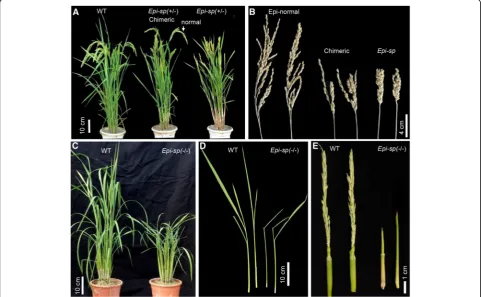
Epi-sp plants. Three distinct phenotypes were observed. Among them, 58 were normal looking (wild type) plants, 103 displayed shortened panicle, and 49 exhi-bited dwarf phenotypes (Fig. 1). The ratio of wild type to short panicle to dwarf phenotypes was 1:1.78:0.84 (for 1:2:1 ratio, χ2= 0.85, P> 0.05). In addition, 35 F1 plants derived from the cross between Epi-sp and Zhonghua11 showed a near 1:1 ratio of wild-type vs short panicle progeny (Data not shown). These results demonstrated that theEpi-sp mutant is a heterozygous allele controlled by a single, semi-dominant locus. Thus, the short panicle progeny is referred to as the heterozygotes Epi-sp (+/−), and the dwarf progeny as the homozygotesEpi-sp(−/−).
The heterozygous Epi-sp (+/−) mutant showed a sig-nificant reduction in plant height (97.4 ± 3.4 cm), com-pared to the wild-type plants (106.7 ± 3.1 cm), resulting
from significantly shortened panicles and branches in the mutant culms (Fig.1Band Additional file1: Fig. S1). But there were no significant differences in the num-ber of primary and secondary branches and grains morphology between wild type and mutant plants (Additional file 1: Figure S1). The overall appearance of the mutant panicle is more compact compared to the wild type. By contrast, the normal tillers have nor-mal features (Fig. 1a). Interestingly, the heterozygous
Epi-sp (+/−) mutant was often chimeric, producing both dwarf (Epi-sp) and normal tillers (Epi-normal) on the same plant (Fig. 1a). In addition, we found chimeric features also in the panicles (Fig. 1b). This strongly suggests that the Epi-sp mutant phenotypes are not ge-netically fixed and can vary epigege-netically in the develo-ping plant. For the homozygous mutant, it exhibited a dwarf phenotype (24.8 ± 2.8 cm) with a defect in shoot apical meristem (SAM) and could not set seeds in paddy field (Fig.1c-e).
To identify the mutated gene responsible for theEpi-sp
phenotypes, map-based cloning method was employed. Initially, linkage analysis with 250 polymorphic SSR markers spanning a 5–10 cM interval on 12 chromosomes was conducted using a small-scale F2population (80 in-dividuals) derived from a cross between Epi-sp and
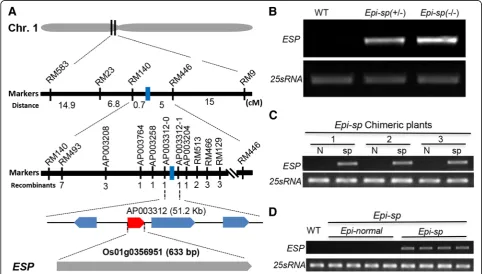
Huajingxian74 (an indica rice cultivar). Genetic map-ping revealed that the ESP locus was associated with one SSR marker RM23 on the short arm of chro-mosome 1. The ESP locus was subsequently narrowed to a region of 5.7 cM between the RM140 and RM446 markers in 290 F2individuals. For fine mapping ofESP, insertion-deletion (InDel) markers were designed accord-ing to sequence differences between indica and japonica
rice. Ultimately, using a large-scale F2population of 1129 mutant individuals, we mapped ESP locus to a 51.2-kb region on chromosome 1 (Fig. 2a). Within this 51.2-kb interval, there are four predicted ORFs (Os01g0356900,
Os01g0356951, Os01g0357100, Os01g0357200). Genome annotation revealed that Os01g0356900 encodes a putative extensin-like protein, partial sequences of
Os01g0356951 is similar to flavin monoxygenase-like genes, Os01g0357100 encodes a putative ferredoxin-nitrite reductase and Os01g0357200 encodes a sterol-binding domain containing protein. However, we found no nucleotide sequence difference between the mutant and the wild type in this region. We next investigated the expression level of four genes annotated in the mapped re-gion. Expression analysis demonstrated that the transcript level ofOs01g0356951was dramatically elevated inEpi-sp
plants (Fig. 2b), while that of three other genes remained
unchanged (Additional file 1: Figure S2), compared to wild type plants. Moreover, Os01g0356951 showed a higher expression in homozygous Epi-spplants than in heterozygous lines (Fig. 2b). These results suggested that the phenotype of Epi-sp might be caused by the elevated expression ofOs01g0356951.
To determine the cause of the metastable phenotype of
Epi-sp, we performed expression analysis of the ESPgene (Os01g0356951). Although ESP was highly expressed in short panicles of chimeric plants, the ESPtranscript was not detected in normal panicles of these same plants (Fig.2c). We also examinedESP expression in the pro-genies of selfed independent chimericEpi-spplants and found that the ESPgene was highly expressed inEpi-sp
but not inEpi-normalplants (the progeny from normal panicle of chimeric plant) (Fig. 2d). These results sug-gest that the epigenetic phenomenon in Epi-spis asso-ciated with the misexpression ofESPgene.
We found no nucleotide sequence difference between the wild type and Epi-sp, but we did observe alteration ofESP expression levels in theEpi-spplants, suggesting that the mutation may result from an epigenetic modifi-cation. We therefore investigated the DNA methylation status of the ESPlocus. We performed bisulfite sequen-cing to analyze their methylation profiles in a 3179-bp
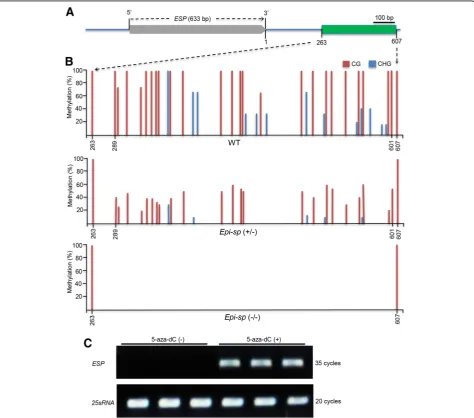
genomic region consisting of 633 bp of gene body, 1545 bp of upstream region, and 1001 bp of 3′distal sequence (Fig. 3a). We observed higher CG and CHG but not CHH DNA methylation in the downstream transcrip-tional termination region of ESP gene in the wild type compared with theEpi-spmutant. All the altered methy-lation sites occurred in a contiguous 313-bp region at 289 to 601 bp downstream of the transcriptional termi-nation site. This region is hypermethylated in the wild type but is demethylated in theEpi-sp mutant, spanning 26 CG sites and 13 CHG sites (Fig.3b).
To determine whether loss of DNA methylation in the transcriptional termination region (TTR) directly causes
the ectopic expression of ESP in Epi-sp, we treated the wild-type seeds with 5-aza-2′deoxycytidine (5-aza-dC), an inhibitor of DNA methylation (Chang and Pikaard 2005), to assess its effect on the expression of ESP. Transcript levels of ESP were measured in 7-d-old seedlings with or without 5-aza-dC treatment (Additional file 1: Figure S3) and found that treatment with 5-aza-dC up-regulatedESP
expression (Fig. 3c). These results indicated that the DNA methylation in the 3′end downstream sequence of ESP plays an essential role in the regulation of ESP
expression. Promoter methylation is a general mechanism for suppressing gene expression in eukaryotes. Interes-tingly, methylation in the transcriptional termination
region (TTR) is also highly correlated with gene expres-sion, even higher than that of promoters, especially for CG methylation in rice (Li et al. 2012). In fact, the TTR of ESPgene is a CpG island, containing 29 CpG dinucleotide repeats (Additional file 1: Figure S4). Consistently, our study showed that ESP TTR hypo-methylation caused induced expression of ESP in
Epi-spplants.
To explore the evolutionary significance of the epigen-etic regulation ofESP, we investigated natural variation in the ESP locus and its downstream methylation region (TTR) in 40 accessions of cultivated rice (Additional file1:
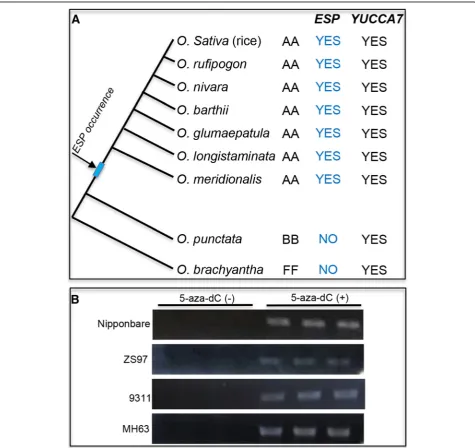
Table S1), representing all of the major groups of Asian cultivated rice (Xu et al. 2011). The results showed that the ESP locus is conserved in all cultivated rice accessions (data not shown). To further confirm this, we aligned the sequences of theESP, in four known as-sembled rice genomes, cv Nipponbare, 93–11, MH63 and ZS97, six AA-genome wild rice, one BB-genome (Oryza punctata) wild rice and one FF-genome (Oryza brachyantha) wild rice. The ESP is conserved in the AA-genome species including cultivated rice genomes but is absent in O. brachyantha and Oryza punctata
(Fig. 4a and Additional file 1: Figure S5). Consistent
with this, the sequence of the TTR region ofESP is also conserved in AA-genome species including cultivated rice (Additional file 1: Figure S6), which might be important for the regulation ofESPexpression.
To further determine the conserved effect of the DNA methylation onESPexpression in cultivated rice accessions, we measured ESP transcript levels in four cultivated rice strains (cv MH63, 9311, ZS97 and Nipponbare). Compared with the high expression ofESPobserved inEpi-sp, we ob-served little or noESPexpression in seedlings in all the cul-tivated rice strains tested (Fig. 4b). Like the pattern of wild-type cv Zhonghua11, the other four cultivated rice ac-cessions also showed higher transcriptional levels ofESPin the seedlings treated with 5-aza-dC (Fig.4b and Additional file1: Figure S3). Thus, it is tempting to speculate that the occurrence of ESP predates the divergence of indica and
japonica rice and the epigenetic regulation of ESP
expression is evolutionarily conserved in cultivated rice.
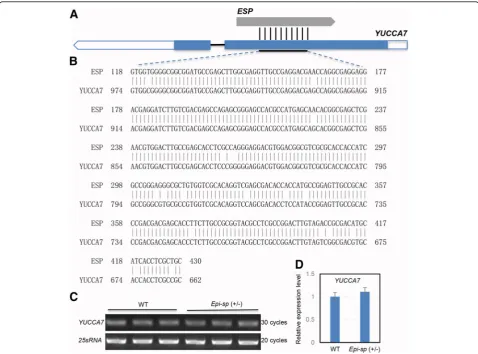
To gain insights into the possible function of theESP, its sequence was used to search rice databases and other public databases. Interestingly, we found thatESP
had high sequence identity with a putative YUCCA-like gene (OsYUCCA7, Os04g0128900) (Fig. 5a). However, the similarity between ESP and OsYUCCA7 is only restricted to a reverse-complementing region of about 300-base sequence (Fig. 5b), like a pair of sense/anti-sense RNA. YUCCAs are a family of important en-zymes which catalyze a key rate-limiting step in the tryptophan-dependent pathway for auxin biosynthesis (Mashiguchi et al. 2011; Won et al. 2011). For most
YUCCA genes of the rice genome, the mean length of coding sequences is more than 1000-bp, encoding about 400 amino acid polypeptides. In addition, we found that three predicted open reading frames (ORFs) of ESP shared no sequence similarity with any known protein (Additional file 1: Figure S7). These results
Fig. 5Genome sequence alignment of theESPlocus and expression analysis ofYUCCA7gene.aESPhad high sequence identity with a putative YUCCA-like gene (OsYUCCA7). Blue boxes indicate the putative coding sequence, white boxes indicate the 5′and 3′untranslated regions.ban alignment of the 313-bp DNA sequence betweenESPandYUCCA7. Expression analysis ofYUCCA7by reverse transcription-PCR (c) and real-time reverse transcription-PCR (d) in young panicles (3–5 cm). Rice25sRNAwas used as a control. Values were means ± SD of three
suggested that ESP might be a long non-coding RNA (lncRNA) gene.
Pseudogenes are usually characterized by a combination of homology to a known gene and loss of some functional-ity (Mighell et al.2000). Compared toYUCCA7gene,ESP
shares very high sequence identity withOsYUCCA7, but has extremely low protein coding probability and gene expression level in cultivated rice (Fig. 4b). Phylogenetic analyses revealed thatYUCCA7-like genes are well evolu-tionally conserved in AA-, BB-, and FF-genome wild rice, but ESP is absent in BB-genome (Oryza punctata) and FF-genome (Oryza brachyantha) wild rice (Fig.4a). Thus, it is highly likely thatESPis the pseudogene ofYUCCA7
gene. Based on the findings mentioned above, we pro-posed that the ESP might be a pseudogene-derived antisense lncRNA gene.
Despite pseudogenes being considered as nontional genomic locus, some pseudogenes may be func-tional, similar to other kinds of noncoding DNA, which can perform regulatory functions to their parent genes (Mighell et al.2000). To explore the effect of ESPon its parent gene, we assessed the relationship between ESP
andOsYUCCA7expression in young panicle (3-5 cm) by qRT-PCR. Expression analysis revealed that the expres-sion level of OsYUCCA7 in heterozygous Epi-sp (+/−)
mutant was similar to that in WT (Fig.5c, d). The result suggested that ESP overexpression probably had little effect on OsYUCCA7 transcription. However, whether
ESP regulates the level of OsYUCCA7 protein produc-tion remains to be elucidated.
In this study, Epi-sp mutant shows low levels of DNA CG and CHG methylation in the TTR of ESP
gene (Fig.3b), causing ectopicESP expression (Fig.2b) and a dense and short panicle architecture in rice (Fig.1). It is important to point out that, although the mechanism for the spontaneous hypomethylation ofESPTTR remains unknown, the TTR ofESPgene displays the characteristic of CpG island (Additional file1: Figure S4). Since there is no CHH methylation in the TTR ofESP(Fig.3b), CG and CHG hypermethylation in this region is likely not established by the RNA-directed DNA methylation (RdDM) pathway. Consequently, hypomethylation of this region in theEpi-spmutant is probably not due to loss of small interfering RNAs (siRNAs). Due to the mechanis-tic nature of maintenance methyltransferases, TTR hypomethylation is also likely not established by lack of OsMET1 and OsCMT3 activities in a locus-specific manner. Therefore, we speculate the epiallele is pro-bably induced by some sort of aberrant active DNA demethylation activity.
In this study, we report the identification and characterization of the rice Epi-sp mutant that dis-plays dense and short panicle phenotype. Morphological analysis showed that the dense and short panicle phenotype
in Epi-sp mutants resulted from the decrease in the length of the rachis, primary and secondary branches. The map-based cloning ofESP revealed that it encodes a putative pseudogene-derived lncRNA. Further studies to clarify the molecular mechanism of ESPshould help shed light on the developmental processes underlying the formation of panicle in rice.
Additional files
Additional file 1:Figure S1.Panicle morphology ofEpi-spmutant.
Figure S2.Expression analysis of three genes annotated in the mapped region in the wild-type andespmutant plants.Figure S3.Phenotype of 10-day-old seedlings treated with (+) or without (−) 5-aza-dC.Figure S4.
Predicted CpG island in the TTR ofESP.Figure S5.Multiple sequence alignment of theESPgene.Figure S6.Multiple sequence alignment for the TTR region ofESP.Figure S7.Open reading frames (ORFs) prediction ofESPgene.Table S1.40 accessions of cultivated line.Table S2.Primers used in this study.File S1.Experimental procedures (PDF 638 kb)
Abbreviations
5-aza-dC:5-aza-2′deoxycytidine; ESP: Epigenetic Short Panicle; lncRNA: long noncoding RNA; SAM: shoot apical meristem; TTR: transcriptional termination region
Acknowledgements
We thank Dr. Haitao Zhu (South China Agricultural University, China) for assistance with the map-based cloning of theESPgene.
Funding
This work was supported by the National Natural Science Foundation of China (grant nos. 30900884 and 31671594 to XQ. Zhang); by Guangxi Key Laboratory of Rice Genetics and Breeding Open Foundation (No.2018– 05-Z06-KF02); by Natural Science Foundation of Guangdong Province, China (grant nos. 2014A030313457 and 2015A020209118 to XQ. Zhang).
Availability of data and materials
The datasets supporting the conclusions of this article are included within the article and its additional files.
Authors’contributions
XL and SL performed the experiments. SK and HD conducted fieldwork and managed the experimental materials. XMX designed the experiments and analyzed the data; TFH supervised and complemented the writing; XQZ conceived the project and wrote the article with contributions of all the authors. All authors read and approved the final manuscript.
Ethics approval and consent to participate
Not applicable.
Consent for publication
Not applicable.
Competing interests
The authors declare that they have no competing interests.
Publisher’s Note
Springer Nature remains neutral with regard to jurisdictional claims in published maps and institutional affiliations.
Author details
1Guangdong Engineering Research Center of Grassland Science, College of
Received: 16 November 2018 Accepted: 27 March 2019
References
Chang S, Pikaard CS (2005) Transcript profiling inArabidopsisreveals complex responses to global inhibition of DNA methylation and histone deacetylation. J Biol Chemi 280:796–804
Cubas P, Vincent C, Coen E (1999) An epigenetic mutation responsible for natural variation in floral symmetry. Nature 401:157–161
Deng Y, Zhai K, Xie Z, Yang D, Zhu X, Liu J, Wang X, Qin P, Yang Y, Zhang G, Li Q, Zhang J, Wu S, Milazzo J, Mao B, Wang E, Xie H, Tharreau D, He Z (2017) Epigenetic regulation of antagonistic receptors confers rice blast resistance with yield balance. Science 355:962–965
Jacobsen SE, Meyerowitz EM (1997) HypermethylatedSUPERMANepigenetic alleles inArabidopsis. Science 277:1100–1103
Li F, Liu W, Tang J, Chen J, Tong H, Hu B, Li C, Fang J, Chen M, Chu C (2010) Rice
DENSE AND ERECT PANICLE 2is essential for determining panicle outgrowth and elongation. Cell Res 20:838–849
Li S, Qian Q, Fu Z, Zeng D, Meng X, Kyozuka J, Maekawa M, Zhu X, Zhang J, Li J, Wang Y (2009)Short panicle1encodes a putative PTR family transporter and determines rice panicle size. Plant J 58:592–605
Li X, Zhu J, Hu F, Ge S, Ye M, Xiang H, Zhang G, Zheng X, Zhang H, Zhang S, Li Q, Luo R, Yu C, Yu J, Sun J, Zou X, Cao X, Xie X, Wang J, Wang W (2012) Single-base resolution maps of cultivated and wild rice methylomes and regulatory roles of DNA methylation in plant gene expression. BMC Genomics 13:300.https://doi.org/10.1186/1471-2164-13-300
Manning K, Tör M, Poole M, Hong Y, Thompson AJ, King GJ, Giovannoni JJ, Seymour GB (2006) A naturally occurring epigenetic mutation in a gene encoding an SBP-box transcription factor inhibits tomato fruit ripening. Nat Genet 38:948–952
Martin A, Troadec C, Boualem A, Rajab M, Fernandez R, Morin H, Pitrat M, Dogimont C, Bendahmane A (2009) A transposon-induced epigenetic change leads to sex determination in melon. Nature 461:1135–1138 Mashiguchi K, Tanaka K, Sakai T, Sugawara S, Kawaide H, Natsume M, Hanada A,
Yaeno T, Shirasu K, Yao H, McSteen P, Zhao Y, Hayashi K, Kamiya Y, Kasahara H (2011) The main auxin biosynthesis pathway inArabidopsis. Proc Natl Acad Sci U S A 108:18512–18517
Mighell AJ, Smith NR, Robinson PA, Markham AF (2000) Vertebrate pseudogenes. FEBS Lett 468:109–114
Miura K, Agetsuma M, Kitano H, Yoshimura A, Matsuoka M, Jacobsen SE, Ashikari M (2009) A metastableDWARF1epigenetic mutant affecting plant stature in rice. Proc Natl Acad Sci U S A 106:11218–11223
Soppe WJJ, Jacobsen SE, Alonso-Blanco C, Jackson JP, Kakutani T, Koornneef M, Peeters AJM (2000) The late flowering phenotype offwamutants is caused by gain-of-function epigenetic alleles of a homeodomain gene. Mol Cell 6:791–802
Won C, Shen X, Mashiguchi K, Zheng Z, Dai X, Cheng Y, Kasahara H, Kamiya Y, Chory J, Zhao Y (2011) Conversion of tryptophan to indole-3-acetic acid by TRYPTOPHAN AMINOTRANSFERASES OF ARABIDOPSIS and YUCCAs in
Arabidopsis. Proc Natl Acad Sci U S A 108:18518–18523
Xu X, Liu X, Ge S, Jensen JD, Hu F, Li X, Dong Y, Gutenkunst RN, Fang L, Huang L, Li J, He W, Zhang G, Zheng X, Zhang F, Li Y, Yu C, Kristiansen K, Zhang X, Wang J, Wright M, McCouch S, Nielsen R, Wang J, Wang W (2011) Resequencing 50 accessions of cultivated and wild rice yields markers for identifying agronomically important genes. Nat Biotechnol 30:105–111 Zhang L, Cheng Z, Qin R, Qiu Y, Wang J, Cui X, Gu L, Zhang X, Guo X, Wang D,
Jiang L, Wu C, Wang H, Cao X, Wan J (2012) Identification and
characterization of an epi-allele ofFIE1reveals a regulatory linkage between two epigenetic marks in rice. Plant Cell 24:4407–4421