Volume 2010, Article ID 909043,11pages doi:10.1155/2010/909043
Research Article
Red-Eyes Removal through Cluster-Based Boosting on Gray Codes
Sebastiano Battiato,
1Giovanni Maria Farinella,
1Mirko Guarnera,
2Giuseppe Messina,
2and Daniele Rav`ı
11Image Processing Laboratory, Dipartimento di Matematica e Informatica, Universit`a di Catania, Viale A. Doria 6,
95125 Catania, Italy
2Advanced System Technology, STMicroelectronics, Stradale Primosole 50, 95125 Catania, Italy
Correspondence should be addressed to Giovanni Maria Farinella,[email protected]
Received 26 March 2010; Revised 2 July 2010; Accepted 29 July 2010
Academic Editor: Lei Zhang
Copyright © 2010 Sebastiano Battiato et al. This is an open access article distributed under the Creative Commons Attribution License, which permits unrestricted use, distribution, and reproduction in any medium, provided the original work is properly cited.
Since the large diffusion of digital camera and mobile devices with embedded camera and flashgun, the redeyes artifacts have de facto become a critical problem. The technique herein described makes use of three main steps to identify and remove red eyes. First, red-eye candidates are extracted from the input image by using an image filtering pipeline. A set of classifiers is then learned on gray code features extracted in the clustered patches space and hence employed to distinguish between eyes and non-eyes patches. Specifically, for each cluster the gray code of the red-eyes candidate is computed and some discriminative gray code bits are selected employing a boosting approach. The selected gray code bits are used during the classification to discriminate between
eye versusnon-eyepatches. Once red-eyes are detected, artifacts are removed through desaturation and brightness reduction. Experimental results on a large dataset of images demonstrate the effectiveness of the proposed pipeline that outperforms other existing solutions in terms of hit rates maximization, false positives reduction, and quality measure.
1. Introduction
Red-eye artifact is caused by the flash light reflected off a person’s retina (seeFigure 1). This effect often occurs when the flash light is very close to the camera lens, as in most compact imaging devices. To reduce these artifacts, most cameras have a red-eye flash mode which fires a series of preflashes prior to picture capturing. Rapid preflashes cause pupil contraction, thus, minimizing the area of reflection; it does not completely eliminate the red-eye effect though it reduces it. The major disadvantage of the preflash approach is power consumption (e.g., flash is the most power-consuming device of the camera). Besides, repeated flashes usually cause uncomfortable feeling.
Alternatively, red eyes can be detected after photo acqui-sition. Some photo-editing software makes use of red-eye removal tools which require considerable user interaction. To overcome this problem, different techniques have been proposed in literature (see [1, 2] for recent reviews in the field). Due to the growing interest of industry, many
automatic algorithms, embedded on commercial software, have been patented in the last decade [3]. The huge variety of approaches has permitted to explore different aspects of red-eyes identification and correction. The big challenge now is to obtain the best results with the minor number of visual errors.
α β Red eye cone Eye
Figure1: Flash-gun light cone generated by reflection offthe retina. If the angleα, representing the cone size, is greater than the angleβ, between the camera lens and the flash-gun, then the red-eye artifact comes out.
present work is to demonstrate that better results are achieved if the multimodally nature of candidates red-eyes as well as the spatial information during classification task are taken into account. To this aim, we have compared the pro-posed cluster-based boosting, to standard boosting in both cases, with and without considering spatial information.
The remainder of the paper is organized as follows. Section 2 gives an overview of related works. Section 3 provides details of the proposed red-eyes removal pipeline. Section 4illustrates the experimental settings and the results obtained using the presented technique. Finally, Section 5 concludes this paper with avenues for further research.
2. Related Works
Several studies have considered the problem of automatic eyes removal. A pioneering technique for automatic red-eye reduction was proposed by Patti et al. [4]. The technique uses a nonstandard luminance-chrominance representation to enhance the regions affected by the red-eye artifacts. After the detection of an interesting block, thresholding operation and a simple color replacement pipeline are employed to remove the red eyes.
Battiato et al. [5] have proposed to deal with the problem of red eye detection by using the bag-of-keypoints paradigm. It involves extraction of local image features, quantization of the feature space into a codebook through clustering, and extraction of codeword distribution histograms. An SVM classifier has been used to decide to which class each histogram, thus each patch, belongs.
Gaubatz and Ulichney [6] proposed to apply a face detector as first stage and then search for the eyes in the candidate face regions by using constraints based on colors, red variance, and glint. One of the drawbacks of such method is the robustness with respect to the multimodality of the face space with respect to poses (e.g., not always frontal and upright). The redness of detected red eyes is attenuated with a tapered color desaturation process.
Schildkraut and Gray [7] used an automatic algorithm to detect pairs of eyes, which is restricted to near-frontal face images. The pair verification technique was used to reduce false positive. However, many photos have single redeyes (e.g., face partially screened) that cannot be corrected with this approach. Detected red eyes are removed blending the corrected region with the neighborhood in order to preserve the natural appearance of the eyes. Building on [7], a combination of boosting classifiers has been proposed
by Ioffe [8]. Specifically, a boosting classifier was used to discriminate between red-eyes versus other, and another boosting classifier was used to detect faces in order to reduce the false positives.
A two-stage algorithm was described by Zhang [9]. At the first stage, red pixels are grouped, and a cascade of heuristic algorithms to deal with color, size, and highlight is used to decide whether the grouped region is red eye or not. At the second stage, candidate red-eyes regions are checked by using Adaboost classifier. Though highlight is useful for red-eyes detection, some red eye with no highlight region may occur when the eye direction does not face toward the camera/flash light. Artifacts are corrected through brightness and contrast adjustment followed by blending operation.
Luo et al. [10] proposed an algorithm that first uses square concentric templates to assess the candidate red-eye regions and then employs an Adaboost classifier coupled with a set of adhoc selected Haar-like features for final detection. Multiscale templates are used to deal with the scale of red-eyes patches. For each scale, a thresholding process has been used to determine which pixels are likely to be red-eye pixels. The correction process is mainly based on adaptive desaturation over the red-eye regions.
Petschnigg et al. [11] presented a red-eyes detection technique based on changes of pupil color between the ambient image and the flash image. The technique exploits two successive photos taken with and without flash con-sidered into YCbCr space to decorrelate luminance from chrominance. The artifacts are detected by thresholding the differences of the chrominance channels and using geometric constraints to check size and shape of red regions. Detected red eyes are finally corrected through thresholding operation and the color replacement pipeline proposed in [4].
A wide class of techniques make use of geometric constraints to restrict possible red-eye regions in com-bination with reliable supervised classifiers for decision making. Corcoran et al. [12] proposed an algorithm for real-time detection of flash eye defects in the firmware of a digital camera. The detection algorithm comprises different substeps onLabcolor space to segment artifacts regions that are finally analyzed with geometric constraints.
The technique proposed by Volken et al. [13] detects the eye itself by finding the suitable colors and shapes. They use the basic knowledge that an eye is characterized by its shape and the white color of the sclera. Combining this intuitive approach with the detection of “skin” around the eyes, red-eyes artifacts are detected. Correction is made through an adhoc filtering process.
Safonov et al. [14] suggested a supervised approach taking into account color information via 3D tables and edge information via directional edge detection filters. In the classification stage, a cascade of supervised classifiers has been used. The correction consists in conversion of pixel to gray color, darkening and blending with the initial image in theYCbCrcolor space. The results were evaluated by using an adhoc detection quality criterion.
color space. A flash mask, used to define the regions where red-eye artifacts may be present, is first extracted from the brightness component. Subsequent processing on the other color components prunes the number of candidate regions that may correspond to red eyes. Though the overall results are satisfactory, this approach is not able to identify red-eyes region outside the flash mask area (i.e.; a very common case). The methods reviewed above comprise techniques pre-sented in literature in the last decade. Other related approaches are reviewed in [1–3].
3. Red-Eyes Detection and Correction
The proposed red-eyes removal pipeline uses three main steps to identify and remove red-eyes artifacts. First, candi-dates red-eyes patches are extracted, then they are they are classified to distinguish between eyes and non-eyes patches. Finally, correction is performed on detected red eyes. The details of the three steps involved in the proposed pipeline are detailed in the following subsections.
3.1. Red Patch Extraction. To extract the red-eyes candidates, we first built a color model from the training set to detect pix-els belonging to possible red-eyes artifacts. We constructed red-eye-pixel and non-red-eye-pixel histogram models using a set of pixels of the training images. Specifically, for each image of the training set, the pixels belonging to red-eye artifacts have been labeled as red-eye pixels (REP), whereas the surrounding pixels within windows of fixed size have been labeled as non-red-eye pixels (NREP). The labeled pixels (in both RGB and HSV spaces) have been mapped in a three-dimensional spaceC1×C2×C3 obtained taking into account the first three principal components of the projection through principal component analysis [16]. By using the principal component analysis, the original six-dimensional space of each pixel, considered in both RGB and HSV color domains, is transformed into a reduced three-dimensional space maintaining as much of the variability in the data as possible. This is useful to reduce the com-putational complexity related to the space dimensionality. We used a 3D histogram with 64×64 ×64 bins in the
C1 ×C2 ×C3 space. Since most of the sample pixels of the training set lie within three standard deviations of the mean, each componentCihas been uniformly quantized in
64 values taking into account the range [−3λi, +3λi], where λiis standard deviation of theith principal component (i.e.,
theith eigenvalue). The probability that a given pixel belongs to the classesREPandNREPis computed as follows:
P(C1,C2,C3|REP)=hREP[C1,C2,C3]
TREP
P(C1,C2,C3|NREP)= hNREP
[C1,C2,C3] TNREP
(1)
wherehREP[C1,C2,C3] is the red-eye-pixels count contained
in binC1×C2×C3of the 3D histogram,hNREP[C1,C2,C3] is
the equivalent count for non-redeye pixels,TREP andTNREP
are the total counts of red-eye pixels and non-red-eye pixels
respectively. We derive a red-eye-pixel classifier through the standard likelihood ratio approach. A pixel is labeled red-eye pixel if
P(C1,C2,C3|REP)> αP(C1,C2,C3|NREP) (2)
whereαis a threshold which is adjusted to maximize correct detection and minimize false positives. Note that a pixel is assigned toNREPclass when both probabilities are equal to zero.
Employing such filtering, a binary map with the red zones is derived. To remove isolated red pixels, a morphology operation of closing is applied to this map. In our approach, we have used the following 3×3 structuring element:
m=
⎡ ⎢ ⎣
0 1 0 1 1 1 0 1 0 ⎤ ⎥
⎦ (3)
Once the closing operation has been accomplished, a search of the connected components is achieved using a simple scanline approach. Each group of connected pixels is ana-lyzed making use of simple geometric constraints. As in [13], the detected regions of connected pixels are classified as possible red-eye candidates if the geometrical constraints of size androundness are satisfied. Specifically, a region of connected red pixels is classified as possible red-eye candidate if the following constraints are satisfied:
(i) the size Si of the connected region i is within the
range [Mins, Maxs], which defines the allowable size
for eyes;
(ii) the binary roundness constraintRiof the connected
regioniis verified as follows:
Ri=
⎧ ⎪ ⎨ ⎪ ⎩
True ρi∈
Minρ, Maxρ
; ηi≤Malxη; ξi0
False otherwise (4)
where
(a)ρi=(4π×Ai)/Pi2 is the ratio between the estimated
areaAiand the perimeterPiof the connected region;
the more this value is near 1, the more the shape will be similar to a circle;
(b)ηi = max(Δ(xi)/Δ(yi),Δ(yi)/Δ(xi)) is the distortion of
the connected region along the axes;
(c)ξi=Ai/(Δ(xi)Δ(yi)) is the filling factor; the more this
parameter is near 1, the more the area is filled.
The parameters involved in the aforementioned filtering pipeline have been set through a learning procedure as discussed inSection 4.
(a) Input image
(b) Red map
(c) Closing operation
(d) Final candidates
Figure2: Filtering pipeline on (a)input image.
classification purpose (Figure 4). Gray code representation allows to have a natural way (e.g., no strong transaction between adjacent values) to pick up the underlying spatial structures of a typical eye.
The gray levels of anm-bit gray-scale image (i.e., a color channel in our case) are represented in the form of the base 2 polynomial
am−12m−1+am−22m−2+· · ·+a121+a020 (5)
Based on this property, a simple method of decomposing the image into a collection of binary images is to separate the m coefficients of the polynomial intom1-bit planes. Them-bit Gray code (gm−1· · ·g2,g1,g0) related to the polynomial in (5) can be computed as follows:
gi=
⎧ ⎨ ⎩
ai⊕ai+1 0≤i≤m−2
am−1 i=m−1
(6)
where⊕denotes the exclusive OR operation. This code has the unique property that successive code words differ only one bit position. Thus, small changes in gray level are less likely to affect allmbit planes.
3.2. Red Patch Classification. The main aim of the classifi-cation stage is the elimination of false positive red eyes in the set of patches obtained performing the filtering pipeline described inSection 3.1.
At this stage, we deal with a binary classification problem. Specifically, we want to discriminate between eye versus non-eye patches. To this aim, we employ an automatic learning technique to make accurate predictions based on past observations. The approach we use can be summarized as follows: start by gathering as many examples as possible of both eyes and non-eyes patches, next feed these examples, together with labels indicating if they are eyes or not, to a machine-learning algorithm which will automatically produce a classification rule. Given a new unlabeled patch, such a rule attempts to predict if it is eye or not.
Building a rule that makes highly accurate predictions on new test examples is a challenging task. However, it is not hard to come up with rough weak classifiers that are only moderately accurate. An example of such a rule for the problem under consideration is something like the following: “If the pixelplocated in the sclera region of the patch under consideration is not white, then predict it is non-eye”. In this case, such a rule is related to the knowledge that the white region corresponding to the sclera should be present in an eye patch. On the other hand, such a rule will cover all possible non-eyes cases; for instance, it is correct to say nothing about what to predict if the pixel p is white. Of course, this rule will make predictions that are significantly better than random guessing. The key idea is to find many weak classifiers and combine them in a proper way deriving a single strong classifier.
Among other, Boosting [18–20] is one of the most popular procedures for combining the performance of weak classifiers in order to achieve a better classifier. We use a boosting procedure on patches represented as gray codes to build a strong classifier useful to distinguish between eye and non-eye patches. Specifically, boosting is used to select the positions{p1,. . .,pn}corresponding tongray code bits
that best discriminate between the classes eye versus non-eye, together withn-associated weak classifiers of the following form:
hi
g=
⎧ ⎨ ⎩
ai gpi=1
bi gpi=0
Figure3: Examples of possible candidates after red patches extraction.
R G
B
Figure4: Example of gray code planes on the three RGB channels of a red-eye patch.
whereg=[g1,g2,. . .,gD] is the gray code vector (gi∈ {0, 1})
of size D = 30×30×3×8 corresponding to a 30×30 patch extracted as described in the previous section. The parametersaiandbiare automatically learned byGentleboost
procedure [18] as explained inSection 3.3. The classification is obtained considering the sign of the learned additive model as follows:
Hg=
n
i=1
hi
g (8)
wherenDindicates the number of weak classifiers involved in the strong classifiersH.
The rationale beyond the use of gray code representation is the following. In the gray code space, just a subset of all possible bit combinations is related to the eyes patches. We wish to select those bits that usually differ in terms of binary value between eye and non-eye patches. Moreover, by using gray code representation rather than classic bit planes decomposition, we reduce the impact of small changes in intensity of patches that could produce significant variations in the corresponding binary code [17].
In Figure 5, an example of n = 1000 gray code bits selected withGentleboostprocedure is reported. Selected bits are shown as black or white points on the different gray code planes. This map indicates that a red-eye patch should have 1 in the position coloured in white and 0 in the positions colored in black. Once gray code bits and the corresponding weak classifiers parameters are learned, a new patch can be classified by using the sign of (8).
The approach described above does not take into account spatial relationship between selected gray code bits. Spatial information is useful to make the classification task stronger (e.g., pupil is surrounded of sclera). To overcome this problem we coupled the gray codes bits selected at the first learning stage using xor operator to obtain a new set of n2 binary features. We randomly select a subset containingmof these features and performed a second round
of Gentleboost procedure to select the most discriminative spatial relationship among the m randomly selected. This new classifier is combined with the one learned previously to perform final eye and non-eye patches classification.
Due to the multimodally nature of the patches involved in our problem (i.e., colours, orientation, shape, etc.), a single discriminative classifier could fail during classification task. To get through this weakness, we propose to perform first a clustering of the input space and then apply the two stage boosting approach described above on each cluster. More specifically, during the learning phase, the patches are clustered by using K-means [16] in their original color space producing the subsets of the input patches with the relative prototypes; hence, the two stages of boosting described above are performed on each cluster. During the classification stage, a new patch is first assigned to a cluster according to the closest prototype and then classified taking into account the two additive models properly learned for the cluster under consideration.
Experimental results reported in Section 4confirm the effectiveness of the proposed strategy.
3.3. Boosting for Binary Classification Exploiting Gray Codes. Boosting provides a way to sequentially fit additive models of the form in (8) optimizing the following cost function [18]:
J=Ee−yH(g) (9)
wherey∈ {−1, 1}is the class label associated to the feature vector g. In this work,y = 1 is associated to the eye class whereasy = −1 is the label associated to thenon-eyeclass. The cost function in the (9) can be thought as a differentiable upper bound of the misclassification rate [19].
Figure5: Selected gray code bits.
of (9) is performed minimizing a weighted squared error at each iteration [22]. Specifically at each iterationI,the strong classifier H is updated as H(g) := H(g) +hbest(g) where the weak classifierhbestis selected in order to minimize the second-order approximation of the cost function in (9) as follows:
hbest= argmin
hd
JHg+hd
g
argmin
hd
Ee−yH(g)y−h
d
g2
(10)
Defining aswj = e−yjH(gj) the weight for the training
sample j and replacing the expectation with an empirical average over the training data, the optimization reduces in minimizing the weighted squared error as follows:
Jwse(hd)= M
j=1
wj
yj−hd
gj
2
(11)
whereMis the number of samples in the training set. The minimization ofJwse depends on the specific form
of the weak classifiers hd. Taking into account the binary
representation of samples (i.e., the gray code of each patch), in the present proposal we define the weak classifiers as follows:
hd
g=
⎧ ⎨ ⎩
ad ifgd =1
bd ifgd =0
(12)
In each iteration the optimaladandbdfor each possible hdcan be obtained through weighted least squares as follows:
ad=
M j=1wjyjδ
gd=1
M
j=1wjδ
gd =1
bd=
M j=1wjyjδ
gd=0
M
j=1wjδ
gd =0
(13)
The best weak classifier hbest is hence selected in each iteration of the boosting procedure such that the cost of (11) is the lowest as follows:
hbest=argmin
hd
Jwse(hd) (14)
Finally, before a new iteration the boosting procedure makes the following multiplicative update to the weights corresponding to each training sample:
wj:=wje−yjhbest(gj) (15)
This update increases the weight of samples which are misclassified (i.e., for whichyjH(gj)<0) and decreases the
weight of samples which are correctly classified.
The procedures employed for learning and classifica-tion on the proposed representaclassifica-tion are summarized in Algorithm 1 and Algorithm 2. In the learning stage, we initialize the weights corresponding to the elements of the training set such that the number of the samples within each class is taken into account. This is done to overcome the problems that can occur due to the unbalanced number of training samples within the considered classes.
Input: A set of gray code vectorsG= {g1,. . .,gM}, and corresponding labelsY= {y1,. . .,yM}
Output: A strong classifierH(g)=n i=1hi(g) begin
C+:= {j|y j=1};
C−:= {j|yj= −1};
wj∈C+:= 1
2|C+|;
wj∈C−:= 1 2|C−|;
fori=1, 2,. . .,ndo ford=1, 2,. . .,Ddo
a∗d :=
M
j=1wjyjδ(gd=1)
M
j=1wjδ(gd=1) ;
b∗d := M
j=1wjyjδ(gd=0)
M
j=1wjδ(gd=0) ;
h∗d(g) :=
a∗d ifgd=1 bd∗ ifgd=0
Jwse(h∗d) :=
M
j=1wj(yj−h∗d(gj))2;
pi:=argmindJwse(h∗d);
ai:=a∗pi;
bi:=b∗pi;
hi(g) :=ai ifgpi=1 bi ifgpi=0
wj:=wje−yjhi(gj);
H(g) :=n i=1hi(g)
end
Algorithm1: Learning.
Input: The strong classifierH, and a new gray code samplegto be classified Output: The inferred classy∈ {−1, 1}
begin
y:=sign(H(g)); end
Algorithm2: Classification.
0 20 40 60 80 100
Figure6: Brightness-saturation mask.
LetIr
c the channelc∈ {R,G,B}, of a region of interestr
within the imageI. For each channelc∈ {R,G,B}, the pixels (x,y) belonging to the regionIrare corrected as follows:
Icr
x,y=
⎧ ⎪ ⎪ ⎪ ⎨ ⎪ ⎪ ⎪ ⎩
Ir c
x,y IRr
x,y,IGr
x,y,IBr
x,y∈W
IGr
x,y
Mx,y otherwise
(16)
Table1: Estimated eye sizes taking into account the distance from the camera.
Distance from the sensor (m) 0.20 0.40 0.60 0.80 1.00 1.20 1.40 1.60 1.80 2.00 2.20 2.40 2.60 2.80 3.00
Pupil Diameter (pixels) 52 26 17 13 10 9 7 7 6 5 5 4 4 4 3
Figure7: Example of clusters prototypes obtained in an LOOCV run.
4. Experimental Settings and Results
The proposed red-eye removal pipeline has been tested on a dataset of 390 images in which 1049 red eyes have been manually labeled. The dataset has been collected from various sources, including digital single-lens reflex (DSLR) cameras, compact cameras, personal collections, and internet photos. Single red eyes, as well as high variability of red-eyes colors, poses, and shapes, have been considered in building the dataset. In order to accurately assess the proposed approach, the size of the eyes to be detected in the collected images must be small enough to ensure that also the smallest red eyes can be detected and corrected. The basic requirement considered in our experimental phase is that the red eyes must be accurately detected and corrected up to three-meter distance from the camera.Table 1presents the estimated eye sizes, in pixels, for XGA image size (1024× 768), with the assumption that the average eye is directed to the camera. In this paper, the collected images have been considered with an XGA image resolution, and the minimum and maximum estimated pupil diameters (Table 1) have been taken into account in building the dataset for testing purposes.
For each image of the dataset, the pixels belonging to red eyes artifacts have been manually labeled as red-eye pixels. The parameters Minh, Maxh,ts, Mins, Maxs, Minρ,
Maxρ, and Maxη involved in the first stage of the proposed
approach (see Section 3.1) have been learned taking into account the true and false red-eyes pixels within the labeled dataset. To this aim, a full search procedure on a grid of equispaced points in the eight- dimensional parameters’ space was employed. For each point of the grid, the correct detection and false positives rates of the true red-eyes pixels within the dataset were obtained. The tuple of parameters with the best tradeoff between correct detection and the false positives have been used to perform the final filtering pipeline. A similar procedure was employed to determine the subspaceWof the RGB space involved in the correction step to identify pixels belonging to the glint area.
In order to evaluate the classification performance of the proposed method, the leave-one-out cross validation proce-dure (LOOCV) has been employed. Each run of LOOCV has involved a single image as test, and the remaining images as training data. This is repeated to guarantee that each input image is used once as test image. At each run of LOOCV, the parameters of the filtering pipeline have been set to maximize
correct detection and minimize false positives. At each run of LOOCV, the training images have been clustered, and then the two-stage boosting approach described inSection 3.2has been performed on each cluster. Seven clusters (Figure 7) and 800 binary features for the additive classifiers corresponding to the clusters have been used on each LOOCV run. The maximum number of iterations used by boosting procedure to obtain the 800 binary features was 1400. The final results have been obtained averaging on the results of the overall LOOCV runs.
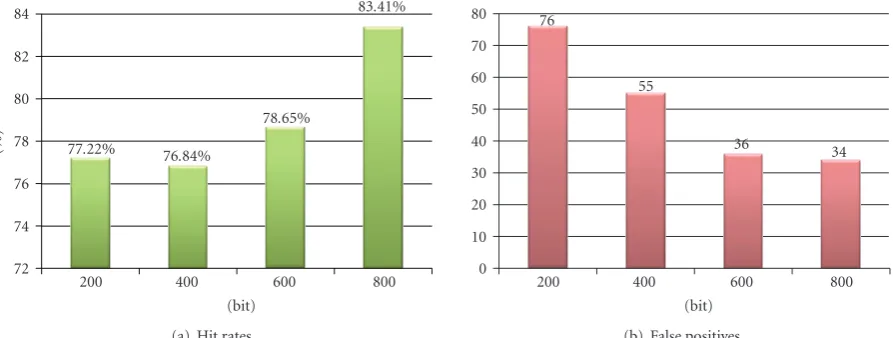
Taking into account both, the filtering and the classifi-cation stages, the hit rate of the proposed red-eyes detector is 83.41%. This means that 875 red eyes have been correctly detected with respect to the 1049 red eyes of the 390 input images whereas only 34 false positives have been introduced. In Figure 8, the training ability increasing the number of bits is shown in terms of Hit Rates (Figure 8(a)) and False Positives (Figure 8(b)).
In Figure 9, two examples of misclassified patches are reported, inFigure 9(a), a “golden” eye is depicted (another possible artifact due to similar acquisition problem). The underlying structure in Figure 9(b) is probably the main reason of misclassification.
In order to point out the usefulness of the proposed cluster-based boosting, as well as the usefulness of the spatial relationship introduced by using xor operation on gray codes bits, we have repeated tests considering dif-ferent configurations. Results reported in Table 2 confirm the effectiveness of the rationale beyond the proposed method.
To properly evaluate the overall red-eyes removal pipeline, the qualitative criterion proposed in [14] was adopted to compare the proposed solution with respect to existing automatic solutions. According to [14], we divided False Positive (FP) and False Negative (FN) to distinguish different detection cases as follows:
FPc: criticalFP(e.g., visibleFP on foreground, like
faces),
FPn: noncritical FP (e.g., undistinguishable FP on
foreground),
FNm: mandatoryFN(e.g., red eyes well
distinguish-able),
FNd: desirableFN(e.g., small red eyes with low local
72 74 76 78 80 82 84
(%)
200 400 600 800
(bit) 77.22% 76.84%
78.65%
83.41%
(a) Hit rates
0 10 20 30 40 50 60 70 80
200 400 600 800
(bit) 76
55
36 34
(b) False positives
Figure8: Performances increasing number of bits.
(a) False negative (b) False positive
Figure9: Examples of misclassified patches.
Table2: Comparison of different configurations.
Configuration Hit Rate False Positives
Gray Codes 75.98% 47
Gray Codes + Clustering 77.51% 44
Gray Codes + XOR 79.31% 36
Gray Codes + Clustering + XOR 83.41% 34
The quality criterion proposed in [14] takes also into account unwanted situation in which the automatic correc-tion is performed on only one eye from pair. The number of faces with one corrected eye from pair of red eyes is indicated with Np. Regarding correction factors, two
cases are distinguished: corrected eyes that look worse of original red eyes (Ci) and situations when retouching is
noticeable, but it does not irritate strongly (Cn). To obtain
a unique quality criterion (Qc), authors of [14] weighted the
aforementioned factors according to observers’ opinions as follows:
Qc=1− 1
Nt
(1.3×FNm+ 0.7×FNd)
− 1
Nt
3.6×FPc+ 0.4×FPn+ 1.6×Np
− 1
Nt(2.1×Ci+ 0.3×Cn)
(17)
where Nt is the total number of red eyes within the test
dataset.
The proposed pipeline has been compared with respect to the following automatic (mainly commercial) solutions: Volken et al. [13], NikonView V6.2.7, KodakEasyShare V6.4.0, StopRedEye! V1.0, HP RedBot, Arcsoft PhotoPrinter V5, and Cyberlink MediaShow. Experiments have been done using effective commercial software and the implementation of [13] provided by the authors. NikonView approach is mainly based on [12].
As reported in Table 3, the proposed approach has obtained the best performances in terms of both, hit rate and quality criterion. Moreover, the proposed approach outperforms the method we have presented in [23] also in terms of computational complexity. Despite the complete set of images used in the experiments is not publicly available, since most of the photos are taken from private collections, some examples with corresponding results are available at the following web address: http://iplab.dmi.unict.it/download/ EurasipSpecialIssue2010.
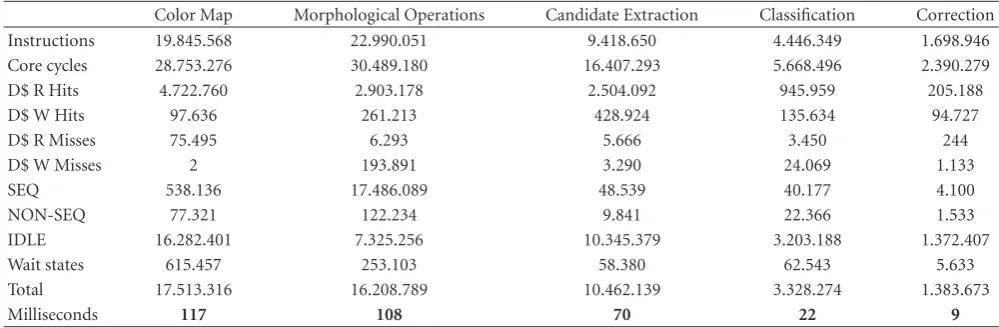
4.1. Computational Complexity. To evaluate the complexity, a deep analysis has been performed by running the proposed pipeline on an ARM926EJ-S processor instruction set sim-ulator. We have chosen this specific processor because it is widely used in embedded mobile platforms. The CPU run at 300 MHz and both data and instruction caches have been fixed to 32 KB. The bus clock has been set to 150 MHz, and the memory read/write access time is 9 ns. The algorithm has been implemented using bitwise operators to work on colour maps and fixed- point operations. Due to the dependence of the operations to the number of red clusters found in the image, we have analyzed a midcase, that is an image containing around 40 potential red eye zones, but only 2 of them are real eyes to be corrected.
Table3: Quality score of different red-eyes removal approaches.
Method FNm FNd FPc FPn Np Ci Cn Qc Hit Rate
Cyberlink MediaShow 270 86 40 19 39 122 61 0.1423 66.06%
Volken et al. [13] 179 117 150 1540 83 17 79 −0.5851 71.78%
KodakEasyShare V6.4.0 194 99 5 20 5 104 100 0.4243 72.07%
HP RedBot 174 109 26 45 85 99 150 0.2345 73.02%
NikonView V6.2.7 143 116 6 29 88 124 129 0.2944 75.31%
StopRedEye! V1.0 124 125 8 12 83 81 91 0.4161 76.26%
Arcsoft PhotoPrinter V5 132 103 10 78 80 89 82 0.3800 77.60%
Battiato et al. [23] 122 85 2 2 60 20 64 0.6346 80.26%
Proposed Pipeline 114 60 9 25 46 34 79 0.6174 83.41%
Table4: Performances of the main steps of the proposed pipeline.
Color Map Morphological Operations Candidate Extraction Classification Correction
Instructions 19.845.568 22.990.051 9.418.650 4.446.349 1.698.946
Core cycles 28.753.276 30.489.180 16.407.293 5.668.496 2.390.279
D$ R Hits 4.722.760 2.903.178 2.504.092 945.959 205.188
D$ W Hits 97.636 261.213 428.924 135.634 94.727
D$ R Misses 75.495 6.293 5.666 3.450 244
D$ W Misses 2 193.891 3.290 24.069 1.133
SEQ 538.136 17.486.089 48.539 40.177 4.100
NON-SEQ 77.321 122.234 9.841 22.366 1.533
IDLE 16.282.401 7.325.256 10.345.379 3.203.188 1.372.407
Wait states 615.457 253.103 58.380 62.543 5.633
Total 17.513.316 16.208.789 10.462.139 3.328.274 1.383.673
Milliseconds 117 108 70 22 9
eyes. The performances information reported inTable 4 is related to the following computational resources.
(i)Instructions:counts the executed ARM instructions. (ii)Core cycles: core clock ticks needed to make the
Instructions.
(iii)Data (D$):Read/Write Hits and Misses, cache mem-ory hits and misses.
(iv)Seq and Nonseq:sequential and nonsequential mem-ory accesses.
(v)Idle:represents bus cycles when the instruction bus and the data bus are idle, that is, when the processor is running.
(vi)Busy:counts busy bus cycles, that is, when the data are transferred from the memory into the cache.
(vii)Wait States: the number of bus cycles introduced when waiting for accessing the RAM (is an indicator of the impact of memory latencies).
(viii)Total:is the total number of cycles required by the specific function, expressed in terms of bus cycles. (ix)Milliseconds:time required by the specific function
expressed in milliseconds.
The overall time achieved on this midcase is 326 ms. The table highlights the efficiency of the classifier because it is
mainly based on bit comparisons. Considering patches scaled at 32 ×32 before the classification stage, the classifier is essentially a comparison of 32×32 bit words for each channel with complexity in the range of one operation per pixel. For this reason, it is very fast and light. Also the correction is very light because, as explained inSection 3.4, it is based on the resampling of a precomputed Gaussian function. The impact on memory is valuable only on the map processing, where data are processed several times, whereas in the remaining steps of the pipeline the weight of the instructions determines the main part of process timing.
We cannot compare the performances and complexity of our methodology with other methods because the other proposed methods are commercial ones; hence, the related codes are not available for the analysis.
5. Conclusion and Future Works
space. The obtained results have pointed out a good trade-offbetween overall hit rate and false positives. Moreover, the proposed approach has shown good performance in terms of quality measure. Future works will be devoted to include the analysis of other eyes artifacts (e.g., “golden eyes”).
References
[1] F. Gasparini and R. Schettini, “Automatic red-eye removal for digital photography,” inSingle-Sensor Imaging: Methods and Applications For Digital Cameras, R. Lukac, Ed., CRC Press, Boca Raton, Fla, USA, 2008.
[2] G. Messina and T. Meccio, “Red eye removal,” in Image Processing for Embedded Devices, S. Battiato, A. R. Bruna, G. Messina, and G. Puglisi, Eds., Applied Digital Imaging Ebook Series, Bentham Science, 2010.
[3] F. Gasparini and R. Schettini, “A review of redeye detection and removal in digital images through patents,”Recent Patents on Electrical Engineering, vol. 2, no. 1, pp. 45–53, 2009. [4] A. Patti, K. Konstantinides, D. Tretter, and Q. Lin, “Automatic
digital redeye reduction,” inProceedings of the International Conference on Image Processing (ICIP ’98), pp. 55–59, October 1998.
[5] S. Battiato, M. Guarnera, T. Meccio, and G. Messina, “Red eye detection through bag-of-keypoints classification,” in
Proceedings of the International Conference on Image Analysis and Processing, vol. 5716 ofLecture Notes in Computer Science, pp. 528–537, 2009.
[6] M. Gaubatz and R. Ulichney, “Automatic red-eye detection and correction,” inProceedings of the International Conference on Image Processing (ICIP ’02), pp. I/804–I/807, September 2002.
[7] J. S. Schildkraut and R. T. Gray, “A fully automatic redeye detection and correction algorithm,” in Proceedings of the International Conference on Image Processing (ICIP ’02), pp. I/801–I/803, September 2002.
[8] S. Ioffe, “Red eye detection with machine learning,” in
Proceedings of the International Conference on Image Processing (ICIP ’03), pp. 871–874, September 2003.
[9] L. Zhang, Y. Sun, M. Li, and H. Zhang, “Automated red-eye detection and correction in digital photographs,” in
Proceedings of the International Conference on Image Processing (ICIP ’04), pp. 2363–2366, October 2004.
[10] H. Luo, J. Yen, and D. Tretter, “An efficient automatic redeye detection and correction algorithm,” inProceedings of the 17th International Conference on Pattern Recognition (ICPR ’04), pp. 883–886, August 2004.
[11] G. Petschnigg, R. Szeliski, M. Agrawala, M. Cohen, H. Hoppe, and K. Toyama, “Digital photography with flash and no-flash image pairs,”ACM Transactions on Graphics, vol. 23, no. 3, pp. 664–672, 2004.
[12] P. Corcoran, P. Bigioi, E. Steinberg, and A. Pososin, “Auto-mated in-camera detection of flash eye-defects,” inProceedings of the International Conference on Consumer Electronics (ICCE ’05), pp. 129–130, January 2005.
[13] F. Volken, J. Terrier, and P. Vandewalle, “Automatic red-eye removal based on sclera and skin tone detection,” in
Proceedings of the European Conference on Color in Graphics, Imaging and Vision, 2006.
[14] I. V. Safonov, M. N. Rychagov, K. Kang, and S. H. Kim, “Automatic red eye correction and its quality metric,” inColor Imaging XIII: Processing, Hardcopy, and Applications, vol. 6807 ofProceedings of SPIE, San Jose, Calif, USA, 2008.
[15] A. M. Ferman, “Automatic detection of red-eye artifacts in digital color photos,” inProceedings of the IEEE International Conference on Image Processing (ICIP ’08), pp. 617–620, October 2008.
[16] R. O. Duda, P. E. Hart, and D. G. Stork,Pattern Classification, Wiley-Interscience, New York, NY, USA, 2nd edition, 2000. [17] R. C. Gonzalez and R. E. Woods, Digital Image Processing,
Prentice-Hall, Englewood Cliffs, NJ, USA, 2006.
[18] J. Friedman, T. Hastie, and R. Tibshirani, “Additive logistic regression: a statistical view of boosting,”Annals of Statistics, vol. 28, no. 2, pp. 337–407, 2000.
[19] R. E. Schapire, “The boosting approach to machine learning: an overview,” in Proceedings of the MSRI Workshop on Nonlinear Estimation and Classification, 2001.
[20] R. E. Schapire, “The strength of weak learnability,”Machine Learning, vol. 5, no. 2, pp. 197–227, 1990.
[21] R. Lienhart, A. Kuranov, and V. Pisarevsky, “Empirical analysis of detection cascades of boosted classifiers for rapid object detection,” inProceedings of the 25th Symposium of the German Association for Pattern Recognition (DAGM ’03), vol. 2781, pp. 297–304, Magdeburg, Germany, September 2003.
[22] A. Torralba, K. P. Murphy, and W. T. Freeman, “Sharing visual features for multiclass and multiview object detection,”IEEE Transactions on Pattern Analysis and Machine Intelligence, vol. 29, no. 5, pp. 854–869, 2007.