1
Distancing when undertaking first person action inquiry: two devices
Abstract
Action Inquiry is a methodology with the desired outcome of research action producing systemic change. In the context of a doctoral study seeking to explore how art-based pedagogies may empower educational practice, Action Inquiry was an obvious choice where empowerment involves social work practitioners exploring this question together. As part of a participatory approach, a process of self-examination is integral to the author’s inquiry as a means of contextualising professional practice in terms of social, cultural and political dynamics, and as a means to appreciate the journeys of participants in the author’s inquiry. In this article the author discusses distancing, a process of estrangement, as a means of exploring and analysing personally generated data. Two devices are developed to enhance distancing in self-inquiry, particularly when the data is challenging because it is ‘too close’ to the inquirer. The first is a visual Johari Window (Luft and Ingram 1955), involving a series of self-portraits and collaged images related to the author’s educational journey in life. The second is a dramatic device inspired by the work of Dorothy Heathcote (Heathcote and Bolton 1995) that involves the development of a fictitious character who presents the work of the author and provides opportunities for
transformative reflection. The character of William Loveday is developed during a number of educational events using an iterative spiral of planning, performance, evaluation and further performance. The inquiry shows how visual art and drama can provided potent possibilities to critique and reappraise both doctoral work and
practice education through a process of distancing. The author highlights how these devices can be adapted to numerous practice situations involving self-inquiry and participatory inquiry and to empower educational practice.
Key Words: distancing; drama; first person action inquiry; visual autoethnography
2
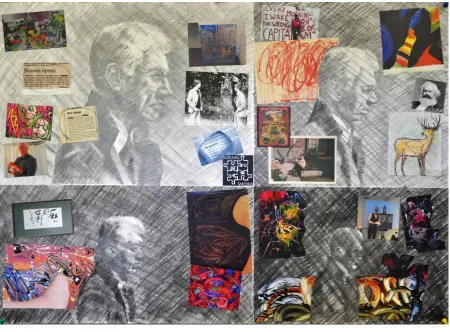
‘Notice the quick hatched pencil marks feeling their way, exploring the contours of the artist’s face. Is the restless drawing betraying an uncertainty? Four
portraits in one, all drawn from a side view, each one different. The eyes are not making direct contact, which you would usually expect from an artist’s gaze in a mirror. What impression do you have from the artist’s expression?’
I have created William Loveday. He has spoken at a number of conferences and educational events to explain and critique aspects of research work that I was finding difficult to articulate as an artist, social work educator and inquirer. In this excerpt he is discussing a drawing/collage I had been making, presented as part of an art installation exhibited at the United Kingdom Council for Graduate Education
(UKCGE) ‘Creative Doctorates’ symposium in 2018. The art installation is a piece of visual autoethnography based on self-examination and reflections of my educational journey through life. Why is self-inquiry so important in my doctoral journey and what voice does William bring to my inquiry that necessitates his presence?
In this article I discuss the interconnecting relationship between first-person action inquiry and visual autoethnography. I was concerned I might be too close to my data, thus posing a risk to the trustworthiness of my inquiry. To provide distance between myself and my doctoral work I developed two artistic/performative devices, a visual Johari Window (Luft and Ingram 1955) and the creation of an alter ego based on a dramatic convention originated by Dorothy Heathcote (Heathcote 2000). I used the action planning cycle/spiral developed by Kurt Lewin (1946) to develop the latter. Although the notion of ‘distancing’ will unfold throughout the article, I use Stig Eriksson’s presentation of this concept as a poetic and pedagogical strategy involving a process of ‘making strange’ or ‘estrangement’ as a means to reflection and learning (Eriksson 2014:3-4).
3
impact on how practice educators empower their students in the development of their critical understanding and skills by developing art-based approaches.
A key opportunity for my development has been my participation in a faculty learning group at Birmingham City University UK, a community of practice involving
academics who are interested in performative modes of inquiry and inquiry
dissemination. This has been a nurturing and enabling forum, with opportunities for individual and collective creative voices to be heard at conferences, symposiums, workshops and in publications. I contributed to a collective sculpture that toured a number of educational events, including ‘Disrupting Inquiry Practices’ at Coventry University, and ‘Creative Caring’ at the Centre for Social Care, Health and Related Research conference at Birmingham City University, both in 2018. This took the form of an art installation and the aforementioned drawing/collage.
4
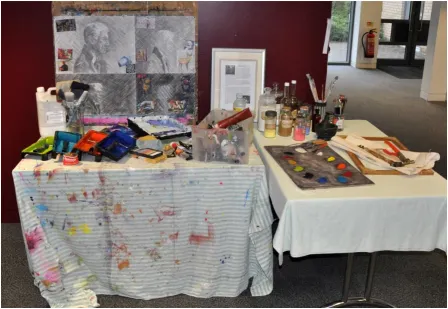
The metaphor of the art studio referenced the apprenticed artist in Renaissance Europe, who was dependent upon using materials discarded by the master to produce apprenticed work as part of his journey towards being a professional artist. This metaphor resonated for me, as I considered myself an apprentice inquirer learning my craft. The installation was put together using materials from my own studio and old jars and bottles acquired from local antique stores and junk shops, filled with powdered pigments.
While putting together and showing the installation I encountered two particular challenges. First, I found it difficult to articulate some of the ideas behind my inquiry that positioned creative outcomes as prominent without being heavily dependent upon a written explanation. Second, I felt I was too close to my material to
differentiate the objective and subjective aspects of my autoethnographical work.
Inquirers need to be aware how their identity and beliefs impact on every aspect of their inquiry (McNiff and Whitehead 2010).Iposition myself as a critical qualitative and participatory inquirer, where the presence of the self as inquirer is essential, impacting upon all stages of the inquiry process (Denzin and Lincoln 2011). From the planning stage, the interaction with participants, the analysis of data and how inquiry is presented, all involve human interaction to some degree or another. Heron (2001) argues that beliefs about the world and how it is experienced are revealed in inquiry by ontological questions about the nature of reality; epistemologically by the extent of our knowledge and the relationship between the knower and reality; and
methodologically by the way the inquirer can find out about reality through
increasingly evolving belief systems constructed between communities of knowers.
This leads to the discourse on objectivity, where reality is external, waiting to be discovered; and subjectivity, where knowledge is constructed and contingent. The hegemony of objectivism found within the positivist paradigm has long been
5
values represented by rejected theoretical assumptions (Heron 2001). In traditional terms, the researcher is distanced from the research, a neutral observer objectively examining human phenomena (Reason 1994). But this is a different kind of
distancing from that concerning this article, where subjectivity is openly
acknowledged and embraced, and where objectivity/subjectivity are not seen as binary opposites but more nuanced (Heron 2001).
Consideration of professional identity has been evident in my career as a social worker. In my professional development it has been essential to be critically aware of my identity, values, and belief systems, and to engage in critical reflective practice in order to avoid discrimination. My self-awareness project has been situated within social and political contexts and has engaged in an understanding and commitment to challenge organisational, cultural and structural oppression (Thompson 2012). A similar journey of exploration is a key area of development for students during their practice placements and the critical self-awareness of practice educators is vital to empower this process. However, it is a continuous one due to the insidious nature of oppressive practice.Thompson (2012;192) states that if we become complacent by failing to check we are carrying through an anti-oppressive stance, ‘discriminatory ideologies can subtly re-establish themselves in our thoughts and actions’. I consider there is a clear symbiosis between the critical self-awareness required to be an effective social worker and inquirer, which is crucial to the humanitarian ambitions espoused by the social work profession such as social justice, human rights, collective responsibility, respect for diversities, empowerment and liberation (IASSW/IFSW 2014).
The link between visual autoethnography and action inquiry
6
The use of visual autoethnography and first person action inquiry seemed relevant choices, but how well would they function and how might the arts relate to these two approaches? Both can provide a systematic inquiry approach to help the practitioner-inquirer investigate and analyse practice related problems or challenges by making sense of her/his own position and professional behaviour, together with those of others, within the context of work cultures (Denzin and Lincoln 2011). Marshall (2016:8) describes first person action inquiry and autoethnography as ‘cousins’ ‘with many similar intentions of reflexivity’ but emerging from different heritages.
As socially orientated inquiry, Whitehead (2002) positions ethnography as a predominantly qualitative approach. The ‘auto’ or ‘self’ denotes the inquirer or ethnographer being the source of the data. Chang (2008:51) states that
autoethnography is a powerful tool for inquirers and practitioners who deal with human relations in multicultural settings, specifically citing social work. Rather than being a descriptive self-indulgent introspective process, Chang supports the inquiry integrity of autoethnography with its provenance in empirical anthropology and social ethnographical inquiry. Defined as a combination of self-situated cultural analysis and interpretation with ‘narrative details’, Chang maintains that vigorous methods of data collection and analysis can result in a social scientific approach to inquiry (ibid 2008:46).
Pink (2013) develops this approach by engaging with visual material in inquiry as the central data component, this being typically generated by the inquirer. A criticism of visual autoethnography is that of image interpretation. The viewer may see the image very different from the image producer; things not intended or envisioned. Pink (2013:23) states that: ‘[a]ny experience, action, artefact, image or idea is never definitively just one thing but may be redefined differently in different situations, by different individuals and in terms of different discourses’. Similar to my art practice and how people view my artwork, I find the participatory and interpretive
engagement in critically orientated artistic endeavour a desired aspect of the
process. Just as the narrative might change every time it is told, so too an image is contingent upon how it is situated, the meanings it evokes, the knowledge it conveys and how it is interpreted (Rose 2016). The centrality of the visual within an
7
In seeking to explore how art-based pedagogies may empower educational practice, the desired outcome of action and change involving practitioners within a specific professional context made action inquiry a clear choice. The systematic, transparent and replicable qualities of action inquiry lend themselves well to the ambitions of my inquiry in extending and developing innovative practice education. A framework involving different levels of plurality outlined by Reason and Bradbury (2001) provides further mutual symbiosis with autoethnography and beyond. First person action inquiry addresses the ability of individual inquirers to act with awareness and meaningfulness when examining and living in the external world. This is not simply an introspective process but is developed by critical feedback from relevant others (Marshall 2016). Such opportunities as supervision sessions with my inquiry
supervisor, presenting at conferences, symposiums and workshops, and sharing reflective drawing/writing with others, have enabled me to develop a deeper critical understanding of my work. Second person action inquiry involves making
co-operative inquiries with others into issues of mutual concern, beginning with a pilot study I undertook with practice educators and to be followed by future iterative cycles of participatory inquiry (Reason and Bradbury 2001). Furthermore, my engagement with fellow academics in the faculty learning group and the shared experience of the collective sculpture are examples of second person action inquiry. Third person action inquiry involves creating a wider community of inquiry and larger scale dialogue, achieved for example by presenting at conferences, engaging in professional media sites and publication.
Acosta et al. (2015) identify individual autoethnography as an initial and inductive stage in collaborative action inquiry, each participant then sharing their narratives in order to explore and evaluate the structural, cultural, and behavioural perspectives related to their practice. Although broader, this resonates with the idea of
reconnaissance, an appraisal of where the practitioner-inquirer is currently
8
reconnaissance often occur throughout the inquiry process, Dillon considers living inquiry as a relevant approach, where beliefs, strategies and ways of behaving are treated as fluid, not fixed, unfinished, and not clear-cut. This requires a continual process of adjusting, observing what emerges, and bringing things into question (Marshall 1999; Marshall 2016). Hill builds upon this embodied approach by stating that the practice of reconnaissance is ‘not restricted to a place and time but
continues in a haphazard way throughout the duration of the action inquiry process’ (Hill 2008:29). The question ‘how far back do you go?’ is posed as a rhetorical one (Dillon 2007; Hill 2008), but in terms of the knowledge generated by exploring historical and cultural situational experience, this needs to be related to the inquiry project. In my case, this goes back to childhood to evaluate how experiences, both positive and troubled, have informed my educational beliefs and practice, uncovering strengths and baggage. In previous praxis as a practice educator I lacked confidence in using my identity as an artist to enrich student learning, because my multiple identities as artist-practitioner-educator-inquirer had not come together sufficiently. Art-based practice was not something that was explicitly related to social work practice, even though social workers are encouraged to be creative (Burgess and Laurance 2007). By taking an autoethnographical approach and exploring factors that had influenced me, inspired me, troubled me and even held me back in the past, I hoped I would appreciate the journeys of other participants in my inquiry, and a desire that valuable insights may be applicable beyond my inquiry.
A visual Johari Window
9
individually or on a team and organisational basis. The window is divided into four panes. The first is the open self, where one is aware of oneself and others are also aware. The second is the hidden self, things one is aware of but others are not. The third is the blind self, where one is not aware of aspects of one’s identity whilst
others are. And the fourth is the unknown self, where one is not aware of oneself and others are also unaware. Usually, through an exchange of adjectives, things are shared that may increase awareness in these four areas leading to greater self-consciousness. The window is often pictorially depicted as four equal sized panes, but the aim is to increase the open self and decrease the hidden, blind and unknown selves.
Developing the idea as a visual autoethnographical exercise to explore how my educational journey through life had informed my ideas and beliefs about education, I drew four self-portraits from a side view, one for each pane of the Johari Window. Each one was drawn in pencil from a photograph, which helped me to treat myself as an object, a piece of data. Each one had a differing degree of clarity created by a hatching effect, to mirror the degree of clarity denoted by the four characteristics of the Johari Window. I became conscious of avoiding self-flattery and attempted to draw with candour, including the tell-tale signs of ageing.
10
Blind Self Unknown Self Figure 2. Visual Johari Window (drawing and collage)
Onto the drawings I collaged images that evoked responses to the different selves within the window. Each image contained a narrative related to my educational journey. Sometimes images were evocative, stimulating memories and reflections. A painting from a series called ‘Bacchus, Psilax, Mainomenos’ by the American
abstract painter Cy Twombly conjured up childhood memories and represented an early example of my reaction against authoritarian educational approaches. I’ll let William comment on the connection:
William Loveday (making a comment about the hidden-self section of the Johari Window drawing/collage)
11
spontaneous experiential expression of discovery found in young children’s art. Inspired by Homer’s Iliad the series references the dual and almost
schizophrenic nature of the god Bacchus (also known as Dionysus), oscillating between pleasure and sensual release (psilax), and debauchery bordering on the nihilistic (mainomenos) (Cullinan 2011). These paintings resonate with David for a number of reasons. He had acute difficulties with reading and writing as a child, and only became confident from the age of eleven. The sweeping, swirling painterly gesticulations of Twombly signify his earliest joy of drawing and painting as a child, where the visual was a primary means of articulating his feelings. David recalls being chastised by a stern and intimidating priest at Sunday school for doodling while he was in full flow of indoctrination. ‘Drawing belongs to the Devil’ he was told, the priest’s face thrust within inches of David’s. Like the theme of Twombly’s painting, David took a Bacchanalian-like pleasure in obstinately continuing with his doodling, much to the priest’s intense annoyance. The priest told his father after class, but fortunately being someone who had a complete distain for pompous authoritarianism, his father took no notice’.
12
Using visual images as part of a research project and making these publicly visible in conferences and publications raises a number of ethical issues. In self-narrative inquiry the identity of the researcher is already disclosed, and the identities of others may be discernible by association. When aiming for inclusivity in self-narrative work, it is useful to ponder the question of ownership posed by Clandinin and Connelly (2000): does the narrator own the story simply by telling of it?
Ethical practice in visual base research is not straightforward (Rose 2016). The continuous and rapid development of information technology and social media have challenged traditional understanding of consent and copyright laws. Images are uploaded on and downloaded from the internet at a phenomenal rate on a daily basis. Kress (2010) argues that image-making, circulation, sharing and mashing are profligate features of contemporary visual culture, and in many situations, privacy, consent and copyright have become irrelevant to many people. Furthermore, Sturken and Cartwright (2009:212) state that contemporary art practice engaging with digital images problematise our understanding of originality, authenticity and ownership, raising ‘questions of reproduction and copyright to new levels of intensity’.
The use of found images in my drawing/collage have been reconstituted and
recontextualised in relation to other images in an attempt to establish new meaning, thus posing questions of authorship. Most of the images have been produced by myself. I have gained consent from my daughter to include images of my
13
on visual-based research ethics is often framed in terms of rights and the
‘institutional imperative of ethics review boards’ (Rose 2016:371). In addition, my reflexive practice is essential in order to be continually aware of the power relations between myself and participants throughout the whole inquiry process.
What have I learned from making a visual Johari Window? That autoethnography and first person action inquiry is not about focusing on myself alone but involves understanding others. Everyone has their unique journeys that inform their beliefs and current practice, and we are socially situated in developing our awareness of ourselves. Understanding my own journey has increased my appreciation of others’ journeys, and how these are culturally framed. Furthermore, working with visual images has enabled a more penetrating inquiry into my own memories, experiences, and the cultural contexts in which these are situated. They have enabled me to identify and examine critical incidents related to the development of my educational practice, and to a degree has helped me to objectify these experiences, a kind of distancing from the emotional attachments associated with my past narratives. Perhaps it has provided a temporary dispassionateness in order to see these
narratives slightly anew. I have stopped taking some of these memories for granted, the familiar has begun to look a little strange. As an educator, such insights have led me to delve more deeply into previously unexplored spaces in my relationship to subjective and objective experience, extending the understanding of my own epistemology and ontology. What about future development of this work? Perhaps William’s critique offers some ideas about this:
William Loveday (William is commenting at a faculty learning group seminar on using drama in research dissemination 2018):
‘The drawing/collage begins to stir David’s memories and to loosen fragments of habituated past narratives into a visual structure. It has been through
exhibition that he has been able to unpack these images for viewers, engaging him and others in interconnected conversations and shared dialogue. Cultural interpretations have begun to develop. Unconscious matter has been
14
reflection is required (Rodriguez and Ryave 2002). I hope to see David develop more works, perhaps focusing on different points of his educational journey’.
Enter stage right
Faced with the daunting problem of being able to disseminate my own work and ideas in a critical way, and encouraged by my inquiry supervisor, I considered a dramatic device to present my art installation at a number of conferences and
educational events. I had not participated in drama since a number of embarrassing performances in school productions as a child and was clearly out of my comfort zone and pushing the boundaries of my own learning. In order to provide an element of distancing from my inquiry I chose an educational drama convention devised by the English drama teacher and academic Dorothy Heathcote. This involved the development of a fictitious character that would present and critically comment upon my work.
Despite showing talent at drama school, Dorothy Heathcote was subject to
discrimination by being told she had no future on the stage because of her size and stature. She began teaching in schools in Yorkshire and immediately developed an unorthodox approach in the way children were engaged as full participants in drama. In the 1950s she began a long academic career, firstly at Durham University, and later Newcastle University, making a significant contribution to drama educational theory. A particular focus of her work was using drama as a means of engaging students in inquiry and reflective learning. By developing theatrical strategies such as ‘Teacher in Role’ (Johnson and O’Neill 1984), ‘Mantle of the Expert’ (Heathcote and Bolton 1995) and ‘Rolling Role’ (Heathcote 2000) she examined the
teacher/student relationship and how to empower students to engage in critical thinking about their lives and society.
15
legacy to drama education (Booth 2012). Eriksson (2014) highlights the central importance of distancing in Heathcote’s pedagogy. Whether used as an aesthetic principle in developing fiction, a protective factor in dealing with sensitive subjects, or a poetic device to facilitate creativity and learning, Erikson maintains that distancing is ‘foundational’ in a process that combines art and pedagogy (Erikson 2014:4). Through strategies of detachment Heathcote’s aim was to make something strange in order to examine it anew.
Erikson (2014) draws parallels between Heathcote’s ideas about distancing and those of a number of writers and dramatists, including the Russian writer and literary theorist Victor Shklovsky and the German playwright and theatre practitioner Bertolt Brecht. Shklovsky (1917) considered the habitualness of perception stemmed from the lethargic effect that results from processing experience and phenomenon for practical action. Things are only recognised and no longer seen, events are computed and categorised but not fully experienced. Shklovsky counteracted this through poetic language, having the potential to move beyond the prosaic language of everyday life and creating fresh powers of perception. In doing so he developed the concept of ‘Ostranenie’which means ‘making strange’. By a process of
estrangement and de-familiarization, routine and automatic responses can be circumvented.
16
Eriksson (2014:8) not only draws comparisons between Heathcote, Shklovsky and Brecht, but states that Heathcote made specific references to them in her writing, which represents a similarity of direction. Drawing from the spirit of this philosophical approach and Heathcote’s concepts of distancing and estrangement, I developed the fictitious character of William Loveday, an independent art critic and curator. The name William came from my grandfather, who died when I was a child, but his loving and generous nature has always remained with me. The surname came from the fact I was born in Loveday Street Hospital in Birmingham, long since demolished to make way for urban development.
To achieve a systematic approach to evaluating the usefulness of this distancing strategy, and because I had the opportunity of developing William over a number of educational events, I considered the process of iteration which was originally
17
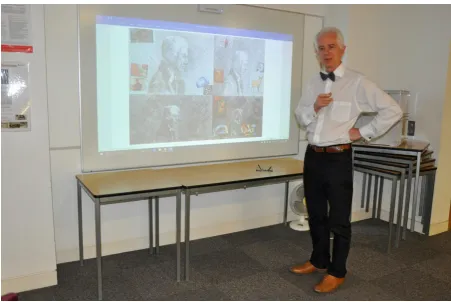
Figure 3. The author enacting William Loveday at UKCGE workshop ‘Doing the doctorate differently’ 2018
Cycle 1: William’s first appearance was at a UK Council for Graduate Education
(UKCGE) all day workshop called ‘Doing the doctorate differently; creative
methodologies and pedagogies’ held in 2018. I had set up my art studio installation in the main room of the symposium during lunch and some of the participants were already curiously exploring the art materials before I began. I had not fully scripted the session but intended to guide the participants through the installation using a detailed sequential structure to ensure that no important information or issues were omitted. Prior to the event I had a few awkward unwitnessed rehearsals and was still feeling apprehensive. When the symposium restarted, and in accordance with
18
number of participants picked up some art materials, paint brushes, jars of powered pigments, and unscrewed paint tubes to smell the oil paint. I overheard evocative memories being exchanged, and playfulness was evident from some of the
participants. William started his talk as participants in the drama started to return to their chairs. The talk went well. I made only one small slip-up during the twenty-minute dialogue and I was surprised how easy I had slipped into the role. William thanked the participants at the end of his talk and announced that he would be leaving the room, returning as David Collins to answer questions. I returned minus the bowtie, formally signifying that I was now out of role and was again myself. This was followed by some useful questions and feedback, which showed that the installation and performance had been positively received.
Reflecting after the event and taking on board feedback from my supervisor, I considered that Heathcote’s technique worked well. By formally announcing I was going in and out of role, the strategy had the effect of engaging the participants in the process and valuing their involvement. In keeping with the Heathcote approach, the smallest of props was needed to effectively signify going into role and maintaining this throughout the performance. It did feel strange being someone else talking about my work, but in a positive way. It shifted my focus and perspective, creating the effect that I was conveying my work less directly. It felt like I was coming to the performance from the side, rather than head-on (enter stage right). I identified a number of areas to develop for the next iteration. I found it difficult to cover all my intended content due to the time being taken with participants viewing the
installation. My pace was quicker than I preferred and I needed to review my material. Perhaps most importantly, I had placed expectations upon William to
explain my work, but there was scope to move beyond explanation and for William to articulate and develop some of the key arguments related to the installation and my doctoral work.
Cycle 2: William’s next performance was a few days later to a group of students at
19
reflections of the previous iteration, I condensed some of the content and elaborated on others, to give William the opportunity to develop some key arguments.
I felt there was a positive level of engagement from the participants, and although they were considering a diverse range of ideas in their own doctoral work, the performance was successful in modelling how creative approaches have value. Furthermore, such approaches can have a philosophical and epistemological basis, and can develop defendable practice. The video recording did not work so well. It did not have the same level of participation as the actual installation, where participants could physically engage with the materials. The timing was problematic as the images in the video were advancing too quickly and became out of synchronisation when William was developing key arguments. One feedback comment suggested that a higher level of understanding would be conveyed to participants if more explanation and context were made before William came into the room. This feedback led to further reflections to inform the next iteration and to change and refine the performance.
Cycle 3: The next iteration was a seminar entitled: ‘Using drama methods to
20
performance. For example, one comment touched on the critical potential of
William’s voice and how this could be extended beyond my own work to include the advantages and tensions of working within different research paradigms and
methodologies. Another participant thought there were traces of witticism and provocativeness in William’s delivery, and considered the potential to develop this further to engage the audience in more debate. This has encouraged me to develop a wider criticality and to develop William’s character further.
A key reflection from all the performative iterations was that Heathcote’s method produced not only an interesting way to disseminate inquiry ideas and activities but was successful in providing new and transformative ways of considering my work through distancing. My experience is attuned to what Eriksson (2014:11) terms ‘poetic distortion’, derived from Heathcote’s own writing. By this he means distortion in a positive context, from the real world to a poetic world in order to see it in a different light. Heathcote made this explicit by saying: ‘The arts are metaphoric and analogous, and we can be spectators of ourselves in ways often denied in a life, because we can distort time to give opportunity for reflection to be encountered’ (Heathcote and Hovda 1980:5).
21
Another key reflection was that the process of inquiry inspired by Lewin (1946) helped me to develop the strategy and role of William in a more systematic and planned way. The spiral of planning, action, fact-finding, and evaluation supported my efforts to adjust, adapt, and refine in order to improve the strategy. Because the context of the performance changed every time, I recognised that this process was an on-going one. The process of reconnaissance went beyond the fact-finding process, to include how I situated myself in the inquiry and to question my own professional identity. William has become an alter ego, a part of myself I was finding difficult to articulate. Engaging participants in the process, maximised most fully in the first iterative performance, has enabled both a self-reflective and a collaborative-reflective inquiry, and has further potential for development. It seems fitting for William to have the last word, which he articulated at the faculty learning group seminar:
William Loveday (William is speaking at the faculty learning group seminar on using drama in research dissemination 2018):
‘By weaving together strands of poetic and dramatic practice from modernists such as Shklovsky, Brecht and Heathcote, pulling these together to underpin inquiry, and valuing the spaces and openings for collaborative dialogue, David has not only created my character to articulate his doctoral work, but he has managed to combine education, art and inquiry in such a way that the
aesthetic quality of inquiry dissemination has taken centre stage. By doing so he is saying that, not only should inquiry be aimed at improving the human condition, but the aesthetic qualities of our practice are important too’.
Conclusion
The process of self-examination common to both first person action inquiry and autoethnography is reliant upon interaction with others, and in gaining feedback within a framework of systematic inquiry to provide rigour. This has been enhanced by developing the two devices inspired by Luft and Ingram, and Heathcote, providing further opportunities for dialogue and critical analysis through exhibition and
22
critique and reappraise my doctoral work through a process of distancing. They have also offered an additional benefit by providing creative ways to disseminate inquiry ideas and findings. Furthermore, such work is congruent with a broader and
emergent agenda involving performative inquiry and research dissemination, strengthened by the Frascati Manual in 2002 (Organisation for Economic
Co-operation and Development 2015) and exemplified by the work of Haseman (2006), Peterson and Langellier (2006), and Gergen and Gergen (2014).
Although undertaken in the context of inquiry into social work practice education, I believe these devices can be adapted to numerous situations involving self-reflection and participatory inquiry. In particular, drawing ability is not necessary when making a visual Johari Window, photographs and other images for collaging purposes are just as relevant. It can be an engaging way of developing relationship building, mutual understanding and co-participatory assessment involving a student and practice educator, and be revisited and developed at several points during a placement. Heathcote’s device could be used by a student as a self-reflexive exercise and part of identity work when developing discriminatory and anti-oppressive practice.
In terms of research methodology, the value of such work in exploring deeper levels of self-awareness is important when moving beyond first person action inquiry to second and third person action inquiry or from autoethnography to more collective forms of ethnography (Chang 2008). This has supported a greater awareness of my positionality in terms of being a social work educational practitioner and inquirer, my impact on other participants, and upon the inquiry methodology. Methods that achieve a distancing effect within the spirit of qualitative inquiry can support the process where the self is seen as a subject of inquiry, and by providing lenses
23
I intend to develop both devices further and to include them in my doctoral thesis, which will take the form of an assemblage including an art installation, performance, and publication of this paper, accompanied by a richly contextualised written
exegesis. I am currently working on the idea of developing a soliloquy involving William interviewing myself, which would be an interesting way to get some of the inquiry context and even methodology across. Such approaches continue to provide new perspectives of self-discovery and to develop my practice as a critical thinking educationalist.
Photo credit: All photographs by Paul Atkinson, Birmingham City University.
References
Acosta, S., Goltz, H., and Goodson, P. 2015, Autoethnography in action inquiry for health education practitioners. Action Inquiry, Sage. Vol. 13. No. 4. 411-431.
Booth, D. 2012, Reconsidering Dorothy Heathcote’s educational legacy. Drama Inquiry Vol.3. No.1. 1-18.
Brecht, B. [1936] 2001, Theatre for pleasure or theatre for instruction (translated Willett, J.). In Willett, J. 2001, Brecht on theatre: the development of an aesthetic. London: Methuen Publishing.
Brecht, B. [1936] 1963 Episches Theater, Entfremdung (translation Eriksson, S.). In Brecht, B. Schriften zum Theater, b.3. Frankfurt am Main: Suhrkamp Verlag
Burgess, H. and Laurance, J. 2007, Reflections on creativity in social work education. The Higher Education Academy – Social Policy and Social Work. Perspectives in Creativity in Higher Education. UK.
Clandinin, D. J., and Connelly, F. M. 2000, Narrative inquiry: Experience and story in qualitative research. San Francisco: Josey-Bass.
24
Cullinan, N. 2011, Twombly and Poussin: Arcadian painters. Exhibition Catalogue. London, Dulwich Picture Gallery.
Denzin, N. and Lincoln,Y. 2011, Introduction, the discipline and practice of qualitative inquiry. In Denzin, N. and Lincoln,Y. (ed) 2011, The Sage handbook of qualitative inquiry. Sage.
Dillon, P. 2007, Using the knowledge management discourse as a framework for the self examination of a school administrator’s professional practice. Queensland University of Technology. Brisbane: Australia.
Dillon, P. 2008, Reconnaissance as an unconsidered component of action inquiry. Action learning and action inquiry journal, Vol 13. No.1. 4-17.
Eriksson, S. A. 2014, Exploring distancing in the work of Dorothy Heathcote: Estrangement as poetic distortion. Drama inquiry: international journal of drama in education, Vol. 5. No.1. 1-15.
Gergen, K. J. and Gergen, M. M. 2014, Mischief, mystery, and moments that matter: vistas of performative inquiry. Qualitative inquiry, Vol 20. No.2. 213-221.
Guba, E.G. and Lincoln, Y.S. 1982, Epistemological and methodological bases of naturalistic inquiry. Education communication and technology, Vol 4. 233-252.
Haseman, B. C. 2006, A manifesto for performative research. Media International Australia Incorporating Culture and Policy: quarterly journal of media research and resources. 98-106.
Heathcote, D. 2000, Contexts for active learning. In Lawrence, C. (ed) Drama inquiry. 1. London: National Drama.
Heathcote, D. and Bolton, G. 1995, Drama for learning: Dorothy Heathcote’s mantle
of the expert approach to education. Portsmouth USA: Heinemann.
Heathcote, D. and Hovda, R. 1980, Drama as context for talking and writing: ‘the
25
(ed) Drama as context: Dorothy Heathcote. Aberdeen: NATE Papers in education, Aberdeen University Press.
Heron, J. 2001, The placebo effect and a participatory worldview. In Peters, D.(ed) 2001, Understanding the placebo effect in complementary medicine. London, Churchill Livingstone.
Heron, J. and Reason, P. 1997, A participatory inquiry paradigm. Qualitative Inquiry Vol. 3, No.3. 274–294.
Hill, G. 2008, Engaging practitioners in change of practice: the importance of reconnaissance. Action learning and action inquiry journal, Vol 13. No.1. 18-31.
Howell, S. 2004, Themes, iteration and recoverability in action inquiry, in Kaplan, B., Truex, D.P., Wastell, D., Wood-Harper, A.T., Degross, J. (ed) Information systems inquiry: relevant theory and informed practice. IFIP Advances in Information and Communication Technology. Retrieved from Springer
https://link.springer.com/chapter/10.1007%2F1-4020-8095-6_20#page-1 accessed
09.05.2018.
IASSW/IFSW. 2004, Global Standards for the Education and Training of the Social Work Profession. International Association of Schools of Social Work and
International Federation of Social Workers: Adelaide, Australia.
http://cdn.ifsw.org/assets/ifsw_65044-3.pdf accessed 09.05.18.
Johnson, L. and O’Neill, C. 1984, Dorothy Heathcote: collected writings on education and drama. London: Hutchinson.
Kress, G. 2010, Multimodality: A social semiotic approach to contemporary communication. London: Routledge.
Lewin, K. 1946, Action inquiry and minority problems, in G.W. Lewin (Ed.) Resolving social conflicts. New York: Harper & Row (reproduced 1948).
26
Marshall, J. 1999, Living life as inquiry. Systemic Practice and Action Inquiry, Vol 12, No 2,155-171.
Marshall, J. 2016, First person action research: living life as inquiry. London, SAGE.
McNiff, J. and Whitehead, J. 2010, You and your action research project. 3rd Edition. Abingdon, Routledge.
Organisation for Economic Co-operation and Development. 2015, Frascati manual: guidelines for collecting and reporting data on research and experimental
development 6th revision.http://www.oecd.org/innovation/inno/frascati-manual.htm Accessed 01.06.2018
Papademus, D. and International Visual Sociological Association. 2009, Code of research ethics and guidelines. Visual Stusies, 24.3, 250-257.
Peterson, E. E. and Langellier, K. M. 2006, The performative turn in narrative studies. Narrative inquiry Vol.16. No.1. 173-180.
Pink, S. 2013, Doing visual ethnography; Images, media, and representation in research, 3rd Edition. London, SAGE.
Reason, P. (Ed.) 1994), Participation in human inquiry. Thousand Oaks, CA, US: Sage Publications, Inc.
Reason, P. and Bradbury, H. 2001, Inquiry and participation in search of a world worthy of human aspiration. In Reason, P. and Bradbury, H. (Eds.) Handbook of action inquiry: participative inquiry and practice. London: SAGE.
Rodriguez, N. and Ryave, A. 2002, Systematic self-observation. Thousand Oaks, CA: Sage.
Rose, G, 2016 Visual methodologies, 4th Edition. London SAGE.
Shklovsky, V. [1917] 1988, Art as technique (translated L. T. Lemon and M. J. Reis). In Lodge, D. (ed) Modern criticism and theory: a reader. London: Longman.
27
Thompson, N. 2012 Anti-Discriminatory Practice: Equality, Diversity and Social Justice. 5th ed. Basingstoke: Palgrave McMillan.
Whitehead, T, L. 2002, What is Ethnography? Methodological, ontological, and epistemological attributes. Cultural Ecology of Health and Change.
http://www.cusag.umd.edu/documents/workingpapers/epiontattrib.pdf accessed
09.05.2018.