Forum: Issues, management, PolIcy, and oPInIons
A
W
AYF
ORWARD FORF
IRE-C
AUSEDT
REEM
ORTALITYP
REDICTION:M
ODELINGA
P
HYSIOLOGICALC
ONSEQUENCE OFF
IREKathleen L. Kavanagh1,*, Matthew B. Dickinson2, and Anthony S. Bova2
1Department of Forest Resources, University of Idaho,
P.O. Box 441133, Moscow, Idaho 83844-1133, USA
2Forest Service, Northern Research Station,
359 Main Road, Delaware, Ohio 43015, USA
*Corresponding author: Tel.: 001-208-885-2552; e-mail: [email protected]
AbstrAct
Current operational methods for predicting tree mortality from fire injury are regression-based models that only indirectly consider underlying causes and, thus, have limited gen-erality. A better understanding of the physiological consequences of tree heating and in-jury are needed to develop biophysical process models that can make predictions under changing or novel conditions. As an illustration of the benefits that may arise from in -cluding physiological processes in models of fire-caused tree mortality, we develop a test -able, biophysical hypothesis for explaining pervasive patterns in conifer injury and func -tional impairment in response to fires. We use a plume model to estimate vapor pressure deficits (D) in tree canopies during surface fires and show that D are sufficiently high to cause embolism in canopy branches. The potential implications of plume conditions and tree response are discussed.
Keywords: cavitation, crown scorch, fire plume, tree mortality, vapor pressure deficit
Citation: Kavanagh, K.L., M.B. Dickinson, and A.S. Bova. 2010. A way forward for fire-caused tree mortality prediction: modeling a physiological consequence of fire. Fire Ecology 6(1): 80-94. doi: 10.4996/fireecology.0601080
IntroductIon
Latent tree mortality from wildfire and pre -scribed fire can be difficult to predict. Initial mortality due to crown combustion and stem girdling is obvious, but an incomplete under-standing of the causes of latent mortality has hampered our ability to predict the amount of long-term mortality under a wide variety of conditions following fires. Independent as -sessment of current tree mortality models points out their strengths such as ease of
bark thickness), and species (e.g., Ryan et al. 1988, Ryan and Reinhardt 1988, Reggelbrugge and Conard 1993, Fowler and Sieg 2004; see review in Michaletz and Johnson [2006a]). These observable model parameters are surro-gates of the physiological processes that may cause mortality but are not direct measures of the actual mortality agents or their physiologi-cal impacts. In addition, it is difficult to decide which biophysical impacts to measure and model if there are lingering questions about the actual causes of latent mortality and how they are inter-related. Fire related mortality due to the combined effects of heat-caused vascular cambium necrosis around the circum-ference of the stem and complete mortality of canopy buds has been predicted using a pro-cess model with promising results (Michaletz and Johnson 2006b). However, as the authors point out, the lack of process-based approaches is limiting our ability to both predict tree func-tional impairment and mortality where injury from fire alone is sub-lethal, and to define and validate potential mechanisms of post-fire tree mortality.
For example, there are several potential causes of latent tree mortality associated with duff consumption at the base of a tree during prescribed and wildfires. It has been hypothe -sized that cambial injury leads to a lack of car -bohydrate transport from the needles to the roots, and thus to root starvation (Ryan and Fransden 1991). A second potential cause is heat-related disruption of sapwood by a wounding response that, for instance, may lead to resinosis (Shigo and Marx 1977) or direct sapwood consumption in recurrent fires (Run -del 1973), thus interrupting water transport and inducing water stress. Knowing the major causes of mortality is crucial because process-based models of post-fire damage associated with a lack of water transport would be very different from process-based models that pre-dict latent mortality due to a loss of phloem transport and due to direct root mortality.
Experimental studies designed to mimic fire injury give us some clues to potential physiological impacts of fire. Two studies in -volving heat girdling of the stem indicate that it takes close to 100 % cambial injury to kill a tree (Ryan 2000, Ducrey et al. 1996). Sap flux measurements of heat girdled trees indicate that there was an immediate disruption in sap-wood water conductance following 100 % heat girdling, but no disruption associated with 37 % to 78 % heat girdling relative to the con -trols (Ducrey et al.1996). Trees with reduced sap flux and 100 % heat girdling also had low -er stomatal conductance and died within five months of treatment, indicating that root death from carbon starvation was not the likely cause. Intermediate girdling caused no change in stomatal conductance relative to controls (Ducrey et al. 1996, Ryan 2000), and the sub -ject trees did not die over the life of the experi -ment (7 months to 2 years). These results in -dicate that it takes nearly complete cambial girdling to kill a tree and that the main physio-logical response preceding death is stomatal closure due to disruption of water flow in the sapwood.
A Xylem Cavitation Hypothesis
Direct measures of physiological impacts of fire may improve our understanding of the causes of latent mortality and improve our ability to predict it. One physiological process that can be disrupted without outward indica-tions is water transport within a tree. This physiological response may not cause direct mortality, but may have long-term detrimental effects on overall photosynthetic processes and tree productivity. By understanding the causal mechanisms, managers will be better able to model the effects of various fuel treatments and post-fire stressors on tree mortality, identi -fying the conditions that cause risk. We pres -ent a physical model that predicts a pot-ential cause of latent tree mortality associated with a loss of sapwood conductance.
Movement of water from the soil into the roots and throughout a tree is fundamental to its survival. According to the cohesion tension theory, water is pulled to the top of the tree un-der tension (e.g. Tyree 1997). Liquid water can withstand high tensions because water molecules form hydrogen bonds with each other. However, hydrogen bonds between wa -ter molecules, analogous to links on a chain, are under very high tension during periods of drought, when the demand for water exceeds supply, resulting in liquid water that is in a meta-stable state. When the tension becomes too great, air bubbles are sucked into water-conducting conduits through micropores in the cell wall (Cochard et al. 1992). The air then nucleates an air embolism when the liquid wa-ter is converted to a vapor state.
Xylem cavitation has often been referred to as the unambiguous limit to water transport in trees (Tyree and Sperry 1988). Once a tra -cheid cavitates, it is no longer able to transport water because of the air embolism that forms (Kavanagh and Zaerr 1997). If a tree cannot transport water to its leaves, it will not survive. Therefore, natural selection has favored trees that minimize cavitation by, for example,
cur-tailing water loss from the leaves during drought (Wang et al. 2003, Kavanagh et al 2009).
Trees minimize water loss rates, and thus prevent tension on the water column capable of causing cavitation, by closing stomata. Sto-mata perform a dual function by allowing wa-ter to exit and CO2 to enter the leaf. The sto-mata close when drought occurs, thereby mini-mizing water loss but also limiting photosyn-thesis because CO2 no longer enters the leaf. In trees, stomata close before the tension in the tracheids reaches a point where excessive cav-itation occurs (Tyree and Sperry 1988, Bond and Kavanagh 1999). However, the difference between the tension at which stomata close and the tension at which hydraulic failure oc-curs is relatively small (Sperry 2004), thus small increases in tension on the water column can initiate cavitation and embolism forma-tion. Although stomatal closure limits photo-synthesis, it allows trees to protect their water transport systems so that they can resume transportation of water when the limitations are relieved.
Although trees have adapted to drought conditions by closing stomata, what happens to their water transport systems when atmospheric water demand is rapidly intensified by wildfire? Wildfire increases water demand by causing sudden shifts in atmospheric vapor pressure in the heated plume that rises above the flames. For example, atmospheric temperature and rel-ative humidity have been recorded at 100 oC and 0 % relative humidity, respectively, during a wildfire (Kremens et al. 2003), resulting in a vapor pressure deficit (D) of 270 kPa. In addi-tion, it took two hours for atmospheric condi-tions to return to pre-fire levels. Maximum at -mospheric D rarely exceeds 6 kPa in forested environments in the western USA (Kavanagh
et al. 2007); therefore, the hot plume generated by a wildfire may place a significant strain on a tree’s drought stress mechanisms.
fire-induced atmospheric heating can be pre -dicted given plume D and data relating xylem water potential (Ψx) to plume conditions. The relationship between D, soil water potential (Ψsoil) and Ψx can be described mathematically as:
where Gs is canopy stomatal conductance (mmol m-2 s-1), D is the vapor pressure deficit
representing the leaf-to-air vapor pressure gra-dient (kPa), and KL is leaf specific conductance (mmol m-2 s-1 MPa-1) (Jones and Sutherland 1991, Dewar 1995, Whitehead 1998, Bond and Kavanagh 1999). It is evident that if stomata are open or cuticular water loss is significant (e.g., high Gs), high D will increase the ten-sion on the water column in the sapwood (i.e., more negative Ψx).
High temperature and low relative humidi -ty (i.e., very high D) associated with fire plumes can cause a rapid loss of water from foliage. For example, lodgepole pine (Pinus contorta Dougl.) stems placed in a 250 oC oven
had a water loss rate 25 times the rate of nor-mal transpiration (Cohen et al. 1990). Water loss rates of this magnitude from living foliage should result in xylem water potentials (Ψx) that can cause xylem cavitation. Like clogged arteries in humans, this loss in the water trans-port system due to cavitation may not be im-mediately evident but may make the tree more prone to future stresses. For instance, in a crown scorch experiment, it was noted that the buds that survived on the scorched branches produced shortened needles and branches with little internode growth (Ryan 2000). These symptoms are consistent with a loss of branch water conductance due to cavitation (Kavana -gh and Zaerr 1997). The irreversible loss in water movement caused by large-scale cavita-tion will result in reduced productivity as sto-matal closure increases (Kavanagh and Zaerr 1997, Bond and Kavanagh 1999), thereby
lim-iting photosynthesis. Excessive heating of the sapwood could also induce cavitation near a tree’s base where heating from flames is most intense and, thus, potentially explain the rapid drop in sapwood conductance associated with heat girdling (Ducrey et al 1996).
It should be noted, however, that if soil moisture is not limiting, a tree may not experi-ence high rates of cavitation during a wildfire because water supply may balance high rates of moisture loss from the leaves. This may be one reason why fire is less likely to cause mor -tality on sites with high soil moisture (Cohen and Omi 1991). In addition, riparian trees on sites with relatively high soil moisture may limit cavitation by replacing water that is rap-idly lost from foliage. In short, pre-existing conditions may influence the level of cavita -tion in an individual tree and, therefore, its subsequent mortality.
Methods
To examine the potential for xylem cavita-tion in trees exposed to forest fire, we used a fire plume model to estimate atmospheric va -por pressure, and a hydraulic conductance model to predict the corresponding xylem wa-ter potential. These xylem wawa-ter potentials were then compared to cavitation vulnerability curves to determine the potential loss of hy-draulic conductance within the tree canopy.
Plume Model
An integral plume model (Mercer and We -ber 1994) was used to generate average D
through the canopy for typical surface-fire conditions (Table 1). The model simulates a plume arising from a line source of heat of specified intensity (kW m-1) on flat terrain and
involves solution of six coupled ordinary dif-ferential equations based on the conservation of mass, momentum, and energy. Cross-winds result in down-wind displacement of the plume (e.g., Mercer and Weber 1994) and, conse -(1)
<x <soilGsD
quently, no-wind conditions will result in the highest D at a given height within the canopy. We compared wind (3 m s-1) and no-wind plume simulations. When wind was applied, its velocity was constant with height. The coupled equations were solved with the Bul-stoer function in MathCad (PTC, Needham, Massachusetts, USA).
To generate water vapor and heat, the mod-el was run over a range of firmod-eline intensities (kW m-1) prescribed by increasing rate of spread at a fixed fuel consumption of 0.75 kg m-2 (Table
2). There was no feedback between wind and fire rate of spread. Heat of combustion for convective heat release was constant at 16 000
kJ kg-1 (Nelson 2002). Boundary conditions for the plume model (Table 2) include flame velocity (wi), plume half-width (bi), flame-tip temperature (Tp0), and flame density (ρi). Plume half-width is one-half of flame depth. Flame tip temperature (K) was estimated as Ti
= 860 + Ta, where ambient (Ta) was set to 298 K (DePuy et al 2003). Average flame temper -ature (K) for biomass burning through the con -tinuous and intermittent zones was set to Tf = 1000 + Ta (DePuy et al. 2003). Flame density was proportional to average flame temperature from the ideal gas law. For this calculation, ambient air pressure at an elevation of 500 m above sea level was used (Campbell and Nor -man 1998) and, given average flame tempera -ture, flame density was 0.31 kg m-3. Variation
in ambient air pressure has minimal effects on the results and so was left constant. Flame ve-locity was calculated from Nelson (2002) and plume half-width was one-half of flame depth. Flame depth (Df, m) was calculated from:
W
m s-1 m minR -1 kW mI -1 mhf m swi-1 mbi
0 1 200 0.9 2.2 0.2
0 2 400 1.2 2.8 0.3
0 4 800 1.7 3.5 0.6
0 8 1600 2.3 4.4 1.2
3 1 200 0.5 2.2 0.2
3 2 400 0.8 2.8 0.3
3 4 800 1.2 3.5 0.6
3 8 1600 1.8 4.4 1.2
Table 1. Characteristics of fires and resulting
plume-model boundary conditions used to predict xylem cavitation. Fuel consumption was held con-stant at 0.75 kg m-2 while wind speed (W) and flame
rate of spread (R) varied, creating a range of fireline intensites (I). Flame height (hf) is determined by
wind speed and fireline intensity while initial plume velocity (wi) is dependent on fireline intensity and
initial plume half width (bi) is dependent on flame
width.
Species Ψsoil (MPa) GS (mmol m-2 s-1) K
L (mmol m-2 s-1 MPa-1) Ψ50% (MPa)
Douglas-fir -1.0a 15b 0.93a -5.2c
Western larch -1.0a 26b 1.34a -4.3c
Lodgepole pine -1.0d 30e 2.2b -3.0c
Table 2. Parameters used to predict stem water potential and degree of cavitation in Douglas-fir (DF),
western larch (WL) and lodgepole pine (LPP). Biophysical parameters include soil water potential (Ψsoil ) set at a typical late summer value, canopy conductance to water vapor (Gs) set at approximately
30 % of maximum for the species of interest to reflect mid-day stomatal closure, leaf specific conduc
-tance (KL) determined from values for mature trees in North Idaho, and the water potential where a 50 % loss in hydraulic conductance can be expected (Ψ50 %).
a Kavanagh et al. 2007.
b Unpublished data Kavanagh
c Pinol and Sala 2000
where R is rate of spread (m s-1), W is fuel con-sumption (kg m-2), and c is combustion rate (kg m-2 s-1).
Water vapor was assumed to mix immedi -ately into a flame zone control volume defined in two dimensions by flame depth and length. Flame length (equivalent to height with no wind) was estimated from fireline intensity us -ing Byram (1959). The two-dimensional flux of water vapor (kg m-1 s-1) was determined
from:
where W2D is two-dimensional loading (kg m-1)
and Yw is yield of water vapor (kg kg-1). Water vapor yield was set to 0.609 kg kg-1 based on
typical combustion stoichiometry and a fuel moisture content of 5 % of dry weight (Byram
1959).
Water vapor concentration in the flame control volume was calculated as follows:
where Cfw is the concentration of water vapor, nw is the number of moles of water, and nCV is the number of moles of all gases in the flame control volume. The number of moles of wa-ter vapor in the two-dimensional control vol-ume was calculated as:
where hf is flame height (m) and Mw is the mo-lecular weight of water (18 g mol-1). The
num-ber of moles of all gases in the two-dimension-al control volume is determined from the idetwo-dimension-al gas law and flame temperature:
where pa is ambient air pressure, R2D is the gas constant for the two-dimensional control vol-ume (8.314 m2 Pa K-1 mol-1), and T
f is defined
above. Ambient vapor concentration was add-ed to vapor concentration arising from com-bustion and fuel moisture.
Because mixing is turbulent, we assume that mass and heat transfer rates between the plume and ambient air are similar. Thus, water vapor concentrations decline toward ambient with height above the flame in proportion to declines in plume temperature:
where Cwh is concentration of water vapor at height h above the flame and Tph is flame tem -perature at height h above the flame. Flame height for fires in wind (Table 2) was deter -mined from flame length and Nelson’s (1986) relation for flame tilt angle. Vapor pressure at height within the plume is the product of am-bient pressure and vapor concentration. Vapor pressure deficit is the difference between plume vapor pressure and saturation vapor pressure (Campbell and Norman 1998).
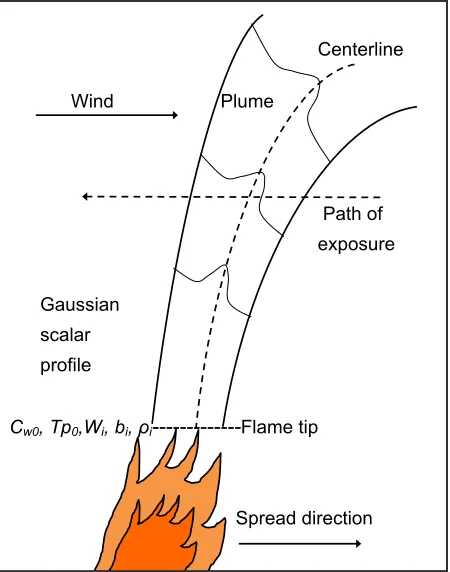
Plume model output is a centerline value that can be considered an average across the width of the plume perpendicular to the cen-terline axis (a top-hat profile). A Gaussian profile is fit to the top-hat results (Figure 1; Mercer and Weber 1994) and the average gas concentrations and temperatures over the resi-dence time of the plume as it travels at the fire’s rate of spread are calculated horizontal to the ground across the plume at 1 m increments in height above the flame tip (Figure 1). The plume in no-wind conditions moves across the frame of reference with no horizontal distor-tion in contrast to the plume in a cross-wind
¸¸ ¹ · ¨¨ © § a h w
wh Cf TpTp TpT
C 0 0 1 (7) c RW
Df (2)
f w D w D RY W
mx 2
(3)
CV w
w nn
Cf (4) i w f f w
w M w
D h m n 2 1 ) ( x (5) f D f f a
CV R T
represented in Figure 1. The residence times and average vapor pressure deficits mimic what a fixed object, for instance, a branch tip with foliage, would be exposed to as a fire spreads underneath.
Hydraulic Conductance Model
The canopy D profiles generated by the plume model were used in a hydraulic conduc-tance model as described in Equation 1 (Bond and Kavanagh, 1999) to determine Ψs. Three species were chosen for the initial model pa-rameterization: Douglas-fir (Pseudotsuga
men-ziesii [Mirb.] Franco), western larch (Larix oc-cidentalis Nutt.) and lodgepole pine. An inte-gral plume model (Mercer and Weber 1994) was used to generate average D through the canopy for typical surface-fire conditions (Ta -ble 1). We chose typical late summer ecophys -iological parameters for Ψsoil, Gs, and KL, as presented in Table 2.
Finally, the Ψs value needs to be related to the degree of xylem cavitation. This can be done using a vulnerability curve expressing the degree of loss in water conductance as a function of Ψs. Vulnerability curves are avail-able for several tree species including Doug-las-fir (Sperry and Ikeda 1997), western larch, and lodgepole pine (Pinol and Sala 2000). The stem water potentials where xylem cavi-tation causes a 50 % loss in hydraulic conduc -tance for these three species are presented in Table 2.
Of interest were plume exposures above the height at which foliage necrosis would be caused by the direct effects of foliage heating. Van Wagner (1973) determined that foliage ne -crosis from heat would occur at the height at which 60 °C was reached in a plume above a surface fire, the 60 °C threshold being the tem-perature at which tissue necrosis would occur nearly instantaneously. Because foliage tem-perature tracks plume temtem-peratures closely, necrosis (scorch) heights predicted from the 60 °C plume temperature compare favorably with scorch height predictions generated from a series of linked models including plume model predictions of gas temperature and ve-locity, needle heating from a lumped capaci-tance heat-transfer model, and tissue necrosis from a thermal tolerance model (Butler and Dickinson 2010).
results And dIscussIon
The effects of the plume are substantially ameliorated by wind because the flow of the plume is inclined and dilution is enhanced (Figure 1). The plume model assumes a con -Centerline
Wind Plume
Path of exposure
Gaussian scalar profile
Cw0, Tp0,Wi, bi, ρi---Flame tip
Spread direction Flame
Figure 1. Structure of a modeled plume in a cross
wind. The wind blows from left to right causing
plume deflection to the right. Flame conditions determine initial flame-tip temperature (Tp0), flame
density (ρi). vertical velocities(wi), and plume half
width (bi) (Table 1). Fuel moisture, fuel consump
-tion, and ambient vapor pressure determine plume
water vapor content (Cwo). A Gaussian profile is fit
to the top-hat (averaged) output of the plume model
and used to calculate average plume vapor pressure
stant heat release from a line-source flaming front. Clearly, this is an idealization with fire rate of spread and intensity, and canopy expo-sures, varying across a burning landscape as fuels, winds, and topography change. We use the plume model only to illustrate that substan-tial xylem cavitation is possible within a range of surface fire intensities typical of manage -ment fires (Johnson 1992).
The models predict Ψx capable of causing xylem cavitation under several fire scenarios (Figure 2). The degree of predicted injury due to xylem cavitation is related to plume temper-ature rise that, in turn, is related to the wind speed and fireline intensity (Figure 2). Stem water potential does not exceed the point of 50 % xylem cavitation very frequently when wind speeds are 3 m s-1 and the fire intensity is
relatively low. The only impairment expected would be in foliage very close to the ground. As fire intensity increases, Ψs declines to a point where cavitation occurs in the canopy up to 10 m above the ground in lodgepole pine and western larch. Finally, at the highest fire intensities, the model predicts foliar necrosis from heat alone up to 30 m when wind is ab-sent. However, when fire intensity is high and wind speeds reach 3 m s-1,foliage necrosis is limited to lower heights but significant amounts of cavitation can be expected in the surviving lodgepole pine and western larch crowns.
Vulnerability to cavitation varies widely between species (Table 2). Of the three spe -cies examined, Douglas-fir is least likely to reach values of Ψs corresponding to cavitation (Pinol and Sala 2000), even during high inten -sity fires. Direct mortality of foliage due to heating, rather than xylem cavitation, is more likely to occur in Douglas-fir canopies. Lodge -pole pine is the most vulnerable to cavitation and therefore more likely to incur cavitation damage when exposed to a hot plume. When fire intensity is moderate and there is no wind, the models predict that lodgepole pine will suf-fer 50 % or greater loss of stem hydraulic con
-ductance in the tree canopy below 25 m above ground.
There are several mechanisms that may limit xylem cavitation in trees exposed to ex-cessive D during a fire. Xylem walls in the leaves of the trees may collapse, preventing the propagation of the negative water potential beyond the leaf. Cochard et al. (2004) found that, as xylem pressure decreased past a certain pressure threshold (Pcollapse), xylem walls in
pine foliage collapsed and so avoided or de-layed the risk of cavitation within the tree. Wall collapse dramatically reduced xylem con -ductance temporarily, and was rapidly revers-ible upon rehydration. Water storage in the bole and branches is an adaptation that helps trees to overcome hydraulic stress (Holbrook 1995). Phillips et al. (2003) found that water stored in the xylem accounted for as much as 25 % of the total daily water use in large Doug -las-fir trees. Water stored in elastic tissues in close proximity to leaves may be utilized dur-ing periods of high atmospheric D and thus limit the amount of cavitation. This mecha-nism may work synergistically with xylem col-lapse to prevent fire-injured trees from reach -ing Ψx where cavitation occurs. Finally, seg-mentation of xylem-damaged tissue may pro-tect the main bole from irreversible loss. Plants preferentially cavitate xylem in more expendable branches, thus improving the like-lihood of maintaining functioning xylem in the main bole (Zimmermann 1983 and Tyree and Sperry 1988). The post-fire mortality of foli -age (crown scorch) and lower branches, where tissue heating does not cause necrosis, may re-flect all of these processes.
-8 -6 -4 -2 0 -8 -6 -4 -2 0
X
yl
em
w
at
er
p
ot
en
tia
l (
M
P
a)
D E F
-8 -6 -4 -2 0
0 10 20 30 40
No wind Wind 3m s-1 A
0 10 20 30 40
Height (m)
B
00 10 20 30 40
C 0
Wind 3 m s-1
G H I
Figure 2. Modeled xylem water potential (MPa) in lodgepole pine (A-C), western larch (D-F) and Doug
-las-fir (G-I) canopies exposed to plumes arising from firelines with various rates of spread (R, m min-1) and
intensities (I, kW m-1). R = 1 and I = 200 (A, D, G); R = 2 and I = 400 (B, E, H) and R = 8 and I = 1600 (C,
F, H). Only the foliage elevated enough to have survived heating in the plume is included in this figure. Two wind conditions were simulated: no wind (dashed line) and 3 m s-1 (solid line). A plume model was
used to estimate atmospheric vapor pressure deficit as an input to a stem hydrologic model to predict stem water potential. The dashed line represents the water potential where a 50 % loss in hydraulic conductivity is expected (Pinol and Sala 2000). Fire and physiological parameters used in the models are in Tables 1
not reflect the daily maximum, which can reach 6 MPa, but the maximum only occurs for a brief period during the day. Atmospheric water deficits in excess of 3.5 MPa will result in higher levels of stomatal closure and there-fore lower rates of cavitation.
The response of stomata to a heated plume may also ameliorate its impacts. If stomata close rapidly and cuticular water loss is not too great, the rate of water loss would be severely curtailed, thus Ψx could be maintained above a cavitation threshold. Stomatal closure is trig-gered by water loss rates (Mott and Parkhurst 1991) and high CO2 concentrations (Morrison 1998). The correlations between rates of sto-matal closure and very high rates of leaf water loss generated by high D have not been studied thoroughly. However, there are some studies that indicate that stomatal closure may not be rapid enough to prevent sudden water loss and stem cavitation during fires. Stomata on ex -cised ponderosa pine branches took approxi-mately one hour to close to a point where tran-spiration rates approached zero (Lopushinsky 1969). When lodgepole branches were ex -posed to air heated to 225 °C to simulate fire, there was a rapid increase in water transport from the non-heated portions of the tree to the heated portions (Cohen et al. 1990). This could not have occurred if water was not also being lost from the foliage. This may indicate a lack of rapid stomatal closure, or deforma-tion of leaf cuticle waxes or stomata due to ex-cessive heat. It is also plausible that stomata may remain open to cool the leaf during sud-den periods of high temperature exposure.
There is a lack of literature on the effects of non-lethal high temperatures on stomatal clo-sure rates and cuticle wax integrity in conifers. If excessive heat deforms its cuticle or stomatal waxes, a tree’s ability to conserve water may be impaired for a longer time. Our models, un-der the assumption that cuticles maintain their integrity, suggest that cuticular water loss was not sufficient to cause significant cavitation (re -sults not shown). However, longer-term expo
-sures to high D where exposures are affected by combustion over large areas and long range transfer of high plume temperatures upslope (not modeled plumes arising from line sources of heat) should be investigated.
Differences in stomatal control among spe-cies and higher taxa may also be important for determining the effects of fire plumes. Sperry (2004) suggests that angiosperms rely on tight -er stomatal control than gymnosp-erms; that is, the difference in water potential at which sto-matal control begins and hydraulic failure oc-curs is small in angiosperms relative to coni-fers. Where this generalization holds, and if rates of stomatal control are similar, angio-sperms would be more vulnerable to the ef-fects of plumes than gymnosperms.
Although these models predict that xylem cavitation will occur under some conditions, it is not evident where the cavitation will occur within the xylem. It has been demonstrated that branch junctions and leaf connections are points of high resistance to water flow within the stem (Zimmermann 1983, Tyree and Sper -ry 1988) and thus would be the most likely lo-cation for xylem cavitation. The older branch-es in the lower canopy are also found to have more resistance to water flow relative to the upper canopy (Zimmermann 1983). There -fore, the hydraulic architecture of the tree sug-gests that cavitation would occur at branch and leaf junctions especially in older branches and perhaps older needles. The loss of older branches and foliage would not be as detri-mental compared to loss of newer foliage and branches that are typically located in full sun.
Higher stomatal conductance can result in an increase in photosynthesis per unit foliage, es-pecially during periods of water stress. This increase in foliar productivity mitigates the ef-fects of foliage loss. However, in the case where the stem hydraulic conductance is re-duced through cavitation, stomatal conduc-tance may not improve on the remaining foli-age, thereby limiting the ability of the remain-ing foliage to maintain tree productivity (Thompson 2007). Further research on the physiological responses of trees exposed to fire will address the potential of this mechanism to offset the impacts of fire damage.
Refilling of cavitated xylem elements may prevent long-term damage to the water con-ducting system following a fire. Winter freeze-thaw cycles commonly cause annual xylem cavitation in some conifers, however the cavi-tated tracheids refill by spring (Sparks and Black 2000, Sperry et al. 1994). Refilling has been demonstrated in detached segments in several conifer species (Edwards et al. 1994, Zwieniecki and Holbrook 1998); however, the mechanism has not been fully described (Hol -brook and Zwieniecki 1999), and no compre -hensive studies have been done on intact seg-ments (see summary in Clearwater and Gold -stein [2005]). The mechanisms currently hy-pothesized involve close proximity to either water-filled tracheids to supply water to the cavitated tracheid or close proximity to living parenchyma cells that can provide the energy to drive the refilling process (Holbrook and Zwieniecki 1999). The conditions required by the above mechanisms may not be present if
widespread cavitation occurs during exposure to a heat plume. Further research is needed to determine the degree of refilling that can occur
in vivo following either high levels of cavita-tion or combinacavita-tions of different kinds of fire-caused injury.
conclusIon
Xylem cavitation is an invisible and poten-tially underappreciated agent in delayed fire-caused mortality and, along with other injuries, may lead to long term decline in tree vigor. Future efforts needed to validate the cavitation model include measuring cavitation rates in trees subjected to heated plumes, determining the locations within a tree that are most sus-ceptible to injury, determining whether refill -ing of cavitated xylem elements is occurr-ing, gaining a better understanding of how fast sto-mata close once exposed to a heat plume, and determining whether variation in pre-fire sto -matal conductance reduces injury. Research should also be conducted to determine if cavi-tation occurs in roots exposed to smoldering fires in the duff and basal stems and if im -proved water relations follow partial defolia-tion. Better understanding of cavitation and other biophysical processes associated with changes in tree function and mortality rates af-ter fire is needed. With this understanding, we can better model changes in post-fire carbon dynamics, and managers will have a tool to help them determine which trees may be avail-able for salvage.
AcknowledgeMents
lIterAture cIted
Byram, G.M. 1959. Combustion of forest fuels. Pages 61-89 in: K.P. Davis, editor. Forest fire: control and use. McGraw-Hill, New York, New York, USA
Bond, B.J., and K.L. Kavanagh. 1999. Stomatal behavior of four woody species in relation to leaf-specific hydraulic conductance and threshold water potential. Tree Physiology 19: 503-510.
Breece, C.R., T.E. Kolb, B.G. Dickson, J.D. McMillin, and K.M.Clancey. 2008. Prescribed fire effects on bark beetle activity and tree mortality in southwestern ponderosa pine forests. For-est Ecology and Management 255: 119-128. doi: 10.1016/j.foreco.2007.08.026
Butler, B.W., and M.B. Dickinson. 2010. Tree injury and mortality in fires: developing process-based models. Fire Ecology 6(1): 55-79. doi: 10.4996/fireecology.0601055
Campbell, G.S., and J.M. Norman. 1998. An introduction to environmental biophysics. Spring -er, New York, New York, USA.
Clearwater, M.J., and G. Goldstein. 2005. Embolism repair and long distance water transport. 2005. Pages 375-399 in: N.M. Holbrook and M.A. Zwieniecki, editors. Vascular transport in trees. Elsevier Academic Press, New York, New York, USA.
Cochard, H., P. Cruiziat, and M.T. Tyree. 1992. Use of positive pressures to establish vulnerabil -ity curves. Plant Physiology 100: 205-209. doi: 10.1104/pp.100.1.205
Cochard, H., F. Froux, S. Mayr, and C. Coutland. 2004. Xylem wall collapse in water-stressed pine needles. Plant Physiology 134: 401-408. doi: 10.1104/pp.103.028357
Cohen, W.B., and P.N. Omi. 1991. Water-stress effects on heating-related water transport in woody plants. Canadian Journal of Forest Research 21: 199-206. doi: 10.1139/x91-024 Cohen, W.B., P.N. Omi, and M.R. Kaufmann. 1990. Heating-related water transport to intact
lodgepole pine branches. Forest Science 36: 246-254.
DePuy, J.L., J. Marechal, and D. Morvan. 2003. Fires from a cylindrical forest fuel burner: com-bustion dynamics and flame properties. Comcom-bustion and Flame 135: 65-76. doi: 10.1016/ S0010-2180(03)00147-0
Dewar, R.C. 1995. Interpretation of an empirical model for stomatal conductance in terms of guard cell function. Plant, Cell & Environment 18: 365-372. doi: 10.1111/j.1365-3040.1995.
tb00372.x
Ducrey, M., F. Duhoux, R. Huc, and E. Rigolot. 1996. The ecophysiological and growth re -sponses of Aleppo pine (Pinus halepensis) to controlled heating applied to the base of the trunk. Canadian Journal of Forest Research 26: 1366-1374. doi: 10.1139/x26-152
Edwards, W.R.N., P.G. Jarvis, J. Grace, and J.B. Moncrieff. 1994. Reversing cavitation in tra -cheids of Pinus sylvestris L. under negative water potentials. Plant, Cell & Environment 17: 389-397. doi: 10.1111/j.1365-3040.1994.tb00307.x
Fowler, J.F., and C.H. Sieg. 2004. Postfire mortality of ponderosa pine and Douglas-fir: a review of methods to predict tree death. USDA Forest Service General Technical Report RM-GTR-132. Rocky Mountain Forest and Range Experiment Station, Fort Collins, Colorado, USA. Heidmann, L.J. 1963. Heavy pruning reduces growth of southwestern ponderosa pine. USDA
Forest Service Research Note RM-3. Rocky Mountain Forest and Range Experimental Sta -tion, Fort Collins, Colorado, USA.
Hubbard, R.M., B.J. Bond, and M.G. Ryan. 1999. Evidence that hydraulic conductance limits photosynthesis in old Pinus ponderosa trees. Tree Physiology 19: 165-172.
Holbrook, N.M., and M.A. Zwieniecki. 1999. Embolism repair and xylem tension: do we need a miracle? Plant Physiology 120: 7-10. doi: 10.1104/pp.120.1.7
Hood, S.M., C.W. McHughs, K.C. Ryan, E. Reinhardt, and S.L. Smith. 2007. Evaluation of a post-fire tree mortality model for western USA conifers. International Journal of Wildland Fire 16: 679-689. doi: 10.1071/WF06122
Johnson, E.A. 1992. Fire and vegetation dynamics: studies from the North American boreal for -est. Cambridge University Press, United Kingdom.
Jones H.G., and R.A. Sutherland. 1991. Stomatal control of xylem embolism. Plant, Cell & En -vironment 14: 607-612. doi: 10.1111/j.1365-3040.1991.tb01532.x
Kavanagh, K.L., and J. Zaerr. 1997. Xylem cavitation and loss of hydraulic conductance in western hemlock following planting. Tree Physiology 17: 59-63.
Kavanagh, K.L., R. Pangle, and A.D. Schotzko. 2007. Nocturnal transpiration causing disequi-librium between soil and stem predawn water potential in mixed conifer forests of Idaho. Tree Physiology 27: 621-629
Kavanagh, K.L., B.J. Bond, S.N. Aitken, B.L. Gartner, and S. Knowe. 1999. Shoot and root vul -nerability to xylem cavitation in four populations of Douglas-fir seedlings. Tree Physiology 19: 31-37.
Kremens, R., J. Faulring, A. Gallagher, A. Seema, and A. Vodacek. 2003 Autonomous field-de -ployable wildland fire sensors. International Journal of Wildland Fire 12: 237-244. doi:
10.1071/WF02055
Lopushinsky, W. 1969. Stomatal control in conifer seedlings in response to leaf moisture stress. Botanical Gazette 134: 258-263. doi: 10.1086/336501
Mercer, G.N., and R.O. Weber. 1994. Plumes above line fires in a cross wind. International Journal of Wildland Fire 4: 201-207. doi:10.1071/WF9940201
Mercer, G.N., A.M. Gill, and R.O. Weber. 1994. A time-dependent model of fire impact on seed survival in woody fruits. Australian Journal of Botany 42: 71-81. doi:10.1071/BT9940071 Michaletz, S.T., and E.A. Johnson. 2006a. A heat transfer model of crown scorch in forest fires.
Canadian Journal of Forest Research 36: 2839-2851. doi: 10.1139/X06-158
Michaletz, S.T., and E.A. Johnson. 2006b. Foliage influences forced convection heat transfer in co -nifer branches and buds. New Phytologist 170: 87-98. doi: 10.1111/j.1469-8137.2006.01661.x
Morison J.I.L. 1998. Stomatal response to increased CO2 concentration. Journal of Experimen -tal Botany 49: 443-452. doi: 10.1093/jexbot/49.suppl_1.443
Mott, K.A., and D.F. Parkhurst. 1991. Stomatal response to humidity in air helox. Plant, Cell & Environment 14: 509-515. doi: 10.1111/j.1365-3040.1991.tb01521.x
Nelson, R.M. 1986. Flame characteristics of wind-drive surface fires. Canadian Journal of For -est Research 16: 1293-1300. doi: 10.1139/x86-229
Nelson, R.M. 2002. An effective wind speed for models of fire spread. International Journal of Wildland Fire 11: 153-161. doi: 10.1071/WF02031
Reid, D., U. Sillins, and V. Lieffers. 2006. Sapwood hydraulic recovery following thinning in lodgepole pine. Annals of Forest Science 63: 329-338. doi: 10.1051/forest:2006013
Pangle, R. 2008 Transpiration and canopy conductance of mixed species conifer stands in an in-land Pacific northwest forest. Dissertation, University of Idaho, Moscow, USA.
Pataki, D.E., R. Oren, and W.K. Smith. 2000. Sap flux in co-occurring species in western subalpine forest during seasonal soil drought. Ecology 81: 2557-2566. doi:
Pataki, D.E., R. Oren, and N. Phillips. 1998. Responses of sap flux and stomatal conductance of
Pinus taeda L. trees to stepwise reductions in leaf area. Journal of Experimental Botany 46: 871-878. doi: 10.1093/jexbot/49.322.871
Pearson, H.A., J.R. Davis, and G.H. Schubert. 1972. Effects of wildfire on timber and forage production in Arizona. Journal of Range Management 25: 250-25. doi: 10.2307/3896904 Phillips, N.G., M.G. Ryan, B.J. Bond, N.G. McDowell, T.M. Hinckley, and C.M. Cermak. 2003.
Reliance on stored water increases with tree size in three species in the Pacific northwest. Tree Physiology 23: 237-245.
Pinol, J., and A. Sala. 2000. Ecological implications of xylem cavitation for several Pinaceae in the Pacific northern USA. Functional Ecology 14: 538-545. doi: 10.1046/j.1365-2435.2000.
t01-1-00451.x
Regelbrugge, J.C., and S.G. Conrad. 1993. Modeling tree mortality following wildfire in Pinus ponderosa forests in the central Sierra-Nevada of California. International Journal of Wild -land Fire 3: 139-148. doi: 10.1071/WF9930139
Rundel, P.W. 1973. The relationship between basal fire scars and crown damage in giant sequoia. Ecology 54: 210-213. doi: 10.2307/1934393
Ryan, K.C. 2000. Effects of fire injury on water relations of ponderosa pine. Proceedings of the Tall Timbers Fire Ecology Conference 21: 58-66.
Ryan, K.C., and W.H. Frandsen. 1991. Basal injury from smoldering fires in mature Pinus pon-derosa Laws. International Journal of Wildland Fire 1: 107-118. doi: 10.1071/WF9910107 Ryan, K.C., and. E.D. Reinhardt. 1988. Predicting postfire mortality of seven western conifers.
Canadian Journal of Forest Research 18: 1291-1297. doi: 10.1139/x88-199
Ryan, K.C., D.L. Peterson, and E.D. Reinhardt. 1988. Modeling long-term fire-caused mortality of Douglas-fir. Forest Science 34: 190-199.
Sparks, J.P., and R.A. Black. 2000. Winter hydraulic conductivity and xylem cavitation in conif -erous trees from upper and lower tree line. Arctic, Antarctic, and Alpine Research 32 397-403. doi: 10.2307/1552388
Shigo, H.L., and H.G. Marx. 1977. Compartmentalization of decay in trees. USDA Forest Ser -vice Agriculture Information Bulletin 405. Washington, D.C., USA.
Sperry, J.S. 2004. Coordinating stomatal and xylem functioning: an evolutionary perspective. New Phytologist 162(3): 568-570. doi: 10.1111/j.1469-8137.2004.01072.x
Sperry, J.S., and T. Ikeda. 1997. Xylem cavitation in roots and stems of Douglas-fir and white fir. Tree Physiology 17: 275-280.
Sperry, J.S., K.L. Nichols, J.E.M Sullivan, and S.E. Eastlack. 1994. Xylem embolism in ring porous, diffuse porous and coniferous trees of northern Utah and interior Alaska. Ecology 75: 1736-1752. doi: 10.2307/1939633
Thompson, M. 2007. The effects of fire on hydraulic properties in conifers. Thesis, University of Idaho, Moscow, USA.
Tyree, M.T. 1997. The cohesion-tension theory of sap ascent current controversies. Journal of Experimental Botany 48: 1753-1765.
Tyree, M.T., and J.S. Sperry. 1988. Do woody plants operate near the point of catastrophic xy-lem dysfunction caused by dynamic water stress? Answers from a model. Plant Physiology 88: 574-580. doi: 10.1104/pp.88.3.574
Wang, T., S.N. Aitken, and K.L. Kavanagh. 2003. Selection for improved growth and wood quality in lodgepole pine: effects on phenology, hydraulic architecture and growth of seed-lings. Trees 17: 269-277.
Wallin, K.F., T.E. Kolb, K. Skov, and M.R. Wagner. 2003. Effects of crown scorch on pondero -sa pine resistance to bark beetles. Environmental Entomology 32: 652-661. doi:
10.1603/0046-225X-32.3.652
Whitehead, D. 1998. Regulation of stomatal conductance and transpiration in forest canopies. Tree Physiology 18: 633-644.
Wyant, J.G., N.O. Philip, and R.D. Laven. 1986. Fire induced tree mortality in a Colorado pon -derosa pine/Douglas-fir stand. Forest Science 32: 49-59.
Zimmermann, M.H. 1983. Xylem structure and the ascent of sap. Springer, New York, New York, USA.
Zwieniecki, M.A., and N.M. Holbrook. 1998. Diurnal variation in xylem hydraulic conductivity in white ash (Fraxinus americana L.) red maple (Acer rubrum L.) and red spruce (Pices rubens