R E S E A R C H
Open Access
High-density mapping of quantitative trait loci for
grain-weight and spikelet number in rice
Dong-Min Kim
1,4, Hyun-Sook Lee
1, Soo-Jin Kwon
2, Mark Edward Fabreag
1, Ju-Won Kang
1, Yeo-Tae Yun
3,
Chong-Tae Chung
3and Sang-Nag Ahn
1*Abstract
Background:High grain yield is one of the most important traits requiring improvement in rice breeding programs. Consequently, the genetic basis of spikelets per panicle (SPP) and grain weight (TGW) have received much research focus because of their importance in rice yield.
Results:In this study, IL28, which is a near isogenic line (NIL) developed by introgressing chromosomal segments of the cultivar‘Moroberekan’into the cultivar‘Ilpumbyeo’, showed a significant increase in the number of spikelets per panicle (SPP) and 1,000-grain weight (TGW) compared to the recurrent parent, Ilpumbyeo. Quantitative trait locus (QTL) analysis in 243 F2 plants derived from a cross between IL28 and Ilpumbyeo indicated that bothqSPP6 andqTGW6are located in the interval RM3430–RM20580. Following substitution mapping with 50 F3:4:5lines,qSPP6 was mapped to a 429-kb interval between RM20521 and InDel-1, whileqTGW6was mapped to a 37.85-kb interval between InDel-1 and SNP–3 based on thejaponicagenome sequence. This result indicates thatqSPP6andqTGW6 are different genes. Yield trials with substitution lines indicated that lines harboring the homozygous Moroberekan segment at both theqSPP6andqTGW6region showed significantly higher grain yield than Ilpumbyeo.
Conclusion:Because the Moroberekan alleles for SPP and TGW have been shown to be beneficial in the genetic background of Ilpumbyeo, both theqSPP6andqTGW6alleles might prove valuable in improving rice yields. Closely linked SSR markers are expected to facilitate the cloning of genes that underlie these QTLs, as well as with
marker-assisted selection for variation in SPP and TGW in rice breeding programs.
Keywords:Rice; Spikelets per panicle; Grain weight; QTL; Linkage; Near isogenic line
Background
Rice (Oryza sativaL.) is the world’s most important cereal food crop. The anticipated rapid increase in the global hu-man population, which is expected to reach 9.1 billion by 2050, might generate serious food shortage problems. Moreover, various factors, such as water scarcity, soil salin-ity, disease, climate change, and reduced arable land, will exacerbate food shortages in the next 50 years (Khush 1999 and Khush 2005; Zhang 2007). Therefore, researchers are focusing on increasing existing crop grain yield levels. Grain weight, spikelets per panicles, and the number of panicles per plant are the most important components of grain yield. However, the genetic analysis of these three yield components is difficult, because these traits are controlled
by multiple genes, in addition to being influenced by the environment. Therefore, the advent of molecular maps for rice (Causseet al. 1994) and quantitative trait locus (QTL) analysis approaches have facilitated the analysis of these quantitative traits.
Genes/QTLs for spikelets per panicle (SPP) have been reported in populations derived from inter-specific crosses (Xionget al. 1999; Thomson et al. 2003; Suhet al. 2005; Liet al. 2006 and Linhet al. 2008),indica-indicacrosses (Linet al. 1996; Zhuanget al. 1997), and inter-subspecific crosses (Yamagishiet al. 2002; Andoet al. 2008). To date, a few QTLs associated with SPPs have been detected, includingGn1a,APO1,DEP1, andOsSPL14. Gn1a con-trols grain number in rice, and was found to encode cytokinin oxidase/dehydrogenase (OsCKX2), which is an enzyme that degrades the phytohormone cytokinin (Ashikari et al. 2005). Higher expression of OsSPL14 during the reproductive stage of rice promotes panicle * Correspondence:[email protected]
1
Department of Agronomy, College of Agriculture & Life Sciences, Chungnam National University, Daejeon 305-764, South Korea Full list of author information is available at the end of the article
branching leading to higher grain yield (Miura et al. 2010). DEP1, which alters panicle architecture, and hence increases grain yield, has also been identified (Huanget al. 2009). Another approach to identify the genes related to panicle architecture is through the analysis of mutants that alter panicle structure. The characterization of the aberrant panicle organization 1 (apo1) mutant in rice revealed that APO1positively controls spikelet number by suppressing the precocious conversion of inflores-cence meristems to spikelet meristems (Ikeda et al. 2007). Ookawaet al. (2010) also reported that a near
iso-genic line carrying APO1 enhanced culm strength and
increased spikelet number per panicle.
Grain weight (GW) is another characteristic that is tar-geted to enhance rice yield. Many QTLs for grain size have been identified in rice populations based on crosses between divergent cultivars or accessions (Linet al. 1996; Cuiet al. 2003; Ishimaru 2003; Zhanget al. 2009). Several genes that regulate grain weight have been identified,
in-cluding GS3, GS5, GW5, GW2, and TGW6. GW2 is a
QTL for rice grain width and weight, which encodes a previously unknown RING-type E3 ubiquitin ligase that negatively regulates cell division by targeting its substrate (s) for degradation by the ubiquitin-proteasome pathway (Songet al. 2007). Ishimaruet al. (2013) found that when the IAA-glucose hydrolase gene stops functioning, TGW6 enhances grain weight through pleiotropic effects on source organs, and leads to significant yield increases.
Numerous studies have reported that one genomic re-gion harbors more than two independent genes that are closely linked, or a gene with pleiotropic effect on sev-eral traits (Xie et al. 2008; Jin et al. 2009; Lou et al. 2013; Ji et al.,2014). Xieet al. (2008) reported that two QTLs, sn9.1 and gw9.1, for 1,000-grain weight and spikelets per panicle were identified in the 37.4-kb inter-val flanked by markers RM24718 and RM30005. Two QTLs acted in an additive manner in this region, result-ing in the NIL with the O. rufipogon alleles exhibiting significantly higher SPP and TGW values compared to the recurrent parent, Hwaseongbyeo (Xie et al. 2008). However, it remains unclear whether either of the two closely linked QTLs, or one pleiotropic QTL, are associ-ated with the observed variation. A large-sized popula-tion combined with high-density mapping is required to determine whether target traits are controlled by closely linked QTLs, or one pleiotropic QTL. In previous stud-ies (Ju et al. 2008), IL28 was developed, which is an introgression line derived from a cross between the cul-tivars Ilpumbyeo and Moroberekan, showing higher SPP
and TGW values compared to Ilpumbyeo. Kim et al.
(2013) reported that a QTL for spikelets per panicle was located between RM20521 and RM20572 using F2:3
pop-ulations derived from a cross between Ilpumbyeo and IL28. The present study was carried out to detect a
novel QTL for TGW, and to clarify its relationship to theqSPP6QTL using F3:4:5populations.
Results
Characteristics of IL28
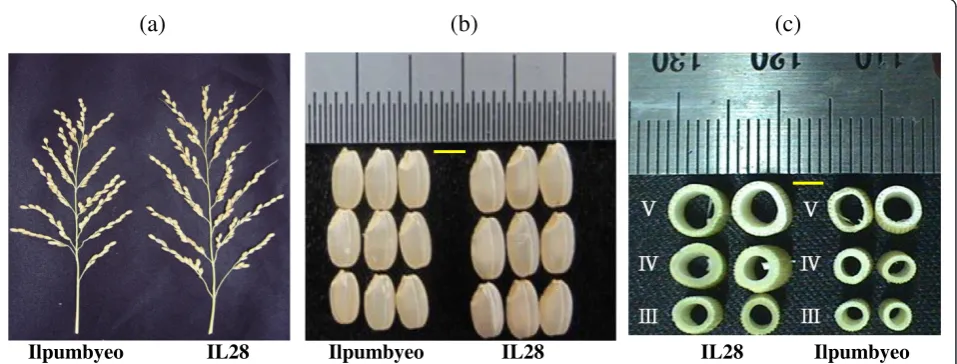
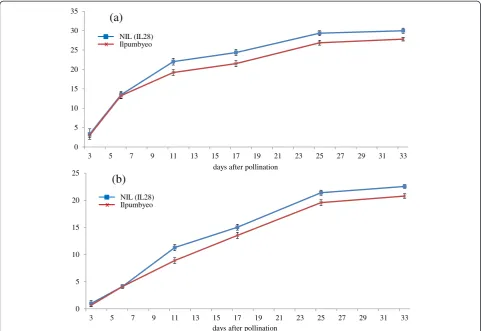
In our previous study (Kimet al. 2013), the genetic map of IL28 was constructed using 134 markers that exhib-ited polymorphism between Ilpumbyeo and Morobere-kan, with 2 Moroberekan introgression segments being detected on chromosomes 4 and 6. The phenotypic evaluation of agronomic traits for the introgression line, IL28, and the recurrent parent was conducted at two lo-cations, Daejeon and Yeasan, in 2013. Comparison of 10 agronomic traits between IL28 and Ilpumbyeo obtained in the current study are shown in Table 1 and Figure 1. The results indicated that there were highly significant differences (P< 0.01) in panicle length (PL), secondary branch number (SBN), spikelets per panicle (SPP), first node width (FNW), second node width (SNW), and 1,000-grain weight between IL28 and Ilpumbyeo, while no significant difference was obtained for tiller number (TN) and culm length (CL). Because IL28 has a large endosperm and heavier grain, we investigated the grain milk-filling rate in IL28 and Ilpumbyeo. No difference was observed in either endosperm fresh weight or dry weight at 3 d and 6 d after fertilization (Figure 2). In comparison, both the fresh and dry weight of IL28 were significantly higher (P< 0.01) compared to those of Ilpumbyeo at 11 d after fertilization. These differences reached a maximum ~25 d after fertilization, at which point the fresh and dry weight of the endosperm of IL28 were 11.2% and 13.4% higher compared to Ilpumbyeo, respectively. Thus, an increase in grain weight in IL28 which is associated with higher grain milk-filling rate might be due to the Moroberekan segment on chromo-some 6 considering that no QTL for grain width and weight was detected in the Moreberekan segment on chromosome 4 .
Trait variation of the F2population
In our previous study (Kimet al. 2013), four traits (panicle length, numbers of primary branches and secondary branches, and spikelets per panicle) exhibited continuous and normal distributions in the 243 F2 plants. The
250-grain weight of Ilpumbyeo and IL28 was 5.51 and 6.14, re-spectively. In all traits measured, transgressive plants with higher or lower mean values compared to either parent were observed. The correlation between spikelets per pan-icle and grain weight was not significant (r= 0.102).
QTL analysis
marker RM3430 (Kimet al. 2013). In addition, the QTL for grain weight was detected in the same region, on chromosome 6. The QTL for grain weight explained 8.3% of phenotypic variance. The Moroberekan alleles increased all trait values of panicle length, secondary branch number, spikelets per panicle and grain weight at this region.
Substitution mapping ofqTGW6
To confirm and narrow down the target region contain-ing qTGW6, 1,120 F2 plants derived from a cross
be-tween Ilpumbyeo and IL28 were genotyped with 4 additional markers near the target region (RM20512, RM20521, RM20562, and RM20572) and one marker
(RM551) located on chromosome 4. A total of 44 F2
homozygous plants with different cross-over break-points between RM7269 and RM20653 on chromosome 6 were selected and selfed to produce F3:4:5lines.
Geno-type analysis indicated that these 44 F2 plants did not
have Moroberekan segment on chromosome 4. Accord-ing to the marker genotype, the 44 F3:4:5lines were
di-vided into 11 groups, and used for the substitution
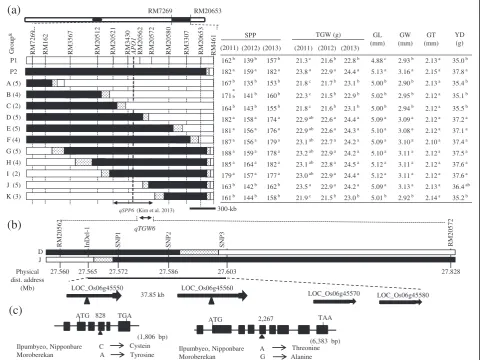
mapping of qTGW6 (Figure 3). The mean phenotypic
values of each trait for each F3:4:5line was compared to
those of Ilpumbyeo and IL28 at the P< 0.05 level. In a previous study, the QTLs for SPP, PL, SBM, FNW, and SNW were consistently mapped between RM20521 and RM20572, which are 680-kb apart (Kimet al. 2013). For the qTGW6locus, groups D, E, F, G, H, I, and J showed significantly higher values than Ilpumbyeo for 1,000-grain Table 1 Comparison of 10 agronomic traits between IL28 and Ilpumbyeo at two locations in 2013
Traits Mean ± S.D.
Daejeon Difference A and B
Yeasan Difference A and B Ilpumbyeo(A) IL28(B) Ilpumbyeo(A) IL28(B)
Days to heading 115 113 NS 113 112 NS
Grain weight/5 plants (g) 175 189 **# 174 190 **#
Panicle length (cm) 22.3 ± 1.3 24.3 ± 2.0 ** 22.5 ± 1.6 25.4 ± 1.8 **
Spikelets per panicle 157 ± 11 182 ± 13 ** 152 ± 14 185 ± 15 **
Secondary branch 25.3 ± 4.4 32.2 ± 1.9 ** 28.3 ± 3.4 34.2 ± 2.2 **
First node width (mm) 4.3 ± 0.2 5.2 ± 0.2 ** **
Second node width (mm) 5.3 ± 0.2 6.2 ± 0.2 ** **
1,000 grain weight (g) 21.6 ± 0.2 22.9 ± 0.3 ** 21.5 ± 0.3 23.1 ± 0.2 **
Amylose content (%) 18.1 ± 0.1 18.3 ± 0.1 NS 18.2 ± 0.1 18.2 ± 0.1 NS
Protein content (%) 5.5 ± 0.1 5.8 ± 0.1 NS 5.8 ± 0.1 5.7 ± 0.1 NS
Data were from the trial 2013 in Daejeon and Yeasan. Comparison of two lines was carried out at Daejeon for three years from 2011 to 2013, and the results were nearly the same. Only the 2013 data from Daejeon are presented.
-Not evalutated #
**Significant atP< 0.01, NS: not significant.
(a)
(b)
(c)
Ilpumbyeo IL28 Ilpumbyeo IL28 IL28 Ilpumbyeo
weight, whereas no significance difference was detected between Ilpumbyeo and groups A, B, C, and K in 2011,
2012, and 2013 (Figure 3a). Thus, qTGW6 was located
downstream of RM20521 and upstream of RM20580. Group D showed significantly higher values for SPP
af-fected by qSPP6 and for TGW compared to Ilpumbyeo,
while group J was significantly different from Ilpumbyeo for TGW but not SPP. This result indicates that
qSPP6 and qTGW6 are different genes. Comparison
of the genotypes of recombinants delimited the
qTGW6 between markers RM20562 and RM20572,
based on the finding that the TGW of both D and J groups were significantly different from that of Ilpum-byeo. The region between the two markers RM20562 and RM29572 for groups D and J shared common
segment harboring of qTGW6. To further confirm the
common segment shared by groups D and J, we ge-notyped the F3 lines using four markers (one InDel
marker and three SNP markers) located between RM20562 and RM20572. The genotypes showed that
qTGW6 was defined in a 37.85-kb region between
InDel-1 and SNP3 (Figure 3b).
Evaluation of the grain shape trait
To determine which grain shape traits are associated with increase in grain weight, three grain shape traits (specifically, grain length [GL], width [GW], and thickness [GT]) were evaluated for the two
par-ents and F5 lines (Figure 3). The mean phenotypic
values of each F5 line were compared to those of
Ilpumbyeo and IL28 at the P< 0.05 level. The GL of Ilpumbyeo and IL28 were 4.88 mm and 5.13 mm, re-spectively. The GW values for Ilpumbyeo and IL28 were 2.93 mm and 3.15 mm, respectively. The GL and GW values of IL28 were significantly higher compared to Ilpumbyeo (P< 0.05), whereas no sig-nificant difference was detected for GT. The GL and
GW of the groups with qTGW6 (D, E, F, G, H, I,
and J) were significantly different from those of the
groups without qTGW6 (A, B, C, and K). This
find-ing indicates that qTGW6 variation is caused by
variation in GL and GW at qTGW6. Grain weight
was significantly correlated with GL and GW
(P< 0.01 for both characteristics), but not with GT (r=−0.06).
(a)
(b)
days after pollination 0
5 10 15 20 25 30 35
3 5 7 9 11 13 15 17 19 21 23 25 27 29 31 33
0 5 10 15 20 25
3 5 7 9 11 13 15 17 19 21 23 25 27 29 31 33
days after pollination NIL (IL28)
Ilpumbyeo
NIL (IL28) Ilpumbyeo
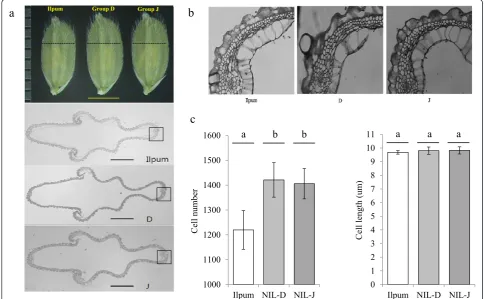
Cross-section of the central part of the spikelet hull Given that the hull of the IL28 spikelet was wider than that of Ilpumbyeo before fertilization, the cross-section of the central part of the spikelet hull for groups D and J was analyzed in comparison to Ilpumbyeo to investigate the origins of the observed size differences (Figure 4). The outer glume cell layer of groups D and J contained substantially more cells (16.5% and 15.3%, respectively) compared to that of Ilpumbyeo, with only a 1.3% and 1.4% increase in cell length, respectively. These data in-dicate that the increased width of group D and J spikelet hulls mainly results from an increase in cell number,
rather than cell size, indicating that qTGW6may be in-volved in the regulation of cell division.
Impact of the QTL cluster on yield per plant
Eleven groups containing 44 F5 lines were used for the
yield trials, together with Ilpumbyeo and IL28 in 2013 (Figure 3). IL28 had significantly higher grain yield com-pared to Ilpumbyeo. IL28 produced 8% higher grain yield on average compared to Ilpumbyeo. All groups
with the Moroberekan segment at both qSPP6 and
qTGW6 (i.e., groups D, E, F, G, H, and I) had signifi-cantly higher grain yield values compared with the
162b 139b 157b 21.3c 21.6b 22.8b 4.88c 2.93b 2.13a 35.0b
182a 159a 182a 23.8a 22.9a 24.4a 5.13a 3.16a 2.15a 37.8a
167 b 135b 153b 21.8c 21.7b 23.1b 5.00b 2.90b 2.13a 35.4b
171
a
b 141b 160b 22.3c 21.5b 22.9b 5.02b 2.95b 2.12a 35.1b
164 b 143b 155b 21.8c 21.6b 23.1b 5.00b 2.94b 2.12a 35.5b
182 a 158a 174a 22.9ab 22.6a 24.4a 5.09a 3.09a 2.12a 37.2a
181 a 156a 176a 22.9ab 22.6a 24.3a 5.10a 3.08a 2.12a 37.1a
187 a 156a 179a 23.1ab 22.7a 24.2a 5.09a 3.10a 2.10a 37.4a
188 a 159a 178a 23.2ab 22.9a 24.2a 5.10a 3.11a 2.12a 37.5a
185 a 164a 182a 23.1ab 22.8a 24.5a 5.12a 3.11a 2.12a 37.6a
179a 157a 177a 23.0ab 22.9a 24.4a 5.12a 3.11a 2.12a 37.6a
163 b 142b 162b 23.5a 22.9a 24.2a 5.09a 3.13a 2.13a 36.4ab
161b 144b 158b 21.9c 21.5b 23.0b 5.01b 2.92b 2.14a 35.2b
SPP TGW (g)
(2011) (2012) (2011) (2012) P1 P2 A (5) B (4) C (2) D (5) E (5) F (4) G (5) H (4) I (2)
Grou
p
&
J (5)
RM7 2 6 9 RM1 6 2 RM3 5 6 7 RM2 0 5 1 2 RM2 0 5 2 1 RM3 4 3 0 RM2 0 5 6 2 RM2 0 5 7 2 RM2 0 5 8 0 RM3 3 0 7 RM2 0 6 5 3 RM2 0 5 6 2 RM2 0 5 7 2 LOC_Os06g45560 LOC_Os06g45550 LOC_Os06g45570 LOC_Os06g45580 APO1 (2013)
27.565 27.572 27.586 27.603 D J 27.560 In Del -1 SNP 1 SNP 2 SNP 3 27.828 37.85 kb (2013) GL (mm) GW (mm) GT (mm) YD (g) RM4 6 1 K (3) Physical dist. address (Mb)
(b)
300-kb qTGW6 RM7269 RM20653(a)
(c)
(1,806 bp) TGA
ATG
Ilpumbyeo, Nipponbare C
Moroberekan A Tyrosine Cystein 828
(6,383 bp) TAA ATG
Ilpumbyeo, Nipponbare A
Moroberekan G Alanine Threonine 2,267
qSPP6 (Kim et al. 2013)
Figure 3Development of a high density map ofqTGW6and structures of candidate genes forqTGW6.(a)Graphical representation of F3:4:5lines and a fine scale map of the target region on chromosome 6.Apo1located between RM3430 and RM20562 might be allelic toqSPP6
detected in this study. White and black portions of the graph are homozygous Ilpumbyeo, homozygous Moroberekan, respectively and dotted regions are where crossing-over occurred. Genotypes of the 44 lines were double checked at F3generation. The table to the right of the graphical
genotypes indicates mean values of traits. Numbers followed by the same letter in each column are not significantly different atP= 0.05 based on Duncan’s multiple range test. & No. in ( ) indicate the number of F3lines. P1: Ilpumbyeo, P2: IL28.(b)High density map ofqTGW6using two groups
groups without the Moroberekan segment at bothqSPP6 andqTGW6(i.e., groups A, B, C, and K) and Ilpumbyeo (Figure 3). Also, the yield per plant of group J with
qTGW6 and without qSPP6 was higher than that of
group C and Ilpumbyeo at P< 0.1 (P= 0.068, P= 0.067, respectively), and this result implies the contribution of qTGW6to the yield increase. However, we could not de-termine the effect of qSPP6on yield due to the lack of line(s) only with the Moroberekan segment atqSPP6.
Candidate genes forqTGW6
qTGW6 was defined in a 37.85-kb region between
InDel-1 and SNP3. On the basis of available sequence annotation databases (http://www.gramene.org), there are four predicted genes in the target region. The func-tional annotations of the four genes are as follows: Loc_Os06g45550 (five exons and four introns) and Loc_Os06g45560 (eight exons and seven introns) are retrotransposon protein putative expressed genes; Loc_Os06g45570 (one exon) is a VQ domain-containing protein putative expressed gene; Loc_Os06g45580 (one exon) is a RING-H2 zinc finger putative protein expressed gene (Figure 3). We compared the genomic
sequences of the open reading frame (ORF) and pro-moter region of the four genes between Ilpumbyeo and Moroberekan. Comparison of the genomic sequence of two genes (Loc_Os06g45550 and Loc_Os06g45560) among Nipponbare, Ilpumbyeo, and Moroberekan re-vealed the existence of a single non-synonymous SNP in the third and fourth exon of Loc_Os06g45550 and Loc_Os06g45560, respectively. The non-synonymous SNP at the third exon of Loc_Os06g45550 is character-ized by the nucleotide Cytosine in Ilpumbyeo and the nucleotide Adenine in Moroberekan. The change in the nucleotide base from Cytosine to Adenine resulted in missense mutation from cysteine to tyrosine. The non-synonymous SNP at the fourth exon of Loc_Os06g45560, is characterized by the nucleotide Adenine in Ilpumbyeo and the nucleotide Guanine in Moroberekan. The nucleotide substitution A (adenine) to G (guanine) in Loc_Os06g45560 resulted in a missense mutation from Threonine to Alanine. No sequence variation in open reading frames and the promoter region of two genes was detected for Loc_Os06g45570 and Loc_Os06g45580 among the three varieties, Nipponbare, Ilpumbyeo, and Moroberekan.
Ilpum Group D Group J
0 1 2 3 4 5 6 7 8 9 10 11
Ilpum NIL-D NIL-J
Cell leng
th
(um)
1000 1100 1200 1300 1400 1500 1600
Ilpum NIL-D NIL-J
Cell number
a
b
c
a b b a a a
Figure 4Histological analyses of spikelet hull 3 days before heading in Ilpumbyeo, group D, and group J. (a)Cross-section of spikelet hull. Upper: spikelets (scale bar, 3 mm). Low: cross-section of spikelet hull (scale bar, 500um). Dotted line indicates position of cross-section(b)
Discussion
There has been much debate as to whether similar gen-omic locations of QTLs that affect different traits are caused by the pleiotropy of a single gene or the tight linkage of several genes that individually influence spe-cific traits. The question of pleiotropy versus tight link-age might be resolved by using a large-size population combined with high-density mapping, because two linked QTLs segregate independently in NIL-F2:3
popu-lations. Recently, several QTLs controlling the same or multiple traits have been confirmed to be closely linked in a small genomic region. For example, the rice photo-period sensitivity gene,Hd3 was originally detected as a heading date-related quantitative trait locus that is localized on chromosome 6 in the F2 population (Yano
et al. 1997). For the fine-scale mapping of Hd3, high-resolution linkage analysis using a large segregating population derived from advanced backcross progeny between the japonica rice variety, Nipponbare and the indica variety, Kasalath, was carried out. As a result of the high-resolution linkage mapping ofHd3, two tightly linked loci, Hd3a and Hd3b, which promote flowering under short-day conditions and inhibit heading under long-day conditions, were identified in the Hd3 region
(Monna et al. 2002). Lou et al. (2013) mapped two
QTLs (qSPP5 andqTGW5) for spikelets per panicle and 1,000-grain weight to the same region on chromosome 5. Substitution mapping with the BC5F3and BC5F4
pop-ulations derived from a cross between QTL-NIL and the recurrent parent, demonstrated that two tightly linked QTLs (qSPP5andqTGW5) were different. Several QTLs with large pleiotropic effects on multiple traits have also
been found and cloned (APO1, Ghd7, and Ghd8 or
DTH8). For instance, Hua et al. (2002) reported that a QTL cluster influences multiple traits (namely, grain per panicle, plant height, and heading date) on chromosome 7 in a primary population. High-resolution mapping with a large-sized segregating population and com-plementation tests revealed that these three traits are
controlled by a single locus, designated as Ghd7
(Xue et al. 2008).
The original target of this study wasqSPP6, which was
mapped on the long arm of chromosome 6 (Ju et al.
2008). In the process of the fine-scale mapping, the QTL for additional yield components (including panicle length, node width, and 1,000-grain weight) were con-sistently detected in the same region. A total of 243 F2
plants derived from a cross between NIL (IL28) and Ilpumbyeo for genetic analysis was not large enough to clarify the relationship between SPP and TGW. To con-firm the precise location of the two QTLs, substitution mapping was carried out. Following substitution map-ping with 44 F3:4:5 lines,qSPP6 was mapped to a 431-kb
interval between RM20521 and SNP1, while qTGW6
was mapped to a 37.85-kb interval between InDel-1 and
SNP3, based on the japonica genome sequence.
There-fore, the development of NIL and substitution mapping has enabled us to map SPP and TGW at the fine-scale.
No TGW-associated QTL was detected near the qTGW6 QTL in this study, indicating that qTGW6 is a novel QTL for TGW. Among the four predicted genes in the target region between InDel-1 and SNP-3 (37.85-kb),
Loc_Os06g45570 encodes a VQ domain-containing
protein. VQ domains are believed to be critical for the defense response to pathogens by interacting with WRKY transcription factors (Tao et al. 2011). Loc_Os06g45580 encodes the RING-H2 zinc finger protein. Recent studies reported a critical role of the ubiquitin pathway in grain development in rice (Songet al. 2007; Wenget al. 2008). GW2, a major QTL for rice grain width and weight en-codes a new RING-type E3 ubiquitin ligase.GW5, another major QTL underlying rice width and weight, is likely to act in the ubiquitine-proteasome pathway to regulate cell division during cell division (Weng et al. 2008). qTGW6
exhibited common function for grain width with GW2
and GW5 in that it was associated with increased cell numbers, a wider spikelet hull and an increased grain milk-filling rate. This raises a possibility that Loc_Os06g45580 is a candidate forqTGW6. However, no sequence variation in open reading frames and the promoter regions of two genes, Loc_Os06g45570 and Loc_Os06g45580 was ob-served between Ilpumbyeo and Moroberekan and this result seems to suggest that they are not candidate genes for qTGW6. The other two genes in the target region are retrotransposon proteins, Loc_Os06g45550 and Loc_Os06g45560. Loc_Os06g45560 was transcribed in seedling and embryo/endosperm 25 days after pollin-ation but Loc_Os06g45550 was not transcribed based on the available gene expression database (RGAP, http://rice.plantbiology.msu.edu/expression.shtml). More than 40% of rice genome is composed of repetitive sequences and transposable elements (Goff et al. 2002). A recent study showed that the expression of Tos17, a copia-like retrotransposon was affected by overexpres-sion or down-regulation of several rice SUVH (Su(var)
3–9 homologs) genes and RNAi plants with
down-regulated SDG728, a rice SUVH gene showed a reduced seed size phenotype (Qin et al. 2010). This raises a possibility that a relationship between altered seed morphology and overexpression of Tos17 might exist.
Interestingly, our alignment analysis of GW5 a.a
sequence using BLASTP program showed that
GW5 protein has high homology with two
retrotrans-poson proteins encoded by LOC_Os08g26160.1 and LOC_Os05g47720.1 (data not shown), although it has
been reported that the protein encoded by the GW5
ORF had no sequence homology with any proteins of
protein showed 56% homology to the retrotransposon
protein with 194 a.a encoded by LOC_Os08g26160.1
and 47-50% homologies to the transposon protein with
411 a.a. by LOC_Os05g47720.1. Numerous Indels and
single-nucleotide polymorphisms (SNPs) were detected between Nipponbare (japonica) and 9311 (indica) and Indels are mainly caused by transposons (Feng et al. 2002). Indels and SNPs in some key domestication
genes including qSH1 and GW2 are responsible for
morphological changes occurred during domestication (Konishiet al. 2006; Songet al. 2007). Also, the differ-ence in grain width between japonicaand indica culti-vars is associated with a 1212-bp deletion harboring the
GW5 ORF which was possibly caused by transposons
(Wenget al. 2008). These observations support our
hy-pothesis that the protein encoded by the GW5 ORF
might be a retrotransposon and Loc_Os06g45560 is a
candidate for qTGW6. However, the presence of SNPs
in the upstream regions of the genes between two par-ents suggests the possibility that a long-distance
regula-tion is involved in controlling the qTGW6 (data not
shown). Konishi et al. (2006) reported that the casual mutation in qSH1 underlying the seed shattering was found in the 12-kb upstream region from the ORF of the gene and caused the absence of the abscission layer in Nipponbare. Additional fine mapping experiments are underway to determine the functional relationship be-tweenqTGW6andGW5in controlling seed development. Also, loss-of-function mutant lines of Loc_Os06g45560 will be evaluated for grain morphology traits and the gene expression. These informations on the molecular mechan-ism of qTGW6 would be necessary to get more insights into the mechanism of grain development.
Although the candidate gene of qTGW6 and its
gen-etic mechanism was not elucidated here, we found that the Moroberekan chromosomal segment at this region (a tropical japonica) harbors QTLs for yield component traits leading to an yield increase in japonica cultivar. Yield trials confirmed that introgression lines containing
the Moroberekan segment at the qSPP6 and qTGW6
loci produced significantly higher yields than Ilpumbyeo (P< 0.05). The grain yield per plant in IL28 was 8% higher than that of Ilpumbyeo. Moroberekan alleles in the target region on chromosome 6 had a favorable effect on yield, by increasing the number of spikelets per panicle and 1,000-grain weight, in addition to lodging tolerance by in-creasing the node width, whereas it had no negative effect on heading date and plant height. Thus, the qSPP6 and qTGW6alleles are potentially valuable for improving rice yield. It is proposed that NILs containing the target seg-ment associated with positive QTLs from Moreberekan should be developed from this population, and evaluated in a wide range of environments, to assess the interaction between QTLs and the environment. Tightly linked SSR
markers are expected to facilitate the cloning of genes underlying these QTLs, in addition to marker-assisted se-lection for variation in the SPP and TGW in rice breeding programs.
Conclusion
In this study, we demonstrated that two QTLs, qSPP6 for spikelets per panicle (SPP) and qTGW6 for 1,000-grain weight (TGW) are tightly linked on chromosome 6. Because Moroberekan alleles for the SPP and TGW have been shown to be beneficial in the genetic
back-ground of Ilpumbyeo, the qSPP6 and qTGW6 alleles
may prove valuable for improving the yield potential of japonica rice cultivars. Tightly linked SSR markers are expected to facilitate the cloning of genes underlying these QTLs, in addition to marker-assisted selection for variation in SPP and TGW in rice breeding programs.
Methods Plant materials
In a previous study (Kimet al. 2013), IL28 was shown to exhibit a higher number of spikelets per panicle and heavier grain compared to the recurrent parent, and contained the Moroberekan chromosomal segment at the qSPP6 region on chromosome 6; hence, it was se-lected for the fine-scale mapping ofqSPP6in the current study. IL28 was crossed with the cultivar Ilpumbyeo, with the resulting F1 plants being self-pollinated to
ob-tain an F2 population (234 plants in 2009 and 1,150
plants in 2010). To confirm qSPP6, 44 F2 homozygous
plants with different cross-over breakpoints between RM7269 and RM20653 were selected and selfed to pro-duce F3lines for the phenotyping and substitution
map-ping of qSPP6. In the process of the fine-scale mapping
of qSPP6, a QTL for 1,000-grain weight (TGW) was
consistently detected in the same region. To confirm the precise location ofqSPP6 and qTGW6, these 44 F3lines
were advanced to F4 and F5 lines, which were used to
evaluate spikelets per panicle, grain weight, grain morphology traits, and grain yield.
Field trial and trait evaluation
A total of 243 F2 plants and 1150 F2plants (2009 and
2010), and 41 F3:4:5lines (2011, 2012, and 2013) and the
parental lines were grown at the experimental field of Chungnam National University, Daejeon, Korea. In 2009, the 243 plants and the parents were planted at dis-tances of 30 × 15 cm, and evaluated for grain (brown rice) weight (150 out of 243 plants were used to evaluate grain weight). In 2010, for the substitution mapping of
qTGW6, 1,150 F2 plants were genotyped with four
experiment using 44 F3:4:5 lines derived from 44 F2plants
followed a completely randomized block design with two replications, one row per plot, and 25 plants per row in 2011, 2012, and 2013. The middle 10 plants from each line were chosen for the evaluation, and the average of the mea-surements was used for the phenotype of each line for the spikelets per panicle (SPP) and 1,000-grain weight (TGW). SPP were measured by averaging the three major panicles per plants. Grains with hulls were allowed to dry naturally after harvesting, and partial or unfilled seeds were removed by soaking grains in water. Fully filled seeds were re-dried in an oven at 30°C for 24 h. The TGW was evaluated by measuring the weight of 250 randomly selected, de-hulled grains per plant (10 plants per line). In 2013, grain length (GL), grain width (GW), grain thickness (GT), and yield per plants (YD) were measured. The grain length (GL), grain width (GW), and grain thickness (GT) were measured for 50 grains (brown rice) per plant (10 plants per line) using a 150-mm Vernier caliper (Mitutoyo Corp., Japan). Yield per plant (YD) was measured by averaging the grain yield (g) of 10 plants that were randomly selected from the center of each plot per block. The 1,000-grain weight and the yield per plant were corrected for the 12% grain moisture content.
DNA extraction and SSR analysis
DNA was extracted from the leaf tissue of the F2
popula-tion using a chloroform-based DNA extracpopula-tion protocol (Causse et al., 1994). A 20-μL reaction mixture was used, containing 5.0 μL (5 ng/μL) of template DNA, 0.1 μl (5 Unit/μL) Taq polymerase, 0.8 μl dNTP (2.5 mM each), Forward + Reverse primer 1μl (10 pmol each), 2.0μl 10×
PCR buffer (10 mM Tris–HCl PH 8.3, 50 mM KCl,
1.5 mM MgCl2, 0.1% gelatin), and 11.1 μl triple-distilled water. Amplification was achieved using a Thermo Cycler (Bio-Rad) based on the step-cycle program set for denatur-ation at 94°C for 5 min, subsequent denaturdenatur-ation was per-formed at 94°C for 1 min, annealing at 55°C for 1 min, extension at 72°C for 1 min; steps 2 to 4 were repeated for a total of 35 cycles, with a final extension step at 72°C for 5 min. PCR products were run on 4% polyacrylamide de-naturing gels for 1–2 h at 1800–2000 V, and marker bands were revealed by silver staining (Panaud et al. 1996). The orientation of the SSR markers was based on the SSR maps (McCouchet al. 2002). Due to the lack of markers showing polymorphism in the region between RM20562 and
RM20572, additional genotyping of the F3lines was
con-ducted with four targeted SNPs and one Insertion/Delition marker. To detect the SNPs and InDels of Ilpumbyeo and Moroberekan, resequencing with NGS (Next-Generation Sequencing) was conducted using the two parents according to Jeonget al. (2013). Through the comparison of genomic sequences corresponding to the region between RM20562 and RM20572, a total of 28 polymorphisms (14 SNPs, and 14 Insertion/Deletions) were detected between Ilpumbyeo and Moroberekan. The polymorphisms were assayed by the direct sequencing of the four regions. Information on the primers used is presented in Table 2. The primers were de-signed according to the Nipponbare sequence (http://rgp. dna.affrc.go.jp/E/IRGSP/Build5/build5.html). The first InDel, hereafter referred to as InDel-1, occurs at the 27,565,774th position based on the Nipponbare sequence (www.gramene. org), and is characterized by nucleotide - (1 bp deletion) in Ilpumbyeo and nucleotide A in Moroberekan. The first SNP, SNP-1, that occurs at the 27,572,767th position, is character-ized by nucleotide G in Ilpumbyeo and nucleotide A in Moroberekan. The second SNP, SNP-2, that occurs at the 27,586,202th position, is characterized by nucleotide A in Ilpumbyeo and nucleotide G in Moroberekan. The third SNP, SNP-3, that occurs at the 27,629,080th position, is characterized by nucleotide A in Ilpumbyeo and nucleotide C in Moroberekan.
Statistical analysis
Statistical analysis was performed using Qgene software version 2.30 for Macintosh (Nelson 1997) and SAS (SAS Institute). Single point analysis (SPA) was performed to determine the effect of each marker on each trait. In SPA, a QTL was confirmed if the phenotype was associ-ated with a marker locus at P< 0.005, or with two adja-cent marker loci at P< 0.01. The proportion of total phenotypic variation explained by each QTL was calcu-lated as an R2value, from the regression of each marker/ phenotype combination. QTLs were mapped at a fine-scale by comparing the phenotypic means of two geno-typic classes of recombinants (Ilpumbyeo homozygote and Moroberekan homozygote) within the target region by using the SAS statistical software package.
Histological analysis
Paraffin-embedded sections of spikelet samples were
prepared according to Li et al. (2009), with minor
Table 2 Primer sequences of newly developed SNP markers
Marker name Forward primer (5’-3’) Reverse primer (5’-3’) Position Product size (bp)
InDel-1 GAGAAAGTGACCCTCGTTTAGT CAAGACATGACACTACGATTGC 27,565,623–27,565,899 276
SNP1 CCATATGATTAAATGGGAGGCTC ACATAGGCACTGCCAAGGTTC 27,572,630–27,572,896 266
SNP2 ACGGACGCCTGCTATAGGGA CACCAGAGGCGATCTTCTTC 27,585,994–27,586,360 366
modifications. Plant materials were fixed in FAA (50% ethanol, 5% glacial acetic acid and 5% formaldehyde) and stored at 4°C for 24 h. The fixed spikelets were dehydrated by soaking them for 6 h in a gradient etha-nol series (60%, 70%, 80%, 90%), and were then incu-bated in 100% ethanol overnight. Dehydrated spikelets were embedded in Paraplast (Sigma). Tissue sections (8 μm thick) were cut using a rotary microtome, trans-ferred onto gelatin-coated glass slides, and dried at 42°C for 1 day. The sections were de-paraffinized with 100% xylene for 5 min, followed by soaking for 2 min in 50% ethanol/50% xylen, 100% ethanol, and sterile water. The samples were stained with toluidine blue for 30 s, and washed twice with sterile water. The samples were then soaked for 2 min in 70% ethanol, 80% ethanol, 90% ethanol, and 100% ethanol. Finally, the samples were cleaned by soaking them twice in 100% xylen. The sec-tions were photographed under an Olympus BH2-RFCA using a U-PMTVC camera.
Competing interests
The authors declare that they have no competing interests.
Authors’contributions
DK participated in phenotyping, genotyping, drafting the manuscript. HL, MF and JK participated in phenotyping. SK participated in sequencing, primer design and genotyping. SA conceived of the study, drafted proposal and corrected manuscript. All authors have read and approved the manuscript.
Acknowledgements
This work was supported by the Korea Research Foundation Grant funded by the Korean Government (MOEHRD, Basic Research Promotion Fund) (KRF-2010-0024118) and the Next-Generation Biogreen 21 Program (Plant Molecular Breeding Center No. PJ008136), Rural Development
Administration, Republic of Korea.
Author details
1Department of Agronomy, College of Agriculture & Life Sciences, Chungnam National University, Daejeon 305-764, South Korea.2National Academy of Agricultural Science, Rural Development Administration, Suweon 441-707, South Korea.3Chungnam Agricultural Research and Extension Services, Yesan 340-861, South Korea.4Present address: Department of Variety Testing, Korea Seed & Variety Service, Ministry of Agriculture, Food and Rural Affairs, Kimcheon 740-220, South Korea.
Received: 2 January 2014 Accepted: 14 July 2014
References
Ando T, Yamamoto T, Shimizu T, Ma XF, Shomura A, Takeuchi Y, Lin SY, Yano M (2008) Genetic dissection and pyramiding of quantitative traits for panicle architecture by using chromosomal segment substitution lines in rice. Theor Appl Genet 116:881–890
Ashikari M, Sakakibara H, Lin SY, Yamamoto T, Takashi T, Nishimura A, Angeles ER, Qian Q, Kitano H, Matsuoka M (2005) Cytokinin oxidase regulates rice grain production. Science 309:741–745
Causse MA, Fulton TM, Cho YG, Ahn SN, Chunwonse J, Wu K, Xiao J, Yu Z, Ronald PC, Harrington SE, Second G, McCouch SR, Tanksley SD (1994) Saturated molecular map of the rice genome based on an interspecific backcross population. Genetics 138:1251–1274
Cui KH, Peng SB, Xing YZ, Yu SB, Xu CG, Zhang Q (2003) Molecular dissection of the genetic relationships of source-sink and transport tissue with yield traits in rice. Theor Appl Genet 106:649–658
Feng Q, Zhang Y, Hao P, Wang S, Fu G, Huang Y, Li Y, Zhu J, Liu Y, Hi X, Jia P, Zhang Y, Zhao Q, Ying K, Yu S, Tang Y, Weng Q, Zhang L, Lu Y, Mu J, Lu Y,
Zhang LS, Yu Z, Fan D, Liu X, Lu T, Li C, Wu Y, Sun T, Lei H et al (2002) Sequence and analysis of rice chromosome 4. Nature 420:316–320 Goff SA, Ricke D, Lan TH, Presting G, Wang R, Dunn M, Glazebrook J, Sessions A,
Oeller P, Varma H, Hadley D, Hutchison D, Martin C, Katagiri F, Lange BM, Moughamer T, Xia Y, Budworth P, Zhong J, Miguel T, Paszkowski U, Zhang S, Colbert M, Sun WL, Chen L, Cooper B, Park S, Wood TC, Mao L, Quail P, Wing R, Dean R et al (2002) A draft sequence of the rice genome (Oryza sativa L. ssp. japonica). Science 296:92–100
Hua JP, Xing YZ, Xu CG, Sun XL, Yu SB, Zhang Q (2002) Genetic dissection of an elite rice hybrid reveal that heterozygotes are not always advantageous for performance. Genetics 162:1885–1895
Huang X, Qian Q, Liu Z, Sun H, He S, Luo D, Xia G, Chu C, Li J, Fu X (2009) Natural variation at the DEP1 locus enhances grain yield in rice. Nat Genet 41:494–497
Ikeda K, Ito M, Nagasawa N, Kyozuka J, Nagato Y (2007) Rice ABERRANT PANICLE ORGANIZATION 1, encoding an F-box protein, regulates meristem fate. Plant J 51:1030–1040
Ishimaru K (2003) Identification of a locus increasing rice yield and physiological analysis of its function. Plant Physiol 133:1083–1090
Ishimaru K, Hirotsu N, Madoka Y, Murakami N, Hara N, Onodera H, Kashiwagi T, Kazuhiro U, Shimizu B, Onishi A, Miyagawa H, Katoh E (2013) Loss of function of the IAA-glucose hydrolase gene TGW6 enhances rice grain weight and increases yield. Nat Genet 45:707–711
Jeong IS, Yoon UH, Lee GS, Ji HS, Lee HJ, Han CD, Hahn JH, An GH, Kim TH (2013) SNP-based analysis of genetic diversity in anther-derived rice by whole genome sequencing. Rice 6:6
Ji SD, Luo XL, Ahn SN (2014) Mapping QTL for ratooning ability in advanced backcross lines from anOryza sativaxO. rufipogoncross. CNU J Agricultural Sci 41(1):1–7
Jin F, Kim DM, Ju HG, Ahn SN (2009) Mapping quantitative trait loci for awnness and yield component tratis in isogenic lines derived from anOryza sativa/O.
rufipogoncross. J Crop Sci Biotech 12(1):9–16
Ju HG, Kim DM, Kang JW, Kim MK, Kim YG, Ahn SN (2008) Mapping QTLs for agronomic traits using an introgression line population from a cross between Ilpumbyeo and Moroberekan in rice. Korean J Breed 40(4):414–421 Kim DM, Kim JH, Kang JW, Lee HS, Ahn SN (2013) Fine mapping of a quantitative
trait loci controlling the number of spikelets per panicle in rice. Korean J Breed 44(4):462–469
Khush GS (1999) Green revolution: preparing for the 21st century. Genome 42:646–655
Khush GS (2005) What it will take to feed 5.0 billion rice consumers in 2030. Plant Mol Biol 59:1–6
Konishi S, Izawa T, Lin S, Ebana K, Fukuta Y, Sasaki T, Yano M (2006) An SNP caused loss of seed shattering during rice domestication. Science 312:1392–1396
Li C, Zhou A, Sang T (2006) Gentetic analysis of rice domestication syndrome with the wild annual species. Oryza Nivara New Phytol 170:185–194 Li H, Wue D, Gao Z, Yan M, Xu W, Xing Z, Huang D, Qian Q, Wue Y (2009) A
putative lipase gene EXTRA GLUME1 regulates both empty-glume fate and spikelet development in rice. Plant J 57:593–605
Lin HX, Qian HR, Zhuang JY, Lu J, Min SK, Xiong ZM, Huang N, Zheng KL (1996) RFLP mapping of QTLs for yield and related characters in rice (Oryza sativa
L.). Theor Appl Genet 92:920–927
Linh HL, Hang NT, Jin FX, Kang KH, Lee YT, Kwon KH, Ahn SN (2008)
Introgression of a quantitative trait locus for spikelets per panicle fromOryza
minutato the O. sativa cultivar Hwaseongbyeo. Plant Breed 127:262–267 Lou X, Ji SD, Yuan PR, Lee HS, Kim DM, Balkunde S, Kang JW, Ahn SN (2013) QTL
mapping reveals a tight linkage between QTLs for grain weight and panicle spikelet number in rice. Rice 6:33
McCouch SR, Teytelman L, Xu Y, Lobos KB, Clare K, Walton M, Fu B, Maghirang R, Li Z, Xing Y, Zhang Q, Kono I, Yano M, Fjellstrom R, DeClerck G, Schneider D, Cartinhour S, Ware D, Stein D (2002) Development and mapping of 2240 new SSR markers for rice (Oryza sativaL.). DNA Res 9:199–207
Miura K, Ikeda M, Matsubara A, Song XJ, Ito M, Asano K, Matsuoka M, Kitano H, Ashikari M (2010) OsSPL14 promotes panicle branching and higher grain productivity in rice. Nat Genet 42:545–549
Monna L, Lin X, Kojima S, Sasaki T, Yano M (2002) Genetic dissection of a genomic region for a quantitative trait locus, Hd3, into two loci, Hd3a and Hd3b, controlling heading date in rice. Theor Appl Genet 104:772–778 Nelson JC (1997) QGENE: software for marker-based genomic analysis and
Ookawa T, Hobo T, Yano M, Murata K, Ando T, Miura H, Asano K, Ochiai Y, Ikeda M, Nishitani R, Ebitani T, Ozaki H, Angeles ER, Hirasawa T, Matsuoka M (2010) New approach for rice improvement using a pleiotropic QTL gene for lodging resistance and yield. Nat Comms 1–132, doi:10. 1038/ncomms1132 Panaud O, Chen X, McCouch SR (1996) Development of microsatellite markers
and characterization of simple sequence length polymorphism (SSLP) in rice (Oryza sativaL.). Mol Gen Genet 252:597–607
Qin FJ, Sun QW, Huang LM, Chen XS, Zhou DX (2010) Rice SUVH histone methyltransferase genes display specific functions in chromatin modification and retrotransposon repression. Mol Plant 3(4):773–782
Song XJ, Huang W, Shi M, Zhu MZ, Lin HX (2007) A QTL for rice grain width and weight encodes a previously unknown RING-type E3 ubiquitin ligase. Nat Genet 39:623–630
Suh JP, Ahn SN, Cho YC, Suh HS, Hwang HG (2005) Mapping of QTLs for yield traits using an advanced backcross population from a cross between
Oryza sativaandO. glaberrima. Korean J Breed 37(4):214–220
Tao Z, Kou Y, Liu H, Li X, Xiao J, Wang S (2011) OsWRKY45 alleles play different roles in abscisic acid signaling and salt stress tolerance but similar roles in drought and cold tolerance in rice. J Exp Bot 62:4863–4874
Thomson MJ, Tai T, McClung AM, Lai XH, Hinga ME, Lobos KB, Xu Y, Martinez CP, McCouch SR (2003) Mapping quantitative trait loci for yield components and morphological traits in an advanced backcross population betweenOryza
rufipogonand theOryza sativacultivar Jefferson. Theor Appl Genet 107:479–493
Weng J, Gu S, Wan X, Gao H, Guo T, Su N, Lei C, Zhang X, Cheng Z, Guo X, Wang J, Zhai H, Wan J (2008) Isolation and initial characterization ofGW5, a major QTL associated with rice grain width and weight. Cell Res 18:1199–1209 Xie X, Jin F, Song MH, Suh JP, Hwan HG, Kim YG, McCouch SR, Anh SN (2008)
Fine mapping of a yield-enhancing QTL cluster associated with transgressive variation in anOryza sativaXO. rufipogoncross. Theor Appl Genet 116:613–622
Xiong LZ, Liu KD, Dai XK, Xu CG, Zhang Q (1999) Identification of genetic factors controlling domestication related traits of rice using an F2population of a
cross betweenOryza sativaandO. rufipogon. Theor Appl Genet 98:243–251 Xue W, Xing Y, Weng X, Zhao Y, Tang W, Wang L, Zhou H, Yu S, Xu C, Li X,
Zhang Q (2008) Natural variation in Ghd7 is an important regulator of heading date and yield potential in rice. Nat Genet 40:761–767 Yamagishi M, Takeuchi Y, Kono I, Yano M (2002) QTL analysis for panicle
characteristics in temperate japonica rice. Euphytica 128:219–224 Yano M, Harushima Y, Nagamura Y, Kurata N, Minobe Y, Sasaki T (1997)
Identification of quantitative trait loci controlling heading date in rice using a high-density linkage map. Theor Appl Genet 95:1025–1032
Zhang Q (2007) Strategies for developing green super rice. Proc Natl Acad Sci U S A 104:16402–16409
Zhang Y, Luo L, Liu T, Xu C, Xing Y (2009) Four rice QTLs controlling number of spikelets per panicle expressed the characteristics of single Mendelian gene in near isogenic backgrounds. Theor Appl Genet 118:1035–1044 Zhuang JY, Lin HX, Lu J, Qian HR, Hittalmani S, Huang N, Zheng KL (1997)
Analysis of QTL X environment interaction for yield components and plant height in rice. Theor Appl Genet 95:799–808
doi:10.1186/s12284-014-0014-5
Cite this article as:Kimet al.:High-density mapping of quantitative trait
loci for grain-weight and spikelet number in rice.Rice20147:14.
Submit your manuscript to a
journal and benefi t from:
7Convenient online submission
7Rigorous peer review
7Immediate publication on acceptance
7Open access: articles freely available online
7High visibility within the fi eld
7Retaining the copyright to your article