M I N I R E V I E W
Open Access
Fructose malabsorption
Karolin Ebert
1,2,3and Heiko Witt
1,2,3*Abstract
Incomplete intestinal absorption of fructose might lead to abdominal complaints such as pain, flatulence and diarrhoea. Whether defect fructose transporters such as GLUT5 or GLUT2 are involved in the pathogenesis of fructose malabsorption is a matter of debate. The hydrogen production by colonic bacteria is used for diagnosis with the hydrogen breath test. However, the appropriate fructose test dose for correct diagnosis is unclear. Subjects with fructose malabsorption show increased breath hydrogen levels and abdominal symptoms after fructose administration but do not report any
symptoms when fructose is given together with glucose. This beneficial effect of glucose, however, cannot be explained yet but might be used for clinical care of these subjects.
Keywords:Fructose malabsorption, Glucose transporters, GLUTs, Hydrogen breath test
Background
The complex process of sugar digestion and absorption can be disturbed due to defect digestion enzymes or monosaccharide transporters. Lactose malabsorption is caused by variants in the promoter region of theLCTgene coding for lactase-phlorizin hydrolase. Consequently, the cleavage of lactose in its components glucose and galact-ose is impaired [1]. In patients with glucgalact-ose-galactgalact-ose malabsorption, mutations in the SLC5A1 coding region result in truncated or mistargeted glucose-galactose trans-porter SGLT1. Due to impaired absorption of glucose and galactose, newborns develop life-threatening diarrhoea and dehydration [2]. The molecular and the genetic causes of fructose malabsorption are unknown. Like other sugar malabsorptions, the disease is characterized by colicky abdominal pain, flatulence and diarrhoea. These symp-toms are caused by bacterial fermentation of unabsorbed fructose in the colon resulting in production of hydrogen, carbon dioxide, methane and short-chain fatty acids. Moreover, the increased sugar load in the colon might cause osmotic diarrhoea (Fig. 1). Patients should avoid fructose-rich food such as apples, pears and red peppers. Nutrition anamnesis is often not helpful for making diag-nosis since affected subjects instinctively avoid fructose-rich foods. For therapy, the beneficial effect of glucose on
fructose absorption is used. Patients tolerate fruits such as bananas or grapefruits which contain fructose and glucose in at least equimolar concentrations. Apples are not toler-ated because of their high fructose (7 g/apple) and lower glucose (2.3 g/apple) content (ratio 3:1). Furthermore, the simultaneous intake of glucose can avoid symptoms after fructose consumption.
Are sugar transporter defects responsible for fructose malabsorption?
Since GLUT5 represents the main intestinal fructose trans-porter, its involvement in the pathophysiology of fructose malabsorption seems obvious.Glut5knock-out mice dem-onstrated decreased fructose uptake in the jejunum and reduced plasma fructose levels compared to their litter-mates. However, intestinal fructose transport is not com-pletely abolished indicating the presence of other intestinal fructose transporters. The feeding of a diet containing 60 % fructose for 14 days resulted in increased GLUT5 expres-sion in mice [3]. Whether fructose absorption can be enhanced by increased GLUT5 expression due to fructose-rich diet in humans is not investigated so far.
TheGLUT5coding region was analyzed using SSCP (sin-gle-strand conformational polymorphism) in 8 children with fructose malabsorption, 6 healthy controls and 13 healthy parents of patients [4]. The patients were diagnosed by hydrogen breath testing with 1 g/kg fructose and occur-rence of symptoms during the test. NoGLUT5variant was found that correlated with the occurrence of fructose malabsorption. Nevertheless, an involvement of GLUT5 in * Correspondence:[email protected]
1
Pädiatrische Ernährungsmedizin, Klinikum rechts der Isar (MRI), Technische Universität München (TUM), Gregor-MendelStr. 2, 85354 Freising, Germany 2Else Kröner-Fresenius-Zentrum für Ernährungsmedizin (EKFZ), Technische Universität München (TUM), Gregor-MendelStr. 2, 85354 Freising, Germany Full list of author information is available at the end of the article
the pathophysiology of fructose malabsorption cannot be excluded since this cohort was quite small, the age of patients was very young (ranging from 8 months to 5 years, median 2.75 years) and half of the patients showed positive sucrose breath test questioning the diagnosis of isolated fructose malabsorption [4]. Moreover, SSCP analysis has a
low sensitivity compared to DNA sequencing, and non-coding regions were not investigated in this study.
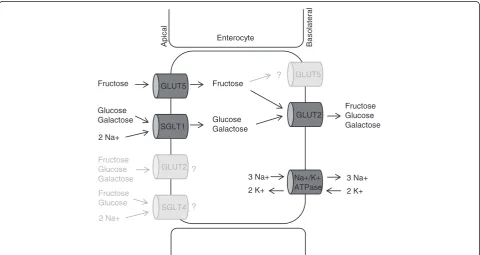
Other fructose transporters such as GLUT2 or SGLT4 are also present in the small intestine and might play a pathogenic role in this condition (Fig. 2) [5–7]. GLUT2 is expressed in the basolateral membrane but the
Fructose
Small intestine Colon
Bacteria
Water
H2
CO2
Methane SCFA
Abdominal pain Flatulence Diarrhea
Fructose +
Glucose No symptoms
Fig. 1Symptom generation in fructose malabsorption. As consequence of impaired absorption, fructose reaches the colon and is metabolized by colonic bacteria. The products hydrogen, carbon dioxide, methane and short-chain fatty acids (SCFA) and the osmotic water influx cause the typical symptoms. The additional consumption of equimolar amounts of glucose enhances fructose absorption and prevents symptoms
GLUT5
SGLT1
GLUT2
SGLT4
GLUT2
Fructose Fructose
Glucose Galactose
2 Na+
Glucose Galactose
Fructose Glucose Galactose
GLUT5
Fructose Glucose Galactose
Fructose Glucose
Apic
al
B
a
s
o
lateral
?
?
?
Enterocyte
2 Na+
Na+/K+ ATPase
3 Na+ 3 Na+
2 K+ 2 K+
presence in the apical membrane is questionable [8, 9]. If GLUT2 is responsible for the exit of fructose only, an important role for fructose malabsorption is unlikely. GLUT2 mutations are associated to Fanconi-Bickel syn-drome, an autosomal recessive inherited disorder char-acterized by hepatorenal glycogen accumulation, renal tubular dysfunction and glucose/galactose intolerance. However, no disturbed fructose absorption has been reported in this disease [10].
The hypothesis that intestinal GLUT5 or GLUT2 expres-sion is reduced in fructose malabsorption was tested by Wilder-Smith et al. in 11 adults with fructose malabsorp-tion (positive breath test after ingesmalabsorp-tion of 35 g fructose in combination with abdominal symptoms) and 15 control subjects. The messenger RNA (mRNA) content and protein expression of GLUT5 and GLUT2 was similar in both groups [11].
Unlike GLUT5 and GLUT2, SGLT4 provides Na
+
-dependent secondary active transport of glucose and possibly fructose. Fructose transport by SGLT4 was not directly shown but an inhibition of glucose uptake by fruc-tose was demonstrated. So far, the expression of SGLT4 in the apical membrane and its role for intestinal fructose absorption has not been investigated [6].
Is the hydrogen breath test appropriate for diagnosis? Fructose malabsorption is usually diagnosed by hydro-gen breath test (HBT). Since the absorption capacity for fructose is limited in healthy people also, the appropriate fructose dose for this test is under discussion. After ingestion of 50 g fructose, 58 % of 102 subjects demon-strated incomplete absorption with a rise in breath hydrogen over the arbitrarily defined threshold level of 20 ppm. In these subjects, 25 % reported abdominal symptoms during the test period. Twenty-one persons with a positive breath test after ingestion of 50 g fructose repeated the procedure with 25 g fructose. With this lower dose, only 11 % showed incomplete absorption. Moreover, of the 11 % who had abdominal symptoms, only one person showed an elevated breath hydrogen level [12]. Rao and co-workers conducted a double-blind study with 20 healthy subjects: all subjects exhibited negative HBT with 15 g fructose. Two subjects (10 %) showed incomplete absorption with a dose of 25 g fruc-tose but did not report symptoms. After administration of 50 g fructose, 80 % of subjects showed breath hydro-gen rise over baseline and 55 % demonstrated abdominal symptoms [13]. When 31 children received 2 g fructose per kg bodyweight (max. 50 g), 71 % showed positive breath test and 13 % had abdominal symptoms [14]. As shown by these and other studies, a dose of 50 g (corre-sponds to approximately seven medium-sized apples) in adults or 2 g/kg in children exceeds in the majority the intestinal absorption capacity whereas the administration
of ≤25 g fructose in adults or ≤1 g/kg in children is thought to be appropriate for diagnosis of fructose malabsorption. Until the reason for fructose malabsorp-tion is unclear, it is hardly possible to define the right dose for HBT and to discriminate between normal and abnormal. Therefore, it is difficult to estimate the preva-lence in the general population. A detailed review about hydrogen breath testing in fructose malabsorption was published by Jones et al. [15].
Age dependence of fructose absorption
There is evidence that the prevalence of fructose malab-sorption correlates with the age. After administration of 1 g/kg fructose, 16 out of 23 children aged 1–3 years showed elevated peak hydrogen excretion, whereas only 7
out of 26 older children (4–6 years) demonstrated
increased breath hydrogen levels. Furthermore, peak hydrogen was higher in the younger age group [16]. A clear correlation between age and HBT (0.5 g/kg, max. 10 g fructose) was found in a study population of 1093 children and adults, where fructose absorption capacity was rising up to the age of 10 years. From the age of 10 to 79, no differences were observed regarding absorption capacity [17]. On the contrary, the prevalence of lactose intolerance is low in infants and rises with the age. In pediatric populations from Finland and Somalia, the lac-tase activity decreased mainly between 5 and 10 years of age [18].
The beneficial effect of glucose
fructose and glucose transporter GLUT2 has been pro-posed because trafficking of GLUT2 to the apical mem-brane after glucose load was observed in rats [8]. In contrast, no evidence for GLUT2 presence in the apical brush-border membrane in response to glucose was shown by Röder et al. indicating the involvement of other trans-porters [9]. In a cohort of six healthy subjects, it was ob-served that glucose and galactose can prolongate gastric emptying [21]. Possibly, the delayed arrival of fructose in the small intestine due to delayed gastric emptying could explain the increased fructose absorption by simultaneous glucose administration. Moreover, an enhancing effect of glucose and lipids on sorbitol absorption was demonstrated which might be explained by similar mechanisms [22].
Fructose malabsorption as cause for recurrent abdominal pain
Gijsbers et al. conducted a double-blinded placebo-controlled (DBPC) trial in children with recurrent abdom-inal pain. First, 121 children performed a HBT with 2 g/kg fructose (max. 50 g). From those children who were posi-tive (65 %), 49 were set on a fructose elimination diet. Sixty-five percent of them reported absence of symptoms during the diet but only 13 out of 31 children (41 %) responded to an open provocation with fructose. Finally, all 8 children which demonstrated symptoms after provoca-tion, showed no symptoms after double-blinded placebo-controlled re-provocation. In summary, none of the chil-dren demonstrated positive hydrogen breath test together with the absence of symptoms during elimination and symptoms during the DBPC trial. An explanation why the children showed positive hydrogen breath test after fructose ingestion but no symptoms during DBPC with fructose could be the different dose. During the breath test, a maximum of 50 g fructose (2 g/kg) was given whereas in the DBPC trial, 25 g was consumed over the whole day. However, factors such as the gut microbiota, transit time and diet composition might also cause varying fructose tolerance [23]. As mentioned above, 2 g/kg fruc-tose cannot be completely absorbed in the majority of children. Therefore, the dose is too high to discriminate between fructose absorption and malabsorption. Since the elimination and provocation was conducted at home, it is possible that children did not strictly follow the elimin-ation and provocelimin-ation guidelines leading to inconsistent results. Nevertheless, fructose malabsorption was most likely not the prominent factor for abdominal pain in this cohort.
Dietary fructose restriction in IBS
High-fructose consumption can trigger symptoms in patients with irritable bowel syndrome (IBS). With a dose of 25 g fructose, 22 % (20/90) of IBS patients showed posi-tive hydrogen breath test. Amongst fructose malabsorbers,
35 % had abdominal symptoms during the test whereas 26 % of the fructose absorbers demonstrated symptoms [24]. With the same fructose dose, 10 % (2/20) of healthy adults demonstrated elevated breath hydrogen without any symptoms [13]. Fructose intake is restricted within the low FODMAP (fermentable oligo-, di- and monosac-charides and polyols) diet often recommended for IBS patients. In a cohort of 90 IBS patients, symptoms im-proved during this diet. Moreover, the occurrence of fruc-tose malabsorption was associated with improvement of symptoms [25]. A further study in 67 IBS patients showed symptom amelioration after standard IBS diet and low FODMAP diet without significant differences between the two diets [26]. However, potential undesirable side-effects of long-term restricted diets should be taken into account.
Conclusion
The pathophysiology of fructose malabsorption remains unclear. If there are genetic or epigenetic variations in intestinal fructose transporters such asGLUT5,GLUT2or SGLT4needs to be elucidated. Genetic variants within the GLUT5 coding regions are unlikely but not excluded as reason for impaired fructose absorption. There are first hints that GLUT5 and GLUT2 expression is not lower in affected subjects. Probably, there are different mechanisms leading to this condition. To elucidate the underlying mechanism, genetic analysis in well-defined cases and controls should be performed either by candidate gene approach or complete genome sequencing. Because the absorption capacity for fructose is highly individual, it is difficult to determine the right dose for HBT. There is agreement that 50 g fructose in adults or 2 g/kg fructose in children exceed the absorption capacity of the majority. A dose of≤25 g in adults or≤1 g/kg in children seems to be appropriate. The variance of breath test results at different times of the day and the reproducibility should be assessed. It remains unclear why increased gas produc-tion in the intestine during HBT does not necessarily cause abdominal symptoms. Possible, the intestinal sensi-tivity and pain perception is highly individual. Whether fructose malabsorption is more common in IBS patients needs to be verified. However, restriction of fructose and other fermentable saccharides can be helpful in therapy. To clarify the absorption enhancing effect of glucose, it is important to understand the mechanisms of intestinal sugar transport and to gain insights into possible interac-tions of sugar transporters. To address this question, fu-ture studies should verify the assumption that different amino acids also promote fructose absorption.
Abbreviations
Competing interests
The authors declare that they have no competing interests.
Authors’contributions
KE has written the manuscript. HW revised the manuscript. Both authors read and approved the final manuscript.
Acknowledgements
This work was supported by Deutsche Forschungsgemeinschaft (GRK 1482).
Author details
1Pädiatrische Ernährungsmedizin, Klinikum rechts der Isar (MRI), Technische Universität München (TUM), Gregor-MendelStr. 2, 85354 Freising, Germany. 2
Else Kröner-Fresenius-Zentrum für Ernährungsmedizin (EKFZ), Technische Universität München (TUM), Gregor-MendelStr. 2, 85354 Freising, Germany. 3Zentralinstitut für Ernährungs- und Lebensmittelforschung (ZIEL), Technische Universität München (TUM), Gregor-MendelStr. 2, 85354 Freising, Germany.
Received: 15 December 2015 Accepted: 4 February 2016
References
1. Enattah NS, Sahi T, Savilahti E, Terwilliger JD, Peltonen L, Järvelä I (2002) Identification of a variant associated with adult-type hypolactasia. Nat Genet 30:233–237
2. Wright EM, Turk E, Martin MG (2002) Molecular basis for glucose-galactose malabsorption. Cell Biochem Biophys 36:115–121
3. Barone S, Fussell SL, Singh AK, Lucas F, Xu J, Kim C, Wu X, Yu Y, Amlal H, Seidler U, Zuo J, Soleimani M (2009) Slc2a5 (Glut5) is essential for the absorption of fructose in the intestine and generation of fructose-induced hypertension. J Biol Chem 284:5056–5066
4. Wasserman D, Hoekstra JH, Tolia V, Taylor CJ, Kirschner BS, Takeda J, Bell GI, Taub R, Rand EB (1996) Molecular analysis of the fructose transporter gene (GLUT5) in isolated fructose malabsorption. J Clin Invest 98:2398–2402 5. Gould GW, Thomas HM, Jess TJ, Bell GI (1991) Expression of human glucose
transporters in Xenopus oocytes: kinetic characterization and substrate specificities of the erythrocyte, liver, and brain isoforms. Biochemistry 30: 5139–5145
6. Tazawa S, Yamato T, Fujikura H, Hiratochi M, Itoh F, Tomae M, Takemura Y, Maruyama H, Sugiyama T, Wakamatsu A, Isogai T, Isaji M (2005) SLC5A9/SGLT4, a new Na+-dependent glucose transporter, is an essential transporter for mannose, 1,5-anhydro-D-glucitol, and fructose. Life Sci 76:1039–1050 7. Blakemore SJ, Aledo JC, James J, Campbell FC, Lucocq JM, Hundal HS (1995)
The GLUT5 hexose transporter is also localized to the basolateral membrane of the human jejunum. Biochem J 309:7–12
8. Kellett GL, Helliwell PA (2000) The diffusive component of intestinal glucose absorption is mediated by the glucose-induced recruitment of GLUT2 to the brush-border membrane. Biochem J 350:155–162
9. Röder PV, Geillinger KE, Zietek TS, Thorens B, Koepsell H, Daniel H (2014) The role of SGLT1 and GLUT2 in intestinal glucose transport and sensing. PLoS One. e89977 doi: 10.1371/journal.pone.0089977.
10. Santer R, Groth S, Kinner M, Dombrowski A, Berry GT, Brodehl J, Leonard JV, Moses S, Norgren S, Skovby F, Schneppenheim R, Steinmann B, Schaub J (2002) The mutation spectrum of the facilitative glucose transporter gene SLC2A2 (GLUT2) in patients with Fanconi-Bickel syndrome. Hum Genet 110:21–29 11. Wilder-Smith CH, Li X, Ho SS, Leong SM, Wong RK, Koay ES, Ferraris RP
(2014) Fructose transporters GLUT5 and GLUT2 expression in adult patients with fructose intolerance. United European Gastroenterol J 2:14–21 12. Truswell AS, Seach JM, Thorburn AW (1988) Incomplete absorption of pure
fructose in healthy subjects and the facilitating effect of glucose. Am J Clin Nutr 48:1424–1430
13. Rao SSC, Attaluri A, Anderson L, Stumbo P (2007) Ability of the normal human small intestine to absorb fructose: evaluation by breath testing. Clin Gastroenterol Hepatol 5:959–963
14. Kneepkens CM, Vonk RJ, Fernandes J (1984) Incomplete intestinal absorption of fructose. Arch Dis Child 59:735–738
15. Jones HF, Butler RN, Moore DJ, Brooks DA (2013) Developmental changes and fructose absorption in children: effect on malabsorption testing and dietary management. Nutr Rev 71:300–309
16. Hoekstra JH, van Kempen AA, Bijl SB, Kneepkens CM (1993) Fructose breath hydrogen tests. Arch Dis Child 68:136–138
17. Jones HF, Burt E, Dowling K, Davidson G, Brooks DA, Butler RN (2011) Effect of age on fructose malabsorption in children presenting with
gastrointestinal symptoms. J Pediatr Gastroenterol Nutr 52:581–584 18. Rasinperä H, Kuokkanen M, Kolho K, Lindahl H, Enattah NS, Savilahti E,
Orpana A, Järvelä I (2005) Transcriptional downregulation of the lactase (LCT) gene during childhood. Gut 54:1660–1661
19. Rumessen JJ, Gudmand-Høyer E (1986) Absorption capacity of fructose in healthy adults. Comparison with sucrose and its constituent
monosaccharides. Gut 27:1161–1168
20. Hoekstra JH, van den Aker JH (1996) Facilitating effect of amino acids on fructose and sorbitol absorption in children. J Pediatr Gastroenterol Nutr 23:118–124 21. Elias E, Gibson GJ, Greenwood LF, Hunt JN, Tripp JH (1968) The slowing of
gastric emptying by monosaccharides and disaccharides in test meals. J Physiol 194:317–326
22. Beaugerie L, Flourié B, Lémann M, Achour L, Franchisseur C, Rambaud JC (1995) Sorbitol absorption in the healthy human small intestine is increased by the concomitant ingestion of glucose or lipids. Eur J Gastroenterol Hepatol 7:125–128
23. Gijsbers CF, Kneepkens CM, Büller HA (2012) Lactose and fructose malabsorption in children with recurrent abdominal pain: results of double-blinded testing. Acta Paediatr 101:e411–e415. doi:10.1111/j.1651-2227.2012.02721.x
24. Melchior C, Gourcerol G, Déchelotte P, Leroi AM, Ducrotté P (2014) Symptomatic fructose malabsorption in irritable bowel syndrome: a prospective study. United European Gastroenterol J 2:131–137 25. de Roest RH, Dobbs BR, Chapman BA, Batman B, O’Brian LA, Leeper JA,
Hebblethwaite CR, Gearry RB (2013) The low FODMAP diet improves gastrointestinal symptoms in patients with irritable bowel syndrome: a prospective study. Int J Clin Pract 67:895–903
26. Böhn L, Störsrud S, Liljebo T, Collin L, Lindfors P, Törnblom H, Simrén M (2015) Diet low in FODMAPs reduces symptoms of irritable bowel syndrome as well as traditional dietary advice: a randomized controlled trial. Gastroenterology 149:1399–1407,e2
Submit your manuscript to a
journal and benefi t from:
7Convenient online submission
7Rigorous peer review
7Immediate publication on acceptance
7Open access: articles freely available online
7High visibility within the fi eld
7Retaining the copyright to your article