Smart Home Implementation Based On Wifi
Technology
P.RAJU, PG STUDENT
B. Karunaiah, ASSOSIATE PROFESSOR DEPT OF ECE
holy Mary institute of technology and science, bogaram (v), keesara (m), rangareddydist, pin code: 501301
ABSTRACT:
Smart home has become more and more popular in recent years. It aims at helping people to manage the home appliance freely and build an autonomous environment in home or work area. This paper introduces a wireless solution based on Internet protocol to manage the smart home units easily. Based on this approach, we design a smart home system with the implementation of related software and hardware. People can use smart phones or tablets to control or monitor the home appliances both locally and remotely. Low cost WiFi module is used to build Smart Units.
I.INTRODUCTION: Home
automation has an important role in today’s human life and it improves the quality of people's life by facilitating a comfortable and safe environment. In international markets Internet based home automation systems is one of the most popular system. This paper presents a low-cost internet based Smart Home System, which uses wifi technology for communication and an Android based application for control of home appliances. With the help of Smart home system the user can supervise household appliances remotely and realize real-time monitoring of home security status through mobile phone. Users can exchange information with home appliances and can monitor and control equipment to perform their command
both hardware as well as software point of view.
1.1.BLOCK DIAGRAM :
Fig1: Proposed block diagram
II.LPC2148 (ARM7)
Microcontroller
The LPC2148 microcontrollers are based on a 32 bit ARM7TDMI-S CPU with real-time emulation and embedded trace support, that combines the microcontroller with embedded high speed flash memory of 512 kB. A 128-bit wide memory interface and a unique accelerator architecture enable 32-bit code execution at the maximum clock rate. For critical code size applications, the alternative 16-bit Thumb mode reduces the code by more than 30 % with minimal performance penalty.
Due to their tiny size and low power consumption, LPC2148 microcontrollers are ideal for the applications where miniaturization is a
key requirement, such as access control and point-of-sale. A blend of serial communications interfaces ranging from a USB 2.0 Full Speed device, multiple UARTS, SPI, SSP to I2Cs and on-chip SRAM of 8 kB up to 40 kB, make these devices very well suited for communication gateways and protocol converters, soft modems, voice recognition and low end imaging, providing both large buffer size and high processing power. Various 32-bit timers, single or dual 10-bit ADC(s), 10-bit DAC, PWM channels and 45 fast GPIO lines with up to nine edge or level sensitive external interrupt pins make these microcontrollers particularly suitable for industrial control and medical systems.
2.1Block Diagram of LPC2148
Microcontroller:-
Fig2: LPC2148 block diagram
III.POWER SUPPLY
constant irrespective of a.c mains fluctuations or load variations is known as “Regulated D.C Power Supply”
Fig3 : Block Diagram of Power Supply
TRANSFORMER
A transformer is an electrical device which is used to convert electrical power from one Electrical circuit to another without change in frequency.
When AC is applied to the primary winding of the power transformer it can either be stepped down or up depending on the value of DC needed. In our circuit the transformer of 230v/15-0-15v is used to perform the step down operation where a 230V AC appears as 15V AC across the secondary winding. One alteration of input causes the top of the transformer to be positive and the bottom negative.
The next alteration will temporarily cause the reverse. The current rating of the transformer used in our project is 2A. Apart from stepping down AC voltages, it gives isolation between the power source and power supply circuitries.
IV.GSM
IV.GSM
Global System for Mobile (GSM) is a second generation cellular standard
developed to cater voice services and data delivery using digital modulation.
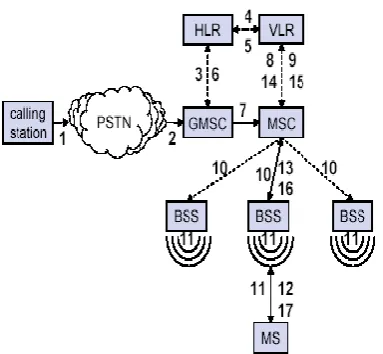
FIG4: Operation of Gsm
4.1GSM operation
Call Routing :
Call Originating from MS Call termination to MS Outgoing Call
Fig 5 : Outgoing Call
1. MS sends dialed number to BSS
3. MSC checks VLR if MS is allowed the requested service. If so, MSC asks
BSSto allocate resources for call.
4. MSC routes the call to GMSC 5. GMSC routes the call to local exchange of called user
6.Answer back (ring back) tone is routed from called user to MS via
GMSC,MSC. BSS
Incoming Call:
Fig 6. : Incomimg Call
V.PIR SENSOR:
The PIR (Passive Infra-Red) Sensor is a pyroelectric device that detects motion by measuring changes in the infrared levels emitted by surrounding objects. This motion can be detected by checking for a high signal on a single I/O pin.
Features
Single bit output
Small size makes it easy to conceal
Compatible with all Parallax microcontrollers
Application Ideas Alarm Systems Halloween
Quick Start Circuit
Note: The sensor is active high when the jumper (shown in the upper left) is in either position.
Fig 7 : Quick Start Circuit
VI.WIFI
The ZG2100M & ZG2101M modules are low-power 802.11b implementations. All RF components, the baseband and the entirety of the 802.11 MAC reside on-module, creating a simple and cost-effective means to add Wi-Fi connectivity for embedded devices. The module(s) implement a high-level API, simplifying design implementation and allowing the ZG2100M or ZG2101M to be integrated with 8- and 16-bit host microcontrollers.
Features
• Single-chip 802.11b including MAC, baseband, RF and power amplifier
• API for embedded markets, no OS required
• PCB or external antenna options
• Hardware support for AES and RC4 based ciphers (WEP, WPA, WPA2 security)
Fig 8: ZG2100M/ZG2101M Module: Functional Block Diagram
VII.RELAY
Fig 9 : Basic Relay Switch
The following schematic shows the basic circuit.
A relay is an electrically operated switch. When you turn it on, it switches on way. When it is off, it switches the other way. You can use a relay to switch on and off a high current device.A relay has an electromagnet, called a coil, and a lightweight switch inside it. When you energize the coil,
a piece of the switch is attracted by the coil's magnetic field, which switches the switch on or off.
VIII.Alphanumeric LCD
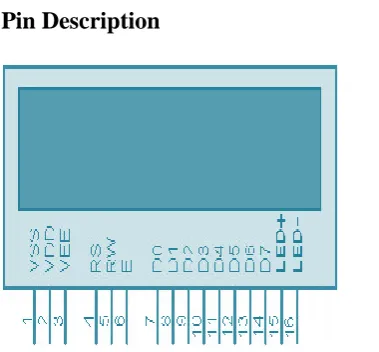
Liquid Crystal Display also called as LCD is very helpful in providing user interface as well as for debugging purpose. The most commonly used Character based LCDs are based on Hitachi's HD44780 controller or other which are compatible with HD44580. The most commonly used LCDs found in the market today are 1 Line, 2 Line or 4 Line LCDs which have only 1 controller and support at most of 80 characters, whereas LCDs supporting more than 80 characters make use of 2 HD44780 controllers.
Pin Description
IX.RESULTS
When the wifi hotspot of the kit is linked with the smart phonewifi and the connection terminal is opened in the smart phone and is configured.
When u type L in the connection terminal and click ok ( for LOAD 1 to ON)Then the LOAD 1 is going to ON
When u type F in the connection terminal and click ok ( for LOAD 2 to ON)
Then the LOAD 2 is going to ON
When u type R in the connection terminal and click ok ( for LOAD 1 to OFF)
Then the LOAD 1 is going to OFF
When u type L in the connection terminal and click ok ( for LOAD 1 to ON)Then the load 1 is going to ONWhen u type F in the connection terminal and click ok ( for LOAD 2 to ON)Then the load 2 is going to ON
When u type S in the connection terminal and click ok ( for both LOAD 1 and LOAD 2 to OFF)
Then the LOAD 1 is going to OFF
Then the LOAD 2 is going to OFF.
When a human comes in close to the PIR SENSOR , then it detects the presence of a persons
And displays the message in the display and in the connection terminal for the user like THEFT ALERT
X.CONCLUSION
In this paper, we proposed a flexible, low cost smart home system based on Internet and WiFi. We come up with the concept of Smart Units and Home Proxy. The combination of remote server and home proxy is a new scheme for remote control in which XMPP is used. Low cost WiFi module
is used to make smart units. Relative apps based on different platforms can be developed and android app is used to demonstrate the system. We use home proxy to solve the synchronization problem and the system supports multiuser. Also one phone can register different Home proxies, thus one phone can control more than one smart home system or smart office system. So the remote server can provide services for different homes and offices and the system is more likely to be promoted.
REFERENCES
[1] Gomez, C.; Paradells, J., Wireless home automation networks: A survey of architectures and technologies, IEEE Communications Magazine, vol.48, no.6, pp.92,101, June 2010
[2] Alam, M.R., Reaz, M.B.I., Ali, M.A.M., A Review of Smart HomesłPast, Present, and Future, IEEE Transactions on Systems, Man, and Cybernetics, Part C: Applications and Reviews, vol.42, no.6, pp.1190,1203, Nov. 2012
[3] Magno, M.; Polonelli, T.; Benini, L.; Popovici, E., A Low Cost, Highly Scalable Wireless Sensor Network Solution to Achieve Smart LED Light Control for Green Buildings, IEEE Sensors Journal, , vol.15, no.5, pp.2963,2973, May 2015
[4] J. Byun, I. Hong, B. Lee, and S. Park, Intelligent household LED lighting system considering energy efficiency and user satisfaction, IEEE Transactions on Consumer Electronics, vol. 59, no. 1, pp. 70C76, Feb. 2013.
[6] Haidong Wang; Saboune, J.; El Saddik, A., ”Control your smart home with an autonomously mobile smartphone,” IEEE International Conference on Multimedia and Expo Workshops (ICMEW), vol., no., pp.1,6, 15-19 July 2013
[7] N. S. Liang, L. C. Fu, and C. L. Wu, An integrated, flexible, and Internet-based control architecture for home automation system in the Internet era, Proceedings of ICRA02, IEEE International Conference on Robotics and Automation, vol. 2, pp. 1101-1106, 2002.