DETERMINANTS OF CROP AND LAND MANAGEMENT PRACTICES AND EFFECTS ON PRODUCTION RISKS UNDER
VARIABLE CLIMATIC CONDITIONS IN EASTERN UGANDA
BY
KANSIIME MONICA KAGORORA (MSC. AGRIe. ECON)
REG. NO. A99EAl20972/2010
A THESIS SUBMITTED IN PARTIAL FULFILMENT OF THE REQUIREMENTS FOR THE DEGREE OF DOCTOR OF PHILOSOPHY IN AGRICULTURAL ECONOMICS, KENY ATTA
UNIVERSITY
AUGUST, 2014
has not been presented for the award of
a
degree in any other university or any other award...~ .
...
~l
~.\
.~.~
...
Kansiime Monica Kagorora Date
Supervisors' approval
We confirm that the work reported in this thesis was carried out by the candidate under our supervision and has been submitted with our approval as University supervisors.
Dr. Stephen K. Wambugu Date
Senior Lecturer
Department of Agribusiness Management and Trade, Kenyatta University
c;j().
<l.
2)
;;~
EZ
~~'y~'
Date Full Professor of Geography
11
DEDICATION
To my husband Charles Owuor
ACKNOWLEDGEMENTS
I greatly appreciate the professional advice given to me by my supervisors, Dr. Stephen Wambugu and Prof. Chris Shisanya. The feedback of all the lecturers in the School of Agriculture and Enterprise Development, independent reviewers and examiners of this thesis is duly acknowledged. I appreciate the contributions of my respondents in Mbale, Pallisa and Sironko, together with enumerators, local and district leaders, in Eastern Uganda, who were so helpful in ensuring that the appropriate data were obtained to facilitate the undertaking of this study. I acknowledge the financial contribution of the Climate Food and Farming (CLIFF) network, who partly funded field work for this study.
My heartfelt thanks go to my spouse Charles Owuor for the moral, spiritual and financial support. The financial resources I diverted to this study could have .been used to do something else for the family, but he preferred that I use them for this study in order to gain more knowledge. My children Jenny, fn a~d Nolan, though young to understand, am sure ythey would have loved
IV
never to get tired. For my sisters and brothers, they were always been a quick
fall back when things got tight.
My colleagues Dr. Charles Recha and Dr. Emmanuel Manyasa, I thank them for their support in running my errands at the university. They both made
my induction and stay at Kenyatta University manageable. I thank them for
being there for me and for being reliable too.
Last but not least, I thank the Almighty God for His favour upon me. He made possible what initially looked impossible!
TABLE OF CONTENTS
DECLARATION i
DEDICATION ii
ACKNOWLEDGEMENTS iii
TABLE OF CONTENTS v
LIST OF TABLES iix
LIST OF FIGURES x
LIST OF APPENDICES xi
LIST OF ABBREVIA TlONS AND ACRONYMS xii
ABSTRACT xiv
CHAPTER ONE
INTRODUCTION 1
1.1 l.2 1.3
)
1.41.5
I' 1.6
1.7 l.8
Introduction 1
Background ofthe Study ' 1
Statement of the Problem 5
Research Questions 6
Objectives of the Study 6
Significance of the Study 7
Theoretical Framework 8
Operational Definition of Terms and Concepts 11
CHAPTER TWO
LITERATURE REVIEW 13
2.1 Introduction 13
2.2 Extent of Current Climate Variability 14
2.3 Effects of Climate Variability on AgriculturalProduction 17
2.4 Agricultural Production Risk Management 22
2.4.1 Income and Asset Management 24
vi
2.4.3 2.4.4 2.5 2.6 2.7
Farm Production Practices 25
Technological Development. 27
Farming Practices and the Management of Production Risks 28
Understanding and Evaluating Production Risks 30
Policy and Institutional Framework for Climate Change Adaptation in
Uganda 34
CHAPTER THREE
METHODOLOGY 37
3.1 Introduction 37
3.2 Research Design 37
3.3 Empirical Models 38
3.3.1 Adoption of Crop and Land Management Practices 38
3.3.2 Crop Production 42
3.4 Predicted Impact of Selected Explanatory Variables 45 3.4.1 Adoption of Management Practices (Outcome Model) 45 3.4.2 Perception of Rainfall Variability (Selection Model) 51
) . 3.4.3 Crop Production 51
3.5 Study Area and Target Population 53
3.6 Sampling Procedure and Sample Size 57
3.7 Research Instruments 59
3.8 Data Types, Sources and Collection 60
3.9 Pilot Study 63
3.1 0 Logistical and Ethical Considerations 64
3.11 Data Analysis and Interpretation 64
CHAPTER FOUR
RESULTS 70
4.2 Descriptive Results 70
4.2.1 Respondent Characteristics 70
4.2.3 4.2.4 4.2.5 4.2.6 4.2.7 4.2.8 4.3 4.4 4.4.1 4.4.2 4.5 4.6
Land Use Pattern and Ownership 74
Livestock Ownership 75
Crop Production 76
Access to Information and Institutional Support Services 77
Rainfall Variables 79
Crop and Land Management Practices used by Farmers 81 Extent of Annual and Seasonal Rainfall Trends and Variability 85 Factors Influencing Farmers' Decisions to Adopt Management
Practices 91
Heckman Selection Model- Two-Step Estimates 91
Multivariate Probit Model Estimates 94
Effects of Management Practices on the Mean and Variance of Crop
Production 98
Effectiveness Scale of Farmer-Preferred Management Practices 104
\cHAPTER FIVE
c:bISCUSSION 108
5.1 Introduction 108
5.2 Descriptive Statistics 108
5.3 Extent of Annual and Seasonal Rainfall Trends and Variability 110 5.4 Farmers' Response Mechanisms to Rainfall Variability 113 5.5 Factors Influencing Farmers' Decisions to Adopt Management
Practices 118
5.6 Effects of Farmer-Preferred Management Practices on the Mean and
Variance of Crop Production 122
5.7 Subjective Effectiveness Scale of Farmer-Preferred Management
Practices 126
CHAPTER SIX
SUMMARY, CONCLUSION AND RECOMMENDATIONS 128
VIII
6.2 Summary of Findings 128
6.3 Implications of the Findings 131
6.4 . Conclusions 133
6.5 Recommendations 135
6.6 Further Research 136
LIST OF TABLES
Table Page
2.1: Landmark Climate Change-Related Disasters in Uganda 21
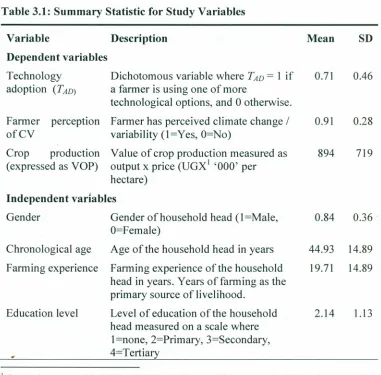
3.1: Summary Statistic for Study Variables 52
3.2: Characteristics of Sample Districts and Relevance to SSA 56
3.3: Study Districts, Sample Villages and Sample Size 58
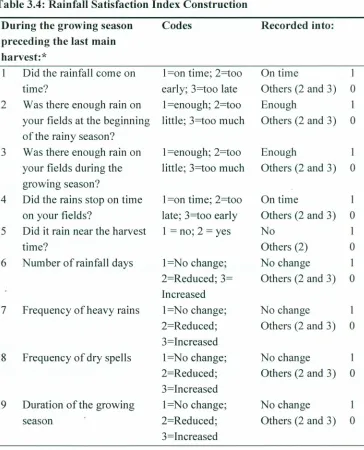
3.4: Rainfall Satisfaction Index Construction 62
4.1 : Proportion of Study Respondents by Sex 71
4.2: Average age of respondents by location 71
4.3: Average age of respondents by sex 71
4.4: Education level of respondent by location 72
4.5: Land Use Pattern in Sampled Villages in Eastern Uganda 75
4.6: Livestock Ownership in the Sampled Villages inEastern Uganda 76 4.7: "Value of Crop Production by District.. 77
\ .
4.8: Level of Access to Information and other Support Services 78
4.9: Rainfall Variables for Mbale, Pallisa and Sironko districts 80
4.10: Proportion of Respondents using various Technologies by District 82
4.11: Reasons for Adopting Various Crop and Land Management Practices in
the Study Districts 84
4.12: Heckman's Sample Selection Model of Whether a Farmer Fails to
Respond to Climate Variability 92
4.13: Marginal Impacts of Adaptation to Climate Variability 94
4.14: Effect of Explanatory Variables on Adoption of Crop and Land
Management Practices 96
4.15: Effects of Management Practices on Mean and Variance of Crop
Production 99
4.16: Effects of Management Practices on Mean and Variance of Crop
Production by District 102
4.17: Subjective Effectiveness Scale of Farmer-Preferred Crop and Land
x
LIST OF FIGURES
Figure Page
3.1: Map of Uganda showing the Study Location 55
4.1: Distribution of Household Income by Source in the study districts 73 4.2: Percent Distribution of Household Income by Source and District 74 4.7: Trend of Annual Rainfall for Mbale, Pallisa and Sironko 86 4.8: Trend of Seasonal Rainfall for Mbale, Pall isa and Sironko 87 4.9: Trends inAnnual Rainfall Anomalies Relative to the 1971-2010
Mean Rainfall for Mbale, Pallisa and Sironko 89
4.10: Trend in Seasonal Rainfall Anomalies Relative to the 1971-2010
LIST OF APPENDIC~
Appendix Page
1. Key Studies Reviewed in Relation to this Study Problem and Knowledge
and Methodological Gaps 167
2. Study Variables, Data Collection and Measurement Procedures 171
3. Data Collection Tools 173
A. Focus Group Discussion Guide 173
B. Key Informant Interview Guide 177
C. Household Survey Questionnaire 178
AEZ ANOVA ASAL ASARECA CAADP CGCM CIMMYT CV ENSO FAO FEWSNET FGD FGLS GCM GDP GIS GOU GRID IFOAM IFPRI IPCC MDG MNL MNP NAADS NAPA OECD OLS PCA XII
LIST OF ABBREVIATIONS AND ACRONYMS
Agro-ecological Zone Analysis of Variance Arid and Semi-Arid Land
Association for Strengthening Agricultural Research in Eastern and Central Africa
Comprehensive Africa Agricultural Development Program Coupled General Circulation Model
International Maize and Wheat Improvement Center Coefficient of Variation
EI Nino Southern Oscillation
Food and Agriculture Organization of the United Nations Famine Early Warning System Network
Focus Group Discussion
Feasible Generalized Least Squares General Circulation Models
Gross Domestic Product
Geographical Information System Government of Uganda
Global Resource Information Database
International Federation of Organic Agriculture Movements International Food Policy Research Institute
Intergovernmental Panel on Climate Change Millennium Development Goals
Multinomial Ligit model Multinomial Probit model
National Agricultural Advisory Services National Adaptation Programme of Action
Organization for Economic Cooperation and Development Ordinary Least Squares
PCM
SD
SDA
SPSS
SSA
TLU
UBOS
UGX
UNDPUNISDR·
UNFCCC
UNWD
USD
VIF
VOP
WDR
Parallel Climate Model
Standard Deviation
Stochastic Dominance Analysis
Statistical Program for Social Scientists
Sub-Saharan Africa
Total Livestock Unit
Uganda Bureau of Statistics
Uganda Shillings
United Nations Development Programme
United Nations International Strategy for Disaster Reduction
United Nations Framework Convention on Climate Change
Uganda National Water Development
United States Dollar
Variance Inflation Factors
Value of Production
XIV
ABSTRACT
1.1 Introduction
In this introductory chapter the background to the study is presented.
The chapter also presents the statement of the problem, research questions, objectives and significance of the study. Also presented in this chapter is the study conceptual framework and operational definitions of terms and concepts
used in this study.
1.2 Background of the Study
Agriculture is often characterized by high variability of production
outcomes, that is, by production risk. Unlike most other entrepreneurs, agricultural producers cannot predict with certainty the amount of output their
production process will yield, due to external factors such as weather, pests, and diseases. The agricultural sector in Sub Saharan Africa (SSA) continues to
be confronted with multiple shocks and crises, threatening the endowment of
the sector, and impeding efforts at attaining the targets of the millennium development goals (MDGs) and the core Comprehensive African Agriculture
Development Programme (CAADP) pillars (Chuku and Okoye, 2009; World Development Report, 2009).
Rainfall variability influenced by large scale inter-seasonal and
2
major risk factors affecting agricultural production and food security in the sub region (Christensen et al., 2007; Easterling et al., 2007; Haile, 2005). This variability in rainfall has also been directly linked to the decline in economic activities in most SSA countries (Brown et al., 2010). Managing climate induced risk is important in agriculture not only for the direct impact that climate has on production, but also for the tendency of most farmers to be risk averse (Cabrera et al., 2009).
Ruttan (1996) indicates that impacts of climate variability on crop yields depend on both technological considerations and farmers' response to changing environmental conditions. Appropriate technologies and management practices present ample opportunities to bridge yield gaps, thereby increasing productivity as well as improving management of climate induced risk in agriculture (Goddard et al., 2001; Hansen, 2005). An increasing body of observations has emphasized the importance of managing climate risk to the optimization of crop/varietal choice especially in marginal areas (Di Falco et al., 2006; Kurukulasuriya and Mendelsohn, 2006a), and farm income (Jones et al., 2000; Kumar et al., 2004). Kassie et al. (2009) and Kato et al. (2009) demonstrated the importance of organic farming, and soil and water conservation techniques respectively as adaptation strategies to climate variability, in specific farming systems.
and change (Ausubel, 1995; Rosenberg, 1992). Several technological and management options have been developed and promoted including; soil and water conservation, new crop varieties, management adjustments, reforestation in fragile landscapes, down-scaled forecasting, and investment in low level irrigation infrastructure in watersheds (Goddard et aI., 2001; Iglesias, 2005; Nzuma et al., 2010).
There have also been efforts to generate and disseminate seasonal climate forecasts, particularly in developing countries (Goddard et al., 2001). A vailability of such information is useful to show direction of change in climate in order to inform farmers' decisions of what type of adaptation actions to take. However, for such information to effectively inform farming decisions, it should be precise (Thornton et al., 2008).
Climate risks to agriculture vary according to location, type of enterprise, and the effectiveness of risk management (Iglesias et al., 2006; Kassie et al., 2009), thus the need for local level analyses that take into account both the biophysical and socio-economic characteristics of the farming system. However, a majorchallenge facing most agriculture-climate evaluations isthe inclusion of both biophysical and socioeconomic aspects in the methodology (Iglesias and Quiroga, 2007). Most assessments of regional climate risk provide only probabilistic information on climate (Hansen and Indeje, 2004).
4
Multiple regression models have been developed to represent process-based yield responses to these environmental and management variables (for example, Cabas et al.,2010; Di Falco et al., 2006; Iglesias and Quiroga, 2007; Iglesias et al. 2000; Pender and Gebremedhin, 2006; Sileshi et al., 2010), and could be used to estimate the risk associated with climate variability.
Local level analyses of rainfall in Uganda have focused on magnitudes of monthly and seasonal rainfall (FEWSNET, 2012; Kigobe et al., 2011) and the occurrence of dry and wet spells (Bamanya, 2007; FEWSNET, 2012; Osbahr et al.,2011), with limited focus on the variability of rainfall within the year and seasons. Yet crop production is sensitive not only to annual changes but also to the seasonal distribution of precipitation (Mukiibi, 2001; Ogallo et al., 2000). There is no study so far in Uganda that has been conducted to
understand the effects of various management practices promoted by government, research, extension and development agencies in reducing production risks under variable rainfall regimes.
system at risk, thus boosting the relevance of results to risk management
(Botterill and Wilhite 2005).
1.3 Statement of the Problem
Climate variability is among the major risk factors affecting agricultural
production and food security of smallholder farm households in SSA. Variability of rainfall both within and between seasons makes it difficult for
farmers to plan for agricultural activities, and frequently leads to crop failure. This uncertainty discourages beneficial investment decisions required from a
wide range of agricultural stakeholders, when the returns to investment appear
so unpredictable from season to season. In the context of sustainable
development and adaptation, several technological and management options
have been developed and disseminated intended to adapt agriculture to
changing and variable climate. However, information is still lacking on their
effect on production risks under variable rainfall in rain-fed farming systems.
In addition, knowledge of within-season characteristics and magnitude of
rainfall variability :emain scarce in most parts of Africa with previous research
emphasizing on annual averages. This study therefore used an integrated
approach to assess the effect of various farmer-preferred technological and
other responses employed by farming households in three distinct
6
1.4 Research Questions
The following questions guided this study:
I. Is there a discernible and significant pattern in the variation of annual and seasonal rainfall in Eastern Uganda that has affected crop production over the period 1971-201 O?
II. What factors influence farmers' decisions to adopt crop and land management practices for reducing production risks under rainfall variability in Eastern Uganda?
Ill. What are the effects of farmer-preferred crop and land management practices on crop production risk under variable rainfall regimes?
iv. What is the perception of farmers regarding the success of different crop and land management practices In reducing rainfall
variability-induced production risks?
1.5 Objectives of the Study
The general objective of the study was to contribute to development of evidence-based decision support system to determine the most effective production risk-reducing management practices given variation in rainfall and
farm household socio-economic characteristics In Eastern Uganda. Specifically, the study aimed to:
2. Determine factors that influence farmers' decisions to adopt crop and land
management practices for reducing rainfall variability-induced production risks;
3. Evaluate the effects of farmer-preferred crop and land management practices on the mean and variance of crop production in variable rainfall regimes; and
4. Assess farmers' perceptions of the effectiveness of different crop and land management practices in mitigating against rainfall variability-induced production risks.
1.6 Significance of the Study
8
the success of adaptation innovations in reducing production risks will be created amongst researchers, development organizations, extension personnel and policy makers, to enhance continuous assessment of technological options in order to promote the most effective ones given future variations in rainfall and other climate extremes.
1.7 Theoretical Framework
The study aimed to establish the effects of various crop and land management practices in reducing production risks under variable rainfall regimes. In this case, production risk is considered a function of crop and land management practices. Production may increase due to introduction of new technologies or farming practices, or production may remain the same with lower level input due to the introduction of a new technology. A farmer adopts an innovation if its output will increase from given resources or if input decreases for a given output.
This study assumed that the production by household hon plot p (Yhp) is determined by crop and land management practices (Thp). Farming practices employed by farmers may either have risk increasing or risk reducing effects on production (Kato et aI., 2009). If they are risk increasing, it means they have a positive influence on the variance of crop production, thus considered ineffective in addressing climate variability-induced production risks.
It is also assumed that the true effectiveness of farming practices on
period, deviation of rainfall from its 40-year average, rainfall satisfaction index), use of purchased inputs (INhp), the household's endowment of physical capital (PCh) (land, livestock), human capital (HCh) (education, age, and gender of household head, size of household), and financial capital (FCh) (household income, off farm income); village-level factors that determine local comparative advantages (X;,)(agro-ecological conditions, access to markets and infrastructure, and population density); and random factors (Uyhp) (Equation 1.1 ).
(1.1 )
On the other hand, choice of crop and land management practices is determined by rainfall variables; the household's endowment of physical, human and financial capital at the beginning of the year, as well as the local agro-ecology. Access to information and institutional support services such as extension (EThp) and use of credit (CRhp), weather information (Whp) and access to markets (MKhp) (input and output markets) affect adoption of technologies, and only have intervening effects on the value of crop production (Equation 1.2).
10
number of factors that potentially affect adoption of management practices. It is assumed that a farmer will adopt a production risk reducing practices, only if they notice or perceive change in rainfall variables. As such perception of rainfall variability is affected by the household's endowment of physical, human and financial capital at the beginning of the year; access to weather information and extension services; and local agro-ecology (Equation 1.3).
(1.3)
Most of the determinant factors in equations 1.2 and 1.3 are either exogenous to the households, for example local agro-ecology or state variables that are predetermined at the beginning of each year (e.g. natural capital of the plot, physical capital, human capital and financial capital). Use of credit on the other hand may be wholly or partially determined in the current year and hence potentially affected by current decisions about crop and land management technologies. In the econometric analysis (discussed in section 3.10), the study used predicted use'of credit as an instrumental variable to address this potential endogeneity bias. Access to credit may depend on the household's endowment of physical (land) and human capital, and village-level factors affecting local comparative advantage (Equation 1.4).
Finally, plot-level characteristics (e.g. plot-level biophysical characteristics, soil, slope and presence of land investments); pests and diseases; and temperature are potential independent variables, affecting both technology adoption and crop production. Since this study is being conducted in three distinct agro-ecological zones, plot-level characteristics (slope, soil type, fertility levels) have been assumed to be homogeneous across agro-ecological zones, thus the study undertook to explain agro-ecology specific rather than plot level characteristics. Pests and diseases and temperature were also considered as control variables, majorly for the reason of difficulty in acquiring this information.
1.8 Operational Definition of Terms and Concepts
A number of terms and concepts have been used in this study. In the following, operational definitions are given, based on how they are used in this study. Some of the definitions are based on citable definitions of terms:
1. Adaptation: Adjustment in natural or human systems in response to actual or expected climatic stimuli or their effects, which moderates harm or exploits beneficial opportunities (IPCC, 2007).
2. Agricultural production risk: The probability of an undesirable outcome in an agricultural enterprise (yield loss, low profit or economic loss, environmental damage).
12
4. Climate variability: The disparities in the mean state and other statistics (standard deviation, occurrence of extreme events) of climate on all time
scales beyond that of individual weather events. Variability may be due to
natural processes within the climate system or to variations in natural or
anthropogenic external forcing. In this study, rainfall variability is used as a
proxy for climate variability.
5. Management practices: Refer to operations and methods of carrying out agri-business such as production methods, land use, land topography,
irrigation and timing of operations. In this study, management practices
refer to crop and land adjustments employed by farmers in response to
rainfall variabil ity.
6. Technological options: Refer to all agricultural-related technologies and
,
innovations which encompass the production to consumption continuum;
e.g. new varieties, management practices, agronomic practices, post-harvest
practices, techniques for natural resources management and biodiversity
CHAPTER TWO
LITERATURE REVIEW
2.1 Introduction
This chapter reviews literature related to the research topic and
objectives. The key concepts in the study problem are climate variability,
technological and management options, and production risk reduction. While it is generally agreed that impacts of climate variability on crop yields depend on
technological considerations and farmers' response to changing environmental conditions, there is need to make reference to other studies conducted in areas related to these concepts specifically, and the study problem in general.
In this chapter, discussion is made of such related literature under three
themes; extent of climate variability and its impacts on agricultural production; agricultural production risk management; and the role of technologies and
management practices in reducing agricultural production risks. The review
further assesses tlie various analytical methods that have been applied in
previous studies related to this study, further identifying knowledge and
methodological gaps and how they have been filled by this study.
In addition, current government of Uganda policy frameworks that
relate to climate change adaptation and agricultural risk reduction are explored.
This is intended to place this study and results into context of national climate
14
2.2 Extent of Current Climate Variability
Evidence is emerging that climate change is increasing rainfall
variability and the frequency of extreme events such as drought, floods, and
hurricanes (IPCC, 2007). Boko et al. (2007) predicted that Africa is likely to
warm across all seasons during this century with annual mean surface air
temperatures expected to increase between 3°C and 4°C by 2099, roughly 1.5
times average global temperatures. Projections in East Africa suggest that
increasing temperatures due to climate change will increase rainfall by 5 - 20%
from December to February, and decrease rainfall by 5-10% from June to
August by 2050 (Hulme et aI., 2001; IPCC, 2007). Analyses from General Circulation Models (GCM's) indicate an upward trend in rainfall under global
warming over much of Burundi, Kenya, Rwanda, southern Somali and Uganda
(van de Steeg et aI., 2009).
In Uganda, there is a general lack of scientific consensus on the trend
and distribution of annual and seasonal rainfall. McSweeney et al. (2008)
reported an annual rainfall decrease of 3.5% since the 1960s, with annual
rainfall due to decline further. McSweeney et al. (2008) further suggested that rains during the March to May rainy season are falling by 4.7% per decade.
This result is corroborated by FEWSNET (2012) where it is reported that both
spring and summer rains have decreased in Uganda during the past 25 years,
with significant declines in west and northwest regions.
However, according to climate analysis in the Ugandan Government's
National Adaptation Programme of Action (NAPA), published in December
and the east and northwest are tending to become wetter, indicating an increase in rainfall in these areas. Also, temperature and rainfall simulations by Goulden (2008) indicated high percentage increases in rainfall for historically dry seasons for many parts of Uganda.
On the seasonal scale, GOU (2007) reported increasing erratic onset and cessation of rainfall seasons across the country in recent years; coupled with increasing frequency of droughts. It has also been observed that falls are heavier and more violent. Non-governmental organizations working in Uganda also reported that farmers recognize an increasingly erratic rainfall pattern in the first March to May rainy season, causing drought and crop failure, but also more intense rainfall, especially in the second rains at the end of the year, causing flooding and erosion (Oxfam, 2008). The spatial variability has been attributed to the complex topography and existence of large inland water bodies (Bamanya, 2007), La Nina and EINino phenomena, with La Nina years tending to bring significant drying and EINino years heavy rains (GOU, 2009). In their study on modelling rainfall in Uganda, Kigobe et al. (2011) indicated variations in the amounts of rainfall in the south and northern parts of the Lake Kyoga basin. Kigobe et al. (2011) further indicated that during the early part of the year, the north is typically dry while the south is moderately wet. During the period 'March-May (MAM), the south eastern parts of the basin receive moderately higher rainfall amounts compared to other areas.
16
to season one in most parts of Uganda. Also, the start of season one varied by
location with adeviation of up to two weeks.
The studies above conducted in Uganda, have been based on the
magnitudes of monthly and seasonal rainfall, the on set and ceasation of
rainfall, and the occurrence of dry and wet spells, with limited focus on the
variability of rainfall within the seasons. Yet crop production is sensitive not
only to annual changes but also to the seasonal distribution of precipitation
(Mukiibi, 2001; Ogallo et aI., 2000).
General Circulation Model scenarios provide no better information as
they are insufficiently precise in terms of spatial resolution or scale of
assessment and fail to reasonably differentiate spatiality (Thornton et aI.,
2008). Therefore, little can be said yet about changes in climate variability or
extreme events in Africa (Sivakumar et aI., 2005; Christensen et aI., 2007).
Considering that previous studies have also been generalized over
Uganda (and East and Central Africa for the case of GCM's) with no focus on
specific region or agro-ecology, such information cannot be reasonably used to
inform decision making at local level, due to lack of understanding of what the
local-level impacts of climate change are likely to be, hence need for research
to address this uncertainty (Bradshaw et aI., 2004). This study addressed this
knowledge gap by providing empirical evidence of the extent of annual and
seasonal rainfall variability in Eastern Uganda, focusing on three distinct agro
-ecologies in the region. Clarity on variability by specific agro-ecology is
essential to support vulnerable communities to adapt their farming systems to
2.3 Effects of Climate Variability on Agricultural Production
An extensive literature has been developed on the impacts of climate change and variability on agriculture, with the earliest focusing primarily on the vulnerability of the sector (for example Kurukulasuriya et aI., 2006b; Kurukulasuriya and Mendelsohn, 2008; Mendelsohn et aI., 1996; Seo and Mendelsohn, 2006). The general message from this literature is that the degree of vulnerability of the agricultural sector to climate variability and change is contingent on a wide range of local environmental and management factors: biological conditions such as soil content, type of crop, extent of knowledge and awareness of expected changes in climate, type and objectives of the management regimes prevalent in agriculture, the extent of support from government and other agencies, and the ability of key stakeholders to undertake the necessary remedial steps to address climate concerns (Kurukurasuriya and Rosental, 2003).
18
Climate variability and change are likely to affect land degradation
processes by altering rainfall averages, variability and extremes and by
increasing evaporation and transpiration of water from soils, vegetation and
surface waters (ASARECA, 2009). In North Africa and the Sahel, increasing drought, water scarcity and land overuse could lead to a loss of 75% of arable, rain-fed land. The Nile Delta, for example, is at risk from both sea-level rise and salinization in agricultural areas with estimates of 12 to 15% loss of arable
land by 2050 affecting 5 million people (Boko et aI., 2007).· Shisanya et al.
(2011) demonstrate the continued effect of climate variability on the vegetation
condition and consequently crop production in Arid and Semi-Arid Lands of Kenya.
In a recent study of rain-fed cereal potential under different climate change scenarios and varying rainfall, losses of rain-fed production potential in
the most vulnerable developing countries was predicted under most scenarios.
Losses were estimated at 10%--20% of production area, with some 1--3 billion people possibly affected in 2080 (Fischer et aI., 2002). These findings are
corroborated by Boko et al. (2007) and Brown and Crawford (2007) who predicted decreases in crop yields from Africa's rain-fed farm production as a
result of changes in climatic conditions. Model based maize yield changes due to climate change in dry land ecosystems in Tanzania predicted average
country yield decrease of 33%, but could be as high as 84% in some regions (Agrawala et aI., 2003). In Kenya, during the 1999--2000 drought, the country lost about 26 percent of its livestock resulting into losses to a tune of Kenya
shilling 5.8 billion (approx. $77 million) (Mogaka et aI., 2005).
Like most of SSA, agricultural productivity in Uganda is being adversely constrained by climate variability manifested through irregular rainfall patterns and erratic onset and cessation of rains, which have increased
the intensity of drought and brought about changes in growing seasons (Nkonya et aI., 2008). In particular, climate variability and change is likely to mean increased food insecurity; soil erosion and land degradation; flood and landslide damage to infrastructure and settlements and shifts in the productivity of agricultural and natural resources (GOU, 2009).
Climate variability has been reported as having a significant impact on rural livelihoods in Uganda (Apuuli et aI., 2000; GOU, 2007; James, 20] 0). Farmers claim increasingly unpredictable weather has led to poor yields, a reduction in pastures, poor animal health, rangeland related conflicts, greater expense and labour, food insecurity and reduced incomes leading to poverty (Osbahr et aI., 2011; Oxfam, 2008). Oxfam, further reported an increase in the frequency of droughts, with for example seven droughts experienced between 1991 and 2000 alone.
20
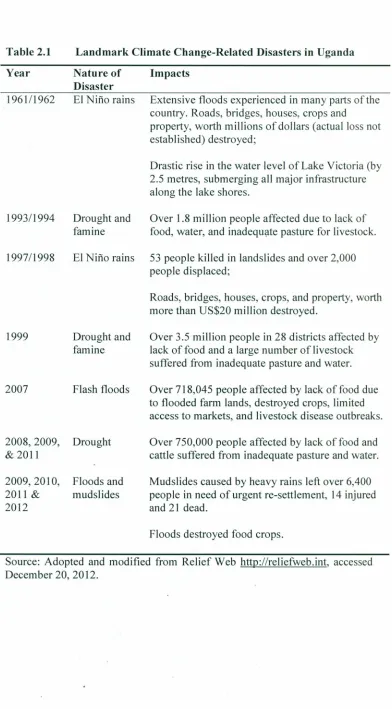
malnutrition (GOU, 2009). An increase inthe intensity and frequency of heavy rains, floods and landslides in the highland areas such as Bududa and areas around Mt. Elgon as well as outbreaks of associated waterborne diseases, has also been observed. Table 2.1 shows land mark climate related disasters in Uganda and the extent of damage caused to various sectors.
Table 2.1 Landmark Climate Change-Related Disasters inUganda
Year Nature of Impacts
Disaster
1961/1962 EINino rains Extensive floods experienced in many parts of the country. Roads, bridges, houses, crops and
property, worth millions of dollars (actual loss not established) destroyed;
Drastic rise in the water level of Lake Victoria (by 2.5 metres, submerging all major infrastructure along the lake shores.
1993/1994 Drought and Over 1.8 million people affected due to lack of famine food, water, and inadequate pasture for livestock.
1997/1998 EI Nino rains 53 people killed in landslides and over 2,000 people displaced;
Roads, bridges, houses, crops, and property, worth more than US$20 million destroyed.
1999 Drought and Over 3.5 million people in28 districts affected by famine lack of food and a large number oflivestock
suffered from inadequate pasture and water.
2007 Flash floods Over 718,045 people affected by lack of food due to flooded farm lands, destroyed crops, limited access to markets, and livestock disease outbreaks.
2008,2009, Drought Over 750,000 people affected by lack of food and &2011 cattle suffered from inadequate pasture and water.
2009,2010, Floods and Mudslides caused by heavy rains left over 6,400 2011 & mudslides people in need of urgent re-settlement, 14 injured
2012 and 21 dead.
Floods destroyed food crops.
22
2.4 Agricultural Production Risk Management
Many definitions of risk exist in literature. For example, Szekely and
Palinkas (2009) defined risk as "the potential deviation between the expected
and the real outcomes resulting from an economic decision where, from a
practical point of view, a negative outcome has greater importance, and
constitutes the one actually considered by most decision makers". Harwood et
al. (1999) described risk as the possibility of adversity and refer to it as the
"uncertainty that matters". Among the many definitions of risk in literature,
three properties emerge as common factors; (1) the chance of a bad outcome,
(2) the variability of outcomes, and (3) the uncertainty of outcomes.
In agriculture, the major risks are business risk (including production,
market, personal and institutional risk) and financial risk (issues related to
financing business operations) (USDA, 1997). Among these risks faced by
agricultural stakeholders, production or yield risk is the most important (Chuku
and Okoye, 2009). This occurs because agriculture is subject to uncontrollable
events usually related to climate such as changes in precipitation, floods, hail,
insects, diseases etc.
Rainfall variability, both within and between seasons creates risk and
uncertainty of farm production as well as for the potential impact of
innovations for crop, soil and livestock management practices (Cooper and
Coe, 2010). Overlaid on this challenge is the IPCe prediction that whatever
happens to future greenhouse gases, we are' locked into global warming and
inevitable changes to climatic patterns which are likely to exacerbate existing
extremes (lPCC, 2007). Considering that African agriculture is primarily rai n-fed and is entirely dependent on rainfall that is both seasonal and highly variable, there is a need to manage the associated risks. Without effective intervention, projected increases in climate variability can be expected to intensify the cycle of poverty, natural resource degradation, vulnerability and dependence on external assistance (Jarvis et aI., 2011).
Risk management is the range of strategies and instruments applied to avoid or minimize losses and to utilize opportunities (Moschini and Hennessy, 2001). A number of options for risk management in agriculture have been cited in literature. Among them are, integrated planning of land and water resources at plot and watershed scales, soil fertility improvement, diversifying agriculture with crops and varieties that can perform better under various climatic stresses, developing sound risk management strategies including safety nets and risk insurance, and adaptive management that disseminates timely climate information to farmers and tailors techniques to shifting climatic conditions (Eakin, 2005; Iglesias, 2005; Nzuma et aI., 2010; Muchena and Iglesias, 1995; Organization for Economic Co-operation and Development [OECD], 2009; Rao, 2011; Reid and Vogel, 2006).
24
2.4.1 Income and Asset Management
Income and asset management are intended to spread exposure to risks
by farmers, and reduce vulnerability to shocks and crises (Chiotti et aI., 1997;
Mahul and Vermersch, 2000). Income and asset management options include
crop insurance, crop shares, options and futures, and asset smoothing.
Insurance against crop loss is receiving increased attention as a means to cover
losses from extreme events such as flooding and droughts and enhance the
resilience to shocks.
Crop insurance schemes are well established in developed countries
where farming is practiced by large commercial farmers, but are new to
developing countries where farming is mainly of subsistence nature that
generates very little marketable surplus. In addition there are also problems
associated with accurate assessment of risks in financial terms and high
transaction costs due to involvement of large number of farmers over small
areas. Index based insurance isone approach that appears to be of considerable
promise in the countries where agriculture is predominantly smallholder in
scale. Formal insurance requires innovation in designing products and services
that are appropriate in terms of coverage, timeliness, accessibility and
affordability.
Informal crop insurance systems have been observed in Nigeria (Udry,
1994), Mozambique (Eriksen and Silva, 2009; Osbahr et aI., 2008), and
Uganda (Asiirnwe and Mpuga, 2007). Informal insurance mechanisms used
village savings schemes, maintaining food stocks and participation in off-farm income generating activities.
2.4.2 Government Programmes and Insurance
Government programmes and support strategies include among others,
governments subsidy and transfers, governments insurance and natural resource management programs (Smit and Skinner, 2002). These represent
adaptation strategies at an aggregate scale and can be. considered as
prerequisite actions for effective and sustainable risk management in
agriculture.
2.4.3 Farm Production Practices
Farm production practices include; diversification of crop and livestock
varieties, the substitution of plant types, land use and topography, innovations
in natural resource management, altering the composition of chemical (fertilizers and pesticides and synthetic inputs) and timing of operations
(Chiotti et aI., 1997; Cooper et aI., 2008; Nzuma et aI., 2010; Skoufias, 2003;
Smit and Skinner, 2002).
Innovations in natural resource management such as broad scale water resource management address the risk of water (moisture) deficiencies or
surpluses associated with shifting precipitation patterns and the proximity of
more frequent floods and/or droughts (Smit and Skinner, 2002). At the
26
contouring, and alternative tillage systems (Smit and Skinner, 2002). Changing the timing of operations, for example rescheduling planting, spraying,
fertilizing and harvesting has the potential to maximize farm productivity
during the growing seasons and to avoid heat stresses. and moisture deficiencies during times of increased climate perturbations (Chiotti et aI., 1997; de Loe et aI., 1999; Smit and Skinner, 2002).
Sustainable land management (SLM) practices such as conservation
tillage, cover cropping, improved livestock practices, water harvesting, agroforestry, and enhanced water and nutrient management can improve soil
carbon sequestration (SCS), increase yields, and enhance resilience to climate change (Thornton and Herrero, 2010). There may also be tradeoffs between increasing farm productivity and profitability, adaptation to climate change,
and mitigation of greenhouse gases (GHGs).
Other production practices employed mostly in Mali, Niger and Burkina Faso involve building of anti-erosion small dykes to allow for sedimentation and particle deposits upstream of the dykes to reduce run-off and
increase water percolation; the "zai" technique, which is also applied in the Sahelian zone, involves planting of crops in small, circular pits perpendicular to the slope to capture rainwater and retain soil moisture (Akponikpe et aI.,
2010; Brown and Crawford, 2007); and improved land clearing technique
2.4.4 Technological Development
The Association for Strengthening Agricultural Research in Eastern and Central Africa [ASARECA] (20 I 0) defines agricultural technologies as
agricultural-related innovations which encompass the production to
consumption continuum. A variety of technological innovations have been developed to better accommodate farming to spatial variations in climate.
Smithers and Blay-Palmer (2001) identify two basic types of technological options - mechanical and biological.
Some of the mechanical technologies that are associated with managing
climate-induced production risks are; irrigation, conservation tillage and development of integrated field drainage systems. The development of
effective irrigation systems, particularly drip systems, has facilitated both more
intensive agricultural activity and a broader range of activities than local climatic resources would otherwise permit.
Similarly, conservation tillage involving improvements In alternative
tillage systems, along with associated planting and harvesting technologies,
have facilitated greater usage of reduced tillage systems. In addition to soil conservation benefits, these systems reduce the number of field operations that
expose soil to evaporation while leaving a vegetation cover that further retards
28
On the other hand, biological technologies include the development of crop varieties with higher yield potential or those that are better suited to the
temperature, moisture and other conditions associated with aparticular ecology (Smithers and Blay-Palmer, 2001). This is most clearly reflected in the
development of hybrids for many major field crops, thus permitting their introduction and/or expansion into regions where climate had previously been a
limiting factor.
The technological components that are suggested under these strategies are mainly aimed at sustainable intensification which is the key to ensure food security especially in countries where good scope for increasing current levels
of productivity exists. The development of information systems capable of
forecasting weather, climate and market conditions associated with agricultural production over a long period of time to farm holders has also been proposed as a technological option.
2.5 Farming Practices and the Management of Production Risks
It is generally agreed that in the medium and longer term, as climate
change becomes more obvious farmers need to adapt their farming practices to a new set of weather-induced risks and opportunities (Cooper and Coe, 2011).
Against this background, awealth of information has emerged over the decades in SSA that has identified a broad range of tested and proven innovations that farmers can adopt to reduce production risks as a result of changes in the local
2006b). Studies in Ethiopia showed that soil and water conservation and sustainable agriculture technologies have significant impacts on reducing production risk (Kassie et al., 2008; Kato et a\., 2009; Shiferaw and Holden,
1999). Di Falco et al. (2006) show that variety richness increases farm productivity. Simulations with estimated parameters illustrate how planting more diverse durum wheat varieties on multiple plots contributes to improving farmer's welfare.
Other studies have related technology effects on crop production to climate change adaptation. For example, Kassie et al. (2009) and Kurukulasuriya and Mendelsohn (2006a) demonstrated that adoption of organic farming techniques, and crop selection are important adaptation strategies to climate variability respectively, in specific farming systems.
However, as noted by Cooper and Coe (2010), the adoption of such innovations remains low. One contributing reason is noted as unavailability of information to farmers and their support agents with regard to the climate-induced risk associated with these innovations and the extent to which such innovations might" mitigate or exacerbate such risk. Such information is considered essential if risk-averse farmers are to make better informed and more profitable decisions, and their support agents to more effectively promote innovative farming practices.
30
thus the need for local level analyses that take into account both the
biophysical and socio-economic characteristics of the farming system.
This study therefore, aimed to develop an evidence base addressing this
knowledge gap by assessing effectiveness of various production practices and technologies employed by farmers in reducing climate-induced production
risks. The study was conducted in the context of Eastern Uganda focusing on three distinct agro-ecological zones in the region. The inclusion of local level
rainfall information In the analysis strengthens the results and recommendations made by this study. There is no specific study that has been
conducted in Uganda analysing impacts of technology on crop production,
given rainfall variability.
2.6 Understanding and Evaluating Production Risks
Several types of econom ic approaches have been used to estimate the
potential impacts of climate change on agricultural production. Economic
models are based on the goal of maximizing economic returns to inputs. These
have been used extensively in the context of climate change (Antle and
Capalbo, 2001). They are designed to simulate the decision-making process of farmers regarding methods of production and allocation of resources. Most
commonly used approaches have been the Ricardian approach, multiple regression analysis and yield functions. .
The Ricardian approach measures the relationship between net
revenues from crops and climate using cross sectional evidence
Ricardian studies generally capture endogenous adaptation measures that farmers actually take to adjust to climate change. However, the model's weakness lies in the need to control for many variables in addition to climate.
The Ricardian approach does not deal with the process of adaptation and how it
occurs, nor those factors that may retard or hasten the process of adaptation (Maddison, 2007).
Multiple regression models have also been developed to represent process-based yield responses to environmental and management variables (for example, Cabas et al.,2010; Di Falco et al.,2006; Iglesias and Quiroga, 2007;
Iglesias et al. 2000; Pender and Gebremedhin, 2006; Sileshi et al.,2010), and could be used to estimate the risk associated with climate variability.
Yield function approach relates per unit area yield to a set of
explanatory variables, such as levels of input use, type of technology and environmental factors. A production function is specified in its general form as
in equation 2.1:
Y=f(X, Z, T,fJ) +
E
(2.1)Where: Y is the per hectare output, X a vector of variable input levels, Z a vector of environmental factors, Ta vector of management practices, fJ a vector of coefficient to be estimated, and [ a random error term. From equation 3.6,
the impact of innovation Tonprofit 7r at output price p and holding other inputs
constant can be expressed as in equation 2.2:
32
The advantages of the production function approach are; regression
model is capable of statistically isolating the individual effects of production
factors, interactions among technologies and inputs can be tested statistically,
and the data used to estimate the production function are taken from farmers
themselves, rather than from controlled experiments.
Crop production functions can be used to optimise the technological
inputs as an adaptation response to climate variations. Climate risk can be
managed by altering decisions before and during the growing season, such as
the level of inputs (low levels of fertilizers in dry seasons versus high levels to
take advance of good seasons), irrigation regimens, or insurance planning.
Cobb-Douglas and translog production functions are also commonly cited
forms in the literature. Translog profit function can also be applied to farm
level data (Sidhu and Baanante, 1981). Logistic regression model can also be
used to analyze the impact of a technology.
However, in the estimation of production functions, ignoring risk
considerations can cause inefficient estimates, whilst biased parameter
estimates arise in the presence of sample selection. For example studies by
Kassie et al. (2008), Kassie et al. (2009), Kurukulasuriya and Mendelsohn
(2006 a & b), and Sileshi et al. (2010) on the effect of technology adoption on
production risk estimated mean crop yield alone. Inference based on the mean
alone can be misleading if the variance around the mean, and hence the
probability distribution of the risk is not known.
Just and Pope (1977, 1978) suggest a production function where inputs
production risk is related to the variance of output and is assumed to have an
additive form. Model specification allows the differentiation of impact of input
on output and risk, and has sufficient flexibility to accommodate both positive
and negative marginal risks with respect to inputs. This approach has been
applied in a number of studies for example; Cabas et al. (2010), Di Falco et al.
(2006), Gardebroek et al. (2010), Kato et al. (2009), Kelbore Z. G. (2012),
Pender and Gebremedhin (2006), Poudel and Kotani (2013). These studies
analyze production risks considering both the mean and variance of yield.
Although different methods of impact assessment have been used to
depending on the objective of the study, the objective of this study was to
measure effect of technologies on production risk given variations in rainfall
regimes in a way that allows making comparisons between different agro
-ecological zones. Identified knowledge and methodological gaps inthe existing
studies relate to failure to include both biophysical and socioeconomic
variables in the analyses; inference of results based on mean rainfall alone and
not its variability; and analysis of both the mean and variance of yield, thus the
risk distribution. Appendix 1 summarises the key studies reviewed in respect to
this study problem, their objectives, results and identified knowledge and
methodological gaps.
This study therefore complemented the existing economic analyses by
using an approach that integrated both rainfall variability and agricultural
production through yield functions. The potential impacts quantification was
34
variability and production using cross sectional data. The statistic tool used was the Just and Pope stochastic production framework.
2.7 Policy and Institutional Framework for Climate Change
Adaptation in Uganda
Uganda has committed to the adoption and implementation of policies and measures designed to mitigate climate change effects and adapt to its impacts. At the international level, Uganda has signed and ratified both the United Nations Framework Convention on Climate Change (UNFCCC)
adopted in 1993 and the Kyoto Protocol that came into force in 2006. These frameworks oblige Uganda to put in place appropriate mitigation and adaptation measures to address the cause and effects of climate change as well as undertake education and awareness programmes. At the regional level, the climate change policy for the East African Community (EAC) urges member countries to develop consistent national policies to ensure harmonised action.
In conformity with UNFCCC, Uganda developed and submitted its National Adaptation Programmes of Action (NAPA) to UNFCCC in 2007, with a list of nine priority projects (GOU, 2007) many of which are yet to be rolled out and implemented (GOU, 2012). Uganda's five-year (2010 - 2015)
National Development Plan (NDP) already recognises that addressing the challenges of climate change is crucial to enhancing sustainable economic and social development (GOU, 2010).
to fulfil its obligations under the conventions. The Climate Change policy is grounded on the fact that a policy response to climate change in Uganda is crucial for reducing the country's vulnerability to climate change, and it is the most appropriate way to adjust to and cope with the projected impacts of climate change on the nation. Actions on climate change undertaken inUganda have tended to be scattered and uncoordinated, with no appropriate institutional framework to ensure effective coordination (GOU 2009). The policy also acknowledges the multi-sectoral nature of climate change and provides direction for key sectors to facilitate adaptation and strengthen efforts towards building an overarching, more resilient national development process.
The Uganda National Climate Change Policy is based on the following priority concerns: adaptation, mitigation, and research and observation. Like the EAC regional policy, this national policy emphasizes climate change adaptation as the top priority for Uganda, while mitigation efforts are embraced by the policy as secondary. One of the policy priorities is to promote research and development, transfer and diffusion of technology through the use of appropriate information sharing, incentive schemes and support mechanisms, as relevant to the various sectors concerned.
36
practices and factors affecting farmers' decisions to adopt certain practices
builds knowledge of what works in what context and why, and how best the
government can foster adoption of adaptation practices. Understanding farmer
behaviors and technology adoption is also critical in informing the role of
farmers in technology development. This affects how farmers' decisions for
adoption are made.
An analytical framework used in this study can also be adopted by other
stakeholders to undertake technology analyses in other geographical locations
to provide a comprehensive listing of technology effectiveness. This study is
therefore well grounded into the national, regional and international climate
change frameworks and will make contributions in ensuring adaptation by
CHAPTER THREE
METHODOLOGY
3.1 Introduction
This chapter presents the research design in section 3.2 and empirical models for the study and variables in sections 3.3 and 3.4 respectively. The chapter further presents the study area and target population, sampling procedure and sample size in sections 3.5 and 3.6 respectively. Research instruments, data collection techniques and pilot study are presented insections 3.7, 3.8 and 3.9 respectively. Further the section looks at logistical and ethical considerations which are presented in section 3.10. Finally, data analysis and interpretation is covered in section 3.11, and shows the procedures for data analysis and estimation of the study variables.
3.2 Research Design
The research used a cross sectional study design. The study was done in phases; the first phase involved collection of preliminary information on the study area such as biophysical characteristics of the region, agro-ecologies and
38
3.3 Empirical Models
The dependent variables analyzed In this study are; adoption of crop and land management practices, and crop production. The econometric models used depended on the nature of the dependent variables, as described in sections 3.3.1 and 3.3.2.
3.3.1 Adoption of Crop and Land Management Practices
A farmer i can choose either to use or not to use particular management practices (crop or land management). This leads to a binary outcome, whether to adopt or not. Choice -either or not to use certain management practices depends on both economic and non-economic factors (X). In econometrics, outcomes which are binary are analyzed using Binary Choice Models (BCM) (Greene 1993). These include Linear Probability Models or nonlinear models (Probit or Logit models). Logit and Probit models are quite comparable; however the logistic has slightly flatter tails. Thus the choice between the two is one of convenience and ready availability of computer programs.
When decision process by farmers to adopt management practices requires more than one step, models with two-step regressions are employed to correct for the selection bias generated during the decision making processes (Heckman, 1976). The probit model for sample selection assumes that there exists an underlying relationship between the selection and outcome models given by equations 3.1 and 3.2:
(3.2)
Where, X is a k-vector of regressors, Z is an m-vector of repressors; the error terms VI and V2are jointly normally distributed, independently of Xand Z with zero expectations. The independent variable YI is only observed if Y2 >O.Thus the actual dependent variable is presented inequation 3.3 as:
Y = YI if Y2 > 0, Y is amissing value if Y2 :::;0
(3.3
)
The latent variable Y2 itself is not observable, only its sign. Y2 > 0, if Y is
observable, and Y2 :::;0 if not. If the sample selection problem is ignored and Y regressed on X using the observed Y's only, then the Ordinary Least Squares
(OLS) estimator of bwill be biased, as depicted by equation 3.4:
E[Y1IY2> 0, X,Z]
=
b'X+ rsj(g'Z)/F(g'Z) (3.4)Where F is the cumulative distribution function of the standard normal
distribution,jis the corresponding density,
i
is the variance of VI, and r is the correlation between VI and V2.When r*
-
0, standard probit techniques yield biased results. Thus, the Heckman probit model provides consistent,asymptotically efficient estimates for all parameters in such models (StataCorp,
2003).
Heckman probit model has been used in previous studies related to
40
William and Stan (2003) employed the Heckman's two- step procedure to
analyze the factors affecting the awareness and adoption of new agricultural
technologies in the United States of America. Similarly, Yirga (2007) and
Kaliba et al. (2000) employed the Heckman's selection model to analyze the
two-step processes of agricultural technology adoption and the intensity of
agricultural input use. Other studies using the same approach are;
Kurukulasuriya and Mendelsohn (2006b) in the developing a choice model for
irrigation; Deressa et al. (2008) and Maddison (2006) in· assessing the perception of, and adaptation to climate change in the Nile Basin of Ethiopia,
and Africa respectively.
The Heckman probit model uses a univariate technique for discrete
choice dependent variables and models adoption as a function of the common
set of explanatory variables. The shortfall of this approach is that it is prone to
biases. caused by ignoring common factors that might be unobserved and
unmeasured and affect the different management practices. Some farmers may
use more than one management practice on their farms, thus this approach fails
to take into account the relationships between adoptions of different measures.
Farmers might consider some combinations of management practices as
complementary and others as competing (Nhemachena and Hassan, 2007).
Analytical approaches that are commonly used in adoption decision
studies involving multiple choices are the multinomial logit (MNL) and
multinomial probit (MNP) models. The shortfall of MNL approach is that
interpretation of the influence of the explanatory variables on choices of each
estimation of multinomial probit (MNP) is more appropriate and both Bayesian and non-Bayesian simulation methods can be used to estimate parameters of large MNP and mixed logit models (Golob and Regan, 2002).
Following Lin et al. (2005), the multivariate probit econometric approach is characterized by a set of n binary dependent variables Yi, is expressed as inequation 3.5:
1'I:= 1IifX'P· I
+
eI >0,V.= OX'p·
+
co.<0 I' = 12 n1, I vi _, , ,..., (3.5)
where X is a vector of explanatory variables, Pi, P2,".,Pn are conformable parameter vectors, and random error terms ei, es.....e« are distributed as multivariate normal distribution with zero means, unitary variance and an nXn contemporaneous correlation matrix R =[py} ,with density 0(e} ,e2.Cn;R).
Multivariate models have been employed in climate change studies pertaining to the conceptual similarities inagricultural technology adoption and climate change. For example, Nhemachena and Hassan (2007) employed the multivariate probit model to analyse factors influencing the choice of climate change adaptation options in Southern Africa. Other studies that analyze such joint endogenous decisions include use of multinomial logit model for crop selection (Kurukulasuriya and Mendelsohn, 2006a), livestock choice (Seo and Mendelsohn, 2006), and adaptation strategies (Hassan and Nhemachena, 2008).
42
•
two-step process. The first step involves farmers perceiving climate variability,
and the second step making a decision to adopt particular practices in response
to the perceived climate variations. This leads to sample selectivity problem
since only those who perceive climate variability will adjust their farm
management practices, whereas there is need to infer about the adaptation
made by the agricultural population ingeneral. In order to correct for selection
bias, this study used the Heckman's two- step probit model to analyze factors
influencing farmers' decisions to adopt crop and land management practices in
response to climate variability. The study estimated a dichotomous choice
model for management practices adoption, TAD, where TAD = 1 if farmers
reported to have adopted one or more management practices in response to
climate variability, and TAD = 0otherwise.
Further, multivariate probit model was used to simultaneously model
the influence of a set of explanatory variables on each of the different
management practices employed by farmers. This was in consideration that
farmers employed more than one measure on their farms in response to climate
variability.
3.3.2 Crop Production
In order to estimate effects of management practices on crop
production, this study employed the Just and Pope stochastic production
frontier framework (1979). Just and Pope Framework focuses on production
risks measured by the variance of output, and suggest the use of production
parametric approach allows yield enhancing inputs to have either a negative or a positive effect on the variance of yield by relating the variance of output to explanatory variables in a multiplicative heteroskedastic regression model (Kato et aI., 2009).
The stochastic production function isrepresented as in equation 3.6:
y =f(X, fJ) +J1=f(X, fJ) +h(X, af5 +G (3.6)
Here, y is the output or yield, X is a vector of explanatory variables,f() denotes the deterministic component (mean function) of yield and relates X to average yield with fJ representing the set of estimated coefficients, J1 is the heteroskedastic disturbance term with a zero mean, h() is the stochastic component (variance function) of yield and relates X to the standard deviation of yield with a representing the corresponding set of estimated coefficients, and £ is a random error term with a mean of zero and variance of (/. Thus this
specification shows mean yield and yield variance as two separate components being explained by change in input variables i.e. rainfall and other derived variables (Chen et aI., 2004; Just and Pope 1979).