Scholarship@Western
Scholarship@Western
Electronic Thesis and Dissertation Repository
9-30-2014 12:00 AM
Three Models for Educating for Empathy and Humanization
Three Models for Educating for Empathy and Humanization
through Values Dialogue in Secondary School Classes
through Values Dialogue in Secondary School Classes
Adam J. Hill
The University of Western Ontario
Supervisor Allan Pitman
The University of Western Ontario
Graduate Program in Education
A thesis submitted in partial fulfillment of the requirements for the degree in Master of Education
© Adam J. Hill 2014
Follow this and additional works at: https://ir.lib.uwo.ca/etd
Part of the Curriculum and Instruction Commons, Curriculum and Social Inquiry Commons,
Educational Assessment, Evaluation, and Research Commons, Educational Methods Commons, Humane
Education Commons, and the Social and Philosophical Foundations of Education Commons
Recommended Citation Recommended Citation
Hill, Adam J., "Three Models for Educating for Empathy and Humanization through Values Dialogue in Secondary School Classes" (2014). Electronic Thesis and Dissertation Repository. 2519.
https://ir.lib.uwo.ca/etd/2519
This Dissertation/Thesis is brought to you for free and open access by Scholarship@Western. It has been accepted for inclusion in Electronic Thesis and Dissertation Repository by an authorized administrator of
Master’s Thesis
Three Models for Educating for Empathy and Humanization through Values Dialogue in Secondary School Classes
Graduate Student: Adam Hill Student # 250465335
Thesis Supervisor: Allan Pitman, Ph.D.
ii Abstract
This thesis develops educable constructs of empathy and of humanization as well as a
theory, a praxis, educational models, and measuring instruments of values dialogue that
hypothetically can be used to foster and to measure changes in empathic and humanizing
capacities among secondary school students. The theory and the praxis of values dialogue utilize
a sample of Western epistemological philosophy, as well as some of the research and literature of
the field of dialogic inquiry. This study then assembles educable constructs of empathy and of
humanization by reviewing related research and scholarship. The empathy constructs consist of
emotional literacy and of role-taking, while the humanizing construct consists of mutualities, the
latter concept denoting ontological and epistemological elements, processes, understandings, and
capacities that potentially can be shared among all human beings. This paper then establishes
three educational models of values dialogue that can hypothetically foster the former constructs,
each model nurturing one of them predominately. Next, this study outlines the procedures of the
execution of the models and the assessments that double as potential instruments for testing for
the presence of this study’s targeted empathic and humanistic capacities. Therefore, this study
presents a testable hypothesis consisting of models of values dialogue which are intended to
foster empathy and humanization. This hypothesis must be empirically tested to condone or to
iii
Almost everything has already been thought of before, fewer things have been discussed, and almost nothing ever actually happens.
(Unknown)
iv
Acknowledgements
I cannot properly convey the degree of appreciation that I have for the assistance of Dr.
Pitman and of Dr. Noel for all of their support during the creation of this thesis. I would like to
thank Dr. Pitman for taking me on as his pupil. I would also like to thank him for his excellent
degree of support and of commitment to my endeavor. I am especially thankful for Dr. Noel for
serving as my mediator with the research on inquiry of Gordon Wells and his associates and for
acting as my voluntary writing guru; my writing has improved by leaps and bounds under her
v
Table of Contents
Abstract……… ii
Dedication………...iii
Acknowledgements……… iv
Table of Contents………. v
List of Figures……… vii
Chapter 1: Introduction……… 1
Rationale………... 1
The Research Problem………...2
Research Questions and Hypotheses………. 3
Structure of Thesis……… 4
Chapter 2: Toward more Affective Dialogic Inquiries……… 6
Defining Values……… 6
Conceptions of Values……….. 7
Unified Definition of Values………... 11
Defining Dialogue………... 13
Conceptions of Dialogue………. 14
Unified Definition of Dialogue………... 19
Toward a Theoretical Definition of Values Dialogue………. 20
Rationale for Values Dialogue……… 20
Potential Significance of Values Dialogue………. 21
Current Limitations of Hypothesis……….. 22
Chapter 3: Toward Fostering Empathy and Humanization………... 23
The Purpose of this Chapter……….... 23
Conceptions of Empathy………. 24
Conditions for Measuring Empathy……….... 32
Toward Measurable Constructs of Empathy………... 34
Addressing the Consequences of Teaching for Empathy Exclusively……….... 37
A Conception of Humanization……….. 39
The Problem of Developing a Measurable Construct of Humanization: An Introduction to Mutualities……….. 41
From Values Dialogue to Empathy and Humanization……….. 43
vi
Chapter 4: The Models……….. 49
The Purpose of this Chapter……….... 49
Developing the Models………... 49
Structure of the Models………... 50
Function of the Models………... 52
Methods of Measuring the Constructs……….... 53
Introduction to the Models……….. 53
Model I: Socio-Political Problem-Solving……….... 56
Learning Objectives……….... 57
Required and Suggested Materials and Equipment……….... 58
Method……….... 58
Costs and Benefits………... 63
Instruments of Measurement………... 64
Model II: Forum Theater of Values………... 65
Learning Objectives……….... 65
Required and Suggested Materials and Equipment……….... 67
Method……….... 67
Costs and Benefits………... 74
Instruments of Measurement………... 76
Model III: Direct Values Discourse………... 78
Learning Objectives……….... 78
Required and Suggested Materials and Equipment……….... 79
Method……….... 80
Costs and Benefits………... 86
Instruments of Measurement………... 88
Chapter 5: Reflection, Potential Consequences, and Conclusion……….. 90
Reflection……….... 90
The Potential Consequences of Fostering Empathy and Humanization through Values Dialogue……….. 90
Conclusion……….. 92
References………. 94
vii List of Figures
Figure 1: Sample Socio-Political Problem Questions………... 61
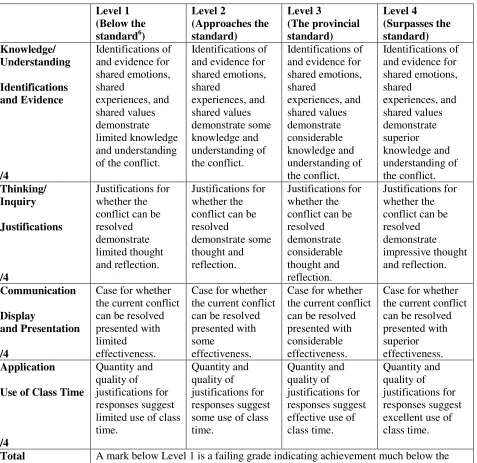
Figure 2: Sample Socio-Political Problem Presentation Assessment Rubric………….... 62
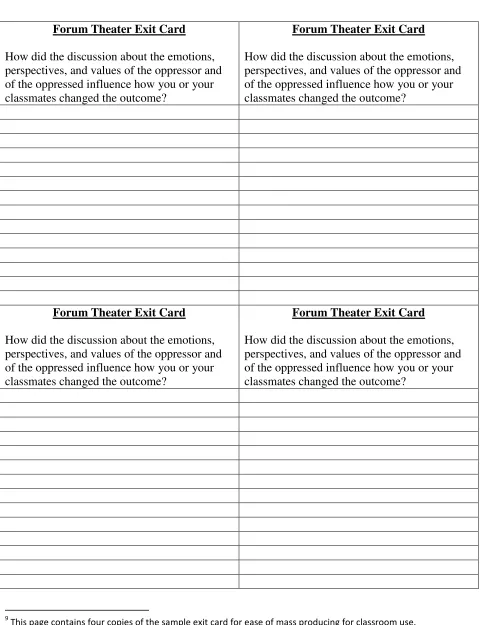
Figure 3: Sample Exit Card………... 75
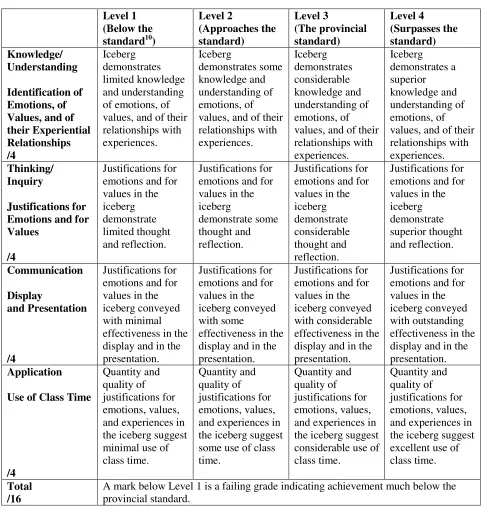
Figure 4: Sample Iceberg Rubric………... 83
Figure 5: Sample Iceberg Questions……….. 84
Chapter 1: Introduction
Rationale
Across communities throughout the world there have been increasing calls for empathy
(Krznaric, 2014; Anderson & Konrath, 2011; Coplan, 2011; Zaki, 2010). From war zones to
intimate domestic relationships, the justifications for teaching and for learning empathy continue
to increase and consolidate (Freedman, 2013). Empathy has growing recognition as a feature of
prosocial behavior (Hoffman, 2000; Eisenberg & Strayer, 1987). It is also sometimes associated
with living a good life (Trout, 2009). As a result, educating for empathy has become an
increasing impetus in educational programming.
Unfortunately, few theories link teaching and learning methods to the development of
empathy. Furthermore, the existing theories tend to generalize about influences on empathic
capacities (Coplan, 2011). Theories aside, there are some comprehensive practical approaches
available which are designed to foster empathic capabilities in students. However, few studies
assess the effectiveness of such approaches and whether or not they actually affect as intended,
and even fewer studies assess the degree to which they affect.
Moreover, there is little written about how to influence secondary school students’
empathy as well as only small attempts to document the consequences of using such instructional
methods. In all, the Ontario secondary school curricula dedicate limited space to the fostering of
empathic capacity and few resources for teachers to that end.
Therefore, given that there is a known void in the research of practical classroom
approaches for the fostering of empathic capacities among secondary school students, this thesis
will develop a hypothesis that will attempt to link a set of pedagogical approaches to teaching to
hypothesis will serve as the basis for three comprehensive educational models that can be used
when teaching Ontario secondary school curricula.1
The Research Problem
There is still much debate as to whether one can teach empathy and, if so, which elements
of empathy can be taught (Goldman, 2011). Hence, the discourse regarding teaching for
empathy, particularly in public school classrooms, has just begun. There are many educational
programs that teach empathy indirectly or as a secondary goal (Collins, 2007). However,
currently there are few curricula dedicated specifically to educating for empathy such as Mary
Gordon’s (2005) Roots of Empathy program, which originated in Canada. Notably, Gordon’s
program targets students in only grades 1 to 8.
In addition, few studies attempt to address or to measure the full consequences of
fostering students’ empathy. Many educators assume that nurturing empathy can have only
positive outcomes for students; rarely do researchers problematize the practical consequences of
greater empathic capacity. This study will attempt to analyze some of the possible outcomes of
teaching for empathy as well as to offer a possible method of balancing these potential
consequences of increased empathy with humanization.
Therefore, this study’s research problem consists of determining which, if any, elements
of empathy can be taught; which educational approaches influence said elements of empathy;
which approaches also consider and balance the potential consequences of increased empathic
capacity; and finally, whether changes in empathic capacity can be evaluated or measured and, if
so, how. Ultimately, the consequences of influencing secondary school students’ empathy
1
through classroom practices remain largely unknown and should be investigated so that students
and society might benefit by engaging in these forms of teaching and learning.
Research Questions and Hypotheses
Given the potential benefits of fostering empathy and the need for discussion about how
one might teach and learn it, this thesis will attempt to develop educational models for various
classroom contexts both to contribute to the discourse and to serve as resources for secondary
school teachers. These models will be designed to cultivate two constructs of empathy,
emotional literacy and role-taking, that will become elements of a construct of humanization.
Also, in order to foster the former constructs, these models will be founded on a dialogic inquiry
of values. In sum, this thesis attempts to establish a hypothesis that will become the basis of
three models which can be tested to demonstrate the utility of the hypothesis. The questions that
will shape this thesis, its hypothesis, and the models developed within include:
1) What elements of empathy can be taught? The researcher expects that emotional literacy
and role-taking can be learned in classroom environments.
2) What curricular models can be used to teach educable elements of empathy in secondary
school classrooms? The researcher expects that models founded upon values dialogue
can foster emotional literacy and role-taking.
3) What ethic(s) can be taught and/or learned through discussions of values? The researcher
expects that the acknowledgement of the humanity in others can be evoked through
Structure of Thesis
This thesis will be divided into five chapters including this introduction. Chapter 2 will
develop unified definitions of values and of an effective dialogue. It will then establish a
definition of a theory of values discourse as well as a definition of a values dialogue praxis. This
chapter will culminate in an exploration of the potential significance of values dialogue which
will be followed by an assessment of the limitations of this thesis’s hypothesis.
Next, Chapter 3 will explore conceptions of empathy and of humanization. Through a
synthesis of conceptions, this chapter will establish educable constructs of empathy. Then this
chapter will investigate the potential consequences of educating for empathy exclusively. The
assessment of the former consequences will culminate in a justification for fostering empathic
capacities as a part of the nurturing of humanization. Next, this chapter will adopt Paulo Freire’s
conception of humanization for the development of a measurable construct. At this point, this
author will introduce mutualities as a method of measuring humanization. The third chapter will
finish by attempting to link values discourse and values dialogue with empathic capacities and
humanization by providing the research and the logic supporting this study’s hypothesis.
Chapter 4 will then outline the general structure and function of the models. This chapter
will also problematize the measurability of the models’ affects. Next, it will describe approaches
to measuring the constructs that utilize the models’ assessments. This chapter will then provide
an introduction to the models within which this author will acknowledge the scholars and the
research that informed the models’ development, as well as the models’ targeted empathic and
humanizing constructs.
After establishing the overall structure and function of the models, their measurability,
models’ learning objectives, required or suggested materials for their execution, and detailed
descriptions of their methods. Then each model will contrast the actual and potential costs and
benefits of its performance and describe means of assessing student comprehension in addition to
the presence of empathic and of humanizing constructs.
Finally, Chapter 5 will reflect on and conclude this thesis. As a part of the reflection, this
chapter will explore the potential consequences and utility of fostering empathy and
humanization through values dialogue. After reflecting on the potential ramifications of this
thesis’s hypothesis, the final chapter will conclude this study by highlighting the merit of testing
the models.
In sum, this thesis will develop a theory and praxis of values dialogue. Then it will
synthesize educable empathic and humanizing constructs. After establishing the constructs, this
author will connect values dialogue to the constructs’ development. Next, he will identify the
structure and the function of the models and problematize measuring the empathic and
humanizing capacities. The following sections will then illustrate the models. Finally, this
author will reflect on the potential utility of the thesis’s praxis and conclude. In sum, this study
will develop a hypothesis consisting of a theory and praxis of values dialogue, of educable
constructs of empathy and of humanization, and of testable educational models that utilize values
Chapter 2: Toward more Affective Dialogic Inquiries
Defining Values
The hypothesis posited in this thesis suggests that values dialogue influences the
development of empathic and humanizing capacities. In order to consider the overall meaning of
the hypothesis, this chapter will analyze its composite parts, values and dialogue. Values, the
foci of the dialogue described in the hypothesis, will be defined first.
The values depicted in this thesis’s hypothesis are those that Immanuel Kant alludes to
including those of a priori biopsychological and of a posteriori epistemological origins (Kant,
trans. 1900). A value has a biopsychological origin when it exists before and after experience
and reason. For example, these innate values include human instincts such as survival.
Meanwhile, a value is epistemological in origin when it is subject to “episteme” (i.e., to
knowledge). As subject to knowledge, epistemological values depend on the experiences and
reason that influence the development of knowledge. While biopsychological values are innate
and change little, epistemological values are derived from experience and reflection and can
change more often (ibid.). These experience- and reflection-based epistemic values often consist
of those entities that are of the highest importance in individuals’ lives such as happiness, a high
Conceptions of Values
Generalized ideas of ends and values undoubtedly exist. They exist not only as
expressions of habit and uncritical and probably invalid ideas but also in the same ways
as valid general ideas arise in any subject. Similar situations recur; desires and interests
are carried over from one situation to another and progressively consolidated.
(J. Dewey, 1939: 44)
Many scholars understand and conceptualize values in varying ways. This thesis’s
hypothesis attempts to consolidate and to synthesize some notable and philosophically
significant conceptions of value and of valuation including those of Plato, Socrates, Ernest Joós,
Tasos Kazepides, Friedrich Nietzsche, and of John Dewey.
Plato (trans. 1955) conceives of epistemological values as Forms. According to him, the
absolute values of his world are unchanging objects that can be defined with certainty through
reason. Moreover, Plato describes values as knowable and therefore as a form of knowledge. To
Plato, knowledge is absolute and certain. He distinguishes knowledge from opinion where
knowledge is eternal and unchanging while opinion is temporary and subjective. He measures
all of the Forms relative to the Good which he describes as the “Form of Forms,” establishing the
Good as the highest value by which one can evaluate all other values.
Unlike Plato, Socrates’s approach to value and to valuation is recapitulated through only
other authors’ writings. Moreover, little evidence remains of the works of Socrates’s
contemporaries from which to consolidate his conception of epistemological values. However,
what does remain demonstrates his dedication to collaborative valuation and to the critiquing of
values. After all, the Socratic dialogues (Plato, trans. 1955; Plato, ca. 427-347 B.C.) often center
their discourses begin with, or return to, attempts to identify and to define values. They perform
collaborative inquiries about issues and entities of mutual concern such as conceptions of justice
and of the Good (Plato, trans. 1955).
At most, the surviving dialogues convey a sense of Socrates’s skepticism toward existing
values, especially toward the patron Gods of Athens (ibid.). According to some of the surviving
writings of Socrates’s contemporaries, it seems that he discussed epistemological values
frequently. Notably, he was indicted for discussing entities of the highest value to himself and to
participants in his dialogues, as well as for challenging people’s conceptions of these entities of
divine value in Athenian society. In the Socratic dialogue Euthyphro, Socrates, when questioned
how it was he had corrupted the young, recalls how Meletus “says that I am a maker of gods
[emphasis added], and on the ground that I create new gods while not believing in the old gods,
he has indicted me for their sake” (Plato, ca. 427-347 B.C., p. 3). Socrates was indicted, and
ultimately executed, on the basis that he had influenced the creation of new gods, of new entities
of the highest value. Most essential to this thesis’s hypothesis is that Socrates influenced the
creation of these new values through dialogue, specifically through collaboratively critically
analyzing these entities. In this way, this thesis’s hypothesis reflects a part of the legacy of
Socrates and of Socratic dialogue, of his dedication to continuous, collaborative, fearless, yet
respectful and honest, valuations.
Echoing Plato and Socrates, Ernest Joós (1991), when commentating on Heidegger’s
conception of values, defines whatever we find valuable as Good concluding that “value and the
good are synonymous” (p. 19). But unlike Plato and Socrates, Joós also argues that we “know
also” (ibid.). Joós highlights the potential enigmatic character of entities of ultimate value but
concludes that it is important to aspire to define them regardless.
Joós questions the fundamental character of values. Throughout his writings he asks
Why are there values? What forces drive valuation? Joós offers the suggestion that the origins
of biopsychological and epistemological values are linked to the finite nature of reality. He
argues that “necessity has meaning for us only in a finite World” (p. 158). Therefore, Joós
implies that we judge the worth of entities or acts relative to their scarcity. Joós demonstrates
that values may remain undefinable but that they have origins that can be described and
understood.
Like Joós, Tasos Kazepides also attempts to identify and to dissect values. Kazepides
(2010) highlights the significance of “riverbed principles” and of moral principles more broadly
as the epistemologically prior criteria, principles, rules and norms that support our perspectives.
For him, riverbed principles are acquired or inherited without any reflection. According to
Kazepides, although they cannot be acquired, these foundational propositions can and must be
taught for students to engage in “sophisticated” forms of education. Moreover, he argues that
“we are born into them” (p. 83). As innate a prioricontingencies, these propositions serve as
criteria for the rationality of moral principles. For this thesis’s hypothesis, Kazepides provides
an acknowledgement of grounding principles that must be brought into focus if we are to
understand and to critique the rationality of our moralities and of their underlying values.
Along with Kazepides, Friedrich Nietzsche also challenges and critiques the values of the
highest importance in his society, specifically those of Christian dogmata. In Beyond Good and
Evil, Nietzsche (1973) attempts to establish the subjection of moralities to individuals by
good and evil and [to] no longer [be], like Buddha and Schopenhauer, under the spell and
illusion of morality” (p. 82). Although he attributes some values to racial origins, he
acknowledges that the epistemic values that influence our well-being and suffering, such as “the
concepts of ‘God’ and ‘sin,’ will one day seem to us of no more importance than a child’s toy
and child’s troubles seem to an old man” (ibid.). He often denigrates Christian moralities; at one
point he describes them as nothing more than the “sign-language of the emotions” (p. 110). In
concluding his attempts to discredit traditional Christian values, he alludes to the development of
new morals by suggesting that just as people valuate Christianity, people will continue to valuate
ad infinitum.
Ultimately, Nietzsche (2002) calls for the “transvaluation of all values” (p. 101). He
argues that society needs
spirits strong and original enough to make a start on antithetical evaluations and to
revalue and reverse “eternal values”; towards heralds and forerunners, towards men of
the future who in the present knot together the constraint which compels the will of
millennia on to new paths. (1973, p. 126)
In other words, Nietzsche stresses that new philosophers need to “traverse the whole
range of human values and value-feelings” in order to “create values” (p. 142). In some ways,
this thesis’s hypothesis is an attempt to evaluate existing and potential values through a process
that can contribute to the realization of Nietzsche’s transvaluation. This process consists of a
collaborative reflection on and an evaluation of values in which participants refine and
potentially create new values. Just as this hypothesis attributes some of its legacy to Socrates, it
also presents a practical methodology by which to operationalize and to actualize Nietzsche’s
Following Nietzsche, John Dewey also explores values but was among the first to
analyze them systematically. Dewey’s (1939) Theory of Valuation attempts to provide a
comprehensive explanation of how values influence interests, desires, and actions. While
exploring the process of valuation, he argues that valuation and the practical realization of
interests and desires can be measured by observable behavior only. He maintains that
“valuations exist in fact and are capable of empirical observation so that propositions about them
are empirically verifiable” (p. 58). As observable patterns of behavior, Dewey claims that they
can be studied empirically. Furthermore, values are verifiable but to the degree that they can be
determined only upon reflection of past valuation and of past actions influenced by interests and
desires. He demonstrates how values can influence and be influenced by action. Through his
exploration, Dewey establishes how desires, interests, and the values that shape them are
influenced by external “environing conditions” (p. 63). Considering external and environing
conditions and, more broadly, all other possible stimuli that can influence value and valuation is
a characteristic of an effective analysis, or revaluation, of values. In the process of valuation
through a dialogue about values, participants can reflect on previous interests, desires, and
actions and collaboratively explore how their values influenced these affects. From Dewey, a
values dialogue will consider external and environing conditions and how they shape particular
epistemological values, as well as how epistemic values together with innate values influence
interests, desires, and ultimately, actions.
Unified Definition of Values
Considering the contributions of Plato, Socrates, Joós, Kazepides, Nietzsche, and Dewey
conceptions and distill them into one unified definition for this thesis’s hypothesis. From Plato,
one witnesses the notions of the highest Good and of the idea that the highest value can be
known through reason. From Socrates, one identifies some of the potential processes by which
people can deliberate about entities of the highest value and by which they can aspire through
these processes to identify and to understand innate and epistemic values. From Joós, one is
encouraged to approach conceptualizations of value and of valuation with a healthy degree of
skepticism and with a generous degree of suspended judgment. Joós demonstrated that one can
unify values as a category of entities by recognizing the scarcity of the objects and of the
subjects that affect and are affected by them. From Kazepides, one could identify values as those
entities that one takes for granted which undergird everything else one knows and believes, one’s
“riverbed principles.” From Nietzsche, one witnesses the challenging of these principles and of
traditional forms of valuation. He attempts to incite the spirit of a discourse of values by
glorifying those who participate in it and by calling for the transvaluation of values; that is, for a
critical revaluation both of values and of the processes by which people valuate. Finally, from
Dewey one begins to acknowledge the linkages among values, desires, interests, and actions.
These linkages are central to a dialogue designed to foster understanding of the origins of values
and to facilitate the execution of valuation. They also serve as the foci of a dialogue about
values, a discourse concerned with the valuing and valuation of entities of the highest and of the
deepest meaning.
Therefore, the values and valuation depicted in this thesis’s hypothesis refer to the
existence and to the development of the deepest meanings each individual fosters and maintains;
that is, of the strongest and most important meanings to each individual. The previous
valuations throughout his/her life. Based on these valuations, the entities of the highest
importance consolidate in and culminate as values that influence every interest, desire, decision,
and action an individual undertakes. Ultimately, this thesis hypothesizes that a collaborative
critical analysis of epistemological and of biopsychological values and of the processes of
valuation can influence the existence and development of value and, in doing so, influence
certain empathic capacities and humanization.
Defining Dialogue
The dialogic orientation of discourse is a phenomenon that is, of course, a
property of any discourse. It is the natural orientation of any living discourse.
(M. Bahktin, 1981: 279)
As with values, one often struggles with defining dialogue. Some participants within the
discourse suggest that an effective dialogue is entered into with suspended judgment and so
scholars of dialogue often approach defining their field in like manner (Wilson, 2012). Many
who attempt to define it suggest that there is no one definition of dialogue. For example,
Geoffrey Rockwell (2003) skeptically and hesitantly concludes that “a dialogue is a unity of
diverse voices” (p. 24). Before settling with his overtly vague definition, Rockwell questioned
why anyone would bother to define dialogue at all as definitions tend to limit discourse. He
admired another connotation of the word “define” which is “to bring something into focus”
(ibid.). This section will attempt to do just that: It will explore some conceptions of dialogue in
order to bring a unified definition into focus. This author will examine several conceptions of
discourse and of dialogue in order to generate a unified definition of dialogue, including those of
Conceptions of Dialogue
Before conceiving of dialogue, it is important to begin by developing a theoretical
conception of discourse in its broadest sense. This thesis’s hypothesis adopts Michel Foucault’s
(1969) Theory of Discourse for this purpose. When exploring the discourse of history in its
many manifestations in The Archaeology of Knowledge, Foucault stresses the absence of
attention for ruptures and for discontinuities and, moreover, of the pattern of inconsistency in the
object of historical discourse, the past. He identifies that “the use of concepts of discontinuity,
rupture, threshold, limit, series, and transformation present all historical analysis not only with
questions of procedure, but with theoretical problems” (p. 21). He stresses that the totality of the
discourse of history is incomplete without at least acknowledging the discontinuities. Foucault
analyzes statements and their formations, as well as their actual and potential relationships in
discourse. Most importantly, in his conception of dialogue, Foucault argues that subjects
exercise enunciative modalities in which each subject inhabits various statuses, sites, and
positions when participating in the dialogue. Here, Foucault establishes not only the transitory
nature of discourse, but also the transitory nature of its participants; their nature as participants is
in flux. From Foucault, this thesis’s hypothesis acknowledges the macro level of discourse
wherein dialogue consists of a micro form of joint meaning-making through language. Although
dialogue itself exists in a state of transition, it does not share the degree of discontinuity and of
rupture of discourse.
Therefore, the models developed in this thesis are founded on a practical manifestation of
discourse. Although this author is biased toward beginning the discussion of conceptions of
dialogue with the Socratic, it serves the purpose of this thesis to begin with the Father of
Mikhail Bakhtin (1981) is best known for his works of literary criticism, but he is also
known as being among the first to describe dialogic relationships, especially in his exploration
and in his glorification of the Socratic dialogues. He characterizes these dialogues as being
among the first examples of the novelistic genre: examples of “dialogized story.” Through his
analysis of the Socratic dialogues, Bakhtin identifies the significance of the rhetoric and of the
diverse characterizations of the dialogues’ participants, especially their varying roles from heroes
to those wearing “the mask of a bewildered fool” (p. 24). From Bakhtin’s characterizations of
participants in dialogue, one can acknowledge the various actual and potential roles that
participants enact, abandon, and transform throughout a dialogue.
Bakhtin’s conception of dialogue is arguably a byproduct of his exploration of the
development of the novel. In his four essays that compose the Dialogic Imagination, Bakhtin
did not set out to establish a comprehensive theory of dialogue but rather to explore and to
understand the relationships between works of literature and how the novelistic genre emerged
from their discursion. His conception of dialogue is derived from his descriptions of the
call-and-response between literary works. He emphasizes that “the novelistic word arose and
developed not as the result of a narrowly literary struggle among tendencies, styles, abstract
world views – but rather in a complex and centuries-long struggle of cultures and languages”
(1981, p. 83). Bakhtin describes the novelistic form as a dialogue in and of itself. Accordingly,
a novel consists of a “diversity of social speech types” as well as a “diversity of individual
voices” (p. 262). He consolidates these diversities into what he describes as a “multiplicity of
social voices” (p. 263) consisting of dialogized links and interrelationships among
meaning-makers. From Bakhtin’s analysis of literary discursive relationships, this thesis’s definition of
In addition to outlining a structure of dialogue, Bakhtin also identifies some of the power
relationships within dialogues through an examination of the consolidation of dialects and
European languages. He argued that
the victory of one reigning language (dialect) over the others, the supplanting of
languages, their enslavement, the process of illuminating them with the True Word, the
incorporation of barbarians and lower social strata into a unitary language of culture and
truth, the canonization of ideological systems, philology with its methods of studying and
teaching dead languages, languages that were by that very fact “unities,” Indo-European
linguistics with its focus of attention, directed away from language plurality to a single
proto-language — all this determined the content and power of the category of “unitary
language” in linguistic and stylistic thought, and determined its creative, style-shaping
role in the majority of the poetic genres that coalesced in the channel formed by those
same centripetal forces of verbal-ideological life. (ibid., p. 271)
Here Bakhtin explores the process of the canonization of languages and the development
of dialectic hegemonies. He describes the development of a single language amid the utterances,
as well as a single national language amid social languages, and finally a unifying culture that
shares the same “socio-ideological cultural horizons” (p. 299). From his critique of the
subduction of languages, this thesis’s conception of dialogue acknowledges the sociocultural and
linguistic power dynamics existent in dialogue.
Bakhtin also highlights the significance of rhetoric and artistic license in dialogue, as
within discourse there are opportunities for individualistic artistic expression (p. 277).
Ironically, Bakhtin’s commentary on the rhetorical and on the distinctly human components of
like Paulo Freire (2000) and Michel Foucault (1969). Here Bakhtin contributes to the ongoing
dialogue about discourse by highlighting the reality that these discourses are enacted by human
beings with varying personalities, interpretive lenses, and capacities of expression.
In addition, Bakhtin (1981) attempts to establish the primacy of the word in dialogue. He
argues that its internal meaning, or what he refers to as the “internal dialogism of the word”,
penetrates the entire structure of dialogue (p. 282). He argues that these individual words cannot
be isolated as independent acts separate from a word’s ability to form a concept of its object.
This internal dialogism finds expression through semantics, syntax, and style. Bringing the
discourse back to the word, Bakhtin identifies it as the symbolic foundation of dialogue, as vital
to the fabrication of joint meaning.
Finally, an important consideration for this thesis’s approach to dialogue, Bakhtin
highlights the importance of a dialogue’s language’s “proximity […] to popular spoken
language” (p. 25). As a form a communication, a language’s capacity to communicate meaning
depends on the receptive capacity of those attempting to communicate. Therefore, as Bakhtin
acknowledges, it is important that the language expressed in dialogue is reflective of the
popularized spoken language of the dialogue’s participants so that everyone can participate fully.
Similar to Bakhtin, Paulo Freire (2000) also concentrates on the importance of the word
to dialogue. However, Freire divides the word into two dimensions, reflection and action. He
argues that without action, dialogue becomes mere “verbalism,” and without reflection, it
becomes mere “activity” or activism. According to Freire, through dialogue “the united
reflection and action of the dialoguers are addressed to the world which is to be transformed and
humanized” (p. 88). Thus, in order for dialogue to create and facilitate a horizontal relationship
humility, and upon faith in humanity. He concludes that if a dialogue is conducted as he depicts,
it will foster trust. From Freire, this thesis’s hypothesis eschews the supposed neutrality of
verbalism or of pure activity in favor of a conception of dialogic inquiry established to foster
transformation and humanization through the dialogic critical analysis of values and of valuation.
Finally, Freire (2000) determines that only dialogue is capable of generating critical
thinking. Therefore, in order to conduct a critical analysis of valuation and of values, the
investigation must be conducted dialogically. Here, Freire provides the justification for the
dialogic approach to analyzing epistemic and innate values as well as the processes of valuation.
In sum, dialogue, as interpreted in this thesis, consists of symbol-mediated
meaning-making, what some Vygotskians refer to as semiotic mediation. To help bring a unified
definition of dialogue into focus, this thesis employs Gordon Wells’s interpretation of dialogue.
This author’s unified definition of semiotic mediation through language will be grounded in
Wells’s (1999) theory of language-based learning espoused in Dialogic Inquiry. Wells offers a
theory of dialogic learning based on a fusion of the perspectives of Lev Vygotsky and of M. A.
K. Halliday. Wells argues that a comprehensive language-based theory of learning should
explain how a language is learned and how a language facilitates the learning and teaching of
cultural knowledge. In addition, such a theory should acknowledge that the understanding of
language and of cultural artifacts arises from collaborative practical and intellectual activities.
Wells concludes that a language-based theory of learning “should explain how change occurs
through the individual’s linguistically mediated internalization and subsequent externalizations
of the goals and processes of action and interaction in the course of these activities” (p. 48).
discourse of dialogue and so provides a substantial representation of their perspectives in his
theory.
In addition, Wells (2009) emphasizes the space for reflective thinking in dialogue. As
Wells argues, “language provides a means not only for acting in the world but also for reflecting
on that action in an attempt to understand it” (p. 72). He demonstrates the reflective potential of
dialogue. Dialogue provides a space for what Wells describes as “inner speech” in which
students “come to be able to frame questions and interrogate their own experience in the search
for an answer” (ibid.). Through this process, “language becomes a tool for thinking” (ibid.).
Therefore, dialogue serves as a vehicle for both reflection and meta-cognition. In conclusion,
Wells’s conception of dialogic inquiry will serve as the bedrock for this thesis’s unified
definition of dialogue and for its dependent concept values dialogue.
Unified Definition of Dialogue
Dialogue is ever in the process of becoming. Any definition of dialogue is
understandably tentative and contingent. For the purposes of this thesis’s hypothesis, drawing
from the existing discourse on dialogue, the fundamental unit of a dialogue is the symbolized
meaning, most often the word. This unit draws its existence from its relationship with other
symbols. Through micro-fusions of meaning, participants in dialogue create and recreate macro
enunciations. These enunciations are expressed by participants in diverse ways along diverse
channels. Based on Paulo Freire’s (2000) reflections, this thesis hypothesizes that participants
can foster their humanity through dialogue with each other and that participants ultimately can
through active intersectionalities of meaning and through methods of meaning-making, people
can more clearly witness themselves and their worlds.
Toward a Theoretical Definition of Values Dialogue
Taken together, a “values dialogue” is a dialogue about values and valuation. It is an
investigation into the entities of the highest importance and of how they became important
through dialogic inquiry. It is concerned with the potential discovery, identification,
classification, development of understanding, critique, and potential revision of the participants’
deepest and ultimate meanings. Through the fostering of mutual awareness of humanistic
symmetries, a values dialogue contributes to the development of the humanity of participants.
Furthermore, as will be demonstrated, such dialogues may also foster empathic capacities as
components of humanization among their participants.
Rationale for Values Dialogue
The goal of this chapter is to establish more affective dialogic inquiries. Therefore, in
many ways, in conceptualizing value and dialogue, this chapter has attempted to contribute to the
discourse of dialogue by first attempting to understand and perhaps to build on the work of
previous contributors. Specifically, this author attempts to expand on the work of Gordon Wells
and that of his colleagues involved in the research in dialogic inquiry. When Wells and his team
launched the Developing Inquiring Communities in Education Project (DICEP) in 1991, they
sought to create opportunities in the classroom for inquiry-based learning through action research
(2001). In conceptualizing values dialogue, this author aspires to continue the work of DICEP
abilities to role-take and to encode and to decode emotions within the process of becoming more
fully human. This thesis offers nothing more than a brief outline of examples of a kind of
dialogic inquiry that focuses on the most important meanings to its participants. This author
pursues this hypothesis because of its potential utility not only to foster better understandings of
human intentionality and of human behavior, but also to increase measurably the empathic
capacities and the humanization of secondary school students.
Potential Significance of Values Dialogue
It is the duty of these scholars to take everything that has hitherto happened and been
valued, and make it clear, distinct, intelligible and manageable, to abbreviate everything
long, even ‘time’ itself, and to subdue the entire past: a tremendous and wonderful task in
the service of which every subtle pride, every tenacious will can certainly find
satisfaction.
(F. Nietzsche, 1973: 142)
Therefore, as Nietzsche obliges, the significance of the potential theoretical and practical
utility of values dialogue is worth exploration. The body of philosophic literature that grounds
this thesis’s hypothesized dialogic inquiry of values and of valuation supports a collaborative
method of investigating values. Although the linkages among empathic and humanistic
capacities and values dialogue have yet to be attempted in this study, their logical consistency
warrant examination.
Logically, if everyone values, and if these values are established through similar
processes, and further, if their existence and relationships with one another and with action can
dialogue. Furthermore, if the establishment of the existence of values and of their relationships
to experience and to action through dialogue fosters empathic and humanistic capacities, then
values dialogue potentially has educational utility for fostering the empathy and the fuller
humanity of students.
Current Limitations of Hypothesis
It must be acknowledged at the close of this chapter that this thesis merely presents a
hypothesis that must be tested if it is to promise any actual utility. This author does not pretend
to know without any empirical evidence whether values dialogue will foster empathic capacity
and humanization, or anything at all. However, based on the existing research and logical
induction and deduction, this thesis will attempt to establish a sensible outline and testable
examples of a kind of dialogic inquiry that can possibly, even plausibly, influence students’
empathy and humanization. This thesis is the beginning of the potential realization of a dream
of some of the greatest philosophers of all time, but it will stay a dream until its hypothesis is
Chapter 3: Toward Fostering Empathy and Humanization
The Purpose of this Chapter
This chapter attempts to bridge the philosophy and the theory involved in the
development of values dialogue to the scaffolding of the models. First, it will explore
conceptions of empathy in order to develop measurable constructs that will serve as targeted
learning outcomes of the models and that act as metrics for assessing the effectiveness of the
models at fostering certain empathic capacities among students. After definitions are
established, the following section will briefly address the consequences of teaching and of
learning the capacities selected. This section will culminate in a justification for fostering
humanization alongside empathy. Next, the chapter will examine Paulo Freire’s conception of
humanization in order to develop a construct. At this point, a method of measuring
humanization will be developed based on Freire’s understanding of humanization and on the
conceptions of value, of valuation, and of empathy as previously discussed. After establishing a
measurable construct of humanization, the subsequent section will attempt to make the case for
values dialogue and for how it can influence each of the synthesized empathic and humanistic
capacities. Finally, the last section will connect the theory to praxis for the purpose of the
succeeding chapter which will endeavor to contribute something practical: that is, to provide
comprehensive, useful, and testable educational resources for secondary school teachers and for
Conceptions of Empathy
Moral imagination is the capacity to empathize with others, i.e., not just to feel for
oneself, but to feel with and for others. This is something that education ought to
cultivate and that citizens ought to bring to politics.
(T. McCollough, 1992: 7)
This section will explore several conceptions of empathy including the contributions of
Theodore Lipps, Janet Strayer, Mary Gordon, Martin Hoffman, and of Amy Coplan. Each
author represents a different school of thought that conceives of and measures empathy in a
different way. After establishing their conceptions of empathy, the following section will limit
the models’ targeted empathic capacities to those that the models can influence most effectively
given the typical conditions of secondary school classrooms and of teaching routines.
Before conceiving of different kinds of empathy, many authors first disambiguate
empathy from sympathy. Many empathy researchers emphasize this distinction because
empathy and sympathy are often used interchangeably; however, they often depict substantially
different affective and cognitive processes. Theodore Lipps (1907), a progenitor of the concept
of empathy, Einfühlung, defines it as“feeling into” someone else’s being. He contrasts
Einfühlung with Mitfühlung, the latter of which he describes as “feeling with” someone else. The
act of feeling with someone else, of sharing the same affective emotion, often characterizes
definitions of sympathy. When exercising sympathy, an observer often becomes entangled in the
emotions of the one emoting. For this reason, some empathy researchers suggest that doctors
should exercise empathy more often than sympathy with their patients (Lussier & Richard,
Lipps (1907) attributes a person’s shared feeling to an affective response which includes
conscious and unconscious motor mimicry. He maintains that this kind of response originates
from afferent feedback rather than from a person’s cognition in which he/she thinks oneself into
another person’s situation.2 Lipps contributes to the establishment of the two broad categories of
processes involved in empathy, affective responses and cognitive role-taking. The former
empathic affects are attributed to a priori biopsychological origin, while he attributes the latter
empathic cognitions to a posteriori previous experience.
Building on the distinctions of scholars of empathy such as Lipps, Janet Strayer (1987)
further compartmentalizes uncontrollable empathic responses. For example, she demonstrates
the existence of innate functions such as “emotional contagion.” Emotional contagion describes
processes like that of newborns’ crying as a reaction to other newborns’ crying through processes
of motor mimicry (p. 230). Strayer attributes empathy partially to evolutionary survival
mechanisms because of its connection with the perception of danger and with the communication
of states of group members. In addition, Strayer cites many researchers of empathy who have
determined that empathy increases with age. Therefore, for the purpose of this thesis’s
hypothesis, of educating for empathy, one must separate developable from innate,
uncontrollable, empathic capacities, as only those capacities that can be influenced by experience
can be educated.
Extrapolating from the work of researchers such as Lipps, Strayer (ibid.) differentiates
cognitive empathic capacities from affective responses. Strayer argues that empathy has a
“singular definition: the self’s feeling into (Einfühlung) the affect of another person” (p. 236).
From her definition, Strayer identifies and emphasizes some of the cognitive aspects of empathy
2
including what she refers to as “vicariously experienced emotion” (p. 218). Accounting for both
affective and cognitive processes, she describes this approach to empathy as a “multidimensional
perspective” (p. 235).
Strayer (ibid.) elaborates on cognitive elements of empathy establishing a criterion for
role-taking. She argues that in order to experience and to engage in empathy, one must
recognize a “rudimentary self-other differentiation” (p. 227). This recognition includes an
acknowledgement of living beings as discrete subjects. Therefore, empathy requires a self-other
merging of affective emotional response as well as an awareness of self-other differentiation.
Notably, Strayer’s self-other differentiation distinguishes empathy from sympathy.
Along with a self-other divergence, Strayer (ibid.) identifies the recognition of emotions
as the second cognitive prerequisite for empathy. She describes emotion recognition as
dependent on analytic skills involved in the decoding of nonverbal cues and of emotions within
situational and verbal content (p. 221).
Another advocate of emotion recognition, Mary Gordon (2005), the founder of the Roots
of Empathy program, also emphasizes the importance of the ability to decode someone’s
emotions to one’s empathic capacity. She describes empathy as the ability to identify with, and
to respond appropriately to, the feelings and perspectives of others. Gordon highlights the value
of empathy and of the “profound, complex, and fundamental role it plays in the healthy
functioning of human relations” (p. 30). She maintains that people often realize the true value of
empathy only in hindsight when it is absent.
Gordon identifies the capacities to read and to understand emotions as components in
what she describes as “emotional literacy” (ibid., p. 37). She describes the development of
in young children by having them interact with babies. According to Gordon, Roots of Empathy
gives
all the children the words to describe their feelings. Focusing on the core emotions, we
ask them to tell us about times when they felt sad, scared, angry or happy. Listening to
the other children and sharing their own story enlarges their vocabulary and sparks
recognition that is an essential part of emotional intelligence. (ibid.)
She argues that empathy includes emotional literacy and that empathic capacity can
therefore be nurtured using similar teaching methods as those that foster other encoding and
decoding processes. As she demonstrates, treating empathy as a literacy of the emotions
presupposes the learning and teaching of expressive language and of recognition of emotional
cues (ibid.).
Furthermore, Gordon (2005) conceptualizes empathy as a set of capacities that can
transcend race, culture, nationality, social class, and age. She demonstrates the potential
universal presence of empathy by citing researchers who used photographs of human faces and
found that “without hesitation, the people can point out which photo shows someone who is
afraid, someone who is happy, someone who is worried, someone who is sad” (p. 32). Based on
this research, Gordon argues that “our feelings, and our expression of them, are universal”
(ibid.). Therefore, she contributes to the credibility of the notion that empathy can be fostered
among students.
Moreover, Gordon identifies empathy as a kind of understanding about our feelings,
connections, and belonging. She argues that “understanding how other people feel is the first
step to building caring relationships in the classroom, in the community, and in the world at
Also conceiving of empathy as a kind of understanding, Martin Hoffman (2000) defines
empathy as “the cognitive awareness of another person’s internal states, that is, his thoughts,
feelings, perceptions, and intentions” (p. 29). Like Strayer, Hoffman suggests that empathy
consists of a duality by arguing that, besides cognition, empathy also includes “the vicarious
affective response to another person” (ibid.). He further defines this affective response as “the
involvement of psychological processes that make a person have feelings that are more
congruent with another’s situation than with his own situation” (p. 30).
Hoffman distinguishes among three “primitive, automatic, and, most important,
involuntary” (p. 36) forms of empathy and two forms based on experience and agency. The
latter two forms are educable; they include mediated association and role-taking. In mediated
association, “a victim’s emotionally distressed state is communicated through language” (p. 49).
Similar to Gordon, Hoffman justifies the need for emotional literacy by arguing that in order for
people to approximate the meaning of other people’s feelings, both parties must be able to
encode and to decode emotion. Through words and body language alone, the observer must
“reverse the sequence, going from the general category of feeling represented by the word to his
own specific feeling and the associated past events in which he had that feeling” (p. 50).
Hoffman argues that “there is always some slippage due to encoding and decoding ‘errors’”
(ibid.) when using linguistic expression and therefore that the meaning of a feeling is never
transferred in its entirety. Therefore, Hoffman identifies mediated association as a form of
empathic cognition.
Along with mediated association, Hoffman synthesizes Strayer’s approach to cognitive
role-taking defining it as “an advanced level of cognitive processing: putting oneself in the
role-taking, self-focused and other-focused. In self-focused role-taking, a person uses past
experiences of similar circumstances to imagine how another would feel. Meanwhile, in
other-focused role-taking, “people focus directly on the victim and imagine how he feels” (p. 54). 3 As
a result of other-focused role-taking, the observer may have feelings similar to the victim’s.
Hoffman suggests that the latter form of role-taking may be enhanced if the observer has more
personal information regarding the victim, including understandings of “his character,
life-condition, [and] behavior in similar situations” (ibid.). Furthermore, he argues that a cognitive
empathic response can be improved if the observer has additional normative knowledge of how
most people would feel in the same circumstance. Therefore, programs dedicated to educating
for empathy can foster more effective role-taking capacities if they explore normative emotional
responses to normative stimuli.
Similar to Strayer, Hoffman (2000) suggests that people have a greater empathic arousal
when they exercise self-focused role-taking, which he attributes to “egoistic drift.” He argues
that a more powerful form of empathic arousal lay in a combination of both self-focused and
other-focused role-taking. This combination is more powerful than either of these role-taking
approaches alone because this form “combines the emotional intensity of self-focused
role-taking with the more sustained attention to the victim of other-focused role-role-taking” (p. 58).
Therefore, combining explorations of affective responses and of social-situational conditions
may have a greater influence on future empathic arousal than the mutually-exclusive
explorations of each.
Hoffman concludes his discussion of categories of role-taking by arguing that it can be
more cognitively demanding than other empathic capacities because of its greater voluntary
component. However, Hoffman recognizes that the existence of multiple modes of empathic
3
arousal enable observers to respond empathically “to whatever distress cues are available” (p.
59). Therefore, a multi-modal approach to empathy instruction may have the greatest impact on
the scope of students’ empathic responses.
Contesting Hoffman’s broad definition of empathy by utilizing the findings of other
present-day empathy researchers and neuroscientists, Amy Coplan attempts to define empathy as
precisely as possible. Coplan (2011) explains empathy as “a complex imaginative process in
which an observer simulates another person’s situated psychological states while maintaining
clear self-other differentiation” (p.5).
Coplan (ibid.) conceptualizes empathy as a combination of “affective matching,
other-oriented perspective-taking, and self-other differentiation” (p. 6). She argues that each of the
former features is necessary for empathy; however, “none is sufficient on its own” (ibid.).
Affect-matching depends on feelings and on degree of physiological arousal. Coplan depicts
affect-matching as a component of empathy “only if an observer’s affective states are
qualitatively identical to a target’s, though they may vary in degree” (ibid.).
Coplan (2011) restricts her definition by limiting the affective component of empathy to
“the same type of emotion (or affect) as the target” (ibid.). Notably, her restricted definition of
affective response shifts her definition of empathy closer to a definition of sympathy than to
other scholars’ definitions of empathy. Her definition of empathy separates from sympathy
when she argues that in order for this affect to be empathic, it must be aroused through
other-oriented perspective-taking. This restriction prevents the aroused affect from resulting by
coincidence, by two people reacting to the same stimulus identically, or by afferent feedback in
Along with affective matchmaking, empathic arousal also includes perspective-taking,
which Coplan (2011) defines as “an imaginative process through which one constructs another
person’s subjective experience by simulating the experience of being in the other’s situation” (p.
9). Coplan stresses that empathy should be conceptualized so as to “exclude processes that
involve self-oriented perspective-taking” (p. 10). She describes self-oriented perspective-taking
as imagining “ourselves in the other’s circumstances,” rather than accounting for the other’s
perspective. Notably, self-oriented perspective-taking can include errors such as those “in
prediction, misattributions, and personal distress” (ibid.). Instead, Coplan argues that empathy
should be defined in terms of “other-oriented taking.” This form of
perspective-taking is oriented toward the other in which a person focuses on his/her simulation of the other’s
experiences and characteristics. In this process, “I imagine being the target undergoing the
target’s experiences rather than imagining being myself undergoing the target’s experiences” (p.
13).
Lastly, along with affective-matching and other-oriented perspective-taking, Coplan
identifies the other differentiation” as the third and final criterion for empathy. A
“self-other differentiation” consists of one keeping separate “one’s awareness of oneself and one’s
own experiences from one’s representations of the other and [of] the other’s experiences” (p. 16).
Through this orientation, one “remains aware of the fact that the other is a separate person and
that the other has his own unique thoughts, feelings, desires, and characteristics” (ibid.). She
concludes that “without [a] clear self-other differentiation, we are almost certain to fail in our
attempts to empathize” (ibid.). Therefore, based on Coplan’s arguments, fostering a self-other
To recapitulate, Theodore Lipps disambiguates empathy from sympathy. He identifies
the existence of two broad categorizations of empathy: affective responses and cognitive
role-taking. Then, Janet Strayer further compartmentalizes the two categorizations by elaborating on
various kinds of empathic cognitions and affects. She identifies self-other differentiation and
emotion recognition as the prerequisites for some forms of cognitive empathy. Next, Mary
Gordon consolidates many cognitive aspects of empathy in her construct of emotional literacy,
including emotion recognition. While exploring this construct, Gordon connects emotional
expression to emotional literacy, demonstrating how it depicts both emotion encoding and
decoding processes. In addition, she demonstrates the universal educability of emotional
literacy. Meanwhile, Martin Hoffman identifies two forms of cognitive empathy, mediated
association and role-taking, that can also be taught. Hoffman distinguishes between self-focused
and other-focused role-taking. He argues that a more powerful empathic response may be
evoked if the observer exercises role-taking from both his/her own and the observed person’s
perspectives. Finally, Amy Coplan attempts to synthesize cognitive and affective components in
her definition of empathy. Coplan characterizes empathy as a combination of affective
matching, other-oriented perspective-taking, and self-other differentiation. In conclusion, from
these various conceptions of empathy, this author will synthesize educable and measurable
constructs.
Conditions for Measuring Empathy
Given the wide range of conceptions of empathy, this author must be selective when
determining which empathic capacities to teach and, for the purposes of empirically testing the
assessed by assembling targeted constructs, by mandating them as learning objectives, and by
measuring their presence using instruments such as rubrics and guided reflection. Notably, there
are numerous physiological and neurological methods by which to measure empathy (Eisenberg
& Miller, 1987). However, not all of these measures are feasible, convenient, useful, or even
possible for classroom teachers participating in action research or for participant observers. This
author excludes most potential physiological and neurological methods of measuring empathy
such as heart rate, skin conductance, and/or fMRI because they are of limited utility in the
common classroom routine. Instead, the constructs developed in the following sections depend
on the measurement of student performances in classroom interactions through peer and teacher
review.
Before developing measurable constructs of empathy, one must consider validity.
Validity, the concept of determining whether one is actually measuring what one is intending to
measure, is an important construct and renders many suggested instruments for measuring
empathy useless. To illustrate, Janet Strayer (1987) emphasizes that conclusions regarding
empathy’s function and structure have depended largely on what researchers have chosen to
measure and on how they have measured it. Moreover, as Strayer argues,
correlations among physiological, somatic, or verbal measures of affect and cognition in
empathy may not cohere for several reasons:
1. They do not all measure empathy […];
2. They are not equally good measures of empathy across different samples […];
3. They measure separate aspects of empathy, which may not accord unless
concurrently assessed; [and]