Design Optimization of Oil Pan using Finite Element Analysis
B.SHYAMSUNDAR REDDY
*, Mr. B. VENKATA NARAYANA **
1
PG SCHOLAR, DEPEARTMENT OF MECHANICAL ENGINEERING,GANDHI ACADEMY OF TECHNICAL
EDUCATION-KODAD
2
ASSISTANT PROFESSOR, DEPEARTMENT OF MECHANICAL ENGINEERING,GANDHI ACADEMY OF
TECHNICAL EDUCATION-KODAD
Abstract
Over the past years an increasing attention has been paid to vibration and noise control in automotive engineering. The control of noise and vibration is essential in the design process of an automobile, since it contributes to the comfort, efficiency and safety. Considering trucks, the power train represents one of the main noise sources. The major contributor to the power train noise emission is the engine oil pan. The purpose of this project is to design a truck oil pan for vibration reduction using numerical simulations. In the analyses Finite Element Method (FEM) is applied to model the structural behavior of the oil pan. There are static load and dynamic load acting on a vehicle structure simultaneously.
The current work explores the effects of pre-stress forces on modal parameters of oil pan. The harmonic response analysis of stressed oil pan is one of the key objectives in this project. The harmonic response analysis of pre-stressed oil pan using ANSYS has been explored. FE simulations of the oil pan are presented, which are aimed to indentify the most dominant mode shapes within a frequency range of 0-1200 Hz. First pre-stress modal analysis is performed using block lanczo's method on the oil pan and then harmonic analysis of the pre-stressed oil pan is completed using full harmonic method. Based on the results obtained, efforts are made to optimize the design of oil pan to reduce the resonance effect caused due to vibrations. NX-CAD software is used to design the oil pan.
Keywords: vibration, FEM, ANSYS, harmonic analysis, frequency, optimize
Introduction
The Oil pan is a large metal pan mounted to the underside of the engine. It holds engine oil, to be drawn up by the oil pump via the oil pickup tube. An oil pan is a component that typically seals the bottom side of four-stroke internal combustion engines in automotive and other similar applications.
Its main purpose is to form the bottom most part of the crankcase and to contain the engine oil before and after it has been circulated through the engine. During normal engine operation, an oil pump will draw oil from the pan and circulate it through the engine, where it is used to lubricate all the various components. After the oil has passed through the engine, it is allowed to return to the oil pan.
The oil is used to lubricate the engine's moving parts and it pools in a reservoir, known as a sump, at the bottom of the engine. Use of a sump requires the engine to be mounted slightly higher to make space for it. Often though, oil in the sump can surge during hard cornering starving the oil pump. For these
reasons racing and piston aircraft engines are " dry sumped" using scavenge pumps and a swirl tank to separate oil from air which is also sucked up by the pumps.
http://internationaljournalofresearch.org/ P a g e | 1803 draw oil from the pan and circulate it through the
engine, where it is used to lubricate all the various components. After the oil has passed through the engine, it is allowed to return to the oil pan. In a wet sump system like this, the amount of oil that an engine can hold is directly related to the size of the oil pan. An engine can hold no more oil than can fit in the pan without reaching the crankshaft, since a submerged crankshaft will tend to aerate the oil, making it difficult or impossible for the oil pump to circulate it through the engine.
Oil pans are detachable mechanisms made out of thin steel and bolted to the bottom of the crankcase. To maximize its function, it is molded into a deeper section and mounted at the bottom of the crankcase to serve as an oil reservoir. The oil pan also hosts the oil pump and on the bottom of which is the oil drain plug. When an engine is at rest, the oil pan gathers the oil as it flows down from the sides of the crankcase.
The oil drain plug can be also removed to allow old oil to seep out of the car during an oil exchange. The plug is then screwed back into the drain hole after the used oil is drained out. Drain plugs are usually constructed with a magnet in it, which in turn collects metal fragments from the oil. Other varieties contain a replaceable washer to prevent leakage caused by corrosion or worn threads in the drain hole.
Compared to other automotive parts, an engine oil pan is far more likely to leak. This is because it holds oil being thrown around which eventually finds a leak if there is one. Thus, extra care should be applied when installing an automotive oil pan. Most of the times, the metal at the bolt holes in the oil pan and front cover will be pushed inward around the bolt holes. This is caused by the gasket getting smashed due to their excessive tightening. As the oil pan attempts to stop oil leaks, the gaskets are rendered useless and the oil leak will just get worse. Careful attention must also be placed on the gasket when tightening the bolts and make sure that the gaskets are not being squeezed out from under the oil pan to prevent future oil leaks.
Literature survey
Two vibration-based methods are discussed that are able to autonomously detect damage and yield updated experimental models of the structure. A first approach is based on (operational) modal analysis. A
A bidirectional interface for direct modification of
CAD Parameters by the optimization tool optiSLang was used for optimization of an oil pan [2].
CAE software is used in designing draw tools [3]. A smart car oil pan has been designed with surface-attached piezoelectric actuators for active noise and vibration reduction using numerical simulations [4]. Finite element (FE) analyses are conducted in order to determine possible high cycle fatigue (HCF) failure modes causing the cracking of a turbine spacer in a gas turbine engine [5]. Effects of prestress forces on modal parameters of concrete beams have been found [6].
Low velocity stone impact analysis was performed to obtain structure's behavior under impact load [7]. Acoustic Control (ASAC) method to reduce noise provided proof that vibration induced noise from the oil pan has the potential to be reduced significantly [8]. Complete product design of integrated breather valve cover with optimal solution of all the available techniques in every aspect of design, development and real time production of valve cover were discussed [9]. Gate valve stress analysis was done using ANSYS and validation is supported by stress analysis using classical theory of mechanics [10].
Methodology
In this project the effects of pre-stress forces on modal parameters of oil pan are considered. The harmonic response analysis of pre-stressed oil pan is carried out in this project. The harmonic response analysis of pre-stressed oil pan using ANSYS is performed. FE simulations of the oil pan are presented, which are aimed to indentify the most dominant mode shapes within a frequency range of 0-1200 Hz. First pre-stress modal analysis is performed using block lanczo's method on the oil pan and then harmonic analysis of the pre-stressed oil pan is completed using full harmonic method. NX-CAD software is used to design the oil pan and ANSYS software is used to do finite element analysis.
3D Modelling of Oil Pan
Figure:
2D Drawing Of Oil Pan
Figure:
3D model of Oil pan (isometric views)
FE Model of Oil Pan
The Oil pan model was meshed with shell 63 element type. A total number of 24029 elements and 24223 nodes were created. The meshed model is shown in the below figure.
Finite element model of the Oil pan
Static analysis is used to determine the
displacements, stresses, strains and forces in structures or components caused by loads that do not induce significant inertia and damping effects. The Objective of this analysis is to check the High stressed locations and deflections on the Oil pan for the applied loads.
Modal analysis is used to determine the vibration characteristics (natural frequencies and mode shapes) of a structure or a machine component while it is being designed. Modal analysis was carried out on the prestressed oil pan to determine the natural frequencies and mode shapes of a structure in the frequency range of 0 -1200 Hz.
Boundary conditions:
Internal pressure in an engine block recorded from lab test engine is 4Kpa around the crankcase and rest of the block. During the combustion and valve
mechanism the pressure rises exponentially.
Empirical value of pressure under the hood of valve cover i,e oil pan is recorded to 30 - 35KPa. Hence the oil pan has to with stand 35Kpa of pressure on a worst case scenario.
The bolting locations are Fixed in all dof. Internal pressure 0.035MPa is applied on Oil pan.
http://internationaljournalofresearch.org/ P a g e | 1805
Boundary conditions for static analysis
Applied pressure Loads for static analysis
Deflections:
Deflection in X-dir for static analysis
Deflection in Y-dir for static analysis
Deflection in Z-dir for static analysis
Total Deflection for static analysis
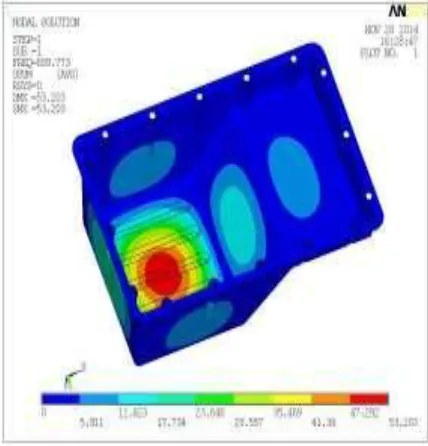
VonMises Stress 1200 Hz. The total weight of the Oil pan considered for the analysis is 5.9kg. The mode numbers and the corresponding frequency values are shown in the below table. The mode shapes for all the frequencies
are plotted below.
Table shows the Frequencies in the range of 0-
1200Hz.
MODE. NO
FREQUENCY (Hz)
1 809
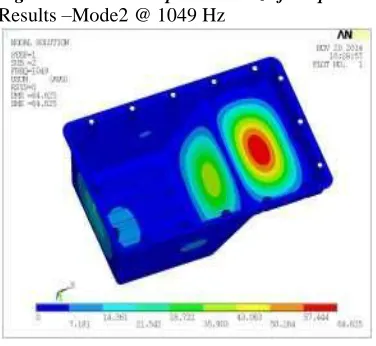
2 1049
3 1064
4 1137
The mode shapes for the above frequencies are plotted below:
Results –Mode1 @809 Hz
Von Mises stress for pre stress analysis
The Maximum Von Mises stress of oil pan observed 54MPa in pre stress analysis.
From the analysis, the maximum VonMises stress of 54 Mpa is observed on the oil pan. The maximum stress is observed on the bolting locations of the oil pan. The yield strength of the material is 414 Mpa. Summary of static analysis:
From the analysis results the maximum deflection of 0.05mm and VonMises stress of 54 Mpa is observed on the oil pan in pre stress condition. This prestressed oil pan will be used to do the modal analysis to obtain the natural frequencies and mode shapes on the prestressed oil pan.
Modal analysis
http://internationaljournalofresearch.org/ P a g e | 1807
Results –Mode2 @ 1049 Hz Mode shape 2@ 1049 Hz of Oil pan
Mode3 @1064Hz
Mode shape 3@1064Hz of Oil pan
Results –Mode4 @ 1137 Hz
Mode shape 4@ 1137 Hz of Oil pan
From the above modal analysis results of the prestressed oil pan, following observations are made: Four natural frequencies exist in the range of 0-1200 Hz.
Deflections are observed on the bottom side for a frequency of 809 Hz. Deflections are observed on the front bottom side for a frequency of 1049 Hz.
Deflections are observed on the side walls for a frequency of 1064 Hz and 1137 Hz. To check the magnitude values of deflections and stresses at the above mentioned frequencies due to the operating loads, harmonic analysis is carried out on the prestressed oil pan.
From the above harmonic analysis, the stresses and deflections at the nearest natural frequencies are recorded and tabulated below.
VON
S.no FREQUENCY(Hz)
DEFLECTIONS MISES
(mm) STRESS
(MPa)
1 900 0.4 131
2 1100 0.48 173
3 1200 0.98 392
From the above results it is observed that the stresses at the nearest natural frequencies 900Hz, 1100Hz, and 1200Hz are 131MPa, 137MPa and 392MPa respectively. The yield strength of the material used for modified oil pan is 414MPa. According to the VonMises Stress Theory, the VonMises stress of modified oil pan at frequencies 900Hz, 1100Hz, and 1200Hz are having stresses less than the yield strength of the material. Hence the design of modified oil pan is safe for the above operating loading conditions.
Results and discussion
The Oil pan was studied for 2 different cases:
Pre -stress modal Analysis
Harmonic Analysis
The following observations were made from the Pre - stress and harmonic analysis of the Oil pan for the operating loads.
Pre -stress Analysis of oil pan:
From the prestress modal analysis the following observations are made,
Four natural frequencies exist in the range of 0-1200 Hz.
Deflections are observed on the bottom side for a frequency of 809 Hz.
Deflections are observed on the front bottom side for a frequency of 1049 Hz.
Deflections are observed on the side walls for a frequency of 1064 Hz and 1137 Hz.
From the prestress Harmonic analysis,
Table: shows the deflections and von mises stress for critical frequencies
VON S.no FREQUENC DEFLECTION MISES
Y (Hz) S (mm) STRES S (MPa)
1 850 0.3 46
2 1050 12.2 1300
3 1150 0.47 118
From the above results it is observed that the stresses at the nearest natural frequencies 850Hz, 1050Hz, and 1150Hz are 46MPa, 1300MPa and 118MPa respectively. The yield strength of the material used for Oil pan is 414MPa. According to the VonMises Stress Theory, the VonMises stress of Oil pan at frequencies 1050Hz is higher than the yield strength of the material. Hence the design of Oil pan is not safe for the above operating loading conditions.
Pre -stress Analysis of modified oil pan: From the prestress modal analysis,
Three natural frequencies exist in the range of 0-1200 Hz.
Deflections are observed on the bottom side for a frequency of 879 Hz.
Deflections are observed on the front bottom side for a frequency of 1063 Hz.
Deflections are observed on the side walls for a frequency of 1113Hz.
From the prestress Harmonic analysis,
The deflections and stresses at the nearest natural frequency in the operation range of 0-1200 Hz are plotted in the below table.
Table: shows the deflections and von mises stress for critical frequencies
VON
S.no FREQUENCY DEFLECTIONS MISES (Hz) (mm) STRESS
(MPa)
1 900 0.4 131
2 1100 0.48 173
3 1200 0.98 392
Conclusion
lanczo's method on the oil pan and then harmonic analysis of the pre-stressed oil pan was done using full harmonic method. Based on the results obtained, it was observed that the original oil pan was not safe for the operating loads. Later design changes were implemented to increase the stiffness of the oil pan. From the FE simulation results of the modified oil pan, it is concluded that the modified oil pan is safe for the mentioned operating loads.
References
[1] Vibration-based damage assessment for
controller reconfiguration application to an oilpan by bart peeters, stoyan kanev,
[2] Optimization of an oilpan (robust design
optimization) by andreas veiz, johannes will,
[3] Design and development of sheet metal
‘draw’component using cae technology by
y.n. dhulugade, p. n. gore.
[4] Design of active noise and vibration control
for car oil pans using numerical simulations by s. ringwelski, t. luft, u. gabbert.
[5] Pre-stressed modal analysis of a turbine
spacer by m. attia, j. hou.
[6] Natural frequencies of pre-stressed concrete
beams: theoretical prediction and numerical validation by marco breccolotti, filippo ubertini, ilaria venanzi.
[7] Design of a lighter and lower cost engine
oil pan for an indian car by aniket bag,
[8] Design of integrated breather valve cover for
large power engines by sudhakar nandam, [9] Finite element analysis of gate valve by dr.
k.h. jatkar, sunil s. dhanwe,