Use of Podcast for Learning among Arts
And Science College Students
Dr.N.Ramakrishnan Professor and Head
Dept. Of Educational Technology Tamil Nadu Teachers Education
University
Mrs. J.Johnsi Priya
Assistant Professor of Mathematics Education Measi College of Education
Choolai, Chennai .ABSTRACT
Personal On Demand Cast known as Podcast is popular in European countries. It is different form of Broadcast and Telecast. Broadcast and Telecast cannot come to our doorstep but Podcast will do through web feed. The distributor of Podcast maintains a list of audio/video files in its server. Listener can get it through web feeds. It can be downloaded in our iPod. The use of iPod is popular among Europeans. In India it is at its budding stage. The famous BBC Podcast Learning comes with sub genres like Adult, Pre-School, Primary, and Secondary levels. The interesting episodes are there for music, drama, english, mathematics and history. iPod can be used by students on transit from home to workplace. The use of iPod is on the increase in India. The advantage of iPod is multitude for learning. The investigator being a technologist wanted to know the use of Podcast among arts and science college students. The school going children are pre mature to know about this gadget though it is popular among some elite children of our society. The study has used questionnaire for finding out the use of Podcast for learning among arts and science college students. The investigator has used Probability sampling technique for the present study. The investigator has collected data from 100 arts and science college students in Chennai Metropolitan city. The findings of the study reveal that the arts and science college students 60% of them have stated that they have never heard of Podcast for learning. 81% of arts and science colleges students prefer random search in Google/ You tube podcast for learning.
INTRODUCTION
Personal On Demand Cast known as Podcast is popular in European countries. It is different form of Broadcast and Telecast. Broadcast and Telecast cannot come to our doorstep but Podcast will do through web feed. The distributor of Podcast maintains a list of audio/video files in its server. Listener can get it through web feeds. For example if a listener is very much interested to know the subject audio/video files available in BBC news. He/She can register in that website as subscriber for regular updates. Through web feeds the regular updated audio/video files will come to your iPod device or your mail. It can be downloaded and played at any time and anywhere. It is also popular in Metropolitan cities of India. The audio files downloaded from website and stored in iPod is user friendly and can be used anywhere. The use of iPod is popular among some elite people. The iPod is also popular among music lovers. The use of iPod is popular among Europeans. In India it is at its budding stage. There are variants in podcast. They
are : 1. Enhance Podcast: An Enhanced Podcast can display images synchronized with audio. It is useful for learning. For example, while delivering lecture on world war, the picture of World war can be shown. It will add learning experience to the students. 2. Podcast Novels: podcast novel is a work of long literary fiction unlike a traditional novel. This form of novel is delivered as serial podcast and can be downloaded at the end. It is elaborated with narration. 3.Video Podcast: Video podcast includes video clips. It is used for web television.
stage. There are 3000 Indian podcasters, offering programmes in English, Hindi and various other Indian languages, predominantly Tamil. Indian podcaster to the NRI community is on the rise. The advantage of iPod is multitude for learning subjects. The investigator being a technologist wanted to know the use of Podcast among arts and science college students. The school going children are pre mature to know about this gadget though it is popular among some elite children of our society.
TERMS AND DEFINITIONS
Podcast - refers to Personal On Demand Cast.
Learning - refers to knowledge that you
get from reading and studying.
Arts and Science College students - refers to one who is studying B.A. / B.Sc. in Arts and Science Colleges.
OBJECTIVES OF THE STUDY
The study has formulated the following objectives:
1. To find out the frequency of use of Podcast for learning by arts and science College students. 2. To find out the awareness of
variants of Podcast among arts and science college students. 3. To find out the preferences in the
list of Podcasting companies among arts and science colleges students.
HYPOTHESES FORMULATED FOR THE STUDY
The hypotheses have been stated in null form:
1. The arts and science college students do not have any frequency in using Podcast for learning.
2. The arts and science college students do not have awareness of variants of Podcast.
3. The arts and science college students do not have any preferences in the list of Podcasting companies.
INSTRUMENTATION
departments of select Engineering Colleges in Chennai for the construction of questionnaire on Use of Podcast for Learning. After having repeated discussion with the experts, the investigator finalized a tool with 13 items.
ESTABLISHMENT RELIABILITY OF THE TOOL:
TEST AND RETEST METHOD:
The questionnaire was administrated among 25 arts and science college students and re administrated among the same 25 arts and science college students after a gap of two weeks. The correlation found between the successive administrations of the questionnaire is 0.78. It is high correlation. Hence it is assumed that the questionnaire is having reliability. Thus the reliability of the rating scale was ensured.
ESTABLISHING VALIDITY OF THE TOOL: The investigator has consulted experts in the IT field and professors in the Communication Departments of select Engineering Colleges of Chennai for constructing the questionnaire. It
ensures face and content validity of the questionnaire.
According, to Garret, H.E (1967, P, 365) the index of reliability is sometimes taken as a measure of validity.
SCORING:
The responses for all the items were counted and percentage analysis was done.
SAMPLE DESIGN
The investigator has followed probability sampling method for the present study. The investigator has collected a sample of 100 arts and science college students in Chennai Metropolitan city.
The details regarding null hypotheses stated and decisions regarding the hypotheses are presented in the following paragraphs.
USE OF PODCAST FOR LEARNING AMONG ARTS AND SCIENCE COLLEGE STUDENTS:
Use of Podcast among arts and science college students are presented in percentage form in Table 1.
The arts and science college students do not have any frequency in using Podcast for learning.
The details regarding the frequency in using Podcast for learning
among arts and science college students are presented in the following Table 1.
TABLE 1. PERCENTAGE ANALYSIS FOR THE FREQUENCY IN USING PODCAST FOR LEARNING
Sl.No. Use of Podcast No. of students Percentage
1. Weekly Once 3 3
2. Monthly Once 14 14
3. Occasionally 23 23
4. Never heard of 60 60
Total 100 100
Weekly Once Monthly
Once Occasionally
Never heard of No. of students 3 14 23 60 Percentage 3 14 23 60
0 10 20 30 40 50 60 70
USE OF PODCAST FOR LEARNING
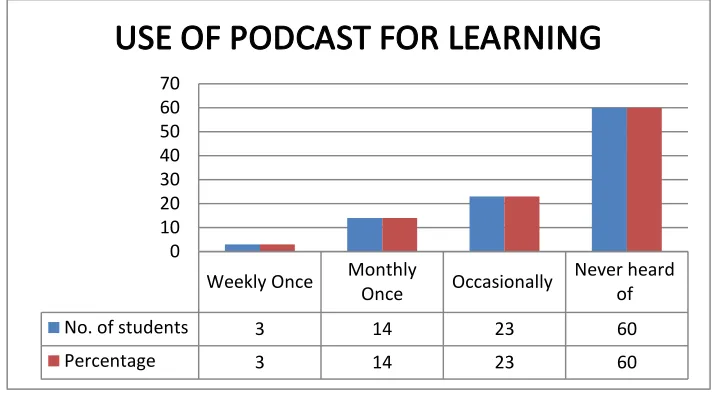
It is evident from Table 1 that the arts and science college students 3% of them use Podcast for learning weekly once, 14% of them use Podcast monthly once, 23% of them use Podcast Occasionally and 60% of them have stated that they have never heard of Podcast.
It may be concluded from the above table that 60% of arts and science college students have stated that they have never heard of Podcast for learning 23 % of them are use Podcast for
learning occasionally, 14% of them use Podcast for learning monthly once and 3% of them use Podcast for learning weekly once.
HYPOTHESIS 2.
The arts and science college students do not have awareness of variants of Podcast among arts and science college students.
The details regarding awareness of variants Podcast among arts and science college students are presented in the following Table 2.
TABLE 2. PERCENTAGE ANALYSIS FOR THE AWARENESS OF VARIANTS OF PODCAST Sl.No. Variants No. of students Percentage 1. Enhanced Podcasts 1 1
3. Video Podcasts 4 4 4. Not aware of 92 92
Total 100 100
FIGURE 2. PERCENTAGE ANALYSIS FOR THE AWARENESS OF VARIANTS OF PODCAST
Enhanced Podcasts
Podcast novels
Video Podcasts
Not aware
of Total No. of students 1 3 4 92 100 Percentage 1 3 4 92 100
0 20 40 60 80 100 120
AWARENESS OF VARIANTS OF
PODCAST
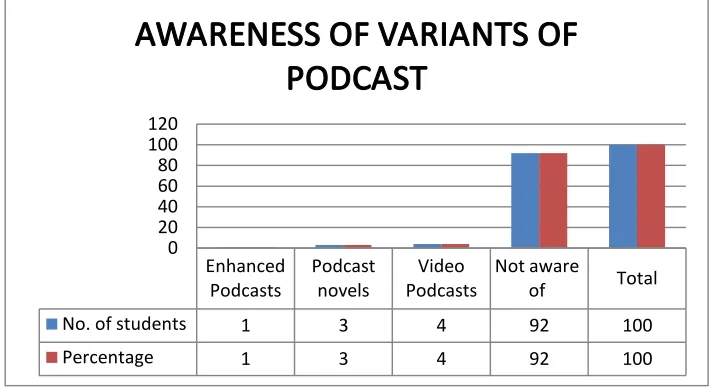
It is evident from Table 2 that 92 % of arts and science college students do not know about variants of podcast, 4 % of them know about video podcast, 3% of them know about podcst novels and 1 % know about enhanced podcast.
It can be concluded from the above Table that the majority of arts and science college students do not have awareness of podcast variants(92%), 4% of them know about video podcast, 3% of them know about podcast novels
and 1 % of them know about enhanced podcast.
HYPOTHESIS 3.
The arts and science college students do not have any preferences in the list of Podcasting companies.
TABLE 3. PERCENTAGE ANALYSIS FOR THE PREFERENCES OF ARTS AND SCIENCE COLLEGE STUDENTS IN THE LIST OF PODCASTING COMPANIES
Sl.No. PODCASTING COMPANIES No. of students Percentage 1. BBC Podcast Learning 12 12
2. My Kitaab ( Book Publishing in India)
1 1
3. Balgatha ( Children’s Bed time stories)
2 2
4. Audiomatic ( offers programmes on science, culture and food to current affairs and comedy)
4 4
5. Random Search in Google/ You tube
81 81
Total 100 100
FIGURE 3. PERCENTAGE ANALYSIS FOR THE PREFERENCES OF ARTS AND SCIENCE COLLEGE STUDENTS IN THE LIST OF PODCASTING COMPANIES
BBC Podcast
Learning My Kitaab Balgatha Audiomatic
Random Search in Google/ You
tube No. of students 12 1 2 4 81
Percentage 12 1 2 4 81
0 10 20 30 40 50 60 70 80 90
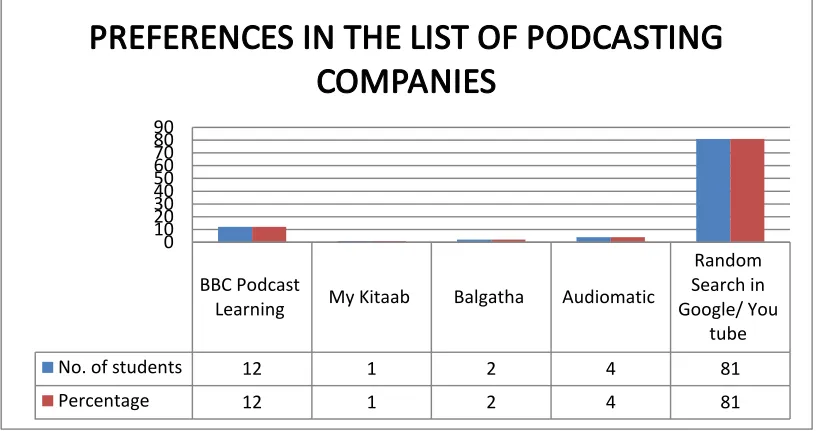
It is evident from Table 3 that the arts and science college students 81% of them prefer podcast through random search in Google and you tube, 12 % of them prefer BBC Podcast Learning, 4 % of them prefer audiomatic (which offers programmes on offers programmes on
science, culture and food to current affairs and comedy), 2 % of them prefer Balgatha ( childrens’ Bed time stories) and 1 % of them prefer My Kitaab ( Book Publishing in India).
It may be concluded from the above table that majority of arts and science college students prefer random search in Google/ You tube podcast for learning, 12 % of them prefer BBC Podcast for Learning, 4% of them prefer audiomatic, 2% of them prefer Balgatha and 1 % of them prefer My Kitaab. CONCLUSION
The study can be concluded by stating the following. They are:
1. The arts and science college students 60% of them have stated that they have never heard of Podcast for learning 23 % of them are use Podcast for
learning occasionally, 14% of them use Podcast for learning monthly once and 3% of them use Podcast for learning weekly once.
2. The majority of arts and science college students (92%) do not have awareness of podcast variants, 4% of them know about video podcast, 3% of them know about podcast novels and 1 % of them know about enhanced podcast.
3. The majority of arts and science college students (81%) prefer random search in Google/ You tube podcast for learning, 12 % of them prefer BBC Podcast for Learning, 4% of them prefer audiomatic, 2% of them prefer Balgatha and 1 % of them prefer My Kitaab.
EDUCATIONAL IMPLICATIONS
researcher indicate that it is popular mostly among NRI’s. The advantages of it have not been much elaborated here in our academic circle. This may be the reason for not heard of by 60% of arts and science college students. Regarding the variants in podcast, the arts and science college students 4% have known about video podcast. This low percentage is due to not popularization of other variants in the colleges by professors. The other significant finding in the study is that the majority of arts and science college students (81%) prefer random search in Google/ You tube podcast for learning and 12 % of them prefer BBC Podcast for Learning. Google is an easy way out for students to search anything on the web so, it has been used for finding out podcast for learning. The BBC is known for its subject delivery and its programme on school radio is popular among some of the best schools in India. Hence, the present outcomes have come from this study.
REFERENCES:
1. "Apollo Podcast Production | Podcast". apollopodcast.com. Archived from the original on November 24, 2015.
Retrieved 2011-10-24. 2. "In Pod We Trust: The man
who accidentally invented the word 'podcast'".BBC Radio 4. BBC. 20 November 2015. Retrieved 1
September 2016.
3. "Oxford Dictionaries Online — podcast".
oxforddictionaries.com. Retrieved2013-02-24. 4. "Podcast – Definition and
More from the Free Merriam-Webster Dictionary".
Merriam-webster.com. 2012-08-31. Retrieved 2014-06-29.
5. "Podcast Production". President and Fellows of Harvard College.
Retrieved2009-08-21. episodes of a particular podcast
Profiling Podcasting as Radio". Convergence: the International Journal of Research into New Media Technologies. 12 (2): 143– 162. doi:10.1177/13548565 06066522.
7. www. Wikipedia.org 8. Golden, S. A. R. (2011).
Problems and Prospectus of
Distance
Learning.Bharathidhasan University, 343, 344.