Implementation of Text-To-Speech for Real Time Embedded
System Using ARM Processor
M. Naresh & G.V Maha Lakshmi
1M.Tech, DSCE, Sreenidhi Institute of Science & Technology, Telangana, India
2Professor, Dept. ECE, Sreenidhi institute of science and technology, Telangana, India
ABSTRACT:
The real time hardware implementation of Text-To-Speech system has been drawing attention of the research community due to its various real time applications. These include reading aids for the blind, talking aid for the vocally handicapped and training aids and other commercial applications. All these applications demand the real time embedded platform to meet the real time specifications such as speed, power, space requirements etc. In this context the embedded processor ARM has been chosen as hardware platform to implement Text-To-Speech conversion. This conversion needs algorithms to perform various operations like parts of speech tagging, phrase marking, word to phoneme conversion and clustergen synthesis. We are using ARM 7 Processor for the implementation.
Index-terms: ARM Processor, Text-to-Speech(TTS), Reading aids, Talking aid, Embedded systems.
I. INTRODUCTION:
An implanted framework is a devoted PC
framework intended for maybe a couple particular
capacities. This framework is implanted as a piece
of an entire gadget framework that incorporates
equipment, for example, electrical and mechanical
segments. The implanted framework is dissimilar
to the
Universally useful PC, which is designed to deal
with an extensive variety of preparing
undertakings. Since an inserted framework is built
to play out specific undertakings just, outline
designers may upgrade estimate, cost, control
utilization, dependability and execution. Inserted
frameworks are normally created on expansive
scales and offer functionalities over an assortment
of situations and applications.
I.I. TEXT-TO-SPEECH
Content to-discourse (TTS) is the issue of
Automatic transformation of content into discourse
that Resembles, as nearly as could reasonably be
expected, a local speaker of the dialect perusing
that content [1]. In TTS Systems a subjective
content is changed over into discourse which can
be heard boisterously.
II. SYSTEM ARCHITECTURE: 2.1 BLOCK DIAGRAM:
Figure-1: block diagram of project
2.2. EXISTING METHOD
Synthesized
speech
can
be
created
by
concatenating part of recorded speech which is
stored in a database. The mainly significant
qualities of a speech synthesis system are
naturalness and Intelligibility
Naturalness expresses how intimately the output
sounds like human speech, whereas intelligibility is
the easiness with which the output is understood
[1] “ Assigning Phrase Breaks from part-of-speech
2.3 PROPOSED METHOD
The proposed method is used to overcome the drawback present in existing method. The design of this project involves text to speech. Here whatever we are giving input from any keyboard corresponding output will get in the form of voice means speech. The development board with ARM architecture is selected as the hardware platform. Start-up codes, OS kernel and user’s application programs are together stored in a NAND FLASH. Application programs run in 64MB SDRAM, which can also be used as the room of various data and the stack
III.IMPLEMENTATION:
3.1ARM microcontroller is used for the
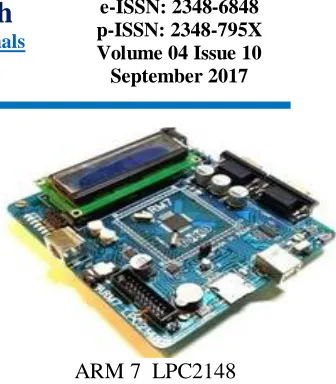
implementation of the text to speech system. ARM is the most widely used platform for the embedded systems. ARM has been chosen as a platform for the project because of its low power and high speed operations.LPC2148 has been specifically chosen for the implementation of text to speech conversion because it has SDRAM memory, and it supports image sensor interfacing which could be used for
embedded system development for visually
challenged readers which is our future scope for research.
ARM 7 VOICE
MODULE
UART
P.C
SPEAKERS
Fig. 1 The block diagram showing the step for implementing the Text to Speech system.
The binary file that implements the entire Text to Speech system should be compatible with the ARM instruction set. The generation of the binary file is done with the compilation of the source code with ARM compatible compiler gcc. The arm-elf-gcc is an open source ARM compiler that can be installed with the ‘gnu arm’ package.
The microcontroller is interfaced with
K4S561632E CMOS SDRAM 256Mb die and AD1981 audio codec IC. The interfacing of the microcontroller is done with the help of the microcontroller interfacing codes provided by ATMEL.
The source coding of different steps of the text to speech system is done using the source code of open source FLITE text to speech system. Changes to the source code of FLITE is done so that the microcontroller executes the program without any errors. Significant modifications were change of floating precision to double precision, change of the default of utterance speed (through stretch), change in the output code etc. Without the above modifications the execution was not successful and was not perceptible for the readers.
Fig. The block diagram of the system used for the Implementation of Text to Speech
ARM 7 LPC2148
3.2 DESCRIPTION OF PROJECT:
Since decades, real time hardware implementation of Text-To-Speech system has been drawing attention of the research community due to its various real time applications. These include reading aids for the blind, talking aid for the vocally handicapped and training aids and other commercial applications. All these applications demand the real time embedded platform to meet the real time specifications such as speed, power, space requirements etc. In this context the embedded processor ARM (Advanced RISC Machine), has been chosen as hardware platform to implement Text-To-Speech conversion. This conversion needs algorithms to perform various operations like parts of speech tagging, phrase marking, word to phoneme conversion and clustergen synthesis. These algorithms are coded and developed in C using eclipse IDE and finally implemented on commercially available ARM11 microcontroller. Experiments have been performed on ARM microcontroller using test cases. It has been observed that the performance of the ARM
based implementation is very close to x86
implementation. In this way we can design text to speech by using
ARM board and Embedded Linux.
Table-1: Table of components
S.NO HARDWARE COMPONENT SPECIFICATION 1 Microcontroller LPC 2148
2 LCD 16x2
3 Voice module APR33A
ARM11 microcontroller is used for the implementation of the text to speech system. ARM is the most widely used platform for the embedded systems. ARM has been chosen as a platform for the project because of its low power and high speed operations. ARM11 has been specifically chosen for the implementation of text to speech conversion because it has SDRAM memory and it supports image sensor interfacing which could be used for embedded system development for visually challenged readers which is our future scope for research.
IV. EXPERIMENTAL RESULTS:
Figure-3: Hardware implementation
Fig. Input by the user
A. Input text”hello” :
The word “hello” is given as input for the ARM based system and x86 based system and the results of the output are as shown in Fig.3
Figure-5: voice Output
V. CONCLUSION
The paper described a way of implementing the text to speech system on ARM microcontroller. Among different speech synthesizing algorithms
CLUSTERGEN synthesis is chosen for
implementing a real time text to speech system. The results of the implementation are presented. These results shows that the x86 based implementation and ARM based implementation are very close. From the results it can be concluded that a complete low cost real time embedded system can be built with the implementation presented in the paper. This embedded system can be used in many applications like reading aid for the visually disabled persons, talking aid for vocally handicapped etc.
The source coding of the text to speech system can be easily modified for implementing new synthesis algorithms. So the text to speech system developed here can be easily upgraded to the latest synthesis technique for speech. Even though the text to speech system developed here is for English language, it can be easily extendable for new languages also. Hence the system developed here is a robust text to speech system.
[1] Shin, C. and Sproat, R. “Issues in text-to-speech conversion for Mandarin”, Computational
Linguistics and Chinese LanguageProcessing, pp.
35-82, August 1996.
[2] The FLITE website. [Online]. Available :
http://www.speech.cs.cmu.edu/flite/
[3] Taylor, P. and Black, A. “ Assigning Phrase Breaks
from part-of-speech Sequences” Computer Speech and Language 12, 99-117,1998
[4] DeRose, S. “Grammatical category
disambiguation by statistical optimization”. Computational Linguistics, pp. 31-39, 1988
[5] Black, A., Lenzo, K. and Pagel, V. “Issues in
Building General Letter to Sound Rules” 3rd ESCA Workshop on Speech Synthesis, pp. 77-80, 1998
[6] Pagel, V., Lenzo, K. and Black, A. “Letter to sound
rules for accentedlexicon compression” ICSLP98, pp 2015-2020, 1998.
[7] Black, A. “Predicting the intonation of discourse segments fromexamples in dialogue speech”, ATR
Workshop on Computationalmodeling of prosody
for spontaneous speech processing, 1995.
[8] Black, A. “CLUSTERGEN: A Statistical
Parametric Synthesizer using Trajectory Modeling”, Interspeech ICSLP, pp. 1763-1765, 2006
[9] Keiichi, K., Takao, K. and Satoshi, I. “Speech
Parameter Generation From HMM Using Dynamics Features” , European Conference on Speech Communication and Technology, 1995
[10]Satoshi, I. “Cepstral Analysis Synthesis on the MEL Frequency Scale” , IEEE International