ISSN (Print) : 2320 – 3765
ISSN (Online): 2278 – 8875
I
nternational
J
ournal of
A
dvanced
R
esearch in
E
lectrical,
E
lectronics and
I
nstrumentation
E
ngineering
(A High Impact Factor, Monthly, Peer Reviewed Journal)
Website: www.ijareeie.com
Vol. 8, Issue 3, March 2019
Highly Secured Dynamic Color QR Pattern
Generation for Real Time Applications
G. Latha1, D.Akshaya2, M.Rindhya3 , B.soundharya4, R.Uma mageshwari5
Assistant Professor, Dept. of ECE, Apollo Engineering College, Poonamallee, Tamilnadu, India1
UG Student, Dept. of ECE, Apollo Engineering College, Poonamallee, Tamilnadu, India2
UG Student, Dept. of ECE, Apollo Engineering College, Poonamallee, Tamilnadu, India3
UG Student, Dept. of ECE, Apollo Engineering College, Poonamallee, Tamilnadu, India4
UG Student, Dept. of ECE, Apollo Engineering College, Poonamallee, Tamilnadu, India5
ABSTRACT : The concept of key drive color QR image generations, an automatic method to overcome distortions that arises in color QR codes with bounded probability of detection error such as: illumination changes –color tonal changes (cross module interference) - image tilt (Geometric Distortion) Develop primary color channels based three unique QR codes commonly used for color printing and the complementary channels, respectively, used for capturing color images. Finally it carried out color QR pattern generation. These QR models are compatible with standard decoding applications and can be applied to any color image with full area coverage.
Keywords: QR code, tilt, pattern generation
I. INTRODUCTION
QR code is a form of 2D barcodes. QR codes are now used over a much wider range of User with a camera phone equipped with the correct reader application can scan the image of the QR code to display text, contact information QR codes can also have different colors. The Black and white QR codes may be the normal among many uses but there is a diverse way that these codes can be generated and created. QR is readable by moderately equipped mobile phones with cameras and QR scanners. Information such as URL, SMS, contact information and plain text can be embedded into the two dimensional matrix. With smart phones, we can visit the Website linked by the URL quickly, we can send the SMS message directly or we can save the contact information onto the address book easily.
II. CODE GENERATION
The signal-rich-art code image IC is printed and posted or displayed against a white background, and that the captured image Id contains only the original image of IC and the background. The first assumption here may be removed simply by adding a white surrounding zone to IC. To extract the message from Id, It must localize the region of IC in Id. Transforming the message into a bit stream. Transform message M into a bit stream B. Generating the pattern image. Split B into n three-bit segments as b11b12b13b21b22b23 … bn1bn2bn3. Expand every three bits bi1bi2bi3 in B into
four bits bi1′bi2′bi3′bi4′ according to (1) and generate the corresponding pattern block Ti according to the rules. Align
ISSN (Print) : 2320 – 3765
ISSN (Online): 2278 – 8875
I
nternational
J
ournal of
A
dvanced
R
esearch in
E
lectrical,
E
lectronics and
I
nstrumentation
E
ngineering
(A High Impact Factor, Monthly, Peer Reviewed Journal)
Website: www.ijareeie.com
Vol. 8, Issue 3, March 2019
A.
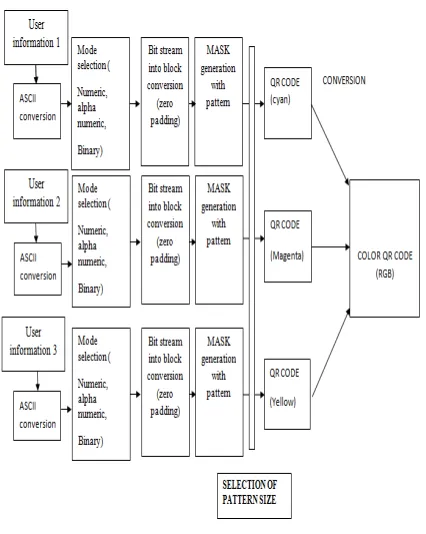
CODE CONVERSIONFig. 1. Code conversion
III. LITERATURE SURVEY
B.SIGNAL-RICH-ART CODE IMAGE GENERATION
Fig 2 Three phases of proposed methods
ISSN (Print) : 2320 – 3765
ISSN (Online): 2278 – 8875
I
nternational
J
ournal of
A
dvanced
R
esearch in
E
lectrical,
E
lectronics and
I
nstrumentation
E
ngineering
(A High Impact Factor, Monthly, Peer Reviewed Journal)
Website: www.ijareeie.com
Vol. 8, Issue 3, March 2019
code image IC is created by four major stages: Transform message M into a bit stream B of codes. Transform every three bits of B into four bits and represent them by a binary pattern block, resulting in a pattern image IP. Modulate each pattern block Ti of IP by two representative values calculated from the Y-channel values of the corresponding block Bi of target image IT, yielding a modulated pattern image IP. Replace the Y-channel of target image IT with IP' to get a signal-rich-art code image IC as the output. In the second phase, given a camera-captured version IC' of a paper or display copy of the signal-rich-art code image IC, a message M', which is supposed to be identical to M, is extracted from IC'
IV. PATTERN IMAGE CREATION
To transforms a message M into a character message image, the proposed method transforms M into a code pattern image similar in appearance to a pre-selected target image. Specifically, the message M is transformed into a bit stream, which is then encoded by binary code patterns in the form of image blocks. Such pattern blocks finally are composed to form the code pattern image. Each pattern block consists of several unit blocks Fi, with each Fi representing a bit of the code pattern C which T represents.
V. PROPOSED METHOD
C. BLOCK DIAGRAM
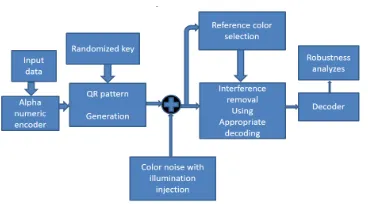
Fig 3 Reliability check model
The model contains the information which is said to be an input data, where it generate the QR code. The input data which contains both integers, characters and it has no size limitation. Then the information which is given by the user is converted into machine readable language i.e.., ASCII language. The alpha numeric encoder to encode the given information and the randomized key is used to secure the information by giving the password. Then it should generate QR pattern which has tonal distortion, noise and tilted pattern. Then the illumination injection recover the original information from these problems. The reference color is chosed for increasing the quality of the image.
D. COLOR SELECTION KEY
ISSN (Print) : 2320 – 3765
ISSN (Online): 2278 – 8875
I
nternational
J
ournal of
A
dvanced
R
esearch in
E
lectrical,
E
lectronics and
I
nstrumentation
E
ngineering
(A High Impact Factor, Monthly, Peer Reviewed Journal)
Website: www.ijareeie.com
Vol. 8, Issue 3, March 2019
During scanning, QR code does not have to be standard black and white color. It can be embedded multiple colors and apply a color gradient without affecting scanability.
E. TONED DISTORTION
Fig 5 Toned distortion
Toned distortion will be used to scan the QR pattern even in dark background. The Color varies dramatically goes under different lightening conditions unfortunately. It is inevitable for real-world QR code applications to operate under a wide range of conditions.
F. SECURED QR CODE
Fig 6 password selection key
Secured QR Code is a new kind of QR code that has public and private data that can be read by a QR reader such as a smart phone. The public data can be read by any reader such as a smart phone much like a normal QR code. The private data is encoded with a password that can unlock the information. A proper scanner is needed to scan the password and reveal the encrypted data.
VI. CONCLUSION AND FUTURE
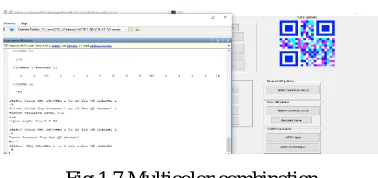
Fig 1.7 Multicolor combination
ISSN (Print) : 2320 – 3765
ISSN (Online): 2278 – 8875
I
nternational
J
ournal of
A
dvanced
R
esearch in
E
lectrical,
E
lectronics and
I
nstrumentation
E
ngineering
(A High Impact Factor, Monthly, Peer Reviewed Journal)
Website: www.ijareeie.com
Vol. 8, Issue 3, March 2019
image with full area coverage. The QR information bits are encoded into the different pattern of the image, taking advantage of the uncorrelated disturbances. To mitigate the visual distortion of the QR image, the algorithm utilizes half toning masks for the selection of modified pixels and nonlinear programming techniques to locally optimize luminance levels.
REFERENCES
1) Gevers, Theo, and Arnold WM Smeulders. "Pictoseek: Combining color and shape invariant features for image retrieval." IEEE transactions on Image Processing 9, no. 1 (2000): 102-119.
2) Gevers, Theo, and Harro Stokman. "Classifying color edges in video into shadow-geometry, highlight, or material transitions." IEEE transactions on multimedia 5, no. 2 (2003): 237-243.
3) Van De Weijer, Joost, Cordelia Schmid, and Jakob Verbeek. "Using high-level visual information for color constancy." In 2007 IEEE 11th International Conference on Computer Vision, pp. 1-8. IEEE, 2007.
4) Bulan, Orhan, Vishal Monga, and Gaurav Sharma. "High capacity color barcodes using dot orientation and color separability." In Media Forensics and Security, vol. 7254, p. 725417. International Society for Optics and Photonics, 2009.
5) Davis, Bruce. "Signal rich art: enabling the vision of ubiquitous computing." In Media Watermarking, Security, and Forensics III, vol. 7880, p. 788002. International Society for Optics and Photonics, 2011
6) Grillo, Antonio, Alessandro Lentini, Marco Querini, and Giuseppe F. Italiano. "High capacity colored two dimensional codes." In Proceedings of the International Multiconference on Computer Science and Information Technology, pp. 709-716. IEEE, 2010.
7) Gijsenij, Arjan, Theo Gevers, and Joost Van De Weijer. "Improving color constancy by photometric edge weighting." IEEE Transactions on Pattern Analysis and Machine Intelligence 34, no. 5 (2012): 918-929.
8) Chow, Yang-Wai, Willy Susilo, Guomin Yang, James G. Phillips, Ilung Pranata, and Ari Moesriami Barmawi. "Exploiting the error correction mechanism in QR codes for secret sharing." In Australasian Conference on Information Security and Privacy, pp. 409-425. Springer, Cham, 2016.
9) Damera-Venkata, Niranjan, Jonathan Yen, Vishal Monga, and Brian L. Evans. "Hardcopy image barcode via block-error diffusion." IEEE transactions on image processing 14, no. 12 (2005): 1977-1989.
10) Shaked, Doron, Avi Levy, Zachi Baharav, and Jonathan Yen. "A visually significant two dimensional barcode. “Hewlett-Packard Lab. Tech. Rep.—HPLTR 164 (2000): 2000.
11) K. O. Siong, D. Chai, and K. T. Tan, “The use of border in colour 2d barcode,” in 2008 International Symposium on Parallel and Distributed Processing with Applications (ISPA’2008), December 2008, pp. 999– 1005.