Canny Edge Detection Algorithm Using DWT
for PCB Laminates
Dr. V.G. Sangam1, Amruta L Kabade2
Professor, Dept of E&IE, Dayananda Sagar College of Engineering, Bangalore, Karnataka, India1 PG Student [MECS], Dept of E&IE, Dayanada Sagar College of Engineering, Bangalore, Karnataka India2
Abstract: Edge is one of the most fundamental algorithms in digital image processing. The canny edge detector is the most implemented edge detection algorithm because of its ability to detect edges even in images that are intensely contaminated by noise. However, there is a time consuming algorithm and therefore its implementations are difficult to reach real time response speeds. Especially nowadays where the demand for high resolution image processing is constantly increasing, the need for fast and efficient edge detector implementation is ever so present. This paper proposes new methods to detect the edges based on one-dimensional and two-dimensional discrete wavelet transformations (DWTs). Recent literature shows that edge detection based on DWT requires less memory space compared to others. Within the contexts of all statistical parameters in detection of edges, DWT shows better results than that of others.
I. INTRODUCTION
Modern image processing applications shows an increasing demand for computational power and memory space. This stems from the fact that image and video resolutions have intensified in the past few years, especially after the introduction of high definition video and high resolution digital cameras. Therefore there is a need for image processing implementations that can perform demanding computations on considerable amounts of data, with high efficiency, and often need to meet real-time requirements. In Fourier analysis, the Discrete Fourier Transform (DFT) decompose a signal into sinusoidal basis functions of different frequencies.
No information is lost in this transformation; in other words, we can completely recover the original signal from its DFT (FFT) representation. In wavelet analysis, the Discrete Wavelet Transform (DWT) decomposes a signal into a set of mutually orthogonal wavelet basis functions. These functions differ from sinusoidal basis functions in that they are spatially localized – that is, nonzero over only part of the total signal length. Furthermore, wavelet functions are dilated,
translated and scaled versions of a common function φ, known as the mother wavelet. As is the case in Fourier analysis,
the DWT is invertible, so that the original signal can be completely recovered from its DWT representation. Unlike the DFT, the DWT, in fact, refers not just to a single transform, but rather a set of transforms, each with a different set of wavelet basis functions. Two of the most common are the Haar wavelets and the Daubechies set of wavelets.[1] a) Wavelet functions are spatially localized.
b) Wavelet functions are dilated, translated and scaled versions of a common mother wavelet and c) Each set of wavelet functions forms an orthogonal set of basis functions.
II. METHODOLOGY AND IMPLEMENTATION
An edge in an image is an important local change in the image intensity, usually associated with a discontinuity in either of the image intensity or the first derivative of image intensity.
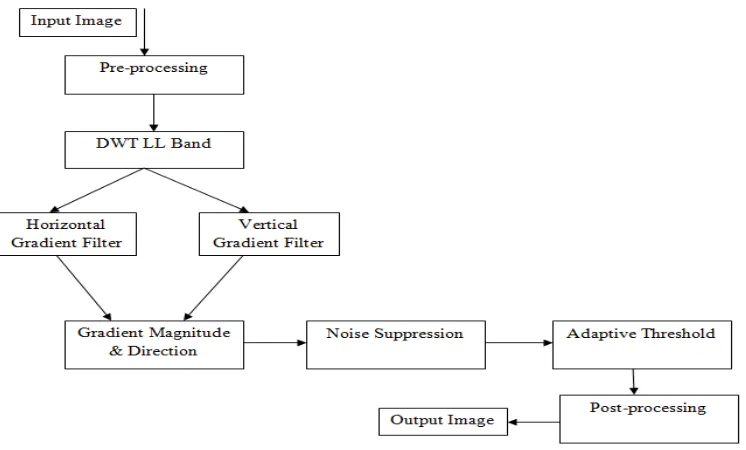
The proposed Efficient Distributed Canny Edge Detection with compression using DWT is as shown in Figure 1. The Canny edge detection algorithm operates on the whole image and has a latency that is proportional to the size of the image. Proposed Efficient Distributed Canny Edge Detection algorithm, it removes the inherent dependency between the various blocks, distributed Canny algorithm are the same as in the original Canny that are now applied at the block level, which is the hysteresis high and low thresholds calculation is modified by using adaptive threshold technique to enable parallel processing.[2] A parallel hysteresis thresholding algorithm was proposed based on the observation that a pixel with a gradient magnitude corresponds to blurred edges.
Fig 1: Efficient Distributed Canny Edge Detector Block Diagram
1. Image pre-processing.
2. Apply DWT on pre-processing block to get LL band. 3. Horizontal and vertical Gradient filter.
4. Non-maximum suppression. 5. Adaptive threshold.
6. Image post-processing.
III. ALGORITHM
Image pre-processing: Basically input image is colour image. But in many image processing applications input image is gray scale image. So color image is not necessary to detect edge for that purpose Color image is converted as gray scale image to minimize that unnecessary color data. This gray scale image containing some noise in it so filtering is applied to minimize that noise. In this Median filter is preferred for this purpose.
Wavelets are a set of functions that satisfy certain mathematical requirements and have to be used to represent other functions or signals. Scalability is the most important property in wavelets, it means that a wavelet function have to be dilated to approximate the low frequency components of a signal, also it is shifted to localize the time or space information of a signal. By using zoom lens we can view analogous scene. Less detailed pictures and bigger but vaguer pictures can be seen by zooming it out, objects in more localized area can be revealed by zooming in, hence the scale function is another name for wavelets.
Fourier analysis uses sine or cosine basis functions, the Fourier analysis function is stretch out infinitely in both time and frequency, both time and frequency components are finite and localized in wavelet functions. The wavelet transform building blocks are fine in size and limited in translation ranges. So the wavelets not only represent the low and high frequency components of a signal it also includes the property of represent the time or location information of the signal. So that wavelets are more efficient in the signal contains discontinuities and sharp spikes.
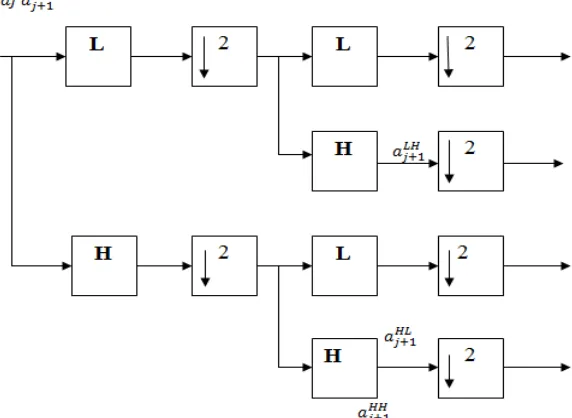
The Two-Dimensional DWT: In the calculation of higher dimensional DWT, there are two major approaches one is the separable algorithm, and the another one uses non-separable multi-dimensional wavelets. 1-D DWT can be calculating by using separable algorithm for each dimension independently. Separable 2-D DWT algorithm is shown in figure 2.
Fig 2: Wavelet decomposition for two dimensional pictures
DWT algorithm for two-dimensional pictures is performed firstly for all image rows and then for all columns as shown in Figure 2.Expect that the separable 2-D DWT can be efficient for approximating images with important information that are arranged in the vertical and horizontal directions it may not be in detail. The non-separable 2-D DWTs use scalable-valued 2-D wavelet basis, it can give the directional information in the original image. Many methods are proposed to constructing the non -separable wavelet bases. Separable algorithm having less computational complexity because of this property, it is used in many application. Wavelet decomposition for two-dimensional pictures, here consider only one set of derived features. It is a vector, which contains energies of wavelet coefficients calculated in sub bands at successive scales. [4]
Sub band image is used only for DWT calculation at the next scale. Maximum of 8 scales can be calculated by given image. If output sub band have dimensions at least 8 by 8 then we can use Haar wavelet.
Horizontal and Vertical Gradient: In order to improve the performance of the edge detection at the block level and achieve the same performance as the original frame-based Canny edge detector when this latter one is applied to the entire image, a distributed Canny edge detection algorithm is proposed. A diagram of the proposed algorithm is shown in Figure 1. In the proposed distributed version of the Canny algorithm, the input image is divided into m × m
overlapping blocks and the blocks are processed independent of each other. For an L × L gradient mask, the m × m
each block by (L + 1)/2 pixels along the left, right, top, and bottom boundaries, respectively. This results in m × m
overlapping blocks, with m = n + L + 1.
The non-overlapping n ×n blocks need to be extended in order to prevent edge artifacts and loss of edges at block boundaries while computing the gradients and due to the fact that the NMS operation at boundary pixels requires the gradient values of the neighboring pixels of the considered boundary pixels in a block.Convolution with masks, Gradient and direction Calculation: Here, suppose G (x, y) is a 2D Gaussian mask and I(x, y) is the image, the first-order derivative of Gaussian is (x, y) and (x, y). Then the gradient of vertical direction Ex (x, y) and horizontal direction Ey (x, y) can be computed by the following equations:
Grad(x,y)=
( , ) +
( , )
( , ) = tan
( , )
( , )
Where G (x, y) = Gaussian mask. I(x, y) = Image.
Ex(x, y) = gradient of vertical direction. Ey(x, y) = gradient of horizontal direction.
Non-maximum suppression: Non maximum suppression is used to reduce the edge thickness for improving localization. Once the direction of the gradient is known, the pixel which is not the local maximum is eliminated is referred as NMS. The comparison is made between the current pixel and its 8-neighbors, along the direction of the gradient. A 3×3 window is adopted during the comparison.
Adaptive Thresholding: Since the output of the non maximum suppression stage contains some spurious edges resulted from noises, these responses which are called 'streaking' can be eliminated by the use of Adaptive thresholding. Next step in flow is generation of bit file to download it on FPGA board and display output image on VGA monitor. In generally, scanned documents have line-drawings, text and graphic regions. It is also considered as mixed type documents. In many real time applications, have to recognizeor improve the contentof the document. In that case, it is required to convert the documents into a binary form. Thus Image binariszation plays a vital role in the field of Image Processing. Binarization, it is a process of converting a gray scale image to a binary image which contain only two classes of pixels. Such as white as a background and black as foreground. Classification is carried out with a separation luminous value called threshold. Threshold plays an important role in binarization and selecting of an appropriate threshold value is a major one. There are many methods to calculate an appropriate threshold value in binarization techniques. Document binarization is the initial step in the document analysis systems. [5]
The aim of document binarization is to transferring the given input gray scale or color document into a bi-level representation. Thresholding is a simple method but effective tool to differentiate examples of thresholding applications are document image analysis, where the aim is to extract logos, graphical content, printed characters, objects from the background. Map processing, where legends, lines, and characters are to be found. Scene processing, a target is to be identified and quality inspection of materials and where defective parts must be delineated.
The output of the thresholding operation is a binary image where one state will indicate the foreground objects, that is, printed text, a legend, a target, defective part of a material, etc., while the another state will correspond to the background. [6] Depending on the application, the foreground can be represented by gray-level 0, that is, black as for text, and the background by the highest luminance for document paper that is 255 in 8-bit images, or conversely the foreground by white and the background by black.
IV. RESULTS
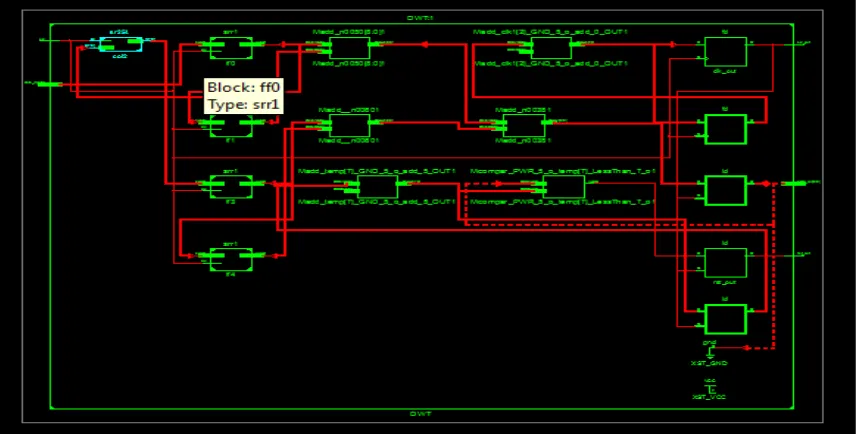
Fig 3: RTL schematic for DWT
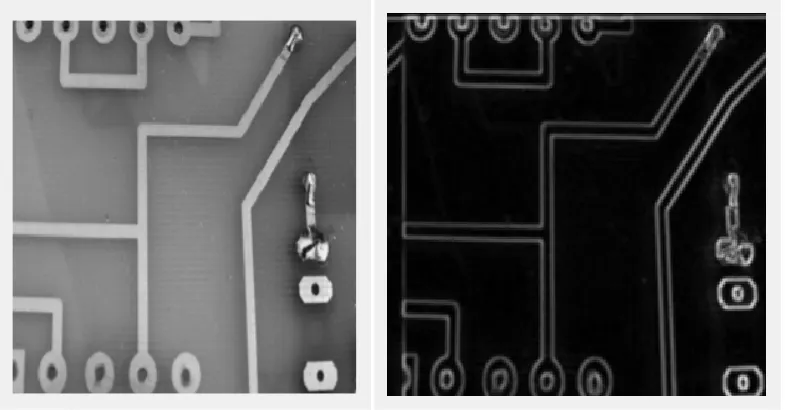
Fig 5: Edge detection output of PCB
REFERENCES
1. Mauro Barni. Document and Image Compression. CRS Press, Taylor and Francis Group, 2006. 2. Al Bovik. The Essentuial Guide to Image Processing. Elsevier, Inc., second edition, 2009.
3. Rafael C. Gonzalez and Richard E. Woods. Digital Image Processing. Pearson Education, Inc., Upper Saddle River, New Jersey, third edition, 2008.
4. Stephane Mallat. A Wavelet Tour Of Signal Processing. Academic Press, 1998.
5. Stephane Mallat and Sifen Zhong. Characterization of signals from multiscale edges. IEEE TRANSACTION ON PATTERN ANALYSIS AND MACHINE INTELLIGENCE, 14(7):23, July 1992.