An Enhanced Cluster Computing System for
IOT Based WSN
M.Jerin Jose
1, S.Suganya
2, G.Karthikeyan
3R.B.Revathy
4Assistant Professor, Department of Electronics and Communication Engineering, SKP Engineering College
Tiruvannamalai, Tamilnadu, India1, 2, 3
Associate Professor, Department of Electronics and Communication Engineering, SKP Engineering College
Tiruvannamalai, Tamilnadu, India 4
ABSTRACT: Industrial wireless sensor networks have attracted much attention as a cornerstone to making the smart factories real. Utilizing industrial wireless sensor networks as a base for smart factories makes it possible to optimize the production line without human resources, since it provides industrial Internet of Things service, where various types of data are collected from sensors and mined to control the machines based on the analysis result. On the other hand, a fog computing node, which executes such real-time feedback control, should be capable of real-time data collection, management, and processing. To achieve these requirements, we introduce wireless computing system (WCS) as a fog computing node. Since there are a lot of servers and each server has 60 GHz antennas to connect to other servers and sensors, WCS has high collecting and processing capabilities. However, in order to fulfill a demand for real-time feedback control, WCS needs to satisfy an acceptable delay for data collection. But in order to reduce power consumption higher than wireless computing system, we propose an enhanced cluster computing system and it also reduces the cost for factory operation. Since there is a tradeoff relationship between the power consumption and the delay for data collection, our proposed system controls the sleep schedule and the number of links to minimize the power consumption while satisfying an acceptable delay constraint. Furthermore, the effectiveness of our proposed system is analyzed using results obtained through Network Simulator 2.
KEYWORDS: Industrial wireless sensor network, cluster head, low power consumption, delay-aware data collection.
I. INTRODUCTION
Fig-1: Our envisioned industrial wireless sensor network using wireless computing system.
But in order to further reduction in power consumption, in this paper, we introduce a cluster computing system .We aim to investigate a system operation scheme for industrial IOT service. Since IOT service is sensitive to the delay, we need to satisfy an acceptable delay for data collection. Additionally, we need to reduce the power consumption of our envisioned system in order to achieve an energy-efficient factory. Consequently, both delay for data collection and system power consumption should be considered. Furthermore, based on the trade-off relationship, we propose an Energy-Efficient and Delay-Aware Cluster Computing System (E2DA-CCS). Our proposed system minimizes the system power consumption while satisfying the acceptable delay of each datum, by controlling the number of servers in a sleep state and the number of links (i.e., the degree of servers).
II. ENERGY-EFFICIENT CLUSTERING STRUCTURES IN WSN
2.1. Clustering
Traditional (or flat) routing protocols for WSN may not be optimal in terms of energy consumption. Clustering can be used as an energy-efficient communication protocol. The objectives of clustering are to minimize the total transmission power aggregated over the nodes in the selected path, and to balance the load among the nodes for prolonging the network lifetime. Clustering is a sample of layered protocols in which a network is composed of several Clumps (or clusters) of sensors. As shown in Figure 2, each clump or cluster is managed by a special node or leader, called cluster head (CH), which is responsible for coordinating the data transmission activities of all sensors in its clump. All sensors in a cluster communicate with a cluster head that acts as a local coordinator or sink for performing intra-transmission arrangement and data aggregation. Cluster heads in tern transmits the sensed data to the global sink. The transmission distance over which the sensors send their data to their cluster head is smaller compared to their respective distances to the global sink. Since a network is characterized by its limited wireless channel bandwidth, it would be beneficial if the amount of data transmitted to the sink can be reduced. To achieve this goal, a local collaboration between the sensors in a cluster is required in order to reduce bandwidth demands. As shown in Figure 2, clustering usually localizes the routing setup within the cluster and therefore it reduces the routing overhead by each node and the topology maintenance overhead. Using clustering, the network appears smaller and more stable. The information, generated from neighboring sensor nodes, is often redundant and highly correlated, so data aggregation by each cluster head conserves communication bandwidth as well. Moreover, the ability to use different power levels in inter-cluster and intra cluster communication reduces the Interferences and the collisions in the network resulting in a better throughput. Clustering is a challenging task. CHs often lose more energy compared to regular nodes. It is necessary to perform reclustering periodically in order to select energy-abundant nodes to serve as CHs, thus distributing the load uniformly on all the nodes.
2.2. Sleep Mode
power consumption and data collection delay in multi-hop communication. The sleep mode aims to reduce system power consumption by letting some servers enter the sleep state. During the sleep state, the power consumption of the server is low. Assuming that the ratio of servers in sleep state is ρ, the system power consumption [W], Esystem, is expressed as
(1)
Where active are the power consumption of the server in sleep state and that in active state, respectively. However, servers cannot act as router while in sleep state in this system. In other words, servers in sleep state are removed from the intra-system network and the original degree distribution of the network, pk , is changed. Here, we assume that the servers in sleep state
are randomly selected regardless of their degree and location.
2.3 Trade-Off Relationship between Power Consumption and Delay
The rest of this section describes the trade-off relationship between system power consumption and internal delay, which is derived from the aforementioned mathematical expressions. Fig. 3 shows the effects of the number of servers in sleep state on the system power consumption and average internal delay and the parameters are set as follows:
,
N|=100, µ=0.4, λ=0.02s As shown in Fig-3(a), the system power consumption can be reduced in inverse proportion to the number of servers in sleep state. On the other hand, as shown in Fig-3(b), the average internal delay increases with the increase of the number of servers in sleep state because the average hop count between servers becomes higher in such case. From these results, we can show a trade-off relationship between the system power consumption and internal delay. Consequently, we need to investigate an optimization scheme that considers both system power consumption and internal delay to find an optimal number of servers in sleep state.
Since a network with lower degree has a shorter time slot cycle, the delay is lower when the number of servers in sleep state is low. However, since the hop-count increases in an exponential fashion and growth rate is higher in case of lower degree, the internal delay in the network with lower degree becomes higher when the numbers of servers in sleep state.
Fig-3: Trade-off relationship between the system power consumption and internal delay. (a) Effect of the number of servers in sleep state on the system power consumption.
III. PROPOSED ENERGY-EFFICIENT AND DELAY-AWARE CLUSTER COMPUTING SYSTEM
In this section, we describe the proposed operation scheme for our envisioned computing system. First, we introduce a bock diagram of Cluster Computing system second; we introduce an optimization problem to minimize the system power consumption while satisfying an acceptable delay constraint. Then, based on the optimization problem, we propose a system operation procedure that jointly controls the sleep mode and the degree of servers in a dynamic scenario.
3.1. Cluster Computing System
This block diagram explains the operational principals of cluster computing system of our proposed model. The N1, N2…, Nn denotes the nodes in NS2, in real time it is considered as different types of sensors used in industrial, medical and in various sectors.In our system we clumps(i.e.,clustering) this nodes by using one of the efficient clustering algorithm. The protocol used to cluster this nodes are IEEE 802.15.4 that is wireless personal area network .AWPAN (wireless personal area network) is a personal area network - a network for interconnecting devices centered around the individual person’s workspace.
A wireless personal area network (WPAN) is a type of personal network that uses wireless communication technologies to communicate and transfer data between the users’s connected devices. It allows an individual to connect all or most of his or her devices together and access the Internet or a local network using any of the native/supported wireless communication techniques. WPAN is also known as a short wireless distance network. Now this nodes are clusteredto the clustering head which is nothing but
one of the node in This cluster head is more efficient node, which used to transmit the packets to the IOT server. This
clustering head uses the IEEE 802.11 as a protocol.
A wireless LAN (or WLAN, for wireless local area network, sometimes referred to as LAWN, for local area wireless network) is one in which a mobile user can connect to a local area network (LAN) through a wireless (radio) connection. The IEEE 802.11 group of standards specifies the technologies for wireless LANs. 802.11 standards use the Ethernet protocol and CSMA/CA (carrier sense multiple access with collision avoidance) for path sharing and include an encryption method, the Wired Equivalent Privacy algorithm. By using 802.11 protocol cluster head transfer the data to the admin that is IOT server through cloud in real time. But in ns2 it is send using WIFI module present in the cluster head. By using cluster computing system we get better energy efficiency when compared to the wireless computing system. This also achieve reduced acceptable delay, it also provide better network lifetime and throughput.
IV. PERFORMANCE EVALUATION
In this section, we evaluate the performance of our proposed energy-efficient and delay-aware operation scheme in our envisioned system by using extensive computer simulations. Furthermore, we confirm the effectiveness of our proposal in comparison with conventional schemes.
4.1. Parameter Settings
The simulations are executed for 100 seconds. In these simulations, a wireless computing system consisting of 100 servers is considered as a system configuration. The antenna uses a single channel from 59:5 to 62:5 GHz, which is divided into multiple time slots based on our multiple access schemes, where the length of each time slot is 0:02 s. As a channel model, the transmission power, antenna gain, and noise power level are set to 10 dBm, 10 dB, and 70 dBm. Additionally, the path loss is calculated by using Due to the limitation of radiation angle the degree of servers varies from 5 to 13.The power consumption of the servers in active state and that in sleep state are set to 32:3W and 10:008W respectively. Additionally, the servers in sleep state need 20 s to start-up
.The computing system receives 1000 packets=s, with 1500 bytes per packets, from the sensors. In order to periodically vary the minimum acceptable internal delay of these packets ,Dint(t) is given by
Where A denotes the weight factor for length of cycle, B is the weight factor for range of acceptable internal delay, and C
denotes the average acceptable internal delay. Additionally,we consider two functions of Dint(t) in order to evaluate the
performance with different ranges of acceptable internal delay. In scenario 1, A, B and C are set to 8, 8, and 0:75. In this Case, the range of acceptable internal delay is small. On the other hand, in scenario 2, A, B and C are set to 8, 5, and 0:75. These settings can model a wider range of acceptable internal delay. Fig. 5 demonstrates the change of minimum acceptable delay in each scenario.
Fig-5: Change in minimum value of acceptableinternal delay.
In order to verify the effectiveness of our proposal, we compare it with the conventional schemes. As one of the conventional schemes, we use a scheme that dynamically controls the sleep scheduling but uses a constant degree, referred to as dynamic sleep with constant degree (DSCD), where the degree is set to 7. The other scheme, referred to as constant sleep with constant degree (CSCD), consistently uses a constant number of servers in sleep state and the degree of servers in active state, where these values are set to 10 and 7.
4.2. Evaluating the Power Consumption
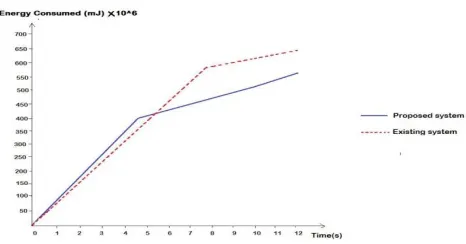
This graph explains the energy consumption ratio between the existing system and the proposed system. By using cluster computing system we reduce the energy consumption in proposed system. Compare to the existing system, in our proposed system the energy consumption is decreased by 11%. This graph explains time versus energy consumption. By using cluster computing system only we achieve this low value energy consumption. The energy consumption achieved by wireless computing system is 650 kJ (i.e., in existing system). But in cluster computing system that is proposed system the energy consumption is reduced when comparison with existing system by 11%.the energy consumed by cluster computing system is 580kJ.
4.3 Evaluating the Improvement in Throughput
This graph explains the throughput ratio between the Existing system and proposed system. Throughput is nothing but number of successful message transmitted to destination. By using cluster computing system we can achieve this much level of throughput. Compare to the wireless computing system, we can easily achieve the throughput highly in cluster computing system. In the existing system the through put value is low, but we improve this throughput in cluster computing system. For this graph explains the increased throughput level in proposed system. The throughput achieved by existing system (wireless computing system) is 210kbps but by proposed system (cluster computing system) it is nearly upto 320kbps i.e., 36% of improvement in throughput is achieved by using cluster computing system.
Fig-7: Evaluating the improvement in Throughput
V. CONCLUSION
Towards the realization of smart factories based on wireless sensor networks, in this paper, we investigated a novel computing system and its operation scheme. Since conventional computing systems lack the capabilities required for providing industrial IOT applications (i.e., high processing and communication capability, high durability, and low power consumption), we first introduced a computing system based on clustering technology. Additionally, we derived a mathematical model to evaluate the performance of our envisioned system based on complex network theory. This model showed the existence of a trade-off relationship between power consumption and delay aware for data collection. Consequently, we proposed an energy-efficient and throughput system operation scheme. Our proposed scheme controls the sleep scheduling and network connectivity to reduce the system power consumption while satisfying an acceptable delay, which is decided based on the requirement of industrial IOT applications. Simulation results showed that by appropriately selecting the number of servers in sleep state and the degree of servers in active state, the proposal can improve both the system power consumption and satisfaction ratio of throughput compared to other approaches.
REFERENCES
[1] Katsuya Suto, Hiroki Nishiyama, Nei kato, “An Energy-Efficient and Delay Aware Wireless Computing System for Industrial Wireless Sensor Network,” IEEE Internet Things , vol. 3,pp.2169-3536,Apr.2015.
[2] S. Savazzi, V. Rampa, and U. Spagnolini, ``Wireless cloud networks for the factory of things: Connectivity modeling and layout design,'' IEEE Internet Things J., vol. 1, no. 2, pp. 180_195, Apr. 2014.
[3] E. Shellshear, R. Berlin, and J. S. Carlson, ``Maximizing smart factory systems by incrementally updating point clouds,'' IEEE Comput. Graph Appl., vol. 35, no. 2, pp. 62_69, Mar./Apr. 2015.
[4] J. Pan, L. Cai, Y. T. Hou, Y. Shi, and S. X. Shen, ``Optimal base-station locations in two-tiered wireless sensor networks,'IEEE Trans. Mobile Comput., vol. 4, no. 5, pp. 458_473, Sep./Oct. 2005.
[5] F. Wang, C. Xu, L. Song, and Z. Han, ``Energy-efficient resource allocation for device-to-device underlay communication,'' IEEE Trans. Wireless Commun., vol. 14, no. 4, pp. 2082_2092, Apr. 2015.
[6] M. R. Palattella, N. Accettura, L. A. Grieco, G. Boggia, M. Dohler, and T. Engel, ``On optimal scheduling in duty-cycled industrial IoT applications using IEEE802.15.4e TSCH,'' IEEE Sensors J., vol. 13, no. 10, pp. 3655_3666, Oct. 2013.
[7] F. Salvadori et al., ``Monitoring in industrial systems using wireless sensor network with dynamic power management,'' IEEE Trans. Instrum. Meas., vol. 58, no. 9, pp. 3104_3111, Sep. 2009.
[9] F. Bonomi, R. Milito, J. Zhu, and S. Addepalli, ``Fog computing and its role in the Internet of Things,'' in Proc. SIGCOMM, Helsinki, Finland, 2012,pp. 13_16.
[10] K. Ahmed and M. Gregory, ``Integrating wireless sensor networks with cloud computing,'' in Proc. 7th MSN, Beijing, China, 2011,pp. 364_366.
[11] J.-Y. Shin, E. G. Sirer, H. Weatherspoon, and D. Kirovski, ``On the feasibility of completely wireless datacenters,'' in Proc. 8th ACM/IEEE Symp. Archit. Netw. Commun.Syst,.New York, NY,USA,Oct.2012,pp.3_14.
[12] J.-Y. Shin, E. G. Sirer, H.Weatherspoon, and D.Kirovski,"On the feasibility of completely wireless datacenters", IEEE/ACM Tran. Netw., vol. 21, no. 5, pp. 1666_1679, Oct.2013.
[13] K. Suto, H. Nishiyama, N. Kato, T. Nakachi, T. Sakano, and A. Takahara, ``A failure-tolerant and spectrum-efficient wireless data center network design for improving performance of big date mining,'' in Proc. 81th VTC,Glasgow, Scotland, May 2015, pp. 1_5.
[14] A. M. Niknejad, ``Siliconization of 60 GHz,'' IEEE Microw. Mag., vol. 11,no. 1, pp. 78_85, Feb. 2010.
[15] S. Pinel et al., ``60 GHz single-chip CMOS digital radios and phased array solutions for gaming and connectivity," IEEE J. Sel. Areas Commun, vol. 27, no. 8, pp. 1347_1357, Oct.2009.
[16] Z. Guo and Y. Yang, ``On nonblocking multicast fat-tree data center networks with server redundancy,'' IEEE Trans. Comput., vol. 64, no. 4,pp. 1058_1073, Apr. 2014.
[17] Cisco. (2009). Cisco Catalyst3750 Series Switches.[Online].Available:http://www.cisco.com/c/en/us/products/coll ateral/switches/catalyst-3750