Vol. 4, Issue 2, February 2015
An Object Oriented Approach to model
Automated Library Book Management
Systems
R.Valarmathi
1, R.Thiyagaraj
2, J.Jayapriya
3, Prof.M.Sowmiya
4and Prof.S.Balamurugan
5 Department of IT, Kalaignar Karunanidhi Institute of Technology, Coimbatore, TamilNadu, India1,2,3,4,5ABSTRACT:This paper examines the relationship between students and the library. It has been acknowledged that library management serves a major role for the students learning. The proposed modeling methodology is based on the principle of object orientation, which allows describing both software and functionalities explicitly. Furthermore, it is illustrated how the well-known object-oriented specification language unified modeling language can be adopted, to provided an adequate formalization of its semantics, to describe structural and behavioral aspects of online personal finance management system related to both logical and physical parts. It is needed to implement the software on the basis of Object Oriented Model developed. Flaw in modeling process can substantially contribute to the development cost and time. The operational efficiency may be affected as well. Therefore special attention should be paid to the correctness of the models that are used at all planning levels and hence Unified Modeling Language (UML) takes its impeccable role.
KEYWORDS: Functional Model, Behavioral Model, Object, Modeling, Operational Efficiency.
I. INTRODUCTION
Most of the effort to date in object oriented community has been focused on programming language issues. Object-oriented programming languages are useful in removing restrictions due to the inflexibility of traditional programming languages. In a sense, however, this emphasis is a step backwards for software engineering by focusing excessively on implementation mechanisms, rather than the underlying thought process that they support.
The real pay-off comes from addressing front-end conceptual issues, rather than back-end implementation issues. Design flaws that surface during implementation are most costly to fix than those that are found earlier. Focusing on implementation issues too early restricts the design choices and often leads to inferior product. An object-oriented development approach encourages software developers to work and think in terms of application domain through most of the software engineering lifecycle.
Vol. 4, Issue 2, February 2015
UML models may be automatically transformed to other representations (e.g. Java) by means of QVT-like transformation languages, supported by the OMG. UML is extensible, offering the following mechanisms for customization: profiles and stereotype. The semantics of extension by profiles have been improved with the UML 1.0 major revision. It is very important to distinguish between the UML model and the set of diagrams of a system. A diagram is a partial graphical representation of a system's model. The model also contains a "semantic backplane" — documentation such as written use cases that drive the model elements and diagrams. UML diagrams represent three different views of a system model:
Functional requirements view: Emphasizes the functional requirements of the system from the user's point of view. And includes use case diagrams.
Static structural view: Emphasizes the static structure of the system using objects, attributes, operations and relationships. And includes class diagrams and composite structure diagrams.
Dynamic behavior view: Emphasizes the dynamic behavior of the system by showing collaborations among objects and changes to the internal states of objects. And includes sequence diagrams, activity diagrams and state machine diagrams.
II. CLASS DIAGRAM
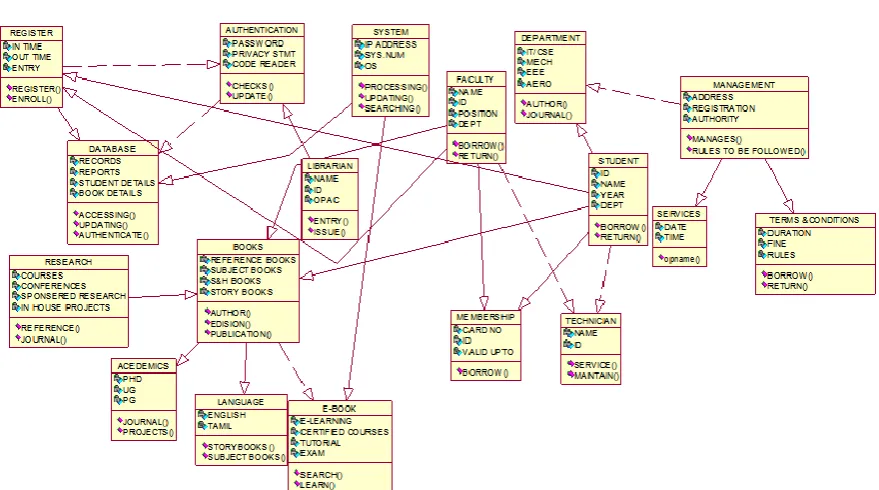
Fig Class Diagram for Book Bank Management System
III.USE CASE DIAGRAM
Use case diagrams model the functionality of a system using actors and use cases. Use cases are services or functions provided by the system to its users. The components in a use case diagram include:
Actors: Actors represent external entities of the system. These can be people or things that interact with the system that is being modeled. For example, if we are modeling an online store we have many actors that interact with the store functionality. The customer browses the catalog, chooses items to buy, and pays for those items. A stocker will look at the orders and package items for the customer. A billing system will charge the customer's credit card for the amount purchase.
Vol. 4, Issue 2, February 2015
actors can share use cases. If we find a use case that is not associated with any actor, this may be a unnecessary functionality.
Associations: Associations are shown between actors and use cases, by drawing a solid line between them. This only represents that and actor uses the use case.
There are also two kinds of relationships between use cases:
Includes : Use cases that are associated with actors can be very general. Sometimes they "include" more specific functionality. For example, the "pump gas" use case that is associated with the customer includes three use cases: Choose Gas Type, Fill Tank, and Calculate Total. Includes relationship is represented by dashed arrows that point to the included functionality. Beside the arrow is <<includes>>.
Extends : An extension use case is an insertion to the base use case. For example, some stores may allow for different payment options like credit card, debit card, or cash on delivery. These specific functionalities are extension of the general "pay for items." Extends relationship is represented by dashed arrows that point to the base functionality. Beside the arrow is <<extends>>
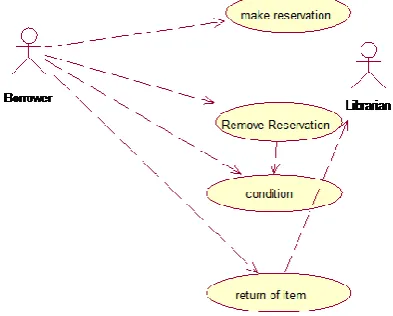
Fig2. Use Case Diagram for Borrower Reservation System
Vol. 4, Issue 2, February 2015
IV.INTERACTIONDIAGRAM
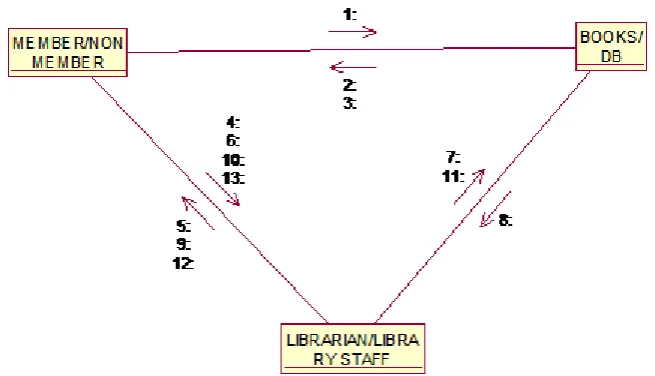
Interaction diagrams are used to model the behaviour of the use cases by describing the way in which the group of objects interact to the complete task.There are two types of interaction diagram sequence and calibration diagram. Inorder to model the behaviour of the several objects in a use case diagram interaction diagrams are used. This diagram is to demonstrate how the object supports for the behavior.Meanwhile the collaboration diagram does not give the deep representstion of the behaviour.The interaction of object in the usecase is done bysequence diagram,collaboration diagram or by both diagrams.The sequence diagrams are used to represent the sequence of events that occurs.collaboration diagrams are used to represent how the objects are connected.
The interactions which has occurred are shown by the sequence diagram in the sequential order. Diagram Elements:
Object. Each of the objects that participate in the sequence diagram. It is drawn across the top. Note that objects are used in this diagram while classes are used in use cases, class diagrams.
Lifeline. A dotted line is dropped from each object in the sequence diagram. Arrows terminating on the lifeline indicate messages (commands) sent to the object. Arrows originating on the lifeline indicate messages sent from this object to another object. Time flows from top to bottom on a sequence diagram.
Active. To indicate that an object is executing, i.e., it has control of the CPU, the lifeline is drawn as a thin rectangle.
Message. A horizontal arrow represents a message (command) sent from one object to another. Note that parameters can be passed as part of the message and can (optionally) be noted on the diagram.
Return. When one object commands another, a value is often returned. This may be a value computed by the object as a result of the command or a return code indicating whether the object completed processing the command successfully. In some instances the object may not be able to return this information immediately. This indicates the flow of information was based on a previous request.
Iteration. Square brackets preceeded by an asterisk (*) indicate iteration. The message is sent multiple times. The expression within the brackets describes the iteration rule.
Deletion. An X is used to indicate the termination (deletion) of an object
Vol. 4, Issue 2, February 2015
Vol. 4, Issue 2, February 2015
1:
borrower administrator :
_BindingIteratorImplBase
database : _BindingIteratorImplBase
5:
7: 2: 6: 10: 14: 16:
8: 11: 18:
12:
13: 3:
9: 15: 17: 4:
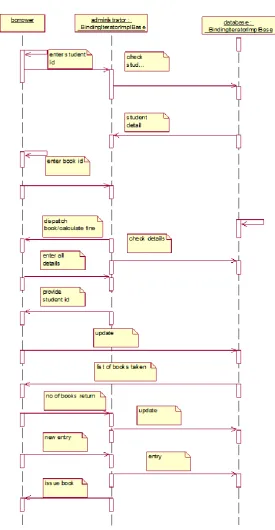
Fig 5. Collaboration Diagram for Issue of Book
Vol. 4, Issue 2, February 2015
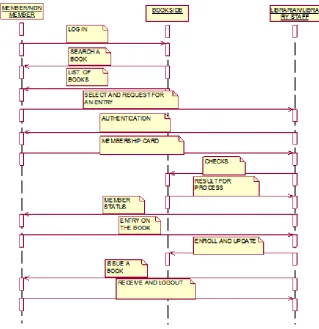
Fig 7.Collaboration Diagram for Searching of Book
V. CONCLUSION AND FUTURE WORK
The paper has focused on the essential and extended Object Oriented features of a library book management system. Various models of UML have been employed to analyze the static, dynamic and functional view of the system. In spite there are lot of functionalities rendered by mobile phones using recent emerging technologies,the mobilephones advancement deserves a major breakthrough.in a few years from now it is expected that mobile phones would replace most of the handheld systems,incorporating modern operating systems such as android 2.3 gingerbread,meego and windows phone and its emergent higher versions. Inorder to further enhance the features provided by the current day smartphones, an object oriented approach would add in the developmental growth .Our further work is focused on developing an ER modeling approach to implement with JAVA as a frontend and MY SQL , the online database as a backend and by establishing JDBC connectivity.The same is planned to be tested using Rational Test Manager.
REFERENCES
1. B.Powmya,NikitaMaryAblett,V.MohanaPriya,S.Balamurugan,”An Object Oriented Approach to model the secure Healthcare Database system”, In the proceedings of international conference on compter, communication and signal processing(IC3SP),in Association with IETE Students Forum and The Society of Digital Information and Wireless communication SDIWC,2011,pp.2-3.
2. Conrad Bock, U.S. National Institute of Standards and Technology, “UML 2 Composition Model”, Journal of Object Technology, Vol.3, No.10, 2007
3. Thomas M.Atwood, “The Case for Object Oriented Databases” IEEE Spectrum, 0018-9235/91/ 0002-004, pp 44-48, 2007
4. James Rumbaugh, Michael Blaha, William Premerlani, Frederick Eddy, William Lorensen “Object Oriented Modeling and Design”, Prentice-Hall of India Private Limited.
5. Grady Booch, “Object-Oriented Analysis & Design with Applications”, Pearson Education
6. Rogert.S.Pressman, “Software Engineering:A Practioner’s Approach” Fifth Edition, McGraw-Hill Higher Education. 7. Armour, Frank, and Granville Miller. Advanced Use Case Modeling: Software Systems. Addison-Wesley, 2000. 8. http://atlas.kennesaw.edu/~dbraun/csis4650/A&D/UML_tutorial/state.htm
9. http://visualcase.com/tutorials/interactions-diagram.htm 10. http://developer.com/design/article.php/2206791
11. Balamurugan Shanmugam, Visalakshi Palaniswami, “Modified Partitioning Algorithm for Privacy Preservation in Microdata Publishing with Full Functional Dependencies”, Australian Journal of Basic and Applied Sciences, 7(8): pp.316-323, July 2013
12. Balamurugan Shanmugam, Visalakshi Palaniswami, R.Santhya, R.S.Venkatesh “Strategies for Privacy Preserving Publishing of Functionally Dependent Sensitive Data: A State-of-the-Art-Survey”, Australian Journal of Basic and Applied Sciences, 8(15) September 2014.
13. S.Balamurugan, P.Visalakshi, V.M.Prabhakaran, S.Chranyaa, S.Sankaranarayanan, "Strategies for Solving the NP-Hard Workflow Scheduling Problems in Cloud Computing Environments", Australian Journal of Basic and Applied Sciences, 8(15) October 2014.
Vol. 4, Issue 2, February 2015
15. Charanyaa, S., et. al., Certain Investigations on Approaches forProtecting Graph Privacy in Data Anonymization. International Journal of Advanced Research in Computer and Communication Engineering, 1(8): 5722-5728, 2013.
16. Charanyaa, S., et. al., Proposing a Novel Synergized K-Degree L-Diversity T-Closeness Model for Graph Based Data Anonymization. International Journal of Innovative Research in Computer and Communication Engineering, 2(3): 3554-3561, 2014.
17. Charanyaa, S., et. al., , Strategies for Knowledge Based Attack Detection in Graphical Data Anonymization. International Journal of Advanced Research in Computer and Communication Engineering, 3(2): 5722-5728, 2014.
18. Charanyaa, S., et. al., Term Frequency Based Sequence Generation Algorithm for Graph Based Data Anonymization International Journal of Innovative Research in Computer and Communication Engineering, 2(2): 3033-3040, 2014.
19. V.M.Prabhakaran, Prof.S.Balamurugan, S.Charanyaa," Certain Investigations on Strategies for Protecting Medical Data in Cloud", International Journal of Innovative Research in Computer and Communication Engineering Vol 2, Issue 10, October 2014
20. V.M.Prabhakaran, Prof.S.Balamurugan, S.Charanyaa," Investigations on Remote Virtual Machine to Secure Lifetime PHR in Cloud ", International Journal of Innovative Research in Computer and Communication Engineering Vol 2, Issue 10, October 2014
21. V.M.Prabhakaran, Prof.S.Balamurugan, S.Charanyaa," Privacy Preserving Personal Health Care Data in Cloud" , International Advanced Research Journal in Science, Engineering and Technology Vol 1, Issue 2, October 2014
22. P.Andrew, J.Anish Kumar, R.Santhya, Prof.S.Balamurugan, S.Charanyaa, "Investigations on Evolution of Strategies to Preserve Privacy of Moving Data Objects" International Journal of Innovative Research in Computer and Communication Engineering, 2(2): 3033-3040, 2014. 23. P.Andrew, J.Anish Kumar, R.Santhya, Prof.S.Balamurugan, S.Charanyaa, " Certain Investigations on Securing Moving Data Objects"
International Journal of Innovative Research in Computer and Communication Engineering, 2(2): 3033-3040, 2014.
24. P.Andrew, J.Anish Kumar, R.Santhya, Prof.S.Balamurugan, S.Charanyaa, " Survey on Approaches Developed for Preserving Privacy of Data Objects" International Advanced Research Journal in Science, Engineering and Technology Vol 1, Issue 2, October 2014
25. S.Jeevitha, R.Santhya, Prof.S.Balamurugan, S.Charanyaa, " Privacy Preserving Personal Health Care Data in Cloud" International Advanced Research Journal in Science, Engineering and Technology Vol 1, Issue 2, October 2014.
26. K.Deepika, P.Andrew, R.Santhya, S.Balamurugan, S.Charanyaa, "Investigations on Methods Evolved for Protecting Sensitive Data", International Advanced Research Journal in Science, Engineering and Technology Vol 1, Issue 4, Decermber 2014.
27. K.Deepika, P.Andrew, R.Santhya, S.Balamurugan, S.Charanyaa, "A Survey on Approaches Developed for Data Anonymization", International Advanced Research Journal in Science, Engineering and Technology Vol 1, Issue 4, Decermber 2014.
28. S.Balamurugan, S.Charanyaa, "Principles of Social Network Data Security" LAP Verlag, Germany, ISBN: 978-3-659-61207-7, 2014 29. S.Balamurugan, ,M.Sowmiya and S.Charanyaa, "Principles of Scheduling in Cloud Computing" Scholars' Press, Germany,, ISBN:
978-3-639-66950-3, 2014