SITE ANALYSIS USING RANDOM VIBRATION THEORY
Alejandro P. Asfura1
1
President APA Consulting, USA
ABSTRACT
This paper compares two methods for the seismic analysis of soil sites when the randomness in the input motion and soil properties is included. The first method is the traditional time history analysis method where the input motion is defined by acceleration time histories. The second method uses random vibration theory with the input motion defined by a mean pseudo-acceleration response spectrum. To study the effect of the two sources of randomness, two sets of analyses are performed. First, only the randomness of the input motion is considered with the soil defined by its mean properties. Secondly, the randomness of the input motion and the randomness of the soil properties are both considered. The mean and the standard deviation of the surface pseudo-acceleration response spectra and the mean of the strain compatible soil properties are calculated using both methods. The comparison of the results of these two methods shows that the use of random vibration techniques is a valid and economical method for soil site analyses and that this method accurately captures the effects of the randomness of soil properties and input motions.
1.0 INTRODUCTION
The typical methodology for developing uniform hazard response spectra at a site involves two steps: the first step is the generation of a bedrock pseudo-acceleration response spectrum; and the second step is the propagation of this bedrock motion to the soil surface or to the structures' foundation level. In the second step the randomness of the soil properties and the input motion is considered. This paper discusses two methods for the second step of the process, commonly referred to as “site analysis.”
To account for the randomness in soil properties and input motion in the site analysis two methods can be used: a time history analysis method (e.g., Monte Carlo sampling, Latin Hypercube sampling) or a random vibration method. This paper presents a comparison between these two methods.
The surface pseudo-acceleration response spectra, the strain compatible soil shear wave velocity, and the strain compatible soil material damping resulting calculated by both methods are compared. This comparison shows that the use of random vibration techniques is a valid and economical method for performing site analyses and that this method accurately captures the effects of the randomness of soil properties and input motions.
2.0 ANALYSIS
23 Conference on Structural Mechanics in Reactor Technology Manchester, United Kingdom - August 10-14, 2015 Division V
2.1 Time History Method Description
The seismic input motion at a particular site is normally defined by a pseudo-acceleration response spectrum. Thus, to perform a time history analysis it is necessary to generate an artificial acceleration record such that its pseudo-acceleration response spectrum matches the input pseudo-acceleration response spectrum. If the randomness of the seismic input is considered, then a suite of time histories needs to be generated such that the mean and the standard deviation of their pseudo- acceleration response spectra match the mean and the standard deviation of the input pseudo-acceleration response spectrum. For the study described in this paper, a suite of 30 acceleration time histories is developed. Computer program SHAKE91 (Idriss and Sun, 1992) is used then to propagate these 30 acceleration time histories from the bedrock to the surface of the soil profile and to calculate the strain compatible soil shear wave velocity and soil material damping.
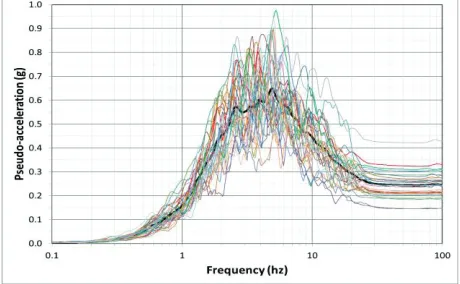
The pseudo-acceleration response spectra of these 30 acceleration time histories at 5% damping used in this paper are shown in Figure 1. The thick black line corresponds to the mean of the pseudo-acceleration response spectra of the 30 acceleration time histories. As shown in this figure, the pseudo-acceleration response spectra of the acceleration time histories are different from one another both in frequency content and amplitude.
Figure 1. Pseudo-acceleration response spectra from 30 acceleration time histories.
2.2 Random Vibration Method Description
The input motion for a site analysis performed with the random vibration method is a mean pseudo-acceleration response spectrum. Implicit in this approach is the fact that this mean pseudo-pseudo-acceleration response spectrum represents the mean of the pseudo-acceleration response spectra of an infinite number of acceleration time histories. The mean pseudo-acceleration response spectrum used in this paper is shown in Figure 1 (thick black line).
The results of this type of analysis are the statistics of the soil maximum responses (e.g., surface pseudo-acceleration response spectra, strain compatible soil properties). For this paper, only the mean and the
standard deviation of the maximum responses are calculated. The mean X and standard deviation s of the
peak responses can be expressed in terms of the peak factors p and q and the zero moment, l0,of the
response as follows:
ò
¥
=
0
0
(
w
)
w
Division V
X
=
p
l
0 (2)
s
=
q
l
0 (3)Where G(w) is the one-sided power spectral density function of the response. Expressions for p and q can
be found in Davenport (1964), Der Kiureghian (1980 and 1981), and Igusa and der Kiureghian (1983).
The analysis in this approach begins with the conversion of the input pseudo-acceleration response spectrum, through an iterative process, into a power spectral density function. Then this power spectral density function is combined with the transfer function of the required response to obtain the power spectral density function of that response.
Once the power spectral density function of the required response is known, expressions developed by various authors (e.g., Davenport, 1964; Der Kiureghian, 1980 and 1981; and Igusa and der Kiureghian, 1983) can be used to calculate the statistical parameters of the maximum of that response.
The expressions developed by A. Der Kiureghian and T. Igusa (1980, 1981, and 1983) were implemented by the Author in computer code APA-SHAKE. This code is used in the site analyses described in this paper to propagate the input pseudo- acceleration response spectrum from the bedrock to the surface of the soil profile and to calculate the strain compatible soil shear wave velocity and soil material damping.
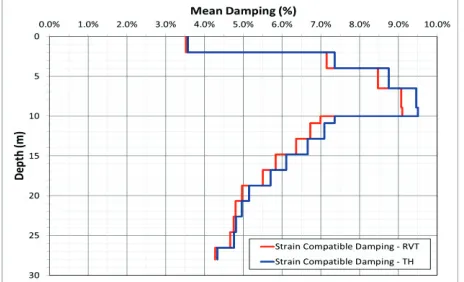
The random vibration method accounts for only the randomness of the input motion, thus to account for the randomness in soil properties, 30 soil profiles are analyzed in this paper. The mean and the standard deviation of the responses are calculated for each soil profile and then combined to calculate the mean and standard deviation of the responses of the complete sample.
The mean value of the complete sample is the mean of the individual 30 mean values. The standard deviation, ss, of the complete sample is calculated as:
X
X
M
Mn M
n
s
[
(
)
]
/
1 2 1 2
å
å
+
-=
s
s
(4)Where M is equal to the number of profiles used in the calculation (30 for this study), sn is the standard
deviation of the response of soil profile n, X is the mean of the response of the complete sample, and Xn is
the mean of the response of soil profile n.
2.3 Soil Profiles
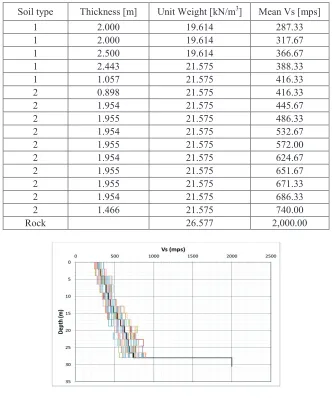
For this paper, a base soil profile is randomized to generate 30 soil profiles. The base soil profile consists of two types of soils up to a depth of 28 meters overlaying a rock half space. Each soil layer of the base soil profile is individually randomized, so the variation of properties with depth is not uniform for each of the resulting 30 profiles. The shear wave velocities of these 30 soil profiles are shown in Figure 2. The thick black line corresponds to the mean of the shear wave velocities of the 30 soil profiles (mean profile). Table 1 lists the properties of the mean soil profile.
23 Conference on Structural Mechanics in Reactor Technology Manchester, United Kingdom - August 10-14, 2015 Division V
Table 1: Soil properties – mean profile.
Soil type Thickness [m] Unit Weight [kN/m3] Mean Vs [mps]
1 2.000 19.614 287.33
1 2.000 19.614 317.67
1 2.500 19.614 366.67
1 2.443 21.575 388.33
1 1.057 21.575 416.33
2 0.898 21.575 416.33
2 1.954 21.575 445.67
2 1.955 21.575 486.33
2 1.954 21.575 532.67
2 1.955 21.575 572.00
2 1.954 21.575 624.67
2 1.955 21.575 651.67
2 1.955 21.575 671.33
2 1.954 21.575 686.33
2 1.466 21.575 740.00
Rock 26.577 2,000.00
Figure 2. Randomized soil shear wave velocity profiles.
Figure 4. Variation of soil damping with shear strain.
2.4 Analysis for Mean Soil Profile
In the first set of site analyses, only the mean soil profile is used. Thus, only the randomness of the input motion is considered in these initial site analyses.
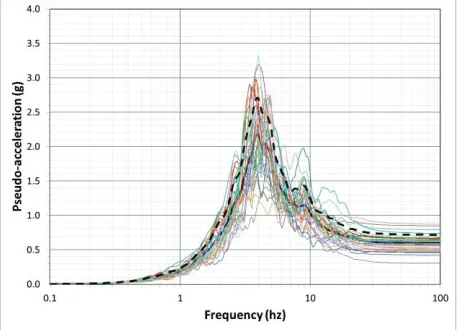
For the initial time history site analysis, the mean soil profile is analyzed for each of the 30 acceleration time histories using computer code SHAKE91. It is considered that 30 time history analyses are enough to capture the mean and standard deviation of an infinite number of time history analyses. Figure 5 shows the surface pseudo-acceleration response spectra at 5% damping for the 30 time history analyses. In that figure, the mean and the mean plus one standard deviation of the surface response spectra are also shown. The continuous thick black line is the mean of the surface pseudo-acceleration response spectra and the dashed thick black line is the mean plus one standard deviation of the surface pseudo-acceleration response spectra.
Figure 5. Surface pseudo-acceleration response spectra from 30 time history analyses – mean soil profile.
23 Conference on Structural Mechanics in Reactor Technology Manchester, United Kingdom - August 10-14, 2015 Division V
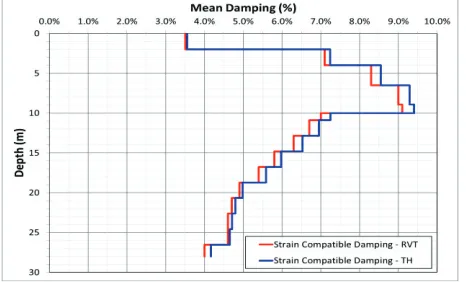
the results from one random vibration analysis are small. The mean and the mean plus one standard deviation of the surface pseudo-acceleration response spectra (Figure 6) from both methods of analyses are virtually identical. Figure 9 shows the ratio between the mean soil properties calculated with the random vibration method and the mean soil properties calculated with the time history method. The differences between the two methods for the mean soil damping are less than 4% and the differences for the mean shear wave velocity are less than 1.5%.
Figure 6. Comparison of surface pseudo-acceleration response spectra – mean soil profile.
Figure 7. Comparison of mean shear wave velocity profiles – mean soil profile.
Figure 9. Ratio of mean soil properties (RVT/TH) – mean soil profile.
These results show that sites analyses performed using the random vibration method accurately calculate soil site responses including the randomness of the input motion.
2.5 Analysis for Randomized Soil Profile
In the second set of analyses, all the 30 soil profiles and the 30 input time histories are used. This implies that the randomness in the input motion and the randomness of the soil properties are included in the analyses. The pseudo- acceleration response spectra of the 30 time histories are shown in Figure 1 and the 30 randomized soil shear wave velocity profiles are shown in Figure 2.
For the time history site analyses a Latin Hypercube sampling is used instead of a complete Monte Carlo sampling. Thus, each acceleration time history was randomly paired to a unique soil profile. In this way only 30 analyses with computer code SHAKE91 are performed. It is considered that the use of the Latin Hypercube sampling results on an accurate estimate of the mean and the standard deviation of the combination of an infinite number of time histories and soil profiles. Figure 10 shows the surface pseudo-acceleration response spectra at 5% damping for the 30 time history analyses. In this figure, the mean (continuous thick black line) and the mean plus one standard deviation (dashed thick black line) of these surface pseudo-acceleration spectra are also shown.
Figure 10. Surface pseudo-acceleration response spectra from 30 TH analyses – randomized soil profile.
23 Conference on Structural Mechanics in Reactor Technology Manchester, United Kingdom - August 10-14, 2015 Division V
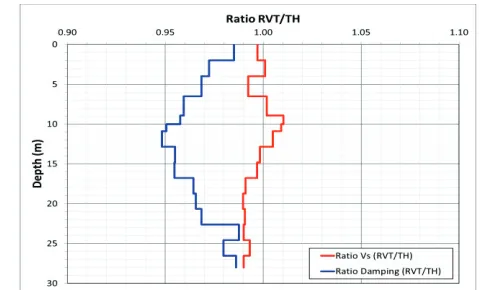
11 shows the comparison of the mean and mean plus standard deviation of the surface pseudo-acceleration response spectra. Figure 12 shows the comparison of the mean of the strain compatible shear wave velocity profiles and Figure 13 shows the mean of the strain compatible soil damping profiles. The differences between the results from the time history analyses and the results from the random vibration analyses are again small. The mean and the mean plus one standard deviation of the surface pseudo-acceleration response spectra (Figure 11) from both methods are virtually identical. Figure 14 shows the ratio between the soil mean properties calculated with the random vibration method and the soil mean properties calculated with the time history analyses. The differences of soil damping ratios are less than about 5% and the differences of shear wave velocities are less than about 1%.
Figure 11. Surface pseudo-acceleration response spectra – randomized soil profile.
Figure 12. Comparison of mean shear wave velocity profiles – randomized soil profile.
Figure 14. Ratio of mean soil properties (RVT/TH) – randomized soil profile.
3.0 CONCLUSION
The study described in this paper shows that the application of random vibration theory to site analyses is an economical, less labor intensive, more efficient, and accurate alternative to the traditional time history site analysis when the randomness in soil properties and randomness in input motion are considered.
REFERENCES
Davenport, A.G. (1964). “Note on the Distribution of the Largest Value of a Random Function with
Application to Gust Loading.” Proceedings, Institution of Civil Engineers, vol. 28, pp. 187-196.
Der Kiureghian, A. (1980). “Structural Response to Stationary Excitation.” Journal of the Engineering Mechanics Division, vol. 106, no. EM6, pp. 1195-1213.
Der Kiureghian, A. (1981). “A Response Spectrum Method for Random Vibration Analysis of MDF
Systems.” Earthquake Engineering and Structural Dynamics, vol. 9, pp. 419-435.
Idriss, I. M. and Sun, J. I. (1992). “SHAKE91. A Computer Program for Conducting Equivalent Linear
Seismic Response Analyses of Horizontally Layered Soil Deposits.” Department of Civil &
Environmental Engineering, University of California, Davis.
Igusa, T.and Der Kiureghian, A. (1983). “Dynamic Analysis of Multiply Tuned and Arbitrarily Supported