BELLEZZA, SHANNON WEEMS. Teacher Efficacy for Behavior Management: An Examination of the Construct and its Predictors. (Under the direction of Dr. Edward Sabornie).
In a meta-analysis, Wang, Haertel, and Walberg (1993) found that out of 228 variables, classroom management had the greatest influence on student achievement. It is perplexing, then, that classroom management is consistently the one area in which teachers report the least expertise (Maag, 2001; Milner & Tenore, 2010; Ritter & Hancock, 2007; Sokal, Smith, & Mowat, 2003). The construct Classroom Management, however, is not uniformly defined and may mean different things to different people. It is important to understand the underlying construct so that teachers’ feelings of expertise for it can be measured in the most precise way in order to more effectively target intervention.
by
Shannon Weems Bellezza
A dissertation submitted to the Graduate Faculty of North Carolina State University
in partial fulfillment of the requirements for the degree of
Doctor of Philosophy
Curriculum & Instruction
Raleigh, North Carolina 2015
APPROVED BY:
_______________________________ _______________________________ Edward Sabornie Susan Osborne
Committee Chair
DEDICATION
BIOGRAPHY
Shannon Weems Bellezza was born on April 19, 1978 in Morristown, New Jersey, though grew up in Salisbury, North Carolina. After graduating from West Rowan High School in 1995, Shannon attended UNC-Chapel Hill, earning a B.A. in Psychology in 1999. As a lateral-entry special education teacher, Shannon began work on her M.Ed. in Special Education at North Carolina State University (completed in 2006) where she met her husband, Sam Bellezza. It was also during this time that Shannon fell in love with the science of behavior management and was inspired to pursue a doctorate.
ACKNOWLEDGMENTS
I would like to thank my advisor, Dr. Edward Sabornie, for his inspiration, guidance, and encouragement. It was in his Classroom Management course that I became fascinated with the science of behavior management, and I will be forever grateful for his knowledge, enthusiasm, and passion for Applied Behavior Analysis and special education. I have truly enjoyed working with and learning from you all of these years.
I would also like to thank the rest of my committee: Dr. Susan Osborne,
Dr. Jessica Decuir-Gunby, and Dr. Shevaun Neupert. Your support and expertise have been invaluable and immensely helpful. I have learned so much from each of you.
Thank you to my husband, Sam, for your support throughout this entire process. You always believed in me and encouraged me to push through. Thank you for sacrificing so much for our family to allow me to reach my dream. It did not go unnoticed.
Thank you to my dude, Paolo, for your constant reminder of everything good in the world.
Thank you to my dad, Earl Weems, for everything. I never would have accomplished this had you not fought so hard for me all my life. You’ve always been in my corner.
I would like to thank Dr. Annette Broadwell and Dr. Beverly McLaughlin at the NCSU Counseling Center for facilitating the women’s dissertation support group. Without your encouragement and guidance, I’m pretty sure I’d still be stuck on my literature review.
TABLE OF CONTENTS
LIST OF TABLES ... xii
LIST OF FIGURES ... xiv
CHAPTER 1. INTRODUCTION ... 1
Background ... 1
Significance of the Study ... 2
Research Questions………...……..3
Overview of Methodology………...………...………4
Definition of Terms………...……..4
CHAPTER 2. REVIEW OF THE LITERATURE ... 8
Teacher Efficacy ... 8
Factors that Influence Teacher Efficacy ... 8
The History of Teacher Efficacy as a Construct ... 10
Rotter’s Social Learning Theory ... 10
Bandura’s Self-Efficacy Theory ... 11
Unified Definition and the Teachers’ Sense of Efficacy Scale ... 12
The TSES in the Literature ... 14
Classroom Management ... 15
Defining Classroom Management ... 15
The Importance of Training and Experience in Classroom and
Behavior Management ... 18
Inadequate Classroom and Behavior Management Preparation ... 22
Teacher Efficacy for Classroom and Behavior Management, Burnout, and Attrition ... 28
Approaches to Classroom Management ... 31
Behaviorism ... 32
Applied Behavior Analysis ... 32
Methods in ABA ... 34
Positive Behavioral Intervention and Support ... 35
Proactive Behavior Management and PBIS—The Primary Level ... 36
Reactive Behavior Management and PBIS—The Secondary and Tertiary Levels ... 37
Effectiveness of PBIS ... 38
Efficacy for Classroom Management: Bi-Dimensional Construct, Unitary Measures ... 40
Gibson and Dembo (1984) ... 42
Emmer and Hickman (1991) ... 43
Brownell and Pajares (1999) ... 44
Tschannen-Moran and Woolfolk-Hoy (2001) ... 44
Summary ... 45
CHAPTER 3. METHODS ... 48
Mixed Methods ... 48
Philosophical Assumptions ... 49
Statement of Bias ... 50
Design ... 51
Instrumentation ... 52
Teachers’ Sense of Efficacy Scale ... 52
Demographic Survey ... 52
Behavior Management Confidence Inventory ... 53
Semi-Structured Interview Protocol ... 54
Reliability ... 54
Validity ... 55
Sample and Procedures ... 56
Data Analysis ... 58
Quantitative ... 58
Regression and ANOVA ... 59
Mediation Analyses ... 60
Repeated Measures ANOVA ... 60
Qualitative ... 60
CHAPTER 4. RESULTS ... 62
Quantitative Data ... 62
Factor Analyses ... 62
Teachers’ Sense of Efficacy Scale ... 62
Behavior Management Confidence Inventory ... 63
Teacher Predictors of and Group Differences for Efficacy for Management of Problematic Behaviors ... 64
Teaching Degree ... 67
Differences Between TSES Scale Scores by Group Membership ... 68
Qualitative Data ... 69
The Art of Behavior Management ... 70
Relationships ... 70
Personality ... 71
The Science of Behavior Management ... 72
Positive Reinforcement as Motivation ... 73
Expectations and Procedures ... 74
Sources of Knowledge ... 77
Informal Learning ... 77
Formal Learning ... 78
Necessities and Facilitators for Effective Behavior Management ... 79
Consistency ... 79
Support ... 80
Qualitative Summary ... 83
Integration of Quantitative and Qualitative Data ... 84
Summary of Findings ... 86
Factor Structure of the Teachers’ Sense of Efficacy Scale ... 86
Factor Structure of the Behavior Management Confidence Inventory ... 86
Relationships Between Teacher Variables, Efficacy, and Behavior Management Confidence ... 87
Relationship Between Efficacy and Competence ... 88
Teachers’ Lived Experiences of Behavior Management in the Classroom ... 88
CHAPTER 5. DISCUSSION ... 89
Discussion of Findings ... 89
Implications for Practice ... 92
Teacher Education ... 92
PBIS ... 93
Attrition ... 93
Future Research ... 94
Limitations ... 95
Sampling Issues ... 95
Instrumentation Issues ... 95
Missing Data ... 96
Conclusions ... 96
REFERENCES ... 98
APPENDICES ... 150
Appendix A. IRB Approval Letter ... 151
Appendix B. Informed Consent Document for Survey Only ... 152
Appendix C. Informed Consent Document for Survey and Interview ... 154
Appendix D. Permission to Us the Teachers’ Sense of Efficacy Scale ... 157
Appendix F. Demographic Survey ... 159
Appendix G. Behavior Management Confidence Inventory ... 162
Appendix H. Semi-Structured Interview Protocol ... 164
Appendix I. Survey Recruitment Email ... 165
LIST OF TABLES
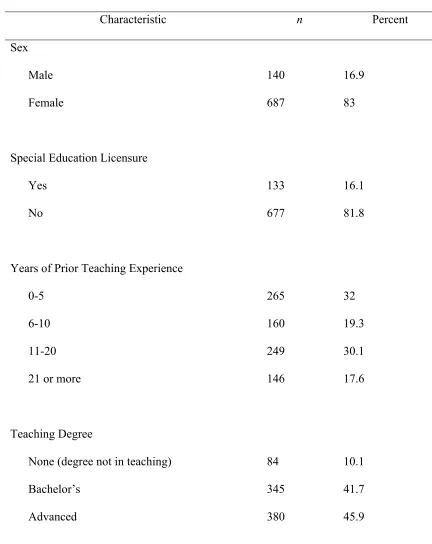
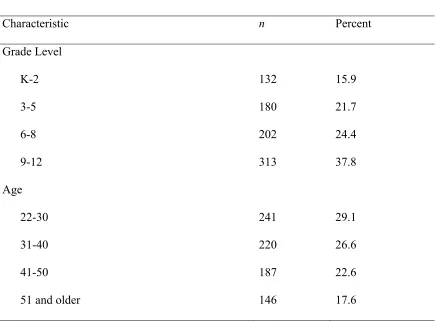
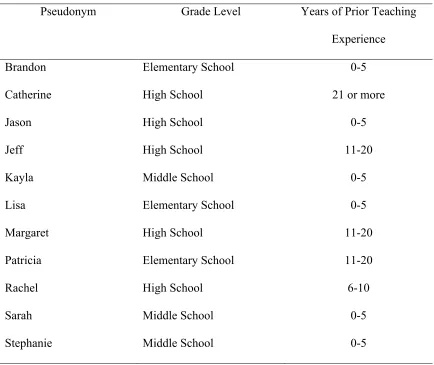
Table 1. Sample Characteristics ... 117 Table 2. Interview Participant Characteristics ... 119 Table 3. Factor Loadings for Exploratory Factor Analysis with Promax Rotation
of the Teachers’ Sense of Efficacy Scale ... 120 Table 4. Factor Loadings for Exploratory Factor Analysis with Promax Rotation
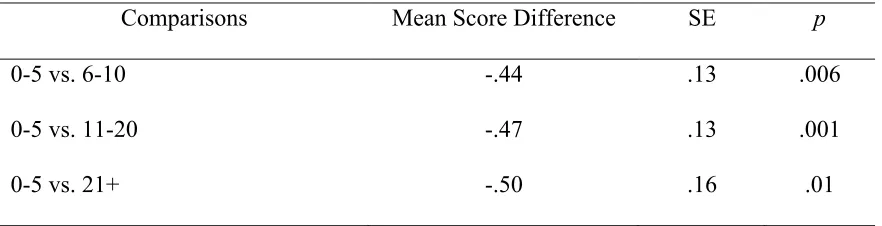
of the Behavior Management Confidence Scale ... 125 Table 5. Games-Howell Comparisons for Years of Prior Teaching Experience
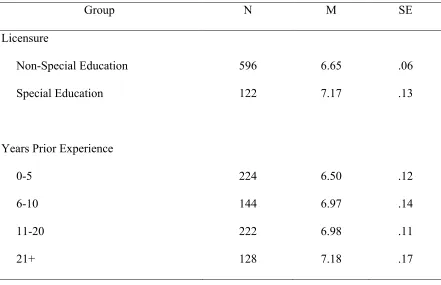
on Efficacy for Management of Problematic Behavior ... 128 Table 6. Summary of Means and Standard Errors for Teachers’ Efficacy for
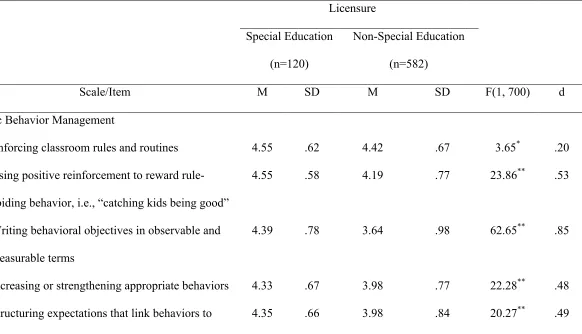
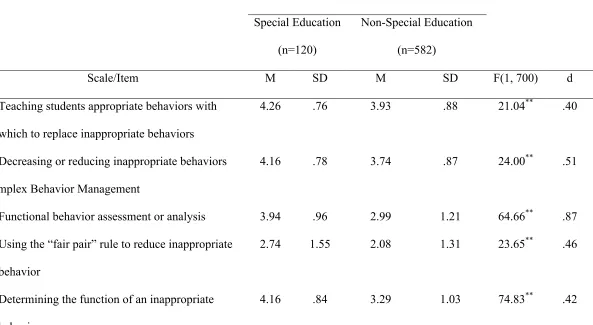
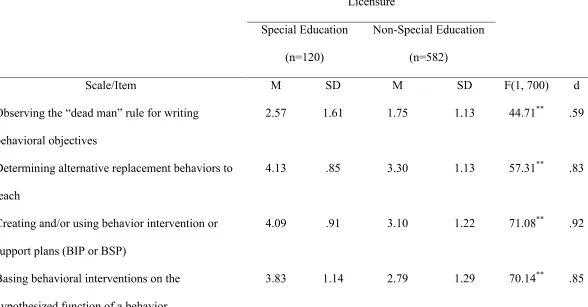
Management of Problematic Behavior by Group ... 129 Table 7. Summary of MANOVA for BMCI Items, Grouped by Subscale, for
Teachers With and Without Special Education Licensure ... 130 Table 8. Differences by Percentages Between Teachers With and Without
Special Education Licensure Who Rated BMCI Items as Confident
or Very Confident ... 134 Table 9. Bootstrapped Unstandardized Regression Coefficients, Standard
Errors, and 95% Confidence Intervals for Indirect Effects of Prior Years of Teaching Greater than Five Years on Efficacy for
Table 10. Normality Diagnostics for Dependent Scale Variables by
LIST OF FIGURES
Figure 1. Graphic representation of the unified definition of teacher efficacy,
including its components and cyclical nature ... 139 Figure 2. Causal model of teacher efficacy on burnout ... 140 Figure 3. Unstandardized regression coefficients for the relationship between
licensure and efficacy for management of problematic behavior as
mediated by confidence in using behavior management strategies ... 141 Figure 4. Unstandardized regression coefficients for the direct and indirect
relationships between years of prior teaching experience beyond five years and efficacy for management of problematic behavior
mediated by confidence in using basic behavior management strategies ... 142 Figure 5. Mean scores and standard errors for teach TSES subscale by
special education licensure status ... 143 Figure 6. Coding hierarchy for qualitative data ... 144 Figure 7. Graphic representation of how having special education licensure
and knowledge of behavior management methods works in the
CHAPTER 1 INTRODUCTION
Background
Currently considered, perhaps, the best way of measuring teachers’ feelings of expertise for classroom management is the Teachers’ Sense of Efficacy Scale (TSES) (Tschannen-Moran & Hoy, 2001). Based on years of past research, the TSES measures teacher efficacy in three areas for practicing teachers: instructional strategies, student engagement, and classroom management (Tschannen-Moran & Hoy). The theoretical underpinning of the TSES represents a unification of Bandura’s (1977) concept of self-efficacy and Rotter’s (1966) social learning theory. In short, teacher self-efficacy is a teacher’s belief that he or she can cause desirable outcomes in the classroom, such as student
engagement and achievement (Tschannen-Moran & Hoy, 2001; Tschannen-Moran, Woolfolk-Hoy, & Hoy, 1998). Because efficacy is a construct that is domain-specific and thus subject to high intraindividual variability across contexts, it is important that measures of teacher efficacy account for specificity in order to provide a valid measurement (Bandura, 1997). It should be noted, however, that though self-efficacy beliefs are an estimation of one’s competence in a given situation, they are not necessarily reflective of actual
significantly related to teacher burnout. At a time when teacher burnout is a considerable problem and when some states are seeing both high rates of teacher attrition and significantly fewer students enrolling in teacher education programs (Pucella, 2011), teacher efficacy— and in particular, teacher efficacy for classroom management—is an important area of study.
The research presented in this dissertation examined the construct of teacher efficacy for classroom management in depth, attempting to account for the appropriate amount of specificity and to discover whether it is useful to conceptualize the construct as multifaceted. Teacher-level predictors and group differences for management efficacy were examined, and several analyses assessed the relationship of management efficacy and management
competence. Finally, data collected via qualitative inquiry were explored as a supplement to the quantitative results.
Significance of the Study
While there are many studies that have used data gathered from the TSES, there is a paucity of research that correlates those data with the types of behavior management methods that teachers feel confident in using. In addition, there is growing evidence that the factor of Efficacy for Classroom Management may be more accurately measured and conceptualized as comprised of the sub factors Efficacy for Proactive Behavior Management (i.e., rules, routines, procedures) and Efficacy for Reactive Behavior Management (i.e., what teachers do to deal with students when they have broken the rules). Analyses in the current study
differences in management efficacy between teacher licensure groups, particularly between those with and without special education licensure. Adding to extant research, the current study analyzed additional comparisons among teachers including education level as well as whether teachers as participants were in schools that use Positive Behavioral Intervention and Support programs. The mixed-methods design of this study also shed light on the
phenomenon that efficacy is not necessarily correlated with actual competence—one would expect that teachers who are both truly efficacious and competent classroom managers would indicate that they are confident in using research-validated effective methods of behavior management. In addition, ratings on the other subscales of the TSES were compared to teachers’ ratings of Efficacy for Classroom Management—significantly lower classroom management ratings may be reflective of an incongruent perception of efficacy and
competence because, as will be illustrated, effective classroom management is a prerequisite for effective student engagement and effective instructional strategies. Finally, qualitative data provided a supplement to the quantitative data in order to tell a more robust story about teachers’ experience of behavior management.
Research Questions
1. Is teacher Efficacy for Classroom Management a unitary construct or is it better conceptualized as the combination of two sub factors: Efficacy for Proactive Behavior Management and Efficacy for Reactive Behavior Management?
3. Are teachers’ ratings of efficacy reflective of competency?
a. Do teachers’ ratings of Efficacy for Classroom Management predict their confidence in using effective methods associated with both Applied Behavior Analysis (ABA) and PBIS?
b. Are teachers’ ratings for Efficacy for Classroom Management congruent with their ratings for Efficacy for Instructional Strategies and Efficacy for Student Engagement? 4. What are teachers’ experiences of behavior management? What can they tell us that the numbers cannot?
Overview of Methodology
This study utilized a mixed-methods design. Quantitative analyses were used to answer Research Questions 1 through 3 and included exploratory factor analysis to more closely examine the construct of efficacy for classroom management, and multivariate analyses designed to discern predictors of and differentiate groups based on Efficacy for Classroom Management scores. Qualitative data were collected via a semi-structured interview to answer Research Question 4 and provided supplementary information about the first three research questions that would not have been possible through quantitative analyses alone.
Definition of Terms
to the same construct. When referring to publications about the construct, the term(s) chosen by the original authors will be used.
Likewise, the term evidence-based is frequently used in reference to educational practices and has a specific legal meaning as per the No Child Left Behind Act of 2001. According to the U.S. Department of Education (2002), a practice is evidence-based if it is supported by “professional wisdom” or empirical research evidence. Professional wisdom can be attained through experience, consensus, or observation (U.S. Department of
Education). Empirical evidence is defined as “scientifically-based research” from a social science field as well as “empirical data on performance used to compare, evaluate, and monitor progress” (U.S. Department of Education).
Several terms used within this study have a general meaning outside of ABA, but when used as ABA terminology can mean something very different and very specific. These terms are defined here (from Alberto & Troutman, 2013, unless otherwise noted):
reinforcement refers to anything that is added to the environment that increases, strengthens, or maintains a behavior. Negative reinforcement refers to anything that is withdrawn from the environment that increases, strengthens, or maintains a behavior.
Punishment—Any consequence following a behavior that decreases the probability or occurrence of that behavior. Positive punishment is anything that is added to the
environment that decreases the probability of occurrence of a behavior such as anything that causes pain or discomfort (primary punishers) or conditioned punishers such as verbal reprimands or extra homework. Negative punishment is anything that is removed from the environment that decreases the probability of occurrence of a behavior such as time-out from positive reinforcement, response cost (removal or points or tokens that have been earned), or extinction (terminating positive reinforcement for a behavior).
Differential reinforcement—A process using a combination of punishment and reinforcement to teach replacement behaviors (Maag, 2004). An inappropriate behavior is punished (usually by withdrawing reinforcement) in some way while at least one alternative replacement behavior is reinforced (Maag).
Functional Behavior Assessment—The process of gathering data to determine the function of a behavior. Data are collected about a behavior’s antecedents (which may
include the time of day, setting, and preceding events, among others), the behavior itself, and the events following the behavior. After enough data are collected, a hypothesis about the function of the behavior can be made.
CHAPTER 2
REVIEW OF THE LITERATURE Teacher Efficacy
Teacher efficacy is a construct that has evolved over the years and has proven to be a difficult construct to define and to measure (Tshannen-Moran & Hoy, 2001). Teacher self-efficacy is an important construct in educational research because it has been correlated with such student outcomes as achievement (Armor, et al., 1976; Kennedy & Shiel, 2010;
Swackhamer, Koellner, Basile, & Kimbrough, 2009) and motivation (Midgley, Feldlaufer, & Eccles, 1989). In fact, it has been suggested that the level of collective teacher efficacy—the confidence teachers have that the entire faculty can achieve desirable goals related to student outcomes—within a school may be a stronger predictor of student achievement than the socioeconomic status of its students (Bandura, 1993; Goddard, Hoy, & Woolfolk Hoy, 2000). Teacher efficacy is also correlated with teacher characteristics including effort used in
teaching, time spent on academic instruction (Gibson & Dembo, 1984), goal setting, level of aspiration, openness to new ideas, willingness to try out new methods in order to meet students’ needs, stress level, professional commitment and burnout (Brouwers & Tomic, 2000; Martin, Sass, & Schmitt, 2012), job satisfaction, and preference for use of positive strategies for classroom management (Emmer & Hickman, 1991; Moe, Pazzaglia, & Ronconi, 2010; Tschannen-Moran et al., 1998).
Factors That Influence Teacher Efficacy
class they taught as well as indicate characteristics of each class related to both the class and to themselves as teachers specific to each class. They found that teachers felt differentially efficacious for each class depending upon how prepared the teacher felt for a particular class period, which track-type a class was (honors vs. non-honors, academic vs. non-academic; honors and academic classes were associated with higher teacher efficacy), the grade level of a class (the higher the grade level, the higher a teacher’s efficacy), class size (the larger the class size, the more efficacious teachers rated themselves), and student engagement (the more engaged teachers rated the students in the class, the more efficacious they rated themselves to teach it).
Hoy and Spero (2005) found that, for beginning teachers, perceptions of efficacy change over time, rising during the preparation phase prior to practicum and into student teaching and then falling, somewhat dramatically, during the first year of teaching. Additionally, the more experience a teacher has, the more stable his or her perception of efficacy is likely to become (Tschannen-Moran et al., 1998). This change in efficacy, particularly the drop during the first year of teaching, has dramatic implications related to teacher burnout and attrition.
Between-teacher predictors of efficacy have been studied in more depth than within-teacher predictors. In general, novice within-teachers report lower levels of efficacy than
respondents were novice or experienced teachers (Tschannen-Moran & Hoy, 2007). For example, for novice teachers, high levels of resources and support (from colleagues, parents, and community) were more strongly correlated with efficacy than for experienced teachers, but grade level was more strongly (negatively) correlated with efficacy for experienced teachers than for novice teacher (Tschannen-Moran & Hoy, 2007). Interestingly, this study also showed that administrator support did not make a significant contribution to teacher efficacy for either novice or experienced teachers (Tschannen-Moran & Hoy, 2007). The History of Teacher Efficacy as a Construct
Rotter’s social learning theory. Rotter’s (1966) social learning theory posits that people choose their behaviors based on both their expectancy that the behaviors will lead to particular outcomes and the desirability of those outcomes. Central to this theory is the notion of locus of control: people can be classified along a continuum as to whether they believe that achieving a particular outcome is a result of their own doing (internal locus of control) or something outside of their control, such as luck (external locus of control).
Armor et al. (1976) created the first instrument to measure teacher efficacy,
consisting of only two items—one measuring a construct named “general teaching efficacy” and one measuring a construct named “personal teaching efficacy”—based on Rotter’s social learning theory. Depending upon their level of agreement with the two items, teachers were placed on the locus-of-control continuum: those who believed that environmental
obstacles exhibited an internal locus of control. Teachers who indicated that they were confident that their teaching would get positive results in student achievement despite environmental and other external obstacles (i.e., had an internal locus of control), were said to have high teacher efficacy. Subsequent studies using this instrument demonstrated positive correlations between teacher efficacy and student achievement, teachers’ goal achievement, and teachers’ use of innovative teaching methods during instructional time (Tschannen-Moran & Hoy, 2001).
Bandura’s Self-Efficacy Theory. According to Bandura (1994), self-efficacy is defined as, “people's beliefs about their capabilities to produce designated levels of
performance that exercise influence over events that affect their lives” (p. 71). People with higher self-efficacy beliefs are more likely to try new or unfamiliar activities, undertake activities in unfamiliar settings, and are more likely to persist in difficult situations (Bandura, 1977). In a process known as reciprocal determinism, efficacy beliefs create a self-fulfilling prophecy: individuals with higher self-efficacy beliefs who persevere through adversity or in novel situations, and those with lower self-efficacy beliefs who do not attempt or who quit in unfamiliar situations, are reinforced that their assessments about themselves and their capabilities were correct, and thus bolster or weaken their perceived self-efficacy further (Tschannen-Moran & Hoy, 2007).
Bandura’s theory states that there are four sources of input for efficacy beliefs: (a) mastery experiences—performing an activity, (b) verbal persuasion—input or feedback from others, (c) vicarious experiences—seeing others perform a task, and (d) physiological
performance of an activity (Bandura, 1994). Translated to teacher efficacy, the four sources of input are (a) actual teaching (mastery experiences), (b) input from colleagues, parents, administrators, students, or anyone else with regard to one’s teaching activities; information learned during teacher-education coursework including input from instructors, class
discussions, or texts (verbal persuasion), (c) seeing others teach (vicarious experiences), and (d) physiological arousal. Mastery experiences provide the strongest contribution to
teachers’ efficacy perceptions (Bandura, 1997). Experienced teachers have the most
mastery-experience input whereas pre-service teachers rely most on verbal-persuasion input (Tschannen-Moran & Woolfolk Hoy, 2007).
Although the development of other teacher efficacy scales were guided by Bandura’s self-efficacy theory (e.g., Gibson & Dembo, 1984), Bandura developed a scale that was the first to take into account the finding that teachers’ sense of efficacy differs across situations and across skill sets (Bandura, 1997; Tschannen-Moran et al., 1998). For example, a teacher who feels highly efficacious teaching an advanced placement science course in a school with adequate resources and supportive parents may not feel as efficacious teaching a science course in a setting with students with disabilities, unsupportive parents, or in a school with inadequate instructional resources. A teacher who feels highly efficacious at crafting and executing lesson plans involving active learning, on the other hand, may not feel efficacious at direct instruction.
(Bandura, 1997). Indeed, research and scale development in teacher efficacy has reflected this, as the construct of teacher efficacy has come to be understood as multi-dimensional. Of particular interest in the current study is the dimension of teacher efficacy for classroom management.
Unified Definition and the Teachers’ Sense of Efficacy Scale. The Teachers’ Sense of Efficacy Scale (TSES) (Tschannen-Moran & Hoy, 2001) was developed as a means of measuring teacher efficacy based on a definition that is a synthesis of Rotter’s and
Bandura’s theories (Tschannen-Moran et al., 1998). The major theoretical foundation of the TSES is that general teacher-efficacy beliefs are most strongly affected by interpretation of Bandura’s (1997) four sources of efficacy antecedents (Tschannen-Moran et al.). Situational judgments about teacher efficacy are formed during the following processes: (a) the
and external factors; a teacher’s confidence to execute a course of action in a given context and includes a teacher’s assessment of their ability (Klassen, Tze, Betts, & Gordon, 2011). This distinction underscores the importance of specificity when measuring teacher efficacy.
The subject of extensive analysis, the TSES has been shown to have a three-factor structure for practicing teachers: Efficacy for Instructional Strategies, Efficacy for Classroom Management, and Efficacy for Student Engagement (Fives & Buehl, 2010; Heneman,
Kimball, & Milanowski, 2006; Tschannen-Moran & Woolfolk-Hoy, 2001), and a one-factor structure for pre-service teachers (Fives & Buehl, 2010; Tschannen-Moran &
Woolfolk-Hoy). The TSES has consistently been shown to have high reliability (α = .94 for the whole
scale, individual factor alphas range from .87-.91), and is considered to be a
psychometrically-sound measurement of teacher efficacy (Tschannen-Moran & Hoy, 2001). The TSES in the Literature
In addition to evaluating its psychometric properties, Heneman et al. (2006), found that the TSES was a good predictor of several teacher performance indices, including demonstration of content knowledge, differentiation to meet the needs of all students, maximizing student-engaged time, and evidence of planning and organization in lesson execution. Dixon, Yssel, McConnell, and Hardin (2014) used the TSES as one of two outcome measures and found that teachers who had had professional development in instructional differentiation felt more efficacious at it than teachers who had not.
Goebel (2008) found that including 15 hours of field experience for students enrolled in an Applied Behavior Analysis course could increase special education pre-service teachers’ efficacy based on pre- and post-test measures. Another popular avenue of inquiry has been student teachers’ efficacy measured with the TSES. Knoblauch and Hoy (2008) found that student teachers exhibited increased efficacy following student teaching, but less so for those whose assignments were in urban schools, and that cooperating teachers’ efficacy was predictive of student teacher efficacy. Putman (2012) found that experience was a predictor of efficacy, but that novice teachers’ (with 3 or fewer years of experience) and pre-service teachers’ scores did not differ significantly. To date, no study has used the TSES to examine differences in teacher efficacy as a result of licensure or PBIS status, nor has any study entertained the idea of rethinking the factor for efficacy for classroom management.
Classroom Management Defining Classroom Management
seeks to establish and sustain an orderly environment so students can engage in meaningful academic learning, it also aims to enhance students' social and moral growth" (Evertson & Weinstein, p. 4). O’Neill and Stephenson (2011) provided another definition of the construct in general as “establishing and maintaining the learning environment by structuring and organizing events” (p. 261). The authors further subcategorize classroom management into such components as managing materials and resources; creating and enforcing classroom rules, routines, and expectations; keeping students engaged during instruction; ensuring appropriate socialization among students; and controlling disruptive behavior (O’Neill & Stephenson). Simonsen, Fairbanks, Briesch, Myers, and Sugai (2008) defined classroom management as a three-component construct consisting of maximizing instructional time, maximizing academic engagement and achievement, and managing student behavior. However, when measuring efficacy for classroom management, how can one be sure which or how many dimensions of it we are measuring?
Classroom and Behavior Management as Prerequisites to Instruction and Engagement Brophy’s (2006) definition of classroom management illustrates the major importance of classroom management: “actions taken to create and maintain a learning environment conducive to successful instruction” (p.17). As such, effective classroom management is a prerequisite for instruction to even occur (Freeman, Simonsen, Briere, & MacSuga-Gage, 2013). Effective classroom and behavior management that relies on evidence-based
methodology is associated with improved student outcomes and contributes significantly to student learning and development (Freeman et al., 2013; Simonsen et al., 2008). Davis and Jordan (1994) found achievement of African-American males in middle school was
correlated with their teachers’ ability to be an effective and efficient classroom manager. The authors suggest that this is likely because time spent on discipline is time taken away from instruction. As one might expect, more time spent on instruction during instructional time (as opposed to additional or extended time) is correlated with higher student
achievement (Launor, 1984; Smith, 1979; as cited in Corey et al., 2012). Hill, Rowan, and Ball (2005) found that for each additional 14 minutes per day of math instruction during an instructional period (rather than in addition to the regular instructional period), third graders’ achievement in math increased significantly. Furthermore, in addition to maximizing
improves student achievement. Disruptions in the classroom caused by misbehavior impact a teacher’s use of classroom time negatively. A study by Pressly et al. (2009) supports this finding as well—first grade literacy teachers who were the most effective (whose students had the highest literacy achievement scores and had the most academic engaged time during instruction) “were characterized by excellent classroom management based on positive reinforcement and cooperation” (p. 36) and were effective in teaching their students self-regulation, allowing these teachers to effectively and efficiently use their time for instruction. The Importance of Training and Experience in Classroom and Behavior Management
Knowledge of and experience using effective behavioral and classroom management methods are crucial skills for all teachers, especially for those who serve students with disabilities or other challenging behaviors (Simonsen, Myers, & DeLuca, 2010) which comprises most, if not all, teachers. According to the United States Department of Education (2013), more than 80% (i.e., 81.6%) of students with disabilities spend between 40% and 100% of their time in regular education settings. Because more regular education teachers are serving students with disabilities in their classrooms, they may find that behavior
management methods that worked for them in the past are no longer effective (Maag, 2001). Specialized training for teachers in meeting non-academic needs (i.e., behavioral needs, particularly for students with problem behaviors) is associated with higher
demonstrated that when teachers receive specialized training in behavior management and implement it successfully, the result is both improvements in target students’ behavior and in the classroom environment as a whole (Allen & Blackston, 2003; Swinson & Cording, 2002). Sawka, McCurdy, and Mannella (2002) implemented a program in an urban school that utilized training and consultation for 64 of its teachers. The program was designed as a preventive measure targeting students with and at risk for emotional and behavioral
disabilities and included two training modules on behavior management. Results showed a dramatic increase in academic engagement and a sharp decrease in disruptive behaviors for students in classrooms of teachers who had participated in the program. This study also demonstrated that the teachers were not able to implement the program effectively without the consultation component—the training alone was not enough. Similarly, Shapiro et al. (1999) found that, with training and consultation, implementation of a behavior management program resulted in students with emotional and behavioral disorders successfully spending more time in regular education settings. Furthermore, teachers reported using the strategies they learned in the program with students who were not originally targeted by the
intervention but who demonstrated behaviors worthy of change and reported that the strategies were highly effective.
achievement gains in their first year of teaching than teachers who had not (Boyd et al.). In addition, Darling-Hammond (2006) found that teachers who experienced the preparation as described above reported high teacher efficacy than those who did not. Aloe et al. (2013) recommended that student teaching programs be restructured to include ample opportunities for student teachers to gain knowledge of behavior management based on vicarious
experiences (observing expert teachers), mastery experiences (clinical immersion with plentiful opportunities to practice), and verbal persuasion (forums for student teachers to discuss their behavior management experiences and concerns). In addition, they recommend that teacher education programs provide mentors exclusively in classroom management (Aloe et al.).
Conversely, teachers without behavior management training are more likely to utilize harsher consequences for students with problem behaviors as well as to utilize interventions that they view as less complex and easier to use, though not necessarily effective
efficacy were positively correlated with teachers having had quality in-service and
pre-service training that addressed (a) the unique needs of students with disabilities, (b) curricular and instructional differentiation and adaptation for students with disabilities, and (c) behavior management methods for students with disabilities.
The issue of poor training in behavior management is problematic for students with disabilities. The use of aversive punishment and seclusion as behavior control are still prevalent and not well-regulated, especially with students with disabilities (U.S. Senate Committee on Health, Education, Labor, and Pensions, 2014). Evidence of this is clear: hundreds of cases of abuse—even death—have been reported as a result of teachers using seclusion and restraint with students with disabilities (Kutz & US Government
Accountability Office, 2009). Additionally, students with disabilities disproportionately represent students suspended or expelled from school for misbehavior. In a large-scale analysis of secondary schools, Losen and Martinez (2013) found that students with
state-controlled. (United States Department of Education, 2012). Unfortunately, many parents may be unaware that their child’s teacher may be relying on such methods until it is too late.
Being skillful in classroom and behavior management is also important for the successful inclusion of students with disabilities. Not only do teachers’ feelings of efficacy for classroom management contribute to their attitudes toward inclusion—a factor shown to be highly predictive for how successful inclusionary practices are (Worrell, 2008)—it affects students directly. General education teachers who report low efficacy or competence for behavior management are less likely than teachers with higher competence or efficacy to implement individualized behavior support plans for students who are identified with emotional and behavioral disorders, putting those students at risk for removal from the general education environment and placement into more restrictive environments (Oliver & Reschly, 2010). Because self-efficacy theory states that people are more likely to pursue things at which they feel competent and to avoid things at which they do not, it follows that teachers who have low self-efficacy teaching students with disabilities are more likely to be hostile and resistant to situations that require them to do so (Smith et al., 2003).
Inadequate Classroom and Behavior Management Preparation
teacher-training and education programs do not provide in-depth coverage of behavior
management techniques, particularly at the undergraduate level. Examining special education teacher education programs, Oliver and Reschly (2010) found that in an analysis of course syllabi from 26 special education teacher training programs, only 27% had coursework devoted to explicit instruction in behavior management. More recently, Freeman et al. (2013) conducted research investigating undergraduate teacher education programs and state requirements for programs to contain components of classroom management. While special education teacher education programs were required by 49 states to include content on classroom management, only 34 states required the content to be evidence-based. For non-special education licensure, there were even fewer states that required such coursework: 45 states required elementary licensure programs to cover classroom management content, 43 states required secondary-grades licensure programs to cover classroom management content, and only 28 states required that the content be evidence-based. Additionally, they found that while 29 states required special education programs to address research-validated ways for teachers to respond to appropriate behavior, only 3 states required elementary and secondary teacher training programs to do so. Similarly, 30 states required that special education programs include research-validated methods to respond to inappropriate behavior, whereas only 4 states required the same for non-special-education teacher education
which teachers were asked to identify evidence-based and non-evidence-based practices from a survey with 11 evidence-based practices and four non-evidence-based practices (Stormont, Reinke, & Herman, 2011). Special educators were more likely than regular educators to correctly identify the methods as either evidence-based or non-evidence-based and also, as a group, rated themselves as having significantly higher confidence that the behavior
management methods that they used in the classroom were effective (Stormont et al.). Tillery, Varjas, Meyers, and Collins (2010) found that most teachers they interviewed had very little preparation when it came to behavior management, indicating that a few rudimentary principles of behavior management were briefly touched upon in their
Many other studies document the lack of classroom management and behavioral instruction training in teacher education programs as well as the associated feelings of distress. Begeny and Martens (2006) surveyed 110 pre-service master’s-level elementary, secondary, and special education students in six different universities and found that respondents reported little training in behavioral-instruction techniques (such as Direct Instruction and Curriculum-Based Measurement) as well as general behavior-management methods such as punishment, shaping, reinforcement, and task analysis. Much of what is in textbooks on classroom management used by pre-service and in-service teachers is based on outdated research without an established evidence base (Simonsen et al., 2008). Chesley and Jordan (2012) found this sentiment echoed in a focus group of beginning teachers and
mentors: participants reported that the little coursework they had in classroom management lacked a strong research base and was fairly useless when they were faced with the reality of actual classroom teaching.
inconsistently, and that they only asked for assistance after feeling helpless and desperate. It is important to note that many of the severe misbehaviors the teachers in this study reported were dangerous not only to the teachers, but to the students in the classrooms as well.
Ritter and Hancock (2007) found that only after teachers had had years of experience did they feel more effective and skilled at managing student behavior, but this was only true for traditionally-certified teachers and not alternatively-licensed teachers (defined as teachers who have a bachelor’s degree in another field and teach while earning certification
concurrently, such as lateral entry). A delay of several years is troubling because of the implications for the many students who are suffering during this gap while their teachers learn “on-the-fly” and for students whose alternatively-licensed teachers may never master behavior management.
Melnick and Meister (2008) found that, of a group of 42 teachers they interviewed, mild discipline issues were not nearly as concerning to the teachers as severe misbehaviors. These teachers were troubled that their university coursework dealing with behavior
management strategies that they used frequently resulted in low success, yet they persisted in using them, and that the strategies they reported as highly successful they used infrequently. This study also showed that while teachers lacked the skills necessary to implement highly successful methods as well as lacked a wider repertoire of effective behavior management skills, they also reported, counterintuitively, feelings of high self-efficacy in their ability to use a wide variety of behavior management skills.
Not only is inadequate skill in classroom management a concern for teachers, it is a concern for administrators as well. Torff and Sessions (2009) examined 251 principals who rated the causes for teacher ineffectiveness from five indicators of teacher quality. Principals rated classroom management as the top contributor, followed by content knowledge, lesson-planning skills, lesson-implementation skills, and ability to establish rapport with children.
Also troubling is the finding that many students beginning coursework in education do not see teaching as a scientific endeavor to be undertaken by a skilled practitioner, and their university coursework does little to change this attitude (Fajet et al., 2005). Instead, they base their perceptions and identity of teaching and teachers on their years as a student spent in Kindergarten through high school. It is possible that this is another reason that teachers may be more likely to rely on punishment as a means of behavior management because it is what may be familiar or salient to new teachers based on their experiences as students.
Of increasing interest in the literature—and for good reason—is the emphasis on cultural responsiveness in teaching and its intersection with classroom management. Shifting demographics of the American student body and the propensity of teachers to over-refer minority students for special education due to behavior issues necessitate this emphasis (Raines et al., 2012). Teachers’ existing apprehension about classroom and behavior
management can be intensified in urban placements due to the differences between teachers’ and students’ languages, experiences, races and ethnicities, and even religions (Milner & Tenore, 2010).
phenomenon that is common and costly in education (Brouwers & Tomic, 2000). Burnout usually precedes decreased motivation for teaching, decreased engagement with teaching (“positive, fulfilling, work-related state of mind that is characterized by vigor, dedication, and absorption,” Hakanen et al., 2006, p. 498), decreased job satisfaction (Skaalvik & Skaalvik, 2010), and teacher attrition (Pucella, 2011), among other things. Burnout is also correlated with and may be preceded by low self-efficacy beliefs (Chwalisz, Altmaier, & Russell, 1992; Friedman, 2003; Greenglass & Burke, 1988; Schwarzer & Hallum, 2008; Skaalvik & Skaalvik, 2007, 2010). Some researchers have found a link between efficacy for classroom management and teacher burnout (Friedman & Farber, 1992). In a meta-analysis of 16 studies on the relationship between classroom management efficacy and burnout, a significant relationship was found between classroom management efficacy and all three dimensions of burnout (Aloe, Amo, & Shanahan, 2013). The correlation of the largest magnitude was found between classroom management efficacy and lowered personal accomplishment, followed by depersonalization and exhaustion (Aloe et al.). The authors explain this finding by proposing that teachers with low classroom management efficacy are more susceptible to the negative feelings associated with the three dimensions of burnout, and likely become entrenched into a dysfunctional pattern until they finally leave the profession altogether (Aloe et al.). Likewise, Brouwers and Tomic (2000) found that emotional exhaustion preceded decreased efficacy for classroom management which
withdraw and their performance to suffer which decreases their efficacy. A hypothetical model proposed by Friedman (2003), who found that lower teacher efficacy was correlated with higher perceived burnout, does much to illustrate how these mechanisms may work (see Figure 2). Structurally similar to Tschannen-Moran and Woolfolk-Hoy’s (1998) model of teacher efficacy (see Figure 1), this model inserts burnout and hypothesizes that it occurs in the loop after a teacher performs a teaching task and sees unfavorable results. This, in turn, leads back into the loop by providing efficacy input and would serve to lower efficacy beliefs which, according to the figure, contributes to more burnout, stress, and poor coping (both of which also contribute to burnout). Looking at this model, it becomes clear that in order to prevent burnout, teachers would benefit from having a number of effective instructional tools in their repertoire to prevent the unfavorable outcomes that may trigger the burnout/low efficacy cycle. It makes sense, then, that student misbehavior is the leading contributor to teacher burnout: due to inadequate pre-service and in-service preparation in classroom and behavior management, we know that most teachers do not have such a repertoire of behavior management methods.
teachers with lower efficacy for classroom management were more likely to feel emotional exhaustion. In general, higher efficacy was correlated with lower rates of burnout symptoms.
For the 2007-2008 school year, 8% of teachers left teaching altogether and 7.6% changed schools (U.S. Department of Education, National Center for Education Statistics, 2010). The attrition rate for beginning teachers (those with five or fewer years of experience) is estimated to be between 40-50% (Ingersoll & Smith, 2003) with less effective teachers leaving at higher rates than more effective teachers (Boyd et al., 2008). What’s more, though, is that for beginning teachers who do not leave the profession but transfer instead, the more effective teachers generally transfer to higher-performing schools. The result is a never-ending cycle of new teachers who are less effective, unprepared to manage student behaviors, more likely to burnout and leave, and a widening achievement gap between high-performing schools and low-high-performing schools (Boyd et al.; Jones, 2006).
Approaches to Classroom Management
There are myriad methods of classroom and behavior management, many of which can be classified into one or more general paradigms. There is often overlap between
Behaviorism. The behavioral approach to classroom management is based on the tenet that behavior—overt, observable, and measurable phenomena—is either maintained or can be changed through environmental stimuli and consequences. More specifically,
behaviors can be increased or maintained through reinforcement and decreased or extinguished by withholding reinforcement or with punishment (Brophy, 2006).
Behaviorism, as conceptualized by John Watson in the early 20th century (cited in Alberto & Troutman, 2013), takes into account only that which can be directly observed and dismisses psychological notions such as thought and emotion. This is the behavioral approach that many are familiar with as it is often covered in introductory psychology courses which, presumably, many pre-service teachers take during their undergraduate studies. It is, perhaps, for this reason that when many hear of a behavioral approach to classroom
management that they automatically reject it. Behaviorism likely conjures mental images of animal torture (Skinner’s experiments with electro shock and rats) and the systematic mental scarring of small children (the Little Albert experiment carried out by Watson). It is no wonder that, in the absence of further instruction, teachers would be reluctant to embrace an approach to classroom management based on behaviorism. This is unfortunate, however, because ABA, which is based on behaviorism but is quite evolved from traditional
Skinnerian and Watsonian theory, is a highly effective method for behavior management (Alberto & Troutman).
several conditions need to be met before attempting to change a behavior. The condition that distinguishes most between traditional behaviorism and ABA is that the behavior(s) selected for change must be socially valid. It would not be considered socially valid (and would now be considered unethical) to condition a child to fear white furry animals as what happened in Watson’s Little Albert experiment, or to use physical punishment to condition a child to push a lever, as Skinner did with rats. Another differentiating condition of ABA is that
practitioners attempt to discern the function that a target behavior may serve. This is done so that practitioners can be aware of students’ needs and continue to meet them by teaching students functionally-similar appropriate behaviors with which to replace inappropriate behaviors (often known as the fair pair) (Alberto & Troutman). Likewise, practitioners can also employ ABA to strengthen, improve, and increase appropriate behavior (Alberto & Troutman). According to Alberto and Troutman:
Teachers who learn and practice the principles of applied behavior analysis can help their students master functional and academic skills in a systematic and efficient manner and can document their students’ progress for parents and other professionals. They can manage behavior positively so that their focus remains on learning. They can teach students to get along with peers and adults and to make good choices. By providing learning environments that are safe, joyful, and successful they can make enormous differences in students’ lives. (p. 20)
Literature searches with the keyword “Applied Behavior Analysis” result in papers almost entirely devoted to special education, supporting what Freeman et al. (2013) found: that evidence-based behavior management methods are primarily reserved for special education. Mastery of ABA requires much more than exposure—it requires in-depth training and supervised practice. In fact, many teachers are critical of ABA or anything resembling behaviorism, despite their unfamiliarity (Allen & Bowles, 2014).
Methods in ABA. At the crux of ABA in the classroom is understanding the
functions of behaviors, knowing how to determine those functions, and knowing how to change, prevent, and/or increase and strengthen behaviors using the right combinations of reinforcement and punishment (Alberto & Troutman, 2013). There are a multitude of
methods for changing behavior that are part of ABA based on the principles of reinforcement and punishment, and while most teachers are somewhat familiar with those concepts, a rudimentary understanding of reinforcement and punishment as non-technical terms is a weak base for behavior management skills but is the most that many teacher education programs provide (Tillery et al., 2010). Teachers need a deep understanding of the technical concepts of reinforcement and punishment and a large repertoire of behavior change
(Lovitt, 2012). Moreover, behavior must be conceptualized in a way that passes the “dead-man test” which states, very candidly, that if a dead “dead-man can do it then it is not considered behavior. For example, if one were to write a behavioral objective that a student should not hit, it fails the dead-man test—a dead man cannot hit. Not-hitting behavior cannot be
replaced because it does not exist as behavior. It is common to see behavioral objectives and to hear teachers admonish students in ways that fail the dead-man test— in terms of what students should not do, and not what they should do instead. It is necessary for a behavioral objective to pass the dead-man test in order to meet the fair-pair criterion for behavior replacement: to punish and not replace will not get the results a teacher wants, but too often, this is likely what is occurring in classrooms. In fact, if the teacher does not teach a
replacement behavior that meets the fair-pair criterion, the student, most likely, will engage in a new and possibly equally or even more inappropriate behavior that does meet his or her original need once the original behavior is punished (Maag, 2004). Applied behavior
analysis will not work in pieces: A teacher must be knowledgeable and comfortable using all of its components in order to successfully and efficiently manage classroom behavior
(Alberto & Troutman, 2013). The functional behavior assessment or analysis (FBA) is the process by which most teachers collect data about a behavior in order to determine its function and find an appropriate replacement behavior (Alberto & Troutman). Knowledge and skill in doing an FBA may be a good indicator of knowledge and skill in ABA (Dukes, Rosenberg, & Brady, 2008; McIntosh & Av-Gay, 2007).
behavior management that may provide some teachers with much needed guidance and support in behavior management. Positive Behavioral Intervention and Support is a
schoolwide, proactive approach to discipline which emphasizes systemic reinforcement for appropriate social behaviors as well as environmental manipulation and the teaching of replacement behaviors (Fenning & Bohanon, 2006). Positive Behavioral Intervention and Support differs from ABA in several ways, but most notably, PBIS is generally a very superficial and incomplete version of ABA (Johnston, Foxx, Jacobson, Green, & Mulick, 2006). It has been given preferential status as the recommended system of discipline since the 1997 reauthorization of the Individuals with Disabilities Education Act (IDEA) (Chitiyo & Wheeler, 2009), yet its use is not widespread (Office of Special Education Programs (OSEP), 2012). A three-tiered system of prevention, PBIS consists of support systems at the whole-school (primary or first-tier) level, classroom or small-group (secondary or second-tier) level, and individual (tertiary or third-second-tier) level (Bradshaw, Koth, Bevans, & Ialongo, 2008). Typically, the primary level—also called the universal level—reaches about 80-90% of students, the secondary level reaches an additional 5-10% of students, and the tertiary level is used for the remaining 1-5% of students who do not respond to first- and second-tier interventions (Reinke, Splett, Robeson, & Offutt, 2008).
Proactive behavior management and PBIS – The primary level. The primary level
yourself, others, and property” (OSEP, 2012). In addition, at the primary level there are schoolwide policies governing teachers’ responses to infractions so that consequences are consistent (Bradshaw et al.). Teachers may create individual classroom rules in addition to the schoolwide rules, and usually these rules consist of a few more specific behavioral objectives that are encompassed by each schoolwide rule (OSEP, 2012).
Reactive behavior management and PBIS – The secondary and tertiary levels.
Based on data collected on infractions at the primary level (office referrals, teacher discipline logs), students may be served at the secondary level within a PBIS system (OSEP, 2012). Though serving students at this level is called secondary prevention, this is actually a reactive measure as it targets students who have already broken the rules. Teachers can carry out secondary interventions with small groups of students, and these interventions usually include the teaching of appropriate behaviors with which to replace inappropriate behaviors, including teaching students self-management strategies (OSEP). Additionally, individual students can be targeted at the secondary level if the interventions required are not too intensive or individualized (which would call for intervention at the tertiary level) (OSEP). For example, a teacher may find one student in one class period needing secondary-level intervention that may include rearranging the physical composition of the classroom or enacting a behavior contract. Such interventions, though targeting only one student, need not be highly intensive nor highly individualized.
behavior issues (OSEP, 2012). Since they are based on functional behavior assessments and target behaviors considered more problematic, tertiary-level interventions are highly
individualized and intensive (OSEP).
Effectiveness of PBIS. Though there is little longitudinal research at this time
always met. In fact, Chitiyo and Wheeler (2009) examined teachers and found that the most pressing barriers to implementation of a successful PBIS system included failing to meet these conditions in various ways, including lack of time (a failure to meet the condition of priority), lack of resources (a failure to meet the conditions of priority and efficient), lack of family-school collaboration (a failure to meet the condition of priority), lack of collaboration with other school staff (a failure to meet the conditions of priority, adaptive, and efficient), and lack of skills necessary to teach replacement behaviors (a failure to meet all four of the necessary conditions). When a PBIS system does not work effectively, teachers may be left without adequate support for discipline and behavior management.
According to the North Carolina Department of Public Instruction (C. McCamish, personal communication, April 30, 2015), as of the 2013-2014 school year in North Carolina there were 708 (26.4%) schools implementing a PBIS program and an additional 502
(18.7%) schools that were trained but not yet implementing a PBIS program, for a total of 1,210 (45.1%) schools participating in PBIS. According to the OSEP Technical Assistance Center on PBIS (2012), there are currently 16,232 schools utilizing a PBIS program.
as to utilize interventions that they view as less complex but easier to use, though not necessarily effective (Cunningham & Sugawara, 1988; Elliott, Witt, Galvin, & Peterson, 1984). Many regular education teacher training programs do not provide explicit training in behavior management, yet behavior management is the skill set in which teachers
consistently report they have the least confidence and for which they desire more training (Maag, 2001).
classroom management is multi-faceted. If teachers view behavior management as being composed of two different skill sets, if could be useful to measure efficacy as such. The Evolution of the Measurement of Efficacy for Classroom Management and Support for a Bi-Dimensional Model of Efficacy for Behavior Management
Though not the most recent addition to the catalog of instruments measuring teacher efficacy, like most instruments, the TSES is characterized by adaptations of items from instruments that preceded it. By fine tuning items and response options, the authors of the TSES were able to craft an instrument that captures the construct of interest with a high level of precision.
some of the instruments examined by O’Neill and Stephenson. Instruments for which items were categorized in either one or both of the “rules, routines, procedures, and expectations” category (analogous to efficacy for general classroom routines and procedures/proactive behavior management) and the “maintaining order and control” category (analogous to efficacy for dealing with problem behavior/reactive behavior management) are considered below. Of the 24 instruments included in O’Neill and Stephenson’s analysis (one was excluded because of its format), eight have items falling into both categories, and 10 have items in the “maintaining order and control” category but not “rules, routines, procedure, and expectations” (there are no scales for which the reverse is true). Furthermore, a few items from some of the instruments categorized by O’Neill and Stephenson as “student
socialization and cooperative behavior” seem better represented by one of the two categories of interest.
Following is a summary of instruments that preceded and were adapted for the TSES as well as a description of items from those instruments that are represented on the efficacy for classroom management scale of the TSES. These items have been categorized as either proactive or reactive behavior management based on O’Neill and Stephenson’s (2011) review. It is in chronological order of the publication dates of the instruments and will illustrate the progression instruments measuring teacher efficacy.
considered a seminal development within the field (Tschannen-Moran et al., 1998). Through four phases of development and analysis, the 30-item instrument was found to consist of 2 factors: personal teaching efficacy (“belief that one has the skills and abilities to bring about student learning” Gibson & Dembo, 1984, p. 573) and teacher’s sense of teaching efficacy (“belief that any teacher’s ability to bring about change is significantly limited by factors external to the teacher” p. 574). Since its development, issues with the original factor
structure, such as frequent item crossloadings and inconsistencies in the underlying construct being measured have been found (Tschannen-Moran et al., 1998), but the instrument has served as a starting point in the development of many subsequent scales of teacher efficacy.
The Gibson and Dembo (1984) instrument has one item that O’Neill and Stephenson (2011) categorized as reactive behavior management: “If a student in my class becomes disruptive or noisy, I feel assured that I know some techniques to redirect him quickly” (Gibson & Dembo, 1984, p.573). This item is represented by item 15 on the TSES (see Appendix E). In Gibson and Dembo’s original analysis, this item loaded on the personal teaching efficacy factor.
TSES by items 5 (represented by two of Emmer & Hickman’s items), 8, and 13. Four items are categorized as reactive behavior management and are represented on the TSES by items 15, 16, 19, and 21. This was the first measure of teacher efficacy to find that efficacy for classroom management is its own factor (as a sub-factor of teacher efficacy).
Brownell and Pajares (1999). Based on Bandura’s (1977) theory of self-efficacy, Brownell and Pajares (1999) created a 46-item instrument to measure teachers’ self-efficacy exclusively pertaining to teaching students with learning and behavior disabilities in
inclusive settings. Efficacy items on their instrument were derived from previously validated measures. In addition to efficacy items, they included items measuring known correlates with efficacy, such as administrative support, quality of pre-and in-service preparation, and special education support, among others. Participants were 128 second-grade teachers. There were a total of 11 efficacy items, 6 of which, according to O’Neill and Stephenson (2011), were classroom management efficacy items, though Brownell and Pajares did not make any further distinctions or categorizations or perform any subsequent analyses of those items beyond indicating that they measured teacher efficacy as a unitary construct. Of those six items, one was categorized as proactive behavior management and appears verbatim on the TSES (item 13). One item, categorized as reactive behavior management is represented by item 3 on the TSES. This instrument was the first to word item stems beginning with “How much can you do…” which is the wording used for the TSES.
Stephenson (2011) categorized three as proactive behavior management (items 5, 8, and 13). They categorize four items as reactive behavior management (O’Neill & Stephenson, 2011): items 3, 15, 19, and 21. O’Neill and Stephenson leave out one of the items on the efficacy for classroom management scale in their review (item 16), however, this item seems to be adapted from the Emmer and Hickman (1991) instrument which fell into the category of reactive behavior management.
Summary
Most teachers are comfortable setting classroom rules. Trouble occurs when students break those rules. Mounting evidence suggests that behavior management may be comprised of two skill-sets: Proactive behavior management, which is what teachers can do to prevent inappropriate behavior, and reactive behavior management, which includes what teachers can do to correct and prevent future inappropriate behavior once it has occurred. Ensuring
appropriate behavior and minimizing inappropriate behavior are prerequisites to content learning, yet most teachers are graduating teacher-education programs without the skills and knowledge to do either. In order for teachers to be effective behavior managers, they need rigorous instruction with ample opportunities for practice and feedback in evidence-based behavior management methodologies. Applied behavior analysis has a decades-long history of research validation, but is oftentimes rejected outright by those who could benefit from learning it due to an inaccurate understanding based on misinformation or lack of