Copyright1999 by the Genetics Society of America
RAD50
and
RAD51
Define Two Pathways That Collaborate to Maintain Telomeres
in the Absence of Telomerase
Siyuan Le,*
,†J. Kent Moore,
‡,1James E. Haber
‡and Carol W. Greider*
,†*Department of Molecular Biology and Genetics, Johns Hopkins University School of Medicine, Baltimore, Maryland 21205, †Cold Spring Harbor Laboratory, Cold Spring Harbor, New York 11724 and‡Rosenstiel Center MS029,
Brandeis University, Waltham, Massachusetts 02454-9110
Manuscript received September 11, 1998 Accepted for publication February 11, 1999
ABSTRACT
Telomere length is maintained by the de novo addition of telomere repeats by telomerase, yet recombina-tion can elongate telomeres in the absence of telomerase. When the yeast telomerase RNA component,
TLC1, is deleted, telomeres shorten and most cells die. However, gene conversion mediated by the RAD52
pathway allows telomere lengthening in rare survivor cells. To further investigate the role of recombination in telomere maintenance, we assayed telomere length and the ability to generate survivors in several isogenic DNA recombination mutants, including rad50, rad51, rad52, rad54, rad57, xrs2, and mre11. The
rad51, rad52, rad54, and rad57 mutations increased the rate of cell death in the absence of TLC1. In
contrast, although the rad50, xrs2, and mre11 strains initially had short telomeres, double mutants with
tlc1 did not affect the rate of cell death, and survivors were generated at later times than tlc1 alone. While
none of the double mutants of recombination genes and tlc1 (except rad52 tlc1) blocked the ability to generate survivors, a rad50 rad51 tlc1 triple mutant did not allow the generation of survivors. Thus RAD50 and RAD51 define two separate pathways that collaborate to allow cells to survive in the absence of telomerase.
T
ELOMERES ensure chromosome stability by pro- Szostak1984;Zakian1989). The repetitive nature of telomeric and subtelomeric sequences makes them a tecting chromosome ends from fusions,recombina-tion, and degradation (reviewed inGreider1996). In good target for recombination (HorowitzandHaber
1984;LouisandHaber1990a). Indeed, a recombina-wild-type yeast Saccharomyces cerevisiae, the repeated
telo-mere sequence containsz300 bp of d(C1-3A)/d(G1-3T) tion model for telomere maintenance based on a gene conversion-type mechanism was proposed before te-sequence. This telomere repeat sequence is bound by
Rap1p and other telomere-binding proteins that partici- lomerase activity was identified (Bernardset al. 1983;
Walmsleyet al. 1984). The ability of linear plasmids to
pate in telomere length homeostasis (reviewed in
Zak-ian 1996). Telomeres are elongated by telomerase, a exchange foreign telomere repeats also suggested that recombination might play a role in telomere mainte-ribonucleoprotein polymerase that contains an essential
RNA and protein component(s) (reviewed inGreider nance (PlutaandZakian1989). The requirement for
RAD52 in the generation of survivors in late passage tlc1
1996;Nugent andLundblad 1998). When the gene
for either the RNA component (TLC1) or a protein and in est1, est2, est3, and est4 yeast cultures also sug-gested a role for recombination in telomere length component (EST2) of yeast telomerase is deleted, cells
exhibit progressive telomere shortening and ultimately maintenance (LundbladandBlackburn1993; Lend-vayet al. 1996). Recently, mutations in the genes
encod-cell death (SingerandGottschling 1994;Landvay
et al. 1996;Lingner et al. 1997). However, “survivors” ing the yeast Ku proteins HDF1 and HDF2 (also known as YKU70 and YKU80) as well as RAD50, XRS2, and that have rearranged and amplified telomere regions
appear in late passage cultures. These survivors are de- MRE11 were shown to affect telomere length
mainte-nance (Boulton and Jackson 1996, 1998;Porter et
pendent on the RAD52-mediated yeast recombination
system (Lundbladand Blackburn1993; Lendvayet al. 1996;KironmaiandMuniyappa1997;Gravelet al.
1998; Nugent et al. 1998; Polotnianka et al. 1998), al. 1996).
Recombination has been thought to play a role at which suggests that more than one recombination path-way may play a role in telomere maintenance.
telomeres for many years (reviewed inBlackburnand
Genes in the yeast RAD52 epistasis group (RAD50,
RAD51, RAD52, RAD54, RAD55, RAD57, XRS2, MRE11)
Corresponding author: Carol Greider, Department of Molecular Biol- are involved in both mitotic and meiotic recombination
ogy and Genetics, Johns Hopkins University School of Medicine, 617
in S. cerevisiae (reviewed in Petes et al. 1991; Haber
Hunterian Bldg., 725 N. Wolfe St., Baltimore, MD 21205.
1998). They can be divided into three subgroups on E-mail: [email protected]
1Present address: Exact Laboratories, Maynard, MA 01754. the basis of their mutant phenotypes. RAD52 appears
MATERIALS AND METHODS to be essential for all forms of mitotic homologous
re-combination, which include both spontaneous and dou- Yeast strains, plasmids, and methods:The yeast strains used ble-strand break (DSB)-induced gene conversion, single- in this study are listed in Table 1. The set of isogenic strains with mutations in different RAD genes has been previously strand annealing between directly repeated sequences,
described (MooreandHaber1996). These strains were main-and break-induced replication (Rudin et al. 1989;
tained in standard growth media and grown at 308. The
McDonaldandRothstein1994;Rattrayand
Symin-tlc1::URA3 disruption plasmid (pLS132A) was created by
re-gton1994, 1995;Sugawaraet al. 1995;Malkovaet al. placing an Asp718-NsiI fragment of the wild-type TLC1 gene
1996a). In contrast, although rad51, rad54, rad55, and with a HindIII fragment of the URA3 gene in pLS131, a pUC119-based plasmid that contains a full-length TLC1
EcoRI-rad57 mutants are defective in repair of chromosomal
XbaI fragment. Yeast strains were constructed by standard ge-DSBs by gene conversion, these mutations do not
pre-netic manipulations (Roseet al. 1988). To construct double vent such repair in plasmid substrates with an apparently
or triple mutants, various heterozygous rad diploid cells were less constrained chromatin structure (Sugawaraet al. transformed with an EcoRI-XbaI fragment of pLS132A to knock
1995). Moreover, these four genes are also not required out the TLC1 gene, and Ura1cells were checked by Southern blot to verify the correct tlc1::URA3 integration. The resulting for single-strand annealing or for break-induced
replica-diploids were sporulated, tetrads were dissected, and spore tion (McDonald and Rothstein 1994; Ivanov et al.
clones were tested for the appropriate markers (some by 1996;Malkovaet al. 1996a;L. SignonandJ. E. Haber,
Southern analysis). Recombination-deficient cells were also unpublished results). A third group, RAD50, MRE11, confirmed by their sensitivity to methyl methanesulfonate and XRS2 has a much less profound role in homologous (MMS).
Cell culture:Cells were passaged in YPD liquid media by recombination (Ivanov et al. 1994; Malkova et al.
serial dilution to examine cell viability and telomere length. 1996b; Tsubouchi and Ogawa 1998), but mutations
When a single spore from a dissection plate was grown to a in these three genes severely impair nonhomologous
colony we assumedz15–20 doublings, depending on the col-DNA end-joining (Ogawa et al. 1995; Moore and ony size. Cells were then streaked further for single colonies
Haber1996). The division of these proteins into sub- and were estimated to have undergone 20–25 divisions per streakout, depending on colony size. In Figure 4b, a cell spot-groups reflects their underlying biochemical
associa-ting assay was used to examine cell viability. Equivalent num-tions. Rad51p, Rad52p, Rad54p, Rad55p, and Rad57p
bers of cells (measured by hemocytometer) of different geno-proteins exhibit a variety of interactions (Donovan et
types were diluted serially by 10-fold in YPD medium, spotted
al. 1994; Hays et al. 1995; Jiang et al. 1996; Clever on a YPD plate, and incubated at 308for 2 days. To assay cell
et al. 1997; Sung 1997). Rad50p, Xrs2p, and Mre11p viability in culture (Figures 2 and 4a), cells were grown to saturation (108cells/ml), and each day were diluted to a con-proteins interact to form a separate complex (Johzuka
centration of 53 105cells/ml in fresh YPD media and the andOgawa1995), which has been associated with
exo-cell density measured 24 hr later by hemocytometer (Singer
nucleolytic activity both in vivo and in vitro (Ivanov et
and Gottschling 1994). This cycle was repeated for 4–9
al. 1994; Furuse et al. 1998; Tsubouchi and Ogawa days. Using this assay, each day of growth represents up to 10
1998;Usuiet al. 1998;Moreauet al. 1999). generations, depending on the cell density of the culture when
diluted. In Figure 3, approximate cell doubling numbers were Telomerase is activated in 80–90% of human tumor
estimated on the basis of actual cell density. At each dilution cells and immortal cell lines and is thought to be
re-point, cells were also plated to examine colony size and possi-quired for the long-term growth of these cells (reviewed
ble contamination, and some cells were pelleted and frozen in Autexier and Greider 1996). However, cell lines for later telomere length analysis.
and tumors that are telomerase negative have extremely Telomere length analysis:Yeast genomic DNA was isolated, andz2–4mg DNA was digested with XhoI or PvuII and sepa-long telomeres, suggestive of a recombination-mediated
rated on a 1% agarose gel. DNA were then transferred to telomere lengthening (reviewed inReddelet al. 1997).
Hybond N1(Amersham, Piscataway, NJ) membrane, UV cross-In addition, the ability of telomerase null mouse cells
linked, and hybridized with a random primed telomeric from late generation animals with short telomeres to poly(d[GT/CA]) (Pharmacia, Piscataway, NJ) probe in form tumors may be through a recombination-mediated Church and Gilbert hybridization solution (1 mmEDTA, 0.5m Na2HPO4 pH 7.2, 7% SDS, and 1% BSA) at 608 overnight. pathway (Blascoet al. 1997). Thus, understanding the
The blots were washed once at room temperature and three role of recombination in telomere maintenance in the
times at 608 with 23SSC and 0.1% SDS and exposed to a absence of telomerase may have implications for tumor
Fuji BAS 2000 PhosphorImager screen. growth in cells that lack telomerase or where telomerase
has been inhibited.
To understand the role of DNA recombination in
RESULTS telomere maintenance more completely, we examined
Rad50,xrs2, andmre11mutants have shortened
telo-telomere length in a set of isogenic yeast mutants of
meres whilerad51, rad52,rad54, andrad57mutant cells the RAD52 epistasis group in both the absence and
do not: Deletion of the telomerase RNA gene TLC1 presence of the telomerase RNA component TLC1. Our
leads to loss of viability only after a phenotypic lag of results suggest that RAD50 and RAD51 define two
sepa-40–60 cell divisions in yeast (SingerandGottschling
rate RAD52-dependent homologous recombination
1994). Interestingly, est1 rad52 or tlc1 rad52 double mu-pathways that collaborate to allow telomere
TABLE 1
Yeast strains used in this study
Strain Genotype
JKM111 MATaDhml::ADE1Dhmr::ADE1 ade1 leu2 lys5 ura3
JKM112 MATa Dhml::ADE1Dhmr::ADE1 ade1 leu2 lys5 ura3 rad1::LEU2
JKM114 MATa Dhml::ADE1Dhmr::ADE1 ade1 leu2 lys5 ura3 rad51::LEU2
JKM116 MATa Dhml::ADE1Dhmr::ADE1 ade1 leu2 lys5 ura3 rad50::hisG9
JKM121 MATa Dhml::ADE1Dhmr::ADE1 ade1 leu2 lys5 ura3 trp1::hisG9rad52::TRP1
JKM126 MATa Dhml::ADE1Dhmr::ADE1 ade1 leu2 lys5 ura3 trp1::hisG9rad57::LEU2
JKM128 MATa Dhml::ADE1Dhmr::ADE1 ade1 leu2 lys5 ura3 trp1::hisG9rad55::LEU2
JKM129 MATa Dhml::ADE1Dhmr::ADE1 ade1 leu2 lys5 ura3 trp1::hisG9xrs2::LEU2
JKM138 MATa Dhml::ADE1Dhmr::ADE1 ade1 leu2 lys5 ura3 trp1::hisG9mre11::hisG9
CSHY76 MATa/aade2/ade2 ura3/ura3 leu2/leu2 his3/his3 trp1/trp1 tlc1::LEU2/TLC1 rad52::TRP1/RAD52
CSHY90 JKM1113JKM112 tlc1::URA3/TLC1 CSHY91 JKM1113JKM114 tlc1::URA3/TLC1 CSHY92 JKM1113JKM116 tlc1::URA3/TLC1 CSHY93 JKM1113JKM121 tlc1::URA3/TLC1 CSHY94 JKM1113JKM126 tlc1::URA3/TLC1 CSHY95 JKM1113JKM128 tlc1::URA3/TLC1 CSHY96 JKM1113JKM129 tlc1::URA3/TLC1 CSHY97 JKM1113JKM138 tlc1::URA3/TLC1
CSHY102 MATa/aade2/ade2 ura3/ura3 leu2/leu2 his3/his3 trp1/trp1 tlc1::LEU2/TLC1
CSHY106 MATaDhml::ADE1Dhmr::ADE1 ade1 leu2 lys5 ura3 rad50::hisG rad51::LEU2 tlc1::URA3
ySL43 MATa Dhml::ADE1Dhmr::ADE1 ade1 leu2 lys5 ura3 rad50::hisG rad51::LEU2
single mutants (LundbladandBlackburn1993;Lend- within the initial broad distribution. This leads to the initial long telomere length of the resulting colony
vayet al. 1996). One explanation for the rapid death
of rad52 tlc1 double mutants might be that the telomere (ShampayandBlackburn1988). This effect is not seen when cells are passaged continuously in liquid media length was shorter in rad52 cells compared to wild type.
To investigate this we examined telomere length in a (data not shown), because founder effects do not oper-ate under those conditions. To further resolve differ-set of isogenic strains that were mutated in genes that
are known to be involved in recombination (RAD50, ences in telomere length, yeast genomic DNA was di-gested with PvuII that does not cut within the Y9
RAD51, RAD52, RAD54, RAD57, XRS2, and MRE11). For
each mutant, telomere length was measured on South- subtelomeric region and thus allows individual telo-meres to be resolved. Again rad50, xrs2, and mre11 cells ern blots after prolonged cell growth by streaking cells
on plates six successive times (Figure 1). Genomic DNA showed distinctly shorter telomeres than wild type (data not shown); similar results were also recently reported was prepared after one and six streakouts, digested with
XhoI, and probed with a telomere repeat sequence. The by other groups (Kironmai and Muniyappa 1997;
BoultonandJackson1998;Nugent et al. 1998).
broad band near 1.3 kb is derived from telomeres
lo-cated adjacent to subtelomeric Y9elements. The larger Viability declines sooner in double mutants of tlc1
and rad51, rad52, rad54, and rad57 than in tlc1 single
bands represent non-Y9-containing telomeres (Louis
and Haber 1990b). rad52 cells did not have shorter mutants: To investigate the role of recombination in telomere maintenance in the absence of telomerase, we telomeres; however, rad50, xrs2, and mre11 mutants had
significantly shorter telomeres than wild-type telomeres constructed a set of isogenic strains deleted for both
TLC1 and RAD50, RAD51, RAD52, RAD54, RAD57, XRS2,
as previously described (Boulton andJackson 1998;
Nugent et al. 1998). The other mutants examined, and MRE11, respectively. To generate these strains, the
TLC1 gene was deleted from diploids heterozygous for rad51, rad54, or rad57, and rad1, had telomere lengths
similar to wild-type cells (Figure 1). In some samples each mutant recombination gene and then double mu-tants were obtained from meiotic segregants (see
mate-telomere length appeared to increase or decrease
be-tween the first and sixth streakout (compare bands be- rials and methods). Cell viability was examined by growing cells in liquid culture, measuring the density tween 2 kb and 4 kb in Figure 1). These size variations
are likely due to telomere length heterogeneity in a of the culture daily before diluting, and passing to a new culture tube (SingerandGottschling1994). We population of cells and the founder effect of
single-colony analysis. Because a single cell gives rise to a col- found that rad51 tlc1, rad52 tlc1, rad54 tlc1, and rad57
tlc1 cells showed more rapid cell death than tlc1 (Figure
Figure2.—Double mutants rad51 tlc, rad52 tlc1, rad54 tlc1, and rad57 tlc1 have a more severe growth defect than tlc1 alone. Cells were grown in YPD to saturation (13108cells/ ml) and were diluted each day to a concentration of 53105 in fresh YPD media. A hemocytometer was used as a measure of the growth rate and viability of the cells to count the total cell number in the culture each day (Singer and Gott-schling1994; seematerials and methods). The cells used in this experiment had been frozen and then revived by streak-ing on plates before the culturstreak-ing was begun. Thus the cells had already undergonez30–35 divisions (equivalent toz3 days of growth) since isolation as a spore clone (seematerials and methods). Thus the X-axis begins at 3 days so that the viability curves are comparable to those shown in Figure 4. The cell density at each time point is plotted for wild type (s), tlc1 (h), rad51 tlc1 (n), rad52 tlc1 (the X), rad54 tlc1 (*),
Figure1.—Telomere length is decreased in rad50, xrs2, and and rad57 tlc1 (d).
mre11, but not in rad1, rad51, rad52, rad54, and rad57 cells.
Southern blots of XhoI-digested yeast genomic DNA from cells that were streaked once (odd-numbered lanes) or six times
epistasis group genes for the generation of tlc1 late pas-(even-numbered lanes) were hybridized with a
telomere-spe-cific probe poly(d[GT/CA]). The exact generation number sage survivors. Double mutant rad50 tlc1, rad51 tlc1, of the cell divisions before the first streak cells is unknown, rad52 tlc1, rad54 tlc1, rad57 tlc1, xrs2 tlc1, and mre11 tlc1 as these strains were not freshly derived spore clones. Relevant cells from freshly dissected spore clones were passaged genotypes of the cells are indicated at the top. The lane on
in liquid culture continuously for .130 generations. the far left is the32P-labeled 1-kb DNA molecular mass ladder
Cell aliquots were taken every 15 generations to examine (BRL).
colony size by plating on YPD plates and telomere length was measured on Southern blots (see materials and methods). All double mutants grew well directly after 2). The rad50 tlc1, xrs2 tlc1, and mre11 tlc1 cells died
germination and then showed a period of slow growth. with similar kinetics to tlc1 mutant cells (data not
Interestingly, after the slow growth period, all cultures shown). The fact that rad51 tlc1, rad54 tlc1, and rad57
except rad52 tlc1 cells regained a fast growth rate that
tlc1 cells died earlier than tlc1 cells, like the rad52 tlc1
is indicative of the generation of survivors (data not mutants, implies a role for these recombination genes
shown). in telomere maintenance.
To determine if the different rates of cell death in Mutations in RAD50 group genes retard generation
the two subgroups of recombination mutants might be oftlc1survivors compared totlc1mutants alone, while
due to a direct effect on telomeres, telomere lengths mutations inRAD51group genes accelerate generation
were examined at several representative passage points of survivors:It was previously shown that survivors are
(Figure 3). For all double mutants, telomere length generated in tlc1 (and est1, est2, est3, and est4) late
pas-initially decreased as the cells were passaged (Figure sage cultures and this process is dependent on the
3 and data not shown). In the late passage cultures,
RAD52 gene product (LundbladandBlackburn1993;
amplification and rearrangement of the telomeric and
SingerandGottschling1994;Lendvayet al. 1996).
subtelomeric region was seen in rad50 tlc1, rad51 tlc1, These survivor cells show significant amplification and
rad54 tlc1, rad57 tlc1, xrs2 tlc1, and mre11 tlc1 cells. New
rearrangement of both telomeric repeats and
subbands with greater intensity of hybridization to the telo-meric regions, and it is presumed that
recombination-meric probe appeared in the late, but not the early mediated telomere lengthening allows their sustained
Figure 3.—Telomere length of wild type,
tlc1, and double mutants rad51 tlc, rad52 tlc1, rad54 tlc1, rad57 tlc1, rad50 tlc1, xrs2 tlc1, and mre11 tlc1. Southern blot of XhoI-digested yeast
genomic DNA from cells that were grown con-tinuously to over 130 generations was hybrid-ized with a telomere-specific probe poly (d[GT/CA]). Equal amounts of DNA were loaded in each lane; however, the signal is stronger in the lanes where survivors were gen-erated because of the amplification in telo-mere repeats in those lanes. Three representa-tive generations of each cell type are shown. The genotypes and approximate number of cell generations are indicated at the top.
generation survivors (LundbladandBlackburn1993; est telomere in Figure 3, lanes 4–6 with lanes 24 and 27), which again suggests that senescence is not strictly
Lendvayet al. 1996). The different recombination
mu-tants generated survivors with different kinetics. rad51 correlated with average telomere length. This is consis-tent with the observation that certain tlc1 mutants with
tlc1, rad54 tlc1, and rad57 tlc1 cells showed
aberrant-sized telomere bands indicative of survivors 72–75 cell shorter telomeres show good viability (Prescott and
Blackburn1997). divisions after germination (Figure 3). This is earlier
than tlc1 single mutant cells, which did not show such Mutations in bothRAD50andRAD51block the genera-tion oftlc1late passage survivors: rad51 and rad50 muta-aberrant telomere bands until generation 85. In
con-trast, rad50 tlc1, xrs2 tlc1, and mre11 tlc1 generated survi- tions have different effects on the kinetics of cell death and the appearance of tlc1-independent survivors. To vors later than tlc1 cells (around generation 100),
al-though the major XhoI band that represents many test whether these two mutations are part of the same pathway or different pathways in generating survivors, telomeres was initially shorter than that in tlc1 cells
(Figure 3, lanes 21, 24, 27, and see Figure 4). Thus the we made a rad50 rad51 tlc1 triple mutant (seematerials and methods). We assayed the growth of the cells in kinetics of generating telomeric amplifications
corre-lated with the initial kinetics of cell death but did not liquid culture assay (Singer andGottschling 1994) as well as in a cell culture spotting assay (Nugentet al.
correlate with telomere length in rad51 tlc1, rad54 tlc1,
and rad57 tlc1 mutants. 1998). In the liquid growth assay the triple mutant rad50
rad51 tlc1 failed to generate survivors (Figure 4A). Each
As reported previously, rad52 tlc1 showed continuous
telomere shortening (Figure 3, lanes 10–12) until gener- of the double mutants rad50 tlc1 and rad51 tlc1 gener-ated survivors with the characteristic kinetics as de-ation 62. No survivors were generated and no evidence
of telomeric amplifications or rearrangements was evi- scribed above. The rad50 tlc1 cells generated survivors later than tlc1 alone and the rad51 tlc1 cells generated dent. Interestingly, the average telomere length in the
last viable passage was longer than in some of the double survivors earlier than tlc1 seen in the previous experi-ment.
short-tion in the rad50 rad51 tlc1 triple mutant cells (data not shown). The failure to recover survivors with telomeric amplification in the rad50 rad51 tlc1 triple mutant is similar to what occurs in a rad52 tlc1 strain. This result suggests that rad50 and rad51 mutations affect two differ-ent pathways of recombinational maintenance of telo-meres.
DISCUSSION
We have analyzed telomere length and cell viability in recombination-deficient strains, which include rad50,
rad51, rad52, rad54, rad57, xrs2, and mre11, in both the
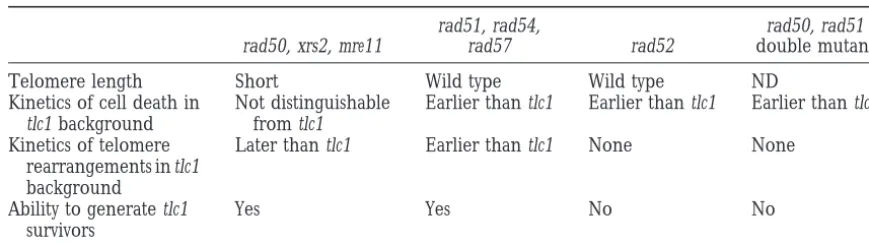
presence and absence of telomerase. These genes can be divided into three groups on the basis of their telomere phenotypes (Table 2). First, rad50, xrs2, and mre11 single mutants showed initial telomere shortening followed by stabilization. When combined with tlc1 mutations, this group generated survivors later than tlc1 alone. Second,
rad51, rad54, and rad57 alone had wild-type telomere
length, but when combined with tlc1, the double mu-tants died sooner than tlc1. Interestingly, survivors ap-peared at earlier generations than in tlc1 single mutants. This earlier generation of survivors may be a direct result of the strong selection imposed by the early cell death in this group of mutants. The final group consists of
Figure4.—Survivors are not generated in rad50 rad51 tlc1
rad52 and the rad50 rad51 double mutant; these cells
triple mutants. (A) A liquid growth cell viability assay was done
died much earlier than tlc1 single mutants and failed as described in Figure 2 to assess the viability of the rad50
to generate survivors. rad51 tlc1 triple mutant compared to double and single
mu-tants. Freshly dissected spore clones were used for this experi- The grouping of these RAD genes into these catego-ment. Four independent rad50 rad51 tlc1 triple mutants were ries on the basis of telomere phenotypes parallels the analyzed. The average and standard deviation is plotted for
grouping on the basis of their recombinational pheno-these. In this experiment only one of each of the other
geno-types and their biochemical properties (reviewed in types was assayed, although similar results were obtained in
Kanaar and Hoeijmakers 1997). First, mutations in several independent experiments. Of the genotypes assayed
here, only the rad50 rad51 tlc1 triple mutant failed to generate RAD50, XRS2, and MRE11 have similar genetic effects survivors. s, Wild type; h, tlc1;e, rad50 tlc1;n, rad51 tlc1; on recombination (Maloneet al. 1990; Ogawaet al.
d, rad50 rad51;j, rad50 rad51 tlc1. (B) Cell viability of triple
1995; Ivanov et al. 1996). These proteins interact to
mutant rad50 rad51 tlc1 cells compared with several other
form a complex (Johzuka and Ogawa1995; Usui et
double mutant combinations. Cells were grown for 60
genera-al. 1998) that appears to provide or regulate an
exo-tions, counted, and diluted to 13107cells/ml. Serial 10-fold
dilutions of each culture were spotted on a YPD plate. The nuclease function (Sugawara and Haber 1992; lack of growth in the more dilute samples represents the loss SharplesandLeach1995;Ivanovet al. 1996; Tsubou-of viability Tsubou-of the culture. The relevant genotypes Tsubou-of the cells
chi and Ogawa 1998), but they also act together in are indicated on the left.
other processes that do not appear to rely on exo-nuclease activity (Alaniet al. 1990; reviewed inHaber
1998; Tsubouchi and Ogawa 1998; Moreau et al.
As an additional method to evaluate the relative
viabil-ity of these cultures, we used the cell spotting assay 1999). Second, genetic evidence indicates that the
RAD51, RAD54, RAD55, and RAD57 genes function
to-described byNugentet al. (1998). This assay was carried
out on cells that had been grown forz60 generations gether in one pathway (Rattray and Symington
1995), and the proteins encoded by these genes interact (similar to days 5–6 in Figure 4A). Tenfold dilutions of
each culture were spotted on YEPD plates to determine physically (Hays et al. 1995;Jianget al. 1996;Clever
et al. 1997;Sung1997). Although Rad52p and Rad51p cell viability. As seen previously, tlc1 and rad50 tlc1 were
slightly less viable than wild type and rad51 tlc1, rad54 proteins have been shown to interact both physically and genetically (Shinohara et al. 1992; Milne et al. tlc1, and rad57 tlc1 showed significantly reduced viability.
Both the triple mutant rad50 rad51 tlc1 and rad52 tlc1 1996), it is clear that their roles in recombination are significantly different (RattrayandSymington1994; were inviable after this extent of cell growth (Figure
4B). Telomere length analysis on Southern blots showed Malkova et al. 1996a). There is increasing evidence
amplifica-TABLE 2
Summary of mutant phenotypes
rad51, rad54, rad50, rad51
rad50, xrs2, mre11 rad57 rad52 double mutant
Telomere length Short Wild type Wild type ND
Kinetics of cell death in Not distinguishable Earlier than tlc1 Earlier than tlc1 Earlier than tlc1
tlc1 background from tlc1
Kinetics of telomere Later than tlc1 Earlier than tlc1 None None rearrangements in tlc1
background
Ability to generate tlc1 Yes Yes No No
survivors
ND, not done.
pathway that requires both RAD52 and RAD59 (Baiand homologous recombination pathways. First, a rad51 mu-tation reduces spontaneous recombination between
Symington1996).
Multiple recombination pathways play a role in telo- heteroalleles as much as 10-fold, while a rad50 mutation increases recombination by about the same extent (
Iva-mere length:Genetic evidence indicates that there are at
least three separate pathways involved with homologous novet al. 1994;RattrayandSymington1995). Sec-ond, for interchromosomal gene conversion induced recombination in yeast and that the RAD52 gene is
in-volved in all three pathways (reviewed inHaber1995; by a DSB, RAD51 is essential, while the absence of RAD50 has only a small effect on the efficiency of repair,
al-RattrayandSymington1995;Malkovaet al. 1996a).
Our data suggest that at least two independent recombi- though the kinetics of repair are delayed (Ivanovet al.
1994;Malkovaet al. 1996b). Third, the discovery that
nation pathways are involved in telomere length
mainte-nance. The group of mutants represented by rad50 had RAD59 defines a RAD51-independent, but
RAD52-dependent pathway of recombination (Baiand
Syming-short telomeres and generated survivors late. The fact
that survivors were generated at all suggests that another ton1996) argues that there are indeed multiple homol-ogous repair pathways. Finally, although a rad51 mutation pathway, or gene product, in addition to the RAD50
pathway plays a role in generating survivors. Similarly, prevents gene conversion, it still can carry out break-induced replication, where one end of a broken chro-survivors were still generated when mutations of the
RAD51 group genes were combined with tlc1. In con- mosome invades a homolog and promotes replication
all the way to the end of the chromosomal template trast, neither rad52 tlc1 nor rad50 rad51 tlc1 triple
mu-tants generated survivors. One interpretation of these (Malkovaet al. 1996a;Morrowet al. 1997;Boscoand
Haber1998). Thus, we interpret the lack of survivors results is that two different pathways defined by the
RAD50 and RAD51 genes are needed to generate survi- in the rad50 rad51 tlc1 triple mutant as the elimination of two separate RAD52-dependent pathways, one requiring vors and that RAD52 plays an essential role in both
pathways. RAD51 and the other requiring RAD50. Although the
data cited above support a model where RAD52 plays a There are two additional interpretations of the result
that rad50 rad51 tlc1 triple mutants fail to generate survi- central role, at the present time we cannot exclude a model in which the lack of survivors in the rad50 rad51 vors. One is that the non-homologous-end-joining
(NHEJ) and homologous recombination are both tlc1 triple mutant is independent of the lack of survivors
in rad52 tlc1. needed for the generation of survivors. However,
be-cause RAD52 affects multiple homologous recombina- Mechanism of recombination-mediated telomere elongation:Recombination-mediated telomere elonga-tion pathways but has little or no effect on NHEJ
path-ways (reviewed inPeteset al. 1991;Krameret al. 1994; tion likely occurs by a mechanism similar to break-induced replication. If a chromosome end is lost or
MooreandHaber1996;Tsukamotoet al. 1996), it is
hard to argue that rad52 tlc1 cells are deficient in both severely shortened, the broken chromosome will only have sequences on one side of the break that are homol-NHEJ and homologous recombination.
Another possible interpretation of the triple mutant ogous to any template from which it can be repaired; thus conventional gene conversion mechanisms will not phenotype is that RAD50 and RAD51 are in the same
homologous recombination pathway but neither dele- allow repair (reviewed inSzostaket al. 1983). A
recom-bination-dependent replication mechanism, however, tion mutant alone inactivates the pathway completely;
only the double mutant completely knocks out the path- can accomplish such repair (Malkovaet al. 1996a; Mor-rowet al. 1997;BoscoandHaber1998). In wild-type way. However, results from earlier experiments support
most often by a gene conversion process in which the may be overwhelmed when faced with too much damage.
intact homologous chromosome is used as a template
RAD50, XRS2, and MRE11 play a role in telomere
to copy sequences around the break. In a rad52 diploid,
maintenance even in the presence of telomerase: The
.99% of the cells lose the broken chromosome. In
fact that telomeres are shorter in rad50, xrs2, mre11, contrast, in a rad51 strain, half of the cells are able
hdf1, and hdf2 mutants suggests that these genes are
to repair the DSB. However, the repair events are not
involved in telomere maintenance (Porteret al. 1996;
conventional gene conversions; instead, the broken
KironmaiandMuniyappa1997;BoultonandJackson
chromosome end proximal to the DSB apparently
in-1998; Nugent et al. 1998). The RAD50, XRS2, and
vades the intact homologous chromosome and
repli-MRE11 genes are involved in both homologous
recom-cates all the sequences (100 kb or more) to the end of
bination and DNA end-joining (reviewed inMooreand the chromosome. This RAD52-dependent break-induced
Haber1996;KanaarandHoeijmakers1997;
Tsuka-replication mechanism (Malkovaet al. 1996a) is
analo-motoet al. 1997;TsukamotoandIkeda1998). Muta-gous to the break-copy repair mechanism proposed by
tions in HDF1 and HDF2 confer an altered chromosome
Morrowet al. (1997). Recent studies have found that
end structure, which suggests that the Ku proteins func-this type of replication is efficient in wild-type cells in
tion in telomere end maintenance (Gravelet al. 1998;
circumstances where gap repair cannot occur, such as
Polotniankaet al. 1998). Double mutants of rad50 tlc1,
when the end of a chromosome has been lost (Bosco
xrs2 tlc1, and mre11 tlc1 generated survivors after more
andHaber1998). This mechanism is similar to earlier
cell divisions than double mutants of tlc1 with rad51, proposals for the repair and maintenance of telomere
rad52, rad54, and rad57. This may be analogous to the
ends (Bernardset al. 1983;Walmsleyet al. 1984;Dunn
mechanism by which rad50 and xrs2 mutants delay but
et al. 1985). The fact that break-copy repair events can
do not prevent mating-type switching in yeast (Ivanov
apparently occur after several cell cycles (Malkova et
et al. 1994). Perhaps unprocessed ends are not able to al. 1996a) suggests that chromosomes lacking telomeres
take part in a normal recombination process at telo-in yeast might be stable through several rounds of
repli-meres, or, as our evidence now suggests, the absence of cation, as has been previously proposed (Sandelland
a RAD50-dependent homologous recombination
path-Zakian 1993). Thus the evidence suggests that
break-way blocks telomere gene conversion (break-induced re-induced replication is the mechanism that elongates
plication) at normal telomeres even in the presence of telomeres in the absence of telomerase.
telomerase.
rad51, rad52,rad54, and rad57mutations accelerate
The analysis of telomere length in recombination-the death of tlc1 mutants:We began this analysis with
deficient mutants presented in this article suggests a the observation that the rad52 tlc1 double mutant dies
role for DNA recombination in normal telomere main-at earlier genermain-ations than mutants in tlc1 alone. We
tenance in yeast. Recombination has been implicated hypothesized that if death is simply due to telomere
in telomere length maintenance under special circum-loss, the rad52 tlc1 double mutant might lose telomeres
stances in human cells (Bryanet al. 1995, 1997). Some
at a faster rate. We saw no evidence of this in Southern
of the RAD52 group genes have homologues in higher blot analysis. The double mutants for rad51 tlc1, rad54
eukaryotes, including human (reviewed inIvanovand
tlc1, and rad57 tlc1 also showed a faster rate of death Haber1997;KanaarandHoeijmakers1997). Thus it
than tlc1, and yet they also showed no increase in the rate will soon be possible to test whether DNA recombina-of average telomere shortening. Because our method tion plays a similar role in mammalian telomere length measures the average length of telomeres, we cannot maintenance.
rule out a subtle effect on a subset of chromosome ends
We thank Dr. Jef Boeke and the Greider and Haber laboratory that is not evident in the Southern blot analysis. members for helpful discussions and critical reading of the manu-If there is no increased rate of telomere shortening, script. We thank Qijun Chen for assistance with tetrad dissection and why do the double mutants rad51 tlc1, rad54 tlc1, and Sang Eun Lee for providing the yeast strain ySL43. This work was supported by National Institutes of Health (NIH) grants GM43080 rad57 tlc1 die sooner? Additive effects of independent
and CA16519 to C.W.G. and by Department of Energy grant 1ER61235 pathways that both affect chromosome stability may play
to J.E.H. S. Le was supported by an NIH postdoctoral fellowship (CA a role. There is an accelerated rate of chromosome loss 68736).
in rad51, rad52, and rad54 mutant cells (reviewed in
Friedberg 1988) and this rate is further increased by X-irradiation, which leads to an increased rate of death
LITERATURE CITED (Mortimer et al. 1981). Assuming that tlc1 cells die,
Alani, E., R. PadmoreandN. Kleckner,1990 Analysis of wild-type at least in part, from chromosome loss, increasing the and rad50 mutants of yeast suggests an intimate relationship chromosome loss rate by combining two mutations, between meiotic chromosome synapsis and recombination. Cell
61:419–436. both of which cause loss, may lead to more rapid cell
Autexier, C.,andC. W. Greider,1996 Telomerase and cancer: death. Alternatively, DNA repair mechanisms that can revisiting the telomere hypothesis. Trends Biochem. Sci. 21: 387–
Bai, Y.,andL. S. Symington,1996 A Rad52 homolog is required strand break formation in Saccharomyces cerevisiae. Genetics 139: for RAD51-independent mitotic recombination in Saccharo- 1521–1532.
myces cerevisiae. Genes Dev. 10: 2025–2037. Kanaar, R., andJ. H. J. Hoeijmakers,1997 Recombination and Bernards, A., P. A. M. Michels, C. R. LinckeandP. Borst,1983 joining: Different means to the same ends. Genes Function 1:
Growth of chromosomal ends in multiplying trypanosomes. Na- 165–174.
ture 303: 592–597. Kironmai, K. M.,andK. Muniyappa,1997 Alteration of telomeric
Blackburn, E. H.,andJ. W. Szostak,1984 The molecular structure sequences and senescence caused by mutations in RAD50 of of centromeres and telomeres. Annu. Rev. Biochem. 53: 163–194. Saccharomyces cerevisiae. Genes Cells 2: 443–455.
Blasco, M. A., H.-W. Lee, P. M. Hande, E. Samper, P. M. Lansdorp Kramer, K. M., J. A. Brock, K. Bloom, J. K. MooreandJ. E. Haber,
et al., 1997 Telomere shortening and tumor formation by mouse 1994 Two different types of double-strand breaks in Saccharo-cells lacking telomerase RNA. Cell 91: 25–34. myces cerevisiae are repaired by similar RAD52-independent, Bosco, G.,andJ. E. Haber,1998 Chromosome break-induced DNA nonhomologous recombination events. Mol. Cell. Biol. 14: 1293–
replication leads to non-reciprocal translocations and telomere 1301.
capture. Genetics 150: 1037–1047. Lendvay, T. S., D. K. Morris, J. Sah, B. BalasubramanianandV. Boulton, S. J.,andS. P. Jackson,1996 Identification of a Saccharo- Lundblad,1996 Senescence mutants of Saccharomyces cerevisiae
myces cerevisiae Ku80 homologue: roles in DNA double strand with a defect in telomere replication identify three additional break rejoining and in telomeric maintenance. Nucleic Acids EST genes. Genetics 144: 1399–1412.
Res. 24: 4639–4648. Lingner, J., T. R. Hughes, A. Shevchenko, M. Mann, V. Lundblad
Boulton, S. J.,andS. P. Jackson,1998 Components of the Ku- et al., 1997 Reverse transcriptase motifs in the catalytic subunit dependent non-homologous end-joining pathway are involved in of telomerase. Science 276: 561–567.
telomeric length maintenance and telomeric silencing. EMBO Louis, E., andJ. E. Haber,1990a Mitotic recombination among
J. 17: 1819–1828. subtelomeric Y9repeats in Saccharomyces cerevisiae. Genetics 124:
Bryan, T. M., A. Englezou, J. Gupta, S. BacchettiandR. R. Reddel, 547–559.
1995 Telomere elongation in immortal human cells without Louis, E. J.,andJ. E. Haber, 1990b The subtelomeric y9repeat detectable telomerase activity. EMBO J. 14: 4240–4248. family in Saccharomyces cerevisiae: an experimental system for re-Bryan, T. M., A. Englezou, L. Dalla-Pozza, M. A. Dunhamand peated sequence evolution. Genetics 124: 533–545.
R. R. Reddel,1997 Evidence for an alternative mechanism for Lundblad, V.,andE. H. Blackburn,1993 An alternative pathway maintaining telomere length in human tumors and tumor- for yeast telomere maintenance rescues est1-senescence. Cell 73:
derived cell lines. Nat. Med. 3: 1271–1274. 347–360.
Clever, B., H. Interthal, J. Schmuckli-Maurer, J. King, M. Sigrist Malkova, A., E. L. IvanovandJ. E. Haber,1996a Double-strand
et al., 1997 Recombinational repair in yeast: functional interac- break repair in the absence of RAD51 in yeast: a possible role tions between Rad51 and Rad54 proteins. EMBO J. 16: 2535– for break-induced DNA replication. Proc. Natl. Acad. Sci. USA
2544. 93:7131–7136.
Donovan, J. W., G. T. MilneandD. T. Weaver,1994 Homotypic Malkova, A., L. Ross, D. Dawson, M. F. HoekstraandJ. E. Haber, and heterotypic protein associations control Rad51 function in 1996b Meiotic recombination initiated by a double-strand break double-strand break repair. Genes Dev. 8: 2552–2562. in rad50 delta yeast cells otherwise unable to initiate meiotic Dunn, B., P. Szauter, M. L. PardueandJ. W. Szostak,1985 Trans- recombination. Genetics 143: 741–754.
fer of yeast telomeres to linear plasmids by recombination. Cell Malone, R. E., T. Ward, S. LinandJ. Waring,1990 The RAD50
39:191–201. gene, a member of the double strand break repair epistasis group,
Friedberg, E. C.,1988 Deoxyribonucleic acid repair in the yeast is not required for spontaneous mitotic recombination in yeast. Saccharomyces cerevisiae. Microbiol. Rev. 52: 70–102. Curr. Genet. 18: 111–116.
Furuse, M., Y. Nagase, H. Tsubouchi, K. Murakami-Murofushi,
McDonald, J. P., and R. Rothstein, 1994 Unrepaired hetero-T. Shibataet al., 1998 Distinct roles of two separable in vitro duplex DNA in Saccharomyces cerevisiae is decreased in RAD1 activities of yeast Mre11 in mitotic and meiotic recombination.
RAD52-independent recombination. Genetics 137: 393–405.
EMBO J. 17: 6412–6425. Milne, G. T., S. Jin, K. B. ShannonandD. T. Weaver,1996
Muta-Gravel, S., M. Larrivee, P. LabrecqueandR. J. Wellinger,1998
tions in two Ku homologs define a DNA end-joining repair path-Yeast Ku as a regulator of chromosomal DNA end structure. way in Saccharomyces cerevisiae. Mol. Cell. Biol. 16: 4189–4198. Science 280: 741–744.
Moore, J. K.,andJ. E. Haber,1996 Cell cycle and genetic require-Greider, C. W.,1996 Telomere length regulation. Annu. Rev.
Bio-ments of two pathways of nonhomologous end-joining repair of chem. 65: 337–365.
double-strand breaks in Saccharomyces cerevisiae. Mol. Cell. Biol. Haber, J. E.,1995 In vivo biochemistry: physical monitoring of
re-16:2164–2173. combination induced by site-specific endonucleases. Bioessays
Moreau, S., H. R. Ferguson and L. S. Symington, 1999 The
17:609–620.
nuclease activity of Mre11 is required for meiosis but not for Haber, J. E.,1998 The many interfaces of Mre11. Cell 95: 583–586.
mating type switching, end joining or telomere maintenance. Hays, S. L., A. A. FirmenichandP. Berg,1995 Complex formation
Mol. Cell. Biol. 19: 556–566. in yeast double-strand break repair: participation of Rad51,
Morrow, D. M., C. ConnellyandP. Hieter,1997 “Break copy” Rad52, Rad55, and Rad57 proteins. Proc. Natl. Acad. Sci. USA
duplication: a model for chromosome fragment formation in
92:6925–6929.
Saccharomyces cerevisiae. Genetics 147: 371–382.
Horowitz, H.,andJ. E. Haber,1984 Subtelomeric regions of yeast
Mortimer, R. K., R. Contopoulou andD. Schild,1981 Mitotic chromosomes contain a 36 base pair tandemly repeated
se-chromosome loss in a radiation-sensitive strain of the yeast Sac-quence. Nucleic Acids Res. 12: 7105–7121.
charomyces cerevisiae. Proc. Natl. Acad. Sci. USA 78: 5778–5782. Ivanov, E. L.,andJ. E. Haber,1997 DNA repair: RAD alert. Curr.
Nugent, C. I.,andV. Lundblad,1998 The telomerase reverse tran-Biol. 7: R492–495.
scriptase: components and regulation. Genes Dev. 12: 1073–1085. Ivanov, E. L., N. Sugawara, C. I. White, F. FabreandJ. E. Haber,
Nugent, C. I., G. Bosco, L. O. Ross, S. K. Evans, A. P. Salinger 1994 Mutations in XRS2 and RAD50 delay but do not prevent
et al., 1998 Telomere maintenance is dependent on activities mating-type switching in Saccharomyces cerevisiae. Mol. Cell.
required for end repair of double-strand breaks. Curr. Biol. 8: Biol. 14: 3414–3425.
657–660. Ivanov, E. L., N. Sugawara, J. Fishman-LobellandJ. E. Haber,
Ogawa, H., K. Johzuka, T. Nakagawa, S. H. LeemandA. H. Hagi-1996 Genetic requirements for the single-strand annealing
hara,1995 Functions of the yeast meiotic recombination genes, pathway of double-strand break repair in Saccharomyces
cerevis-MRE11 and MRE2. Adv. Biophys. 31: 67–76. iae. Genetics 142: 693–704.
Petes, T. D., R. E. MaloneandL. S. Symington,1991 Recombina-Jiang, H., Y. Xie, P. Houston, K. Stemke-Hale, U. H. Mortensenet
tion in yeast, pp. 407–522 in The Molecular and Cellular Biology of
al., 1996 Direct association between the yeast Rad51 and Rad54
the Yeast Saccharomyces, edited byJ. R. Broach, J. R. Pringleand recombination proteins. J. Biol. Chem. 271: 33181–33186.
E. W. Jones.Cold Spring Harbor Laboratory Press, Cold Spring Johzuka, K.,andH. Ogawa,1995 Interaction of Mre11 and Rad50:
Pluta, A. F.,andV. A. Zakian,1989 Recombination occurs during like protein [published erratum appears in Cell 1992 Oct 2;71(1):following 180]. Cell 69: 457–470.
telomere formation in yeast. Nature 337: 429–433.
Polotnianka, R. M., J. Liand A. J. Lustig,1998 The yeast Ku Singer, M. S.,andD. E. Gottschling,1994 TLC1: Template RNA
component of Saccharomyces cerevisiae telomerase. Science 266: heterodimer is essential for protection of the telomere against
nucleolytic and recombinational activities. Curr. Biol. 8: 831–834. 404–409.
Sugawara, N.,andJ. E. Haber,1992 Characterization of double-Porter, S. E., P. W. Greenwell, K. B. RitchieandT. D. Petes,1996
The DNA-binding protein Hdf1p (a putative Ku homologue) is strand break-induced recombination: homology requirements and single-stranded DNA formation. Mol. Cell. Biol. 12: 563–575. required for maintaining normal telomere length in
Saccharo-myces cerevisiae. Nucleic Acids Res. 24: 582–585. Sugawara, N., E. L. Ivanov, J. Fishman-Lobell, B. L. Ray, X. Wu
et al., 1995 DNA structure-dependent requirements for yeast Prescott, J.,andE. H. Blackburn,1997 Telomerase RNA
muta-tions in Saccharomyces cerevisiae alter telomerase action and RAD genes in gene conversion. Nature 373: 84–86.
Sung, P.,1997 Yeast Rad55 and Rad57 proteins form a heterodimer reveal nonprocessivity in vivo and in vitro. Genes Dev. 11: 528–
540. that functions with replication protein A to promote DNA strand
exchange by Rad51 recombinase. Genes Dev. 11: 1111–1121. Rattray, A. J.,andL. S. Symington,1994 Use of a chromosomal
inverted repeat to demonstrate that the RAD51 and RAD52 genes Szostak, J. W., T. L. Orr-Weaver, R. J. RothsteinandF. W. Stahl, 1983 The double-strand-break repair model for recombination. of Saccharomyces cerevisiae have different roles in mitotic
recombi-nation. Genetics 138: 587–595. Cell 33: 25–35.
Tsubouchi, H.,andH. Ogawa,1998 A novel mre11 mutation im-Rattray, A. J.,andL. S. Symington,1995 Multiple pathways for
homologous recombination in Saccharomyces cerevisiae. Genetics pairs processing of double-strand breaks of DNA during both mitosis and meiosis. Mol. Cell. Biol. 18: 260–268.
139:45–56.
Reddel, R. R., T. M. BryanandJ. P. Murnane,1997 Immortalized Tsukamoto, Y., andH. Ikeda, 1998 Double-strand break repair mediated by DNA end-joining. Genes Cells 3: 135–144. cells with no detectable telomerase activity: a review. Biochemistry
62:1254–1262. Tsukamoto, Y., J. KatoandH. Ikeda,1996 Hdf1, a yeast Ku-protein
homologue, is involved in illegitimate recombination, but not in Rose, M. D., F. WinstonandP. Heiter,1988 Methods in Yeast
Genet-ics. Cold Spring Harbor Laboratory Press, Cold Spring Harbor, homologous recombination. Nucleic Acids Res. 24: 2067–2072. Tsukamoto, Y., J. KatoandH. Ikeda,1997 Silencing factors partici-NY.
Rudin, N., E. SugarmanandJ. E. Haber,1989 Genetic and physical pate in DNA repair and recombination in Saccharomyces cerevis-iae [see comments]. Nature 388: 900–903.
analysis of double-strand break repair and recombination in
Sac-charomyces cerevisiae. Genetics 122: 519–534. Usui, T., T. Ohta, H. Oshumi, H. Tsubouchi, J.-I. Tomizawaet al.,
Sandell, L. L.,andV. A. Zakian,1993 Loss of a yeast telomere: 1998 Complex formation and functional versatility of Mre11 of arrest, recovery, and chromosome loss. Cell 75: 729–739. budding yeast in recombination. Cell 95: 706–716.
Shampay, J.,andE. H. Blackburn,1988 Generation of telomere- Walmsley, R. W., C. S. M. Chan, B.-K. TyeandT. D. Petes,1984 length heterogeneity in Saccharomyces cerevisiae. Proc. Nat. Acad. Unusual DNA sequences associated with the ends of yeast
chro-Sci. USA 85: 534–538. mosomes. Nature 310: 157–160.
Sharples, G. J.,andD. R. Leach,1995 Structural and functional Zakian, V. A.,1989 Structure and function of telomeres. Annu. Rev. similarities between the SbcCD proteins of Escherichia coli and Genet. 23: 579–604.
the RAD50 and MRE11 (RAD32) recombination and repair pro- Zakian, V. A.,1996 Structure, function, and replication of Saccharo-teins of yeast [letter]. Mol. Microbiol. 17: 1215–1217. myces cerevisiae telomeres. Annu. Rev. Genet. 30: 141–172. Shinohara, A., H. Ogawa and T. Ogawa, 1992 Rad51 protein