Copyright1999 by the Genetics Society of America
Expression Vectors for
Methanococcus maripaludis
: Overexpression of
Acetohydroxyacid Synthase and
b
-Galactosidase
Warren L. Gardner and William B. Whitman
Department of Microbiology, University of Georgia, Athens, Georgia 30602-2605 Manuscript received March 23, 1999
Accepted for publication May 5, 1999
ABSTRACT
A series of integrative and shuttle expression vectors was developed for use in Methanococcus maripaludis. The integrative expression vectors contained the Methanococcus voltae histone promoter and multiple cloning sites designed for efficient cloning of DNA. Upon transformation, they can be used to overexpress specific homologous genes in M. maripaludis. When tested with ilvBN, which encodes the large and small subunits of acetohydroxyacid synthase, transformants possessed specific activity 13-fold higher than that of the wild type. An expression shuttle vector, based on the cryptic plasmid pURB500 and the components of the integrative vector, was also developed for the expression of heterologous genes in M. maripaludis. Theb-galactosidase gene from Escherichia coli was expressed toz1% of the total cellular protein using this vector. During this work, the genes for the acetohydroxyacid synthase (ilvBN) and phosphoenolpyruvate synthase (ppsA) were sequenced from a M. maripaludis genomic library.
M
ETHANOGENS are important catalysts in the coccus species (Gernhardt et al. 1990; Cohen-Kup-iecet al. 1997;Tumbulaet al. 1997). These vectors are global carbon cycle. These strictly anaerobicarchaea are the source of most of the earth’s atmo- efficiently transformed into M. maripaludis by a polyeth-ylene glycol-based method (Tumbulaet al. 1994). Like spheric methane, a potent greenhouse gas, and they
are responsible for processing 1–2% of the carbon fixed other methanogens, M. maripaludis contains many oxy-every year during photosynthesis (Reeburgh et al. gen-sensitive enzymes with complex prosthetic groups. 1993). Given the enormity of this biogeochemical pro- These enzymes are not frequently expressed in an active cess, it is not surprising that methanogens are found in form in Escherichia coli. Thus, a genetic system in M. many different types of environments, ranging from maripaludis might be suitable for the expression of genes psychrophilic to hyperthermophilic conditions (for a encoding these types of enzymes. We report here the review seeBoone et al. 1993). In this regard, they are development of expression shuttle and integrative vec-the most cosmopolitan archaea; vec-they are abundant in tors for M. maripaludis that use the M. voltae histone extreme environments, such as deep-sea hydrothermal promoter (PhmvA).
vents, as well as temperate environments, such as the gastrointestinal tracts of man and animals.
Methanococcus maripaludis strain J J is typical of other MATERIALS AND METHODS hydrogenotrophic methanococci. It was isolated from
Bacterial strains, media, and growth conditions: M.
maripa-the sediment of a salt water marsh and grows by maripa-the
ludis J J was obtained from W. J. Jones. The plasmids used in
conversion of carbon dioxide and hydrogen gas or for- this study are listed in Table 1. M. maripaludis was grown at mate into methane (Jones et al. 1983a). Amino acids 378on 275 kPa of H2:CO2(80:20) in McN (mineral medium),
McC (complex medium minus the vitamin solution), or McNA and acetate are assimilated, but they are not significantly
(McN plus 10 mmsodium acetate;Whitmanet al. 1986). The
metabolized, indicating that methanogenesis is the sole
sodium bicarbonate in the medium was reduced from 5 g or major energy source (Whitmanet al. 1987). An
im-liter21to 2 g liter21during growth at 100 kPa in 1-liter Wheaton
portant characteristic of M. maripaludis is its relatively bottles. Transformation of M. maripaludis with plasmid DNA rapid doubling time of 2.3 hr at the optimal tempera- was described previously (Tumbulaet al. 1994). For selection of puromycin-resistant methanococci, a stock solution of 500 tures of 35–398(Jones et al. 1983a). Thus, it is one of
mg ml21 puromycin dihydrochloride (Sigma, St. Louis) in
the fastest growing mesophilic methanogens.
distilled water was filter sterilized and added to the medium M. maripaludis has also proven amenable to genetic
at a final concentration of 2.5 mg ml21. Strictly anaerobic
analysis (Tumbula and Whitman 1999). Integrative techniques were used for medium preparation and cultivation. and shuttle vectors have been developed for Methano- The E. coli strains were grown at 378on low-salt Luria-Bertani (LB) medium with the NaCl at 50% of the regular concentra-tion (Maniatis et al. 1982). Antibiotic concentrations were 60mg ml21for ampicillin and 50mg ml21for kanamycin in
Corresponding author: William B. Whitman, Department of
Microbiol-both liquid and solid LB medium.b-Galactosidase was used ogy, University of Georgia, Athens, GA 30602-2605.
E-mail: [email protected] as a blue/white screen on LB agar plates with
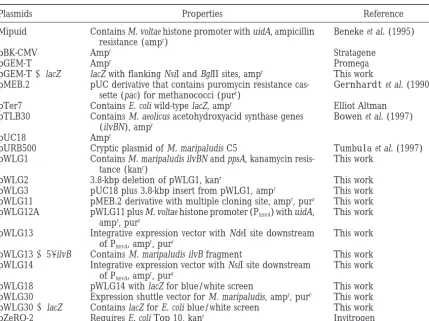
TABLE 1 Plasmids used in this studya
Plasmids Properties Reference
Mipuid Contains M. voltae histone promoter with uidA, ampicillin Benekeet al. (1995) resistance (ampr)
pBK-CMV Ampr Stratagene
pGEM-T Ampr Promega
pGEM-T1lacZ lacZ with flanking NsiI and BglII sites, ampr This work
pMEB.2 pUC derivative that contains puromycin resistance cas- Gernhardtet al. (1990) sette (pac) for methanococci (purr)
pTer7 Contains E. coli wild-type lacZ, ampr Elliot Altman
pTLB30 Contains M. aeolicus acetohydroxyacid synthase genes Bowenet al. (1997) (ilvBN), ampr
pUC18 Ampr
pURB500 Cryptic plasmid of M. maripaludis C5 Tumbulaet al. (1997)
pWLG1 Contains M. maripaludis ilvBN and ppsA, kanamycin resis- This work tance (kanr)
pWLG2 3.8-kbp deletion of pWLG1, kanr This work
pWLG3 pUC18 plus 3.8-kbp insert from pWLG1, ampr This work
pWLG11 pMEB.2 derivative with multiple cloning site, ampr, purr This work
pWLG12A pWLG11 plus M. voltae histone promoter (PhmvA) with uidA, This work
ampr, purr
pWLG13 Integrative expression vector with NdeI site downstream This work of PhmvA, ampr, purr
pWLG13159-ilvB Contains M. maripaludis ilvB fragment This work pWLG14 Integrative expression vector with NsiI site downstream This work
of PhmvA, ampr, purr
pWLG18 pWLG14 with lacZ for blue/white screen This work
pWLG30 Expression shuttle vector for M. maripaludis, ampr, purr- This work
pWLG301lacZ Contains lacZ for E. coli blue/white screen This work
pZeRO-2 Requires E. coli Top 10, kanr Invitrogen
aAmpicillin (amp) and kanamycin (kan) are for selection in E. coli. Puromycin (pur) is for selection in M. maripaludis.
b-d-galactoside (IPTG) and 5-bromo-4-chloro-3-indolyl-b-d- which time the cells lysed. The cell extract was then transferred to a Corex tube, and 5 ml of 50% phenol saturated with 0.15m galactopyranoside (X-gal) according to the method of
Sam-brook et al. (1989). Plasmids were transformed into E. coli NaCl/0.1mEDTA (pH 8.0) and 50% chloroform:isoamyl alco-hol (24:1 v/v) were added. The solution was gently mixed by strains by electroporation with a Gene Pulser (Bio-Rad,
Rich-mond, CA) using the settings of 200 V, 2.5 kV, and 25 mF inversion before centrifugation at 82003g for 10 min. The red aqueous phase was extracted with another 5 ml of phenol/ with cuvettes (0.2 cm gap width).
Growth rates of E. coli and M. maripaludis were measured chloroform/isoamyl alcohol. Two volumes of cold 100% etha-nol were then added to the aqueous phase, and the suspension at 600 nm with a spectrophotometer (Spectronic 20).
Plasmid purification fromM. maripaludisandE. coli:Plas- was gently inverted before centrifugation at 48for 15 min at 82003g. The supernatant was decanted, and the pellet was mid isolation from M. maripaludis was begun by centrifuging
a 5-ml culture at 16,0003g at 48 followed by resuspension dried at room temperature. The pellet was resuspended in 100ml of 15 mmNaCl/1.5 mmtrisodium citrate (SSC) and of the cells in 100ml of methanococcal medium. After
resus-pension, the Wizard miniprep kit (Promega, Madison, WI) stored at 48. Additional SSC was added every 24 hr until the DNA was resuspended.
minus the resuspension step was used for preparation of the
plasmid DNA for transformation into E. coli. pURB500 was To make a genomic library for M. maripaludis, the genomic DNA (12mg in 100ml) was partially digested with 0.01 units isolated from M. maripaludis C5 as described previously (
Tum-bulaet al. 1994). Plasmids from E. coli, grown with selective of Sau3AI at 378for 5 min. The reaction was terminated by the addition of phenol/chloroform/isoamyl alcohol, pH 8.0 conditions, were isolated with the Wizard miniprep kit.
Construction ofM. maripaludisgenomic library: M. maripa- (Ameresco). The resulting linear DNA fragments ranged from 1 to 6 kbp, as measured by gel electrophoresis. The DNA was ludis genomic DNA was isolated using a modified procedure
fromSaitoandMiura(1963). M. maripaludis was grown in precipitated upon the addition of one-half volume of 7.5 m ammonium acetate and two volumes of cold 100% ethanol 150 ml of McN to A600 5 0.8. The cells were harvested by
centrifugation at 77003g at 48 for 15 min in a JA-21 rotor followed by centrifugation. After the supernatant was de-canted, the pellet was resuspended in 10ml of distilled water. (Beckman, Fullerton, CA) and washed once in 28 ml of sterile
0.4mNaCl. The cell pellet was then resuspended in 3 ml of Five micrograms of digested DNA (5ml) was ligated with 2 ml of Zap Express (Stratagene, La Jolla, CA) that was predi-0.15mNaCl/0.1mEDTA (pH 8.0). The cell suspension was
(Stratagene) before storage at 2808 according to the com- To replace the NdeI site near the histone promoter of pWLG13 with a NsiI site, the promoter was PCR amplified pany’s directions.
Isolation and sequencing of theM. maripaludis ilvBN:The using the primers 59-ATCTGCGAATTCAGCTGATCGAT CAAAATATAACATAAATAACATAGGTTTAA-39 (PhmvANsiI1) M. maripaludis genomic library was screened with a polymerase
chain reaction (PCR) product of the acetohydroxyacid syn- and 59-GAAGATCTTCAGCGCTAAACATGCATTTCACCTA TTAGTTATCTATAAAATTATA-39 (PhmvANsiI2). The first 12
thase (AHAS) large subunit gene (ilvB) from M. aeolicus using
pTLB30 as the template. The PCR contained the primers 59- nucleotides of PhmvANsiI1 contained an EcoRI site and 59
exten-sion for EcoRI digestion. Restriction sites for PvuII and ClaI GAACGGAGCAGAGGC-39 and 59-ACCAACCATACCAAGG
GC-39, 5 units Taq DNA polymerase, 1 mmdATP, 1 mmdGTP, were also added immediately upstream of the M. voltae histone 1 mmdCTP, 0.65 mmdTTP, and 0.35 mmdigoxigenin-deoxy- promoter. PhmvANsiI2 possessed a BglII site plus a two-nucleotide
uridine-59-triphosphate (DIG-dUTP) from Boehringer Mann- extension that allowed endonuclease digestion. The PCR an-heim (Indianapolis, IN). The annealing temperature was 488, nealing temperature was 438, and the extension time was 1 min and the extension time was 2 min at 728. This DIG-dUTP- at 728. The PCR product was digested with EcoRI and BglII labeled PCR product was used to screen plaque lifts from the for directed ligation into pWLG11, which had been digested library according to Boehringer Mannheim protocols. The with the same enzymes and treated with CIAP. The product, hybridization temperature was 638. The isolated phagemid pWLG14, contained the NsiI site as part of the start codon was then converted to the plasmid form (pWLG1). SacI was downstream of the histone promoter.
used to subclone a 3.8-kbp fragment of pWLG1. This fragment The E. coli lacZ gene was engineered by PCR for ligation was ligated into a SacI-digested pUC18, yielding pWLG3. The into pWLG14. The PCR contained pTer7 as the template and remaining portion of pWLG1 was religated together to form the primers 59-CCAATGCATGACCATGATTACGGATTCA pWLG2. These three plasmids were sequenced by primer walk- CTGG-39 and 59-GAAGATCTTTCCTTACGCGAAATACGGG ing utilizing API sequencers at the Molecular Genetics Facility, CAG-39to introduce flanking NsiI and BglII sites. It was per-University of Georgia. All oligonucleotides were made by Inte- formed with 2.5 units of Taq DNA polymerase and an anneal-grated DNA Technologies (Coralville, IA). Sequence analysis ing temperature of 52.38and an extension time of 3.75 min was performed with the GCG software package (Genetics Com- at 728. The lacZ product was cloned into pGEM-T, yielding puter Group, Madison, WI). FRAMES was used to identify pGEM-T1lacZ. This vector was digested with NsiI and BglII to open reading frames (ORFs) using ATG, GTG, or TTG as release the lacZ fragment. After treatment of pWLG14 with the start codons. GAP was used to calculate the percentage NsiI and BglII followed by CIAP, the lacZ fragment was ligated identities between the methanococcal proteins. PILEUP was in to yield pWLG18. Upon electroporation into E. coli XL1-used to identify the truncated regions for the phosphoenopy- Blue MRF9(Stratagene), pWLG18 was identified byb -galactos-ruvate synthase gene (ppsA) and the AHAS small subunit gene idase production on plates that contained X-gal and IPTG.
(ilvN). pWLG30, the expression shuttle vector, was constructed by
Plasmid construction:The integrative vectors developed in ligation of a partial EcoRI digestion of pURB500 with a com-this study were based on pMEB.2 (Figure 1). To remove the plete EcoRI digestion of pWLG14 (Figure 2). The ligation a-complementation fragment of lacZ, pMEB.2 was digested mixture was then transformed into M. maripaludis. The trans-with NdeI and SacI, followed by mung bean nuclease treatment formants were then inoculated into McC/puromycin broth and blunt-end ligation (Figure 1). This deletion allowed a to select for plasmids that contained both a methanococcal unique NdeI site to be introduced into the multiple cloning origin of replication from pURB500 and the pac cassette from site (MCS). The MCS was added after digestion of the plasmid pWLG14. Plasmids were then prepared from the broth culture with EcoRV and EcoRI and dephosphorylation with CIAP (calf of the transformants and electroporated into E. coli XL1-Blue intestine alkaline phosphatase). The phosphorylated oligonu- MRF9. The location and orientation of pWLG14 within cleotides, 59-AATTCAAGCATCATATGAAGCATACGCGTCT pURB500 was determined by digestion with SacII and TAAGAGATCTCATGAT-39and 59-ATCATGAGATCTCTTAA EcoO109I and was confirmed by sequencing. To form pWLG30 GACGCGTATGCTTCATATGATGCTTG-39, were annealed 1
lacZ, pWLG30 was digested with NsiI, BglII, and XbaI. BglII and ligated into the vector forming pWLG11. The EcoRI frag- lowered the background of the plasmids that were digested ment of Mipuid, which contained the M. voltae histone
pro-by only NsiI or XbaI. pWLG18 was digested with NsiI and XbaI, moter (PhmvA) and ribosome binding site and the E. colib
-gluc-and the NsiI-XbaI fragment containing lacZ was gel purified. uronidase (uidA), was then cloned into the EcoRI site of
After ligation and transformation into E. coli XL1-Blue MRF9, pWLG11. Removal of uidA by NdeI digestion formed the M.
pWLG30 1 lacZ was found by screening for blue colonies maripaludis integrative expression vector pWLG13. To form
on LB1ampicillin1X-gal plates. The sequencing primers pWLG13159-ilvB, the first 641 bp of the M. maripaludis ilvB
designed for confirming cloned DNA in pWLG30 or pWLG30 were cloned into pWLG13. First, the 59end of ilvB was
ampli-1 lacZ were 59-ACTCTCCAGAATACATAAAA-39 (pWLG30 fied by PCR using the primers 59-AAAAAAACATATGAAAG
seq1) and pMEB.2seq2. GAGCAGAGGCTATGATG-39 and 59-AAAAAAAGATCTCCG
Assays of AHAS activity:The wild-type strain J J1 or a strain CCTGCAATAATAACAGGTCTT-39. These primers contained
transformed with pWLG13159-ilvB was grown in 100 ml of NdeI and BglII sites at the 59and 39 ends, respectively. The
McNA in modified Wheaton bottles at 100 kPa of H2:CO2to
PCR contained 2.5 units of Pfu DNA polymerase (Stratagene),
A60050.60–0.75. The cells were harvested by centrifugation
and it was performed at an annealing temperature of 558for
under anaerobic conditions (Shiehet al. 1988). The pellets 1 min and an extension time of 2 min at 728. The PCR product
were resuspended in 100ml of dilution solution per 100 ml was drop dialyzed against distilled water with VSWP
mem-of medium. The dilution solution, which was sparged with N2
branes (Millipore, Bedford, MA) before digestion with NdeI
for 1 hr, contained 1 mmcysteine hydrochloride, 1 mm dl -and BglII for 4 hr. The enzymes in the reactions were removed
dithiothreitol, 1 mg bovine pancreatic DNase I (Boehringer using the Wizard clean-up kit (Promega).
Mannheim), 7.5 ml NaCl solution (293 g liter21), 50 ml
dis-After the digestion of pWLG13 with NdeI and BglII, the
tilled water, and 50 ml general salts solution (Whitmanet al. PCR product was ligated in to form pWLG13159-ilvB. The
1986). The cells were placed in an aluminum seal vial on ice sequence of the PCR product was confirmed by sequencing
and flushed with hydrogen gas for 2 min before freezing at with the primers that flanked the insertion site, pMEB.2seq1,
2208for 2 hr. Upon thawing, the cells had lysed, and the cell 59-AGGCACCCCAGGCTTTACAC-39 (59 end), and
Figure2.—Construction of methanococcal expression shuttle vectors pWLG30 and pWLG301lacZ. pWLG30 was constructed by ligation of a partial EcoRI digestion of the cryptic methanococcal plasmid pURB500 into the EcoRI site of pWLG14. lacZ from pWLG18 (Figure 1) was then added between the unique NsiI and BglII sites of pWLG30. The low level of lacZ expression of pWLG301lacZ forms a blue/white screen for clones in E. coli. The unique ClaI site in pWLG14 and pWLG30 allows the PhmvA
to be replaced with other promoters in future studies.
off (MWCO) tubing overnight at 48. The dialysis buffer was protein assay (Pierce Chemical, Rockford, IL), the dialyzed extract was first diluted 1:50 in 0.1msodium hydroxide, boiled the basic purification buffer that had been sparged with N2
and autoclaved (XingandWhitman1994). The AHAS assays for 10 min, and cooled on ice.
Assays ofb-galactosidase activity:Theb-galactosidase assay were performed at 378 as described previously (Park et al.
1995). For protein quantification by the bicinchoninic acid was performed with 2-nitrophenyl-b-d-galactopyranoside
Figure1.—Construction of the integrative vectors pWLG13, pWLG14, and pWLG18. Only the unique or otherwise useful restriction sites are shown. pMEB.2 was digested with NdeI and SacI to remove lacZ9before a MCS was added to form pWLG11. pWLG14 was constructed by the addition of PhmvAbetween the EcoRI and BglII sites of pWLG11. lacZ, modified by PCR to contain NsiI and BglII restriction sites, was ligated into pWLG14 to form pWLG18. pWLG12A was developed from pWLG11 by the addition of PhmvAand uidA from Mipuid. The uidA was released from pWLG12A by a NdeI digestion to form pWLG13. The MCS
quence of the large subunit (IlvB), which contained 587 amino acids, had 68.1, 72.9, and 31.4% sequence identity to the M. aeolicus, M. jannaschii (MJ0227), and M. jannaschii (MJ0663) IlvB homologs, respectively. The low amino acid sequence similarity to MJ0663 was consis-tent with the assignment of this ORF to another function
(Bowen et al. 1997). Fourteen nucleotides separated
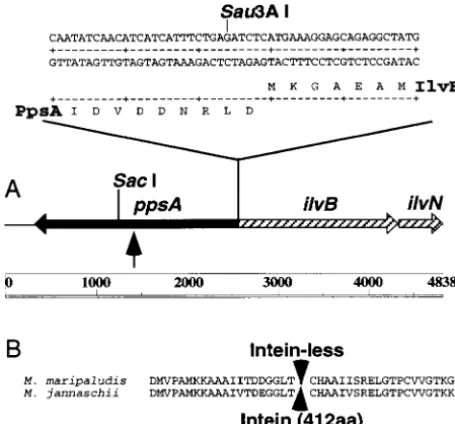
ilvB from ilvN. Upon comparison to the M. aeolicus gene, ilvN appeared to be truncated at the 39end to form a deletion equivalent to eight amino acids. This conclu-sion was supported by the presence of a Sau3A I site and the beginning of the pBK-CMV vector before a stop codon in the ilvN sequence. The deduced amino acid sequence of the small subunit (IlvN) from M. maripa-ludis was 71 and 73% identical to the M. aeolicus and M. jannaschii IlvN homologs, respectively. The ilvBN genes from M. aeolicus, which were separated by 172 bp, and M. maripaludis were linked (Bowenet al. 1997). In contrast, the M. jannaschii AHAS genes were unlinked Figure 3.—(A) Sequenced region of pWLG1 containing
(Bultet al. 1996). the M. maripaludis genes encoding AHAS (ilvBN) and
phos-Enzyme activity corresponding to a phosphoenolpy-phoenolpyruvate synthase (ppsA). The junction between ppsA
and ilvB indicating the position of the Sau3AI site likely to ruvate synthase (E.C. 2.7.9.2; pyruvate, water dikinase) be involved in formation of a chimera is shown. The arrow has been described in the cellular extracts of M. maripa-corresponds to the position of the putative intein splice junc- ludis (ShiehandWhitman1987), and ppsA appeared tion in the M. jannaschii ppsA. (B) Deduced amino acid
se-immediately upstream of ilvB. When compared to the quence of PpsA from M. maripaludis and M. jannaschii near
M. jannaschii, Pyrococcus furiosus, and Staphylothermus mar-the intein splice junction. Arrow represents putative intein
splice junction. inus homologs, the M. maripaludis PpsA was between 29
and 38 amino acids shorter at the N terminus. In addi-tion, an initiation codon was not observed at the 59 (ONPG) at a temperature of 378(Miller1992). E. coli
XL1-end of the cloned ORF, but a Sau3AI site was present, Blue MRF9containing pWLG301lacZ was grown overnight in
low salt LB broth medium/ampicillin without IPTG. These suggesting that the cloned ppsA had been truncated and cells were inoculated into fresh LB broth/ampicillin with and that the cloned DNA in pWLG1 was chimeric (Figure without 1 mmIPTG and grown to OD60050.64–0.70 before 3A). Alternatively, it is also possible that the ppsA cloned
being assayed. M. maripaludis was grown on McC medium/
was a pseudogene naturally present in the genome. In puromycin unless stated otherwise. M. maripaludis assays used
contrast, ilvB did not appear to be truncated because the same conditions as E. coli.
SDS-PAGE:This procedure was performed according to the the 59end of the gene encoded an amino acid sequence method ofLaemmli(1970) for a 10% polyacrylamide gel. nearly identical to the N-terminal sequence of the M.
Nucleotide sequence accession numbers:The GenBank ac- aeolicus AHAS (XingandWhitman1994). At the amino cession nos. for the M. maripaludis AHAS gene (ilvBN) and
acid level the M. maripaludis PpsA was 72% identical to
ppsA are AF118061 and AF118060, respectively. The accession
the M. jannaschii PpsA (MJ0542). The M. jannaschii ppsA nos. for pWLG11, pWLG13, pWLG14, and pWLG30 are
AF134196, AF134197, AF134198, and AF134199, respectively. contained an internal insertion that translated into a putative intein of 412 amino acids (Bultet al. 1996). At the intein/extein junction, a mechanistically important RESULTS AND DISCUSSION
cysteinyl residue was found in the first position of the second extein (Bult et al. 1996; Chong et al. 1996; Cloning of the ilvBN genes of M. maripaludis: The
two subunits of AHAS, which catalyze an early step in Figure 3B). The deduced amino acid sequence of the M. maripaludis PpsA was nearly identical to the M. jannaschii branched-chain amino acid biosynthesis, are encoded
by the ilvBN genes in M. aeolicus (Bowenet al. 1997). homolog near the intein/extein junction, and the mechanistically important cystienyl residue was con-Screening of the M. maripaludis genomic library
identi-fied one plaque that hybridized with the M. aeolicus ilvB served. The putative intein, however, was absent. Overexpression ofilvBNinM. maripaludis:AHAS is probe. Upon conversion of the phagemid to the plasmid
form, the plasmid pWLG1 was found to containz7 kbp normally expressed at the low levels typical of biosyn-thetic genes within the methanococci (Xingand
Whit-of M. maripaludis genomic DNA. A total Whit-of 4838 bp was
sequenced, and three ORFs with homology to known man 1987). Because this enzyme is both unstable and O2 labile, it would be much easier to characterize
bio-genes were identified (Figure 3A). Two ORFs encoded
se-TABLE 3 TABLE 2
Overexpression of the acetohydroxyacid synthase in Expression ofb-galactosidase inM. maripaludis
by the shuttle vector
M. maripaludistransformed with pWLG13159ilvB
Vector Specific activitya Vector Specific activitya
pWLG30 ,0.02b
None 0.011
pWLG13159ilvB 0.150 pWLG301lacZ 4.5
Cells were grown to an absorbance of 0.45–0.48 in McC Cells were grown to an absorbance of 0.7–0.9 in McNA.
aMicromoles of acetolactate formed per minute per milli- medium/puromycin.
aMicromoles per minute per milligram of protein. Average
igram of protein. Average of triplicate assays.
of duplicates.
bNo activity was detected.
mid, the start codon of ilvB overlapped with the NdeI
site 4 bp downstream of the ribosome-binding site and same site near the P
hmvA. Therefore, pWLG14 was chosen
promoter (PhmvA) for the M. voltae histone (Figure 1). because it contained an NsiI site downstream of P hmvA.
This plasmid also contained 641 bp of the 59 end of The expression vector was then constructed by ligation ilvB to allow for efficient homologous recombination of a partial EcoRI digestion of pURB500 into pWLG14 into the genomic copy of ilvB. After transformation into and transformation of M. maripaludis to select for the M. maripaludis, integration of the pWLG13159-ilvB into methanococcal origin of replication and puromycin re-the genome would place a truncated ilvB gene under sistance. Plasmids isolated from two independent trans-control of the native promoter and place the intact formants contained the same SacII and EcoO109I endo-ilvBN operon under the control of PhmvA. To test this restriction maps, indicating that pWLG14 was inserted
hypothesis, the specific activity of AHAS in extracts of in the same EcoRI site of pURB500, as utilized in pDLT44 a pWLG13159-ilvB transformant was determined (Table (Figure 2,Tumbulaet al. 1997). The expression shuttle 2). Compared to extracts of wild-type cells, AHAS spe- vector pWLG30 was then further modified by adding cific activity was 13-fold higher in the transformant. The lacZ to allow for blue/white screening in E. coli (Fig-anticipated specific activity was calculated from the ex- ure 2).
pression of the Methanothermus fervidus histone. In this E. coli XL1-Blue MRF9containing pWLG301lacZ pro-organism, the number of histone molecules was 1–23 duced blue colonies in the presence of X-gal. The pro-104molecules per genome, and the genome possessed
duction ofb-galactosidase was independent of the addi-two genes (StroupandReeve1992). The level of expres- tion of IPTG, indicating that expression was not from sion per gene would then be expected to bez0.5–13 the lac promoter. Enzymatic assays of E. coli in LB broth 104molecules. On the basis of the specific activity and
plus ampicillin detectedb-galactosidase activity slightly molecular weight of the M. aeolicus AHAS (Xing and above background levels. Weak expression with PhmvAin
Whitman1994), the same level of expression of the M. E. coli was also observed byBeneke et al. (1995) using
maripaludis ilvBN operon would yield a specific activity Mipuid. Like pDLT44, pWLG30 transformed M. maripa-of 0.08–0.17 units (mg maripa-of protein)21or very close to the ludis with a high efficiency even though the plasmid observed value. This result also demonstrated that the yields were low from E. coli. pWLG30, isolated from M. voltae promoter was active in M. maripaludis. M. maripaludis, was checked for rearrangements after To facilitate cloning into the integration vectors, transformation back into E. coli. No rearrangements pWLG18 was constructed with lacZ downstream of the were observed.
PhmvAto provide an opportunity for blue/white screening Expression oflacZinM. maripaludisandE. coli:The
of clones in E. coli (Figure 1). Because lacZ contains an expression shuttle vector pWLG30 was tested for in vivo NdeI site, pWLG18 was constructed with an NsiI site expression of the b-galactosidase gene (lacZ) from E. immediately downstream of the PhmvA, overlapping the coli. M. maripaludis does not containb-galactosidase, and
start codon. The availability of a vector with an NsiI site activity was not detectable in wild-type cells (
Cohen-also provides an alternative method for cloning genes Kupiecet al. 1997). However,b-galactosidase was readily that possess NdeI sites near their 59end and that would detectable in cell-free extracts of a transformant bearing not be suitable for cloning in pWLG13. pWLG301lacZ (Table 3). A protein band correspond-Construction of the expression shuttle vector:To ex- ing to the expected size of b-galactosidase was found press heterologous genes in M. maripaludis, an expres- by SDS-PAGE in the transformants of pWLG301lacZ, sion shuttle vector was constructed from pWLG14 and but not in cells transformed with pWLG30 alone (Fig-pURB500 (Figure 2). (Fig-pURB500 is a cryptic plasmid from ure 4).
M. maripaludis C5 and contains a methanococcal origin The specific activity ofb-galactosidase varied with the of replication, an NdeI site, and three EcoRI sites (Tum- growth phase of the culture. During growth on H2:CO2,
exponential growth was usually observed only at low cell
Figure4.—Overexpression ofb-galactosidase in M. maripa-ludis by the expression shuttle vector pWLG30. SDS-PAGE of total protein from M. maripaludis stained with Coomassie blue. Bio-Rad low-molecular-weight standards (lane A): rabbit mus-cle phosphorylase b (97.4 kD), bovine serum albumin (66.2 kD), hen egg white ovalbumin (45.0 kD), and bovine carbonic anhydrase (31.0 kD). The transformants were grown in McC medium/puromycin to an absorbance of 0.5, and the wild type was grown to an absorbance of 0.8 in McC medium. Lane B, wild-type cells; lane C, cells transformed with pWLG30; lane D, cells transformed with pWLG301lacZ; arrow is a protein with the expected Mrofb-galactosidase (116.3 kD).
densities, i.e., A600,0.4 (Joneset al. 1983b). At higher
cell densities, the rate of H2 transfer from the gas to
liquid phases probably limited growth, and arithmetic Figure5.—Expression ofb-galactosidase in a transformant of pWLG30 1 lacZ. Specific activity was in micromoles of
growth was observed (Figure 5A). In cultures of the
X-gal transformed min21 (mg of protein)21. (A) Effect of
transformant, the specific activity ofb-galactosidase
in-growth phase on the specific activity. Cells, 4% v/v, were inocu-creased threefold from exponential to stationary phase.
lated into McC/puromycin medium. (B) Stability of pWLG30 During the stationary phase, where absorbance (600 1lacZ in M. maripaludis upon serial transfers of the culture. nm) 5 1, the b-galactosidase specific activity was 7.5 M. maripaludis was grown to an absorbance (600 nm) of 0.62– 0.85 in McN (j), 0.40–0.58 in McC (m), and 0.44–0.66 in
mmol min21(mg of protein)21. Purifiedb-galactosidase
McC/puromycin (d). The inoculum was 4%. Every 24 hr, the has a specific activity of 600 mmol min21 (mg of
pro-culture was transferred to fresh medium, and the specific tein)21(Boehringer Mannheim). Thus, theb-galactosi- activity was determined after 14 hr of growth. The average dase appeared to representz1% of the cellular protein number of generations in the three media after transfers 1, of the transformant. Whether or not the increase in 2, 3, and 4 were 5, 10, 14.5, and 23, respectively. Data points were the average of duplicate assays. For McN, McC, and specific activity resulted from changes in the level of
McC/puromycin media, correlation coefficients of the specific expression from PhmvA or in the copy number of the
activity with the number of transfers were 0.99, 0.98, and 0.74, plasmid was not determined. respectively. Critical values for significance at P50.05 and
The stability of pWLG30 in methanococci is impor- 0.01 were 0.88 and 0.96, respectively. tant for the production of large amounts of
recombi-nant protein. In one experiment, pWLG301lacZ was
Protein splicing involving the Saccharomyces cerevisiae VMA intein.
appeared to have little affect on this process. In contrast,
J. Biol. Chem. 271: 22159–22168.
in the presence of puromycin, the level ofb-galactosi- Cohen-Kupiec, R., C. BlankandJ. A. Leigh,1997 Transcriptional
regulation in Archaea: in vivo demonstration of a repressor
bind-dase activity was maintained for at least four transfers,
ing site in a methanogen. Proc. Natl. Acad. Sci. USA 94: 1316–
and the apparent decline was not statistically significant
1320.
(Figure 5B). Gernhardt, P., O. Possot, M. Foglino, L. SiboldandA. Klein,
1990 Construction of an integration vector for use in the archae-Summary: To our knowledge, this report is the first
bacterium Methanococcus voltae and expression of a eubacterial
description of an expression shuttle vector for the
meth-resistance gene. Mol. Gen. Genet. 221: 273–279.
anogenic archaea. Because these strict anaerobes con- Jones, W. J., M. J. B. PaynterandR. Gupta,1983a Characterization
of Methanococcus maripaludis sp. nov., a new methanogen isolated
tain many oxygen-sensitive enzymes and unusual
coen-from salt marsh sediment. Arch. Microbiol. 135: 91–97.
zymes, they are good candidates for an expression
Jones, J. W., W. B. Whitman, R. D. FieldsandR. S. Wolfe,1983b
system for enzymes that are not expressed in an active Growth and plating efficiency of methanococci on agar media.
Appl. Environ. Microbiol. 46: 220–226.
form in E. coli. Among the methanogens, the
methano-Laemmli, U. K.,1970 Cleavage of structural protein during the
cocci may be especially useful in this regard. Their rapid
assembly of the head of the bacteriophage T4. Nature 227: 680–
growth facilitates genetic manipulations. They can be 685.
Maniatis, T., E. F. FritschandJ. Sambrook,1982 Molecular
Clon-cultured on a large scale on formate, which substantially
ing: A Laboratory Manual. Cold Spring Harbor Laboratory Press,
reduces the hazards and expense of cultivation with
Cold Spring Harbor, NY.
H2:CO2. Thus, even though the levels of expression are Miller, J. H.,1992 A Short Course in Bacterial Genetics: A Laboratory
Manual and Handbook for Escherichia coli and Related Bacteria. Cold
onlyz1% of the total cellular protein, it is possible to
Spring Harbor Laboratory Press, Cold Spring Harbor, NY.
obtain large amounts of protein.
Park, S. H., R. Xing and W. B. Whitman, 1995 Nonenzymatic
In addition to expressing homologous enzymes for acetolactate oxidation to diacetyl by flavin, nicotinamide and
quinone coenzymes. Biochim. Biophys. Acta. 1245: 366–370.
biochemical studies, the integrative expression vectors
Reeburgh, W. S., S. C. WhalenandM. J. Alperin,1993 The role
may be useful for manipulating the physiology of M.
of methylotrophy in the global methane budget, pp. 1–14 in maripaludis. For instance, a spontaneous mutation in Microbial Growth on C1Compounds, edited byJ. C. Murrelland
D. P. Kelly. Intercept Ltd., Andover, MA.
Methanosarcina barkeri overexpressed the genes
encod-Saito, H.,andK.-I. Miura,1963 Preparation of transforming
deoxy-ing pyruvate oxidoreductase and allowed the mutant
ribonucleic acid by phenol treatment. Biochim. Biophys. Acta.
to grow on pyruvate as an electron donor (Bock and 72:619–629.
Sambrook, J., E. F. FritschandT. Maniatis,1989 Molecular
Clon-Scho¨ nheit1995). With the integrative expression
vec-ing: A Laboratory Manual, Ed. 2. Cold Spring Harbor Laboratory
tor, it would be possible to recreate such a mutant in M.
Press, Cold Spring Harbor, NY.
maripaludis to determine if it also allows heterotrophic Shieh, J. S.,andW. B. Whitman,1987 Pathway of acetate assimila-tion in autotrophic and heterotrophic methanococci. J. Bacteriol.
growth on pyruvate.
169:5327–5329.
The authors are grateful to Elliot Altman for helpful discussions Shieh, J., M. MesbahandW. B. Whitman,1988 Pseudoauxotrophy on pTer7. We are also grateful to Albrecht Klein for the plasmids of Methanococcus voltae for acetate, leucine, and isoleucine. J. pMEB.2 and Mipuid. This work was supported by Department of Bacteriol. 170: 4091–4096.
Stroup, D.,andJ. N. Reeve,1992 Histone HMf from the
hyperther-Energy grant DE-FG02-97ER20269 and National Science Foundation
mophilic archaeon Methanothermus fervidus binds to DNA in vitro award DBI-9413236 to Warren L. Gardner.
using physiological conditions. FEMS Microbiol. Lett. 91: 271– 276.
Tumbula, D. L.,andW. B. Whitman, 1999 Genetics of
Methanococ-cus: possibilities for functional genomics in archaea. Mol.
Micro-LITERATURE CITED
biol. (in press).
Beneke, S., H. BestgenandA. Klein,1995 Use of the Escherichia Tumbula, D. L., R. A. MakulaandW. B. Whitman,1994
Transfor-coli uidA gene as a reporter in Methanococcus voltae for the analysis mation of Methanococcus maripaludis and identification of a
PstI-of the regulatory function PstI-of the intergenic region between the like restriction system. FEMS Microbiol. Lett. 121: 309–314. operons encoding selenium-free hydrogenases. Mol. Gen. Genet. Tumbula, D. L., T. L. BowenandW. B. Whitman,1997
Character-248:225–228. ization of pURB500 from the archaeon Methanococcus maripaludis
Bock, A.-K.,andP. Scho¨ nheit,1995 Growth of Methanosarcina bark- and construction of a shuttle vector. J. Bacteriol. 179: 2976–2986.
eri (Fusaro) under nonmethanogenic conditions by the fermenta- Whitman, W. B., J. Shieh, S. Sohn, D. S. CarasandU.
Premachan-tion of pyruvate to acetate: ATP synthesis via the mechanism of dran, 1986 Isolation and characterization of 22 mesophilic substrate level phosphorylation. J. Bacteriol. 177: 2002–2007. methanococci. Sys. Appl. Microbiol. 7: 235–240.
Boone, D. R., W. B. WhitmanandP. Rouvie`re,1993 Diversity and Whitman, W. B., S. Sohn, S. KukandR. Xing,1987 Role of amino
taxonomy of methanogens, pp. 35–80 in Methanogenesis: Ecology, acids and vitamins in nutrition of mesophilic Methanococcus spp.
Physiology, Biochemistry, and Genetics, edited by J. G. Ferry. Chap- Appl. Environ. Microbiol. 53: 2373–2378.
man & Hall, New York. Xing, R.,andW. B. Whitman,1987 Sulfometuron methyl-sensitive
Bowen, T. L., J. Union, D. L. TumbulaandW. B. Whitman,1997 and -resistant acetolactate synthases of the archaebacteria
Metha-Cloning and phylogenetic analysis of the genes encoding acetohy- nococcus spp. J. Bacteriol. 169: 4486-4492.
droxyacid synthase from the archaeon Methanococcus aeolicus. Xing, R., andW. B. Whitman,1994 Purification and
characteriza-Gene 188: 77–84. tion of the oxygen-sensitive acetohydroxy acid synthase from the
Bult, C. J., O. White, G. J. Olsen, L. Zhou, R. D. Fleischmann archaebacterium Methanococcus aeolicus. J. Bacteriol. 176: 1207–
et al., 1996 Complete genome sequence of the methanogenic 1213. archaeon, Methanococcus jannaschii. Science 273: 1017–1140.