ISSN(Online): 2319-8753 ISSN (Print): 2347-6710
I
nternational
J
ournal of
I
nnovative
R
esearch in
S
cience,
E
ngineering and
T
echnology
(An ISO 3297: 2007 Certified Organization)
Vol. 4, Issue 8, August 2015
An Effective Load Balancing Approach in
Cloud Using Dynamic AB Algorithm
Pooja .B.Gothi1, Piyush .V.Gohel2
P.G student, Department of Computer Engineering, Noble Group of Institutions, Junagadh, Gujarat, India
Associate Professor, Department of Computer Engineering, Noble group of Institutions, Junagadh, Gujarat, India
ABSTRACT: The aim of the research work for AB algorithm is to develop new approach to combine two dynamic two dynamic algorithm is Ant and Bee colony algorithm cloud computing is a collection of parallel and distributed system which have both cluster as well as grid .In this approach we exists effective load balancing for using (AB) algorithm for the resource allocation in load balancing .In this we can use the combination for ant’s evaporations .The main advantages is that in that in this system we manage load balancing.
KEYWORDS: load balancing, cloud computing, Ant colony algorithm, Bee’s life algorithm, Ant-Bee algorithm, Pheromone value.
I.INTRODUCTION
Load balance is essential for efficient operate in distributed environments. As cloud computing is a greatest raised area which provides storeroom of in sequence in very lower cost and available for all time over the web, that’s why load balancing for the cloud has become a very interesting and important research area.
Load balancing helps to achieve a high user pleasure and resource utilization ratio by ensuring an efficient and fair allotment of every computing resource. It makes sure that all the processor in the system or every node in network does more or less the equal amount of work at any moment of time.
Achieve the following important collision using load balancing. a) Improve the presentation.
b) Maintain system constancy. c) Build fault acceptance system. d) Increase the ease of use. e) Increase the user satisfaction. f) Improve the resource operation ratio.
There are two mainly approach for load balancing named static load balancing and dynamic load balancing.
A . Static load balancing:
In cloud computing environment all the collective resource of system all making is static because they all are not flexible, in here the basic knowledge of resource allocation in nodes facility , memory of processor, presentation and configuration by the user requirement.
ISSN(Online): 2319-8753 ISSN (Print): 2347-6710
I
nternational
J
ournal of
I
nnovative
R
esearch in
S
cience,
E
ngineering and
T
echnology
(An ISO 3297: 2007 Certified Organization)
Vol. 4, Issue 8, August 2015
B. Dynamic load balancing:
In energetic location the cloud provider installs heterogeneous wherewithal. The asset are flexible in energetic environment. In here effectively load distribution of system cloud provides heterogeneous resource. These provide dynamic atmosphere for flexibility in cloud. It is not requirement the previous knowledge of resource allocation .its works on dynamic to make flexible to change at runtime also. Dynamic algorithm get load in efficient environment can easy to maintain load divided in process. It is difficult to simulated but gives high or better throughput in cloud. In this way, proposed systems are easily despite the high quality of result, complexity and enhance the better result to next data centre in cloud environment. [2]In this way, proposed system easily despite the high quality of result, complexity and enhance the better result to next data centre in cloud environment. Dynamic has better concert report as it consider current load of system for choosing next data centre to serve the request. It will be implement by their administration time to various QOS parameter in energetically change by their attribute.In here I use AB algorithm which is combination of 2 dynamic algorithms are Ant colony and Bee’s life algorithm.
Ant colony information:
Dorigo M. introduced the ant algorithm follow on the nature of real ants in 1996. Investigations show that: Ant has the ability of finding an optimal path from nest to food. [3] Naturally ants (initially) roam randomly, and upon discovery food is return to hive, while lay down pheromone trails. If remaining ants find a path, there is no need to travel randomly, but they can follow the trail, inveterate and reinforce it if they in the long run find food (see Ant communication). Eventually, the pheromone starts to fade away, thus it reducing the strength. More the time taken by an ant for searching the food, more the pheromone defaces away . The pheromone thickness becomes higher on shorter paths than longer ones. Pheromone vanishing also has the benefit of negating the union to a locally optimal solution. If there is no defusing the way is chosen would be greatly attractive to the following ones. In that scenario, the inspection of the solution space would be forced. so, when one ant search a superior path from the colony to a food resource, the probability choose there will be high .[10]ACO is residents based meta-heuristic that can be used to find approximate explanation to difficult optimization problem. This algorithm can be used to schedule bulky scale work flow with various QOS parameters. There is only one kind of pheromone in ACO and the path weight is stable, and cannot fit for dynamically further using DACO it get maximum satisfaction service.In ACO ant’s pheromone is locally not globally works dynamic in everywhere after initialization the pheromone of ants by moving through neighbour node of the construction in path.
Bee’s colony algorithm:
Bee colony optimization is a swarm used meta-heuristic algorithm. [9]
ABC algorithm is a multitude used meta- heuristic algorithm. Karaboga introduced this algorithm in 2005. This algorithm simulates the foraging activities of honey bees. This algorithm has three phases. There are employee bees, onlooker bees and survey bees. In the employee bee and the onlooker bee phases, bees build up the sources by local searchers in the zone of the solution preferred based on deterministic selection in the employed bees phase and the probabilistic selection in the onlooker bees phase. In the scout bee phase, which is an analogy of abandon drained food sources in the foraging method, solutions that are not useful anymore for search instead of them to explore new regions in the search space? The algorithm has a well-balanced traveling around and development ability [9]. These are steps of intelligent behavior of foraging bees for finding foods:
At the First steps of the, the bees start to discover the atmosphere randomly.
In the second phase, after searching a food source bee turns into an employed bee and starts to follow the exposed resource. The employed bee returns to the colony with the scout. After getting the scout, bees can go back to her exposed resource lane directly or bees can share data about source path by performing arts which is known as waggle dance on these area. If resource is worn out, she becomes a scout and starts searching randomly.[3] In the third phase, onlooker bees who waits the hive watches the dances evaluate the frequency of dance and based on that frequency she chooses a source path.[9]
ISSN(Online): 2319-8753 ISSN (Print): 2347-6710
I
nternational
J
ournal of
I
nnovative
R
esearch in
S
cience,
E
ngineering and
T
echnology
(An ISO 3297: 2007 Certified Organization)
Vol. 4, Issue 8, August 2015
II. RELATED WORK
I reviewed many papers and done the following analysis for load balancing. There are static and dynamic load balancing have done in research paper which I have studied. Ant colony algorithm is used to get to the bottom of travelling sales man problem. This algorithm achieves QOS obligation and direct path. Thus we get more improved result or throughput for the calculating node lode in classified and load balancing and pheromone of ACO’S is cannot move on or update information in resource relocated in node. Bee life algorithms are business for task forecast in cloud. In modified job forecast for task to used optimal solution. In bee algorithm used in load balancing we get optimal solution but it provide only in small path. They can’t share load among the available resources it’s fail in produce load balance schedule.
III.PROPOSED METHOD
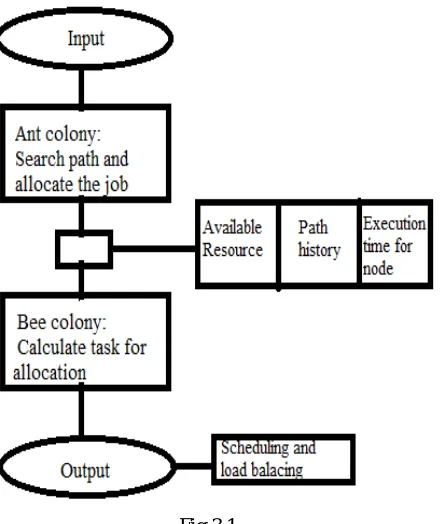
In our existing system has some limitation of ACO and ABC optimization. It work for not dynamically and one remaining one drawback is not updated the globally updating the pheromone value. so now we will improve them using by some new strategy used in both like called AB algorithm , to overcome these problem proposed system established a new dynamic approach for effective load balancing used by AB algorithm. Here fig (3.1) shows the how the ACO and ABC are perform operation dynamic by both combination.[5] let us show the ANT-BEE algorithm. Here table shows the literature survey for the various kinds of ant and bee algorithms paper. Include in it there are advantages and some drawback for the paper which I have reviewed.
Paper Advantages Drawbacks
An Ant colony optimization for effective load balancing in cloud computing .Publication year:2014
Provide dynamic and effective load balancing.
Ant can move only one direction, it can’t rollback.
Workflow scheduling in grids computing: An Ant colony optimization approaches.
Ieee -
Publication year :2007
Give dynamic solution using QOS parameters.
In shortest path ant’s choice is ignoring it work for priority.
Grid resource management by means of Ant colony optimization. Ieee -
Publication Year : 2007
Established optical network for important requirement in load balancing .
It is not scalable and can’t extended process to incorporate information about job requirement.
A bee colony based multi-objective load balancing technique for cloud computing environment. publication year : 2014
Bee colony and genetic combination based algorithm provides better efficiency and effectively utilize the resource.
Runtime fault tolerance may become unavailable and during heavy load condition improve QOS qualities.
Improve performance of load balancing using artificial Bee colony.
Publication year : march 2015
Improve time efficiency and reduce makespan time and minimize the node of failure
ISSN(Online): 2319-8753 ISSN (Print): 2347-6710
I
nternational
J
ournal of
I
nnovative
R
esearch in
S
cience,
E
ngineering and
T
echnology
(An ISO 3297: 2007 Certified Organization)
Vol. 4, Issue 8, August 2015
Fig.3.1
Fig 3.1 shows to dynamic approach combination of both the ACO and ABC algorithm how the ant and bee both are dynamically work in AB algorithm and also give the information for the load balancing and its dynamic approach is how flow in system to get better throughput.
ANT-BEE algorithm [12,9]
A promote ant start travelling through the network .whenever this promote ant reaches a node , in this node is not the target node, it is heading for toward the destination. These promote ants have the same priority as data packet in node. When a promote ant reach the destination based on the provided in sequence by her, a toward the back bee is created then the promote ant is killed and new born bee continues the journey for next node.
This toward the back bee traverse the promote ant’s travelled route in reversed way and on its way update the pheromone values and is finally killed at the early node.[12] (the node which had initiate the forward ant)
Working manner process:
ISSN(Online): 2319-8753 ISSN (Print): 2347-6710
I
nternational
J
ournal of
I
nnovative
R
esearch in
S
cience,
E
ngineering and
T
echnology
(An ISO 3297: 2007 Certified Organization)
Vol. 4, Issue 8, August 2015
It is a chemical substance which called pheromone, [6] and ant release on path while traversing the path.
The probability of traversing a particular path by ants depends on the path, which can be retrieved from foraging, trailing pheromone.[17] The pheromone evaporation at time t and ρt. Where the value of ρt lies on [0 ,1], now
evaporation of pheromone at time t+1 is suggest one natural and traditional equation is
ρt +1 = α ρt + β (1- ρt) = k ρt + β
where α and β = constant k = α-β , 0 ≤ α ,β ≤ 1 f(ρt) = ρt + 1
1) Foraging pheromone:
while touching from under loaded node join to overloaded node , ant will update FP. Equation for update
FP (t+1)=(1- βeva) FP(t)+∆FP
Where , βeva= pheromone evaporation rate
Fp= forging pheromone of edge before the move FP(t+1) = foraging pheromone of edge after the move.
∆FP = change in FP
2) Trailing pheromone:
While touching overloaded node to underloaded node, ant will remain informed TP. for the equation is
TP (t+1)=(1- βeva) TP(t)+∆TP
Where , βeva= pheromone evaporation rate
TP= Trailing pheromone of edge before the move TP(t+1) = Trailing pheromone of edge after the move.
∆FP = change in TP
In this approach the ant colony will be modified by their pheromone updating and globally update for optimization and bee’s life have been optimized by some strategy by their equations to finding optimal solution in load balancing. It has mainly differentiated by three kinds of bees.
ISSN(Online): 2319-8753 ISSN (Print): 2347-6710
I
nternational
J
ournal of
I
nnovative
R
esearch in
S
cience,
E
ngineering and
T
echnology
(An ISO 3297: 2007 Certified Organization)
Vol. 4, Issue 8, August 2015
3. Follower bee
Nectar bee: it is one kind of investigator bee foe all the bee among work on nectar instruction. in all bees only one bee become nectar and remaining are called as worker bee. When the nectar source is abandoned by the bees, a new food source is randomly determined by a scout bee. [13]
Dancer bee: in worker bee , which one are finding the good food source in shortest path ,so next process is The exchange of information among bees is the most important occurrence in the formation of collective knowledge. The most important part of the hive with respect to exchanging information in dancing area .Communication among bees related to the quality of food sources takes place in the dancing area. This dance is called a “Waggle dance”. [22]In our proposed system after updating the node’s pheromone dynamic value, sets down its traversed time in related field . the pheromone updating strategy is the same as backward ants in ant-net algorithms.
Follower bee : In these phases, bees build up the sources by local searchers in the neighborhood of the solutions selected based on deterministic selection in the employed bees phase and the probabilistic selection in the other bees phase. In the scout bee phase, which is an analogy of abandoning exhausted food sources in the foraging process, solutions that are not beneficial anymore for search instead of them to explore new regions in the search space? The algorithm has a well-balanced exploration and development ability. Bees start with scout bees with initial population first the bees choose randomly in space. Then, suitability is premeditated for bees. The highest fitness is chosen as “selected bees” and left behind bees are workers. The selected bees alone visit the site by choosing neighbour search, in proposed system follower bee are measured as in sequence based on dancer bee’s dancing parameters [22]. They use equation for doing so, presume that the follower bee has come from node j to i , on its way to destination d.
T = β T_foll + (1-β)T_dan 0 ≤ β ≤ 1
Where T_foll = follower bee’s trip time
T_dan = selected trip time among dancer bee based
β: An impact factor which determines the two first factor’s effect. If β = 1 it means the follower bee does not pay any
attention to dancer bee and this algorithm will work the same as ant-net algorithm. In contrast , if the follower bee is entirely following the dancer bee.
Process: Therefore the ants attract to pheromone laid from ants in some colony the so called “repulsion” strategy prevents ants from different colony in same path.This strategy is introduced by varela & sinclire. it used in multiple way network for virtually. In multiple Ant-Bee colony, using several ant-bee colonies with different types of pheromone on effort has been made to distributed the network traffic in several optimal local paths by creating on pheromone value in each node. now updating the pheromone value by bee’s value then selecting a next node whenever ant is killed here then we used two strategy for the selection to next node.
1. Attraction strategy 2. Repulsion strategy.
Attraction strategy: In these particular area the pheromone lays down and some other ant attract by them is simply
called attraction strategy. We use α as parameter to indicate attraction of a forward ant from colony k to node i on its
way to destination.
=
∑
Here is a parameterized by equation for dynamic value.
ISSN(Online): 2319-8753 ISSN (Print): 2347-6710
I
nternational
J
ournal of
I
nnovative
R
esearch in
S
cience,
E
ngineering and
T
echnology
(An ISO 3297: 2007 Certified Organization)
Vol. 4, Issue 8, August 2015
Repulsion strategy:teams repulsion suggest the next node selection process is to be continued by updated pheromone whenever ant is killed so in here used repulsion strategy like a next ant cannot follow this way to on goes ant killed there so it’s not go this way to make called repulsion these not a get collective information to next node. In the proposed algorithm we use β parameter to show repulsion of forward ants of colony K to j on its way to destination d
=
∑ ′
= repulsion of forward ants of colony k, i to j on its way to destination d.
′ = it is amount of pheromone from all colonies (except k itself ) in edge linked to node j on its way towards destination.
Ni = sum of all possible edges for the forward ant.
IV. SIMULATION AND RESULT
The proposed algorithm is implemented using cloudSim simulator which runs on NetBeans IDE 7.2.1. In cloud environment different users, resources, scheduler implement by Cloudsim. Cloudsim is a well known simulation for cloud computing and designed to support various simulation tests across the IAAS, PAAS and SAAS. So AB algorithm used Cloudsim as a developing tool. Result was been analyzed as per the pheromone table work same as routing table in cloud.VMs processing power range is 2000-8000 MIPS.
V. CONCLUSION AND FUTURE WORK
We have represented reviewed of existing Ant and Bee colony work different dynamic strategy in load balancing. After applying the mathematically equation in natural heuristics algorithm , the modified ACO and ABC optimization to finding common best suited nodes for shifting loads on overloaded to underloaded and as well as perform underloaded to overloaded nodes are balanced to fetch result and get output for effective load balancing. It can be extended with scenario having more data centre scattered around different location and trying to improve load balancing approach according to some different way like used AB as another new approaches, In future work I will show whole system in brief that provide good solution for effective load balancing using various QOS parameter in improved AB algorithm for better optimal solution.
REFERENCES
[1] Christian Blum,”Ant colony optimization: Introduction and recent trends”, Elsevier Physics of Life Reviews 2 (2005) 353âAS373.
[2] Mayanka Katyal, Atul Mishra” A Comparative Study of Load Balancing Algorithms in Cloud Computing Environment”, International Journal of Distributed and Cloud Computing, Volume-1, Issue -2 , December-2013.
[3] Shagufta khan ,Niresh Sharma,” Ant Colony Optimization for Effective Load Balancing In Cloud Computing”, nternational Journal of Emerging Trends & Technology in Computer Science (IJETTCS) , Volume 2, Issue 6, November – December 2013.
[4] Radha G. Dobale, Prof. R. P. Sonar .”Review of Load Balancing for Distributed Systems in Cloud” International Journal of Advanced Research in Computer Science and Software Engineering, Volume 5, Issue 2, February 2015 .
[5] N. Sasikala and Dr. D. Ramesh,” Effective Load Balancing for Cloud Computing using Hybrid AB Algorithm”, International Journal of Innovative Research in Computer and Communication Engineering, Vol. 2, Issue 4, April 2014.
[6] wei-nengchen ,junzhank, ”Workflow scheduling in grids :An Ant colony optimization approach”,IEEE-2007.
[7] Ashish soni, ganga viswakarma,Kumar jain ,” A Bee Colony based Multi-Objective Load Balancing Technique for Cloud Computing Environment”, International Journal of Computer Applications (0975 – 8887) Volume 114 – No. 4, March 2015.
[8] Gustavo Sousa Pavani, Helio Waldman Optical Networking Laboratory (OptiNet),” Grid Resource Management by means of Ant Colony Optimization”, IEEE – 2006.
[9] Deepika Nee Miku, preeti gulia,” Improve Performance of Load Balancing using Artificial Bee Colony in Grid Computing”, International Journal of Computer Applications (0975 – 8887) Volume 86 – No 14, January 2014.
[10] R. Sagayam, Mrs. K. Akilandeswari,” Comparison of Ant Colony and Bee Colony Optimization for Spam Host Detection”, International Journal of Engineering Research and Development eISSN : 2278-067X, pISSN : 2278-800X, www.ijerd.com Volume 4, Issue 8 (November 2012). [11]D. Karaboga, C. Ozturk, (2011) "A novel clustering approach: Artificial Bee Colony (ABC) algorithm", Applied Soft Computing , Vol. 11 (1), pp. 652-657.
ISSN(Online): 2319-8753 ISSN (Print): 2347-6710
I
nternational
J
ournal of
I
nnovative
R
esearch in
S
cience,
E
ngineering and
T
echnology
(An ISO 3297: 2007 Certified Organization)
Vol. 4, Issue 8, August 2015
[13] Ms. Anna Baby , Dr. Joshua Samuel Raj,” An efficient load balancing using Bee foraging technique with Random stealing”, IOSR Journal of Computer Engineering (IOSR-JCE) e-ISSN: 2278-0661,p-ISSN: 2278-8727, Volume 17, Issue 2, Ver. V (Mar – Apr. 2015), PP 97-104.
[14] Ekta gupta,vidya deshpande,” A Technique Based on Ant Colony Optimization for Load Balancing in Cloud Data Center”,IEEE-2014. [15] Santanu Dam, Gopa Mandal, Kousik Dasgupta, and Paramartha Dutta,” An Ant Colony Based Load Balancing Strategy in Cloud Computing”,springer-2014.
[16] M. A. Mahajan , G. T. Chavan ,” USE OF MULTIPLE ANT COLONY OPTIMIZATION FOR LOAD BALANCING IN PEER TO PEER NETWORKS”, international journal of computer engineering and technology(ijcet) Volume 4, Issue 3, May-June (2013), pp. 419-42.
[17] Prasanna kumar, Raghvendra g.s ,”On the evaporation mechanism in the Ant colony optimizationalgorithm”,Analesersina information, volume-1, 2011.
[18] John A. Bullinaria and Khulood AlYahya,” Artificial Bee Colony Training of Neural Networks”, (NICSO 2013), Studies in Computational Intelligence 512, DOI: 10.1007/978-3-319-01692-4_15, © Springer International Publishing Switzerland 2014.
[19] Atul Vikas Lakraa, Dharmendra Kumar Yadavb,” Multi-Objective Tasks Scheduling Algorithm for Cloud Computing Throughput Optimization”, Springer - Procedia Computer Science 48 ( 2015 ) 107 – 113
[20] Liu Youhui, Liu Xinhua, and Li Q,” Assembly Sequence Planning Based on Ant Colony Algorithm”, © Springer-Verlag Berlin Heidelberg 2012. [21] Gurpreet Singh' , Parveen Kumar,” Self-Adaptive Task Distribution for Load Balancing using HABACO in Cloud”, EEE International Conference on Advanced Communication Control and Computing Technologies (lCACCCT), ISBN No. 978-1-4799-3914-5/14/$31.00 ©2014 IEEE.