Copyright 0 1991 by the Genetics Society of America
Structure and Transcription
of
the
singed
Locus
of
Drosophila melanogaster
Jamie Paterson and
KevinO’Hare
Department of Biochemistry, Imperial College of Science, Technology and Medicine, London SW7 2A2, England
Manuscript received February 18, 1991 Accepted for publication August 8, 199 1
ABSTRACT
Developmental and genetic studies of the singed gene of Drosophila melanogaster indicate that the gene has a role in somatic cells during the formation of adult bristles and hairs, and in the female germline during oogenesis. During metamorphosis a single 3.6-kilobase (kb) RNA is made, and this R N A is also present in adults and early embryos. Early embryos and adult females have additional 3.3- and 3.0-kb RNAs. The RNAs differ only in the length of the 3‘ untranslated region and a single gene product of 57 kilodaltons is predicted. Analysis of RNA from females lacking ovaries suggests that the 3.3- and 3.0-kb RNAs are made only in ovaries. The absence of the 3.3- and 3.0-kb RNAs in pupae and the time course of their appearance in adult females after eclosion suggests that transcription of singed in the ovary is from middle to late stages of oogenesis. Analysis of RNA in embryos from the reciprocal crosses between wild type and singed-3 showed that all three RNAs are maternally inherited with very little zygotic transcription in embryos. The mutation singed3 appears to separate the two requirements for singed function as it has an extreme effect upon bristle development, but does not obviously affect oogenesis. In singed-3, there is a deletion at the 5’ end of the gene, but the coding region is intact. Transcription in singed-3 is from a cryptic promoter in the upstream flanking sequences which is sufficiently active during oogenesis for fertility, but less active than the wild-type promoter during metamorphosis. The role of the single singed gene product may be in the asymmetric organization and/or movement of cytoplasmic components.
T
HE singed ( s n ) gene of Drosophila melanogasterhas a role in both somatic and germ cells. T h e bristles and hairs found over much of the body of wild-type flies are shortened, or twisted and gnarled in singed mutants. This phenotype is most easily seen in the large bristles (macrochaetes) on the dorsal sur-
face of the thorax of the
fly,
but the smaller bristles (microchaetes) and hairs are also affected. Alleles canbe distinguished as having extreme or weak affects on bristles and hairs. T h e phenotype is autonomously expressed, and somatic sn mutant clones are easily recognized in a wild-type background.
In addition to this bristle phenotype many sn mu- tants are female sterile. There is no effect on male fertility. Ovary transplantation showed that sn is ex- pressed autonomously in the ovary (CLANCY apd BEA- DLE 1937). Mutant sn g e r m h e clones d o not make eggs, indicating a requirement for sn expression in the germline during oogenesis (PERRIMON and GANS
1983). T h e ovaries of female sterile sn mutants have few late stage egg chambers, and few eggs are laid. T h e eggs are flaccid with shortened filaments, and they do not develop. For most sn mutants, there is a correlation between the effect a mutation has on
female sterility and its effect upon bristle morphology. Extreme bristle mutants (such as sn’ and sn”) are female sterile while weak bristle mutants (such as s n 2 ) are female fertile. A notable exception to this is sn’,
Genetics 129: 1073-1084 (December, 1991)
which is one of the most extreme bristle mutants, but is fertile.
Many mutations reduce female fertility, but most of these are weak alleles of vital genes rather than mutations of genes with a specific function in the ovary (PERRIMON et al. 1986). No lethal alleles have ever been described for sn, and mutations at sn se- lected as female sterile mutations d o have bristle phe-
notypes (PERRIMON and GANS 1983). Developmental genetic studies have not clarified the relationship be- tween the role of sn in the development of bristles and hairs, and its role during oogenesis. To gain more insight into this, we need to understand how the gene is expressed in somatic and germ cells, and the nature of the gene product (s).
We have reported the isolation of sequences from the sn locus by chromosomal jumping and detected alterations in the DNA maps of some sn mutants
(ROIHA, RUBIN and O’HARE 1988). We report here a molecular analysis of the structure of the gene and its pattern of transcription throughout development. This leads to the conclusion that there is only one sn
gene product, and that mutations such as sn’, which separate the bristle and fertility phenotypes, affect regulation of gene expression rather than the struc- ture of the gene product.
MATERIALS AND METHODS
Drosophila stocks and genetics: Drosophila melanogaster
1074 J. Paterson and K. O'Hare
dium at 25". In analyzing sn mutants for DNA lesions, we have found differences between stocks of supposedly the same allele. A stock of snz analyzed earlier (ROIHA, RUBIN and O'HARE 1988) showed no differences from wild type in its DNA map, while a second stock analyzed here did (see
RESULTS). We assume that this weak allele of sn has been lost from some stocks. We suspect that there may be prob- lems with stocks of other sn mutants. Some mutants origi- nally described as sterile appear in stocklists as apparently female fertile stocks. The wild-type P cytotype strain, Har- wich, was from M. G. KIDWELL (University of Arizona). All other strains were from the Bowling Green Drosophila Stock Center.
The reciprocal crosses between Canton S (wild-type M cytotype) and Harwich (wild-type P cytotype) were made at 29". The progeny were allowed to mature in fresh yeasted bottles for 3 days at 25" before harvesting. This regime allows the ovaries of females to develop fully so that egg chambers of all stages are present. Examination of these bottles showed that the progeny from the cross of Canton S females with Harwich males were sterile, while the progeny of the cross of Harwich females with Canton S males were fertile. Dissection showed that the sterile females lacked ovaries, as expected for this dysgenic cross.
The reciprocal crosses between Canton S and y sn3 v were made at 25 "
.
Embryos were collected after overnight laying (0-16-hr embryos) and at the end of the day (0-8-hr em- bryos), and pooled. Some embryos were allowed to develop and the genotypes were as expected. Heterozygous sn+/sn3and sn3/sn+ females were harvested and shown to have both wild-type and mutant RNAs (data not shown, see RESULTS).
Molecular biology: Genomic DNA was prepared from frozen adult flies as described by LEVIS, BINGHAM AND RUBIN (1982). The construction of genomic libraries for sn3 and snxz, screening of genomic and cDNA libraries, purifi- cation of recombinant clones, subcloning and DNA blotting were all by standard techniques (SAMBROOK, FRITSCH and MANIATIS 1989). The wild-type (Oregon R) library was that of MARIANI, PIRROTTA and MANET (1985) and cDNA li- braries prepared from staged poIy(A+) RNA were those of POOLE et al. (1985). Preparation of total RNA from em- bryos, larvae, pupae and adults, selection of poly(A+) RNA, and electrophoresis on formaldehyde agarose gels was as described by LEVIS, O'HARE and RUBIN (1 984).
Double-stranded DNA probes were prepared as described by FEINBERG and VOCELSTEIN (1 984). Strand-specific DNA probes for hybridizing to RNA blots were prepared by the method of BURKE (1984). A complementary radiolabeled copy of the inserts in M13 clones was synthesized using Klenow fragment or T 7 DNA pol merase in the pres- ence of dTTP, dGTP, dATP and
Y
PIdCTP (Amersham). The products of the extension reaction were digested with a restriction enzyme at the end of, or at a site within, the insert, denatured in 0.1 M NaOH and electrophoresed on a1.5% low-gelling-temperature agarose gel (FMC Bio-
Products) containing 30 mM NaOH and 10 mM EDTA. The single-stranded labeled DNA was located by autoradiogra- phy, excised, melted and added directly to the hybridization. RNA blots were reprobed with either the yolk protein 1 gene (HUNG and WENSINK 1981) to control for sex, or the 5C actin gene (FYRBERG et al. 1983) to control for loading.
Regions of DNA to be sequenced were either subcloned into M 13 vectors as restriction enzyme fragments, or DNA fragments were first progressively shortened using Ba131 nuclease (PONCZ et al. 1982). Fragments treated with exo- nuclease were phenol extracted and ethanol precipitated before ligation. T o determine the terminal sequences of cDNAs, the cDNA fragment was subcloned into pBluescribe
a
36a 4 5
3 2 1
II R n n I n n P J n
I I I I 1 1
I I l l I 1 I1 I I I '
n r n n n n n xrn s 8
I I I I I I
-3 0 5 10 15 20
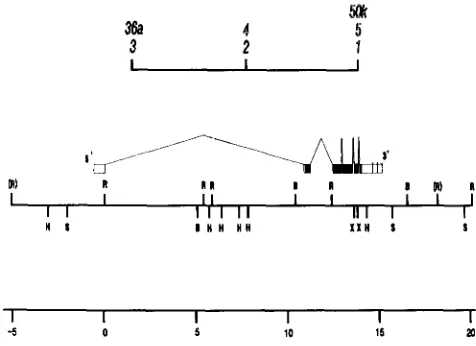
FIGURE 1.-Genetic and DNA map of the singed region. The genetic map of the singed locus is from HEXTER (1957). Distal to proximal with respect to the centromere is from left to right. Alleles with detectable DNA lesions are shown dark while those without detectable DNA lesions are in light letters. The DNA map was derived by restriction mapping overlapping phage containing in- serts from either Canton S or Oregon R. The coordinate system, in kilobases, is that of ROIHA, RUBIN and O'HARE ( 1 988), and refers only to the DNA map. The genetic map is shown for comparison with the DNA map, but cannot be precisely aligned. The orientation with respect to the chromosome was determined from analysis of chromosome inversions (for details see ROIHA, RUBIN and O'HARE
1988). Restriction enzyme sites are: R, EcoR1; H, HindIII; S, M I ;
B, BumHI; X , XhoI. Restriction enzyme sites in brackets are poly- morphic. The intron-exon map is derived from cDNA, sequencing and RNA blotting data. Noncoding sequences are open boxes and protein coding regions are filled boxes. The alternate 3' ends are marked by vertical lines in the final exon.
(Stratagene) and sequencing template was prepared as de- scribed by Guo, YANG and WU (1983). DNA sequencing was by the dideoxy chain terminating method (BANKIER and BARRELL 1983). Reactions were performed using the Kle- now fragment of DNA polymerase (Amersham) or T 7 DNA polymerase (United States Biochemicals or Pharmacia).
Consensus sequences were built up from individual gel readings using the MicroGenie software package (Beckman). The DNA sequences have been entered into the EMBL Nucleotide Sequence Database as accession numbers X17548, X17549 and X17550. The sequences were ana- lyzed using the SEQNET facility of the SERC Daresbury Laboratory. The nucleic acid sequence of cDNA clone P5 was compared with the GenBank and EMBL nucleic acid data bases using FASTA. The longest open reading frame in clone P5 was translated and the predicted amino acid sequence compared to the NBRF and SWISS protein data- bases using FASTA. This peptide sequence was also com- pared with the combined protein and nucleic acid OWL data base using PROSRCH at the Biocomputing Research Unit in Molecular Biology of the University of Edinburgh.
RESULTS
The Drosophila singed Gene 1075
blotting showed that two mutations which had been mapped by recombination to the distal end of the locus (HEXTER 1957), differed from wild type in the interval -1.2 to 0.0. In sn3 there is a 0.3-kb deletion in the interval between -0.9 to 0.0, while in sn36a there is a 5.5-kb insertion between -1.2 and 0.0
(ROIHA, RUBIN and O’HARE 1988). As no differences
were detected for mutations which mapped to central or proximal sites within sn, it seemed possible that only the distal end of the gene had been cloned. We therefore extended the cloned interval in the proxi- mal direction to
+27
by chromosome walking using a wild-type Oregon R library.We have analyzed sn mutants by DNA blotting using subclones covering the region from -5.0 to
+20. A few restriction enzyme site polymorphisms
were noted (sites in parentheses in Figure 1). Further- more, the sizes of a number of fragments in the interval +10.0 to +15.0 were variable in mutants, but also between the wild-type strains Canton S and Ore- gon R. We have not precisely localized these differ- ences, but as sn RNAs from the two wild-type strains comigrate (data not shown), we presume that these differences in the DNA maps are due to small differ- ences in the sizes of introns of sn. In the course of this work, the 0.1-kb insertion mapped between -1.2 and -1.9 in snx2 (ROIHA, RUBIN and O’HARE 1988) was found to be present in the parental Zn(l)d149 chro- mosome. This insertion is upstream from the position where transcription starts (see below) and is a poly- morphism between wild-type chromosomes rather than the cause of the mutant phenotype in sd’. As
no other differences were detected in sn”, we con- clude that there is a point mutation elsewhere in the gene.
The 0.3-kb deletion reported for sn3 between -1.2
and 0.0 (ROIHA, RUBIN and O’HARE 1988) was ex-
amined by cloning and DNA sequencing. The dele- tion is from -0.8 to -0.5 and corresponds to deletion of nucleotides 1 184 to 1475 of the wild-type sequence (shown below in Figure 4A). A DNA breakpoint as- sociated with the chromosome rearrangement DP(l;3)sn1”’ was mapped between 0.0 to +5.5 (data not shown). This duplication stock is derived from the extinct transposition stock TP(1;3)sn1”’ (VALENCIA
1966) which broke the X chromosome within sn. In contrast to our earlier results we did detect a DNA
alteration in a stock of sn’. This is between +8.0 and
+10.5, and is a large insertion or a cytologically un-
detectable rearrangement (data not shown). This al- lows us to extend our comparison of the genetic and physical maps of sn (Figure 1). The distal allele sn3 has a deletion from -0.8 to -0.5 while the central allelesn’ has an alteration in the region +8.0 to +10.5. This indicates that mutations in the proximal alleles, snl, sn5 and sn’Ok, lie to the right of +8.0, and that at
i
4‘
w ’
di
-
9.4- 6.6
-
4.3-2.3
- 2.0
- 0.6
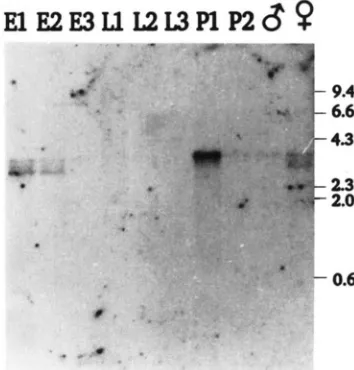
FIGURE 2.-Profile of singed RNA during development. Poly(A+) RNA samples from different stages of development were probed with sequences from the sn locus (-2.0 to 0.0 of Figure 1). E l , 0-
4-hr embryos; E2, 4-8-hr embryos; E3, 0-24-hr embryos; L1, 1st instar larvae; L2, 2nd instar larvae; L3, 3rd instar larvae; P1, early pupae; P2, late pupae; 6, adult males; 0, adult females. Lambda DNA digested with Hind111 was used as molecular weight markers. Similar quantities of RNA were loaded in each lane as judged by hybridization to a 5C actin probe (data not shown).
a minimum, the sn gene spans from -0.5 to +8.0.
Transcription of singed during development:
From the phenotypes of sn mutants, expression of the gene is expected during metamorphosis and in adult females. A probe from -2.0 to 0.0, the region altered in sn3, sn36a and P element insertion alleles of sn
(ROIHA, RUBIN and O’HARE 1988), was hybridized to
an RNA blot of poly(A+) RNA made from various stages during Drosophila development. The results (Figure 2) show a 3.6-kb RNA, most abundant in pupae and present in embryos and adults of both sexes. RNAs of 3.0 and 3.3 kb are present in embryos and in adult females. Using strand specific probes we demonstrated that all three RNAs are transcribed from distal to proximal (left to right in Figure 1). The abundance of these RNAs is quite low, and we have generally used single-stranded probes to increase the sensitivity of detection. For example, compare Figure
2
(double-stranded probe) with Figures 5 and 6 (sin- gle-stranded probe).With a more distal DNA fragment as a probe, -5.0 to -2.0, we detect a 5.4-kb RNA transcribed from proximal to distal (data not shown). This is the oppo- site direction to the 3.0-, 3.3- and 3.6-kb RNAs and is away from the region disrupted in sn mutants. This transcript has been shown to be from a gene with a role in olfaction, the oljE gene (HASAN 1990).
Extent of the singed transcription unit-RNA
analysis: The approximate 5’ and 3’ ends of the three
sn RNAs were mapped by blotting RNAs from male
1076 J. Paterson and K. O'Hare
8Q
A
8 9
B
8Q
C
89
D
EQ
1
-irl)
+.,<.
.
*;
i.
e:.
-,;$
1 .:
i .
4
' ::
A E
9 - E - = - . -7
. ~~~ -
- -~ C
D
" -.
-~
-u
,
~- "~
- " "~
:
R H S B R
I 1 I I I I I
15
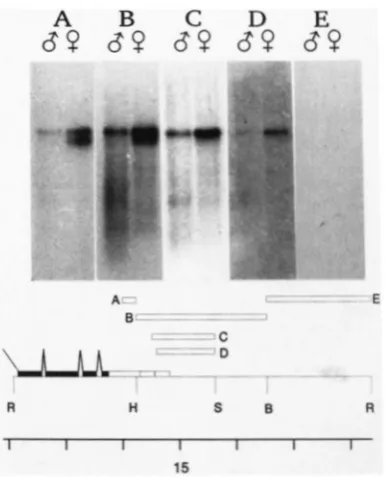
FIGURE 3.-Mapping the 3' ends of singed transcripts. Panels A to E show RNA blots of male and female RNA hybridized to the corresponding strand specific probe shown in the diagram below.
either detected all three RNAs or none of them (data not shown). Two probes whose proximal limits dif- fered by only 100 basepairs (bp) were most informa- tive. The first probe (- l .8 to -0.6) detected all three RNAs, while the second probe (-2.7 to -0.7) did not detect any sn transcripts. This suggests that the 5' ends of all three RNAs map between -0.7 and -0.6. If the
5'
ends of all three RNAs are within such a small interval, then it is most likely that they have the same 5' end and differ elsewhere, at the 3' end and/ or internally due to differential splicing.T o map the 3' ends of the RNAs, a series of more proximal probes were used. Probes from within the interval -0.6 to +14.3 hybridized to all three RNAs, or to none of them. These probes (e.g., probe A from +14.0 to
+
14.3 in Figure 3A) showed approximately equal hybridization to the 3.0- and 3.6-kb RNAs and less hybridization to the 3.3-kb RNA. Different pro- files of hybridization were detected using probes from +14.3 to +18.3 (Figure 3). A probe from +14.3 to +16.6 hybridizes most strongly to the 3.6-kb RNA, less strongly to the 3.3-kb RNA and least strongly to the 3.0-kb RNA (Figure 3B). Only the 3.6-kb RNA is clearly detected using probes from+
14.5 to +15.6 or +14.6 to +15.6, while no RNA is detected with a more distal probe from +16.6 to +18.3 (Figure 3). From analysis of cDNAs (see below), we believe that the 3' end of the 3.0-kb RNA maps to +14.3, the 3' end of the 3.3-kb RNA to +14.55 and the 3' end of the 3.6-kb RNA to +14.8. If this is so, then probe Cfrom +14.5 to +15.6 should detect the 3.3-kb RNA in Figure 3C. Hybridization of this probe to the more abundant 3.6-kb RNA (and any degraded 3.6-kb
RNA) may be obscuring detection of the 3.3-kb RNA. Furthermore, the short region of homology (57 bp) and the high A-T content (46/57) of the expected hybrid between probe C and the 3.3-kb RNA make it impossible to draw a definitive conclusion. Nonethe- less, these results suggest that the 3' ends of the RNAs map to different positions within the interval +14.3 to +16.6.
Extent of the singed transcription unit-cDNA
analysis: T o define more precisely the limits and
structure of the sn transcription unit, cDNA clones were isolated from adult female, embryonic and pupal cDNA libraries (POOLE et al. 1985). Initially, a probe from the proximal region of the gene (-2.7 to +5.7) was used. A total of 22 clones were isolated from four different libraries. Two of the cDNAs were from olj??, and 4 of the 20 sn cDNA inserts were smaller than 1.5 kb. The remaining 16 were mapped and their maps can be aligned with that of the largest clone, the 2.9-kb pupal cDNA P5. The other cDNAs appear to be terminally deleted with respect to P5 at one or both ends.
The regions of genomic DNA corresponding to the ends of the P5 cDNA were mapped by probing DNA blots of the cloned genomic interval. This placed the 5' end of P5 at -0.7 and the 3' end at +14.4 (Figure 1). The genomic sequence around these end points was determined and compared to the terminal se- quences of the different cDNAs. Four more inde- pendent cDNAs, 2 embryonic and
2
pupal, have the same 5' end as P5 (Figure 4A), suggesting that tran- scription initiates at this site.The sequence at the 3' end of P5 maps to +14.4. However, sequences more proximal than +14.4 are present in the 3.6 kb RNA (Figure 3), so the 3' end of this cDNA cannot correspond to the 3' end of the RNA. The cDNA ends in a stretch of oligo-A (AN) which is longer than the corresponding run of A residues encoded in the genome (A14-Figure 4C). We believe that the 3' end of P5 was generated during cDNA synthesis by oligo-dT priming on this internal A rich region of the mRNA rather than on the 3' poly(A) tail.
T o isolate cDNAs containing the 3' sequences of sn
The Drosophila singed Gene
Section 5
I077
50 100
g t c g a c t t t a g a a c g g a t a t t t c a a a a t a a t g t t a a c c t t t c g a a a a a t t t a g g t a t a t g c a a g c c g a a t t a t t t g a t t t g g a a a a t a a t a c t t a g g g c g
150 200
t c c a t a t c a g a a a a a a c g t t t a g a g t a a c a t a a c g t a t t t t a a a a t t t g t a t t a g g c c a c g t t a t g t a g t c a a a t a t a t a t a a a t a a a t t a t t c a t t t t a
250 300
a t t t t t a c a a a a g t g a t a t g c t g a t a t g c t t a t a a a t g t a a g a t t c t t g t t t a t t t g a c t t t t t t t t t a a a t t t c a t t a t c a t t a t t t c t t g c t t g a c a a
350 400
c c c t a t g t t a a g t g c g a c a c t g c g t t g a c a a c a g c t a a g a a c a t g g c t g t g g g g c g a c a a a c t t a g c a g a g c g c g c g c t g c t a g a g c t t a a a t t g t a t t t
450 500
g a a a a c a g t g c a g g t g a a t c g a a a a t g t c t t g g c a t g c a g t c a a a c a t t a a t t t g c g a g c a t a a t t a a c t c c g c t t a a g a t t g c t g g t a g t c a a g g a g c c
550 600
gtgaagagcggagacggccgctggtaatattcagtgattaacaactgtaaaatctaaaatcagtataaatattcatgtgtgttgatttaaaggattttgg
6 5 0 700
t g a a a t c c g g a c c c g a a t c g g a g c t g a g g t c c g a a a c t a a c g t g c a a c a t c c a a t a a a a g c a a g t g c a g c t t g g g t t a t t a g a g c a t a a a g c a t c t c c a c
750 800
c a g a g t c t c g g t t g c c a g c c a a g c a a a a c g g c c g a g a c g c g t c t t t c g g g t g g c c a g c t g c a g t g t c g g a t g c a g t t t t t g g c t g c a g c t g c a a t t a a a t
8 5 0 9 0 0
a t g c a a t g c a c t t a a g t t a t g c a c a t t t c c t t t g c c c a g g g a c c g t t a c g a t t t c g t a t t t t a a a a g c c g c g c g a a a g c t a a c a g c g c t g t t g g c t a g c a
950 1000
9 a c g t c t g t t t C t g c t g t t g t t a g c C a a c a g c c a a c a a c a a c a a a c t g g c t g t t g t r t c g a a t g c a c t g a g a t c t t a g c t c t t t t c c c g c t a a a t g t t t c
1050 1100
t t t g t g t g t c a t ' t t t g t c a a c c a t t c g a ~ c g a t a t c g a t a t t c c t t t g t g a a g g c t a a a a a t a a a a t t c t t a c a t g c t c a t c t t a t a c a a t a a t g g a t c g
1150 1200
c a c a t a t a g c t a c t c c t t t t t c a t g t a t c c a a t t c a c t a g g t a a g c t a c a a a g a t a g c c a g a c g g c t g t g c t a a c a g a g c g c t ~ c t a t g ~ t ~ a g a a g C c g
1250 1300
c c g c a a t g g c a a c a g t g c c a t c t c t g g c c g g c g a t a c a a a t a g c g c a a c t t c g c t c g c a a c g g g t t t c A T T C C C A C T G G A G T G C A G T T C G T G A G C G G T C G
1400
T T C T C T C C T C T C T C T C G C A A A A G T A A A A C T T A A A G T T T T G T G C G C G C A T G C G T C T C G T C T T A G A A A A A C C T G C A A T C A G T A A T C T C G A A T C G T G A A A A T C
1350 I - - - - >
P 3 , P 5 , P7, E74, E76
1450 1500
C T T T T C T G C C A T A C C A A A A A A A G A G C C G G A C A A A G C A A A G C G T T C G A T T G C C T l C l G C C A A T T T G A G C A G G A A A T T A C A A A T T A A l T G C C G C C C T G A C C G
1550 1600
T G A T T T G T T T A C G T l T T T T T C l T C A C T T T T T T I T A C A l T G T G T G A G I G T G A G A A A T T T G l ~ G G C C A A A A A A T A T T C C A G A T A ~ ~ C C C A G A G A T A T A T A T A
1650 1700
T T C G A A A T T C C A A T T G G C G A A G T G A A G G G I G T G A C G A C A G A C G C A C A C A C A C G C A C G C A C A C G A A A A C G C A C T G A A A A A A C A C C G G C T A A A A G G C A G A C A
1750 1800
A A A A G G A G A C G A C A G A G C G A G T G C T A A A T A G A A A A C G C G A A A A C A G G A T A A T A A T C A G C A A A C T A A T A C T A T A A A A C A A G C A A C T A A G T G A C A T C T C G A T
1850 1900
C T C G C C G A C A A A C A A C A A A A A C A A C A C T T A C A A C T T C G G C A A C A G C A A C A A A A A C A G C G C C A G C A G C A G C A A C A A C A A C A A A A T C A G C G A A G A G C A T A G A
1950
G C C A A A A A G A A G G A G C A G C A A A A G C A A A G A A A g t a a g t g g a a t t c c t t g c c c a a a g a t g g c t c t c c t c t c c t t t g c c t t t g c t c t c t c a t c
Section B
50 100 a c t t a c c a t a c t t t a c c c g g a a a c t a a t c g t c c c a c t c t c a c a t c c t t c a t t g c a g C A C C A T A A G l T C G A T C T T C C T T A C G C A A A G A A G C C G G A T T C C G G
A G A C A G C C T C A A G A T T G C T C C C A T C A G C A C C ~ A A C G G C C A G G G C T G C G A G C ~ G G G C C A C A G C A A T G ~ C G A C A T C A l C l C A C A G A A T C A A C A G A A G G G A
200 150
M N C O C C E L ~ H S N G D I I S P N O O K G
250 300
~ G G ~ G G A C C A T C G C C C T G A T C A A C G G C C A G C A C A A G T A C A T G A C C G C G G A G A C C ~ T ~ G G G T T C A A G C T C A A C G C C A A T G G C G C C A G T C ~ G A A G A A G A ~ G C
U U T I G L I N G P M K Y M T A E T F C F K L N A N G A S L K K K
3 5 0 400
A A C T G T G C A C G C T G G A A C C C T C G A A C A C C G G l G A A A g t g a g t a ~ a g g t t c t t a a a c a g a t g g g a g a a a t g t t a g t t a g t t g g g t t c t t g a a a g a t t t a a g
1078
section C
J. Paterson and K. O'Hare
50 100
g a a t t c t t c g a a a a a t g c t t t c c t t g c a g c a a t a g c t c g c c a a t g a a g c g a c t t a c t a a t c c a t g g a c t t t a c c a t a t c t g t t t c a g G T A T T A T C T A C T T
S l l Y L
150 200
A C G A T C T C A T C T G A A C A A G T A C C T T T C G G T C G A T C A G T T T G G C A A C G T G C T G T G C G A G A G C G A T G A G A G G G A C G C G G G C A G C C G C T T C C A G A T C A G C A T C
R S H L N K Y L S V D P F G N V L C E S D E R O A G S R F P I S I
250 300
A G T G A G G A C G G C A G C G G A C G T T G G G C G C T G A A G A A C G A G T C G C G C G G C T A C T T T C T G G G C G G C A C T C C G G A C A A A C T G G T C T G C A C G G C C A A G A C G C C C G
S E D G S G R Y A L K N E S R G Y F L G G T P D K L V C T A K T P
350 400
G T G C C A G T G A G T T T T G G A C G G T C C A T T T G G C T G C C C G G C C G C A G G T G A A T C T G C G C T C C A T T G G A C G C A A G C G A T T C G C C C A T T T G T C G G A G T C G C A G G A
G A S E F U T V H L A A R P P V N L R S I G R K R F A H L S E S P D
450 500
C G A G A T C C A T G T G G A C G C C A A T A T T C C T T G G G G C G A G G A T A C G C T C T T T A C G C T G G A G T T C C G T G C C G A G G A G G G C G G T C G C T A T G C T C T G C A T A C G T G C
E l H V D A N l P V G E D T L F T L E F R A E E G G R Y A L H T C
550 600
A A C A A C A A g t g a g t g g a c t c a t t g c c g t a a c t c t a c a a t g c a t c a a a c t t t t t t t t t t c c c c t t t g c a g A T A T C T G A A C G C C A A T G G A A A A T T G C A G G T G
N N K Y L N A N G K L P V
650 700
G T G T G C A A C G A G G A T T G C C T G T T C A G C G C C G A A T A T C A T G G T G G C C A T C T G G C G C T G C G C G A T C G T C A G G G T C A G T A C T T G T C G C C C A T T G G C T C C A A G G
V C N E D C L F S A E Y H G G H L A L R D R P G ~ Y L S P I G S K
75 0 800
C G G T G T T G A A G T C C C G C T C G T C G T C A G T G A C G C G G G A T G A G C T C T T C T C G C T G G A G G A T T C G C T G C C T C A G G C T T C C T T T A T A G C C G G A C A C A A T T T G C G
A V L K S R S S S V T R D E L F S L E D S L P P A S F I A G L N L R
850 900
A T A T G T G A G C G T T A A G C A G G G C G T C G A T G T G A C G G C C A A C C A G G A C G A G G T C G G T G A G A A C G A G A C G T T C C A G C T G G A G T A C G A T T G G T C G G C G C A C C ~ T
Y V S V K P G V D V T A N ~ D E V G E N E T F ~ L E Y D U S A H R
950 1000
T G G G C C C T A C G C A C C A C C C A G G A T C G C T A C T G G T G T C T G T C G G C G G G C G G T G G C A T C C A G G C C A C C G G C A A T C G T C G C T G T G C C G A C G C T C T C T T C G A G C
W A L R T T P D R Y U C L S A G G G I ~ A T G N R R C A D A L F E
< - - - I P7
1050 1100
T G A T C T G G C A C G G C G A T G G C T C G C T C T C G T T C C G G G C T A A C A A C G G C A A G T T C T T G G C C A C C A A G C G C T C T G G T C A T C T G T T T G C C A C C T C G G A G T C G A T
L I U H G D G S L S F R A N N G K F L A T K R S G H L F A T S E S ~
1150 1200
C G A G G A G A T A G C C A A G T T C T A T T T C T A C T T G A T C A A T A G g t a a g g g a a t t g t t t a c a c c a t t c t g t a t t t t c c g t t t t t a a t t g c a t t g t t t t t g t t a a a
E E I A K F Y F Y L I N R
( 1 P2
1250 1300
t t a a c a g A C C A A T T C T T G T A C T G A A G T G C G A G C A G G G A T T C G T G G G C T A T C G c A C G C c C G G T A A C C T G A A G c T C G A G T G C A A T A A G G C C A C C T A C G A A A C
P I L V L K C E Q G F V C Y R T P C N L K L E C N K A T Y E T
< -
- -
I E761350 1400
G A T T C T G G T G G A G C G G G C C C A G A A G G G C C T G G T G C A T C T G A A G G C G C A T A G C G G C A A A T A C T G G C G C A T C G A G G G C G A A A G C A T C T C G G T G G A T G C C G A T
I L V E R A Q K C L V H L K A H S G K Y ~ R I E G E S I S V D A D
1450 1500
GCGCCCAGCGATGGTiTCTTCCTCGAGCTTCGCGAGCCGACCAGGATCTGCATAAGgttggaccgcatttgctgtcatttaaaaacggctgtaaattatg
A P S D G F F L E L R E P T R I C I R
1550 1600
a t t g t t a a C t a a t g C C g a t C c t c t a t a t t t t a g A T C G C A G C A G G G C A A G T A C C T G G G C G C T A C G A A G A A C G G G G C G T T C A A G C T G C T G G C T G A T G G A A C C
S P Q G K Y L G A T K N C A F K L L O D G T
1650 1700
G A T ~ C G G C C A C A C A G T G G G A G T T C ~ G G C G T G A C C A C G A C C A T C C C G A A T G G G T T G C T G C A C G C G T C A T C A G T A T C A C A A T C A C A C A C A T A C T T C C C A A
D s A T a u E F * * *
1750 1800
C C A A C C G G G G A T T C C C T A A T T A T T G A T C C A C C ~ A C C T C A A G C G C C A A G A A G A G T C G C A C A A G A A T T T G A T A T A T C C T A A A C A A T T G C A A A A T G A A C G A A A
1850 1900
The Drosophila singed Gene 1079
S e c t i o n g c o n t i n u e d
2 0 5 0 2 1 0 0
C A A C A A A A C A A A A C ~ ~ C ~ G ~ c ~ c ~ A G ~ c ~ ~ ~ ~ ~ ~ ~ ~ ~ ~ ~ ~ ~ ~ ~ ~ ~ ~ ~ ~ ~ ~ ~ ~ ~ ~ ~ ~ ~ ~ ~ ~ ~ ~ ~ ~ ~ ~ ~ ~ ~ ~ ~ ~ ~ ~ ~ A A A ~ A C ~ ~ " ' ~ " " " " " " '
2 1 5 0 2 2 0 0
A T C A ~ ~ ~ ~ ~ A C A C C A A T A ~ ~ ~ ~ ~ ~ ~ ~ ~ ~ ~ ~< - ~ ~
-
~ ~ ~ ~ ~ ~ ~ ~ ~ ~ ~ ~ ~ ~ ~ ~ ~ ~ ~ ~ ~ ~ ~ ~ ~ ~ ~ ~ ~ ~ ~ ~ ~ ~ ~ ~ ~ ~ ~ ~ ~ ~ ~ ~ A A A ~ A A ~ A ~ C A A ' A A A ' ' ' ' ' A A A '2 2 5 0 2 3 0 0
A l t A A A A A A A T A A A ~ A ~ A A A ~ c ~ A ~ ~ ~ ~ ~ ~ ~ ~ ~ ~ ~ ~ ~ ~ ~ ~ ~ ~ ~ ~ ~ ~ ~ ~ ~ ~ ~ ~ ~ ~ ~ ~ ~ ~ ~ ~ ~ ~ ~ ~ ~ ~ ~ ~ ~ ~ ~ ~ A ~ C C ~ A A ~ A C A ~ ~ A A C A C A C A C A C A ' A C
2 3 5 0 2 4 0 0
A C A C C A C T C C A C A C ~ c ~ ~ A C A ~ ~ ~ ~ ~ ~ ~ ~ ~ ~ ~ ~ ~ ~ ~ ~ ~ ~ ~ ~ ~ ~ ~ ~ ~ ~ ~ ~ ~ ~ ~ ~ ~ ~ ~ ~ ~ ~ ~ ~ ~ ~ ~ ~ ~ ~ ~ ~ ~ ~ ~ ~ ~ ~ ~ ~ ~ ~ ~ ~ ~ ~ A A A C A A A A ~ ~ ~ A ~ ~ C ~ C
I PS, € 6 7 , E74
< - - ~ I 3E1
2 4 5 0 2 5 0 0
~ A A ~ C A A A A A C T T A A A A A A A A ~ ~ A A T C ~ ~ T A A T A A A A A A A C A A A G T C A A A A A T T A A A C A T C A A A ~ C ~ ~ ~ ~ ~ ~ ~ ~ ~ ~ ~ ~ ~ A ~ ~ ~ ~ C A A ~ ~ ~ A A ~ C A A C ~ C C
< - - - I 3E3
2 5 5 0 2 6 0 0
A C T A T A T C ~ A ~ C A T A T G C A T A ~ A T T G A A T T A G T T T T ~ T T A T T T A T T T G C G T C G A T T T C T T A A T T A A ~ T A A ~ ~ A ~ ~ A A ~ C ~ ~ ~ ~ ~ ~ ~ ~ ~ ~ ~ ~ A A ~ ~ ~ ~ ~ ~
2 6 5 0 2 7 0 0
~ ~ C ~ ~ ~ ~ A A A C ~ A A A C A A A A A C ~ ~ A A ~ C C A A T T T A G T T G C T A A A T C T T A A A A T G G A A A T T T ~ G G T A ~ G A ~ A C C A T A ~ G ~ ~ A ~ ~ ~ ~ ~ ~ ~ ~ ~ ~ ~ ~ ~ ~ ~ ~ ~ ~ ~
2 7 5 0 2 8 0 0
T a t g g t t g g t t a c t t t t t a t g g g t t a a t g t a c a a c g g a a a g c t g a a t a t g c g a a g g g t t g c a t t a t t t t a a C g g t t a c t t t t t g t t C a g C a t t t C a a a g t
< I 3 P 2 , 3 P 4 , 3 E 4
2 8 5 0 2 9 0 0
t c a a a c t t a a a t a c a t g c a t c t g g c a t c c c c a t t t c c g c t a a c t g g c a a c t c g g c g c c g a a t a c a a c c c t g c a a t g t a c t g c c a t t t t g a a a a g g a g t t a
2 9 5 0 3000
g a a a t t c a a g a a a t a a t t t c a a t a t a a t t t a t t t a t c g t g a a a t a a a a t g c a a a t g a a c c g a a g g c a t a a g t t t a a a t a c t g t t a t t c a t a a t t t t g t a t
3 0 5 0 3 1 0 0
g a a a a g c a t t a a a g t g c a a t c a a t t t a g t g a g c a g c a g t g a a a t a a c g c c a t g t a a t g c a a t a a g t c t a a a g g t c g c c a a c t t t t g a t t g a c c g g c t g a c
3 1 5 0 3 2 0 0
a a a t g g t t g g t g g t a g a c c c c g c c c c c c t c g c a a t t t t c c a a c g c c c a c g g g c c a t g g s c a c c t g c a a c g t g t g c g g a a a t t g g t g c c a a c t g t c a t a a c
3250 3300
a a g a t g g a g c a c a c t t g c a t a c a c a c a t a c a c g t a c a c c t c t a a a t a c a t a t g t a c a t a a a t g t g g c a g t g g c a a c c a g g a a c a a t g g g g c g t g g c t g t g
3 3 5 0 3 4 0 0
g g g a t g g a g g g g g t g c g c t c a c t t c g t t g g c g t c c a a c t g c c t c c g t c a g c a a t a a t a a t t c g c c a g t c a t t g a c a a t g t c g g t g c c a t a a t g g c t c t c c
3 4 5 0 3 5 0 0
a c t g g C t C c g g t g g c c a g t a t t c t c t a t c t t t g g c t t c g t c c g c a a g c c a t t a t a t c c c a t c g c c g c c a c c c a a t t c c a t c c a a t c c c t g g c c c a t t t g ~
t g c a c t g c g t c g a c
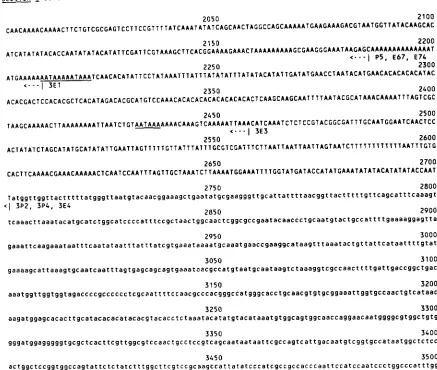
FIGURE 4."Sequence of the singed gene. Exon sequences are in upper case. The positions corresponding to the ends of cDNA clones are shown below the DNA sequence. Pupal cDNAs are prefixed P, embryoic cDNAs are prefixed E. The proposed start and stop codons for the
sn protein are underlined and the single letter code used to indicate the predicted amino acid sequence of the putative sn protein. Potential polyadenylation signals near the 3' ends of RNAs are underlined. Section A is from the SalI site at -2.0 to 47 bp beyond the EcoRI site at 0.0. Section B shows the sequence of the second exon and surrounding DNA, around +10.8. Section C is from the EcoRI site at +12.5 to the SalI site +16.
adenylation at +14.3, +14.55 and +14.8, and that the RNAs do not otherwise differ in their intron-exon structures.
DNA sequence of singed: Analysis of RNA and cDNA defined the 5' and 3' ends of the sn transcrip- tion unit. An approximate intron-exon structure for
sn was generated by hybridizing cDNA clones to DNA blots of cloned genomic DNA. T h e pattern of hybrid- ization was consistent with that expected from the RNA blotting experiments (data not shown) and showed that the sn transcription unit covers approxi- mately 15 kb. T o precisely define the gene structure, the complete DNA sequence of the P5 cDNA was determined together with the DNA sequences of the corresponding genomic regions, and upstream and downstream sequences. This structural and sequence information is shown in Figures 1 and 4.
Our analysis of RNA and cDNA clones suggests that transcription initiates around position 1269 of Figure 4A. T h e sequence at this position is a minor variant of the Drosophila transcript initiation consen- sus sequence (BUSSLINGER et al. 1980). T h e region immediately upstream from this position has no TATA or CAT sequences and the absence of these eukaryotic promoter signals (BREATHNACH and
J. Paterson and K. O’Hare
1080
8 ! 1 2 3
FIGURE 5.-The 3.0- and 3.3-kb RNAs are expressed in ovaries of mature egg-laying females. The left panel shows poly(A+) RNAs from chromosomally identical females with (P 0 X M d) or without (M 0 X P d) ovaries hybridized to a probe from -2.0 to 0.0. The blot was then hybridized with a yolk protein 1 probe to demonstrate the sex of each sample. The right panel shows poly(A+) RNAs from males (d), newly eclosed females $) and females allowed to
mature for 1,2, or 3 days hybridized to a probe from -2.0 to 0.0.
translation initiation sites (CAVENER 1987). This would be the second AUG in the RNAs, and there is a continuous open reading frame (ORF) from this position through successive exons to a stop codon in the 6th exon (position 1625 of Figure 4C). The 1536 nucleotide long ORF is present in all three transcripts and encodes a protein of 57 kilodaltons. The pre- dicted polypeptide has no unusual sequence features and when compared to computer databases of protein sequence, no clearly homologous entries were found. The final exon of sn RNAs varies in length accord- ing to the position of polyadenylation, and the use of the three polyadenylation sites is developmentally reg- ulated. In pupae, only the site at 2701 of Figure 4C is used to produce a single 3.6-kb transcript. However, in adult females two additional sites around 2457 and
2209 of Figure
4C
are also used to produce additional3.3- and 3.0-kb mRNAs.
Adult female 3.0- and 3.3-kb RNAs are from mid-
dle to late stage ovaries: The arrest of oogenesis in
female sterile sn mutants indicates that some or pos- sibly all of the transcripts seen in adult females are from ovaries. T o investigate this, flies lacking ovaries were made using the gonadal dysgenesis (GD) sterility which occurs in P-M hybrid dysgenesis. (See legend to Figure 5 and MATERIALS AND METHODS for details.) RNAs from flies without ovaries, from chromosomally identical flies with ovaries, and from the male siblings of these flies are analyzed in Figure 5. In dysgenic females lacking ovaries, the sn probe (-2.0 to 0.0)
detects only the 3.6-kb RNA. The other samples show wild-type patterns of sn transcripts. This shows that the 3.0-kb and 3.3-kb RNA are at least ovary depend-
ent, and probably are made in ovaries. The remaining 3.6-kb RNA present in dysgenic females is presumably from somatic tissue. As a control, the RNA blot was probed for RNA from the yolk protein 1 gene (Figure
5). This gene is not expressed in males, but is ex- pressed in both somatic and germ cells of adult females (HUNG and WENSINK 1981).
Only the 3.6-kb RNA is detected in late stage pupae (Figure 2). As female pupae have ovaries with previ- tellogenic egg chambers (stages 1-7; see KING 1970),
this implied that the 3.3- and 3.0-kb RNAs might be restricted to later stages of oogenesis and only accu- mulate as the ovary matures. The time of appearance of the 3.3- and 3.0-kb RNAs was therefore deter- mined. Females were harvested immediately after eclosion, or allowed to age before harvesting. Analysis of sn RNA in these females shows that the ovary specific RNAs do accumulate with time and significant amounts are not detectable until 2 days after eclosion (Figure 5).
Maternal inheritance of singed transcripts: The
presence of all three sn transcripts in early embryos (Figure 2) suggested that they were being made in the ovary and maternally inherited by embryos. No role is known for sn during embryogenesis. Eggs laid by a mutant sn- female sterile mother are not rescued by a paternal wild-type sn+ gene, and sn- eggs laid by heterozygous sn+/sn- mothers hatch and develop nor- mally. We suspected that the presence of sn RNAs in early embryos reflected expression of sn in nurse cells during oogenesis and transfer of the RNA into the developing oocyte, rather than zygotic expression of sn in embryos. Analysis of transcription in sn3 (see below) suggested a way to follow the maternal inher- itance of sn RNAs. Although the deletion in this mutant from
-0.8
to -0.5 has removed the position where transcription initiates in sn+, RNAs are made (see below). Sequences upstream of -0.8 are incor- porated into sn3 RNAs, and a probe from -1.3 to-0.7 (probe A used in Figures 6 and 7) detects sn3
RNAs, even in heterozygous sn3/sn+ adults (data not shown). Conversely, a probe from within the interval deleted in sn3 (probe B in Figures 6 and 7) detects wild-type sn+ RNAs in sn3/sn+ adults.
T h e Drosophila singed Gene
A
0-16haureggsIaMby
m u
m
B
S 5 ' E 3 '
" ~ "~ ~~
"-
m +m3
~- " ". . .. ". ~ . . .
Probe3 " A - -
-. - ." . " - . .
6
FIGURE 6.-Maternal inheritance of singed RNAs. Poly(A+) RNAs were prepared from 0-16-hr embryos from the crosses indicated above each lane. In panel A, probe A from -1.3 to -0.7 only detects RNAs in embryos laid by sn3 mothers, irrespective of the genotype of the fathers. In panel B the same RNA blot is reprobed with a sn+ specific probe (probe B), and RNAs are only detected in embryos laid by sn+ mothers irrespective of the geno- type of the fathers.
Transcription in stl mutants: RNA from sn3 and
snx2 was examined. These mutants have very similar
extreme bristle phenotypes, but snx2 is sterile while
sn3 is fertile. The RNAs detected in sn3 pupae were the same as those detected in sn3 adult males (data not shown). Compared with wild type, only trace amounts of some large RNAs are found in snx2 males and females (Figure
7).
As this mutant has no obvious lesion within the sn transcription unit, perhaps there is a point mutation which disrupts processing of the large sn precursor RNA.Some probes do detect RNAs in sn', but they are less abundant than sn+ RNAs (Figure
7).
These sn3 RNAs have been investigated in more detail and our interpretation of their 5' ends is shown in Figure7.
With a sn3 specific probe (probe A in Figures 6 and
7
from -1.3 to -0.7), RNAs of 3.5 and 3.0 kb are detected in larvae, pupae and adult males. Only the 3.5 kb sn3 RNA hybridizes with a probe from -0.5 to -0.3 (probe C). The pattern of hybridization with
698969
+
3 x2singed
actin
1081
E,L P $ ?
m
m
S E
l
\
S E
+
sn
h
4
m 37
FIGURE 7.-Transcription in m mutants. The left panel shows poly(A+) RNAs from sn+, sn' and snXZ adults hybridized with a probe from -0.5 to -0.3 (probe C). The blot was then hybridized with a 5C acfin probe to control for loading. The right panel shows the developmental profile of sn' RNAs. Poly(A+) RNA from 0-16- hr embryos (E), larvae (L), pupae (P), adult males (6) and adult females (?) were hybridized with probe A from -1.3 to -0.7. The lower panel shows the position of probes A and C (and also probe
B used in Figure 6) and our interpretation of the 5' exons in sn+ and sn'.
these specific probes suggests that there is a single transcription start site around -0.9, with the larger
RNA being spliced from the normal exon 1 donor site at 0.0 and the smaller RNA being spliced from a potential donor site at -0.8 (position 1 141 of Figure
4A). This would make 5' exons of about 600 and 100
bp for sn3 compared to the 670 bp in sn+. If these alternate 5' exons were spliced to exon
2
and all other splices were as in sn+, this would generate RNAs of the size detected. The patterns of hybridization seen in RNA from adult females and embryos is more complex, but is consistent with polyadenylation during oogenesis at the same three sites used in sn'.The sn coding region is not affected by the deletion
in sn3, and it appears to be incorporated intact into
sn3 RNAs. The phenotype of sn3 suggests that there
1082 J. Paterson and K. O’Hare
in RNA stability, or because the cryptic promoter revealed by the sn3 deletion is weaker than the sn+ promoter. T h e sn3 promoter may also have a different developmental program than the sn+ promoter. RNA is detected in sn3 larvae but not in sn+ larvae, and there is no obvious peak of RNA in sn3 during meta- morphosis (Figures 2 and 7). In comparison with sn+, the transcription start site in sn3 is about 200 bp closer to the oljE promoter. This may lead to the develop- mental profile of snj transcription more closely resem- bling the profile of oljE, with little variation during development (data not shown; HASAN 1990), than that
of sn (Figure 2). It is also possible that the sn3 pro- moter is not active in the correct cells or at the correct time for the production of normal bristles. T h e ma- ternal inheritance of sn3 RNAs (Figure 6) suggest that it is active in the nurse cells during oogenesis. Al- though there has been no quantitative measure of fertility in sn3, it is not obviously less fertile than sn+. Perhaps less sn protein is required during oogenesis than during bristle development, and the sn3 pro- moter may be sufficiently active in nurse cells, but not in bristle mother cells.
DISCUSSION
Gene structure: We originally used chromosome jumping to clone a 35-kb segment of DNA which included sequences from the singed locus (ROIHA,
RUBIN and O’HARE 1988). We are confident that the
transcription unit described here corresponds to sn. Its size, about 15 kb, is big enough for intra-allelic mapping of mutations. It is disrupted in many sn mutants. It is transcribed at the times and in the tissues (soma and germline) where sn gene products are required. Transcription is altered in the mutants snx2 and sn3.
Our physical map can be correlated with HEXTER’S (1957) genetic map of singed (Figure 1). We have detected DNA lesions in sn mutant alleles mapping to the distal and central intra-allelic recombination sites, but not in those which map to the proximal site. This is probably due to the location of the protein coding sequences at the proximal end of the sn gene (Figure
1). Point mutations in protein coding regions will often be deleterious while point lesions in noncoding regions are less likely to affect the phenotype. Muta- tions which map to noncoding regions are therefore more likely to be associated with large scale changes, such as insertions and deletions, and these alterations in gene structure are readily detected by DNA blot- ting. We suggest that mutations which map to the proximal recombination site (sn’, sn5 and sn50k) are point mutations which alter the sn protein sequence. This uneven distribution of point and large-scale le- sions between structural (coding) and regulatory (non- coding) sequences within a gene was first pointed out
by ZACHAR and BINGHAM (1982) for the white locus of
D.
melanogaster.In addition to characterizing the sn transcription unit, we have identified the neighboring distal tran- scription unit. Transcription of this gene initiates less than 1.7 kb upstream of the sn RNA initiation site and is away from sn to produce a 5.4-kb RNA present at all stages of development (data not shown). It corresponds to the olfE gene (HASAN 1990). DNA blotting experiments using cDNA clones for this tran- script show that like sn, it has a short first exon followed by a large intron (our unpublished results). T h e profiles of transcription of sn and olfE during development are very different yet the intergenic gap is quite small. Since each gene has a large first intron relatively close to where transcription initiates, it is possible that some of the sequences involved in con- trolling transcription are in the nearby introns rather than in the upstream intergenic region. Although there is no requirement for zygotic sn expression during embryogenesis we did detect a very low level of zygotic sn transcription in embryos (Figure 6). Perhaps zygotic transcription of olfE results in the nearby sn transcription start site being occasionally used. A more sensitive developmental RNA blot than that in Figure 2 might reveal a low level of sn+ RNA throughout development. T h e cryptic transcription start site uncovered by the sn3 deletion is about 200 bp closer to olfE than is the start site in sn+. This reduced distance may contribute to the generation of sn3 RNAs during times when the sn+ promoter is essentially inactive.
Only one sn gene product: From the genetics and
the phenotypes of different sn mutants, we originally hypothesized that different proteins were made dur- ing metamorphosis and oogenesis. This could have explained why, for example, the mutation in sn3 sep- arated the bristle and fertility phenotypes. However, the results of our molecular analysis indicate that while different RNAs are transcribed from sn during met- amorphosis and oogenesis, they differ only in the length of the 3‘ untranslated region and so encode the same protein product. T h e phenotypes of point mutations of sn are entirely consistent with there being only one gene product; weak bristle mutants are fertile and extreme bristle mutants are sterile. Mutants such as sn3 appear to affect how the gene is expressed rather than the structure of the gene product.
T h e Drosophila singed Gene 1083
events which occur during metamorphosis and ooge- nesis, and how they are affected in sn mutants.
The role of sn during metamorphosis: T h e devel- opment of hairs and bristles in wild-type and sn mu- tants has been studied using the light and electron microscopes (LEES and WADDINCTON 1942; OVERTON
1967; PERRY 1968; REED, MURPHY and FRISTROM 1975; reviewed by POODRY 1980). Bristles such as the macrochaetes are made up of four cells; the trichogen which produces the bristle shaft, the tormogen which produces the socket, a sensory cell and a neurilemma cell. The bristle shaft develops as a cytoplasmic exten- sion of the trichogen. T h e center of the shaft is filled with longitudinally oriented microtubules and there are bundles of similarly oriented microfibrils at regu- lar intervals just beneath the cell membrane. T h e shaft is finally covered with cuticle, and the shape of the bristle therefore depends upon the form of this cyto- plasmic extension of the trichogen. In sn mutants, electron microscope studies of the elongating shaft shows that there are far fewer bundles of microfibrils than in wild type. T h e shaft (and hence the bristle) in sn mutants is short and curved compared to wild type.
The role of sn during oogenesis: Oogenesis in wild- type flies has been extensively reviewed (KING 1970; MAHOWALD and KAMBYSELLIS 1980). T h e ovary is made up of 10-20 ovarioles along which egg cham- bers move as they develop. When a germline stem cell divides, one cell remains a stem cell while the other goes through four rounds of cell division with incom- plete cytokinesis to produce a 16-cell cyst where the cells are linked through intercellular bridges. One of these germ cells develops as the oocyte while the remainder are nurse cells. T h e nurse cells become polyploid and increase in size until stage 11 when their cytoplasmic contents are transferred into the developing oocyte. In female sterile sn mutants, very few late stage egg chambers are produced (BENDER 1960). The eggs produced are flaccid, and shortened with abnormal filaments. T h e most severely affected mutant, sn36n also showed reduced levels of ploidy in the nurse cells (KING and BURNETT 1957).
T h e time course for sn RNAs from late pupae through to mature egg-laying females (Figures 2 and 6) suggests that sn is not transcribed during the early previtellogenic stages of oogenesis (1-7). Transcrip- tion is initiated during vitellogenesis (stages 8-1 0) and the RNAs are present during late stages of oogenesis and in early embryos. T h e maternal contribution of
sn RNAs presumably reflects transcription in nurse cell nuclei and transfer of the RNA along with other cytoplasmic components from the nurse cells into the oocyte at stage 1 1.
A single role for sn?: Several processes are common to both bristle development and oogenesis. Sister cells assume different fates (trichogen versus tormogen,
nurse cell versus oocyte). However, these fates are not altered in sn mutants, so it is unlikely that sn has a role in determining the fates of these sister cells. Endoreplication occurs in the trichogen and tormogen during bristle development, and in nurse cells during oogenesis. One mutant, sn36a, has been reported to show a defect in nurse cell endoreplication. This allele is associated with an insertion in the promoter region (ROIHA, RUBIN and O’HARE 1988), and it is possible that this aspect of the mutant phenotype does not reflect a simple absence of sn gene product. Further- more, endoreplication occurs in many other tissues which are not affected in sn mutants, so it is unlikely that sn is required for endoreplication. Finally, there are asymmetric movements of cytoplasmic contents (up the developing bristle shaft of the trichogen, from nurse cells to the oocyte). Electron microscopic studies
of bristle development in sn mutants show a reduction in the number and size of bundles of peripheral mi- crofibrils in the elongating shaft. There have been no equivalent studies on the ovaries of sn mutants, but a study of the organization of microtubules and micro- filaments in the nurse cell/oocyte complex during normal oogenesis and in sn mutants could be very informative. In both circumstances when sn is re- quired, there is a reorganization and redistribution of cytoplasmic components, suggesting that sn may have a role in this process, perhaps in the function of microfilaments.
We thank DAVE HARTLEY for a critical reading of the manu- script, MARY BOWNFS for the yolk protein I probe and stock centers for Drosophila melanogaster strains. ALAN DRIVER helped with some of the DNA sequencing. J. P. was supported by a Science and Engineering Research Council studentship. K. 0. H. was a Medical Research Council (MRC) Senior Fellow and work in the laboratory was supported by an MRC project grant.
LITERATURE CITED
BANKIER, A. T., and B. G . BARRELL, 1983 Shotgun DNA sequenc- ing, pp. 1-34 in Techniques in L$e Sciences. Nucleic Acid Biochem-
istry, edited by R. A. FLAVELL. Elsevier Scientific Publishers, New York.
BENDER, H. A., 1960 Studies on the various singed alleles in
Drosophila melanogaster. Genetics 45: 867-883,
BREATHNACH, R . , and P. CHAMBON, 1981 Organisation and expression of eukaryotic split genes coding for proteins. Annu. Rev. Biochem. 5 0 349-385.
BURKE, J. F., 1984 High sensitivity S1 mapping with single- stranded [PJ2]DNA probes synthesised from bacteriophage
MI 3mp templates. Gene 3 0 63-68.
BUSSLINGER, M., R. PORTMANN, J. C. IRMINCER and M. L. BIRN-
STEIL, 1980 Ubiquitous and gene specific regulatory 5’ se-
quences in sea urchin histone DNA clones coding for histone variants. Nucleic Acids Res. 8: 459-472.
CAVENER, D. R., 1987 Comparison of the consensus sequence flanking start sites in Drosophila and vertebrates. Nucleic Acids Res. 15: 1353-1361.
CLANCY, C. W., and G. W. BEADLE, 1937 Ovary transplants in
Drosophila melanogaster. Studies of the characters singed, fused