To Arrive At Solution for Root Step Problem
Occurring During Shaving Operation of Gear
Manufacturing Process Using Root Cause
Analysis
Raveen John
1, Dr. Y. S. Varadarajan
2, Paul Pereira
3P.G. Student, Dept. of Industrial and Production Engineering, The National Institute of Engineering, Mysore, India1
Professor, Dept. of Industrial and Production Engineering, The National Institute of Engineering, Mysore, India2
Chief Technical Advisor, Dept. of Engineering and Development, Oerlikon Fairfield, Belgaum, India3
ABSTRACT: The automobile normally uses spur and helical gears in transmission with bevel gears in the rear end. Automatic transmission is now widely used. Gear Box, assemblies and quality of its components play a vital role during transmission mechanism. Modern gearboxes are characterized by high torque, load demands, low running noise and compact design. In order to fulfil these requirements, gear specifications have to be accurately controlled. Many issues have occurred and still do occur during the processing of gears, especially in the areas of Hobbing, Shaving, Heat Treatment processes, etc. and attempts have been made to address them. Fulfilling the customer’s requirements is one of the key performance indicators for any organization. Meeting the quality specifications, costs and delivery times are vital elements for organization when a project is undertaken. The major challenges faced by the companies in the areas of quality and productivity, can be addressed by using Quality control tools, Statistical approaches, Lean tools, etc. which help in achieving the desired targets. Oerlikon Fairfield- a gear manufacturing MNC successfully uses Root Cause Analysis Techniques (PDCA cycle, Cause and Effect Diagram with Shainin Technique combination), DMAIC quality improvement Methodology in order to solve the problems occurring during part’s processing. The present paper deals with Root Step problem occurring during shaving processing of new development part i.e. helical gear. Root Step occurrence has to be eliminated. Current problem being one of important quality issues is resolved and controlled by using a combination of Cause and Effect Diagram with Shainin Technique and DMAIC-6 sigma break through methodology. Hob modifications being tried as final resort and hence implementation of modified hob during hobbing stage helped in elimination of root step problem occurring during shaving stage.
KEYWORDS: Cause and Effect Diagram, Helical gear, Root Step Problem, Root Cause Analysis (RCA), Hob modifications..
I. INTRODUCTION
Heat-treating processes have been greatly used to enhance the mechanical properties of components made up of steel like bearings, gears, shafts, etc.
Hobbing cutters, gear shaping cutters, shaving cutters, broaches are ranked as cutting tools which require high degree of precision during manufacturing. The resharpening of these precision tools is art by itself. Any slightest mistake during resharpening can/would affect the ultimate result.
Hob is a cutting tool used for cutting gears or similar forms by the generating principle. The principle behind hobbing is generating process with continuous indexing of work piece at predetermined time relation between the cutter and the work. A hob resembles wormlike in appearance with its cutting teeth on the outside of cylindrical body following a helical path corresponding to the thread of worm. As the hob rotates in timed relation with the blank, each row of the teeth successively cuts the next portion of gear tooth spaces, hence generating gears. Hob teeth profiles with non topping, semi topping, no topping with protuberance, semi topping with protuberance play a very vital role in undercut generation during machining/generation of work gear teeth.
Gear Shaving is a finishing operation. It is also a corrective process where surface finish is improved, gear run out is reduced and tooth to tooth spacing is improved. Even Helix errors can be controlled by shaving. The shaving cutter teeth are serrated with many small rectangular notches. As the shaving cutter rotates with gear, these notches scrape off little shavings of materials. Gears to be shaved are cut before shaving with a cutting tool (hob) which has a slight protuberance on its tip. This is very helpful as the shaving cutter is not intended to remove metal from the root fillet of gear. The protuberance on the cutting tool ( hob) produces a slight relief or undercut which allows the tip of shaving cutter to roll freely instead of hitting the shoulder where shaving action is hindered at the bottom of the gear tooth.
The present work is carried out at Oerlikon Fairfield where difficulty occurred during shaving process while developing a new helical gear. Root Step was getting generated/forming at the start of active profile during shaving operation and this is not acceptable as it causes variations, major problems like uneven meshing, backlash problems, damage problems, noise problems. Hence efforts are made to eliminate the root step. Finding the root cause using tools like Root Cause Analysis Techniques so as to eliminate the root step problem becomes imperative. Generally Failure Mode Effective Analysis (FMEA), Cause and Effect Diagrams, Shainin Methodology, Plan do check act cycle (PDCA),DMAIC(define-measure, analyze -improve-control) methodology are effectively used in industries to attain solutions for problems encountered during part’s processing.
II. LITERATUREREVIEWS
Denis Gimpert[1], discusses the importance of vitality of gear hobbing process. His studies indicate that hobbing is a generating process and hob does not cut the same shape as that of cutting tool form. He also discusses about the cutter tool modifications, hobbing machine, hobbing feed, multiple start hobs, thread spacing errors. He concludes pertaining to cutter modifications saying that, it is possible to design the shape of cutting tool so as to produce the modified tooth forms.
Denis Gimpert [2] , studied on consequences on hob run out when mounted. He reported that hob run out can be caused by bad hob, wrong mounting, damaged arbor, etc. Incorrect hob sharpening also affects and causes run out problems. Excessive backlash in hob spindle system and work spindle system on hobbing machine can cause inadvertent machining problems.
Jeroen de Mast [4] has discussed on an accurate and detailed description of Shainin System (SS) for quality improvement. The type of problems tackled using this system are variation problems such as excessive variations, too low yields, too long cycle times, occurrence of undesired events, etc. The discussion stressed on the point that SS is an effective and valuable methodology as it verifies the problem, problem statement. The study verified that this system actually manages to capture the felt problem.
III.PROBLEMIDENTIFICATION,METHODOLOGIESANDEXPERIMENTATIONS
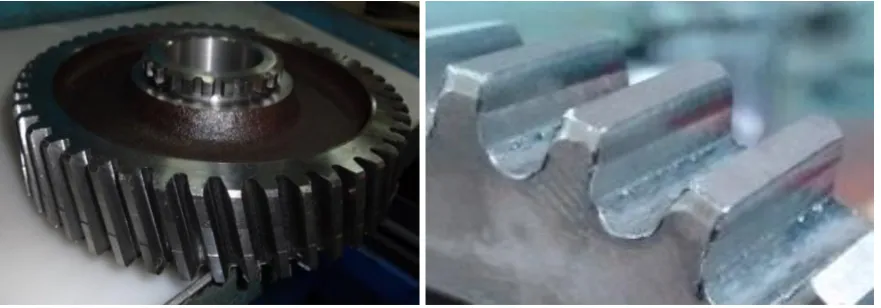
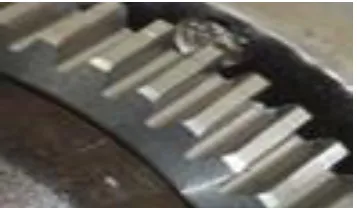
The present work focuses on solving Root step problem occurring near root fillet or near to start of active profile during shaving operation. The main objective is to arrive at authentic solution for the root step problem encountered during Shaving Process, also meeting quality, cost and delivery criterion. Figure 1 shows gear having root step problem.
Figure 1: Gear having root step problem
Hence efforts are made to identify the problems (machining related), carry out investigations on the same so as to understand and thus recommend solutions to them, to arrive at the appropriate setting parameters, machining parameters, tool specifications and modifications, etc for the manufacturing of undertaken gear/part so that this problem does not recur during PPAP lot. PDCA cycle is mainly used. Root Cause Analysis Technique (Cause and Effect Diagram with Shainin Methodology is used in PDCA cycle’s check phase) with DMAIC methodology are adopted in the present study to identify and solve the root step occurring during shaving operation.
A. Cause and Effect Diagram for Root Step Problem
Figure 2: Cause and Effect Diagram for Root Step problem occurring during shaving process.
Using Cause and Effect diagram, causes and their effects were understood and based on the same experimentations were carried out so as to eliminate the problem. Combination of DMAIC and PDCA were used in order to solve this problem. Figure 2 explains the Cause and Effect Diagram framed in order to find out the cause for root step occurrence.
B . Experimentations carried out to find out and solve Root Step Problem
The following experiments were carried out in order to eliminate the Root Step problem occurring during shaving operation
1) Diameter over pin (DOP) inspection
Figure 3: Root Step getting generated
Figure 3 explains pictorially root step getting generated if higher allowances exists between hobbing and shaving operations.
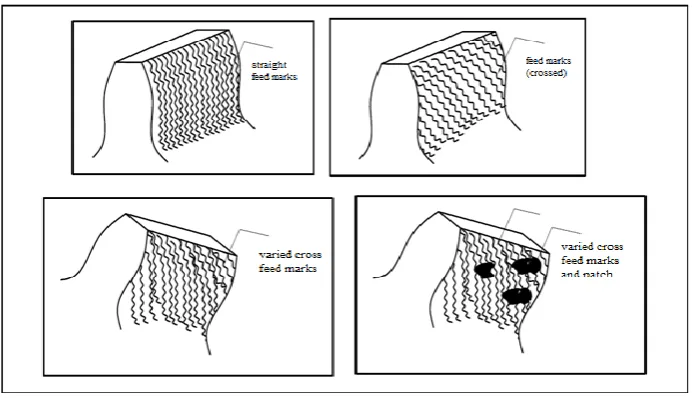
2) Check on feed marks (generated during preshaving i.e. hobbing operation)
Uneven feed marks generated during hobbing can lead to generation of root step during shaving operation. Hence detailed visual inspection was carried out to check whether crossed feed marks, uneven feed marks, uneven feed marks with patches were formed during hobbing operation. But no such feed marks were noticed. This indicated that the root step problem was not because of wrong feed marks generated on the flanks of gear teeth. Figure 4a) and 4 b) portrays the types of feed marks and also the actual feed marks attained on the gear teeth flank.
Figure 4 b): Actual feed marks attained on gear flank after hobbing operation
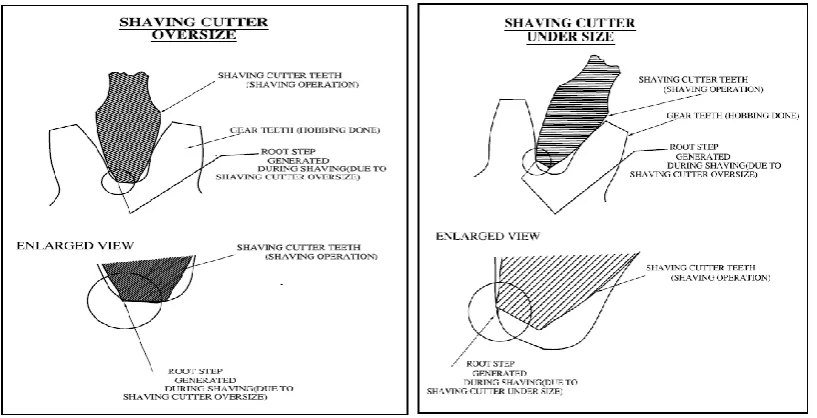
3) Check for shaving cutter outside diameter (OD –under size and oversize)
Shaving Cutter OD was checked using Coordinate Measuring Machine (CMM) and found that the cutter diameter is accurate i.e. shaving cutter OD was neither undersize nor oversize in its dimensions and thus no problems with the cutter diameter. Shaving Cutter accuracy plays a very important role during shaving operation.
Figure 5: Shaving Cutter OD-oversize and undersize effects
If shaving cutter OD is oversize, then there are greater chances that the cutter hits the centre and end areas of gear teeth’s root fillet and if shaving cutter is undersize, there are high chances that shaving cutter hits the area near to the start or at the start of root fillet area. Figure 5 explains the consequences of shaving cutter oversize and undersize.
4) Check for hob teeth wear, damage
5) Checking for hob run out or hob wobble
If hob run out exists, the stock removed during hobbing is uneven and hence excess or extra stock remains in some areas leading to root step when the part/work gear is shaved during shaving operation.
Hob run out was checked and found that run out was within 5 microns (indicating high accuracy). Hence hob run out was ok.
6) Hob design (Hob teeth) protuberance modification
Hob modification was the last resort to solve the root step problem. The idea for hob modification was that by changing/modifying the hob protuberance, sufficient undercut would get generated. Once sufficient undercut is generated, chances of Shaving Cutter hitting the work gear teeth’s end shoulder during shaving operation is eliminated as there is no extra/excess stock due to sufficient undercut that would be generated during hobbing operation. Therefore hob teeth protuberance was increased (so as to generate undercut during hobbing) and finally root step problem occurring during shaving was eliminated.
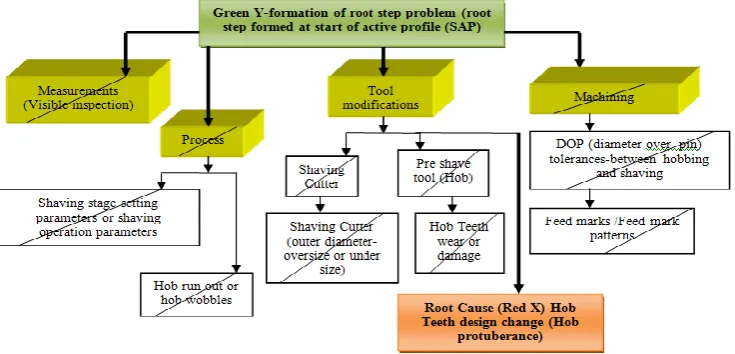
C. Shainin diagram for Root Step Problem
Figure 6: Shainin Tree Diagram for Root Step Problem
In the depicted Shainin Solution/ Tree Diagrams, the “Green Y” or problem statement for the problem encountered is Root Step formation and this problem has to be eliminated before the part is processed for next processing phases.
In order to find “Red X-Root Cause” for the problem encountered, investigations and experiments have been carried out at various phases of work gear’s processing and the correct phases, processes, experiments are eliminated in order to arrive or identify the root cause of problem. After elimination of correct processes, phases, experiments which are not causing problems, the anticipation of problem’s root cause converges and focuses to a problem causing area.
IV.RESULTS AND DISCUSSIONS
After various trials were carried out to eliminate the occurrence of root step problem by varying different parameters, it was established that these parameters were not influencing the occurrence of root step problem during shaving operation. Finally hob was sent for modification so as to change the hob protuberance. The results of these modifications/changes are discussed as follows
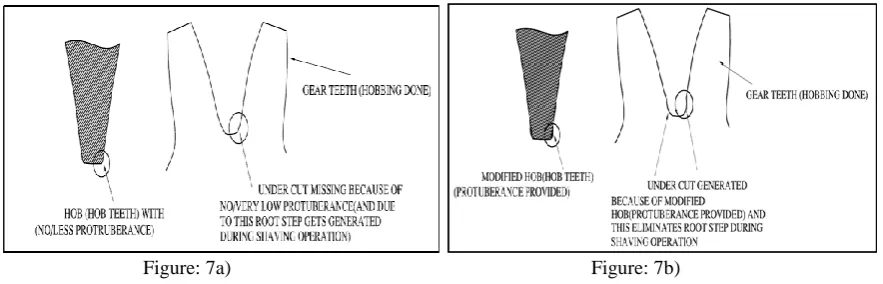
Initial hob protuberance provided to hob teeth was 0.05mm-0.063mm. This was increased to 0.090mm-0.11mm. When this modified hob was used, the required undercut was generated during hobbing operation and this eliminated the root step problem which was getting generated during shaving operation
Figure: 7a) Figure: 7b)
Figures 7 a) and 7 b), explain the undercut missing when low/less protuberance was used and undercut getting generated after hob modification (i.e. when increased hob protuberance is used.
Figure 8) a) and 8 b): Hob teeth before and after modification.
Figure 9) a) and 9 b)
Figure 10 shows root step eliminated after shaving operation when modified hob was used during hobbing operation.
Figure 10: Root step eliminated after shaving operation
Root Step occurring at the entrance of root fillet area was eliminated as the increased hob protuberance generated the extra required undercut, because of which the shaving cutter could pass between the hobbed teeth of gear without hitting the shoulder of root fillet area. Hence clean shaving operation was performed without the shaving cutter brushing the start of active profile area. Root step, most of the times, is checked by visual inspection, using a pin to feel the ridge/root step formed. When modified hob was used, the root step that was occurring during shaving operation was no more evident.
V. CONCLUSION
1)By using RCA techniques, Root step problem occurring on work gear teeth during shaving process was corrected. Combination of PDCA cycle, Cause and effect diagram with Shainin Methodology helped in identifying the root cause and hence finding authentic solution for the same.
2)Shainin Tree Diagram helped in finding the root cause for the occurrence of root step problem by eliminating the other probabilities which were experimented. Measurement oriented, process oriented experiments were eliminated and finally the need for hob modifications was focussed. Hence hob modifications requirement formed the Red X(Root cause).
3)DMAIC 6 sigma break through methodology helped in defining the process, measuring and analysing the results. Devised analysis led to improvements in hob modifications and these modifications done on hob generated the required undercut during hobbing which further helped in elimination of root step problem that was occurring during shaving operation.
ACKNOWLEDGEMENT
We take this opportunity to thank especially Mr.Deva Jacob for giving an opportunity to carry out project at Oerlikon Fairfield. Sincere thanks to all production and quality department people and the entire Engineering Team, for their constant guidance and support.
REFERENCES
[1] Denis Gimpert, “Gear Hobbing Process”, Gear Technology, Jan-Feb 1994, 39-44.
[2] Denis Gimpert, “Gear Inspection Trouble shooting tips” Gear Solutions, February 2008, 42-45
[3] Dalgobind Mahto and Anjani kumar, “Application of Root Cause Analysis in improvement of product quality and productivity”, Journal of Industrial Engineering and Management,Vol 2, Issue 2,2008, 16-53.
[4] Jeroen de Mast et.al, “ A discussion on Shainin System”, Quality Engineering, 2008, 20-22 [5] Gear technology Magazine.