MUTATION STUDIES AT THE A, LOCUS
IN
MAIZE.I. A MUTABLE ALLELE CONTROLLED BY Dtl
M. G. NUFFER
Department of Field Crops, University of Missouri, Columbia, Missouri
Received November 28, 1960
HE gene A , in maize was first reported, with its mutant allele a,, by EMERSON (1918, 1921). In these reports and later publications by EMERSON and ANDERSON (1932) and LAUGHNAN (1948) the A , allele found in North American races was shown to be necessary for the production of anthocyanin pigments in various tissues of the corn plant. With the complementary genes
A,, B, Pl, and R' or r', A , produces a deep purple pigmentation of the sheath, brace roots, auricle, leaf margin, husks, tassel, and anthers; with A,, Pry C , and R, it produces a purple pigment in the aleurone. With P it produces a bright red pigment in the pericarp. When a, is homozygous in the above genotypes, it causes the substitution of a brown pigment for purple in all tissues where anthocyanin normally appears, except for the aleurone, where there is no pigment. Various allelic combinations of the above genes can alter the type of pigment produced and the regions in which pigment is expressed, giving sun red, brown and green plants depending upon the genotype involved.
The A locus is in linkage group 3 between lg, and et with 33 crossover units separating lg, and A, and 12 units separating A and et. It has been placed cytologically in the distal one fifth of the long arm of chromosome 3 (MCCLIN-
TOCK 1931 )
.
The mutant a which behaves as a normal stable recessive was shown by
RHOADES (1938, 1941) to be mutable in the presence of the dominant factor Dt.
This factor, located near the end of the short arm of chromosome 9, causes a to mutate to A in all the tissues where A vs. a differences can be seen. In the proper genetic background, the mutant areas appear as small dots of A tissue on a color- less aleurone, and as long narrow purple sectors on the brown sheath, culm, husks, etc. These sectors may extend into the tassel to give purple anthers which, depending on whether or not the sector includes the germ line, may transmit a mutant A allele in 50 percent of the pollen.
There are known, at the present time, many A , alleles in addition to those reported by EMERSON in his original study. Most of these have arisen as mutants from the four original parent alleles A , a, Ab and ap and have been organized into several groups according to their phenotype, parentage, and mode of origin
(RHOilDES 1941 ; LAUGHNAN 1949; NUFFER 1952).
The compound nature of certain alleles of South American origin has been demonstrated by LAUGHNAN (1949). These alleles characterized as Ab have at
ment Station.
1 Journal series paper No. 2237 approved by the Director of the Missouri Agricultural Experi-
626 M. G . NUFFER
least two components, a (dilute anthocyanin in seed and plant and dominant brown pericarp) and P (strong anthocyanin in seed and plant and recessive red pericarp) which can be separated by crossing over to produce single unit alleles. The original ap allele apparently is an LY isolated by crossing over or by mutation
of P. Further subdivision of these units is suggested by recent investigations ( LAUGHNAN 1956).
The common allele in North American races ( A ' ) appears to be a single unit with a phenotype that closely resembles the isolated P component of A*. The remaining one of the four original parent alleles ( a ) apparently arose as a mutant from A. Although it is phenotypically at the null level it retains its pairing affinity for all the known components of the A , locus and it has the property of reverting back to A in the presence of Dt.
With the increasing complexity of the A locus, both as to its structure and the diversity of its mutant alleles, there arises a serious problem of terminology. Not only are there many mutant types, but they are involved in successive mutational steps whose sequence is important. For this reason. any notation of these alleles should include, besides the descriptive symbol, a designation of the parent allele and the mode of origin. The following is a variation of the system used by L. J.
STADLER in his research and various publications:
The notation of each allele requires the base symbol ( A ) , which has been previously used in the literature. An additional descriptive symbol is added as a superscript. Thus Ab' describes the A allele with recessive brown pericarp. Following this descriptive symbol and separated from it by a colon is a distinctive name, if the allele is not a mutant, or its origin if it is a mutant. The only alleles of unknown origin are Ab, A, ap, and possibly a. Accessions of these alleles are each given a distinctive name after the allele has been purified by extracting from a heterozygote with a distinguishable allele. For example, various A alleles used here are designated A:Cache, A:Quapaw, etc.
The mutants from a particular allele are numbered in consecutive order in a single series such as a-1, a-2, a-3:A Cache As further study reveals more about these mutant alleles, they may be distinguished as am-l, a-2, a"-3, etc.. without changing their number (the symbol a" signiEies the null level, a n allele which will not mutate back to the dominant form in the presence of D t )
.
If there has been some agent such as Dt causing the mutation, then this fact is added as a descriptive capital letter immediately preceding the numerical designation of the mutant. Therefore, the mutant Ab' from a by the action of Dt is Ab'-D4:a. The designations of the various origins are: D for Dt, U for ultra- violet, X for X ray. When the mutant arose spontaneously or from unknown causes this symbol is omitted.
In actual use these designations can be shortened to include only the allelic symbol and its serial number, as A-D4, am-1, a"-3, etc.
Origin of anl-l: On a selfed ear of a plant carrying A:Cache/a, Dt Dt there occurred a single seed which was colorless and heavily dotted (the ear segregated
MUTATOR SYSTEM 62 7
FIGCRE 1 .-Ear from U’” a, Dt Dt selfetl showing U”’ In one, two, and three dose.s compared
to a in three doses, all with three doses of D t .
the colorless sibs ( a a a in 3n endosperm) which averaged only 58 dots per seed. The plant grown from this seed produced a selfed ear (Figure 1 ) that had 26 normal a dotted and 93 very heavily dotted seeds. Subsequent tests proved the case to be a highly dottable allele of a, which like a was unstable in the presence of Dt but completely stable in its absence.
Further mutation trials with both the parental alleles, A:Cache and a, have shown that the former yields additional cases while the latter does not. It is con- cluded that am-1 came from A:Cache and it is therefore, tentatively designated a”’-1:Cache.
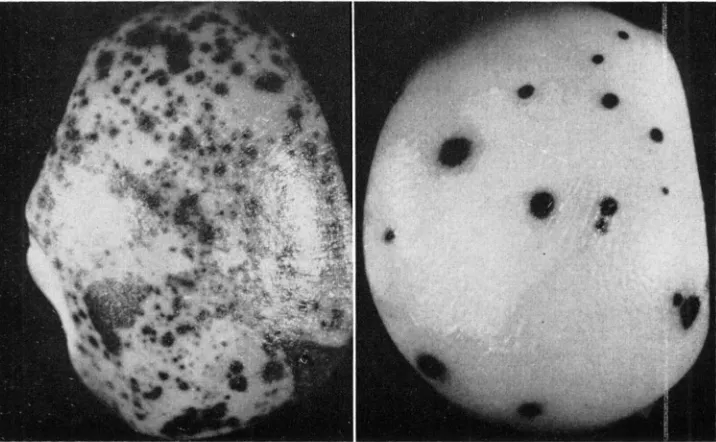
Comparison with a: I n the absence of Dt there is no apparent difference be- tween a and a”‘, both producing a colorless aleurone and brown plant. In the presence of Dt however, striking differences are seen. These can best be described by comparison of am with a in the sib progeny from the cross a a, dt dt X a”’ a, Dt Dt. The two classes of seeds seen on the resulting ear have endosperms (3n) of the constitutions Q a a , Dt dt dt and a)“ a a , Dt dt dt. The number, size and
appearance of the Q”’ vs. a dots are clearly demonstrated in the aleurone layer of these endosperms (Figure 2). Cer:ain aspects of a dotting however. are more clearly seen on seeds from the cross a a, Dt Dt X a”’ Q, Dt Dt (Figure 3).
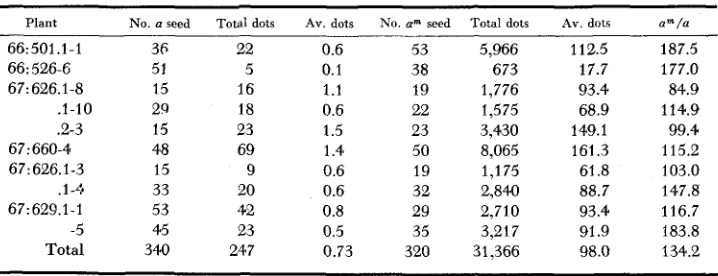
The most obvious difference between the two alleles is in the frequency of mutation (number of dots). Counts cf the do: number in all the seeds from nine ears of the cross of a”’ a Dt Dt on different a a dt dt cultures are listed in Table 1.
628 M. G . NUFFER
FIGURE 2.-Comparison of a”’ a a, Dt dt dt (left) vs. a a a, Dt dt dt (right) on sib sectls from
a cross of a a, dt dt X a’” a, Dt Dt.
FIGURE 3.-Comparison of a”& aa, Dt Dt Dt (left) vs. aaa. Dt Dt Dt (right) on sib srctls
from a cross of a a, Dt Dt x a”’ a, Dt Dt.
MUTATOR SYSTEM 629 TABLE 1
Comparison of a us. a"' dot frequency from a cross of a a, dt dt b y a'" a, Dt Dt
Plant No. a seed Total dots AV. dots No. a" seed Total dots AV. dots a"/a
66: 501.1-1 66: 526-6 67:626.1-8 .1-IO .2-3 67:660-4 67:626.1-3 .I-<* 6 7 : 629.1 - 1
-5 Total 36 51 15 29 15 48 15 33 53 45 340 22 5 16 18 23 69 9 20 42 23 247 0.6 0.1 1.1 0.6 1.5 1.4 0.6 0.6 0.8 0.5 0.73 53 38 19 22 23 50 19 32 29 35 320 5,966 673 1,776 1,575 3,430 8,065 1,175 2,840 2,710 3,217 31,366 112.5 17.7 93.4 68.9 149.1 161.3 61.8 88.7 93.4 91.9 98.0 187.5 177.0 84.9 114.9 99.4 115.2 103.0 147.8 116.7 183.8 134.2
2/3 of the a class counts from both classes. Thus 0.73 - 2/3 (0.73) = 0.24 dots for each a gene per seed and 98.0 - 2/3 (0.73) = 97.5 dots for each a" gene per seed. The frequency of a" dots is, therefore, 97.5/0.24 or 406 times as great as a. This is misleading as a large portion of the am dots are very small indicating that they must have occurred at a later stage when the number of cells in the aleurone, and therefore the number of chances of mutation, for a given seed were much greater. A count of the dots of the a size (78-cell average) on am seeds reveals that at the stage when a mutates 0.24 times per seed, a" mutates 16 times. or in other words, at a given stage, am mutates 67 times as frequently as a.
It will be noted that the frequency of 0.73 for the a a a, Dt dt dt seeds is con- siderably below the average of 2.7 dots, for this same genotype, found by RHOADES
(1938). This is probably due to genetic modifiers, and perhaps due to the fact that RHOADES used a different allele which he describes in his report. Further discussioi of the effect of modifiers of dotting will be found in a later report. A second major difference is seen in the size of dot. Those on the a seeds at both Dt dosage levels (Figures 2 and 3) were comparatively uniform in size averaging 78 cells each and ranging from 25 to 560. (On other sib a seeds there were occasional extreme variants on each side but most grouped very near the mean.) The dots on the seeds, however, ranged widely from single-cell to whole-seed cases with no tendency toward grouping at an average size. There was, however, a proportionate decrease in frequency per kernel as the size of the sector (dot) increased. This can be explained when one considers that each dot is a sector of mutant tissue composed of cells that have descended from a single cell in which a mutational change occurred, and that the earlier the mutationa1 event occurs the larger will be the sector and the smaller will have been the population of cells among which such mutational events could have taken place. Thus it can be seen that a mutates most frequently at a particular stage while am apparently mutates at an even higher rate at all stages.
630 M. G. NUFFER
are mostly round. uniform, intensely colored, and have a diffuse outline. Occa- sionally there may be found a single dot which is lighter in color and has a sharp outline. The dots on the all8 seeds include a few of the type just described (since the seeds are actually a"' a a ) but mostly dots with a very sharp erratic outline and moderate to light intensity. The moderately intense dots usually have a single course of lightly pigmented cells representing a diffusion layer all the way around the sector. The irregular outline of the a"' dots appears to follow the developmental pattern of the aleurone cells more closely than does that of the a dots.
It appears, therefore, that the a dots are more symmetrical and diffuse in outline because they have more pigment which can therefore diffuse farther into the area of genetically colorless tissue giving a blending effect along their borders. These last two differences can be equated to a more basic difference that is in the types of mutant alleles produced. RHOADES (1941) found that among 29 extracted A mutants from a through the action of
Dt,
27 were A"s (strong), one was A"" (less strong) and one A"' (medium). In contrast it has been found that 23 unselected A mutants from a"' included two A', two A'", 13 A"' and six A"(weak).
These differences, described as they are expressed in the aleurone, are also projected into the other tissues of the plant and can be recognized when one understands the developmental pattern of the cells of the tissue being observed. Thus, whereas a few intense sectors occur in all potentially anthocyanin- producing tissues in a a plants, several times as many occur in the same tissues of
a"' a" plants (Figure 4).
Gene dosage: By appropriate crosses as pointed out by RHOADES ( 1941 ) it is
MUTATOR SYSTEM 63 1
possible to manipulate the dosage of a particular gene in the 3n maize endosperm. For example, a cross of a” aJt’, dt dt X a”’ a”&, Dt Dt can be made to produce ears which have seeds with one dose of am (a”’ a“ a’) and three doses of a”’ (a”’ a”’ a”’).
Similarly from a”’ a”, dt dt by a’ am,
Dt
Dt, ears with two doses (a”’ ant a x ) and three doses ( a m am a’”) of a”’ can be produced. Dot counts on such seeds were made and it was found that the frequency for one dose was 114 dots per seed, for two doses 225 dots, and for three doses approximately 330 (an approximation, because seeds with more than 300 dots cannot be counted accurately. These counts show that there is a simple linear relationship between gene dosage and mutation frequency of a”’.Similar crosses were made to study varying doses of Dt against an a”’ back- ground. They were a” a”’, Dt dt X am a”’, Dt Dt which gave a comparison of one
us. three doses (Figure 5 ) and the reciprocal cross which gave a comparison of two us. three doses of Dt. The counts were as follows: one dose, approximately 300 dots; two doses. 800 or more; and three doses well over 2,000. Accurate counts were impowible because of the overlapping and blending of dots. The two- and three-dose counts were probably on the conservative side. These counts suggest the exponential relationship reported for Dt dosage by RHOADES (1938, 1941).
T y p ~ s of Mutants: As previously stated, plants with a n am a” Dt Dt genotype produce frequent mutant sectors of various sizes and types, including those aris- ing in germinal tissue. Whenever a mutational event occurs in a cell in the germ line 50 percent of the gametes produced from that cell’s descendents will be mutant. This may occur either as a tassel or an ear sector, or if the event is late enough it may be expressed only as a single megaspore or microspore, in which case a single mutant seed will be produced.
By sampling ear and tassel sectors and collecting individual seeds (each representing a different occurrence) it has been possible to collect a sizeable
632 M. G . NUFFER
FIGURE 6.-Four mutant types from the cross a y a*, Dt Dt x a”’ a”’. Dt D t . Row 2 no. 4 a”, 2 no. 10 a”’-, 3 no. 3 A “ . 3 no. 5 A, and 3 no. 7 another a - . The grouping of these mutants is by chance as a)” came from the male parent.
number of mutants including a wide array of types, several of which are demon- strated on a n ear from the cross a” a”, Dt Dt x a”‘ a”‘, Dt Dt (Figure 6 ) . The grouping of mutants in this example is by chance since the a7jG in this case comes
from the male. This ear was selected for photographing because it carried a n ideal collection of mutants. Other seeds from this and sib ears had partial seed sectors (Figure 7) that demonstrate several of the types of mutant alleles
-
FIGURE 7.-Mosaic seeds from a cross of a“ ax, Dt dt x a”’ a”’, Di Dt; no. 1 Q“, no. 2 A r f - a n , no. 3 A, no. 4 A r t , no. 5 A-A“, no. 6 d. Numbers 7 a m a m alll, Dt Dt Dt, and 8 a a a , Dt Dt
are included for comparison.
produced. These when considered with the partial ear sectors (Figures 8 and 9)
indicate the wide range in size (an expression of time of mutation) and type of mutational event.
MUTATOR SYSTEM 633
FIGURE &-A brown pericarp ear from the cross am-Sh, Dt Dt, P X a-sh, Dt Dt showing sector of A' with red pericarp.
FIGURE 9.-Ear from the cross a"'Sh/a-sh, Dt Dt, p x a-sh, Dt Dt showing a large sector segregating mutant as-Sh vs. parental a"-sh types and a small sector segregating parental a)li-Sh YS. a*-sh.
mutants, which have acquired the ability to perform some degree of A function in producing anthocyanin but which have lost the property of being able to mutate to a higher level of A action though not to lower forms; (2) unstable phenotypic mutants, which have acquired anthocyanin-producing properties and have retained the mutability of the parent allele; ( 3 ) changes in state of muta- bility. These mutants are phenotypically like the parent allele in that they are unable to produce anthocyanin but have either lost or undergone a change in mutability. It should be emphasized at this point that all mutational change considered here is dependent on the presence of Dt.
The first group of mutants includes stable anthocyanin-producing alleles which range in phenotypic level from the strongest known allele, A' (full purple plant. full colored seed, red pericarp), through a continuous series of levels of pigmentation characterized by Arb (full purple plant, full colored seed, red- brown pericarp), Ab' (medium plant and seed color, recessive brown pericarp), down to AI', which has reddish brown plant color, dilute seed color, and recessive brown pericarp. These four classes constitute a n arbitrary classification of what appears to be a continuous series of alleles.
634 M. G . NUFFER
to dominant alleles) can be established by direct observation only in the case of the medium and light color alleles Ah‘ and A z t since with these alleles if the locus still retained the a” type of mutability one could expect to see medium or light colored seeds with dots of darker color which represent further mutations to dark color alleles. Such observations are impossible with the darker Avo and A’ alleles since they already have a threshold or maximum pigmentation in the aleurone cells. However, it is possible to reduce their expression below this threshold by placing them in one dose in a heterozygote with ah, an allele that partially suppresses the action of most A alleles (probably by competing for a substrate that is essential for anthocyanin production). The cross ab ab x AT A‘ yields seed with an endosperm of the constitution ab ah A‘. These seeds are considerably lighter in color than corresponding A‘ A‘ A‘ seeds. One then expects to find darker dots on an otherwise dilute seed if the new mutant A‘ cases still retain the mutability of the a”% allele. Such was not the case in this group of alleles. The second or mutable phenotypic group includes at present only two repre- sentatives, Ah‘ mutable and A z t mutable, hereafter designated AbT and Alf n’,
respectively. The A Z t n’ allele resembles the other A z t alleles in most respects,
giving a dilute aleurone, red-brown plant color and recessive brown pericarp. However, superimposed on this phenotype are many dots or sectors of darker tissue representing mutations to darker alleles. In addition to dots of darker color, seeds of the proper genotype (d a9 A z t ”) have frequent dot-like colorless sectors indicating mutation of A“ to a as well as to A. One of these colorless dots which was quite large had within its borders a single dark A-like dot, suggesting that mutates to a mutable form of a which in turn can mutate to A . This fact
Alt m
was later confirmed by obtaining germinal cases of a from A z t m.
The third class consisting of the cases of change in state of mutability. have, in the absence of Dt, the same phenotype as a”’. When Dt is present, however, they show distinct differences in mutability. With regard to these differences they can be classified into two types: (1 ) those capable of mutating to A but at a lower frequency as shown by the dots they produce (designated a”‘-), and (2) those which are stable and fail to give dots in the presence of Dt (designated
cy). The first of these two includes alleles of several levels with regard to dotting,
the highest of which has only one tenth the dotting ability of an‘ and the lowest of which approaches the level of the a allele.
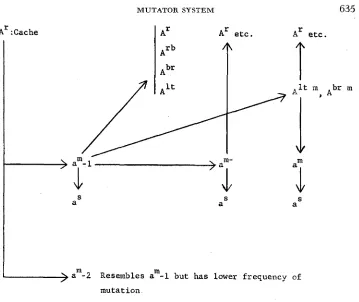
The foregoing description of mutant types and their mutational potentialities are summarized in the diagram of mutational sequences resulting from a”& (Figure IO). Not all the possibilities are listed, only those that are known to occur.
MUTATOR SYSTEM 635
Ar :Cache etc. A': etc.
>
*lt m m
I'
s s s
a a a
m m
Resembles a - 1 but has lower frequency of
mutat ion
a -2
FIGURE 10.-Mutational sequence from A:Cache.
vidually. All the colored cases except A z t were listed as A because there was no way to separate the A', Arb, and Abr phenotype in the aleurone tissue of single- seed cases. The data are presented in Table 2. The as cases were not tested because they were growing in a part of the field destroyed by high water.
From this sample 48 A , 13 A z t , and six on+ cases received a test. Of these 21
A , four A L t , and two am- cases transmitted the mutant type and therefore were good corresponding mutants which had arisen from a change that occurred early enough, or in the proper nuclei, to be included in both the endosperm and the embryo. Their frequency was 13, 3, and 2 x IO-*, respectively. The remaining
TABLE 2
Frequency of mutant types among 15,450 seeds from am am, Dt Dt
~ ~ ~~
A
Total mutant phenotype 57
Mutant embryo 21
Number tested 48
Rate per 10,000 13
Nonmutant embryo 27
Rate per 10,000 18
~~ ~
A ' t AIL m U" - U'
13 0 7 17
13 0 6 0
4 0 2
3 0 2
9 0 4
636 M. G . NUFFER
27 A , nine A z t , and four an'- cases were not mutants but produced normal a"' a', Dt Dt plants. These were apparently cases in which the mutation had occurred a t or after the initial division of the megaspore that produces the two nuclei, one of which through subsequent divisions contributes one nucleus to the embryo and one to the endosperm, while the other contributes one nucleus to the endosperm only. If a mutation occurs in the latter it can affect only the endosperm, while if it occurs in the former it can affect either or both. These cases that are not con- firmed, that is. the mutant seeds which grew into nonmutant plants can also be used as a measure of mutation rate. They represent mutations occurring one division later, in those nuclei contributed to the endosperm only. The rate of mutation at this stage is 27 A , nine A z t , and four a"- from 15,450 chances or 18, 6, and 3 x respectively.
The many sizes of dots on a"' seeds suggest that am mutates at practically all stages of development. An accurate measure of the frequency of mutation to the
A types, at a particular stage of development, can be obtained by counting the number of dots of a given size on am as as, Dt Dt dt seeds (homozygous Dt seeds from the above cross could not be used because they produced too many dots for counting). The population tested in such an experiment is the number of aleurone cells per seed, divided by the number of cells in the dots of the size selected for count. A count of two-cell dots was made of the top surface of 30 seeds from an ear from the cross a' a', Dt Dt x a" am, d t dt. They yielded a total of 808 cases with an average of 27 dots per 60.000-cell seed surface. The mutation rate then would be 27 in 30,000 or 9 x 1 O-4.
Seeds of this same genotype can also be examined for half-seed sectors which represent mutations occurring when the chromatids of the primary endosperm nucleus are effectively separate. Each seed observed represents two chances for a mutation (expressed as a half-seed sector) to occur, hence the examination of 10,350 seeds represents a population of 20,700 chances. Five such sectors were found in this examination giving a mutation rate of 5/20,700 or 2.5 X IO-'.
Similar examinations were made of am a' as, Dt Dt Dt seeds from the cross of a y as, Dt Dt x a"' an&, Dt Dt. This is like the first cross described above except that male and female parents were reversed. Whole-seed mutants with corresponding mutant embryos cannot be counted in this case because a single tassel sector could produce manv such mutant seeds (Figure 6 ) . However, mutant seeds with nonmutant embryos avoid this problem and permit a measure of the frequency
of mutation occurring at a stage between that in which the chromatids become effectively separate for the second microspore division and when they become separate again in the triple fusion nucleus. Among 5,870 seeds examined. 62 whole-seed mutants were found of which ten were mutant with nonmutant embryos thus giving a frequency of 10/5,870 or 17 X
These same seeds were examined for half-seed sectors like those previously described (except in this case there were three doses of D t ) . The count was 64 among 5,870 seeds or 64/11,740 or 54 x
M U T A T O R SYSTEM 637
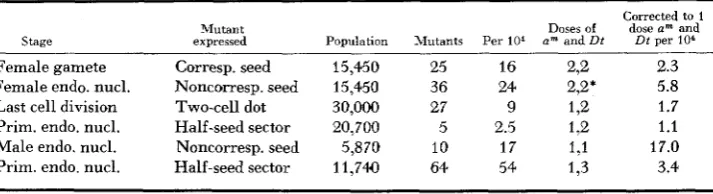
TABLE 3
Summary of m u d o n frequencies (am to A) at various stages of development
Stage
Corrected to 1
Mutant Doses of dose am and
expressed Population Mutants Per 101 a"' and Dt Dt per l o 4
Female gamete Corresp. seed 15,450 25 16 222 2.3
Last cell division Two-cell dot 30,000 27 9 1,2 1.7
Male endo. nucl. Noncorresp. seed 5,870 10 1 7 1 9 1 17.0 Female endo. nucl. Noncorresp. seed 15,450 36 24 2,2+ 5.8
Prim. endo. nucl. Half-seed sector 20,700 5 2.5 1,2 1.1
Prim. endo. nucl. Half-seed sector 11,740 64 54 133 3.4
* The two Di factors are in separate proendosperm nuclei hence the correction is on a linear not an exponential scale.
column lists the frequency after correction to one dose of am and one dose of Dt. Since changes in dose of am result in a linear change in dot frequency those cultures with two doses of am (line 1 and 2 of table) were corrected for this by dividing by two. Similarly, since an increase in dosage of Dt results in a n exponential increase in dot frequency these results were corrected by taking the square or the cube root of the frequencies from two- or three-dose cultures, respectively. It should be pointed out that this manipulation of dot frequencies results in reduced differences between classes.
Even when one takes into account the above distortion, the differences are not great considering the other factors which could influence the frequency of dots. Such things as (1) length of stage during which a mutant must occur to be ex- pressed in the manner observed, (2) differences in basic genotypes between cultures, and ( 3 ) differences in suitability of stage for mutational events all add a certain unmeasured amount of variability to the data. W e are permitted to draw valid conclusions from this data with its several variables only because in com- parison with mutation studies at other loci and with another allele of the A locus ( a )
,
the differences appear to be negligible. The a allele (and many other genes) mutates, with rare exception, at a particular time while a" mutates at all stages. One can, therefore, conclude that, except for the effect of Dt, the time of muta- tion is more dependent on the allele involved than on the particular cellular environment.DISCUSSION
The a"$ allele and its associated modifiers present a unique combination whose analysis bears on several genetic problems including ( 1 ) mutational behavior
(2) allelic variability and (3) genetic modification of mutability.
638 M. G. NUFFER
with other higher organisms generally have dealt with mutations that could be expressed in terms of frequency per gamete or per generation while a whole class of heritable changes that occur in the somatic cells and that are variously described as due to unstable genes, viral infections, chromosomal aberrations, etc., have been neglected. This was true, that is, until the amazing analysis of the mutator systems in maize by MCCLINTOCK (1950, 1951). With our present constructs of hereditary material it is necessary to postulate gene mutation as the ultimate source of genetic variability, but modern researches have syste- matically reduced the reservoir of gene mutations by eliminating gross aberra- tions, deficiencies and then rearrangements within compound loci ( LAUGHNAN
1949; STADLER and NUFFER 1953; STADLER and EMMERLING 1954, 1956). Muta- tion rate of a particular locus ( A ) in maize was thus reduced from 7.31 x’
to 0.58 x (LAUGHNAN 1952). One can follow this sort of reasoning to final elimination of all gametic mutants if one accepts LAUGHNAN’S ( 1955) hypothesis that even the noncrossover mutants at the P locus may be due to intrastrand exchange. The so-called unstable loci, on the other hand, produce large numbers of mutant types which fit all the criteria of a change of the gene from one form to another. Furthermore, they produce dominant and intermediate mutants. some- thing which normal genes rarely do.
When Dt is present the mtuable allele of the A , locus ( a m ) described in this report produces a pattern of variegation comparable to that of other mutable loci in other species (DEMEREC 1935), MCCLINTOCK (1950) offers convincing proof that the a-Dt system is similar to the Ac-Ds system which can be equated to others (BARCLAY and BRINK 1954; NUFFER 1955a). Yet when the mutation frequency of in gametes (not to be confused with frequency of mutant gametes since a single mutant sector could produce a high percentage of mutant gametes) is measured, the rate 1.6 x is not out of line with the previously reported rate of less than 1 to 18 x reported for the R locus, (STADLER 1948) nor is the mutation rate in somatic cells when considered on the basis of cell generation (1.1-14 x significantly higher than the gametic rate. The am allele, and perhaps many unstable genes, therefore, represent not highly mutable genes but genes which mutate at all stages of development. One can argue that the previous reports of mutation frequencies for R. C. Pr,
MUTATOR SYSTEM 639
occur as single gametes, such as the type that have usually been considered typical of spontaneous mutation in general, are actually peculiar to and possibly a direct result of the meiotic process.
When one looks for possible sources of genetic variability one is struck by the way in which the mutable allele described in this report can provide it. The presence of Dt in a certain variety of corn may cause its A' allele which is other- wise stable to mutate to am, which is highly mutable in the presence of Dt but stable otherwise. I n those progenies still carrying Dt, the am mutates to produce many mutants of various allelic types which also may become stable (in those segregants lacking Dt) or continue to mutate (in those with Dt)
.
Therefore, in a culture which is segregating for Dt a single A' allele may produce many new alleles, each of which may be either stabilized to form a new unit for selection or may continue to be a source of further variability, depending on the absence or presence of Dt in the plants carrying the new allele.Certainly such systems of control of mutation are widespread enough ( NUFFER 1955b) and divergent enough in this action (MCCLINTOCK 1956) that a major share of genetic variability in maize could be attributed to this cause. Further- more, these systems are not recent in origin but have been active in maize since prehistoric times as is shown by their wide distribution and the fact that one of them (the variegated pericarp system) is found in sorghum which is a distant relative of corn (G. F. SPRAGUE, personal communication).
It should be pointed out that the prevailing hypothesis for the mechanism of mutator systems, namely that of a system of controlling elements which suppress
or release from suppression the locus involved (MCCLINTOCK 1951), also re- moves the mutable loci from the category of gene mutations (if defined as changes of the gene from one form to another). However, regardless of the mechanism involved the mutable loci do produce a wide variety of alleles which satisfy all the criteria for mutants and which provide an unlimited source of hereditary variability.
SUMMARY
A mutable allele of A , which mutates to several new allelic levels has been found. In the presence of Dt it mutates at all stages of development of the plant giving a high total mutation rate but a moderate rate when measured on a cell generation basis.
The mutational behavior of this allele was found to be quite different from the previously reported Dt-responding alleles and from other loci which have had extensive mutation trials.
The differences observed may be interpreted to indicate that previous studies of spontaneous mutation have dealt with phenomena which are peculiar to and possibly the result of the meiotic process.
640 M. G. N U F F E R
L I T E R A T U R E CITED
BARCLAY, P. C., and R. A. BRINK, 1954
DEMEREC, M., 1935 EMERSON, R. A., 1918
The relation between Modulator and Activator in maize. Proc. Natl. Acad. Sci. U S . 40: 11 18-1 126.
Mutable genes. Botan. Rev. 1 : 233-248.
A fifth pair of factors, A a , for aleurone color in maize, and its relation to the Cc and Rr pair. Cornel1 Agri. Exp. Sta. Bull. 16.
1921 The genetic relations of plant colors in maize. Cornel1 Agri. Exp. Sta. Bull. No. 39. EMERSON, R. A., and E. G. ANDERSON, 1932 The A series of allelemorphs in relation t o pigmen-
tation in maize. Genetics 17: 503-509.
LAUGHNAN, J. R., 1948 The action of allelic forms of A in maize. I. Studies of variability, dosage, and dominance relations. The divergent character of the series. Genetics 33 :
488-51 7.
The action of allelic forms of the gene A in maize. 11. The relation of crossing over to mutations of Ab. Proc. Natl. Acad. Sci. U.S. 35: 167-178.
The action of allelic forms of the gene A in maize. IV. On the compound nature o f A h and the occurrence and action of its Ad derivatives. Genetics 37: 375-395.
Intrachromosomal association between members of an adjacent serial duplication as a possible basis for the presumed gene mutations from A b complexes. Genetics 40: 580.
Evidence for the complexity of beta components of Ab complexes. Maize Genetics Coop. 30: 68-69.
Cytological observations of deficiencies involving knom-n genes, translocations, and a n inversion in Zeu mays. Univ. MO. Agri. Exp. Sta. Res. Bull. 163.
The origin and behavior of mutable loci in maize. Proc. Natl. Acad. Sci. U.S. 36: 344-355.
Chromosome organization and genic expression. Cold Spring Harbor Symposia Quant. Biol. 16: 13-44.
Controlling elements and the gene. Cold Spring Harbor Symposia Quant. Biol. 21:
A study of a mutable allele of A , and certain related modifiers of mutation 1949
1952
1955
1956
MCCLINTOCK, BARBARA, 1931
1950
1951
1956 197-226. NUFFER, M. G., 1952
in maize. Thesis. Univ. MO. 1955a
1955b
Similarity of M and Ac mutator systems. Maize Genetics Coop. 29 : 59.
Dosage effect of multiple Dt loci on mutation of a in the maize endosperm. Science
Effect of the Dt gene on the mutability of the a allele in maize. Genetics
1941-The genetic control of mutability in maize. Cold Spring Harbor Symposia Quant. Biol.
Some observations on gene variability and spontaneous mutation. Spragg Memorial Lectures. 3rd series: 3-15. Michigan State College.
1946 Spontaneous mutation at the R locus in maize. I. The aleurone color and plant color effects. Genetics 31 : 377-394.
194,s Spontaneous mutation at the R locus. 11. Race differences in mutation rate. Am. Naturalist 82: 289-314,
1949 Spontaneous mutation at the R locus in maize. HI. Genetic modification of mutation rate. Am. Naturalist 83: 5-30.
Problems of gene structure. 111. Relationship of unequal crossing mer to the interdependence of R T elements (S) and (P). Science 119: 585.
Relation of unequal crossing over to the interdependence o f Rr elements ( P ) and (S). Genetics 41: 124-137.
Problems of gene structure. 11. Separation of R r elements (S) and ‘P) by unequal crossing over. Science 117: 471-472.
121 : 399-400. RHOADES. M. M., 1938
23 : 377-397.
9 : 138-144. STADL~R. L. J., 1939
STADLER, L. J., and M. H. EMMERLING, 1954
1956