LOCUS DEPENDENCE OF T H E PARAMUTANT R PHENOTYPE I N MAIZE1
R. A. BRINK, D. F. BROWN, J. KERMICLE AND W. H. WEYERS
University of Wisconsin, Madison, Wisconsin and Uniuersity of Natal, Pietermaritzburg, Natal, Union of South Africa
Received April 26, 1960
HE R' gene in maize conditions anthocyanin pigmentation in the aleurone T l a y e r of the endosperm and in certain vegetative tissues of the plant. R' gam- etes produced by heterozygotes containing either the stippled (R") or the marbled
( Rmb) allele determine conspicuously reduced aleurone pigmentation and more
weakly pigmented seedlings and anthers relative to the standard R' phenotype (BRINK 1956; BRINK and WEYERS 1957; BRINK and MIKULA 1958). All, o r
nearly all, of the R' gametes from these heterozygotes are so affected, and the change in R' expression is heritable through successive generations. The term paramutation has been applied to these regularly occurring, directed, genetic changes (BRINK 1958a).
Data upon which it was concluded that the basis of paramutation is a change at, or near, the R locus, as opposed to a n alteration in an autonomous cytoplasmic element affecting Rr expression, have been published previously by BRINK ( 1956, 1958a,b). The purpose of this paper is to present decisive evidence that the basis of paramutation is indeed chromosomal and that the immediate R region is in- volved. The new evidence shows that independently distinguishable R alleles of
paramutant and nonparamutant origins, respectively, retain their identity in a common cytoplasm. Direct demonstration of R-locus dependence of the para- mutant R phenotype was made possible by the use of a series of RQ mutants from standard Rr which were unchanged in aleurone pigment-producing action and in sensitivity to paramutation in heterozygotes with stippled, but which differed from R r in giving green, rather than red, seedlings.
MATERIALS A N D METHODS
1298 R. A. BRINK, et al.
T h e allele rl determines colorless aleurone and red seedlings and anthers. T h e paramutagenic alleles stippled ( R " ) and marbled ( R m b ) give fine and coarse spotting patterns of aleurone color on a colorless background, respectively, and no (or occasionally slight) anthocyanin in the seedlings and anthers.
T h e symbol Rg in this paper refers to mutant genes derived from standard R'
differing in plant, but not aleurone. color determination. A series of ten such mutants, designated R; to R:o, were isolated as colorless (green) seedlings among red sibs in the progeny of the cross W22 R'R' x W22 rgrg. For convenience and clarity in the text, R' and Rg alleles extracted from heterozygotes containing R"t
are designated R" and Rg', and those extracted from heterozygotes containing
Rntb are designated R'"' and Rgrrr, respectively.
T h e aleurone pigmenting capacities of the various alleles were measured in single dose in the triploid endosperm. This was done by using plants containing the alleles to be tested as pollen parents in crosses with either W23 r g r g or W22 r g r g . Individual testcross kernels were scored for pigmentation by matching them against a set of six standard kernels selected so as to define seven classes ranging from colorless (class 1 ) through increasing grades of mottling (classes 2 to 6 ) to self-colored (class 7). I n tests of heterozygous plants carrying R alleles differing i n plant color expression (for example, R'Rg plants), the two genotypic classes of testcross kernels were separated following scoring for aleurone pigmentation by germinating the kernels and observing seedling color. Unless otherwise indicated, 100 kernels from each testcross ear were scored for aleurone color, and the aleurone phenotypes of the two respective genotypic classes were then evaluated on the basis of the first 42 kernels scored of the appropriate seedling class.
The experimental results to be presented later are based on the results of the series of testcrosses itemized below. The symbol RV, as employed in this schedule of matings, refers to all the mutants of this class derived from standard R'. Eight such Rg factors of independent origin were systematically tested.
(1)
This type of mating was made in order to compare the aleurone pigment-pro- ducing action of each of the RQ mutants from standard R' with standard R' itself, under conditions in which the background inheritance was equalized. Origin of the mutants from standard R' in a W22 inbred stock insures that the factors close to the R locus also were alike throughout.
(2) W23 rgrg P x RrRFt 8 ( 3 ) W23 rgrQ 0 X RgRct 8 (4) W23 r g r g 0 X R"Rq 8
from R'R" x Rgrg matings.
( 5 ) W23 r g r g 0 X R'RQ' 8
T h e staminate parents in this case were the offspring from RgRqt x RiR'
matings.
Testcrosses (2) and ( 3 ) , above, provide for a comparison of the paramutability of the respective RQ mutants with that of the parent Rr allele, in heterozygotes with stippled.
W23 rgrg 0 X R'Rg 6
CHROMOSOMAL BASIS O F PARAMUTATION 1299 Items (4) and ( 5 ) represent key testcrosses in the series. Two kinds of R'Rg
heterozygotes are involved as staminate parents. In (4)
,
Rg is derived from a stock culture, and R' from a n RrRSt heterozygote. Origin of the two alleles is reversed in mating ( 5 ) ; the Rg allele present is derived from an R g R t heterozygote, whereas the R' factor is from an R'R' stock culture. The prediction, on the hy- pothesis that the paramutant R phenotype is R-locus dependent, is that two about equally frequent classes of kernels will result from each of the testcrosses, darkly mottled and weakly mottled, and that the latter class, in each instance, will be of the seeding color, red or green, corresponding to the allele that has been passed through the heterozygote with stippled, and, thus, is in the paramutant form. (6)The staminate parents in this instance were derived from RrRr x RTRSt matings. The-hypothesis under examination calls for the production of two about equally frequent classes of kernels, darkly mottled and lightly mottled. Both kinds of seeds, however, will give red seedlings on germination, and so are not separable with reference to origin by an independent criterion, as in matings (4) and (5).
( 7 )
The RgR'"' plants involved in this test were derived from Rgr' Q x R'Rmb 8
matings, and thus provide a means of checking directly whether the paramutant form of the R' allele extracted from a marbled heterozygote maintains its identity when paired with a mutant Rg factor derived from a stock culture.
(8)
The Rg"'Rr plants tested in this mating were derived from the cross R'R' Q x RgRmb 8 . Since the origins of the R alleles were reversed relative to the staminate parents in (7) the expectation on the basis of the hypothesis under test is that the relative pigmenting capacities of the two alleles will be reversed accordingly. Thus, two classes of testcross kernels are expected, and the lightly pigmented class should produce green seedlings (Rg) .
The genotypic constitutions of the male parents employed were verified throughout by the kernel phenotypes on the ear borne by the male parent, anther color of these individuals, and the testcross ear phenotypes.
W23 r g r g 0 x RTRr' 8
W23 rgrg 0 X RgRr"' 8
W23 rgrg 0 X Rg"'R' 8
E X P E R I M E N T A L RESULTS
Testcross ( I ) r g r g Q x R'R" 8 : All the kernels from testcrosses involving R'Rg
plants carrying, respectively, nine of the ten Rg mutants derived from standard
R' displayed a darkly mottled phenotype. Table 1 shows the distributions of aleurone color scores for the R'rgrg and Rgrgrg classes of kernels, as separated retroactively by the seedling color test. No significant differences between the two classes in level of aleurone pigment-producing action were disclosed by the
t test.
Comparison of the results from testcrosses ( 1 ) rqrg Q x RgR' 8 (2) r z r g Q X RrRSt 8
,
and ( 3 ) r"rg 0 x RgRbt 8 : Three groups of testcross results are brcught together in Table 2. In the first place, the aleurone color data for eight mutant1300 R. A. BRINK, et al.
TABLE i
Frequency distributions and means of aleurone color scores for R r r g r g and R g r g r g kernels on
testcross ears from W23 r g r g 0
x
W22 R r R g 8 matings. Each distribution andmean represents the pooled tests of four staminate plants
Staminate Aleurone color classes
parent Endospeiin Mean t
family genotvDe 1 2 3 4 5 6 7 Scale value
579
580
58 1
582
583
584
585
586
587
~ ~~ ~
. . . . .
.
8 83 77 . . 5.41 . ._ _
. . 5 84 77 2, .
_ _
. . 17 83 67 1 . . . . , . 5 84 79 . ._ . _ . . . 1 6 4 94 9
. . . . . . . . 51 116 1
_ . . . _ . 6 97 64 1
_ . . .
_ _
4 7%. 91 1. . . . 1 1 9 94 54 . .
. . . . . , 27 99 42 . .
. . . . . . 2 67 94 5
. . . . . . 6 81 81 . .
. . _ . . . 6 94 67 1
. . . . . . . . 80 87 1
. , . . _ . 6 58 101 3
. . . . . . 56 108 4
. . . . . . 7 105 56 . .
. . . . . . 5 95 68 . .
5.45 5.31 5.44 5.66 5.70 5.36 5.53 5.20 5.09 5.61 5.45 5.38
5.53 5.60 5.69 5.29 5.38
0.442
1.617
0.632
2.507
1.446
2.729
2.119
0.717
1.729
CHROMOSOMAL BASIS O F P A R A M U T A T I O N 1301
R g results in a change in paramutability of the allele when measured in terms of aleurone pigment-producing action.
Since the R s t r g r g and R g ' r g r g kernels on the ears from testcross (3) could not be differentiated by the seedling test, they were separated visually on the basis of aleurone phenotype alone. The stippled phenotype is distinguished by sharply defined pigment spots of relatively uniform size, whereas paramutant R kernels characteristically display somewhat diffusely pigmented areas that are more irregular in extent. A potential bias arises from the fact that occasional kernels carrying a stippled gene are colorless, and all colorless kernels were classified as R g ' r 0 r - g . The observation that the two groups of kernels separated in this way were
TABLE 2
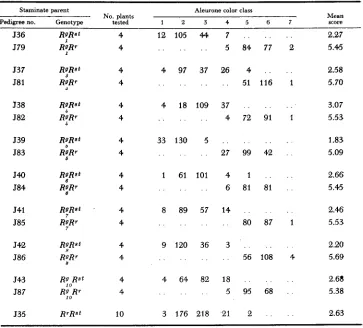
Frequency distributions and means of aleurone color scores for Rg'rgrg kernels from W23 r g f i Q
x
W22 R g R * t 8 matings in comparison with those of Rgx-grg kernels from W23 rgrg 0x W22 R r R g 8 matings. The bottom line of the table gives the corresponding ualues for the Rr'rgrg kernels from testcrosses of standard R r heterozy-
gous with R s t on W23 rgrg females
Staminate parent Aleurone color class
No. plants Mean
Pedigree no. Genotype tested 1 2 3 4 5 6 7 score
536
579
4 4
12105 44. 7 . . .
. _ _ . _ . 5 84 77 2
2.27 5.46
537
581
4 97 37 26 4 . . . .
. . . 51 116 1
2.58 5.70 4 4 J38 582 3.07 5.53 4 4
4 18 109 37 . . . .
. . , . , . 4 72 91 1
539
583
4 4
33 130 5 . . . .
. . . 27 99 42 . .
1.83 5.09 540 584 4 4
1 61 101 4 1 . .
. . . 6 81 81
2.66 5.45 541 585 4 4
8 89 57 14 . . . .
. . . 80 87 1
2.46 5.53
542 586
9 1 2 0 36 3 . .
_ _
. .. . . 56 108 4
2.20 5.69 4
4
4 64 82 18 . . . .
. . . 5 95 68
2.68 5.38 543 587 4 4
3 176 218 '21 2 2.63
1302 R . A. BRINK, et al.
approximately equal in number indicates, however, that this source of error is not important.
The data in Table 2 show that all, or nearly all, of the R3’ gametes produced by the eight groups of RgR& heterozygotes are markedly impaired in pigmenting potential. The paramutant and nonparamutant kernel classes overlap little or not at all in each of the paired distributions. This relation is even more evident when it is considered that the scoring method did not differentiate between kernels with phenotypes at opposite extremes of a single pigment class and, consequently, tends slightly to exaggerate the overlap.
The average pigmenting capacity of R3’ gametes from each set of RgRSt plants appears similar to that of R” gametes from RrRSt plants. The average scores for the eight groups of Rg’rgrg kernels in Table 2 is 2.47. This value is close to the mean score for the Rr’rgrg kernels, which was 2.63.
Testcrosses ( 4 ) r g r g P x R”Rp 8 and (5) r‘r” 0 x R’Rg’ d : The experimental
results just presented establish two facts that make the tests for locus dependence of the paramutant R phenotype, now to be discussed, decisive. The mutant Rg
alleles derived from standard R‘ are indistinguishable from the latter in ( a ) aleurone pigment-producing action when in standard form, and (b) paramutabil- ity in heterozygotes with stippled. Added to equivalence in these two essential respects is the further characteristic, upon which design of the experiments in question rests, that R3rg kernels yield green seedlings, whereas R‘rg kernels give red seedlings, thus permitting definitive separation of the two classes of seeds in segregating populations.
Testcrosses (4) and ( 5 ) involved R‘Rg plants as staminate parents, in which one, but not the other, of the two R alleles was derived from a stippled heterozy- gote in the previous generation, and thus was in the paramutant form. In test- cross (4) it is the Rr allele that has this history, whereas in testcross ( 5 ) , it is one or another of the mutant RQ factors that is derived from an RgRSt parent. The source of the other allele in the heterozygotes, in each case, was a stock culture.
The results expected from such testcrosses differ according to the assumptions made regarding the basis of the differences between the paramutant and non-
paramutant phenotypes. If paramutation does, in fact, involve a chromosomal change at or near the R locus, it is expected that two equally frequent phenotypic classes of testcross kernels would be observed, a lightly pigmented paramutant class carrying an R allele derived from a stippled heterozygote in the previous generation, and a more darkly pigmented class containing the nonparamutant
form of R characteristic of R R stock cultures. On the other hand, if the basis of paramutation is a regularly transmissible cytoplasmic element, the two classes of
testcross kernels containing R genes of paramutant origin and those containing R
genes of nonparamutant origin should display the same phenotype, because, as previously shown, R‘ and Rg normally are equivalent in aleurone pigment-pro- ducing action, and they react alike to the conditions under which the paramutant phenotype arises.
CHROMOSOMAL BASIS O F P A R A M U T A T I O N 1303 TABLE 3
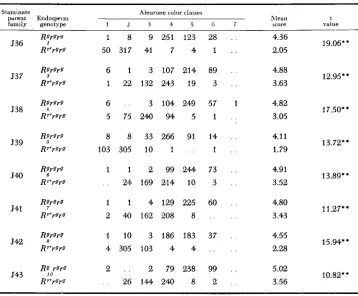
Frequency distributions and means of aleurone color scores for Rr'rgrg and Rgrgrg kernels f r o m mean represents the pooled tests of ten staminate plants
the cross W23 r g r g 9 x W22 RI'Rg 8 (ex. R'Rst x Rgrg). Each distribution and
Staminate Aleurone color classes
g a e n t Endospei m lLIean t
family genot,pe 1 . 2 3 4 5 0 7 score value
536
537
538
539
540
J41
542
543
1 8 9 251 123 28 . .
50 317 41 7 4 1 . . 6 1 3 107 214 89 . .
1 22 132 243 19 3 . .
6 . . 3 104 249 57 1 5 75 240 94 5 1 . .
8 8 3 3 2 6 6 91 14 . .
103 305 10 1 . . 1 . . 1 1 2 9 9 2 4 4 73 . .
. . 24 169 214 10 3 . .
1 1 4 129 225 60 . .
2 40 162 208 8 . . . .
1 10 3 186 183 37 . .
4 305 103 4 4 . . . .
2 . . 2 7 9 2 3 8 99 . .
. . 2 6 1 4 4 2 4 0 8 2 . _
4.36 2.05
4.88 3.63
4.82
3.05
4.11 1.79
4.91 3.52
4.80
3.43
4.55 2.28
5.02 3.56
19.06"
12.95**
17.50**
13.72**
13.89**
11.27**
15.94**
10.82**
'* Significant a t the 1 percent level.
mutants, although of independent origin, are indistinguishable in action, the ex- periment, in effect, is an eight-fold repetition of the same test. It will be seen from the table that the testcross kernels yielding green seedlings ( R g ) show higher mean scores for aleurone color throughout than do their counterparts giving red seedlings (R')
.
The difference is large in each case, and is very highly significant statistically. Thus, the capacity for reduced aleurone pigmentation of the test- cross kernels regularly follows the allele descended from the stippled heterozygote -in this case, the R' factor.1304 R. A. BRINK, et al. TABLE 4
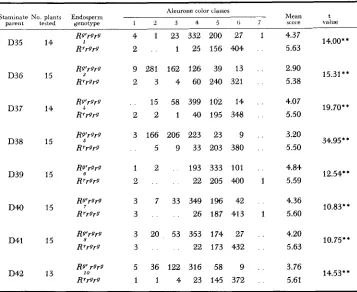
Frequency distributions and means of aleurone color scores for Rs'rgrg and Rrrgrg kernels from crosses of the type W23 r g r g 0 x W22 RrRg' 8' (ex. R g R s t X RrRr)
Aleurone color classes
Staminate No plants Endosperm Mean t
1 2 3 4 5 0 7 scoie value
parent teated genotype
D35 D36 D37 D38 D39 D40 D41 D42 14 15 14 15 15 15 15 13 4 1 2
9 281
2 3
15
2 2
3 166 5
1 2
2
3 7
3
3 20 3
5 36
1 1
23 332
1 25
162 126 4 60
58 399
1 40
206 223 9 33
193
22
33 349 26
53 353 22
122 316 4 23
200 156 39 240 102 195 23 203 333 205 196 187 174 173 58 145
27 1
404 . .
13 . .
321 . .
14 . .
348 . .
9 . .
380 . .
101 . .
400 1
42 . .
413 1
27 . .
432 . .
9 . . 372 .
4.37 5.63 2.90 5.38 4.07 5.50 3.20 5.50 4.84 5.59 4.36 5.60 4.20 5.63 3.76 5.61 14.00;; 15.31;'
19.70' *
34.95;;
12.54;;
10.83**
10.75;'
14.53;;
* * Significant at the 1 percent level.
scores for aleurone color than the kernels yielding green seedlings (Rg). Again, therefore, the capacity for reduced aleurone pigmentation follows the particular factor previously carried in a stippled heterozygote-in this instance, Rg.
It is apparent that, whereas Rr and Rg initially are equivalent in aleurone pig- ment-producing action and yield the same paramutant phenotype, they may be differentiated from each other regularly by passing either one through a hetero- zygote with stippled. Whatever the means by which the paramutant phenotype is mediated during development of the plant, these results show that the phenome-
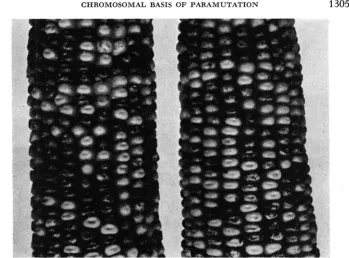
non rests upon a distinctive chromosomal condition at, or near, the R locus. The reversal of the relative pigmenting capacities of the R' and R g alleles, which results from reversal in the origins of the two alleles, is illustrated in the photo- graph in Figure 1, and the frequency polygons in Figure 2.
Testcross (6) r g r g 0
x
RrRr' 8' : One hundred thirty kernels from each testcrossCHROMOSOMAL BASIS O F P A R A M U T A T I O N 1305
FIGURE 1 .-Mendelian distributions of darkly mottled and weakly pigmented kernels on testcross ears from two different rgro 0 x RgRr$ matings, proving that the paramutant aleurone phenotype is R-locus dependent. Left: R; allele was derived from an R;Rat heterozygote, and Rr
came from an RrRr stock culture. The 50 percent of weakly pigmented kernels, on sprouting, yielded green seedlings (R;'), and the darkly colored kernels gave red seedlings (RI). Right: The
R: was derived from a stock RgRe culture, and Rr came from an RrRSt heterozygote. The 50 per-
cent weakly pigmented kernels, in this instance, gave red seedlings (Rp), whereas the darker kernels yielded green seedlings (R;). (Reproduced from the Quarterly Review of Biology with permission of the Editor).
5 5
TABLE 5
Frequency distributions for Rrrgrg and Rr'rgrg kernels on individual ears from crosses of W23 firg female with Rr'Rr male ( e x R W t
x
RrRr)Distribution of aleurone color scores
Mating 1 2 3 4 5 6 7
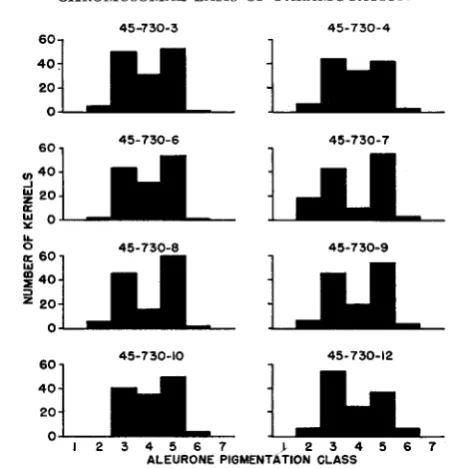
W23 X 45-730-3 . . 5 40 31 53 1 . .
-4 . . 7 44 34 42 3 . .
-6 . . 2 43 31 48 6 . .
-7 . . 19 43 10 55 3 . .
-8 . . 6 4 6 16 60 2 . .
-9 . . 7 4 6 20 53 4 . .
-10 . .
. .
41 35 50 4 . .1306 R . A. BRINK, et aL.
WRY 6 (035)
1
Rr'RY C (J36)
1
60
40 20
0
"im
20 1 2 3 4 5 6 7' 1 2 3 4 5 6 7
ALEURONE PIGMENTATION CLASS
e0 Rgrgrg (left), Rg'rgrg (right). I ir'rgrg Oeft),Rrrgrg (right)
FIGURE 2.-Percentages of kernels from the test matings rgrg 0 x Rr'Rg 8 (left) and r g r g 0 x R'Rg' 8 (right) in sevzn pigmentation classes. The staminate testcross parents are indicated above the histograms.
throughout, with the largest numbers of entries in the "3" and "5" color classes. This is the result expected if, in the R'R" stamhate parent, the
R'
allele derived from an R'R' stock culture is strong, and the R" allele, extracted from an R'RStheterozygote, is relatively weak, in aleurone pigment-producing action. Since both R' and R" condition red seedlings and their aleurone color effects overlap, the available data do not prove that this is the basis of the bimodality of the fre- quency distributions. By analogy with the results presented in the preceding section it may be inferred, however, that the reduction in pigment-producing ac- tion which R' is known to undergo in RrRst heterozygotes tends strongly to be maintained in the R'R" offspring from R'Rst x R'R' matings.
CHROMOSOMAL BASIS O F P A R A M U T A T I O N 1307
45-730-3 45-730-4
60
-
420 0 o I r
in-
45-730-10 45-730-12
1 2 3 4 5 6 7 L 2 3 4 5 6 7
ALEURONE PIGMENTATION CLASS
FIGURE 3.-Frequencies of R r r W and Rr’rgrg testcross kernels in seven pigmentation classes. The staminate testcross parents are indicated above the histograms.
TABLE 6
Mean aleurone color scores for Rrrgrg and Rgrgrg kernels from the crosses rgrg 0 X R’”’Rg 8
(ex. Rgrr
x
RrRmb) and rgrg 0x
RrRg”’ 8 (ex. R’R’ X RgRmb)Mating of No. ears R ’ r g r g Mean aleurone color scores kernels R g r g r g kernels
r g r g 0 x Rr’”Rg 8 (ex. Rgrr x WIZmb)
W22’X w535 4 4.56 6.25
x W536 4 4.23 6.03
x w537 4 4.14 6.15
rgro 0 x RrRg”’ 8 (ex. R‘R‘ x RgRmb)
W22 x W505 ( c ) 6 6.27 4.33
evidence for R-locus dependence of the R paramutant phenotype was obtained from experiments in which the paramutant alleles, R r f f ’ , or R g f r f , were derived from heterozygotes with the paramutagenic marbled ( R m b ) factor. The reversal plan described under testcrosses (4) and ( 5 ) was again used, whereby R‘ or Rg
was passed through an Rmb heterozygote and then tested for pigment-producing action in plants canying the contrasting allele (either Rg or R’) derived from a stock culture.
1308 R. A. BRINK, et al.
engendered in the heterozygote by marbled, as in the case of stippled also, is in- trachromosomal, and subsequently follows the R locus in inheritance.
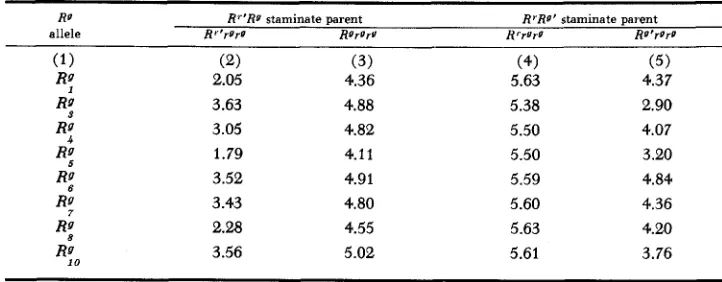
Table 7 is designed to bring together in convenient form the data from Tables 3 and 4 to which particular reference will be made in the Discussion.
Secondary processes influencing R action: Two secondary processes are known
to be operative in R'R9' and R"Rg plants which tend to moderate the distinctive effects of these pairs of alleles on aleurone pigmentation in testcrosses on rgrg 0 0 . The first of these processes has been termed reversion (BRINK 1958a). Following extraction in paramutant form from RrRst or R'Rmb plants, R" reverts partially toward the level of pigment-producing action characteristics of standard R'. NO
genotype has yet been found (aside from those carrying R a t , Rmb, or other para- mutagenic allele) in which such partial reversion does not occur. The amount of reversion is variable, but in no established case has the full action of standard
R
'
been regained.The other secondary process was first noted during the course of the present in- vestigation, and involves an aspect of paramutation that will be dealt with in de- tail in a subsequent paper. It is found that in RrRst plants not only is the R' factor reduced in pigment-producing potential but it also becomes paramutagenic, al- though only weakly so, as compared with R a t .
Both these processes would be expected to reduce the difference in aleurone pigment-producing potential of the paired factors in R'RO' and R"R0 plants. Partial reversion would result in shifts toward the standard level of action of the paramutant Rg'and R" alleles; and the secondary paramutation promoted by R9'
and R" would weaken somewhat the effect on aleurone color of their respective
R' and Rg mates. Since the two processes are convergent in their effects, there would be a tendency for both alleles in RrRg' and R"R0 heterozygotes to change in the direction of a common level of pigment-producing action.
The significance of these facts in the present connection is that, although the secondary processes in question are operative in testcrosses on rgfl 0 0 of R'RO'
TAaBLE 7
Mean aleurone color scores for Rrrg.g% and Rgrgrg kernels from outcrosses of W22 Rr'Rg males (ex. RrRst x Rgrg) and W22 RrRg' males (ez. RrRst X RrRr) on W23 rgrg females
RI R"Rg staminate parent R'Rg' staminate parent
allele Rr'rorr ROrgru H r r u r g Ro'rW
4
R:
(2) 2.05
3.63 3.05
1.79 3.52
3.43 2.28
3.56
(3) 4.36 4.88
4.82 4.11
4.91 4.80
4.55 5.02
(4) 5.63
5.38 5.50
5.50 5.59
5.60 5.63
5.61
(5) 4.37 2.90
4.07
3.20 4.84
4.36 4.20
CHROMOSOMAL BASIS OF P A R A M U T A T I O N 1309 and R"Rg plants, they do not override the basic difference in aleurone color de- termining action of the paired factors in either case. Or, to state the point in an- other way, the residual difference between the two alleles derived from RrRQ' and
Rr'Rg heterozygotes is still large enough to be readily demonstrable in testcrosses on rgl-8 9 9 , as the data in Tables 3 and 4 show. There is little doubt, however, that much of the overlapping in the aleurone color scores of the "red seedling" and "green seedling" classes of testcross kernels in such cases is attributable to partial reversion of the paramutant allele plus secondary paramutation of the other factor.
DISCUSSION
The initial observations on the reduced pigment-producing action of the R'
allele in maize following passage of R' through a heterozygote with stippled cre- ated a strong presumption in favor of the view that the genetic basis of the pheno- typic change was intrachromosQma1 (BRINK 1956). An explanation of the phe- nomenon in terms of a self-reproducing cytoplasmic element appeared improb- able on the grounds that both male and female R' gametes produced by R'Rst
plants invariably determined weakly colored kernels, when appropriately tested. Pollen transmission of a plasmid had not been observed in maize in any previous instance; and in no other Angiosperm had it been found that even a majority, not to say all, of the offspring could acquire an element of this kind from a potential donor through the male gametophyte. Furthermore, it was demonstrated that color of the RrRStRst kernels from RstRst 9 x RrRr 8 crosses was not depressed below the level expected to result from the action of normally functioning Rst and
R' alleles, even though R+'RStRSt seeds from RntRst 9 X R'Rst 8 matings clearly showed reduced pigmentation. This fact precluded stippled cytoplasm, per se, as the basis of the paramutant R' phenotype.
Positive evidence to exclude an autonomous cytoplasmic element as the genetic basis of the phenomenon was obtained from the following experiment (BRINK
1958a). R'R' plants were pollinated by R"r' individuals, and the resulting two classes of offspring, R*Rst and R r ' , were then testcrossed on rrrr 9 9 . The R'
gametes from the R+Rgt plants only were found to determine the paramutant phenotype. The R' gametes produced by the R'r' sibs proved to be unchanged in aleurone color potential. This, of course, is not the result expected if an autono- mous, pollen transmisslble, cytoplasmic element conditions the reduced color ex- pression of R'.
Testcrosses on flrg 9 9 of R'R" plants, derived from R R s t x R'R' matings, had disclosed also that two about equally frequent classes of kernels differing in grade of aleurone mottling often resulted. These seemingly Mendelian distributions were in accord with the view that the paramutant phenotype was R-locus depend-
1310 R. A. BRINK, et al.
matings in terms of aleurone color grade, the amount of overlap between the two presumed phenotypes was great enough on occasional ears to render a n estimate of relative frequencies meaningless. Reversion of R" toward the level of action characteristic of standard R', in RrRr' plants, was recognized as a factor probably contributing to the overlap in the Rr and R" phenotypes; but this circumstance alone appeared insufficient to account for the intergradation in color intensity among the kernels on testcross ears showing the greatest overlap. It was not known at the time the first experiments with R'R?' plants were made that a second factor, namely, paramutagenicity of Rr', also was operative in R'R" heterozygotes in reducing the difference in pigment-producing potential of the two alleles. Until paramutation at this secondary level was established, it was not possible to ex- plain satisfactorily why about 50 percent of the kernels resulting from r g r g ? X
R'R" 8 testcrosses were not of the rather uniform darkly mottled phenotype ob- tained in r g r g ? x standard R'R' 8 matings, and so distinguishable, in most in- stances at least, from the equally frequent Rr'rgrg sib seeds, even after allowance was made for partial reversion of R" toward the R' level of action.
The foregoing considerations made it apparent that a critical test of the hypoth- esis that, in an R R plant derived from an R RSt x R R cross the R allele with a history of heterozygosity for stippled in the preceding generation is weaker in aleurone pigment-producing potential than its R mate derived from a stock cul- ture requires, in the first instance, that the two respective R factors be identifiable in the progeny as to origin. This condition was met in the present experiments by the use of a series of Rg mutants from W22 standard Rr, distinguishable with cer- tainty in the early seedling stage by their differential effect on anthocyanin pig- mentation. All the Rg mutants used were found to be indistinguishable in stand- ard form from R' in aleurone pigmentation, and all proved to be highly paramut- able in heterozygotes with stippled (RgR").
Two minor sources of error attending the use of such Rg factors in rgrg 0 x
CHROMOSOMAL BASIS O F P A R A M U T A T I O N 1311
The principal body of new experimental data relating to R-locus dependence of the paramutant phenotype are summarized in Table 7. Reference to columns 2 and 3 in the table shows that following r g r g 0 x Rr'Rg 8 testcrosses, involving eight Rg mutants from R', the kernels yielding red seedlings are more weakly pig- mented, on the average, than those giving green seedlings. As previously stated, the difference is statistically significant in each of the eight comparisons. Thus the R'
allele, on being passed through a heterozygote with Rst in the previous generation, and then paired with Rg from a stock culture, in an Rr'R9 plant, is reduced in aleurone pigment-producing potential, relative to Rg, to which it is equivalent in this respect when in standard form.
The results obtained when the origin of R' and Rg are reversed, as between a heterozygous stippled parent and a stock culture, are shown in columns 4 and 5
in Table 7. The 50 percent of kernels which yielded green seedlings were found to be significantly inferior in pigmentation, in each of the eight comparisons, in this case, to those giving red seedlings. Again, therefore, it is the allele in the R'Rg
staminate parent derived from the heterozygote with stippled that is the weaker
in pigment-producing action in the testcross kernels.
It is evident from these data that reversing the origin of Rr and Rg as between a stock culture plant and a stippled heterozygote correspondingly reverses the order in which R7 and Rg stand in level of aleurone pigment determination. R'
and Rg as carried in stock cultures, are equivalent in aleurone pigment-producing action. Both are changed to weakly acting, paramutant forms in heterozygotes with stippled. The testcross data reviewed show that, following such change, each persists through the next generation in differentiated form in the common C ~ O - plasm of a plant carrying, as a control, the oppositely marked factor, either R' or
Rg, derived from a stock culture. The results of parallel tests with paramutant R'
and Rg alleles derived from heterozygotes with marbled are in agreement with these findings. Partial reversion of the paramutant allele toward the normal form and secondary paramutation of the normal allele, in R"R0 and R'RO' heterozy- gotes, reduces but does not obliterate the difference in action between the paired factors.
It is noteworthy that partial reversion and secondary paramutation, operating at somewhat more intensive levels than those encountered, could have rendered impossible the demonstration of R locus dependence of the paramutant phenotype b y the procedure followed in the present experiments.
S U M MARY
1312 R. A. BRINK, et al.
R"Rg and R'Rg' plants representing eight independent Rg mutants were con-
structed from matings of the types RrRgt ? x Rgrg 6 and RgRst ? x RrRr $, re- pectively, and testcrossed on rgrg 0 ? . The testcross kernels were scored by a ker- nel matching procedure, and then separated definitively into Rr'rgrg and Rgrgrg
or Rg'rgrg and R'rgrg classes by the seedling test. The ability to separate Rrrg and
Rgrg sibs on the basis of seedling color was an essential feature in the design of the
experiments. The results showed that the paramutant phenotype followed the allele previously paired in heterozygotes with R S t , and the more darkly pigmented phenotype followed the allele derived from a stock culture. When R"Rr plants from the mating RrRst x R'R' were testcrossed, a bimodal distribution of aleurone phenotypes resulted, in agreement with the expectation on the basis of R-locus dependence of paramutation. The results obtained when Rmb was substituted for
RSt as the paramutagenic allele in heterozygotes with R' or Rg were confirmatory.
ACKNOWLEDGMENTS
This study was aided by grants from the Research Committee of the Graduate School, University of Wisconsin, of funds supplied by the Wisconsin Alumni Re- search Foundation, and by grants from the National Science Foundation.
LITERATURE CITED
BRINK, R. A., 1956 A genetic change associated with the R locus in maize which is directed and
Paramutation at the R locus in maize. Cold Spring Harbor Symposia Quant. Biol. 23:
Basis of a genetic change which invariably occurs in certain maize heterozygotes.
Plant color effects of certain anomalous forms of the R7
potentially reversible. Genetics 41 : 872-899.
379-391.
Science 127: 1182-1183.
allele in maize. Z. Ind. Abst. Vererb. 89 : 94-102.
for marbled aleurone. Proc. Natl. Acad. Sci. U.S. 43: 1053-1060. 1958a
1958b
BRINK, R. A., and B. MIKULA, 1958