To Control Effects of Air Pollution Using
Roadside Trees
Archana R. Mate
1, Dr. Ratnadeep R. Deshmukh
2P.G. Student, Department of Computer Science and Information Technology, Dr. Babasaheb AmbedkarMarathwada
University, Aurangabad, Maharashtra, India1
Professor and Head, Department of Computer Science and Information Technology,Dr. Babasaheb Ambedkar
Marathwada University, Aurangabad, Maharashtra, India2
ABSTRACT:Pollution is one of the serious problem in the world. There are different types of pollution. Pollution affects on Environment Degradation, Human Health, Global Warming, Ozone Layer Depletion, and Infertile Land. Vehicles are one of the main causes of air pollution. It is known fact that 60 % of air pollution in metro city is caused by automobilesonly. Vehicles releases Particular matter (PM), Hydrocarbons (HC), Nitrogen oxides (NOx), Carbon
monoxide (CO), Sulphur dioxide (SO2), Toxics, Greenhouse gases into the air. The effect of these pollutants is
observed on plants which are considers for investigation of effect of auto exhaust pollutants on road side trees. Plants are one of the natural solution to reduce air pollution.
This Paper states work that is done on different trees at different places for analyse the effects of air pollution on tree leaves. The all author is used air pollution tolerance index (APTI) method to measure plants responses towards air pollution. The four properties of leaves are considered namely ascorbic acid content, relative water content, total chlorophyll content and leaf extract pH for determine APTI value. Also study shows APTI value of same plants is vary according to area which is polluted or control area and seasons.
KEYWORDS:Air Pollution Tolerance Index (APTI), Ascorbic acid, Leaf extract pH, Relative water, Total chlorophyll.
I. INTRODUCTION
Air pollution is a most important problem in the world. Urban air often contains high levels of pollution that are harmful to human health and wellbeing. The main cause of increase the level of air pollution is increasing population, urbanization and industrialization. Rapid industrialization and vehicular traffic adds toxic gases and other substances to the atmosphere. The degradation of air quality is major environmental problem that affects many urban and industrial sites and the surrounding regions worldwide and the India is one of this. There are various solutions have been done for reduce or avoid pollution.
Various strategies exist for controlling atmospheric pollution but vegetation provides one of the best natural way of cleaning the atmosphere. Plants not only helps in attenuation of air pollution but also in noise pollution reduction, controlling soil erosion and enhancing the aesthetic beauty of the area. Air pollutants effect plant growth adversely. By monitoring plants tolerance toward air pollution they can be screened and can be employed as biological indicator or monitors of air pollution. Then they can be used effectively by planners and green belt developers in managing the urban air pollution.
II. RELATEDWORK
From all over the world many people have studied for controlling air pollution. Four leave properties namely; leaf extract pH, ascorbic acid, total chlorophyll and relative water content, were combined together in a formulation signifying the Air pollution tolerance index (APTI) of plants.
In Coimbatore (Tamilnadu) R. Karthiyayini et al. were determined APTI value of 27 plants which was growing adjacent to Coimbatore-Ooty highways. After determining APTI value of plants, this is used as bio indicators and grown as accumulator [1]. In Varanasi (Uttar Pradesh) A. K. Dwivedi and B. D. Tripathi was evaluated APTI value to categories plants as sensitive or resistant with respect to air pollutants [2].
In Delta state (Nigeria), Agbaire P.O. and Esiefarienrhe E. were determined air pollution tolerance indices (APTI) of six plant species around Otorogun gas plant in Ughelli-South Local Government Area of Delta State [3]. In Moradabad, Anamika Tripathi et al. were determined APTI value to see the relative tolerance of the plant species ten different plant species was taken from residential, industrial, and commercial area of the city. This study shown that Brass and allied industrial are the prominent sources responsible for the elevated level of air pollutants at the industrial site [4].
Also same study had done by P. O. Agbaire around the Erhoike-Kokori oil exploration station of Delta state on 10 plant species [5]. In Rourkela Susmita DasandPramila Prasad were used 20 trees to study Seasonal variation in air pollution tolerance indices and selection of plant species for industrial areas. The result of this analysis shown that APTI value of plant did not significantly change during the sample seasons that is summer, rainy and winter seasons. In winter season some plant exhibited their highest APTI value but some plant exhibited their highest APTI value in summer season [6]. In Thiruvananthapuram (Kerala) S. Jissy Jyothi and D.S. Jaya also studied for find out the air pollution tolerance as well as sensitivity of the plant species during different seasons. For this purpose APTI method was used [7]. In South Bengalure, Abida Begum and S. Harikrishna were evaluated some trees for absorb air pollutants in three industrial locations. This study indicated that the air pollution was maximum in Jigani industrial area and minimum in Electronic city [8].
In Allahabad city, Mohammed Kuddus et al. were determined APTI value of seven plants for check susceptibility level of plants to air pollutants [9]. In Indore city, Chouhan Aarti et al. were evaluated APTI value of six plants which are growing in Pithampur Industrial area sector 1, 2 and 3. This work had done for growing green plants in and around industries and control air pollution in industrial area [10].In Virudhunagar (Tamilnadu) phytomonitoring of atmospheric pollution in a dry tropical environment usingperennial trees is done by Sarala Thambavani D. and Maheswari J [11]. In Udaipur (Rajasthan), G.S. Mahecha et al. was evaluated the APTI value of plants for selecting plants for plantation. The plant species having higher APTI value was used for plantation program in urbanize and industrial areas [12]. In Nigeria Tanee et al. were used 10 plants which were growing aroundUmuebulu Gas Flare Station in Rivers State. The samples were collected from vicinity of gas station. From selected plant Psidium guajava was the most tolerant species while Ocimumgratissimum as the most sensitive species to air pollution stress [13].In Esfahan city (Iran), A. Abed Esfahani et al. was assessed Air Pollution Tolerance Index of HigherPlants for Green Belt Development. This study was evaluated the tolerance level of higher plants and select plant for green belt which have highest APTI value [14]. By using the APTI value comparative study was done by Prabhat Kumar Rai et al. on six common road side plants which are collected from industrial (Rourkela) andnon-industrial area (Aizawl) [15].
In Baroda city, Tanushree Bhattacharya et al. was studied Seasonal Variation in Air Pollution Tolerance Index of Various Plant Species. The six plant samples are collected from 9 sites in three different seasons. Chlorophyll value of all plant was highest during monsoon season & decreased in winter and summer. This study shown higher leaf relative water content in all the species was in monsoon season. Whereas the higher average ascorbic acid concentration was found in winter season followed by summer and least in monsoon [16]. In Yammuna Nagar, Manju Sharma et al were calculatedAir pollution tolerance index (APTI) for ten plant species growing in different industrial areas (Paper mill, Sugar mill, Thermal Power Plant) and Yamuna River belt of Yamuna Nagar. In this analysis out of ten plant species only Ficus benghalensis) shown moderately tolerant response in all selected sites, while other species showed sensitive response [17].
Khureshi. S.G.Dwas collected 8 plants from highly polluted road side area and residential colony. The APTI value of plants is evaluated to find the tolerance level towards air pollutants [19].
In Periyar university (Salem) the study had done by Krishna Veni et al. for assess the air pollution tolerance index of plant. There were 12 plant are selected for study. The samples are collected from near road sides of railway junction and from residential area. The APTI values of plant ranges from 02.29 to 12.53 were found to be sensitive to pollution [20]. In Annamalainagar (Tamilnadu) air pollution tolerance index of some terrestrial plants around anindustrial area was calculated by S. Agrawal and S. L. Tiwarito evaluate the sensitivity/tolerance level of plants to air pollutants, ten parameters namely leaf extract pH, Relative Water Content, Ascorbic acid, Chlorophyll, protein, amino acid, reducing sugar, starch and phenol were determined and computed together in a formulation signifying the Air Pollution Tolerance Index (APTI) of Eleven frequently grown plant species around Neyveli Lignite CorporationLimited (NLC) area [21]. Also in Anand city (Uttrakhand), Mitul Kotecha et al. were determined Air pollution tolerance index (APTI) to select plant species tolerant to air pollution. Also this comparative study understands the effect of air pollution on vegetation composition in disturbed and undisturbed community investigated based on Importance Value Index (IVI) [22].
In Indore city (Madyapradesh) the work done by Rajesh Kumar Pathak et al. for analyses the effects of air pollution on roadside plants due to vehicularemission. The sample taken from two places one from Industrial area pologround which is more polluted and another from college campus which is less polluted. The two plants were selected for study Bouganvillia spectabili and Delbergia sisoo which are dominated on road side. The result of this analysis was the leaves of more polluted site recorded reduction in chlorophyll content in the leaves of plant due to probably emission of SO2
and NO2 and other gases in the air [23].
Also in Gujarat APTI value of five plants was evaluated by Dileswar Nayak et al. to develop the usefulness of plants as bio indicator. The samples are collected around city area and Navsari Agricultural University campus (Control). Plants with high APTI can serve as tolerant and low APTI value serve as sensitive species for air pollution bio monitor which is helpful for development of green environments [24]. In Varanasi, Ashutosh Kumar Pandey a. et al. evaluated APTI value of plants to develop urban forest. There were 29 plant species are used for analysis. The two tool air pollution tolerance index (APTI) and anticipated performance index (API) were used for select tolerant plant [25].
III.METHODOLOGY
The air pollution tolerance index (APTI) is used to identify the tolerance of air pollutants. The four major properties of leaves namely ascorbic acid content, relative water content, total chlorophyll content and leaf extract pH content was used to calculate air pollution tolerance index.
APTI = [A (T + P) + R] / 10
Where
A =Ascorbic acid content (mg/g) T = Total chlorophyll mg/g P = pH of leaf extract
R = Relative water content of leaf %
IV.RESULT ANDDISCUSSION
the lowest score (3.898751) for APTI with a pH of 6.08, chlorophyll content of 0.4357mg/gm, 38.88% Relative Water Content and 0.0165mg/gm of ascorbic acid so it is more sensitive tree to air pollution [12].
Prabhat Kumar Rai et al. states thatAPTI value of same tree change according to area of air pollution. The Ficus bengalensis, Mangiferaindica, Bougainvillea spectabilis, Psidium guajava,Hibiscus rosa-sinensis and Lantana camara trees samples are collected from industrial area and non-industrial area and table 1 shows APTI values of trees which is from Rourkela (Industrial area) and Aizawl (Non-industrial area). In Industrial areaHibiscus rosa-sinensis is more tolerant to air pollution and Bougainvillea spectabilis is more sensitive to air pollution. In Non-industrial area Mangifera indica is more tolerant to air pollution and Lantana camarais more sensitive to air pollution. Also it states that Rourkela area is more polluted than Aizawl area [15].
Table 1. APTI value of trees selected from Rourkela (Industrial area) and Aizawl (Non-industrial area)
Plant species APTI Value
Rourkela Aizawl
Ficus bengalensis 8.64 6.3
Psidium guajava 9 6
Bougainvillea spectabilis 7.72 6.94
Mangifera indica 8.98 7.95
Lantana camara 8.11 5.95
Hibiscus rosa-sinensis 9.35 7.43
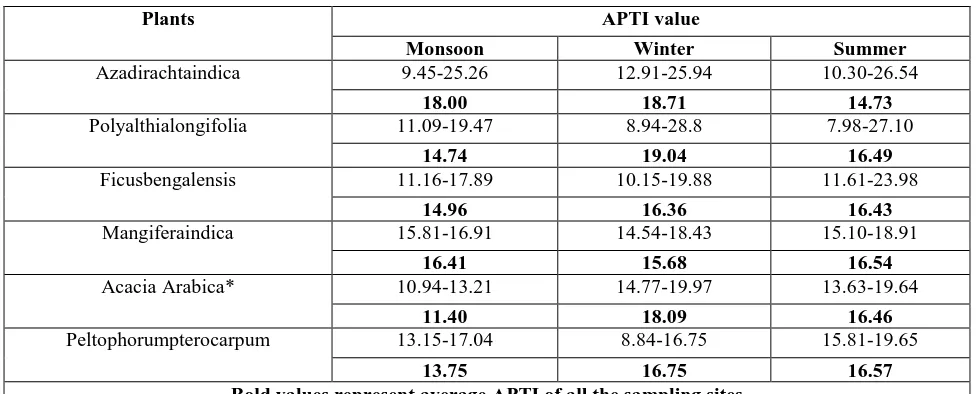
The effects of air pollution on trees which are vary according to seasons. Tanushree Bhattacharya et al. Determine APTI value of Azadirachta indica, Polyalthia longifolia, Ficus bengalensis, Mangifera indica, Acacia arabica & Peltophorum pterocarpum in three different seasons Monsoon, Winter& Summer from different 9 sites. The result is shown in table 2. The result shows that according to average value of APTI Azadirachtaindica is more tolerant and Acacia Arabica is more sensitive to air pollution in monsoon season, Polyalthialongifolia is more tolerant and Mangiferaindica is more sensitive to air pollution in winter season, Peltophorumpterocarpum is more tolerant and Azadirachtaindica is more sensitive to air pollution in summer season [16].
Table 2. APTI value of trees in different seasons.
Plants APTI value
Monsoon Winter Summer
Azadirachtaindica 9.45-25.26 12.91-25.94 10.30-26.54
18.00 18.71 14.73
Polyalthialongifolia 11.09-19.47 8.94-28.8 7.98-27.10
14.74 19.04 16.49
Ficusbengalensis 11.16-17.89 10.15-19.88 11.61-23.98
14.96 16.36 16.43
Mangiferaindica 15.81-16.91 14.54-18.43 15.10-18.91
16.41 15.68 16.54
Acacia Arabica* 10.94-13.21 14.77-19.97 13.63-19.64
11.40 18.09 16.46
Peltophorumpterocarpum 13.15-17.04 8.84-16.75 15.81-19.65
13.75 16.75 16.57
The plants having higher APTI value which is more tolerant to pollution and give priority for plantation program in urbanize and industrial areas; so as to reduce the effects of air pollution and make ambient atmosphere clean and healthy.
V. CONCLUSION
It is concluded that this study is most important, useful for the better understanding, controlling and management of air quality. It is also useful for selection of suitable plant species for plantation in highly polluted industrial areas, road side areas to reduce the air pollution. The use of plants, as bio indicators is inexpensive and easy technique. The air pollution threatening the environment because is rapidly increased industrialization, unplanned urbanization, danger of deforestation and due to this determination of APTI is important. The trees having higher APTI value is more tolerant to air pollution and the trees having lower APTI value is more sensitive to air pollution. The tress having a high APTI score has a low acidic pH in their leaves with a high chlorophyll content and maximum relative water content.
REFERENCES
[1] R. Karthiyayini, N. R. Ponnammal and Ragina Joseph, “Air Pollution Tollerance Index of certain plants of Coimbatore-Ooty Highways, Near
I.I.T. area, Coimbatore, Tamilnadu “, Poll Res., vol. 24(4), pp. 801-803, 2005.
[2] A. K. Dwivedi and B. D. Tripathi, “Pollution Tolerance and Distribution Pattern of Plants in surrounding area of Coal-Fired Industries”,
Journal of Environmental Biology, vol. 28(2), pp. 257-263, 2007.
[3] Agbaire P.O. and Esiefarienrhe E., “Air Pollution Tolerance Indices (APTI) of some plants around Otorogun Gas Plant in Delta State, Nigeria.”, J. Appl. Sci. Environ. Manage. , vol. 13(1), pp. 11 – 14, 2009.
[4] Anamika Tripathi, P.B. Tiwari, Mahima and Dharmveer Singh, “Assessment of Air Pollution Tolerance Index of some trees in Moradabad City,
India”, Journal of Environmental Biology, vol. 30(4), pp. 545-550, 2009.
[5] P. O. Agbaire , “Air Pollution Tolerance Indices (APTI) of some plants around Erhoike-Kokori oil exploration site of Delta State, Nigeria”,
International Journal of Physical Sciences, vol. 4(6), pp. 366-368, 2009.
[6] Susmita DasandPramila Prasad, “Seasonal Variation in Air Pollution Tolerance Indices and selection of plant species for industrial areas of Rourkela”, Indian Journal of Environmental Protection, vol. 30(12), pp. 978-988, 2010.
[7] S. Jissy Jyothi and D.S. Jaya, “Evaluation of Air Pollution Tolerance Index of selected plant species along Roadsides in Thiruvananthapuram,
Kerala”, Journal of Environmental Biology, vol. 31, pp. 379-386, 2010.
[8] Abida Begum and S. Harikrishna, “Evaluation of some Tree Species to absorb Air Pollutants in three industrial locations of South Bengaluru,
India”, E-Journal of Chemistry, vol. 7(S1), pp. S151-S156, 2010.
[9] Mohammed Kuddus, RashmiKumariandPramod W. Ramteke, “Studies on Air Pollution Tolerance of selected plants inAllahabad City, India”,
Journal of Environmental Research and Management, vol. 2(3), pp. 042-046, 2011.
[10] ChouhanAarti, IqbalSanjeeda, Maheshwari R.S. andBafna A., “Study of Air Pollution Tolerance Index of plants growing inPithampur
Industrial Area sector 1, 2 and 3”, Research Journal of Recent Sciences, vol. 1, pp. 172-177, 2012.
[11] SaralaThambavani D. andMaheswari J, “Phytomonitoring of Atmospheric Pollution in a dry tropical environment usingPerennial trees”, Asian
Journal Of Science And Technology, vol. 2, pp. 011-016, 2012.
[12] G.S. Mahecha, B.R. Bamniya, Neelima Nair andDhavanSaini , “Air Pollution Tolerance Index of certain plantspecies-A Study of Madri
Industrial Area,Udaipur (Raj.), India”, International Journal of Innovative Research in Science,Engineering and Technology, vol. 2(12), pp. 7927-7929, 2013.
[13] Tanee , F.B.G. and Albert, E., “Air Pollution Tolerance Indices of Plants growing aroundUmuebulu Gas Flare Station in Rivers State, Nigeria”,
African Journal of Environmental Science and Technology, vol. 7(1), pp. 1-8, 2013.
[14] A. Abed Esfahani, H. Amini, N. Samadi, S. Kar, M. Hoodaji, M. Shirvani and K. Porsakhi , “Assesment of Air Pollution Tolerance Index of
HigherPlants Suitable for Green Belt Development in Eastof Esfahan City, Iran”, Journal of Ornamental and Horticultural Plants, vol. 3(2), pp. 87-94, 2013.
[15] Prabhat Kumar Rai, Lalita L. S. Panda, BikuMoniChutia and M. Muni Singh, “Comparative Assessment of Air Pollution ToleranceIndex
(APTI) in the Industrial (Rourkela) andNon Industrial Area (Aizawl) of India: An Ecomanagement Approach”, African Journal of Environmental Science andTechnology, vol. 7(10), pp. 944-948, 2013.
[16] Tanushree Bhattacharya, LeenaKriplani andSukalyanChakraborty, “Seasonal Variation in Air Pollution Tolerance Index of various Plant
Species of Baroda City”, Universal Journal of Environmental Research and Technology, vol. 3(2), pp. 199-208, 2013.
[17] Manju Sharma, NeerajPanwar, PoojaArora, JyotiLuhach and SmitaChaudhry, “Analysis of Biological Factors for determination of Air
Pollution Tolerance Index of Selected Plants in Yamuna Nagar, India”, Journal of Environmental Biology, vol. 34(3), pp. 509-514, 2013. [18] G. Buchchi Babu, S. NazaneenParveen, K. Naveen Kumar and M. Sridhar Reddy, “Evaluation of Air Pollution Tolerance Indices of Plant
Species growing in theVicinity of Cement Industry and Yogi Vemana University Campus”, Indian Journal of Advances in Chemical Science, vol. 2(1), pp. 16-20, 2013.
[19] Khureshi. S.G.D, “Air Pollution Tolerance Indices (APTI) of Some Plants aroundPonnur, Guntur(Dt)”, International Journal of Engineering
Research & Technology, vol. 2(10), 2366-2375, 2013.
[20] Krishna Veni, Marimuthu andLavanya K, “Air Pollution Tolerance Index of Plants A Comparative Study”, International Journal of Pharmacy
[21] S. Agrawaland S. L. Tiwari, “Air Pollution Tolerance Index of Some Terrestrial Plants around anIndustrial Area”, International Journal of Modern Research and Review, vol. 2(1), pp. 1-7, 2014.
[22] MitulKotecha, KasturiNaikandLeena Abraham, “Study of Air Pollution Tolerance Index (APTI) andDistribution Pattern by using Importance
Value Index (IVI)of Plants in Disturbed and Undisturbed Locality aroundAnand City (India)”, Carpathian Journal of Earth and Environmental Sciences, vol. 9(1), pp. 163-169, 2014.
[23] Rajesh Kumar Pathak, ChhayaTomar, NeelumalviyaandSarojMahajan, “Phytomonitoring of Atmospheric Pollution in road side Perennial
Trees of Indore City (M.P.)India”, An International Journal of Advances in Engineering & Technology, vol. 7(6), pp. 1727-1734, 2015.
[24] DileswarNayak, D.P. Patel, H.S. Thakare, K. Satashiya and P.K. Shrivastava, “Evaluation of Air Pollution Tolerance Index of Trees”, Research
In Environment And Life Sciences, vol. 8(1), pp. 7-10, 2015.
[25] Ashutosh Kumar Pandey a, MayankPandey a, Ashutosh Mishra a, Ssiddhant Mohan Tiwary b and B.D. Tripathi b, “Air Pollution Tolerance