Characterization of Dispersive Soils- A
Comparative Evaluation between Available
Tests
Neetu singh
1, Sameer Vyas
2, R.Chitra
3, Beena Anand
4Central Soil and Materials Research Station, Olof Palme Marg, Hau zkhas, Ne w De lhi, India1,2,3,4
ABSTRACT: Dispersive soils which occur in many parts of the world a re easily e rodible and deflocculated in water causing serious problems of stability of earth and earth retaining structures.Earth dams constructed on dispersive soils have suffered internal and surface erosion. The erosion features such as rill and gully ma rks, channels, internal cavities and tunnels with in the soil mass have been observed in natural slopes of dispersive soils. The failure of slopes due to dispersion of clay partic les by seepage water a long cracks, fissures and root holes are in itiated by e rosion of soil. Thus the failu re in itiated by piping ma kes the embankments constructed on dispersive soil susceptible.
The mechanis m of d ispersivity of soils is reasonably well understood. However there is no single method to identify the dispersive soil there fore in absence of proper diag nostic criteria it is difficu lt to differentiate between d ispersive soil and ordinary erodible soils. The available test methods for dispersive soils are Cru mb Test, Pinhole test,SCS double hydrometer and chemica l analysis of pore water e xt ract. Th is p aper deals with the best possible evaluation of test methods for confirming and characterizing the dispersive soils. The role of surface chemistry responsible for dispersivity is further understood with the he lp of Sodiu m absorption ratio ( SA R) and minera logical e xa mination with X-ray differacto meter ( XRD). The rationale of using the methods and correlation between the dispersivity determined by various methods has been expla ined.
KEYWORDS
:
Dispersive soil, Colloida l erosion, Deflocculation, Dispersivity testsI. IN TRO DUC TION
Dispersive soils are highly susceptible to erosion and piping phenomenon and undergo deflocculation in the presence of flowing water[1]. It rapidly e rode forming tunnels and deep gullies by a process in which the individual clay particles go into suspension in slow-moving water (co llo idal e rosion), damag ing earth dams, canals, and other hydraulic structures [2].
the failure in itiated by piping makes the embankments constructed on dispersive soil susceptible . Dispersive piping in dams has occurred either on the first reservoir filling or, less frequently, after ra ising the reservoir to highest level.
Fig.1 Showing negatively charge d clay particle with adsorbe d sodium counter ions.
The tendency for dispersive erosion in a given soil alsodepends on variables such as mineralogy and chemistry of the clay, as we ll as dissolved salts in the water in soil pores and in the eroding water.
The dispersive mechanis m have been reported by various researchers such as Sherardet al., [2], He inzen and Arulalandan [4], Ho lmgren and Flanagan [5]. Many slope and earth dam fa ilures, foundation and pavement failures have been observed in these types of soils.
Mechanism of Cl ay Dis persion:
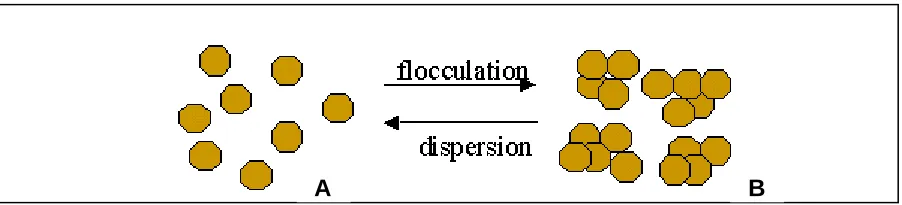
Clay particles are negatively charged as the result of isomorphous substitution or broken edges so they naturally repel each other (like charges repel). However, the presence of adsorbed cations tends to mask this negative charge (re pulsion) to varying degrees, depending on the type of cation. Sma ll mul ti-charge d c ati ons (i.e., Al+3, Ca+2, Mg+2) are strongly adsorbed by colloids (unlike charges attract), greatly reducing the negative charge. If the negative charge of the colloid is sufficiently reduced, flocculation will occur as represented shown in Figure 2B. If, on the other hand, the colloids are saturated with large we akly charge d c ati ons (i.e. Na+, K+), d ispersion will occur as represented in Figure 2A. Sodiu m, a wea kly charged cation that encourages dispersion and calciu m, a mult i-charged cation that encourages flocculation, provide an exa mp le of the intricate re lationship between soil che mistry and the physical condition of a soil. The importance of the physical condition and the influence of sodium, creates the situation where knowing the concentration of this cation in a soil is essential.
Figure 2: Soil Particles in a Disperse d and Flocculated Condition
The flocculation and dispersion reactions are the result of cation exchange. Cat ion exchange is the interaction between a cation in solution and another cation on the surface of any surface-active materia l , such as clay or organic matter The cation e xchange that occurs between sodium and calciu m on clay minera l surfaces.
Diffuse double layers
Clay part icles some t imes behave as a colloida l part icles in suspension. The diffuse double layer occurs at the interface between the clay surface and the soil solution. It is made up of the permanent negative charge of the clay and the
cations or counter-ions in the soil solution that balance the negative charge.When the electrical diffused double layers of the two clay partic les carry ing similar outer charge co me c lose to each other , they repel due to e lectro static repulsion and thus initiated colloida l dispersion phenomenon. Most studies reported in the literature have shown that failures of structures built of dispersive clay soils occurred on first wetting. All fa ilures were associated with the presence of water and cracking by shrinkage, diffe rential settle ment, or construction deficiencies. These failures emphasize the importance of early recognition and identification of dispersive clay soils; otherwise, the problems they cause can result in sudden, irreversible, and catastrophic failures.
II. RELATED WORK
First time, Midd leton introduced the phenomenon of dispersion as a factor of fine - gra in soil erosion. He stated that high percentage of sodium minera ls in dispersive soils is the main cause of dispersion. During 1935 to 1938 Volk a lso realized that soil dispersions the main cause of the destruction of small da ms and levees designed by SCS. The da ms were generally da maged after first filling [ 6]. Because classificat ion and routine laboratory tests, such as grain size distribution and Atterberg limits, cannot be used to identify dispersive soils, certain tests have been proposed by researchers and codes. Due to comple x mechanisms of dispersion, so far no unique test has been proposed for soil dispersivity. Co mmon tests for determining the degree of d ispersion of soils inc lude: Cru mb test, double hydrometer test, Pinhole test and chemical tests (Sherard che mical c riteria ) [7]. These tests have been carried out for each soil in accordance to ASTM.
Dispersive soils cannot be differentiated fro m ordinary soils by conventional soil mechanics tests. An investigation in which four different laboratory tests for dispersion were performed on a considerable nu mber of soils of d iverse orig ins and properties has provided improved understanding of the properties of dispersive soil and strengthened identification criteria.
The objectives of this study is to established a confirmatory test for identification of soil dispersivity by using interpretation of results obtained fro m a ll the four e xisting soil d ispersivity test i.e. Cru m test, Pinhole Test, SCS dispersion test and chemica l analysis of pore water e xt ract.
III EXPERIMENTAL
Soil sa mples fro m four different irrigation projects we re co llected for this purpose and the following reco mmended dispersivitytestes were conducted as per ASTM & BS standard procedures [8-11].
Crumb test
This test indicates erodibility of c layey soil . Th is test is generally performed in fie ld fo r pre limina ry visual identification of dispersive nature of soils. (Fig.3)
Dispersive Intermediate Non Dispersive
Pin Hole Test
In the pinhole test, distilled water is allo wed to flow through a 1.0 mm dia meter hole drilled through a compacted specimen. The water beco mes muddy and the hole rapidly e rodes in dispersive cla ys. For non dispersive clays the water is clear and there is no erosion. ( Fig.4)
Fig.4 Pin Hole Te st Apparatus
SCS Double Hydr ometer Test
The soil conservation service laboratory d ispersion test, also known as the double hydro meter test is one of the first methods developed to assess dispersion of clay soils. The current test method was developed in 1937 fro m a procedure proposed by Volk [12]. The partic le size d istribution is first determined using the standard hydrometer test in which the soil specimen is dispersed in distilled water with a che mical dispersant. A paralle l hydrometer test is then made on a duplicate soil specimen, but without a chemica l d ispersant. Procedures for pe rforming the test are outlined in USBR 5405. ( Fig.5)
Che mical Tests
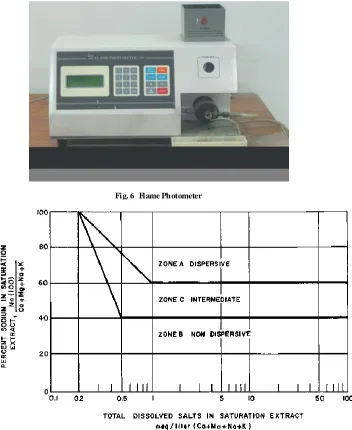
The chemical analysis of soils pore water e xtract was seems to the most reliab le methods for characterizing soil dispersivity. The phenomenon of dispersivity is due to the presence of dissolved sodium content in pore water and therefore its percentage was calculated by estimating total dissolved cations ( Na, K. Ca& Mg) present in soils pore water e xt ract.To obtain saturation e xtract, soil is mixed with distilled water until a sa turated soil paste with water content near the liquid limit is obtained. The paste is allowed to set for a number of hours untilequilibriu m is attained between the salts in the pore water and those on the cation exchange comple x. Subsequently, a small qua ntity of pore water is filtered fro m the soil paste using a vacuum. Th is e xtracted pore water is tested using EDTA titrat ion method (For Ca & Mg) and using fla me photometer( For Na & K).( Fig.6)
Fig. 6 Flame Photometer
After plotting the above graph for each samples the results were categorizedas follows
Soil with water soluble Sodiu m Percentage below 40 meq/lit. a re categorized in Zone B ( Non Dispersive) Soil with water soluble Sodiu m Percentagebetween 40-60 meq/lit. are categorized in Zone C ( Intermed iate) Soil with water soluble Sodiu m Percentage above 60 meq/lit. are categorized in Zone A ( Dispersive)
Sodium absor ption r atio (SAR)
The SAR is a ratio of the concentration of sodium ions to the con centration of calc iu m plus magnesium ions,.The
Sodiu m absorption ratio (SA R) o f the soil solution adequately defines the soil sodicity proble m and has a ma rked influence on the physical soil properties. Sodiu m adsorption ratio, SAR, is defined by the equat ion:
where a ll concentrations are in meq / lit re.
XRD tests
X-ray d iffraction ana lysis (XRD) is perhaps the most widely used X-ray based analytical techniques for characterizing materia ls. The X ray analysis helps in identifying the types of minera ls present in soil samp les.When an X-ray beam hits a sample and is diffracted, we can measure the distances between the planes of the atoms that constitute the sample by applying Bragg's Law, :nλ =2d sinθ, where the integer n is the order of the diffracted beam,λ is the wavelength of the incident X-ray beam, d is the distance between adjacent planes of ato ms (the d-spacings), and θ the angle of incidence of the X-ray bea m.
IV. RES ULTS & DISCUSS ION
Table-1 Result of Pinhole Test
Table-2
Table-3 Result of Crumb Test
Table-4
The results of SAR of all the four samples are presented in table 5
Table-5
The results presented in table no.1-4 c learly shows dispersive/intermediate trend for sample no,2, however for re main ing samp les, a d isagreement shown between these four tests. The results of chemica l analysis presented in table no.4 however observed to be different fro m other engineering tests.
The results of sodium absorption ratio ( SA R) presented in table 5, a lso in agree ment with results of table 4, wh ich shows dispersive nature of three soil samp les.
In vie w of the different out co me of above mentioned engineering and che mica l test, a XRD study was also conducted for further confirmat ion regard ing dispersivity of soil sa mple no.2 co mpare this with the XRD pattern of standard clay samples.
The observations are presented in fig. 8 & 9
Fig.9 XRD pattern of Dispe rsive sample no.2
V. CONCLUS ION
The results of differenttests conducted on all the four soil sa mples indicated d iffe rent outcome on dispersivity criteria and shows very littile agree ments with each other . The observation of engineering tests were found to be different fro m che mical tests. The SAR results also in agree ment with the chemica l analysis results . The dispersivity is a surface phenomena and certain c lay minera ls are responsible for this , therefore a XRD ana lysis was also conducted to confirm the presence of clay minerals responsible for d ispersivity. In order to reach any conclusion regard ing , a detail analysis of all the available tests are need to be conducted on large numbers of soil samples with known dispersive history. The XRD ana lysis with detail interpretation of types of minera ls present need to be further investigate,
REFER ENC ES
[1]. Forrest, T . G. “ Engineering and design - Laboratory soils testing, AppendixXIII: Pinhole erosion test for identification of dispersive clays”, U.S.A.,(1980).
[2]. J. L. Sherard, L. P. Dunnigan and R. S. Decker, “Identification and Nature of Dispersive Soils,” ASCE Geotechnical Division, Vol. 102, No. 4, , pp. 69-87,1976.
[3]. McElroy, C. H. “ Using Hydrated Lime to Control Erosion of Dispersive Clays”Lime for Environmental Uses.AST M STP, 931, pp 100-114,(1987).
[4]. R. T. Heinzen and K. Arulanandan, “ Factors Influencing Dispersive Clays and Methods of Identification ,” ASTM Special T echnical Publication, Vol. 623, pp. 202- 217,1977.
[6]. Ludwig, H. “A study of some aspects of dispersive clay particle interaction”, Master thesis, McGill University (1979),
[7]. Sherard, J.L., Dunnigan, L.P., Decker, R.S., “Identification and nature of dispersive soils”, J Geotech Eng 102 (GT 4):298–312 , (1976) [8]. ASTM.Standard test method for dispersive characteristics of clay soil by double hydrometer.ASTM D422199. AST M Pennsylvania.
International.2007a .ASTM.Standard test method for particle-size analysis of soils. AST M D422-63.AST M Pennsylvania- International. 2007b. [9] .ASTM D6572 Standard T est Methods for Determining Dispersive Characteristics of Clayey Soils by the Crumb Test.
[10]. AST M D4647Standard Test Methods for Identification and Classification of Dispersive Clay Soils by the Pinhole Test.
[11].British Standard (BS). 1990. Methods of test for soils for civil engineering purposes: Part 2: Classification tests. British Standard 1377-2: 1990, British Standards Institute, London.