ABSTRACT
KIM, NA EUN. Sharing Styles without Feeling Gross: The Influence of Consumer
Contamination on Consumers’ Collaborative Consumption Intentions. (Under the direction of Dr. Byoungho Ellie Jin).
Collaborative consumption or the sharing economy—where consumers share ownership of cars, clothes, lodging, or other commodities—has gained tremendous popularity in recent years, through the emergence of platforms like Uber, Airbnb, and Rent the Runway.
Nevertheless, studies have yet to uncover the specific factors that can be leveraged by companies to increase consumer purchase or rental intentions toward shareable goods. Additionally, extant research on collaborative consumption focuses on identifying consumers’ motivations for participating in sharing activities, and little known about the deterrents to collaborative consumption. One major concern among collaborative consumption users is the issue of contamination (i.e., feeling ‘grossed out’ when sharing items with anonymous others). Hence, this study aims to investigate various management factors that can address the contamination issue, thereby understanding the ways consumers engage in collaborative fashion consumption.
The consumer contamination effect theory states that consumers evaluate
ownership or management types of shared goods (e.g., corporate versus consumer ownership). In studies 2 and 3, factors that may induce positive contamination effect were examined, such as the seller’s physical attractiveness (Study 2) and buyer/seller racial similarity (Study 3).
Furthermore, each study examined the moderation effect of the degree of contact with the body, using two fashion items of high (i.e., shirt) versus low contact (i.e., handbag).
For this purpose, 559 usable responses were collected through MTurk, and each respondent was randomly assigned to one of the eighteen experimental scenarios. Results showed that all three hypotheses proposed in Study 1 testing the negative contamination effect were supported. That is, consumers preferred corporate-ownership of fashion goods over consumer-ownership in both rental and secondhand purchase settings (H1 & H2). However, when testing the positive contamination effects in studies 2 and 3, consumers only preferred to purchase items from an attractive or racially similar seller over an unattractive or racially dissimilar seller in secondhand purchase setting (H4 & H6) and not in rental setting (H3 & H5). Moreover, the moderation effect of the degree of contact was discovered only in the negative contamination setting (H2a) and not in the positive contamination setting (H4a & H6a). The heightened sensitivity to the degree of contact in the presence of negative contamination can be explained by the negativity bias, which maintains that people are more sensitive to negative stimuli than to positive stimuli (Rozin & Royzman, 2001). Since such sensitivity to the degree of contact was not relevant during positive contamination, the effect of positive contamination holds, regardless of product types.
contamination effect. Additionally, the findings reveal meaningful implications for practitioners on alleviating consumers’ concern about contamination, thereby increasing their sharing
Sharing Styles without Feeling Gross: The Influence of Consumer Contamination on Consumers’ Collaborative Consumption Intentions
by Na Eun Kim
A dissertation submitted to the Graduate Faculty of North Carolina State University
in partial fulfillment of the requirements for the degree of
Doctor of Philosophy
Textiles Technology Management
Raleigh, North Carolina 2019
APPROVED BY:
_______________________________ _______________________________ Dr. Byoungho Ellie Jin Dr. Lori Rothenberg
Committee Chair
_______________________________ _______________________________ Dr. Marguerite Moore Dr. Eui Kyung Kim
_______________________________ Dr. Jin Su
BIOGRAPHY
ACKNOWLEDGMENTS
The path toward this dissertation has been arduous, yet it remains one of the most rewarding journeys I have ever embarked on. For its completion, I owe my deepest gratitude to these individuals who have supported me along the way.
First, and most of all, I would like to express my sincere appreciation for my advisor and mentor, Dr. Byoungho Ellie Jin. Her knowledge, passion for research, and devotion to students are the very reasons why I decided to pursue the life of an academician. During my graduate years, she provided me with extraordinary professional and personal guidance and taught me the qualities a good researcher and educator should strive for. It is thanks to her encouragement, wisdom, patience, enthusiasm, and understanding that I was able to finish this journey and feel confident about going forward. I shall be eternally grateful for all the advice and mentorship I received from her, and I hope to follow her example by inspiring future students as she has done for me.
I would like to extend my gratitude to the exceptional committee members whom I was privileged to be associated with. I would like to thank Dr. Lori Rothenberg, Dr. Marguerite Moore, Dr. Jin Su, and Dr. Eui Kyung Kim for their willingness to serve as committee members despite the short notice due to my transfer, and also for their invaluable advice and insight. I am thankful for their thoughtful feedback and encouragement, always aimed at moving me forward.
although we were apart for the duration of my studies, thank you for making me feel like I was never alone.
TABLE OF CONTENTS
LIST OF TABLES ... vii
LIST OF FIGURES ... ix
Chapter 1: Introduction ... 1
Background ... 1
Trend of Collaborative Consumption ... 1
Determinants and Deterrents of Collaborative Consumption ... 3
Consumer Contamination Effect ... 4
Research Gaps ... 5
Research Objectives ... 8
Contributions of the Study ... 9
Definition of Key Terms ... 11
Dissertation Outline ... 13
Chapter 2: Literature Review ... 14
Collaborative Consumption ... 14
Concept and Classification of Collaborative Consumption ... 14
Analyses of Previous Studies on Collaborative Consumption ... 20
Consumer Motivations and Deterrents toward Collaborative Consumption ... 25
Theoretical Foundations ... 28
The Law of Contagion ... 28
Physical Attractiveness: “What is Beautiful is Good” ... 33
Similarity Attraction Theory ... 35
Proposed Conceptual Framework and Hypotheses Development ... 37
Ownership of Shared Goods ... 41
Physical Attractiveness of Seller ... 44
Racial Similarity between Seller and Buyer ... 46
Chapter 3: Methodology ... 48
Pretest ... 48
Overall Research Design ... 49
Sample ... 49
Stimuli Development ... 50
Measurements ... 55
Data Collection ... 57
Data Analysis ... 62
Chapter 4: Data Analysis & Results... 65
Pilot Test Results ... 65
Preliminary Analysis ... 66
Descriptive Analysis ... 66
Reliability Test ... 76
Manipulation Check ... 76
Results of Hypotheses Testing ... 78
Study 1 Ownership of Shared Goods (H1, H2, H2a) ... 78
Study 2 Physical Attractiveness of Seller (H3, H4, H4a) ... 82
Study 3 Racial Similarity between Seller and Buyer (H5, H6, H6a) ... 84
Summary of Hypotheses Testing ... 86
Chapter 5: Conclusions ... 88
Summary of Findings ... 88
Discussion of Findings ... 89
Study 1 ... 89
Study 2 ... 91
Study 3 ... 94
Summary of Discussion ... 96
Implications ... 97
Theoretical Implications ... 97
Managerial Implications ... 100
Limitations and Future Studies ... 102
REFERENCES ... 105
APPENDICES ... 117
APPENDIX A. PRETEST ... 118
APPENDIX B. IRB LETTER... 122
LIST OF TABLES
Table 1 Categorization of Collaborative Consumption Services ... 16
Table 2 Categorization of Collaborative Consumption Services in the Fashion Industry .... 18
Table 3 Forms of Product Ownership for Fashion Collaborative Consumption Activities .. 20
Table 4 Literature on Collaborative Consumption ... 21
Table 5 Summary of Stimuli ... 52
Table 6 Summary of Measurements ... 57
Table 7 Summary of Experimental Design ... 61
Table 8 Company Description Scenarios ... 62
Table 9 Summary of Variables and Analysis ... 64
Table 10 Results of Scale Reliability Tests ... 66
Table 11 Results of T-test for Stimuli Image Selection Validation ... 66
Table 12 Data Collection Results ... 67
Table 13 Descriptive Statistics for Study 1 ... 70
Table 14 Descriptive Statistics for Study 2 ... 71
Table 15 Descriptive Statistics for Study 3 ... 72
Table 16 Results of Scale Reliability Tests ... 76
Table 17 Manipulation Check: Independent T-Tests for Perceived Contamination ... 77
Table 18 Manipulation Check: Independent T-Tests for Physical Attractiveness ... 77
Table 19 Study 1: ANCOVA Results Testing H1 ... 80
Table 20 Study 1: ANCOVA Results Testing H2 ... 81
Table 21 Study 1: Regression Results Testing H2a ... 81
Table 23 Study 2: ANCOVA Results Testing H3 ... 83
Table 24 Study 2: ANCOVA Results Testing H4 ... 83
Table 25 Study 2: Regression Results Testing H4a ... 84
Table 26 Study 3: ANCOVA Results Testing H5 ... 85
Table 27 Study 3: ANCOVA Results Testing H6 ... 86
LIST OF FIGURES
Figure 1 Conceptual Framework ... 40
Figure 2 Frequency of Collaborative Consumption ... 74
Figure 3 Motivations for Collaborative Consumption ... 74
Figure 4 Deterrents of Collaborative Consumption ... 75
CHAPTER I INTRODUCTION
Since the early 2000s, consumers have demonstrated a growing tendency to share commodities by renting or secondhand purchasing with others in the community—a
phenomenon known as collaborative consumption. Given the trend’s global popularity, a large number of companies that provide platforms for connecting users online have also emerged (e.g., Uber, Airbnb, and Rent the Runway). These companies seek ways to attract users and have them actively engage in collaborative consumption through their platforms. Nevertheless, current academic research has yet to uncover the specific factors that can be leveraged by companies to increase consumer purchase or rental intentions toward shareable goods. The purpose of this dissertation is to identify such factors that may affect consumers’ intentions to participate in the collaborative consumption of fashion goods. This introductory chapter comprises the following sections: (1) Background, (2) Research Gaps, (3) Research Objectives, (4) Contributions of the Study, (5) Definition of Key Terms, and (6) Dissertation Outline.
Background Trend of Collaborative Consumption
Collaborative consumption or the sharing economy—where consumers share access to ownership of cars, clothes, lodging, or other commodities—has gained tremendous popularity in recent years. Collaborative consumption involves a market in which strangers, as opposed to kin or acquaintances, exchange goods and services via information technology (Schor &
users may rent or purchase items from a service provider (i.e., business-to-consumer model) or connect and share items with other users (i.e., consumer-to-consumer model).
In 2011, Time magazine ranked collaborative consumption as one of the top ten ideas that will change the world (Walsh, 2011). According to estimates provided by PwC (2015), the international market of collaborative consumption reached $15 billion in 2015 and is expected to increase to $335 billion by 2025. In the U.S., 44% of consumers are already familiar with the concept, and nearly 72% of adults have expressed their intention to engage in collaborative consumption activities in the near future (PwC, 2015). Collaborative consumption is gaining momentum in other parts of the world as well. In China, about 700 million people, nearly half of the country’s population, have reported using sharing services in 2017. The collaborative
consumption industry in China is expected to grow at an annual rate of 30% over the next five years (2018–2023) (Yang, 2018). With the development of information technology and the emergence of sharing platforms, the impact of collaborative consumption on the global economy promises to be monumental.
countries and its selection of over 5 million rental listings worldwide (Airbnb Press Room, 2018). As Airbnb expands its offering to include luxury properties and loyalty programs, it may develop the potential to compete against traditional hotel chains like the Hilton and Marriott (Solon, 2018). In the fashion retail world, companies that offer rental services (e.g., Rent the Runway) or peer-to-peer secondhand marketplaces (e.g., Poshmark) have garnered success. A market research report showed that the global online clothing rental market is expected to expand at an annual growth rate of 9.8%, with a valuation of $1.95 billion by 2026 (Future Market Insights, 2016). In addition, toy libraries that lend toys and games have gained popularity around the world. With over 4,500 locations, toy libraries serve as hubs that increase community
efficacy (Ozanne & Ballantine, 2010). Other used or unwanted consumer goods, including electronics and household items, are also frequently purchased, sold, or traded on platforms such as eBay, Yerdle, and Splinster.
Determinants and Deterrents of Collaborative Consumption
materialism or attachment to worldly possessions (Belk, 2007; Dall Pizzol et al., 2017), and issues with hygiene or contamination regarding the shared goods (Bardhi & Eckhardt, 2012; Edbring et al., 2016).
Notably, many consumers have expressed fear of using objects that were previously owned or used by anonymous others. When sharing cars, people often feel “grossed out” by the residue left inside vehicles by previous passengers (Bardhi & Eckhardt, 2012). When sharing fashion items such as shirts or dresses, consumers may perceive them to be less fresh or clean since the items have been worn by others. Hence, the issue of contamination may lead consumers to devalue the shared objects, thus discouraging current and prospective consumers. Since
collaborative consumption heavily involves items used by others, consumer reactions toward contamination will be important to address when studying the phenomenon.
Consumer Contamination Effect
The concept of consumer contamination has been studied extensively in the field of social science. It is derived from the law of contagion, which states that “people, objects, and so forth, that come into contact with each other may influence each other through the transfer of some or all of their properties” (Nemeroff & Rozin, 1994, p. 159). Research has shown that such contact with a contagion source can elicit either a positive or negative response, depending on the nature of the contagion (Rozin, Nemeroff, Wane, & Sherrod, 1989). For example, if an object comes into contact with a loved one, the value of the contaminated product becomes enhanced; however, if it comes into contact with an undesirable source and is left with odor or other forms of residue, the value of the object decreases (Nemeroff & Rozin, 1994).
2008), which describes “contamination from consumer touching” that often results in negative implications for the touched product (Argo et al., 2006, p. 81). Studies have since discovered that various factors—the number of contact sources, proximity to contact, time elapsed since contact, organization of shelf displays, and product packaging—can influence consumer evaluations of a product (Argo et al., 2006; Castro, Morales, & Nowlis, 2013; Sogn-Grundvåg & Østli, 2009). For instance, if a product appears to be touched by several individuals rather than one, purchase intentions toward the product are subsequently reduced. However, not all contamination is necessarily associated with negative implications. Studies have revealed that factors relating to the contagion source, such as a high level of physical attractiveness, can indeed lead to positive contamination effects, enhancing product evaluations (Argo et al., 2008).
Research Gaps
Through extensive review of the academic literature on collaborative consumption and its progression in practice, five major gaps in research have been identified. First, while
the identification and empirical testing of factors that companies may leverage to increase consumer willingness to participate in collaborative consumption can provide practical insight for lucrative business operations.
Second, the issue of consumer contamination has not been thoroughly considered in collaborative consumption research. Collaborative consumption activities—rental, subscription, or redistributed ownership of goods through consignment—entail people sharing the usage of goods. Therefore, the issue of consumer contamination inevitably emerges as a major hurdle for companies to overcome, which warrants an investigation of factors that could alleviate potential negative contamination effects. On the other hand, consumer contamination research has
indicated the presence of positive contamination effects, which may result from factors such as a contagion source’s physical attractiveness or similarity (Argo et al., 2008). Despite the gravity of the issue, there remains a lack of understanding about the extent to which negative or positive contamination affects consumer sharing intentions and about other factors that mitigate or leverage the contamination effect during collaborative consumption.
Third, addressing the issue of contamination leads to a potential moderating variable: the degree of contact with the shared goods. Consumers are known to be increasingly “grossed out” when the vicinity of contaminated objects to their bodies decreases (Angyal, 1941). In other words, the more an object touches one’s body, the more “grossed out” that person tends to be. The shared objects under investigation in this study are fashion items, as items such as garments and jewelry often come into direct contact with one’s body, though they may vary in the level of contact. Hence, the degree of contact with the body may affect the influence of consumer
Fourth, there is a need to test factors related to collaborative consumption from two modes of exchange. Researchers agree that collaborative consumption occurs in two types of exchange: access to ownership (e.g., renting) and transfer of ownership (e.g., purchasing secondhand goods) (Hamari et al., 2016). However, studies on collaborative consumption thus far have mostly focused on access-to-ownership contexts, such as ride sharing or accommodation rentals (Bardhi & Eckhardt, 2012; Cheng, 2016; Dall Pizzol et al., 2017; Lamberton & Rose, 2012; Möhlmann, 2015; Tussyadiah, 2015). Only a few studies have examined sharing contexts in which ownership of an object is transferred from one individual to another through
secondhand purchasing or swapping (Gopalakrishnan & Matthews, 2018; Johnson, Mun, & Chae, 2016). Fashion goods are among the most popular collaboratively consumed goods; they are not only rented out for a short period of time but can also be frequently consumed
secondhand. Therefore, greater attention to the transfer of ownership context in collaborative consumption is needed. Moreover, people may have different motivations or inclinations when renting goods for a short period of time (possibly lower risk) or purchasing a previously owned product (potentially higher risk). Therefore, it is necessary to examine whether consumers display similar or different participation intentions in each exchange context.
inclinations toward survey methods, a more diverse range of methodologies, such as the experimental study, can shed new light on collaborative consumption research. Experimental design is especially needed, as it can establish a cause-and-effect relationship for one’s research questions rather than the mere description of associations provided by a survey method (Grabe & Westley, 2003). To make significant predictions regarding consumers’ purchase or rental
intentions toward collaborative consumption while controlling for extraneous factors, an experimental study is ideal.
Research Objectives
In order to close the aforementioned research gaps, the overall purpose of this study is to investigate various management factors that can effectively address the contamination issue, thereby increasing consumers’ collaborative consumption intentions. The variables will be tested in two distinct contexts: secondhand purchase and rental. This section discusses three specific research questions that this study will address through a series of experiments.
The second research question will determine whether there is any discrepancy between the rental (i.e., access over ownership) and secondhand purchase (i.e., transfer of ownership) contexts. The identified variables related to the contamination effect may have different results on consumer participation intentions depending on the exchange setting (i.e., rental versus purchase). This research question can be answered by measuring and comparing consumer responses from the two exchange contexts.
The third research question explores whether the influence of consumer contamination varies across product type, particularly those with different degrees of contact. Consumers may react differently to contaminated objects depending on their level of contact with the body. This potential difference may influence the strength of the proposed relationships between the independent and dependent variables. Therefore, this study aims to research the moderating effect of a product’s degree of contact on purchase/rental intentions.
Contributions of the Study
Second, as one of the earliest attempts to examine the collaborative consumption of fashion goods and the variables involved in consumer attitude formation toward the activity, this study advances the scope of collaborative consumption research. In particular, this study raises the important issue of contamination in collaborative consumption, which has not been fully considered in previous literature. Studying collaborative consumption based on consumer contamination theory will provide new insight about how consumers react to goods shared with others and about possible factors that may reduce the negative contamination effect. Moreover, by researching consumers’ purchase or rental intentions toward fashion sharing, this study expands the product categories and research contexts (e.g., access and transfer of ownership) currently addressed in the collaborative consumption research field. Empirical tests and theoretical explanations about the role of contamination in collaborative consumption will add depth to a relatively nascent field of research.
Third, the examination of a potential moderator (i.e., degree of contact of shared goods) can provide greater understanding of the consumer contamination theory. Testing the influence of degree of contact using different fashion items (e.g., shirts versus handbags) can offer
insightful suggestions for practitioners regarding the type of fashion product they may choose to market to collaborative consumption consumers.
Fourth, the exploration of factors that positively affect collaborative consumption
individuals with certain traits (e.g., attractiveness, demographic similarity). By finding new variables that can positively affect consumers’ collaborative consumption intentions, this study can make valuable contributions to the current body of consumer contamination research.
Lastly, only a few other studies have employed an experimental design that manipulates the level of independent variables and tests their effects on consumers’ purchase intentions. This method allows for a controlled setting by limiting the presence of extraneous variables. The findings of the experiment can also help explain the cause-and-effect relationship between the manipulated and dependent variables (Grabe & Westley, 2003). Furthermore, the use of a series of experiments rather than a single study allows for improvement on previous results.
Definition of Key Terms
• Collaborative Consumption refers to people sharing access to and redistributing
ownership of goods and services in exchange for a fee or compensation using information technology platforms (Belk, 2014; Hamari et al., 2016).
• Access to ownership refers to when users gain temporary access to goods offered by other users or retailers through activities such as renting or lending (Hamari et al., 2016). • Transfer of ownership refers to when ownership of a good is passed from one user to
another through swapping, donating, or purchasing of secondhand goods within the collaborative consumption context (Hamari et al., 2016).
• Secondhand Fashion Consumption refers to purchasing or selling previously-owned fashion goods (Xu, Chen, Burman, & Zhao, 2014). It is described as a form of
collaborative consumption in that a transfer of ownership over a good takes place. • Corporate-owned Shared Goods in this study refer to goods that are owned, managed,
and curated by a retailer or service provider and are available for purchase or rental. • Consumer-owned Shared Goods in this study refer to goods that are owned, managed,
and curated by a consumer and are available for purchase or rental.
• Law of Contagion explains that when people and objects come into contact with one another, a transfer of some or all of their properties occurs. This transfer causes the entities to influence one another even after the physical contact has ended (Nemeroff & Rozin, 1994).
• Consumer Contamination Effect refers to the contamination resulting from consumer touching of a product, which often influences consumer evaluation of the product (Argo et al., 2006).
• Physical Attractiveness refers to “the extent to which an individual’s features are aesthetically pleasing to others” (Converse et al., 2016).
• Similarity Attraction Theory describes the increase in interpersonal attraction or liking that occurs between individuals with similar attributes, particularly in terms of
Dissertation Outline
CHAPTER II LITERATURE REVIEW
This chapter provides a literature review on the major concepts and theories that lay the groundwork of the research. First, the concept of collaborative consumption is discussed, followed by its application in academic research as well as in the fashion industry. Second, theoretical foundations, including the law of contagion, physical attractiveness, and similarity attraction theory, are reviewed. Based on this literature review, a conceptual framework is proposed, along with nine hypotheses. The rationale for each hypothesis is also provided.
Collaborative Consumption Concept and Categorization of Collaborative Consumption
In order to understand the concept of collaborative consumption, it is important to examine its definition and dimensions. Collaborative consumption is generally defined as a phenomenon in which people share and redistribute ownership of various goods and services using information technology. Although people throughout history have always traded unwanted or used items with others in the community, the concept has recently gained momentum with the development of information technology, which can connect users online and mediate
transactions. The modern notion of collaborative consumption encompasses activities in which both the access to (e.g., renting) and transfer (e.g., secondhand purchasing) of ownership take place. Examples of companies performing the former activity include Zipcar and Airbnb, and examples of those performing the latter include eBay and ThredUp. Yet, debate persists about whether collaborative consumption does indeed embody both of these activities.
Bardhi and Eckhardt (2012) first suggested that the phenomenon of collaborative
be market mediated in which no transfer of ownership takes place” (p. 881). In other words, access to ownership means borrowing others’ idle assets for temporary use through a mediating platform. Similarly, Lamberton and Rose (2012) define collaborative consumption as “marketer-managed systems that provide customers with the opportunity to enjoy product benefits without ownership” (p. 109). However, Belk (2014) criticized these definitions because they exclude activities related to “transferring” ownership, such as bartering, trading, and swapping. Botsman and Rogers (2010) also attempted to define the phenomenon by including activities such as “traditional sharing, bartering, lending, trading, renting, gifting, and swapping” (p. xv). However, Belk (2014) again suggests that this definition is too broad, for it includes the concepts of
marketplace exchange, gift giving, and sharing, which are not clearly delineated.
As a result, Belk (2014) defines collaborative consumption as “people coordinating the acquisition and distribution of a resource for a fee or other compensation” (p. 1597). In addition to incorporating the notions of both access to and transfer of ownership, this definition provides theoretical evidence for the differences between collaborative consumption and pure sharing. Unlike pure sharing, in which properties are jointly owned through pro-social intentions (Belk, 2007), collaborative consumption may include a fee or other compensation and also involves a commercial organization. The inclusion of compensation—which can be monetary or non-monetary, the latter of which may include bartering, trading, or swapping—excludes sharing activities in which no compensation or reciprocal obligation is involved (Belk, 2014).
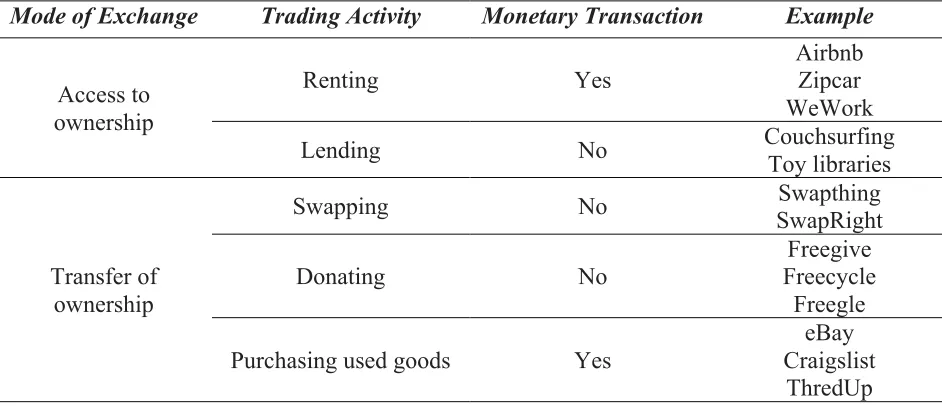
encompasses the “obtaining, giving, or sharing [of] access to goods and services, coordinated through community-based online services” (p. 2050). Similar to Belk (2014), Hamari et al. (2016) categorize the existing collaborative consumption services into two modes of exchange: access to ownership (e.g., renting and lending) and transfer of ownership (e.g., swapping, donating, and purchasing used goods). Table 1 displays this categorization of the existing collaborative consumption services.
Table 1. Categorization of Collaborative Consumption Services
Mode of Exchange Trading Activity Monetary Transaction Example
Access to ownership
Renting Yes Airbnb Zipcar
WeWork Lending No Couchsurfing Toy libraries
Transfer of ownership
Swapping No SwapRight Swapthing
Donating No
Freegive Freecycle
Freegle Purchasing used goods Yes
eBay Craigslist
ThredUp Source: Adapted from Hamari et al. (2016) with examples added by the author.
Nonetheless, debates have continued about the type of sharing activities that should be considered collaborative consumption as opposed to traditional sharing. One of the earliest attempts to map out where each activity belongs in the collaborative consumption and sharing spectrum was Bardhi and Eckhardt’s (2012) identification of the following dimensions of collaborative consumption: (1) temporality (i.e., duration of use), (2) anonymity (i.e.,
society, business, and government). The authors argue that within the collaborative consumption practice, different goods or services may fall into multiple dimensions. For example, car sharing may be characterized as anonymous, market mediated, and functional, while Couchsurfing may be considered social, less market-mediated, and experiential. While this conceptualization was among the first attempts to dimensionalize collaborative consumption, it is rather difficult to objectively compare the nature of different activities.
Addressing this limitation, Habibi, Davidson, and Laroche (2017) developed a sharing-exchange continuum by creating a sharing score for each collaborative consumption activity. This continuum maps collaborative consumption activities using degrees of sharing versus exchange nature. Pure sharing (e.g., pooling resources) is on the left-hand side, characterized by non-reciprocity, irrelevancy of money, inclusion of social links and networks, and love.
Collaborative consumption programs such as Couchsurfing, an online platform that allows members to stay at someone’s home or host travelers free of charge, would fall near the pure sharing side of the continuum. Pure exchange (e.g., buying bread from the store) is on the right-hand side, characterized by reciprocity, exchange of money, calculation, and impersonal relationship. Zipcar is more similar to this exchange side of the continuum, as it requires low degrees of socialization and community bonds (Habibi et al., 2017).
Based on the preceding conceptualizations, the notion of collaborative consumption in this study will be defined as an event in which people share access and redistribute ownership of goods and services in exchange for fees or compensation using information technology
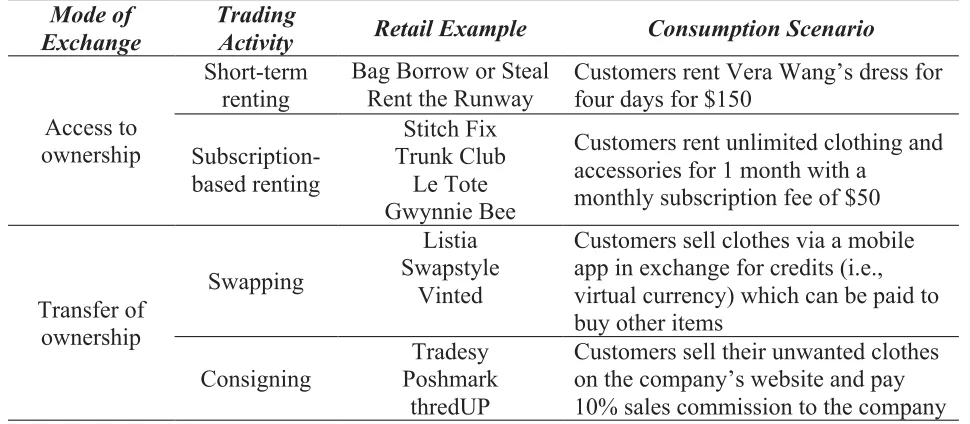
of this research will focus on the fashion retail industry, where the collaborative consumption market is manifested by two distinct modes of exchange: access-based ownership (i.e., online fashion rental services) and transfer of ownership (i.e., peer-to-peer (P2P) consignment platforms). Table 2 summarizes the types and examples of fashion collaborative consumption services.
Table 2. Categorization of Collaborative Consumption Services in the Fashion Industry Mode of
Exchange
Trading
Activity Retail Example Consumption Scenario
Access to ownership
Short-term renting
Bag Borrow or Steal Rent the Runway
Customers rent Vera Wang’s dress for four days for $150
Subscription-based renting Stitch Fix Trunk Club Le Tote Gwynnie Bee
Customers rent unlimited clothing and accessories for 1 month with a
monthly subscription fee of $50
Transfer of ownership Swapping Listia Swapstyle Vinted
Customers sell clothes via a mobile app in exchange for credits (i.e., virtual currency) which can be paid to buy other items
Consigning
Tradesy Poshmark
thredUP
Customers sell their unwanted clothes on the company’s website and pay 10% sales commission to the company Source: Adapted from Park & Armstrong (2017) with examples added by the author.
another peer users using virtual currency (e.g., company credit). Consumers may also directly sell or purchase items from/to other users through the collaborative consumption company; however, this often requires paying the company a small fee or commission of the sales amount.
In addition to classification based on mode of exchange, collaborative consumption business models for fashion goods can be classified by their types of ownership and management of “shared goods”: corporate-owned versus consumer-owned (Table 3). Corporate ownership means that the shared goods are purchased, managed, and merchandised by the collaborative consumption service provider. In other words, consumers interact with the company that owns and manages the items when renting or even purchasing secondhand goods (i.e., B2C, or
business-to-consumer). Examples of corporate-owned or corporate-managed service providers in the fashion collaborative consumption industry include Rent the Runway, Stitch Fix, and
ThredUp. On the other hand, consumer ownership indicates shared goods owned, managed, and merchandised by consumers, who merely borrow the service provider platforms and interact directly with one another to shop or rent from each other’s closets (i.e., C2C, or consumer-to-consumer). Examples of this format include Poshmark, eBay, and Style Lend. It is important to note that both forms of shared good ownership can occur across the aforementioned
Table 3. Forms of Product Ownership for Fashion Collaborative Consumption Activities Product
Ownership
Trading
Interaction Retail Example Consumption Scenario
Corporate
Business-to-Consumer
(B2C)
Rent the Runway Stitch Fix
ThredUp Bag Borrow or Steal
The RealReal
Customers rent a handbag listed on Bag Borrow or Steal
&
Customers purchase a previously-owned dress from ThredUp
Consumer Consumer-to-Consumer (C2C) Poshmark eBay Style Lend Grailed
Customers borrow a dress directly from its owner through Style Lend &
Customers purchase a previously-owned jacket from its owner on Grailed
Source: Organized by the author
Analyses of Previous Studies on Collaborative Consumption
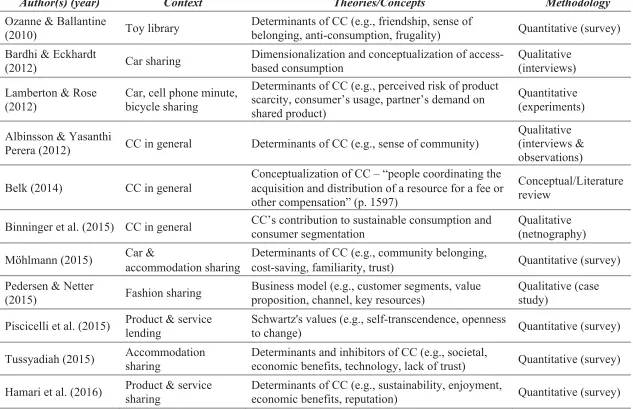
Given that collaborative consumption has emerged recently with the development of information technology, the academic literature and research on the topic is not yet extensive. Nonetheless, the literature has grown in recent years as collaborative consumption has rapidly gained a foothold in the market. Table 4 summarizes the major studies on collaborative
Table 4. Literature on Collaborative Consumption (CC)
Author(s) (year) Context Theories/Concepts Methodology
Ozanne & Ballantine
(2010) Toy library Determinants of CC (e.g., friendship, sense of belonging, anti-consumption, frugality) Quantitative (survey) Bardhi & Eckhardt
(2012) Car sharing
Dimensionalization and conceptualization of access-based consumption
Qualitative (interviews) Lamberton & Rose
(2012)
Car, cell phone minute, bicycle sharing
Determinants of CC (e.g., perceived risk of product scarcity, consumer’s usage, partner’s demand on shared product)
Quantitative (experiments)
Albinsson & Yasanthi
Perera (2012) CC in general Determinants of CC (e.g., sense of community)
Qualitative (interviews & observations)
Belk (2014) CC in general
Conceptualization of CC – “people coordinating the acquisition and distribution of a resource for a fee or other compensation” (p. 1597)
Conceptual/Literature review
Binninger et al. (2015) CC in general CC’s contribution to sustainable consumption and consumer segmentation Qualitative (netnography)
Möhlmann (2015) Car &
accommodation sharing
Determinants of CC (e.g., community belonging,
cost-saving, familiarity, trust) Quantitative (survey) Pedersen & Netter
(2015) Fashion sharing Business model (e.g., customer segments, value proposition, channel, key resources) Qualitative (case study) Piscicelli et al. (2015) Product & service lending Schwartz's values (e.g., self-transcendence, openness to change) Quantitative (survey)
Tussyadiah (2015) Accommodation sharing
Determinants and inhibitors of CC (e.g., societal,
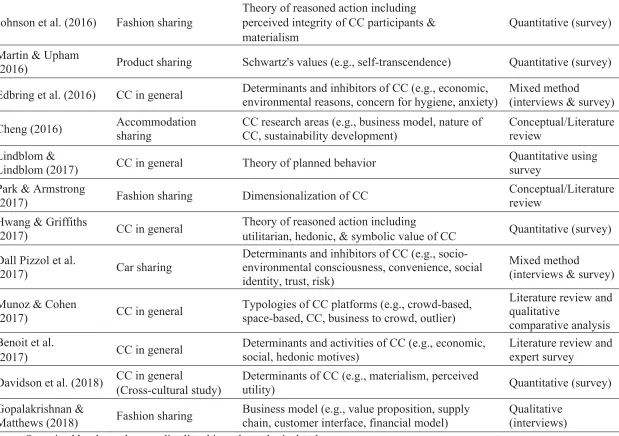
Table 4 (continued)
Johnson et al. (2016) Fashion sharing
Theory of reasoned action including perceived integrity of CC participants & materialism
Quantitative (survey)
Martin & Upham
(2016) Product sharing Schwartz's values (e.g., self-transcendence) Quantitative (survey) Edbring et al. (2016) CC in general Determinants and inhibitors of CC (e.g., economic, environmental reasons, concern for hygiene, anxiety) Mixed method (interviews & survey)
Cheng (2016) Accommodation sharing CC research areas (e.g., business model, nature of CC, sustainability development) Conceptual/Literature review Lindblom &
Lindblom (2017) CC in general Theory of planned behavior
Quantitative using survey
Park & Armstrong
(2017) Fashion sharing Dimensionalization of CC
Conceptual/Literature review
Hwang & Griffiths
(2017) CC in general
Theory of reasoned action including
utilitarian, hedonic, & symbolic value of CC Quantitative (survey) Dall Pizzol et al.
(2017) Car sharing
Determinants and inhibitors of CC (e.g., socio-environmental consciousness, convenience, social identity, trust, risk)
Mixed method
(interviews & survey)
Munoz & Cohen
(2017) CC in general Typologies of CC platforms (e.g., crowd-based, space-based, CC, business to crowd, outlier)
Literature review and qualitative
comparative analysis Benoit et al.
(2017) CC in general
Determinants and activities of CC (e.g., economic, social, hedonic motives)
Literature review and expert survey
Davidson et al. (2018) CC in general
(Cross-cultural study)
Determinants of CC (e.g., materialism, perceived
utility) Quantitative (survey)
Gopalakrishnan &
Matthews (2018) Fashion sharing
Business model (e.g., value proposition, supply chain, customer interface, financial model)
First, as shown in the first column of Table 4, academic research has addressed
collaborative consumption in various contexts, as these activities have occurred across a wide range of industries, from car sharing to accommodation sharing. Most notably, significant amounts of research have focused on the context of access to ownership, such as car sharing (Bardhi & Eckhardt, 2012, Lamberton & Rose, 2012; Möhlmann, 2015; Dall Pizzol et al., 2017). Companies like Zipcar, which allows consumers to gain temporary access to cars, and Uber, a ride-sharing business model, have become prevalent in major cities around the world. Car sharing may be a popular as a research context since it is thought to be a representative and well-known business model for collaborative consumption.
into direct contact with a consumer’s body. Hence, the level of intimacy associated with fashion goods tends to be greater than that for cars or household goods. Therefore, it is essential to examine the variables that are unique to the fashion context.
Second, the theoretical domains of collaborative consumption research are presented in the second column of Table 4. In order to understand collaborative consumption, most studies have researched consumer motivations or determinants for engaging in the relevant activities (Albinsson & Yasanthi Perera, 2012; Benoit et al., 2017; Dall Pizzol et al., 2017; Davidson. Habibi, & Laroche, 2018; Edbring et al., 2016; Hamari et al., 2016; Lamberton & Rose, 2012; Möhlmann, 2015; Ozanne & Ballantine, 2010; Tussyadiah, 2015). In addition, studies have applied the theory of reasoned action or planned behavior (Hwang & Griffiths, 2017; Johnson et al., 2016; Lindblom & Lindblom, 2017), analyzing several antecedents to collaborative
consumption attitudes and intentions. Researchers have also examined consumer values through Schwartz’s model (Martin & Upham, 2016; Piscicelli et al., 2015) and explored collaborative consumption as a business model (Cheng, 2016; Munoz & Cohen, 2017; Pedersen & Netter, 2015). For example, it was found that consumers with pro-social values tend to engage in collaborative consumption more actively (Martin & Upham, 2016). However, while the current body of literature sufficiently explains who engages in collaborative consumption and what motivates them to do so, little is known about the factors that companies can control and offer to consumers to effectively increase their collaborative consumption intentions. Thus, identification of the management factors involved in collaborative consumption is needed.
Ballantine, 2010; Piscicelli et al., 2015; Tussyadiah, 2015). One study (Lamberton & Rose, 2012) utilized a series of experiments to test consumer interest in the sharing option in three distinct contexts (i.e., car sharing, cell phone minute sharing, and bicycle sharing). This series of studies allowed researchers to include additional variables and build on the shortcomings of the previous results.
A few studies have employed the qualitative method—one used netnograpy to monitor collaborative-consumption-related websites or blogs (Binninger et al., 2015), and another used semi-structured interviews to identify dimensions of collaborative consumption (Bardhi & Eckhardt, 2012). Moreover, Pedersen and Netter’s (2015) analysis was based on case studies of fashion libraries. Several articles (Cheng, 2016; Belk, 2014; Park & Armstrong, 2017) were exploratory studies based on literature review of academic journals and popular articles. Greater diversity in research methodology, using procedures such as an experimental design, can
certainly contribute to the academic research on collaborative consumption.
Consequently, the above review of research on collaborative consumption suggests that there are substantial gaps in research in terms of contexts researched, concepts studied, and methodologies employed. The management factors that may be critical to consumer engagement with collaborative consumption of fashion goods remain largely unexplored. Furthermore, there is a lack of experimental study despite its significance in identifying cause-and-effect
relationships between determinants and participation intentions while controlling for extraneous variables. This study seeks to address these gaps.
Consumer Motivations and Deterrents regarding Collaborative Consumption
collaborative consumption is economic gain (Benoit et al., 2017; Dall Pizzol et al., 2017; Edbring et al., 2016; Hamari et al., 2016; Möhlmann, 2015; Tussyadiah, 2015). Collaborative consumption assumes that consumers will replace exclusive ownership of goods with lower cost, temporary access to ownership—buying secondhand goods or borrowing goods instead of buying new items (Hamari et al., 2016). Through collaborative consumption, consumers may rent or trade items at cheaper prices than what can be found in the regular market.
Another key determinant can be found in consumer concern for sustainable consumption (Benoit et al., 2017; Botsman & Rogers, 2010; Edbring et al., 2016; Hamari et al., 2016;
Möhlmann, 2015). Collaborative consumption is known to “optimize the environmental, social, and economic consequences of consumption in order to meet the needs of both current and future generations” (Luchs et al., 2011, p. 2). Therefore, consumers driven by socioeconomic concerns and preferences for greener consumption are inclined to engage in collaborative consumption practices (Hamari et al., 2016).
Research shows that convenience is another factor behind collaborative consumption practice (Dall Pizzol et al., 2017; Lamberton & Rose, 2012), especially for those that fall under the access-to-ownership category. For example, in the context of car sharing, consumers enjoy the convenience offered by sharing transportation as opposed to owning a car, which requires greater responsibility and higher expenses (e.g., taxes, insurance, maintenance, and fuel) (Dall Pizzol et al., 2017).
suggest that collaborative consumption allows like-minded consumers to share and exchange goods, ideas, and feedback through online communities.
Meanwhile, several deterrents or obstacles to collaborative consumption have also been identified in the literature (Dall Pizzol et al., 2017; Edbring et al., 2016; Johnson et al., 2016; Lamberton & Rose, 2012). Most frequently cited among them is the perceived risk or anxiety that arises from participating in collaborative consumption activities. Uncertainties associated with collaborative consumption include the necessity of financial transactions with strangers and unfamiliarity with the concept of collaborative consumption itself (Edbring et al., 2016; Johnson et al., 2016). Since these activities take place in online platforms, consumers also need to rely on the product descriptions provided by the seller or service provider and are unable to physically check the products to ensure quality.
An additional obstacle found in the literature is materialism, or the feeling of
possessiveness (Belk, 2007; Dall Pizzol et al., 2017; Edbring et al., 2016; Johnson et al., 2016). Consumers who have strong emotional connections and attachments to their possessions are reluctant to share them with others (Dall Pizzol et al., 2017). They may prefer to own their objects, especially those associated with social status (Edbring et al., 2016). Ozanne and
Ballantine (2010) argued that materialistic consumption is perhaps the antithesis of collaborative consumption, a practice often associated with anti-consumption and frugality.
out” by the residue left by previous users. While this issue has been identified, it remains unclear how and to what extent the matter of contamination influence consumer participation in
collaborative consumption. In focusing on this critical deterrent of contamination, this study seeks to uncover unique factors that can help consumers overcome the fear of contamination and feel more comfortable sharing items with others. In the next section, three theories and concepts for identifying such factors are explored.
Theoretical Foundations
This section discusses the theories and concepts used for building the conceptual
framework of this study. The following theories and their applications in the retail industry will be examined: (1) the Law of Contagion, (2) the Effects of Physical Attractiveness, and (3) the Similarity Attraction Theory.
The Law of Contagion
In the late 1800s and early 1900s, anthropologists such as Sir James Frazer (1890), Marcel Mauss (1902), and E. B. Tylor (1871) introduced the laws of sympathetic magic, which were principles and practices consistent across cultures that described how the world works (Argo et al., 2006; Nemeroff & Rozin, 1994). The “magical law of contagion” was one of these laws, which holds that “people, objects, and so forth, that come into contact with each other may influence each other through the transfer of some or all of their properties. The influence
continues after the physical contact has ended and may be permanent” (Nemeroff & Rozin, 1994, p. 159). The underlying assumption behind the law of contagion is that either through explicit or implicit contact, some essence or undefined entity may be transmitted to another object
children whom one has nourished (Frazer, 1890). The idea also surfaces in contagion beliefs in food-related domains; people tend to avoid a drink if it has been touched by a cockroach (Rozin, Millman, & Nemeroff, 1986). Research suggests that the contagion effect often begins to
influence people after the age of seven, as this is when adequate levels of cognitive development may allow one to understand the idea of germs and disgust (Rozin, Fallon, & Augustoni-Ziskind, 1985).
Research has shown that such contact with a contagion source may result in positive or negative responses (Rozin et al., 1989). Rozin et al.’s (1989) study revealed that when an object has been contacted by a loved, respected, or revered person, the value of that object is enhanced (i.e., positive contagion). Conversely, when an object has been touched by a disliked, despised, or feared person, the value of that object decreases (i.e., negative contagion). According to Nemeroff and Rozin (1994), the negative contagion effect can be explained primarily by the residue (or physical trace) model, in which the effect is caused by “sensible, perceptible residues such as odor, dandruff, body heat, and so forth” (p. 172). On the other hand, the positive
value of the object, such that the contaged item serves as a pleasant or unpleasant reminder of the source” (p. 172).
The positive and negative influence of a contagion has been researched in the marketing and retail context. O’Reilly, Rucker, Hughes, Gorang, and Hand (1984) noted the negative sentiments associated with second-order marketing (i.e., secondhand consumption) of fashion items. O’Reilly et al. (1984) discovered that consumers tend to reject certain types of used fashion items due to fear of contamination. The awareness that the clothes have been owned and worn by other people can significantly reduce consumer preferences and purchase intentions. In particular, the reluctance to consume used fashion items increases when the items are closer to the body: 76% of participants rejected purchases of used underwear, as opposed to the 20% rejection rate for purchasing used outerwear. This implies that body contact is a critical deterrent to secondhand clothing consumption (O’Reilly et al., 1984). Similarly, Roux’s (2006)
phenomenological approach to understanding secondhand clothing consumption revealed that rejection occurs due to fear of both physical and symbolic contamination. The research suggested a possible symbolic transfer of identities between the previous owner and the new owner, with clothing as the mediator. Participants expressed that used clothing items are an extension of the previous owner and that grooming or laundering cannot fully eradicate the imagery of bodily contamination (Roux, 2006).
shirt, product evaluations and purchase intentions were measured after participants observed another shopper trying on the item. The product evaluations decreased in favorability when the product became closer to touching the other wearer’s body (i.e., proximity to contact), when the product was more recently touched by the other consumer (i.e., time elapsed), and when more consumers had touched the product (i.e., number of contact sources). The authors also suggested that the feeling of disgust plays a mediating role between contamination cues and product evaluations. In other words, consumers evaluate products that have been contaminated by other shoppers (even just the idea of it) less favorably because they feel disgusted, which in turn generates negative emotions toward the product (Argo et al., 2006).
Similarly, Morales and Fitzsimons (2007) developed a theory of product contagion in which “offensive properties of disgusting products are believed to transfer to other products through physical contact” (p. 272). As a result, the transfer of properties elicits disgust and leads to less favorable evaluations of products that are contaminated. Through a series of experimental studies, the authors found several discoveries regarding product contagion. The negative effect of product contagion holds true even when actual contact does not take place, based on the belief that the contact had occurred was enough to generate a response. In addition, such effects are not temporary and lead to a permanent change in the perception of the contaminated products. Notably, product contagion is affected by visualization; if the physical contact is easily
imagined, the transfer of negative properties and the unfavorable evaluations increase. Therefore, researchers recommend avoiding the use of transparent packaging for products subject to
when a disgusting object spoils one’s surroundings and even more so when it spoils one’s clothing. That disgust increases further if the object touches one’s bare skin or if one must touch the object with the mouth or ingest it. Therefore, the intensity of disgust increases with the vicinity or level of contact with the skin (Angyal, 1941; O’Reilly et al., 1984). This explains why consumers are more likely to reject previously owned underwear compared to outerwear
(O’Reilly et al., 1984). This implies that the intensity of the contamination effect depends on the type of product, as the degree of contact varies by product category (Argo et al., 2006).
Nonetheless, this proposition requires further empirical support.
While most research on the contagion effect centers on its negative consequences, Argo et al. (2008) examined the factors that lead to more positive contagion effects. The main factor in the study was the physical attractiveness of the contagion source. The authors tested this
supposition by hiring professional models to wear a shirt and leave it in a fitting room for participants to evaluate. After participants observed the model leaving the fitting room, their product evaluations were measured, and they were significantly more favorable than those of the control group. In addition to physical attractiveness, the researchers revealed that the sex of the contagion source plays a moderating role on this positive contagion effect; male consumers were more influenced by the attractiveness of another woman, while female consumers were more influenced by the attractiveness of another man. The findings of the study suggest that
intentional contact with attractive contagion sources (e.g., well-groomed sales associates) may help generate positive consumer response toward products (Argo et al., 2008).
collaborative consumption process, in which people share the usage of items, the issue of contamination can be especially prevalent. Hence, the influence of contamination may be a critical factor affecting consumers’ collaborative consumption intentions. Also, it is imperative to identify factors that may induce positive contamination effects, enhancing the evaluation of products that have been contaminated. When a consumer tries to rent or purchase used fashion items from a peer seller, he/she may look for cues that would reduce the risk of contamination and enhance sharing intention. This study explores two potential cues: the physical attractiveness of the contagion source and the demographic similarity between the seller and buyer. The
following sections explain the two concepts.
Physical Attractiveness: “What is Beautiful is Good”
The first factor in this study regarding the positive contamination effect is the physical attractiveness of the contagion source. Physical attractiveness has been studied extensively in social science research (Kahle & Homer, 1985); it functions as a very noticeable social stimulus since people tend to categorize others as attractive or unattractive immediately upon encounter (Gulas & McKeage, 2000). Moreover, humans tend to associate high levels of physical
attractiveness with positive attributes (Dion, Berscheid, & Walster, 1972). Dion et al.’s (1972) research on “what is beautiful is good” suggests that physically attractive individuals not only are assumed to possess more socially desirable personality traits but also are expected to lead better lives (e.g., associated with marriage and career success) than those who are physically
unattractive. These stereotypes about beauty have led to subsequent studies showing how
In marketing and retailing, physical attractiveness has been frequently researched in the context of advertising (Baker & Churchill, 1977; Caballero, Lumpkin, & Madden, 1989; Kahle & Homer, 1985; Patzer, 1983; Petty & Cacioppo, 1980). Since attractiveness is associated with socially desirable traits and personalities, the use of attractive individuals (e.g., models) in advertisements is known to increase the effectiveness of the ad (Baker & Churchill, 1977). Indeed, physically attractive people elicit more positive responses from others and exert greater social power than their more unattractive counterparts (Patzer, 1983). Furthermore, the
attractiveness of a person is known to create a “halo effect,” increasing the credibility and persuasion of the communicator as well as of the message itself (Baker & Churchill, 1977).
Another common context for physical attractiveness in the retail context is the attractiveness of salespersons or service workers. Studies have demonstrated that physically attractive salespersons perform better than their more unattractive counterparts (Ahearne, Gruen, & Jarvis, 1999; DeShields, Kara, & Kaynak, 1996; McElroy & DeCarlo, 1999; Reingen & Kernan, 1993; Söderlund & Julander, 2009). Consumers tend to be more receptive and rate sales pitches more favorably with attractive salespersons, and this positively influences purchase decisions and satisfaction (DeShields et al., 1996; Söderlund & Julander, 2009). This effect has been explained using the exchange theory, which suggests that the attractiveness of a salesperson contributes value to the interpersonal exchange, increasing the utility of purchase (Ahearne et al., 1999; Bagozzi, 1974). In addition, physically attractive individuals often receive higher ratings as job applicants (Dipboye, Arvey, & Terpstra, 1977) and are more likely to receive help from others than unattractive individuals (Benson, Karabenick, & Lerner, 1976).
has yet to be explored. In the C2C sharing context (i.e., consumer-owned/managed products), the seller’s profile picture is generally available to potential buyers. Given this, the physical
appearance of the seller may significantly influence buyers’ purchase intentions. Therefore, the role of beauty in the collaborative consumption context deserves further inspection.
Similarity Attraction Theory
Another cue that is easily observed from a seller’s profile picture in the C2C context is the seller’s demographic background, in terms of gender, age range, and race. In addition to the seller’s attractiveness, the demographic similarity between seller and buyer can also contribute to the positive contamination effect. This idea can be explained by the similarity attraction theory.
As the saying “birds of a feather flock together” insinuates, people are attracted to others who are similar to themselves (Byrne, 1971). Researchers in the fields of social psychology, sociology, and marketing have found empirical evidence for such attraction, which became formally known as the similarity-attraction theory. Here, similarity indicates “the extent to which members of a dyad are similar in personal attributes and characteristics” (Smith, 1998, p. 6). The attributes may include demographic characteristics, such as age, gender, or ethnicity, as well as psychographic characteristics such as attitudes, personality, and values (Dwayer, Richard, & Shepherd, 1998; Smith, 1998). Researchers have noted that an external cue such as clothing can also signal similarity, leading to interpersonal attraction (Buckley & Roach, 1974; Davis, 1984).
which explains that when an individual becomes aware that he/she shares similar attitudes with another person, there is an accompanying assumption that the other person will like him or her. Since liking tends to be reciprocated (Newcomb, 1961), the implied evaluation (assumption) causes further liking. The fourth interpretation comprises the anticipated rewards of future interaction (Berschieid & Walster, 1969). According to this principle, interaction with a similar other stems from anticipation that future interaction would be rewarding (Layton & Insko, 1974).
Similarity attraction theory has notably been adapted in the marketing field to explain the buyer and seller relationship (Dwayer et al., 1998; Jackson & Alvarez, 1992; Lichtenthal & Tellefsen, 2001; Smith, 1998). Smith (1998) found that similarities in gender and life stage (i.e., age, marital status, family situation) between a buyer and seller are associated with greater communication, commitment, and relationship investment. A study has shown that a close match between salespersons and customer demographics can lead to improvement in a salesperson’s understanding of customer preferences (Jackson & Alvarez, 1992). This may be due to a
salesperson’s tendency to interact with customers with whom they feel more comfortable and to whom they can easily relate (Dwyer et al., 1998).
During collaborative consumption, one of the most salient demographic features visible to buyers through the seller’s profile picture is the seller’s race. As with the physical appearance variable, buyers may rely on cues such as the seller’s race when forming their attitudes toward collaborative consumption. Therefore, the influence of racial similarity on buyer-seller
Proposed Conceptual Framework and Hypotheses Development
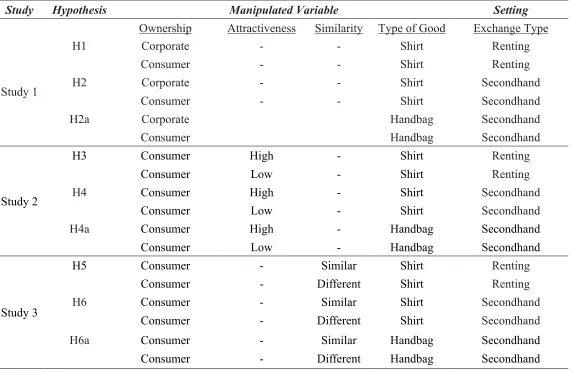
Based on the literature review, a conceptual framework is proposed (Figure 1). The purpose of this study is to investigate various management factors that can address the contamination issue, thereby increasing consumers’ collaborative consumption intentions. Specifically, it will examine the influence of several positive and negative contamination factors involved in the collaborative consumption of fashion goods. For this purpose, a total of three experimental studies with nine hypotheses will be conducted, and each will be supported by a relevant theory and unique manipulated variables. The nine hypotheses are tested across two contexts (e.g., access to ownership versus transfer of ownership) to strengthen the
generalizability of the findings. In Study 1, the manipulated variable comprises a factor that may reduce the negative contamination effect. It examines whether the ownership and management types of shared goods (e.g., corporate versus consumer ownership) have influence over
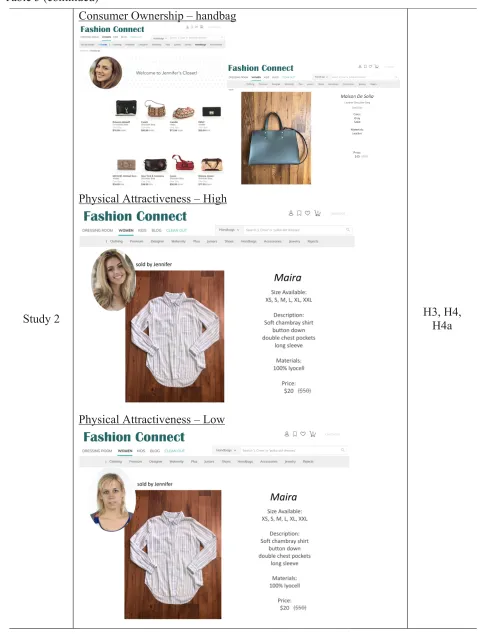
rental/purchase intentions. In Studies 2 and 3, factors that may lead to the positive contamination effect are examined. Such factors include the physical attractiveness of the seller (Study 2) and racial similarity between the seller and buyer (Study 3). All three studies consist of two
dependent variables: rental intention and purchase intention. Moreover, each study will test for the moderation effect of degree of contact by incorporating two different fashion items as part of the stimuli.
Study 1 examines two different types of ownership of shared goods (i.e., corporate-owned versus consumer-corporate-owned) and their influence on rental intentions (H1) and secondhand purchase intentions (H2). In terms of theoretical background, the law of contagion or the
attractiveness of the previous owner will be manipulated in rental (H3) and secondhand purchase (H4) settings. Also based on the consumer contamination theory, the effect of physical
attractiveness (“what is beautiful is good”) explains the potential positive impact of the previous owner’s attractiveness on purchase or rental intention. Study 3 investigates the effect of racial similarity between the previous owner and the prospective buyer on rental intention (H5) and secondhand purchase intention (H6). The similarity attraction theory can also the enhance positive contamination effect and provide reasons for why the perceived racial similarity between the previous and prospective user may affect rental (purchase) intention.
For all three studies, hypotheses are formulated to investigate the moderating role of the degree of contact with the shared fashion items (H2a, H4a, & H6a). Two items (shirt and
handbag) with varying degrees of contact with the body will be tested. However, the moderation effect will be tested in the secondhand purchase context only because the contamination effect is expected to be more pronounced when one purchases an item (more risk) than when one rents the item (less risk) for a short period of time.
Moreover, while Study 1 is tested in both the B2C and C2C settings, Studies 2 and 3 will be examined in the C2C setting only. This is because sources of information about the previous owner, such as a profile picture, are only available in the C2C setting. It is not possible to assess the physical attractiveness or racial similarity between the seller and buyer in the B2C context since the previous owners or users remain unidentified.
attitudes toward collaborative consumption. Thus, controlling the influence of these
Ownership of Shared Goods
According to the law of contagion, when a person comes into contact with an object, that
contact leaves an enduring influence on the object, whether the contact is physical (e.g., residue,
germs) or symbolic (e.g., meanings, soul) (Nemeroff & Rozin, 1994). In retail, studies have
shown that an object’s contact with another consumer reduces the value of the object through a
phenomenon described as the consumer contamination effect (Argo et al., 2006; Morales &
Fitzsimons, 2007). Indeed, one of the key deterrents to purchasing food products touched by
other consumers or secondhand clothing stems from the consumer belief that such products have
been “contaminated” (Argo et al., 2006; O’Reilly et al., 1984). Since objects exchanged through
collaborative consumption are shared or used by a number of individuals, the issue of consumer
contamination is inevitable.
As discussed in the previous section, collaborative consumption business models
generally take two different forms: corporate-owned or consumer-owned. Under corporate
ownership, items are purchased, managed, and merchandised by the collaborative consumption
service provider (e.g., Rent the Runway, Stitch Fix, and ThredUp). On the other hand, under
consumer ownership, items are owned, managed, and merchandised by the consumers (e.g.,
Poshmark, eBay, and Style Lend). Compared to consumer-owned and -merchandised fashion
goods, corporate-owned rental or secondhand fashion goods are often perceived to be more
neutral for the following reasons. When consumers rent or purchase secondhand fashion items
from corporate-owned websites like ThredUp, the previous owners of the items remain
unknown. There is no direct contact with the previous owner or user throughout the consumption
process. Furthermore, the items are curated and managed by a company that provides cleaning