!
"!" # $ $"
% & ''' (
Performance Analysis of WiMAX Scheduling Algorithms for QoS support in PMP
Mode
Harpreet Kaur*
Department of Computer Science & Engineering Bhai Gurdas Institute of Engineering & Technology,
Sangrur, India [email protected]
Gurpal Singh
Department of Computer Science & Engineering & IT Baba Banda Singh Bahadur Engineering College,
Fatehgarh Sahib, India [email protected]
Abstract: WiMAX (Worldwide Interoperability for Microwave Access) is being touted as the most promising and potential broadband wireless technology. The scheduling algorithm is the crucial point in QoS provisioning over such broadband wireless access (BWA) network. IEEE 802.16 standard supports two different topologies: point to multipoint (PMP) and Mesh. In this paper, a comprehensive performance study of scheduling algorithms in Point to Multipoint mode of WiMAX network had been conducted and it also describes Quality of Service over wi-max network. In the analysis, a WiMAX module was developed based on OPNET 14.0 simulator. Various real life scenarios like data, voice call are setup in the simulation environment. Parameters that indicate quality of service, such as, throughput, average load, average jitter and average delay, are analyzed for different types of service flows as defined in WiMAX. The simulation was carried out for scheduling algorithms such as Priority Queue and MDRR and evaluating the performance of each scheduler to support the different QoS classes.
Keywords: IEEE 802.16, QoS, OPNET, Scheduling Algorithms, WiMAX
I. INTRODUCTION
The increasing interest in wireless broadband communications is a consequence of both rapid growth and the rising importance of wireless communications and multimedia services to end users. Standard activities for BWA are being developed within IEEE project 802, Working Group 16, often referred to as 802.16[1].The technology provides basic Internet Protocol (IP) connectivity to the user. The variety of applications used in IP networks has increased tremendously in the recent years. Various multimedia applications along with the common email, file transfer and web browsing applications are becoming increasingly popular. These applications send large audio and video streams with variable bandwidth and delay requirements [2].WiMAX is an emerging standard for global broadband wireless access. It is capable of delivering high data rate throughput supporting fixed, portable, and mobile operation. The IEEE 802.16 standard provides QoS to all different kinds of application including real time traffic in the form of flow type association with each application.
This paper is organized as follow. The section II, describes the overview of MAC Layer and QoS and its five service flow classes. WiMAX scheduling algorithms has been discussed in section III. Section IV is concerned with the related work and Section V describes the simulation model and its obtained results. Section VI concludes the work.
II. IEEE 802.16 MAC
In IEEE 802.16, the medium access control (MAC) layer supports two modes: Point-to-Multipoint (PMP) and Mesh mode. The basic IEEE 802.16 architecture consists of one base station (BS) and one (or more) subscriber stations (SSs).Both BS and SS are stationary while clients connected to the SS can be mobile. BS acts as a central entity to transfer all data from SSs in PMP architecture. Any two (or more) SSs are not allowed to communicate directly[3]. The
transmission take place through two independent channels- downlink (DL) channel and uplink (UL) channel. The uplink channel is shared between all SSs while downlink channel is used only by the BS. The standard defines both Time Division Duplex
(TDD) and Frequency Division Duplex (FDD) for channel allocation. Both channels are time slotted and composed of frames. The TDD frame is composed of downlink and uplink sub-frames. The duration of these frames can be controlled by the BS whenever needed. The downlink channel is a broadcast channel and the BS broadcast data to all SS on the downlink channel. SSs accept only those packets which are destined for it. In the mesh mode, the nodes are organized in an ad-hoc fashion and scheduling is distributed among them [3][4].
The IEEE 802.16 MAC layer performs the standard Medium Access Control (MAC) layer function of providing a medium-independent interface to the physical (PHY) layer. The IEEE 802.16 MAC layer is divided in three parts - Privacy sublayer (lower), MAC Common Part Sublayer (middle) and Convergence sublayer (upper). The core of the MAC layer is Common Part Sublayer (CPS). The MAC CPS is designed to support PMP and mesh network architecture and the MAC is connection oriented. Upon entering the network, each SS creates one more connections over which their data packets are transmitted to and from the BS. It takes service data units (MSDUs) packets from the upper layer and organizes them into MAC protocol data units (MPDUs) for sent transmission and vice versa for received transmission [5][6].
supports optimized handover schemes with latencies less than 50 milliseconds to ensure real-time applications such as VoIP perform without service degradation. Flexible key management schemes assure that security is maintained during handover. The fundamental premise of the IEEE 802.16 MAC architecture is QoS [8].
A. Quality of Service (QoS)
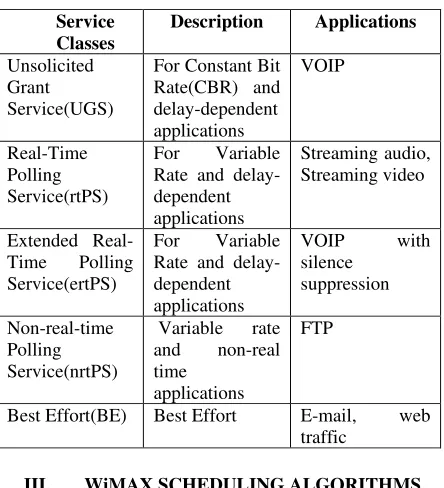
[image:2.612.65.287.348.592.2]Quality of Services (QoS) refers to different parameters in the network that determine the types of traffic that can be supported. For each application and for each customer, a different set of QOS are required. The IEEE 802.16 standard includes the QoS mechanism in the Medium Access Control (MAC) layer architecture. To support a wide variety of applications, WiMAX defines five scheduling services that should be supported by the base station. It defines service flows which enables the end-to-end IP based QoS [8]. The MAC layer is also responsible for scheduling of bandwidth for different users based on their requirements. The standard is designed to support a wide range of applications. These applications may require different levels of QoS. To accommodate these applications, the 802.16 standard has defined five service flow classes which are summarized in Table I [9][10].
Table .1Service Classes Defined by WiMAX
Service Classes
Description Applications
Unsolicited Grant Service(UGS)
For Constant Bit Rate(CBR) and delay-dependent applications VOIP Real-Time Polling Service(rtPS)
For Variable Rate and delay-dependent applications
Streaming audio, Streaming video
Extended Real-Time Polling Service(ertPS)
For Variable Rate and delay-dependent applications
VOIP with silence
suppression
Non-real-time Polling Service(nrtPS)
Variable rate and non-real time
applications
FTP
Best Effort(BE) Best Effort E-mail, web traffic
III. WiMAX SCHEDULING ALGORITHMS
Packet Switching networks came into existence, need was recognized to differentiate between different types of packets [11][13]. A scheduling algorithm has to determine the allocation of bandwidth among the users and their transmission order. One of the most important tasks of a scheduling scheme is to satisfy the Quality of Service (QoS) requirements of its users [12].
The IEEE 802.16 standard does not specify the scheduling algorithm to be used. Vendors and operators have the choice among many existing scheduling techniques or they can develop their own scheduling algorithms. Some of these algorithms are:
A. Priority-Queue
Strict-Priority packets are first classified by the scheduler according to the QoS class and then placed into different priority queues. It services the highest priority queue until it is empty, and then moves to the next highest priority queue. This mechanism could cause bandwidth starvation for the low priority QoS classes [14][15].
B. Modified Deficit Round Robin (MDRR)
MDRR scheduling is an extension of the previously mentioned DRR scheduling scheme [16].There may be different modifications of the DRR scheme and yet share the name is MDRR. The algorithm depends on the DRR scheduling fundaments to a great extent, however, in MDRR the quantum value given to the queues is based on the weight associated with them.
The MDRR scheduling scheme adds a Priority Queue (PQ) into consideration with DRR. A Priority Queuing scheme isolates high demanding flows from the rest of the other flows for the reason of better quality of service provisioning [17].
IV. RELATED WORK
There are many articles on the WiMAX QoS scheduling that have presented the scheduling disciplines to guarantee QoS. The IEEE working group has designed a new standard based on BWA systems for last mile wireless access named IEEE 802.16 Wireless MAN.
K. Wongthavarawat et al in [10] evaluates Packet
scheduling for QoS support in IEEE 802.16.They describes the concept of various scheduling algorithms.
C. Ravichandiran et al in [17] focuses on the Analysis, Modification, and Implementation (AMI) of MDRR scheduling algorithm’s attributes, properties and architecture for the IEEE 802.116e (Mobile WiMAX).
J. Lin et al in [18] describes the analysis of QoS in WiMAX networks. It includes the definition of various service flows classes and their applications defined by the IEEE 802.16.
Hemant Kumar Rath et al in [19] describes an
Opportunisitic DRR(O-DRR) Uplink Scheduling Scheme For IEEE802.16-based Broadband Wireless Networks.
V. SIMULATION RESULTS
The overall goal of this simulation study is to analyze the performance of different existing scheduling algorithm in WiMAX environment. The simulations have been performed using OPNET version 14.0 educational version [20][21].The main method to evaluate a Scheduling algorithm is implementation/simulation. This is the most versatile method of testing scheduling algorithms which actually simulate the designed algorithm with real life data and conditions.
A. OPNET Modeler
systems [21]. The package consists of a number of tools, each one focusing on particular aspects of the modeling task. These tools fall into three major categories that correspond to the three phases of modeling and simulation projects: Specification, Data Collection and Simulation, and Analysis.
It has a Graphical User Interface (GUI) with a “user friendly” sense. It has an enormous library at the service of the user. On request, OPNET Technologies can provide ready-to-use models [21]. For the research to be done in this project, “OPNET Modeler Wireless Suite” was provided with an accompanying “WiMAX Model”.
B. System Modeling and Scenario
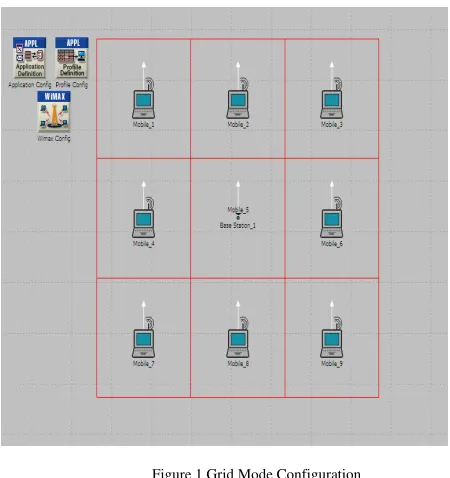
[image:3.612.323.536.123.354.2]The network topology of simulation scenarios is illustrated in Figure 1. A scenario of 8 mobile stations and 1 Base station in WiMAX Network is created in grid mode using OPNET 14.0. The WiMAX configuration node is used to store profiles of PHY and service class which can be referenced by all WiMAX nodes in the network. We have assigned different interface having different IP addresses to the BS and eight mobile nodes also called subscriber stations (SS) then applied Priority Queue and MDRR scheduler at BS and SSs and used best-effort type of service (TOS) respectively.
Figure 1 Grid Mode Configuration
[image:3.612.63.288.329.568.2]The simulation parameters are summarized in Table II. A 10 MHz channel bandwidth with 5 GHz base frequency is configured to study the effect of network traffic on each QoS class with different scheduling algorithm.
Table.2 Simulation parameters
Simulation Parameter Value
Channel Bandwidth 10MHz Duplexing Technique TDD Channel Frequency 5GHz Antenna Type Omni Antenna Gain 15 dBi
PHY Profile Wireless OFDMA 20MHz
Modulation scheme 64 QAM,16 QAM
To present the results of simulations we have compared Average WiMAX delay at base station (BS) and at each mobile node (SSs) using Priority Queue and MDRR scheduler with different type-of-service (TOS) respectively. The simulation is performed on created scenario for transfer of data and voice over WiMAX network.
Figure 2 Average Delay (sec) in WiMAX
[image:3.612.324.535.450.661.2]Average WiMAX delay (in sec) using Priority Queue scheduler at base station is more as compared to average WiMAX delay using MDRR scheduler as shown in the figure 2. and average load in WiMAX (bits/sec) at base station using Priority Queue scheduler is also higher than Average load in WiMAX (bits/sec) at base station using MDRR scheduler which is shown in figure 3.
Figure 3 Average Load (in bits/sec) in WiMAX
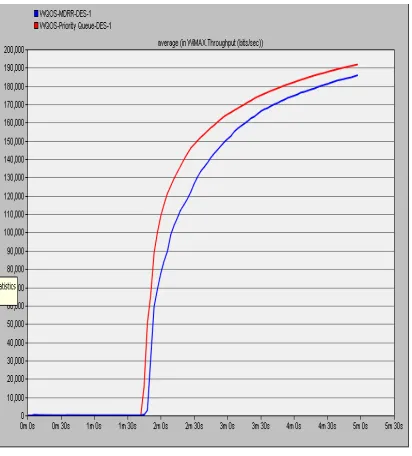
[image:3.612.67.273.634.737.2]Figure 4 Average Throughput (bits/sec) in WiMAX
[image:4.612.323.535.50.294.2]In Fig. 5 the jitter graph, represent that the MDRR scheduler has the higher average jitter (sec) value in voice as compared to Priority Queue scheduler and the average packet delay variation of MDRR scheduler is also higher than the Priority Queue scheduler in voice as shown in figure 6.
Figure 5 Average Jitter (sec) in Voice
Figure 6 Average packet Delay variation in voice
[image:4.612.332.546.370.593.2]The average traffic received (bytes/sec) of Priority Queue scheduler is higher than the MDRR scheduler in voice as shown in figure 7.
Figure 7 Average traffic received (bytes/sec) in voice
VI. CONCLUSION & FUTURE WORK
[image:4.612.75.275.385.615.2]For future work, the effect of these algorithms can also be studied by varying the size of packets, Jitter, Latency and other parameters and to improve throughput and reduce delay for different scheduling algorithms.
VII. REFERENCES
[1] IEEE Std 802.16e-2005, "IEEE Standard for Local and metropolitan area networks--Part 16: Air Interface for Fixed Broadband Wireless Access Systems--Amendment 2: Physical and Medium Access Control Layers for Combined Fixed and Mobile Operation in Licensed Bands," Feb. 2006. [2] IEEE 802.16-2004, “IEEE standard for Local and
Metropolitan Area Networks - Part 16: Air Interface for Fixed Broadband Wireless Access Systems,” Oct. 2004.
[3] Malik Muhammad Asim, Muid Mufti, “Design and Implementation of IEEE 802.16 MAC Layer Simulator”, IJCSNS International Journal of Computer Science and Network Security, VOL.9 No.8, August 2009
[4] Eduardo Flores Flores, Raul Aquino Santos, Victor Rangel Licea, Miguel A. Garcia-Ruiz, Arthur Edwards Block, “MAC layer Mechanism for Wireless WiMAX Networks with Mesh Topology”, Electronics, Robotics and Automotive Mechanics Conference 2008, pp. 151-156, IEEE Computer Society.
[5] Jungnam Yun, “Phy/Mac Cross-Layer Issues in Mobile WiMAX”, Bechtel Corporation 2006. [6] Haitham Abu Ghazaleh, Jun Cai, and Attahiru Sule
Alfa, “Performance Analysis for Polling Service in IEEE 802.16 Networks Under PMP Mode”, IEEE-2008.
[7] Bashir Hayat, Raheel Mansoor Abdul Nasir, “802.16 2001 MAC Layer QoS”, Ubiquity - Volume 7, Issue 17 (May 1, 2006 -May 8, 2006).
[8] Rohit A. Talwalkar, Mohammad Ilyas, “Analysis of Quality of Service (QoS) in WiMAX networks”, IEEE 2008.
[9] Mikael Gidlund, Gang Wang, “Uplink Scheduling Algorithms for QoS Support In Broadband Wireless Access Networks”, Journal of Communications, Vol. 4, No. 2, March 2009
[10] K. Wongthavarawat and A. Ganz, ”Packet scheduling for QoS support in IEEE 802.16 issue 1, pp. 81-96, Feb. 2003
[11] L. Georgiadis, R. Guerin and V. Peris, “Efficient network QoS provisioning based on oer node traffic shaping,” IEEE/ACM Trans. Networking, vol. 4, pp. 482-501, 1996.
[12] Ahmed H. Rashwan, Hesham M.ElBadawy, Hazem H. Ali, “Comparative Assessments for Different WiMAX Scheduling Algorithms”, Proceedings of the World Congress on Engineering and Computer Science 2009 San Francisco, USA Vol I, WCECS 2009, October 20-22, 2009.
[13] Pratik Dhrona, Najah Abu Ali, Hossam Hassanein, “A Performance Study of Uplink Scheduling Algorithms In Point to Multipoint WiMAX Networks", Queen’s University Kingston, Ontario, Canada, December, 2007
[14] Sammy Chan1, Yan Wang, Aun Haider, Richard Harris, Moshe Zukerman, “Algorithms for WiMAX Scheduling”, IEEE, 2008
[15] Jin-Cherng Lin, Chun-Lun Chou, Cheng-Hsiung Liu, “Performance Evaluation for Scheduling Algorithms in WiMAX Network”, 22nd International Conference on Advanced Information Networking and Applications-Workshops, pp. 68-74, 2008
[16] M.Shreedhar and G.Varghese, “Efficient Fair Queuing using Deficit Round Robin”, IEEE/ACM Transactions on Networking, vol.1, no.3, pp.375-385, June 1996.
[17] C. Ravichandiran, Dr.C. Pethuru Raj, Dr. V. Vaidhyanathan, “Analysis, Modification, and Implementation (AMI) of Scheduling Algorithm for the IEEE 802.116e (Mobile WiMAX)”, (IJCSIS) International Journal of Computer Science and Information Security, Vol. 7, No. 2, 2010
[18] J. Lin and H. Sirisena, ”Quality of service scheduling in IEEE 802.16 broadband wireless networks,” in Proc. First International Conference on Industrial and Information Systems, Aug. 2006
[19] Hemant Kumar Rath, Abhijeet Bhorkar, Vishal Sharma,”An Opportunisitic DRR(O-DRR) Uplink Scheduling Scheme For IEEE802.16-based Broadband Wireless Networks, Department of Electrical Engineering, Indian Institute of technology Bombay, Mumbai,2006.
[20] OPNET Technologies, OPNET modeler. Software Package. Available at: http://www.opnet.com [21] James D. Boggs, “A Tutorial on Basic Use of