Volume 5, No. 3, March-April 2014
International Journal of Advanced Research in Computer Science
RESEARCH PAPER
Available Online at www.ijarcs.info
Artificial Neural Network Classification for Handwritten Digits Recognition
Mohammed Hussein Naji Jabardi*1, 2
1
Department of Computer Science Jamia Hamdard, New Delhi, India
2
University of Kufa, Najaf, Iraq
Harleen Kaur
Department Of Computer Science Jamia Hamdard, New Delhi, India
Abstract: Handwritten recognition is very powerful technology to support many applications comes in the forefront of automated sorting of letters and bank checks, and help the blind and Who have difficulty to read books and magazines, and the translation of books from one language to another, and converted to texts can store and processed in the computer. This paper is present two artificial neural network classification for handwritten digit recognition (from 0 to 9) with accuracy more than 98% by using an application of feed-forward multilayer neural network with two different classifiers (Forward Multilayer Neural Network FMNN and Binary Coding Neural Network BCNN).The highest recognition reliability and minimal error rate for the recognition of handwritten digits have been achieved. The back propagation algorithm minimizing the total error of the network over a set of training by searching of the weight value that achieves the objective. Binary coding approach is used to reducing the number of output that it leads to reducing the time that need for processing and saving the resources and finally reduce the network’s complexity.
Keywords: Artificial neural network, handwritten digits recognition, Back propagation, forward multilayer neural network, classifier
I. INTRODUCTION
The history of discrimination numbers is a relatively old in the field of pattern recognition In 1929 was the first to obtain a patent for the symbols of discrimination by the German Tauscheck where the matching principle was used template matching and techniques that have been used in the optical and mechanical time[1].With the development that has occurred in the field of digital computers and microprocessors emerged in the mid- forties appeared a modern version of the system recognize letters visually (recognition optical character) for the first time been recognized by OCR as an input for the treatment of the data. OCR software uses the principle of templates matching, extensively in application's discrimination symbols and letters and numbers until the present day [1]. Many researchers and specialists in the field of pattern recognition Tried to find ways and means to achieve a high rate of matching up to 99% using neural networks smart addition to the traditional techniques to recognize letters and numbers [2]. Handwriting recognition is a crucial field that has been studied and many researchers developed many methods. [8] Clarify that handwritten digit recognition can be divide into two categories, offline recognition and online recognition.
Offline recognition primarily deal with the user input handwritten digit by processing and recognizing, based on patterns (the scanned images of handwritten digit transformed from the real handwritten to the digital system).Several methods have been proposed to solve offline recognition by [8].On-line recognition, deals with the recognition of handwriting captured by a touch-sensitive device as mobiles and tablet, and uses the digitized trace of the pen to recognize the symbol. The main difficulty of handwriting recognition mechanism is that there are great variability’s for different writing styles. Great progress have been made in recognition of handwritten numerals and English letters each single-stage neural network produces the recognition rate of 90.92%, 89.58% and 88.06% respectively, the combined system achieve the overall
recognition rate of 99.34% [8], showing that the multi-stage architecture system is more suitable and do help to improve the performance of the recognition system efficiently.
The main objectives achieved in this thesis. Firstly, present a reliable system that can recognize handwritten digits with high accuracy (more than 98%) by using neural network topologies with two different models (Forward Multilayer Neural Network FMNN and Binary Coding Neural Network BCNN). The highest recognition reliability and minimal error rate for the recognition of handwritten digits have been achieved. Secondly, show the effect of neural network parameters on the efficient and stability of network and how controls parameters can and increase the capability of the network working with minimum errors. Different structures and configuration have been discussed and examined in this thesis to show the role of the hidden neurons and the learning rate in change performance of the network and its accuracy. Third make comparison between the two models and explain the better and why, depending on the results that toke from implementation the two models by training, validation and testing several patterns. Fourth Improve the efficiency of Binary Coding Neural Network (BCNN) with patterns recognition and how this technique is powerful in reducing the complexity of the neural network and reduces the time processing which saving the resources.
II. METHOD
solution optimized for by achieving the lowest rate of error [6]. This research adopts the above operations to design a reliable and flexible system that recognizes the digits 0-9. There are many issues must be taken into consideration when designing the network.
A. The number of input nodes:
The number of input nodes can be affected on the network performance. The number of input nodes is corresponding to the variable number of the input vector. The number of input nodes in the pattern recognition system usually determine by the number of feature extract, until this time there is no restricted rule to determine the number of nodes [4].
B. Network topology:
First of all network topology single layer (no hidden layer) or multilayer (has one or more hidden layer) depend on the nature of the problem, Most researchers believe one hidden layer is enough to solve any problem pattern recognition purposes [7].However, one hidden layer networks may consist of a very large number of hidden may be leads the training time and the neural network generalization ability will worsen. In the other side, many problems is better working with two hidden layer neural network and the result will be more accurate, so two hidden layers provide more benefits. The most common way in determining the number of hidden nodes is via experiments or by trial-and error [3].
C. The number of neuron in hidden layer:
The number of hidden units This determines the expressive power of the network For smooth functions only a few number of hidden units are needed for wildly fluctuating functions more hidden units will be needed. The effect of the number of hidden units, a large number of hidden units leads to a small error on the training set but not necessarily leads to a small error [3]. The most common way in determining the number of hidden nodes is via experiments or by trial-and error.
D. The number of output layer:
The number of hidden units This determines the expressive power of the network For smooth functions only, a few number of hidden units are needed for wildly fluctuating functions more hidden units will be needed, a large number of hidden units leads to a small error on the training set but not necessarily leads to a small error [3]. The most common way in determining the number of hidden nodes is via experiments or by trial-and error.
E. Learning rate:
The learning rate is a very important factor in many of the learning algorithms, because the speed of learning depend on that parameter and at which artificial neural network arrives at the minimum[11] solution Choices that must be identified on the designer during the training speed of learning, this variable is determined by the speed of modernization weights and access to the final weights, in standard back propagation, too low a learning rate[6]makes the network learn very slowly .Too high a learning rate makes the weights and objective function swerve, so there is no learning at all[14]. Trying to train a neural network using
a constant learning rate is usually a monotonous process requiring much trial and error.
F. Determiner:
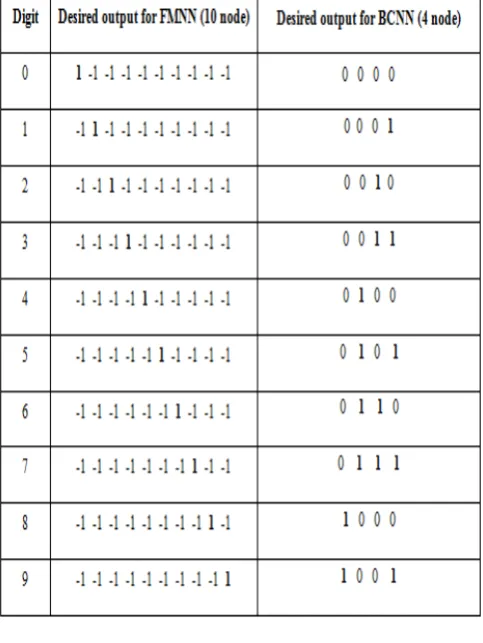
The purpose of Determiner is to determine the output of the neural network by making some operation on the output and then compare the output with the Desired output data as in table (1) in order to decide if the result is one of digits numbers (from 0 to 9) or not. The Determiner will show the success output or failed, so we can calculate the accuracy of the network in this stage by helper of Determiner. The table shows the desired output for each digit.
Table 1. Desired output for FMNN and BCNN
III. THE CLASSIFIERS
In our research, we have two proposed classifiers have been built as multilayer feed-forward neural network with one hidden layer, the input layer has 10 inputs neuron, number of neurons in the hidden layer will be select by training different set and choose the best one with minimal error, learning rate has been chosen in a range [0.01 to 0.1] and the output neuron is 10 neurons for FMNN and 4 output neurons for BCNN).The output vector will be compared with target vector (desired).Each element of target vector is a binary value (-1 or 1) in the FMNN and the output is in the range [-1,1],so we take the index of maximum output. In the BCNN the output in the range [-1, 1] and the target value is a binary value (0 or 1) as in table (1). The outputs of this network are calculated according to the following equations [9].
Y = (1)
Z= (2)
(4)
So= (D - Z) x (5)
Syj=Wij x x So (6)
The Hidden layer weight is calculated as
Wnew= W + x Sy x Y (7)
The output layer weight is calculated as
Wnew= W + x So x Z (8)
(9)
Where
ƒ( ) is the transfer function of the neurons.
base1 are the weights of the bias in the input layer. base2 is the weight of hidden layer.
W is the weight connection vector between the input layer and the hidden layers
W is the weight connection vector between the hidden layer and the output layers
Y is the output of the hidden layer,
X is the input vector.
Zi is the output vector of classifier
So is Error Signal of hidden layers
Sy is Error Signal of output layers E is total error
IV. NETWORKS DESIGN
A. Forward Multilayer Neural Network (FWNN):
The first model is A feed-forward multilayer neural network topology with Back-propagation algorithm as training algorithm with the input vectors that represent the handwritten digit image features and single hidden neural with 10 neuron output that acts the ten digits (from 0 to 9).The number of hidden neurons in hidden layer can be determine by training the network with different set number of hidden neuron [8 , 11, 14 , 17 , 20 , 23 , 26 , 29 , 32, 35, 38, 42, 46, 50, 54, 60] and select the best set that has minimum error. Mean Square Error (MSE) will be used as a measure of the accurate of network that mean the network that has the minimum error during the training procedure. Learning rate in general is small enough to ensure convergence. A learning rate between (0.01 and 0.1) is often adequate as a first choice. Weight Initializing as random data are generated for all weights in the range of (-1.0 and 1.0).Training data will have been taken from 150 persons and each person write the digits(0 to 9) five times so, the total sample is 7500 samples. The methodology of validation has been divided as in table (2)
Table 2. Methodology of training, validation and testing
Figure 1 shows that best number of hidden neuron is 20 because it has the minimum error
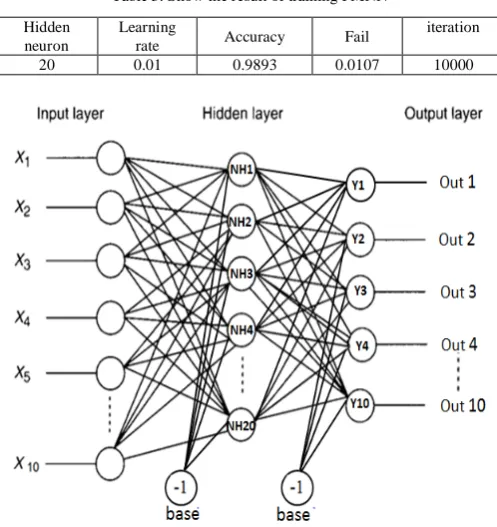
The final architecture and parameter of FMNN as in Figure(1)
a. 10 input neurons
b. Single hidden layer with 20 neurons
c. Training algorithm is back-propagation with 0.01 learning rate
d. 10 output neurons e. Final result as in table(3)
Table 3. Show the result of training FMNN
Hidden neuron
Learning
rate Accuracy Fail
iteration
20 0.01 0.9893 0.0107 10000
Figure (1) Architecture of FMNN proposed
B. Binary Coding Neural Network (BCNN):
35, 38, 42, 46, 50, 54, 60] and select the best set that has minimum error. Mean Square Error (MSE) will be used as a measure of the accurate of network that mean the network that has the minimum error during the training procedure. Learning rate in general is small enough to ensure convergence. Learning rate between (0.01 and 0.1) is often adequate as a first choice. Weight Initializing as random data are generated for all weights in the range of (-1.0 and 1.0).
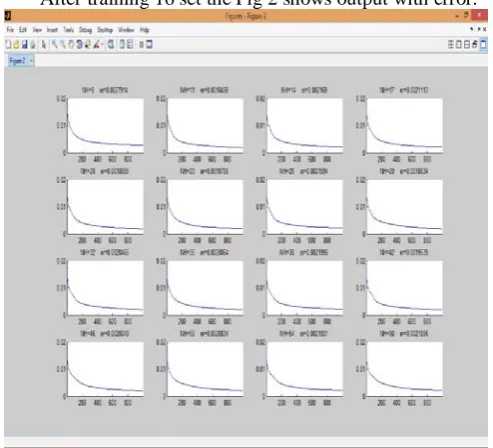
After training 16 set the Fig 2 shows output with error.
Figure 1 shows that best number of hidden neuron is 11 because it has the minimum error.
The final architecture of BCNN as in Figure (4) a. 10 input neurons
b. Single hidden layer with 11 neurons
c. Training algorithm is back-propagation with 0.03 learning rate
d. 4 output neurons e. Final result as in table(4)
Table 4. Show the result of training FMNN
Hidden neuron
Learning
rate Accuracy fail
iteration
11 0.03 0.9846 0.0154 10000
Figure (4) Architecture of BCNN proposed
V. RESULTS DISCUSSION AND LIMITATION
After the Training, Validation and Testing from previous, we summarized the results as in Table (5) and Table (6) it is easy to see that there three issues can be discuses according to our results as follow
A. The accuracy:
The accuracy of both model ( FMNN and BCNN) are very near and the difference in part of thousand , so in spite of the high accuracy of FMNN than BCNN, but that not mean the FMNN better than BCNN. If we disuse the result of two models with same number of neurons hidden 20 we found the accuracy for FMNN is 0.9893 and accuracy for BCNN is 0.9846,so the differences just 0.0047,which mean every 1000.
Table 5. Show the result of training 4 best FMNN
Hidden neuron
Learning
Rate Accuracy fail
Time in SC
iteration
20 0.01 0.9893 0.0107 551.153 10000
23 0.01 0.9864 0.0136 568.552 10000
32 0.01 0.9808 0.0192 616.275 10000
50 0.01 0.9769 0.0231 710.767 10000
Table 6. Show the result of training 4 best BCNN
B. Time Processing:
The era of speed, yes we are in technology’s era and The era of speed, yes we are in technology’s era and machines enter in every part of our live, so the speed and accuracy are very important factors as a measure of all operation and activities, therefore, our neural network must satisfy and include speed and accuracy. From above there is no big differences between the two models in the result, but the differences clearly in a time of processing, but if take the same models with processing time we found for FMNN processing time is 568.552 second and BCNN processing time is 400.991 second, the differences between them is 167.561 second very big time for recognition one samples, above all if we have 100 samples of handwritten digits and we want to test those samples by two models, we find the FMNN model needs 56855 seconds and BCNN model needs 40099 seconds, so the differences between two time are 16756 seconds, that scary and very huge number..
C. Complexity:
The complexity of the neural network is very important issue when we want to plan to design the network, the complexity is related with the number of neurons output, for example, in our network we have two models FMNN with 10 output neurons and BCNN model with four output neurons, so the degree of complexity of FMNN more than complexity of BCNN, but very small degree because the differences between the output neurons of two models just 6 neurons and that number no big enough to illustrate the complexity. The output neurons of neural network for
Hidden neuron
Learning
Rate Accuracy fail
Time in SC
iteration
11 0.01 0.9885 0.0115 349.721 10000
20 0.01 0.9846 0.0154 400.991 10000
29 0.01 0.9815 0.0185 436.307 10000
recognize the patrons include digits, letters (capital and small) and space needs 63 neurons, so imagine complexity the network with 63 outputs and the number of connections between the neurons and the complicated to calculate the weight and errors, so if we decided to build a network with the FMNN model the network will be very complex, inversely we need just 6 neurons output if use BCNN, which is mean the network is simple and high scalability because there is no complexity in the network.
D. Limitation:
The limitation of the two models FMNN and BCNN that illustrate in this research are simple and reliable, but it using for single digit from (0 to 9).this limitation can be solve it in future by implementation the concept of this technique on hole pattern that may be contains numbers and letters.
This thesis is deal with single isolated hand written digit, so if we need to use the proposed FMNN and BCNN in any string of digits ,firstly we must separate each single digit from digit’s string by splits and divided the string into number of digits and then perform processing of recognition N times where N act number of digits in string of digit.
VI. CONCLUSION AND FUTURE
ANN can be trained to solve certain problems using a teaching method and sample data. In this way, identically constructed ANN can be used to perform different tasks depending on the training received. With proper training, ANNs are capable of generalization, the ability to recognize similarities among different input patterns, especially patterns that have been corrupted by noise. Neural Networks are a powerful tool for Pattern recognition, generalizing to a problem and Machine learning. The neural network is one of the active techniques that belong to artificial intelligent and accrues mythology for pattern recognition especially if we selected the correct value of parameters Number of hidden neurons and best learning rate.
The number of output neurons important factors for simplicity the neural network, this concept can be applied by using binary coding technique, so by reducing the number of output neurons will reduce the complexity of the network and saves the resources. We plan in the future to develop a model, especially BCNN to work patterns that contains letters and numbers as words by split the words and cutting to a single element and recognize it. In order to make our model BCNN more efficiency and more powerful by mixing the features of artificial neural network concept and Genetic Algorithm (GA) to establish a new network that can learn by itself by exploiting the power and features GA, so GA is using to training the network Genetic algorithms (GAs) offer a particularly attractive approach to optimization since they generally perform an effective search of large, non-linear spaces. Recurrent/feedback neural network can be used in future, in our system to make the system take
decision automatically without the need to teacher that means the system is unsupervised learning.
VII.REFRENCES
[1] Sinha A.: An Improved recognition module for the identification of handwritten digits. Unpublished, M. Sc., Thesis, Department of Electrical engineering and computer Science(1999)12,13
[2] Amin, A. , Kavianifar, M. , :Automatic Recognition of printed Arabic Text Using Neural Network Classifier (1997) ,2
[3] Chester, D.L.:Why two hidden layers are better than one? . In: Proceedings of the International Joint Conference on Neural,( 1990)1266-1268.
[4] Guoqiang Zhang, B. Eddy Patuwo, Michael Y. Hu : Forecasting with artificial neural networks Graduate School of Management, Kent State University, Kent, Ohio 44242-0001, USA (1997)44-47.
[5] Zurada, J.M: Introduction to Artificial Neural Systems.(1992)185-195.
[6] Barron, A.R.,. : A comment on ‘‘Neural networks: A review from a statistical perspective’’. Statistical Science 9 (1)( 1994) 33–35.
[7] Cybenko, G.,. : Approximation by superpositions of a sigmoi- dal function. Mathematical Control Signals Systems 2 (1989), 303–314.
[8] Tang, Z., Fishwick, P.A.,.: Feedforward neural nets as models for time series forecasting. ORSA Journal on Computing 5 (4)( 1993), 374–385.
[9] Ping Zhang,A : Reliable Recognition of Handwritten Digits Using A Cascade Ensemble Classifier System and Hybrid Features Thesis in The Department of Computer Science and Software Engineering,(2006)8-11.
[10] Laurene Fausett: Fundamental of Artificial Neural Systems Architectures,Algoritms and application , ,( 2002)11-25.
[11] CHRISTOPHER M. BISHOP :Neural Networks for Pattern Recognition ,Department of Computer Science, and Applied Mathematics, Aston University Birmingham, UK ,(1995),332-349.
[12] Fausett, L :Fundamentals of Neural Networks, Prentice-Hall, Englewood Cliffs, NJ,( 1994)187.
[13] Nguyen, H., T.,:Neural network and Fuzzy logic, University of technology, Sydney.( 2013).
[14]
Methods to Fix Number of Hidden Neurons in Neural Networks. 2.