Strategies for Teaching “Mixed” Computational Linguistics classes
Eric Fosler-Lussier
Dept. of Computer Science and Engineering Dept. of Linguistics
The Ohio State University Columbus, OH 43210, USA [email protected]
Abstract
Many of the computational linguistics classes at Ohio State draw a diverse crowd of students, who bring different levels of preparation to the classroom. In the same classroom, we of-ten get graduate and undergraduate students from Linguistics, Computer Science, Electri-cal Engineering and other departments; teach-ing the same material to all of these students presents an interesting challenge to the in-structor. In this paper, I discuss some of the teaching strategies that I have employed to help integrate students in two classes on auto-matic speech recognition topics; strategies for a graduate seminar class and a standard “lec-ture” class are presented. Both courses make use of communal, online activities to facilitate interaction between students.
1 Introduction
As one of the themes of the Teach-CL08 workshop suggests, teaching students of many kinds and many levels of preparation within a single course can be an interesting challenge; this situation is much more prevalent in a cross-disciplinary area such as compu-tational linguistics (as well as medical bioinformat-ics, etc.). At Ohio State, we also define the compu-tational linguistics field relatively broadly, including automatic speech recognition and (more recently) information retrieval as part of the curriculum. Thus, we see three major variations in the preparation of students at OSU:
1. Home department: most of the students tak-ing CL courses are either in the Ltak-inguistics
or Computer Science and Engineering depart-ments, although there have been students from foreign language departments, Electrical En-gineering, Psychology, and Philosophy. Al-though there are exceptions, typically the en-gineers have stronger mathematical and com-putational implementation skills and the non-engineers have a stronger background in the theoretical linguistics literature. Bringing these groups together requires a balancing between the strengths of each group.
2. Specialization (or lack thereof): Many of the students, particularly in seminar settings, have particular research agendas that are not tradi-tionally aligned with the topic of the class (e.g., students interested in parsing or computer vi-sion taking an ASR-learning course). Further-more, there are often students who are not se-nior enough to have a particular research track, but are interested in exploring the area of the course. Our courses need to be designed to reach across areas and draw on other parts of the curriculum in order to both provide con-nections with the student’s current knowledge base, and allow the student to take away use-ful lessons even they do not plan to pursue the topic of the course further.
enroll are usually very motivated (and conse-quently do well), but one must keep in mind the differences in abilities and time constraints of each type of student. If the graduate stu-dents outnumber the undergraduates, introduc-ing mentorintroduc-ing opportunities can provide a re-warding experience for all concerned.
From a practical perspective, this diversity presents a significant challenge – especially in uni-versities where enrollment concerns drive curricular matters to some degree. Inclusiveness is also a rea-sonable goal from a financial, not just a pedagog-ical, perspective. CSE enrollments have declined significantly since the dot-com bust (Vegso, 2008), and while the declines are not as sharp as they once were, the current environment makes it more diffi-cult to justify teaching narrow, advanced courses to only a few students (even if this were the practice in the past).
In this paper, I describe a number of strategies that have been successful in bringing all of these diverse populations into two different classes of-fered at OSU: a graduate seminar and a under-grad/graduate lecture class. The topic of both classes was statistical language processing, with a signif-icant emphasis on ASR. Sample activities are dis-cussed from each class.
While there are significant differences in the way that each class runs, there are several common ele-ments that I try to provide in all of my classes.:
I first establish the golden rule: primary among my self-imposed rules is to make clear to all participants that all points of view are to be re-spected (although not necessarily agreed with), and that students are coming to this class with different strengths. If possible, an activity that integrates both linguistic and computer science knowledge should be brought in within the first week of the class; in teaching CSE courses, I tend to emphasize the lin-guistics a bit more in the first week.
I try to help students to engage with each other: a good way to foster inter- and intra-disciplinary respect is to have the students work col-laboratively towards some goal. This can be chal-lenging in a diverse student population setting; mon-itoring progress of students and gently suggesting turn-taking/mentoring strategies as well as
design-ing activities that speak to multiple backgrounds can help ease the disparity between student back-grounds. Preparing the students to engage with each other on the same level by introducing online pre-class activities can also help bring students together. I try to allow students to build on previous knowledge via processes other than lecturing: a lecture, presented by either a student or a profes-sor, is a “one-size-fits-all” solution that in a diverse population can sometimes either confuse unprepared students, bore prepared students, or both. Interac-tive in-class and out-of-class activities have the ad-vantage of real-time evaluation of the understanding of students. This is not to say that I never lecture; but as a goal, lecturing should be short in duration and focused on coordinating understanding among the students. Over the years, I am gradually reduc-ing the amount of lecturreduc-ing I do, replacreduc-ing it with other activities.
By putting some simple techniques into place, both students and I have noticed a significant im-provement in the quality of classes. In Section 2, I describe improvements to a graduate seminar that facilitated interaction among a diverse group of par-ticipants. The most recent offering of the 10-week seminar class had 22 participants: 14 from CSE, 7 from Linguistics, and one from another depart-ment. In my informal evaluation of background, 13 of the 22 participants were relatively new to the field of computational linguistics (<2 years experience). Student-directed searching for background materi-als, pre-posing of questions via a class website, and blind reviewing of extended project abstracts by fel-low students were effective strategies for providing common ground.
Section 3 describes improvements in a lecture-style class (Foundations of Spoken Language Pro-cessing) which has a similarly diverse participant base: the most recently completed offering had 7 CSE and 3 Linguistics Students, with the under-grad/graduate student ratio 3:7. Devoting one of the two weekly sessions to in-class group practical ex-ercises also bolstered performance of all students.
2 Seminar structure
seri-ous challenge: the previseri-ous seminar offering (on se-quential machine learning) two years prior was not as inspiring as one would hope, with several students not actively participating in the class. This happened in part because students were permitted to suggest papers to read that week, which usually came from their own research area and often had esoteric termi-nology and mathematics. There was nothing wrong with the papers per se, but many of the students were not able to bridge the gap from their own experience to get into the depths of the current paper. While I thought having students partially control the seminar agenda might provide ownership of the material, in practice it gave a few students control of the session each time. In the more recent offering, this problem was likely to be exacerbated: the increased diversity of backgrounds of the students in the class suggested that it would be difficult to find common ground for discussing advanced topics in machine learning.
In previous seminars, students had given computer-projected presentations of papers, which led to rather perfunctory, non-engaged discussions. In the offering two years prior, I had banned computerized presentations, but was faced with the fact that many students still came unprepared for discussions, so the sessions were somewhat hit-and-miss.
In sum, a reorganization of the class seemed de-sirable that would encourage more student partici-pation, provide students the opportunity to improve their background understanding, and still cover ad-vanced topics.
2.1 A revised seminar structure
The previous instantiation of the seminar met twice weekly for 1 1/2 hours; in the most recent offering the seminar was moved to a single 2 1/2 hour block on Fridays. Each week was assigned a pair of stu-dent facilitators who were to lead the discussion for the week. The instructor chose roughly four papers on the topic of the week: one or two were more ba-sic, overview papers (e.g., the Rabiner HMM tuto-rial (Rabiner, 1989) or Lafferty et al.’s Conditional Random Fields paper (Lafferty et al., 2001)), and the remaining were more advanced papers. Students then had varying assigned responsibilities relating to these papers and the topic throughout the week. Out-of-class assignments were completed using
dis-cussion boards as part of Ohio State’s online course management system.
The first assignment (due Tuesday evening) was to find relevant review articles or resources (such as class or tutorial slides) on the internet relating to the topic of the week. Each student was to write and post a short, one-paragraph summary of the tuto-rial and its strengths and weaknesses. Asking the students to find their own “catch-up” resources pro-vided a wealth of information for the class to look at, as well as boosting the confidence of many stu-dents by letting them find the information that best suited them. I usually picked one (or possibly two) of the tutorials for the class to examine as a whole that would provide additional grounding for class discussions.
The second assignment (due Thursday evening at 8 pm) was for each student to post a series of questions on the readings of the week. At a min-imum, each student was required to ask one ques-tion per week, but all of the students far exceeded this. Comments such as “I totally don’t understand this section” were welcome (and encouraged) by the instructor. Often (but not exclusively) these ques-tions would arise from students whose background knowledge was sparser. In the forum, there was a general air of collegiality in getting everyone up to speed: students often read each others’ questions and commented on them inline. Figure 1 shows a sample conversation from the course; many of the small clarifications that students needed were han-dled in this manner, whereas the bigger discussion topics were typically dealt with in class. Students often pointed out the types of background informa-tion that, if discussed in class, could help them better understand the papers.
Student 1: After reading all of these papers on [topic], astoundingly, a few of the concepts have started to sink in. The formulas are mostly gibberish, but at least they’re familiar. Anyhow, I have only mostly dumb questions....
• [Paper 1]:
– Anyone want to talk about Kullback-Leibler divergence? – We’ve see this before, but I forget. What is anl2norm? – What’s the meaning of an equal symbol with a delta over it?
– When it talked about the “SI mode”, does that mean “speaker independent”?
• [Paper 2]:
– In multiple places, we see the where we have a vector and a matrix, and they compute the product of the transpose of the vector with the matrix with the vector. Why are they doing that?
• [Paper 3]:
– I came away from this paper feeling like they gave a vague description of what they did, followed by results. I mean, nice explanation of [topic] in general, but their whole innovation, as far as I can tell, fits into section [section number]. I feel like I’m missing something huge here.
• [Paper 4]:
– So, they want to maximize2/|w|, so they decide instead to minimize|w|2/2. Why? I mean, I get that it’s a
reciprocal, so you change from max to min, and that squaring it still makes it a minimization problem. But why square it? Is this another instance of making the calculus easier?
– What are the ‘sx’ and ‘si’ training sentences?
Student 2: But why square it? Is this another instance of making the calculus easier? I think so. I think it has to do with the fact that we will take its derivative, hence the 2and 1/2 cancel each other. And since they’re just getting an
argmax, the 2exponent doesn’t matter, since the maximumx2can be found by finding the maximumx.
Student 3: ‘sx’ are the phonetically-compact sentences in the TIMIT database and ‘si’ are the phonetically-diverse sentences.
Student 4: Ah thanks for that; I’ve wondered the same thing when seeing the phrase “TIMIT si/sx” Student 5: Oh, so ‘si’ and ‘sx’ do not represent the phones they are trying to learn and discern?
Figure 1: Conversation during question posting period in online discussion forum. Participants and papers have been anonymized to protect the students.
had something to contribute to the conversation; re-leasing them from absolutely needing to be sure of the answer made them (and other participants) able to go out on a limb more in the discussion.
I found that since the instructor usually has more background knowledge with respect to many of the questions asked, it was critical for me to have a sense of timing for when the discussion was falter-ing or gettfalter-ing off track and needed for me to jump in. I spent roughly a half hour total of each session (in 5-10 minute increments) up at the blackboard quickly sketching some material (such as algorithms unknown to about half of the class) to make a con-nection. However, it was also important for me to realize when to let the control of the class revert to
the facilitators.
The blackboard was a communal workspace: in some of the later classes students also started to get up and use the board to make points, or make points on top of other students drawings. In the future, I will encourage students to use this space from the first session. I suspect that the lack of electronic pre-sentation media contributed to this dynamism.
2.2 Class projects
What single aspect of the course did you find most helpful? Why? Discussions.
Very good papers used. Style of teaching atmosphere. Just the discussion style. Informal, discussion based. The project.
[Instructor] really explained the intuitions behind the dense math. The pictorial method to explain algorithms. The breadth of NLP problems addressed.
Instructor’s encouragement to get students involved in the classroom discussion. Interaction between students, sharing questions.
Reading many papers on these topics was good training on how to pull out the important parts of the papers.
What single change in the course would you most like to see? Why?
There are a lot of papers – keeps us busy and focused on the course, but it may be too much to comprehend in a single term.
More background info. None.
I think it is highly improved from 2 years ago. Good job. Less emphasis on ASR.
Have some basic optional exercises on some of the math techniques discussed. Less reading, covered at greater depth.
Make the material slightly less broad in scope.
More quick overviews of the algorithms for those of us who haven’t studied them before.
Figure 2: Comments from student evaluation forms for the seminar class
work, as if for a conference submission.
Each abstract was reviewed by three members of the class using a standard conference reviewing form; part of the challenge of the abstract submis-sion is that it needed to be broad enough to be re-viewed by non-experts in their area, but also needed to be detailed enough to show that it was a reason-able project. The reviews were collated and pro-vided back to authors; along with the final project writeup the team was required to submit a letter ex-plaining how they handled the criticisms of the re-viewers. This proved to be an excellent exercise in perspective-taking (both in reviewing and writing the abstract) and provided experience in tasks that are critical to academic success.
I believe that injecting the tutorial-finding and question-posting activities also positively affected the presentations; many of the students used ter-minology that was developed/discussed during the course of the term. The project presentations were generally stronger than presentations for other
classes that I have run in the past.
2.3 Feedback on new course structure
The student evaluations of the course were quite positive (in terms of numeric scores), but perhaps more telling were the free-form comments on the course itself. Figure 2 shows some of the comments, which basically show that students enjoyed the dy-namic, interactive atmosphere; the primary negative comment was about how much material was pre-sented in the course.
All in all, while the course was clearly not perfect, it seems that many of the simple strategies that were put into place helped bridge the gap between the backgrounds of students; almost all of the students found the class a rewarding experience. It is not clear how this technique will scale to large classes: there were roughly 20 participants in the seminar (including auditors who came occasionally); dou-bling the number of postings would probably make facilitation much more difficult, so modifications might be necessary to accommodate larger classes.
3 Group work within a lecture class
I have seen similar issues in diversity of prepara-tion in an undergraduate/graduate lecture class enti-tled “Foundations of Spoken Language Processing.” This class draws students from CSE, ECE, and Lin-guistics departments, and from both undergraduate and graduate populations.
3.1 Course structure
In early offerings of this class, I had primarily pre-sented the material in lecture format; however, when I taught it most recently, I divided the material into weekly topics. I presented lectures on Tues-day only, whereas on most ThursTues-days students com-pleted group lab assignments; the remaining Thurs-days were for group discussions. For the practi-cal labs, students would bring their laptops to class, connect wirelessly to the departmental servers, and work together to solve some introductory problems. The course utilizes several technologies for build-ing system components: MATLAB for signal pro-cessing, the AT&T Finite State Toolkit (Mohri et al., 2001) for building ASR models and doing text analysis1, and the SRI Language Modeling Toolkit (Stolcke, 2002) for training n-gram language mod-els. One of the key ideas behind the class is that students learn to build an end-to-end ASR system from the component parts, which helps them iden-tify major research areas (acoustic features, acous-tic models, search, pronunciation models, and lan-guage models). We also re-use the same FST tools to build the first pieces of a speech synthesis mod-ule. Componentized technologies allow the students
1
Subsequent offerings of the course will likely use the Open-FST toolkit (Riley et al., 2008).
to take the first step beyond using a black-box sys-tem and prepare them to understand the individual components more deeply. The FST formalism helps the Linguistics students, who often come to the class with knowledge of formal language theory.
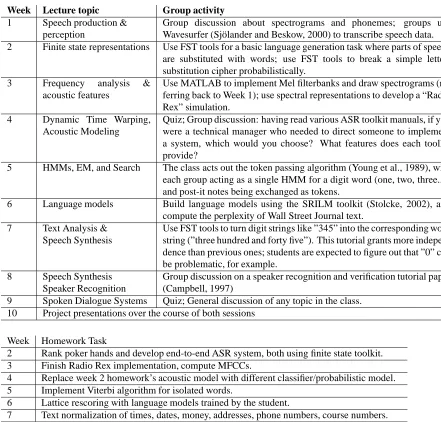
The group activities that get students of varying backgrounds to interact constitute the heart of the course, and provide a basis for the homework assign-ments. Figure 3 outlines the practical lab sessions and group discussions that were part of the most re-cent offering of the course.
Weeks 1 and 3 offer complementary activities that tend to bring the class together early on in the term. In the first week, students are given some speech examples from the TIMIT database; the first ex-ample they see is phonetically labeled. Using the Wavesurfer program (Sj¨olander and Beskow, 2000), students look for characteristics in spectrograms that are indicative of particular phonemes. Students are then presented with a second, unlabeled utterance that they need to phonetically label according to a pronunciation chart. The linguists, who generally have been exposed to this concept previously, tend to lead groups; most students are surprised at how difficult the task is, and this task provokes good discussion about the difference between canonical phonemes versus realized phones.
In the third week, students are asked to recreate the spectrograms by implementing the mel filter-bank equations in MATLAB. Engineering students who have seen MATLAB before tend to take the lead in this session, but there has been enough rap-port among the students at this point, and there is enough intuition behind the math in the tutorial in-structions, that nobody in the previous session had trouble grasping what was going on with the math: almost all of the students completed the follow-on homework, which was to fully compute Mel Fre-quency Cepstral Coefficients (MFCCs) based on the spectrogram code they developed in class. Because both linguists and engineers have opportunities to take the lead in these activities they help to build groups that trust and rely on each other.
Week Lecture topic Group activity 1 Speech production &
perception
Group discussion about spectrograms and phonemes; groups use Wavesurfer (Sj¨olander and Beskow, 2000) to transcribe speech data. 2 Finite state representations Use FST tools for a basic language generation task where parts of speech
are substituted with words; use FST tools to break a simple letter-substitution cipher probabilistically.
3 Frequency analysis & acoustic features
Use MATLAB to implement Mel filterbanks and draw spectrograms (re-ferring back to Week 1); use spectral representations to develop a “Radio Rex” simulation.
4 Dynamic Time Warping,
Acoustic Modeling
Quiz; Group discussion: having read various ASR toolkit manuals, if you were a technical manager who needed to direct someone to implement a system, which would you choose? What features does each toolkit provide?
5 HMMs, EM, and Search The class acts out the token passing algorithm (Young et al., 1989), with each group acting as a single HMM for a digit word (one, two, three...), and post-it notes being exchanged as tokens.
6 Language models Build language models using the SRILM toolkit (Stolcke, 2002), and compute the perplexity of Wall Street Journal text.
7 Text Analysis & Speech Synthesis
Use FST tools to turn digit strings like ”345” into the corresponding word string (”three hundred and forty five”). This tutorial grants more indepen-dence than previous ones; students are expected to figure out that ”0” can be problematic, for example.
8 Speech Synthesis Speaker Recognition
Group discussion on a speaker recognition and verification tutorial paper (Campbell, 1997)
9 Spoken Dialogue Systems Quiz; General discussion of any topic in the class. 10 Project presentations over the course of both sessions
Week Homework Task
2 Rank poker hands and develop end-to-end ASR system, both using finite state toolkit. 3 Finish Radio Rex implementation, compute MFCCs.
4 Replace week 2 homework’s acoustic model with different classifier/probabilistic model. 5 Implement Viterbi algorithm for isolated words.
6 Lattice rescoring with language models trained by the student.
7 Text normalization of times, dates, money, addresses, phone numbers, course numbers.
Figure 3: Syllabus for Foundations of Spoken Language Processing class with group activities and homeworks.
various finite state operations; the two tasks are a simplified language generation task (convert the se-quence “DET N V DET N” into a sentence like “the man bit the dog”) and a cryptogram solver (solve a simple substitution cipher by comparing frequen-cies of crypttext letters versus frequenfrequen-cies of plain-text letters). The students get experience, in par-ticular, with transducer composition (which is novel for almost all of the students); these techniques are used in the first homework, which involves build-ing a transducer-based pronunciation model for dig-its (converting “w ah n” into “ONE”) and imple-menting a FST composition chain for an ASR sys-tem, akin to that of (Mohri et al., 2002). A
sub-sequent homework reuses this chain, but asks stu-dents to implement a new acoustic model and re-place the acoustic model outputs that are given in the first homework. Similarly, practical tutorials on language models (Week 6) and text analysis (Week 7) feed into homework assignments on rescoring lattices with language models and turning different kinds of numeric strings (addresses, time, course numbers) into word strings.
group code base, assignments will often look simi-lar. Since the potential for plagiarism is a concern, it is important that the assignments extend the group activities enough that one can distinguish between group and individual effort.
Another group activity that supports a homework assignment is the Token Passing tutorial (Week 5). The Token Passing algorithm (Young et al., 1989) describes how to extend the Viterbi algorithm to continuous speech: each word in the vocabulary is represented by a single HMM, and as the Viterbi al-gorithm reaches the end of an HMM at a particu-lar timeframe, a token is “emitted” from the HMM recording the ending time, word identity, acous-tic score, and pointer to the previous word-token. The students are divided into small groups and each group is assigned a digit word (one, two, ...) with a particular pronunciation. The HMM topology as-sumes only one, self-looping state per phone for simplicity. The instructor then displays on the pro-jector a likelihood for every phone for the first time frame. The groups work to assign the forward prob-abilities for the first frame. Once every group is syn-chronized, the second frame of data likelihoods is displayed, and students then again calculate forward probabilities, and so forth. After the second frame, some groups (“two”) start to emit tokens, which are posted on the board; groups then have to also con-sider starting a new word at the third time step. The activity continues for roughly ten frames, at which point the global best path is found. Including this ac-tivity has had a beneficial effect on homework per-formance: a significantly higher proportion of stu-dents across all backgrounds correctly completed an assignment to build an isolated word decoder in this offering of the class compared to the previous offer-ing.
Some of the activities were more conceptual in nature, involving reading papers or manuals and discussing the high-level concepts in small groups (Weeks 4 and 8), with each group reporting back to the class. One of the skills I hope to foster in stu-dents is the ability to pick out the main points of pa-pers during the reports back to the main group; I am still thinking about ways to tie these activities into strengthening the project presentations (Week 10).
For the next offering of the class in the upcoming quarter, I would like to reuse the ideas developed in
the seminar to reduce the amount of lecturing. The strategy I am considering is to give the students the old lecture slides as well as readings, and have them post questions the evening before class; we can then focus discussion on the points they did not under-stand. This will likely require the instructor to seed the online pre-discussion with some of the impor-tant points from the slides. These changes can be discussed at the workshop.
3.2 Feedback
Student evaluations of the course were very positive; in response to “what single aspect of the course did you find most helpful?,” half of the students chose to respond, and all of the responses focused on the util-ity of the hands-on practicals or homeworks. Anec-dotally, I also felt that students were better able to re-tain the concepts presented in the course in the most recent offering than in previous offerings.
4 Summary
In trying to serve multiple populations of students with different aims and goals, I have found that activities can be designed that foster students’ de-velopment through team problem-solving and small group work. Online resources such as discussion boards and tutorials using software toolkits can be effectively deployed to minimize the discrepancy in preparations of the students.
Moving away from lecture formats (either in lec-ture class or seminar presentations) has been helpful in fostering cross-disciplinary interaction for both seminar and lecture classes. I have found that ac-tive learning techniques, such as the ones described here, provide more immediate feedback to the in-structor as to what material is understood and what material needs extra emphasis.
Acknowledgments
References
J.P. Campbell. 1997. Speaker recognition: A tutorial. Proceedings of IEEE, 85:1437–1462.
J. Lafferty, A. McCallum, and F. Pereira. 2001. Con-ditional random fields: Probabilistic models for seg-menting and labeling sequence data. In Proc. 18th In-ternational Conference on Machine Learning. M. Mohri, F. Pereira, and M. Riley, 2001. AT&T FSM
LibraryTM – General-Purpose Finite-State Machine Software Tools. AT&T, Florham Park, New Jersey. Available at http://research.att.com/˜fsmtools/fsm. M. Mohri, F. Pereira, and M. Riley. 2002. Weighted
finite-state transducers in speech recognition. Com-puter Speech and Language, 16(1):69–88.
L. Rabiner. 1989. A tutorial on hidden Markov models and selected applications in speech recognition. Pro-ceedings of the IEEE, 77(2).
M. Riley, J. Schalkwyk, W. Skut, C. Allauzen, and M. Mohri. 2008. OpenFst library. www.openfst.org. K. Sj¨olander and J. Beskow. 2000. Wavesurfer – an open
source speech tool. In Proceedings of ICSLP, Beijing. A. Stolcke. 2002. SRILM — an extensible language modeling toolkit. In Proc. Int’l Conf. on Spoken Lan-guage Processing (ICSLP 2002), Denver, Colorado. J. Vegso. 2008. Enrollments and degree
produc-tion at us cs departments drop further in 2006/2007. http://www.cra.org/wp/index.php?p=139.