Coupling hierarchical word reordering and decoding in phrase-based
statistical machine translation
Maxim Khalilov and José A.R. Fonollosa
Universitat Politècnica de Catalunya Campus Nord UPC, 08034,
Barcelona, Spain
{khalilov,adrian}@gps.tsc.upc.edu
Mark Dras
Macquarie University North Ryde NSW 2109,
Sydney, Australia [email protected]
Abstract
In this paper, we start with the existing idea of taking reordering rules automatically derived from syntactic representations, and applying them in a preprocessing step before translation to make the source sentence structurally more like the target; and we propose a new approach to hierarchically extracting these rules. We evaluate this, combined with a lattice-based decoding, and show improvements over state-of-the-art distortion models.
1 Introduction
One of the big challenges for the MT community is the problem of placing translated words in a natural order. This issue originates from the fact that dif-ferent languages are characterized by difdif-ferent word order requirements. The problem is especially im-portant if the distance between words which should be reordered is high (global reordering); in this case the reordering decision is very difficult to take based on statistical information due to dramatic expansion of the search space with the increase in number of words involved in the search process.
Classically, statistical machine translation (SMT) systems do not incorporate any linguistic analysis and work at the surface level of word forms. How-ever, more recently MT systems are moving towards including additional linguistic and syntactic infor-mative sources (for example, source- and/or target-side syntax) into word reordering process. In this pa-per we propose using a syntactic reordering system operating with fully, partially and non- lexicalized reordering patterns, which are applied on the step
prior to translation; the novel idea in this paper is in the derivation of these rules in a hierarchical manner, inspired by Imamura et al (2005). Furthermore, we propose generating a word lattice from the bilingual corpus with the reordered source side, extending the search space on the decoding step. A thorough study of the combination of syntactical and word lattice re-ordering approaches is another novelty of the paper.
2 Related work
Many reordering algorithms have appeared over the past few years. Word class-based reordering was a part of Och’s Alignment Template system (Och et al., 2004); the main criticism of this approach is that it shows bad performance for the pair of languages with very distinct word order. The state-of-the-art SMT system Moses implements a distance-based re-ordering model (Koehn et al., 2003) and a distor-tion model, operating with rewrite patterns extracted from a phrase alignment table (Tillman, 2004).
Many SMT models implement the brute force ap-proach, introducing several constrains for the re-ordering search as described in Kanthak et al. (2005) and Crego et al. (2005). The main criticism of such systems is that the constraints are not lexicalized. Recently there has been interest in SMT exploiting non-monotonic decoding which allow for extension of the search space and linguistic information in-volvement. The variety of such models includes a constrained distance-based reordering (Costa-jussà et al., 2006); and a constrained version of distortion model where the reordering search problem is tack-led through a set of linguistically motivated rules used during decoding (Crego and Mariño, 2007).
A quite popular class of reordering algorithms is a monotonization of the source part of the parallel corpus prior to translation. The first work on this approach is described in Nießen and Ney (2004), where morpho-syntactic information was used to ac-count for the reorderings needed. A representative set of similar systems includes: a set of hand-crafted reordering patterns for German-to-English (Collins et al., 2005) and Chinese-English (Wang et al., 2007) translations, emphasizing the distinction be-tween German/Chinese and English clause struc-ture; and statistical machine reordering (SMR) tech-nique where a monotonization of the source words sequence is performed by translating them into the reordered one using well established SMT mecha-nism (Costa-jussà and Fonollosa, 2006). Coupling of SMR algorithm and the search space extension via generating a set of weighted reordering hypothe-ses has demonstrated a significant improvement, as shown in Costa-jussà and Fonollosa (2008).
The technique proposed in this study is most similar to the one proposed for French-to-English translation task in Xia and McCord (2004), where the authors present a hybrid system for French-English translation based on the principle of auto-matic rewrite patterns extraction using a parse tree and phrase alignments. We propose using a word distortion model not only to monotonize the source part of the corpus (using a different approach to rewrite rule organization from Xia and McCord), but also to extend the search space during decoding.
3 Baseline phrase-based SMT systems
The reference system which was used as a transla-tion mechanism is the state-of-the-art Moses-based SMT (Koehn et al., 2007). The training and weights tuning procedures can be found on the Moses web
page1.
Classical phrase-based translation is considered as a three step algorithm: (1) the source sequence of words is segmented into phrases, (2) each phrase is translated into the target language using a transla-tion table, (3) the target phrases are reordered to fit the target language. The probabilities of the phrases are estimated by relative frequencies of their appear-ance in the training corpus.
1http://www.statmt.org/moses/
In baseline experiments we used a phrase depen-dent lexicalized reordering model, as proposed in Tillmann (2004). According to this model, mono-tonic or reordered local orientations enriched with probabilities are learned from training data. During decoding, translation is viewed as a monotone block sequence generation process with the possibility to swap a pair of neighbor blocks.
4 Syntax-based reordering coupled with word graph
Our syntax-based reordering system requires access to source and target language parse trees and word alignments intersections.
4.1 Notation
Syntax-based reordering (SBR) operates with source and target parse trees that represent the syntactic structure of a string in source and target languages according to a Context-Free Grammar (CFG).
We call this representation "CFG form". We
formally define a CFG in the usual way as G =
hN, T, R, Si, whereN is a set of nonterminal
sym-bols (corresponding to source-side phrase and
part-of-speech tags); T is a set of source-side terminals
(the lexicon), R is a set of production rules of the
formη→γ, withη ∈N andγ, which is a sequence
of terminal and nonterminal symbols; andS∈N is
the distinguished symbol.
The reordering rules then have the form
η0@0. . . ηk@k→
ηd0@d0. . . ηdk@dk|Lexicon|p1 (1)
where ηi ∈ N for all 0 ≤ i ≤ k; (do. . . dk) is
a permutation of(0. . . k);Lexiconcomes from the
source-side set of words for eachηi; andp1is a
prob-ability associated with the rule. Figure 1 gives two examples of the rule format.
4.2 Rules extraction
(1) align the monotone bilingual corpus with GIZA++ (Och and Ney, 2003) and find the intersection of direct and inverse word alignments, resulting in the construction
of the projection matrixP (see below));
(2) parse the source and the target parts of the parallel corpus;
(3) extract reordering patterns from the par-allel non-isomorphic CFG-trees based on the word alignment intersection.
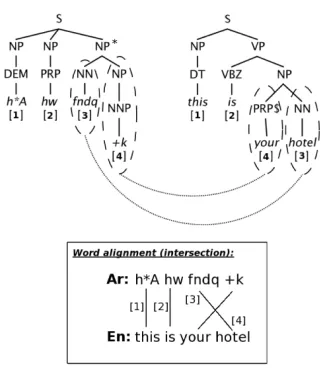
Step 2 is straightforward; we explain aspects of Steps 1 and 3 in more detail below. Figures 1 and 2 show an example of the extraction of two lexicalized rules for a parallel Arabic-English sentence:
Arabic:
English: h*Athis hWis fndqyour +khotel
[image:3.612.378.469.191.246.2]We use this below in our explanations.
Figure 2: Example of subtree transfer and reordering rules extraction.
Projection matrix. Bilingual content can be rep-resented in the form of words or sequences of words depending on the syntactic role of the corresponding grammatical element (constituent or POS).
Given two parse trees and a word alignment
in-tersection, a projection matrix P is defined as an
M×N matrix such thatM is the number of words
in the target phrase; N is the number of words in
the source phrase; and a cell(i, j)has a value based
on the alignment intersection — this value is zero
if wordiand wordj do not align, and is a unique
non-zero link number if they do. For the trees in Figure 2,
P =
1 0 0 0 0 2 0 0 0 0 0 3 0 0 4 0
Unary chains. Given an unary chain of the form
X → Y, rules are extracted for each level in this
chain. For example given a rule
N P@0ADV P@1→ADV P@1N P@0
and a unary chain "ADV P →AD", a following
equivalent rule will be generated
N P@0AD@1→AD@1N P@0.
The role of target-side parse tree. Although re-ordering is performed on the source side only, the target-side tree is of great importance: the reorder-ing rules can be only extracted if the words covered by the rule are entirely covered by both a node in the source and in the target trees. It allows the more accurate determination of the covering and limits of the extracted rules.
4.3 Rules organization
Once the list of fully lexicalized reordering patterns is extracted, all the rules are progressively processed reducing the amount of lexical information. These
initial rulesare iteratively expanded such that each element of the pattern is generalized until all the lex-ical elements of the rule are represented in the form of fully unlexicalized categories. Hence, from each
NN@0 NP@1→NP@1 NN@0|NN@0<<fndq>>NP@1<<+k>>|p
NN@0 NNP@1→NNP@1 NN@0|NN@0<<fndq>>NNP@1<<+k>>|p0
[image:3.612.104.266.335.520.2]initial pattern withN lexical elements,2N −2
par-tially lexicalized rules and 1 general rule are gener-ated. An example of the process of delexicalization can be found in Figure 3.
Thus, finally three types of rules are available: (1) fully lexicalized (initial) rules, (2) partially lexical-ized rules and (3) unlexicallexical-ized (general) rules.
On the next step, the sets are processed separately: patterns are pruned and ambiguous rules are re-moved. All the rules from the fully lexicalized, par-tially lexicalized and general sets that appear fewer
thanktimes are directly discarded (kis a shorthand
for kf ul, kpart and kgener). The probability of a
pattern is estimated based on relative frequency of their appearance in the training corpus. Only one the most probable rule is stored. Fully lexicalized
rules are not pruned (kf ul= 0); partially lexicalized
rules that have been seen only once were discarded
(kpart = 1); the thresholdskgener was set to 3: it
limits the number of general patterns capturing rare grammatical exceptions which can be easily found in any language.
Only the one-best reordering is used in other stages of the algorithm, so the rule output function-ing as an input to the next rule can lead to situa-tions reverting the change of word order that the previously applied rule made. Therefore, the rules that can be ambiguous when applied sequentially during decoding are pruned according to the higher probability principle. For example, for the pair of patterns with the same lexicon (which is empty for a general rule leading to a recurring contradiction
NP@0 VP@1 → VP@1 NP@0 p1, VP@0 NP@1 → NP@1 VP@0 p2), the less probable rule is re-moved.
Finally, there are three resulting parameter tables analogous to the "r-table" as stated in (Yamada and Knight, 2001), consisting of POS- and constituent-based patterns allowing for reordering and
mono-tone distortion (examples can be found in Table 5).
4.4 Source-side monotonization
Rule application is performed as a bottom-up parse tree traversal following two principles:
(1) the longest possible rule is applied, i.e. among a set of nested rules, the rule with a longest left-side covering is selected. For example, in the case of the
appearance of anNN JJ RBsequence and presence
of the two reordering rules
NN@0 JJ@1→... and
NN@0 JJ@1 RB@2→... the latter pattern will be applied.
[image:4.612.386.466.331.427.2](2) the rule containing the maximum lexical infor-mation is applied, i.e. in case there is more than one alternative pattern from different groups, the ized rules have preference over the partially lexical-ized, and partially lexicalized over general ones.
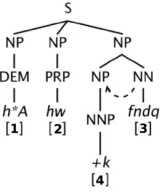
Figure 4:Reordered source-side parse tree.
Once the reordering of the training corpus is ready, it is realigned and new more monotonic align-ment is passed to the SMT system. In theory, the word links from the original alignment can be used, however, due to our experience, running GIZA++ again results in a better word alignment since it is easier to learn on the modified training example.
Example of correct local reordering done with the SBR model can be found in Figure 4.
Initial rule: NN@0 NP@1→NP@1 NN@0|NN@0<<fndq>>NP@1<<+k>>|p1
Part. lexic. rules: NN@0 NP@1→NP@1 NN@0|NN@0<<fndq>>NP@1<<->>|p2
NN@0 NP@1→NP@1 NN@0|NN@0<<->>NP@1<<+k>>|p3
General rule: NN@0 NP@1→NP@1 NN@0|p4
4.5 Coupling with decoding
In order to improve reordering power of the transla-tion system, we implemented an additransla-tional reorder-ing as described in Crego and Mariño (2006).
Multiple word segmentations is encoded in a lat-tice, which is then passed to the input of the de-coder, containing reordering alternatives consistent with the previously extracted rules. The decoder
takes the n-best reordering of a source sentence
coded in the form of a word lattice. This approach is in line with recent research tendencies in SMT, as described for example in (Hildebrand et al., 2008; Xu et al., 2005). Originally, word lattice algorithms do not involve syntax into reordering process,
there-fore their reordering power is limited at representing long-distance reordering. Our approach is designed in the spirit of hybrid MT, integrating syntax trans-fer approach and statistical word lattice methods to achieve better MT performance on the basis of the standard state-of-the-art models.
During training a set of word permutation patterns is automatically learned following given word-to-word alignment. Since the original and monotonized (reordered) alignments may vary, different sets of reordering patterns are generated. Note that no in-formation about the syntax of the sentence is used: the reordering permutations are motivated by the crossed links found in the word alignment and,
con-S 1 2 3 4 5 6 7 8 9 1 0 1 1 1 2 1 3 1 4 L > n
+ h
+ h > n
m T E m m T E m
* w E r y q
> n
* w
E r y q t A r y x
m T E m
E r y q * w
E r y q t A r y x
* w
* w
E r y q m T E m
t A r y x E r y q
* w S 1 2 3 4 5 6 7 8 9
> n + h
+ h > n
m T E m m T E m
> n
* w
t A r y x * w
m T E m
t A r y x
1 0 L
E r y q m T E m
E r y q
t A r y x
> n + h m T E m * w t A r y x E r y q W o r d l a t t i c e , p l a i n t e x t :
W o r d l a t t i c e , r e o r d e r e d t e x t : > n + h m T E m * w E r y q t A r y x ( c )
( b )
S > n 1 + h 2 m T E m 3 * w 4 t A r y x 5 E r y q L
> n + h m T E m * w t A r y x E r y q M o n o t o n i c s e a r c h , p l a i n t e x t :
[image:5.612.92.522.274.672.2]( a )
sequently, the generalization power of this frame-work is limited to local permutations.
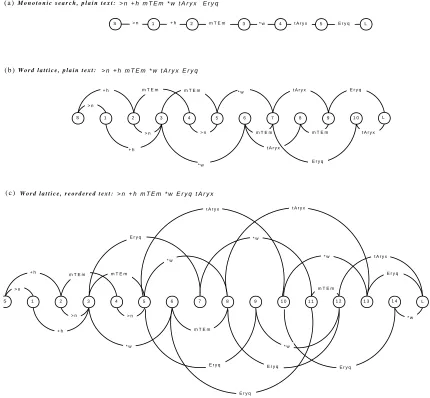
On the step prior to decoding, the system gen-erates word reordering graph for every source sen-tence, expressed in the form of a word lattice. The decoder processes word lattice instead of only one input hypothesis, extending the monotonic search graph with alternative paths.
Original sentence in Arabic, the English gloss and reference translation are:
Ar.: Gl.:
>n +h
this
mTEm
restaurant
*w
has
Eryq
history
tAryx
illustrious
Ref: ’this restaurant has an illustrious history’
The monotonic search graph (a) is extended with a word lattice for the monotonic train set (b) and re-ordered train sets (c). Figure 5 shows an example of the input word graph expressed in the form of a word lattice. Lattice (c) differ from the graph (b) in number of edges and provides more input options to the decoder. The decision about final translation is taken during decoding considering all the possible paths, provided by the word lattice.
5 Experiments and results
5.1 Data
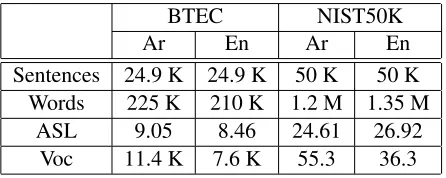
The experiments were performed on two Arabic-English corpora: the BTEC’08 corpus from the tourist domain and the 50K first-lines extraction from the corpus that was provided to the NIST’08 evaluation campaign and belongs to the news do-main (NIST50K). The corpora differ do-mainly in the average sentence length (ASL), which is the key cor-pus characteristic in global reordering studies.
A training set statistics can be found in Table 1.
BTEC NIST50K
Ar En Ar En
Sentences 24.9 K 24.9 K 50 K 50 K
Words 225 K 210 K 1.2 M 1.35 M
ASL 9.05 8.46 24.61 26.92
[image:6.612.75.298.545.634.2]Voc 11.4 K 7.6 K 55.3 36.3
Table 1: Basic statistics of the BTEC training corpus.
The BTEC development dataset consists of 489 sentences and 3.8 K running words, with 6 human-made reference translations per sentence; the dataset
used to test the translation quality has 500 sentences, 4.1 K words and is also provided with 6 reference translations.
The NIST50K development set consists of 1353 sentences and 43 K words; the test data contains 1056 sentences and 33 K running words. Both datasets have 4 reference translations per sentence.
5.2 Arabic data preprocessing
We took a similar approach to that shown in Habash and Sadat (2006), using the MADA+TOKAN sys-tem for disambiguation and tokenization. For dis-ambiguation only diacritic unigram statistics were employed. For tokenization we used the D3 scheme with -TAGBIES option. The scheme splits the fol-lowing set of clitics: w+, f+, b+, k+, l+, Al+ and pronominal clitics. The -TAGBIES option produces Bies POS tags on all taggable tokens.
5.3 Experimental setup
We used the Stanford Parser (Klein and Man-ning, 2003) for both languages, Penn English bank (Marcus et al., 1993) and Penn Arabic Tree-bank set (Kulick et al., 2006). The English TreeTree-bank is provided with 48 POS and 14 syntactic tags, the Arabic Treebank has 26 POS and 23 syntactic cate-gories.
As mentioned above, specific rules are not pruned away due to a limited amount of training material we
set the thresholdskpart andkgenerto relatively low
values, 1 and 3, respectively.
Evaluation conditions were case-insensitive and with punctuation marks considered. The target-side 4-gram language model was estimated using the SRILM toolkit (Stolcke, 2002) and modified Kneser-Ney discounting with interpolation. The highest BLEU score (Papineni et al., 2002) was cho-sen as the optimization criterion. Apart from BLEU, a standard automatic measure METEOR (Banerjee and Lavie, 2005) was used for evaluation.
5.4 Results
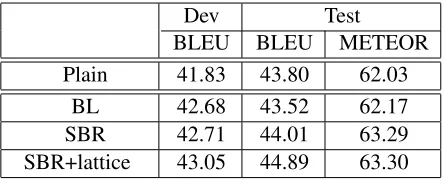
The scores considered are: BLEU scores obtained for the development set as the final point of the
MERT procedure (Dev), and BLEU and METEOR
scores obtained on test dataset (Test).
re-sults obtained on the NIST corpus (Tables 3) with much longer sentences and much need of global re-ordering.
Dev Test
BLEU BLEU METEOR
Plain 48.31 45.02 65.98
BL 48.46 47.10 68.10
SBR 48.75 47.52 67.33
[image:7.612.74.299.110.200.2]SBR+lattice 48.90 48.78 68.85
Table 2: Summary of BTEC experimental results.
Dev Test
BLEU BLEU METEOR
Plain 41.83 43.80 62.03
BL 42.68 43.52 62.17
SBR 42.71 44.01 63.29
SBR+lattice 43.05 44.89 63.30
Table 3: Summary of NIST50K experimental results.
Four SMT systems are contrasted: BL refers to
the Moses baseline system: the training data is not reordered, lexicalized reordering model (Tillman,
2004) is applied; SBRrefers to the monotonic
sys-tem configuration with reordered (SBR) source part;
SBR+latticeis the run with reordered source part, on the translation step the input is represented as a word lattice.
We also compare the proposed approach with a
monotonic system configuration (Plain). It shows
the effect of source-reordering and lattice input, also decoded monotonically.
Automatic scores obtained on the test dataset evolve similarly when the SBR and word lattice rep-resentation applied to BTEC and NIST50K tasks. The combined method coupling two reordering
techniques was more effective than the techniques applied independently and shows an improvement in terms of BLEU for both corpora. The METEOR score is only slightly better for the SBR configura-tions in case of BTEC task; in the case of NIST50K the METEOR improvement is more evident. The general trend is that automatic scores evaluated on the test set increase with the reordering model com-plexity.
Application of the SBR algorithm only (without a word lattice decoding) does not allow achieving statistical significance threshold for a 95% confi-dence interval and 1000 resamples (Koehn, 2004) for either of considered corpora. However, the
SBR+lattice system configuration outperforms the
BLby about 1.7 BLEU points (3.5%) for BTEC task
[image:7.612.75.298.246.336.2]and about 1.4 BLEU point (3.1%) for NIST task. These differences is statistically significant.
Figure 6 demonstrates how two reordering tech-niques interact within a sentence with a need for both global and local word permutations.
5.5 Syntax-based rewrite rules
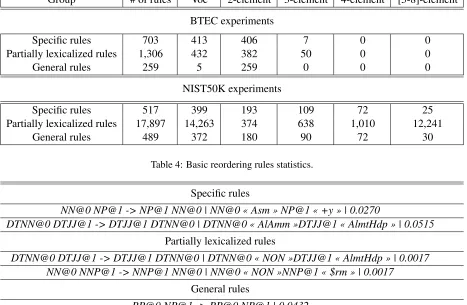
As mentioned above, the SBR operates with three groups of reordering rules, which are the product of complete or partial delexicalization of the origi-nally extracted patterns. The groups are processed and pruned independently. Basic rules statistics for both translation tasks can be found in Table 4.
The major part of reordering rules consists of two or three elements (for BTEC task there are no patterns including more than three nodes). For NIST50K there are a few rules with higher size in words of the move (up to 8). In addition, there are some long lexicalized rules (7-8), generating a high number of partially lexicalized patterns.
Table 5 shows the most frequent reordering rules with non-monotonic right part from each group.
Ar. plain.:
En. gloss: AElntannounced Ajhzppress AlAElAmrelease lby bEvpmission AlAmm AlmtHdpnations united
fy
in syrAlywnsierra leone Anthat ...
En. ref.:’a press release by the united nations mission to sierra leoneannouncedthat ...’
Ar. reord.: Ajhzp AlAElAm l bEvp AlmtHdp AlAmm fy syrAlywnAElntAn ...
6 Conclusions
In this study we have shown how the translation quality can be improved, coupling (1) SBR al-gorithm and (2) word alignment-based reordering framework applied during decoding. The system automatically learns a set of syntactic reordering patterns that exploit systematic differences between word order of source and target languages.
Translation accuracy is clearly higher when al-lowing for SBR coupled with word lattice input rep-resentation than standard Moses SMT with existing (lexicalized) reordering models within the decoder and one input hypothesis condition. We have also compared the reordering model a monotonic system. The method was tested translating from Arabic to English. Two corpora and tasks were considered: the BTEC task with much need of local reordering and the NIST50K task requiring long-distance per-mutations caused by longer sentences.
The reordering approach can be expanded for any other pair of languages with available parse tools. We also expect that the method scale to a large train-ing set, and that the improvement will still be kept, however, we plan to confirm this assumption exper-imentally in the near future.
Acknowledgments
This work has been funded by the Spanish Gov-ernment under grant TEC2006-13964-C03 (AVI-VAVOZ project) and under a FPU grant.
Group # of rules Voc 2-element 3-element 4-element [5-8]-element
BTEC experiments
Specific rules 703 413 406 7 0 0
Partially lexicalized rules 1,306 432 382 50 0 0
General rules 259 5 259 0 0 0
NIST50K experiments
Specific rules 517 399 193 109 72 25
Partially lexicalized rules 17,897 14,263 374 638 1,010 12,241
[image:8.612.75.540.349.502.2]General rules 489 372 180 90 72 30
Table 4: Basic reordering rules statistics.
Specific rules
NN@0 NP@1 -> NP@1 NN@0 | NN@0 « Asm » NP@1 « +y » | 0.0270
DTNN@0 DTJJ@1 -> DTJJ@1 DTNN@0 | DTNN@0 « AlAmm »DTJJ@1 « AlmtHdp » | 0.0515
Partially lexicalized rules
DTNN@0 DTJJ@1 -> DTJJ@1 DTNN@0 | DTNN@0 « NON »DTJJ@1 « AlmtHdp » | 0.0017 NN@0 NNP@1 -> NNP@1 NN@0 | NN@0 « NON »NNP@1 « $rm » | 0.0017
General rules
PP@0 NP@1 -> PP@0 NP@1 | 0.0432
[image:8.612.74.541.357.662.2]NN@0 DTNN@1 DTJJ@2 -> NN@0 DTJJ@2 DTNN@1 |0.0259
References
S. Banerjee and A. Lavie. 2005. METEOR: An auto-matic metric for MT evaluation with improved corre-lation with human judgments. InProceedings of the ACL Workshop on Intrinsic and Extrinsic Evaluation Measures for Machine Translation and/or Summariza-tion, pages 65–72.
M. Collins, Ph. Koehn, and I. Kuˇcerová. 2005. Clause restructuring for statistical machine translation. In
Proceedings of the 43rd Annual Meeting on ACL 2005, pages 531–540.
M.R. Costa-jussà and J.A.R. Fonollosa. 2006. Sta-tistical machine reordering. In Proceedings of the HLT/EMNLP 2006.
M.R. Costa-jussà and J.A.R. Fonollosa. 2008. Comput-ing multiple weighted reorderComput-ing hypotheses for a sta-tistical machine translation phrase-based system. InIn Proc. of the AMTA’08, Honolulu, USA, October. M.R. Costa-jussà, J.M. Crego, A. de Gispert, P. Lambert,
M. Khalilov, J. A. Fonollosa, J.B. Mari no, and R.E. Banchs. 2006. TALP phrase-based system and TALP system combination for IWSLT 2006. InProceedings of the IWSLT 2006, pages 123–129.
J.M. Crego and J. B Mariño. 2006. Reordering experi-ments for N-gram-based SMT. InSLT’06, pages 242– 245.
J.M. Crego and J.B. Mariño. 2007. Syntax-enhanced N-gram-based smt. InProceedings of MT SUMMIT XI. J.M. Crego, J. B. Mariño, and A. de Gispert. 2005.
Re-ordered search and tuple unfolding for ngram-based smt. In In Proc. of MT SUMMIT X, pages 283–289, September.
S. Nießen and H. Ney. 2004. Statistical machine transla-tion with scarce resources using morpho-syntactic in-formation. volume 30, pages 181–204.
N. Habash and F. Sadat. 2006. Arabic preprocessing schemes for statistical machine translation. In Pro-ceedings of the Human Language Technology Confer-ence of the NAACL, pages 49–52.
A.S. Hildebrand, K. Rottmann, M. Noamany, Q. Gao, S. Hewavitharana, N. Bach, and S. Vogel. 2008. Re-cent improvements in the cmu large scale chinese-english smt system. InProceedings of ACL-08: HLT (Companion Volume), pages 77–80.
K. Imamura, H. Okuma, and E. Sumita. 2005. Practical approach to syntax-based statistical machine transla-tion. InProceedings of MT Summit X, pages 267–274. S. Kanthak, D. Vilar, E. Matusov, R. Zens, and H. Ney. 2005. Novel reordering approaches in phrase-based statistical machine translation. InIn Proc. of the ACL Workshop on Building and Using Parallel Texts, pages 167–174, June.
D. Klein and C. Manning. 2003. Accurate unlexicalized parsing. InProceedings of the 41st Annual Meeting of the ACL 2003, pages 423–430.
Ph. Koehn, F. J. Och, and D. Marcu. 2003. Statistical phrase-based machine translation. InProceedings of the HLT-NAACL 2003, pages 48–54.
Ph. Koehn, H. Hoang, A. Birch, C. Callison-Burch, M. Federico, N. Bertoldi, B. Cowan, W. Shen, C. Moran, R. Zens, C. Dyer, O. Bojar, A. Constantin, and E. Herbst. 2007. Moses: open-source toolkit for statistical machine translation. InProceedings of ACL 2007, pages 177–180.
Ph. Koehn. 2004. Statistical significance tests for machine translation evaluation. In Proceedings of EMNLP 2004, pages 388–395.
S. Kulick, R. Gabbard, and M. Marcus. 2006. Parsing the Arabic Treebank: Analysis and improvements. Tree-banks and Linguistic Theories.
M.P. Marcus, B. Santorini, and M.A. Marcinkiewicz. 1993. Building a large annotated corpus of En-glish: The Penn Treebank. Computational Linguistics, 19(2):313–330.
F. Och and H. Ney. 2003. A systematic comparison of various statistical alignment models. Computational Linguistics, 29(1):19–51.
F.J. Och, D. Gildea, S. Khudanpur, A. Sarkar, K. Ya-mada, A. Fraser, S. Kumar, L. Shen, D. Smith, K. Eng, V. Jain, Z. Jin, and D. Radev. 2004. A Smorgasbord of Features for Statistical Machine Translation. In Pro-ceedings of HLT/NAACL04, pages 161–168.
K. Papineni, S. Roukos, T. Ward, and W. Zhu. 2002. Bleu: a method for automatic evaluation of machine translation. InProceedings of ACL 2002, pages 311– 318.
A. Stolcke. 2002. SRILM: an extensible language mod-eling toolkit. InProceedings of the Int. Conf. on Spo-ken Language Processing, pages 901–904.
C. Tillman. 2004. A unigram orientation model for sta-tistical machine translation. In Proceedings of HLT-NAACL’04.
C. Wang, M. Collins, and P. Koehn. 2007. Chinese syn-tactic reordering for statistical machine translation. In
Proceedings of the Joint Conference on EMNLP. F. Xia and M. McCord. 2004. Improving a statistical mt
system with automatically learned rewrite patterns. In
Proceedings of the COLING 2004.
J. Xu, E. Matusov, R. Zens, and H. Ney. 2005. In-tegrated chinese word segmentation in statistical ma-chine translation. InProc. of IWSLT 2005.