International Journal of Advanced Research in Computer Science
RESEARCH PAPER
Available Online at www.ijarcs.info
Increase life of Cluster Head in Wireless Sensor Network by using LEACH Protocol
Maghrib Abidalreda Maky Alrammahi
Information Technology Research and Development Center University of Kufa
Najaf, Iraq
Abstract: In case of detector network the nodes loss some quantity of energy once performing the communication. To boost the lifetime of network a energy economical communication approach is needed. In case of multicast network an collective approach is employed by LEACH protocol by creation of chain of nodes. The basic work is to add and change the Leach protocol to some parameter and the underlying variables in the algorithm. Here we are proposing the three call parameters to pick following node in network .These parameters embrace the space, energy and also the residual energy. The projected work can improve the potency even in case of engorged and congested network and improve the network life. Sensing element network is the large set of small sensors that transfer small piece of data. As it forms a huge range of sensors it suffers from the matter of QOS. Every sensing element node consumes some energy with totally different communication operations. If no external energy is provided to them, a sensing element can be dead because it participates for long-standing within the communication The main planning work is proposed to increase the time period for the work of the network in Issue of using the Leach protocol transfer information to at least one of its neighbor node supported distance. During this planned work we are going to take the choice primarily based on the remaining energy on transmission. If the remaining energy is a smaller amount than the threshold, it'll communicate to some compromising node rather than effective distance node. The work is about to provide higher utilization of energy and to enhance the node and network life.
Keywords: Wireless Sensor Network; leach protocol; Node; BS Base Station; Wi-Fi
I.INTRODUCTIONTOWIRELESSSENSOR NETWORKS
[image:1.595.310.553.396.560.2]A wireless device and mechanism network (figure 1) may be an assortment of tiny arbitrarily distributed devices that 3 basic processes are easy to follow the physical situations that occur in the environment such as cases of temperature and the difference of pressure and humidity and follow-up state of the work of devices such as engines that control the devices as keys, which help to increase economic production, which is very reliable work in wireless networks. Has been designed to follow the management of changes that occur to the data movement and not to help to provide important information that occurs in networks such as Wi-Fi. The rate of data transmission during WSN is between 20 kbps in the second to one Mbps in the second so the process of energy consumption will be a little and this helps to increase the battery life on the node and also helps to reduce the mechanical problems in the network and does not sometimes need manual intervention For maintenance, there are several different data paths to access the node and address required in the event of malfunction in the network and at the end it can measure the work of the network and its flexibility and accuracy Check performance and cost [6]. Through the second sort can use a formula to one of the protocols to boost the energy consumption in nodes.
Figure 1. Wireless Sensor Network Architecture [16]
In general, devices containing a set of nodes in each device include handling, packaging, transmission, GPS system and on the devices of the units of energy and the spread of devices in there is a coordination between the nodes to reduce the size of the data much in terms of the environment adjacent to each node or a set of sensors have a function and a specific work is selected such as the routing of information to another contract and identify the main stations fixed or Mobile and also have the ability to connect to other networks such as Internet or communications infrastructure that helps the user to easily access data in a short time .
II. LITERATURE REVIEW
Table 1: Routing Protocol for Wireless Sensor Network [6] The Leach protocol is the probability of a routing protocol based on the aggregation of WSN and this is based on (Heinzelman, 2000)[6] and others. Its work has been improved for the purpose of reducing the waste produced by the main energy in the networks and through the uncoordinated rotation and will spread on the cluster leader and at each stage of Building the Section, There are corrupt phases in processes that occur in Leach protocols, wherever information is transferred to the bottom stations.
There is a view by ((Younis,2004)[7] that there is a certain pattern in sensor networks called HEED which follows a hybrid pattern and a high - power mode that improves network operation and increases the life of devices in the network and the ability to measure, the HEED pattern intermittently select the forms of hybrid depending on the leaders of the head and on the basis of two things are the cost of communications that occur through the head of the inside and the ability remaining in each node. And through use should avoid one
cluster-leaders are hand-picked among sure vary. The operation of HEED will be break down into 3 stages: low-level formatting section, repetition section, and culmination section. The authors compared the network life exploitation HEED with LEACH, and results show that it's the next performance in prolonging network life.
There is also the view of (Lindsey, 2005) [9] that is Power-Efficient Gathering in Sensor Information Systems the output of the development of the Leach protocol and its purpose is to measure the data consumed through communications in the network and also to work to increase node intervals. The operations of PEGASIS are divided into completely different rounds. In every spherical, the device nodes are shaped into a sequence constructer, and every device node solely communicate with its nearest device; Finally there is a main sensor responsible for receiving all the data and then it connects with the other sub stations in the router network, and on balance sensors have communicated with the bottom station, another spherical starts. During this paper, PEGASIS is compared with direct information transmission and LEACH protocol in terms of prolonging device nodes life. Experiment results indicate that PEGASIS is capable of accelerating the life of the network nearly double as LEACH.
The other opinion of (Manjeshwar, 2001) [10] is the proposed protocol called TEEN which is Threshold Energy Efficient Network the purpose is to increase the energy and accelerate it by responding to the occurrence of changes in the vicinity and with some interactive networks in the protocol TEEN, that eliminates the transactions would possibly occur once there’s no or solely very little changes happen within the surroundings. The authors evaluated the performance of TEEN by examination the energy dissipation and node life in WSN exploitation TEEN with LEACH. Results show that the projected protocol outperforms in terms of energy potency. There is another suggestion for the same publisher above (Manjeshwar, 2002) [11] that there is another protocol different from the former and was modified and hybrid name APTEEN to take advantage of it economically and his work is changing the values of the edge used in the network and with different applications and environments. In APTEEN, a cluster-head sends its members attributes (physical parameters showing the sort of knowledge needed), laborious threshold and soft threshold (same as utilized in TEEN), schedule (slot for every sensor), and count time (the most time between 2 report sent by a member sensor). The authors evaluated the performance of APTEEM by examination the common energy dissipation, node life, total range of knowledge signals received at base station, additionally as average delay for LEACH, APTEEN and teenage. By examining the protocol work through simulations and depending on the increased longevity of the node device and more energy is shown to be better than the LEACH protocol but not better than the TENN protocol.
problems to be self-addressed for LEACH, like overhead and hot spot downside.
The characteristic that differentiates LEACH and HEED is that HEED doesn't choose cluster-heads arbitrarily. HEED outperforms LEACH in terms of saving energy. However, up to now HEED is merely applicable in single cluster layer network; but, in step with the author, this protocol may be extended to multi-level hierarchies.
PEGASIS features a high performance in saving energy and information aggregation. This can be primarily as a result of it eliminates the overheads and reduces the quantity of transmissions. One in every of the fundamental assumptions of PEGASIS is that each device within the network is capable to speak directly with the bottom station; but, it's not invariably true. The delay in transmission is another issue of this approach.
TEEN and APTEEN are develop for active WSN wherever immediate responses are needed. the most downside of TEEN and APTEEN is that since all activities within the network believe the brink price, the nodes won't communicate if the brink values don't seem to be received. During this method, the lustiness of the network could also be influenced.
III.PROPOSED WORK
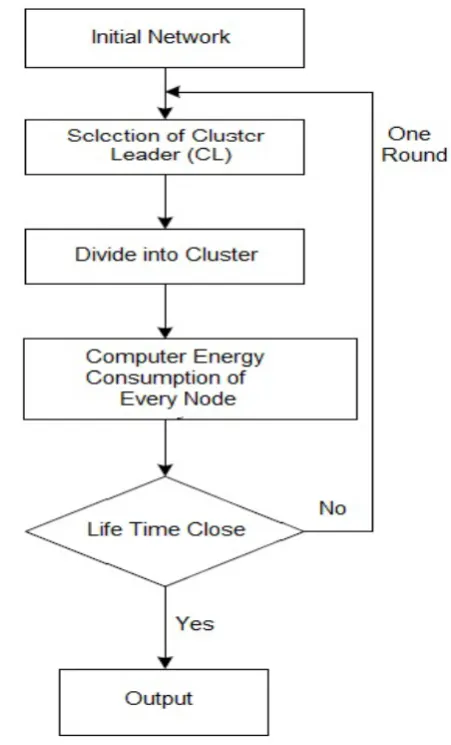
The Leach protocol contains two basic phases: the first phase, the construction stage, the second stage, the stage of the steady state, and the first stage, it is necessary to select the cluster head irregularly, which helps the formula, through which all requirements are determined and all the formulas and parameters.
• Cluster leader choice:-
In the protocol, a random number is chosen between zero and one through the node and through T(n) mathematical equations are calculated threshold price Depending on the random output number, the node becomes the cluster head as in the equation below:-
Equation .1.1
Details of the equation as follows:
P= is the part that is elected in the node as a CHs.
G=through the final stages, a set of contract is selected manually and is considered the head of the block
r= is the current stage.
• Building of cluster:-
Is calculated by three parameters, the first parameter is through the energy, the second parameter is through the residual energy and the last parameter is calculated by calculating the third gap between the head of the block and the short distance in the node, the note is chosen cluster leader with the lowest distance and the most energy remaining there is a selection Another is the second assistant (deputy) cluster leader and shall be responsible for the administration and work in case of failure or malfunction of the head of the cluster.
• At this stage CL the information will be received from the rest of the sub node and then compile it and then send the data to the base stations in the network and there are two cases to connect the first case if there is a gap between CL and with the node then will use several leaps forward to reach the node In the second case, if there is no significant gap with the base stations then the relays will be sent to the nearest node.
•In this case, the energy consumed from each node is calculated and deducted from the remaining energy. Some of the node that contains energy will be deleted. Thus, the life period in which it has ended and its end result will be obtained.
• If the energy is CL (<=0) then we will make CL= deputy of cluster leader and then the decisions will be made by the
deputy.
• This stage is very important because the cluster leader will be selected and the process of selection depends on three factors, first on the nearest limit of the distance and the second
[image:3.595.322.548.277.650.2]on the shortest gap between the node and the third on the remaining energy.
Figure 2. Flowchart for leach Protocol
equipment and in the solid equipment of the node, In the process of the protocol to leech in the network there are procedures occur in the transmission of data to the node and also in the receipt of data where initially the node to send information to the other node, so the second node when you receive the details will send to the remaining points adjacent to the network and thus continue to access the base stations , Noting that the cluster leader is responsible for the organization to send data between the rest of the nodes and is also responsible for the distribution of high energy between the contract and equally and divide the functions into several rounds starting from the node by sending information to the leader of the cluster and continue to the end of the base station.
IV.EXPERIMENTALSETUP
The Leech protocol uses irregular rotation in the cluster leader assembly process and works to distribute the energy between the nodes equally depending on the self-regulation. This protocol works on two basic hypotheses: the first is the installation and processing of the base stations with sensors that help to access the remote control and the second is a set of The nodes work harmoniously within the network and are also affected by the power of increasing or decreasing. As we have already explained, the idea of the protocol of Leach is to create groups of points, which are the nodes, which contain the sensors, The network is also responsible for the transmission and receipt of data between them. A leader of the cluster is also responsible for the organization, administration and control of the rest of the contract. Therefore, the main functions of the protocol are as follows:
- Control and internal management on totals nodes.
- Control the operations that take place between international communications.
- Mainly work on the random rotation that occurs between basal stations and other groups
1. PROBLEM DEFINITION
Whenever we tend to name applications or protocols to be developed for Wireless Sensor networks, the key options or problems that we tend to think about are the energy issue and maintenance of the network. The energy thought is especially the energy dissipation within the wireless device network The basic capability is to get the longest period of continuity to work on the network and the power in it. In order to realize the required result, i.e. the maximized network life, we are able to do the energy economical device state designing as finding and best assignment of states to the sensors within the network. For example, in space police investigation applications, we are able to establish best sensors which will offer by the most coverage then once finding the best set,
Secondly, the best sensors are the devices that cover the largest possible area in the network, which in turn helps to optimize the design of the network at work and also to reduce the cost and reduce the consumption of energy in the case (Networks sensor), in most cases when the work of the network changes occur such as the suspension of some of the contract or failure leads to the promotion of cluster leader or the election of a new deputy and all these cases related to the consumption of energy specified in all variables and this in turn helps to develop the network and improve its performance and Giving longer life in her work with more thirsty time to cover more areas.
2. OBJECTIVES
In this section you must achieve the following: - Apply the Leach protocol that is designed.
- Study on all protocols that specialize in wireless networks. - Implementation of cluster leader decisions through the design of parameters.
- Utilize the full power of the nodes and not consume them randomly to keep life longer in a working network.
- Time division and analysis of the nodes and packets used in the transmission and reception in the network.
3. MOTIVATION
Sensors in wireless networks are small devices that contain certain equipment and some energy; because the information is transferred over the network every device spends some energy in receiving information, causation information and forwarding information. This network life depends on what proportion energy spends in every transmission. There are certain cases occur for the sensors and the node because of the energy specified, for example the transition node is different from jumping to another jump during the network to reach (processing node) then need a high energy and therefore the main work for the use of the current protocol is to maintain the highest proportion of energy and high speed and less Cost.
4. RESEARCH DESIGN
The Leech protocol is TDMA meaning that its work depends on the MAC and through it is connected with the sensors in the wireless networking devices, the purpose of Leach is to collect the information from the remaining nodes located in the network while saving the power consumption by sending the data from a particular node to the CL is sent to the main stations and through the transmission of data is compressed, CL is responsible for the organization of data transmission and also there is a deputy in case of malfunction of the leader of the cluster, each node sends information by the sensors using the radio transmission to reach the farthest and also to get to CL, knowing that the high energy radio caused the loss of power during transmission and receiving data in the wireless network.
5. ALGORITHM FOR PROPOSED WORK
Leach Protocol with M nodes: {
For a=1 to M {
Define Initial Power, Transmitting Power, Rev Power and other parameters for Node (a)
Set Node (a)=”M” }
for a=1 to Max Rounds
if Power Node(a)>=0 and P(i)>=Random Value {
if(Node(a)=’M’ and Power(Node(a))=Max and Residual Power(Node(a))=Max and Distance(Node(a))=Min
{
Set Node (a)=’c’ }
} else {
} }
V.SIMULATION&RESULTS
In simulation we tend to evaluate the performance of improved protocol in terms of network life, range of dead nodes, and range of a live nodes compared with existing protocol. The results of modification we tend to exhausted LEACH is additionally compared with existing protocol in terms of dead nodes, alive nodes and life time of network
1. SIMULATION TOOL
After comparing and viewing the important programming languages that use high - level technology, such as MATLAB, C, C, ++, and finally JAVA, it is found that the best programming language is MATLAB because it is considered the appropriate environment for the application of the algorithm, in addition to it, contains all the facts and programming instructions and is suitable for most protocols working in networks The language supports all the classes and functions in the algorithm used in the Leach protocol. The language is used as a simple language. It can also integrate certain symbols with different programming languages and applications. Finally, this language provides all the basic tools For the algorithm.
2. SIMULATION
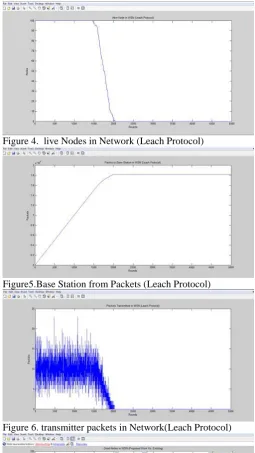
Through the application in the simulation program on the algorithm and the length of the life of the network work, we will rely on four basic parameters, the first is the number of live nodes and Second, the number of dead nodes and the third total packets that will finally send the sum of the long-term nodes that will continue in the network, through these parameters Basic and final results we can conclude and get the following results:
- The minimum number of the dead nodes. - Increase the number of live nodes.
- There is an increase in the transmitter packets continuously to the base station.
- There is an increase in the transmitter packets continuously in the network
3. RESULTS
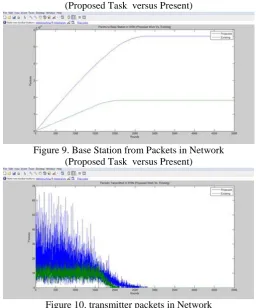
The result refers to the mensuration of network life time. Figure shows the output of existing protocol, changed LEACH protocol and comparison between existing work and changed result.
[image:5.595.304.560.55.509.2]Figure 3. Dead Nodes in Network (Leach Protocol)
Figure 4. live Nodes in Network (Leach Protocol)
Figure5.Base Station from Packets (Leach Protocol)
Figure 6. transmitter packets in Network(Leach Protocol)
Figure7.Dead Nodes in Network (Proposed Task versus Present)
(Proposed Task versus Present)
Figure 9. Base Station from Packets in Network (Proposed Task versus Present)
Figure 10. transmitter packets in Network (Proposed Task versus Present)
VI.CONCLUSIONANDFUTURESCOPE
1. CONCLUSION
Through this work we have obtained an improvement in the algorithm of Leach protocol in wireless networks and through the development of sensors in the node and implementation we were able to obtain energy savings and maintenance on the longest possible period in the life of the network during the work and this, in turn, helped to save energy and reduce the cost.
2. FUTURE SCOPE
After getting power savings in medium networks, we hope to develop more algorithms and then implement them on more complex networks, heterogeneous devices, more sensors and nodes, and also get the ultimate performance on faster performance, higher power extension, and high stability.
VII.REFERENCES
[1] Irshad ullah and shoaib ur rehman,” analysis of black hole attack on manets using different manet routing protocols”, blekinge institute of technology ,box 520 ,se – 372 25 ronneby, sweden.
[2] Xiaoyang guan, “face routing in wireless ad-hoc networks”, proceedings in graduate department of computer science university of toronto, 2009.
[3] Tony larsson, nicklas hedman, ”routing protocols in wireless
ad-hoc networks-a simulation study”, civilingenjörsprogrammet1998:362 , issn: 1402-1617.
[4] Zur erlangung des grades, “modeling and simulation of a routing protocol for ad hoc networks combining queuing network analysis and ant colony algorithms”, vorgelegt dem fachbereich 5,institut für informatik und wirtschaftsinformatikder universität duisburg-essen, april 2005
[5] Aura sharma, “routing in wireless sensor networks”, computer science and engineering department thapar university patiala – 147004 , may 2009.
[6] Heinzelman, wendi rabiner and chandrakasan, anantha and balakrishnan, hari, (2000), ‘energy-efficient communication protocol for wireless micro-sensor networks’, proceedings of the 33rd hawaii international conference on system sciences-volume 8, volume 8, pp.8020.
[7] Younis, o.; fahmy, s. (2004), ‘heed: a hybrid, energy-efficient, distributed clustering approach for ad-hoc sensor networks’, mobile computing, ieee, vol. 4, pp. 366 – 379.
[8] Muruganathan, s.d.; ma, d.c.f.; bhasin, r.i.; fapojuwo, a.o.; (2005) ‘a centralized energy-efficient routing protocol for wireless sensor networks’, ieee radio communications, march 2005.
[9] Lindsey, s. And raghavendra, c., (2002) ‘pegasis: power-efficient gathering in sensor information systems,’ ieee aerospace conf. Proc., 2002, vol. 3, 9–16, pp. 1125–30.
[10] Manjeshwar, a., agrawal, d., (2001) ‘teen: a routing protocol for enhanced effeciency in wireless sensor networks’, in: 1st international workshop on parallel and distributed computing issues in wireless networks and mobile computing.
[11] Manjeshwar, a. And agarwal, d. P.,(2002) “apteen: a hybrid protocol for efficient routing and comprehensive information retrieval in wireless sensor networks,” proc. Int’l. Parallel and distrib. Proc. Symp., pp. 195–202.
[12] Li, c., ye, m., chen, g.and wu, j.(2005).eeuc: an energy efficient unequal clustering mechanism for wireless sensor networks. Proceedings of ieee mass 2005.
[13] Yi, s., heo, j., cho, y., and hong, j. , (2007) “peach: power-efficient and adaptive clustering hierarchy protocol for wireless sensor networks,” computer communications, vol. 30, pp. 2842-2852. [14] Chen, b. Et al., (2002) “span: an energy-efficient coordination algorithm for topology maintenance in ad hoc wireless networks,” wireless networks, vol. 8, no. 5, pp. 481–94.
[15] Ye, m., li, c., chen, g. And wu, j, (2007), ‘an energy efficient clustering scheme in wireless sensor network’, ad hoc & sensor wireless networks, vol. 3, pp. 99-119.
[16] M. J. Handy, m. Haase, d. Timmermann “low energy adaptive clustering hierarchy with deterministic cluster-head selection” institute of applied microelectronics and computer science university of rostock , richard-wagner-str. 31, 18119 rostock, germany. [17] Rajashree v. Biradar, v.c .patil, dr. S. R. Sawant, dr. R. R. Mudholkar “classification and comparison of routing protocols in wireless sensor networks” special issue on ubiquitous computing security systems.
[18] Chandan maity, chaitanya garg, sourish behera “adaptive cluster head characterization in leach protocol for power optimization in wsn” proceedings of ascnt-2011, cdac, noida, india, pp
[19] Puneet azad, brahmjit singh, vidushi sharma “a novel clustering approach for extending the lifetime for wireless sensor networks” international journal of advances in engineering & technology, nov 2011, ©ijaet issn: 2231-1963.
[20] Laiali almazaydeh, eman abdelfattah, manal al- bzoor, and amer al- rahayfeh “performance evaluation of routing protocols in wireless sensor networks” international journal of computer science and information technology, volume 2, number 2, april 2010.
[21] Ge ran, huazhong zhang , shulan gong “improving on leach protocol of wireless sensor networks using fuzzy logic” journal of information & computational science 7: 3 (2010) 767–775.
[22] M. J. Handy, m. Haase, d. Timmermann “low energy adaptive clustering hierarchy with deterministic cluster-head selection” institute of applied microelectronics and computer science university of rostock, richard-wagner-str. 31, 181 19 rostock, germany.
[23] Liang ying, yu haibin “energy adaptive cluster-head selection for wireless sensor networks” proceedings of the sixth international conference on parallel and distributed computing, applications and technologies (pdcat’05) 0-7695-2405-2/05 © 2005 ieee.
[24] Do-hyun nam, hong-ki min “an energy-efficient clustering using a round-robin method in a wireless sensor network” fifth international conference on software engineering research, management and applications, 0-7695-2867-8/07 © 2007 ieee.
on software engineering research, management and applications, 0-7695-2867-8/07 © 2007 ieee.
[26] Inbo sim, koungjin choi, koungjin kwon and jaiyong lee ” energy efficient cluster header selection algorithm in wsn” yonsei university, seoul, korea, international conference on complex, intelligent and software intensive systems, 978-0-7695-3575-3/09 © 2009 ieee. [27] Wendi b. Heinzelman, member, ieee, anantha p. Chandrakasan, senior member, ieee, and hari balakrishnan, member, ieee “an application-specific protocol architecture for wireless microsensor networks” ieee transactions on wireless communications, vol. 1, no. 4, october 2002.
[28] P.t.v. bhuvaneswari and v.vaidehi “enhancement techniques incorporated in leach- a survey” department of electronics engineering, madras institute technology, anna university, chennai, india, indian journal of science and technology vol.2 no 5 (may 2009) issn: 0974- 6846.
[29] Nitin mittal, davinder pal singh, amanjeet panghal, r.s. chauhan “ improved leach communication protocol for wsn” ncci 2010 -national conference on computational instrumentation csio chandigarh, india, 19-20 march 2010.
[30] Hamid barati, ali movaghar, ali barati, and arash azizi mazreah “a review of coverage and routing for wireless sensor networks” world academy of science, engineering and technology 37 2008. [31] Jamal n. Al-karaki, ahmed e. Kamal “routing techniques in wireless sensor networks: a survey” dept. Of electrical and computer engineering iowa state university, ames, iowa 50011, icube initiative of iowa state university, ames, ia 50011.
[32] Y. Yao and j. Gehrke, “the cougar approach to in-network query processes in sensor networks", in sigmod record, september 2002. [33] F. Ye, h. Luo, j. Cheng, s. Lu, l. Zhang, “a two-tier data dissemination model for large-scale wireless sensor networks", proceedings of acm/ieee mobicom, 2002.
[34] F. Ye, a. Chen, s. Liu, l. Zhang, “a scalable solution to minimum cost forwarding in large sensor networks", proceedings of the tenth international conference on computer communications and networks (icccn), pp. 304-309, 2001.
[35] W. Heinzelman, j. Kulik, and h. Balakrishnan, "adaptive protocols for information dissemination in wireless sensor networks," proc. 5th acm/ieee mobicom conference (mobicom '99), seattle, wa, august, 1999. Pp. 174-85.
[36] J. Kulik, w. R. Heinzelman, and h. Balakrishnan, "negotiation-based protocols for disseminating information in wireless sensor networks," wireless networks, volume: 8, pp. 169-185, 2002.
[37] C. Intanagonwiwat, r. Govindan, and d. Estrin, "directed diffusion: a scalable and robust communication paradigm for sensor networks," proceedings of acm mobicom '00, boston, ma, 2000, pp. 56-67.
[38] D. Braginsky and d. Estrin, “rumor routing algorithm for sensor networks," in the proceedings of the first workshop on sensor networks and applications (wsna), atlanta, ga, october 2002.
[39] C. Schurgers and m.b. srivastava, “energy efficient routing in wireless sensor networks", in the milcom proceedings on communications for network-centric operations: creating the information force, mclean, va, 2001.
[40] R. C. Shah and j. Rabaey, “energy aware routing for low energy ad hoc sensor networks", ieee wireless communications and networking conference (wcnc), march 17-21, 2002, orlando, fl. [41] S. Servetto and g. Barrenechea, “constrained random walks on random graphs: routing algorithms for large scale wireless sensor networks", proceedings of the 1st acm international workshop on wireless sensor networks and applications, atlanta, georgia, usa, 2002. [42] S. Lindsey, c. Raghavendra, “pegasis: power-efficient gathering in sensor information systems", ieee aerospace conference proceedings, 2002, vol. 3, 9-16 pp. 1125-1130.
[43] L. Subramanian and r. H. Katz, “an architecture for building self-configurable systems", in the proceedings of ieee/acm workshop on mobile ad hoc networking and computing, boston, ma, august 2000. [44] B. Karp and h. T. Kung, “gpsr: greedy perimeter stateless routing for wireless sensor networks", in the proceedings of the 6th annual acm/ieee international conference on mobile computing and networking (mobicom '00), boston, ma, august 2000.
[45] Q. Li and j. Aslam and d. Rus, “hierarchical power-aware routing in sensor networks", in proceedings of the dimacs workshop on pervasive networking, may, 2001.
[46] Y. Yu, d. Estrin, and r. Govindan, “geographical and energy-aware routing: a recursive data dissemination protocol for wireless sensor networks", ucla computer science department technical report, ucla-csd tr-01-0023, may 2001.
[47] J.-h. Chang and l. Tassiulas, “maximum lifetime routing in wireless sensor networks", proc. Advanced telecommunications and information distribution research program (atirp2000), college park, md, mar. 2000.
[48] D. Braginsky and d. Estrin, ”rumor routing algorithm for sensor networks", international conference on distributed computing systems (icdcs'01), november 2001.
[49] K. Sohrabi, j. Pottie, "protocols for self-organization of a wireless sensor network", ieee personal communications, volume 7, issue 5, pp 16-27, 2000.
[50] P.t.v.bhuvaneswari and v.vaidehi “enhancement techniques incorporated in leach- a survey ” department of electronics engineering, madras institute technology, anna university, chennai, india, indian journal of science and technology vol.2 no 5 (may 2009) issn: 0974- 6846
[51] d. Hall, mathematical techniques in multisensor data fusion. Boston, ma: artech house, 1992.
![Figure 1. Wireless Sensor Network Architecture [16]](https://thumb-us.123doks.com/thumbv2/123dok_us/691711.1076676/1.595.310.553.396.560/figure-wireless-sensor-network-architecture.webp)
![Table 1: Routing Protocol for Wireless Sensor Network [6] The Leach protocol is the probability of a routing protocol](https://thumb-us.123doks.com/thumbv2/123dok_us/691711.1076676/2.595.37.287.69.564/routing-protocol-wireless-sensor-network-protocol-probability-protocol.webp)