International Journal of Advanced Research in Computer Science
REVIEW ARTICLE
Available Online at www.ijarcs.info
CONFERENCE PAPER
Review of Wireless Sensor Networks- Architecture and Applications
Narinder Singh Assistant Professor Guru Nanak College, Budhlada
Gagandeep kaur Assistant Professor Guru Nanak College, Budhlada
Malika Mittal Tech Analyst Infosys, USA Atlanta [email protected]
Abstract: Wireless sensor networks are as of now getting critical consideration because of their boundless potential. A remote sensor system (WSN) is a collection of hubs composed into a helpful system, called cooperative network. Every node has their own processing capacity. In this Paper, I Concentrate on Architecture and the uses of Wireless Sensor Networks .I have additionally said future extent of WSN. The system must have self-sorting out abilities since the positions of individual nodes are not foreordained.
Keywords: Mesh Network, Star Network, Industrial Automation.
I. INTRODUCTION
The rising field of wireless sensor systems consolidates detecting, calculation, and communication into a single minor device. Through cutting edge protocols, these devices frame an ocean of availability that expands the reach of the internet out into the physical world. The force of WSN lies in the capacity to send huge quantities of small nodes that collect and arrange themselves. Use situations for these devices range from constant following, to observing of ecological conditions, to pervasive registering situations.
The most clear use of remote sensor system innovation is to screen remote situations for low frequency information patterns. For instance, a compound plant could be effortlessly observed for leaks by number of sensors that naturally shape a remote interconnection system and instantly report the discovery of any substance leaks. Not at all like conventional wired frameworks, arrangement expenses would be insignificant.
Ability to radically lessening the establishment costs, remote sensor systems can powerfully adjust to evolving situations. Adjustment components can react to changes in system topologies or can bring about the system to move between definitely diverse methods of operation.
Current wireless frameworks just touch the most superficial layer of conceivable outcomes rising up out of the joining of low-power communication, detecting, energy saving, and procassing. unlike to traditional system, WSN don't have to discuss straightforwardly with the closest high control tower or base station, however just with their nearby companions. Rather,
of depending on a pre-deployed framework, every individual sensor or actuator turns out to be a piece of the general foundation. Shared systems administration conventions give a mesh-like interconnect to carry information between the a great many small implanted devices in a multi-hop style.
II.
LITERATURE
A sensor system is de_ned as being made out of countless which are conveyed thickly in close closeness to the wonder to be checked. Each of these nodes gathers information and its motivation is to course this data back to a sink. The system must have self-arranging capacities since the locations of individual nodes are not foreordained. Collaboration among hubs is the prevailing element of this sort of network, where gatherings of nodes participate to scatter the data assembled in their region to the client.
Significant contrasts amongst sensor network and ad-hoc network:
•Number of hubs can be requests of size higher. •Sensor nodes are thickly sent
•Sensor nodes are inclined to disappointment. •Frequent topology changes
•Broadcast correspondence worldview
•Limited power, handling and power capacities •Possible nonattendance of one of a kind worldwide recognizable proof per node.
The creators call attention to that none of the studies overviewed has a completely coordinated perspective of the considerable number of variables driving the outline of sensor networks and continues to present its own correspondence engineering and plan elements to be utilized as a rule and as a device to think about different conventions. Subsequent to reviewing the writing, this is our impression too and we incorporate it in the open examination issues that can be investigated for future work.
The configuration elements recorded by the creators:
sorts of network. The system should to support data dispersal notwithstanding disappointments.
Versatility: Number in the request of hundreds or thousands. Protocols ought to have the capacity to scale to such high degree and exploit the high thickness of such networks.
Creation Costs: The expense of a solitary node must be low, substantially less than $1.
Equipment Constraints: A sensor node is involved numerous subunits (sensing, preparing, correspondence, power, area Finding framework, power rummaging and activate). Every one of these units joined together should devour to a great degree low power and be contained inside a to a great degree little volume.
Sensor Network Topology: Must be kept up even with high node densities.
Environment: Nodes are working in inaccessible areas either on account of threatening environment or on the grounds that they are inserted in a structure.
Transmission Media: RF, Infrared and Optical.
Power Consumption: Power protection and force administration are essential outline components.
Power Consumption: Power conservation and power management are primary design factors.
III. WIRELESS SENSOR
NETWORKS ARCHITECTURE
There are various diverse topologies for radio correspondences systems. A brief dialog of the system topologies that apply to remote sensor systems are sketched out below.
There are a number of different topologies for radio communications networks. A brief discussion of the network topologies that apply to wireless sensor networks are outlined below.
A. Star Network (Single Point-to-Multipoint)
A star system (Figure 1) is an interchanges topology where a solitary base station can send and/or get a message to various remote nodes. The remote nodes can just send or get a message from the single base station, they are not allowed to send messages to each other. The benefit of this kind of system for remote sensor systems is in its effortlessness and the capacity to keep the remote nodes poweatr utilization to a base. It additionally takes into account low inactivity interchanges
[image:2.612.334.529.146.349.2]between the remote hub and the base station. The weakness of such a system is, to the point that the base station must be inside radio transmission scope of all the individual hubs and is not as powerful as different systems because of its reliance on a solitary hub to deal with the system.
Figure 1: Star Network
B. Mesh Network
A mesh network takes into consideration any node in the system to transmit to whatever other node in the system that is inside its radio transmission range. This takes into consideration what is known as multi-hop correspondences; that is, if a node needs to make an impression on another hub that is out of radio interchanges range, it can utilize a moderate hub to forward the message to the craved hub. This system topology has the upside of repetition and adaptability.
CONFERENCE PAPER
Figure 2: Mesh Network
C. Hybrid Star – Mesh Network
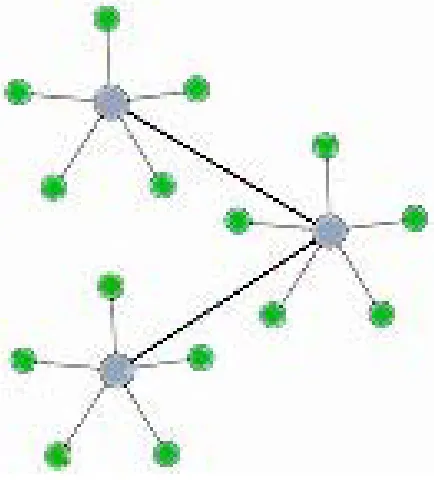
A hybrid between the star and work system accommodates a adaptable and robust interchanges network, while keeping up the capacity to keep the wireless sensor nodes power utilization to a base. In this type of network topology, the least power sensor hubs are not empowered with the capacity to forward messages. This takes into consideration negligible force utilization to be kept up. Be that as it may, different hubs on the system are empowered with multi-jump ability, permitting them to forward messages from the low power nodes to different nodes on the system. By and large, the hubs with the multi-hop ability are higher force, and if conceivable, are regularly connected to the electrical mains line.
Figure 3: Hybrid Star-Mesh Network
IV APPLICATIONS OF WIRELESS
SENSOR NETWORKS
A.Structural Health Monitoring – Smart
Structures
Sensors implanted into machines and structures empower condition-based upkeep of these advantages. Normally, structures or machines are assessed at standard time interims, and segments might be repaired or supplanted in view of their hours in administration, instead of on their working conditions. This strategy is costly if the parts are in great working request, and sometimes, booked upkeep won't secure the benefit in the event that it was harmed in the middle of the review interims. Remote detecting will permit resources for be examined when the sensors demonstrate that there might be an issue, decreasing the expense of upkeep and counteracting cataclysmic disappointment in the occasion that harm is identified.
Now and again, remote detecting applications request the disposal of lead wires, as well as the end of batteries too, because of the inborn way of the machine, structure, or materials under test. These applications incorporate sensors mounted on constantly pivoting parts , inside concrete and composite materials [5], and inside medicinal inserts
B. Modern Automation
[image:3.612.45.253.69.278.2]and permits access to areas that would not be down to earth if links were joined. A case of such an application on a creation line is appeared. In this application, normally ten or more sensors are utilized to gauge holes where elastic seals are to be set. Beforehand, the utilization of wired sensors was too awkward to be in any way executed in a generation line environment. The utilization of remote sensors in this application is empowering, permitting an estimation to be made that was not beforehand useful.
Different applications incorporate vitality control frameworks, security, wind turbine wellbeing monitoring,environmental checking, area based administrations for logistics, and social insurance.
C. Common Structure Monitoring
A standout amongst the latest utilizations of today's more astute, vitality mindful sensor systems is auxiliary wellbeing observing of vast common structures, for example, the Ben Franklin Bridge (Figure 22.6.2), which traverses the Delaware River, connecting Philadelphia and Camden, N.J [9,10]. The extension conveys vehicles, train and person on foot movement. Span authorities needed to screen the strains on the structure as rapid passenger trains traversed the scaffold.
A star system of ten strain sensors were conveyed on the tracks of the suburbanite rail train. The remote detecting hubs were bundled in ecologically fixed NEMA evaluated fenced in areas.
The strain gages were additionally reasonably fixed from the earth and were spot welded to the surface of the extension steel bolster structure. Transmission scope of the sensors on this star system was around 100 meters.
V. FUTURE DEVELOPMENTS
The most broad and adaptable organizations of wireless sensor networks request that batteries be sent. Future work is being performed on frameworks that endeavor piezoelectric materials to reap surrounding strain vitality for vitality stockpiling in capacitors and/or rechargeable batteries. By consolidating smart, energy saving gadgets with cutting edge thin film battery sciences that grant boundless energize cycles, these frameworks could give a long term, maintenance free, remote checking arrangement.
V. CONCLUSION
WSN are empowering applications that beforehand were not down to earth. As new principles based systems are discharged and low power frameworks are ceaselessly created, we will begin to see the boundless arrangement of wireless sensor
networks. Sensor nodes can be envisioned as little PCs, amazingly fundamental as far as their interfaces and their parts. In software engineering and information transfers, remote sensor systems are a dynamic examination region with various workshops and meetings organized every year. Every one of this sensor system exploration is delivering another innovation which is as of now showing up in numerous reasonable.
REFERENCES
[1]Arms, S.W., Townsend, C.P., Hamel, M.J.; “Validation of Remotely Powered and Interrogated Sensing Networks for Composite Cure Monitoring,” paper presented at the 8th International Conference on Composites Engineering (ICCE/8), Tenerife, Spain, August 7–11, 2001.
[2] R. C. Shah ; Berkeley Wireless Res. Center, California Univ., Berkeley, CA, USA ; J. M. Rabaey;“Energy aware routing for low energy ad hoc sensor networks”Wireless Communications and Networking Conference, 2002. WCNC2002. 2002 IEEE (Volume:1 ) pages350-355 17-21 Mar 2002
[3]Arms, S.W., Townsend, C.P., Galbreath, J.H., Newhard, A.T.; “Wireless Strain Sensing Networks,” Proceedin gs 2nd European Workshop on Structural Health Monitoring, Munich, Germany, July 7–9, 2004.
[4]Kohlstrand, K.M, Danowski, C, Schmadel, I, Arms, S.W; “Mind The Gap: Using Wireless Sensors to Measu re Gaps Effi ciently,” Sensors Magazine, October 2003.
[5]A.Tiwari, A., Lewis, F.L., Shuzhi S-G.; “Design & Implementation of Wireless Sensor Network for Machine Condition Based Maintenance,” Int’l Conf. Control, Automation, Robotics,& Vision (ICARV), Kunming, China, 6– 9 Dec. 2004.
[6]Arms, S.A., Townsend, C.P.; “Wireless Strain Measurement Systems – Applications & Solutions,” Proceedings of NSF-ESF Joint Conference on Structural Health Monitoring,Strasbourg, France, Oct 3–5, 2003 .
[7]C. Decker, M. Beigl, A. Krohn, U. Kubach, and P. Robinson. eSeal - a system for enhanced electronic assertion of authenticity and integrity of sealed items.In Proceedings of the Pervasive Computing, volume 3001 of Lecture Notes in Computer Science (LNCS), pages 254– 268. Springer Verlag, 2004.
[8]I.F. Akyildiz, W. Su, Y. Sankarasubramaniam, E. Cayirci “A survey on sensor networks”IEEE communications Magazine, 40 (8) (2002), pp. 104–112
CONFERENCE PAPER
countersniper system”, in: Proceedingsof the Second International Conference on Embedded Networked Sensor Systems (Sensys), Baltimore, MD, 2004.
[10] J. Yick, G. Pasternack, B. Mukherjee, D. Ghosal “Placement of network services in sensor networks”