2216
A Study on the Behaviour of SAODV with TCP and
SCTP Protocols in Mobile Adhoc Networks
S. Mahalakshmi1, Dr. K. Geetha2
Research Scholar, Department of Computer Science, Periyar Arts College, Cuddalore1 Associate professor, Department of Computer Science, Periyar Arts College, Cuddalore2
Email: [email protected]1
Abstract- SAODV (Secure Ad-Hoc On-Demand Distance Vector) Protocol is an efficient routing protocol. It maintains the security with the help of cryptography and key management algorithm. In this paper, the behavior of SAODV protocol is analyzed with TCP and SCTP protocols in MANET. The performance is analyzed with the Quality of Service Parameters such as Throughput, Packet Delivery Ratio, End-to-End Delay, Network Overhead, Control Overhead and Jitter. NS-2 is used for the simulation.
Keywords - SAODV, MANET, TCP, SCTP, NS-2.
1. INTRODUCTION
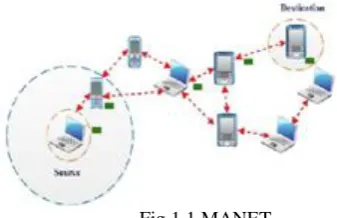
MANET means Mobile Ad-Hoc Network. The node acts as a mobile device and each node is connected through the wireless link. This can be Wi-Fi Connections or another medium such as cellular or satellite transmission. It is a complex system. Every node acts as a router to share the message or traffic to another node. The nodes are randomly moved and different topologies are used in MANET. Once the connection is established data is transferred through the connection oriented protocol (TCP) or connectionless protocol (UDP). Each node is connected in different wireless links. It form self configuring network. It maintains many nodes with security to each sender and receiver node. SCTP protocol is a message stream oriented protocol. It provides Multistream and Multihoming facility. SAODV provides security in MANET.
Fig 1.1 MANET
1.1 Features of MANET:
MANET has following features [1]:
Autonomous Terminal
Distributed Operations
Provides fast transmission
Multi-Hop Routing
Dynamic Network Topology
Self - Directed Terminal
Self – Creation and Self – Organization and Self – Administration
This paper is organized as follows: section 2 describes Review of Literature, section 3 describes Description of the problem, the analysis of performance is provided in section 4 and section 5 describes conclusion of the paper.
2. REVIEW OF LITERATURE
Dr. K. Geetha and N. Sreenath [2] transfer multimedia data through the mobile adhoc network. The multimedia data is sent through the mobile adhoc network and performance are measured through the quality of service parameter like throughput, end-to-end delay, jitter, routing control overhead and normalized network overload. Performance are compared in different routing protocols are AODV, DSDV, OLSR and FSR. Ashwini kumar ,Lillykutty Jacob and A.L. Ananda [3] Mobile Ad-Hoc Network is a complex system. TCP and SCTP both are wired protocol but in wireless its performance is different. The SCTP has Multihoming facility. TCP and SCTP performances are evaluated through Good put comparison, retransmission comparison and sack bandwidth comparison. Finally TCP is not well perform in MANET. SCTP multihoming is slightly slow but Multistream mechanism is best in SCTP, So SCTP is best in MANET.
2217 AODV. SCTP and TCP performances are compared
and evaluated through the DSR routing protocol. Again SCTP and TCP performances are evaluated through the AODV routing protocol. TCP and SCTP is produce same results but SCTP provides better results than TCP. Finally SCTP handling route failures in MANET.
Durgesh wadbude, Vineet richariya [5] secure AODV routing protocol in MANET. SAODV is a advanced version of AODV. SAODV is an efficient routing protocol. design new algorithm to improve the secure AODV in MANET. Finally the Secure AODV performance is analyzed through the quality of metrics such as end-to-end delay, packet loss and throughput.
3. DESCRIPTION OF THE PROBLEM
The SAODV is a special protocol; an extended version of AODV, which is a well known routing protocol. In MANET information is sent from sender to receiver and information is received without correct destination multiple nodes are connected through the wireless link. So MANET provides security routing protocol. Security is important concept of MANET. The SAODV is an extension of AODV. It is a MANET routing protocol. It is used for security purpose. All the nodes are connected through the SAODV. The SAODV provides digital signature [6] for nodes for asymmetric cryptosystem. SAODV is an efficient routing protocol. It maintains the security with the help of cryptography and key management algorithm. It provides integrity, Authentication and non- repudiation. In MANET the key management is divided into two categories: Symmetric and Asymmetric key management. The symmetric key uses the same key for encryption and decryption. Asymmetric key it uses encryption and decryption algorithm. It uses digital signature or public key algorithm for encryption. The performance of SAODV is analyzed with TCP and SCTP protocols. 3.1 TCP (Transmission Control Protocol)
TCP (Transmission Control Protocol) is one of the most important protocols in transport layer. It is a byte oriented protocol. TCP is the fast transmit protocol. it provides 95% data transfer with Security [7]. The TCP protocol provides full duplex methods (Both side data transmission) and point to point line configuration. It is a connection oriented protocol. TCP provides Segmentation and Re-assembly method. If the sender sends the large data TCP divide the large packet into small packets and assign the ID to each small packet and the receiver receives each small packet with ID. Finally all the small packets are combined with one large packet. This method is used to detect packet loss. TCP is
combined with IP (Internet Protocol). IP is used to send the packet from source to destination machine. TCP provides 3- way handshaking mechanism. Such as
Connection establishment
Data transfer
Connection termination 3.1.1 Services of TCP
TCP includes several features [7]. Such as
Connection Oriented Service
Full Duplex Service
Retransmission Service
Segmentation and Reassembly
3.1.2 TCP in MANET
TCP is a connection oriented Transport Layer Protocol. It well performed in wired network. But in wireless network TCP performance is slightly slow. It provides low bandwidth and high packet loss. TCP includes Congestion Control Methods to detect packet loss and improve the throughput. But in wireless TCP needs an efficient algorithm to avoid the packet loss.
3.2 SCTP (Stream Control Transmission Protocol) SCTP means Stream Control Transmission Protocol [8]. SCTP is the transport layer protocol. It is a reliable message oriented transport layer protocol. SCTP contains advanced features of TCP. It is a combination of the TCP and UDP. It is specially designed for internet application. SCTP maintains message boundaries, detects the lost packet or data, duplicate data and out-of-ordered data. It provides connection oriented services.
3.2.1 Services of SCTP
The SCTP contain many services. Are:
Process to process communications
Multistream facility
Full duplex connection
Reliability
Multihoming facility
4. ANALYSIS OF SAODV WITH TCP AND SCTP
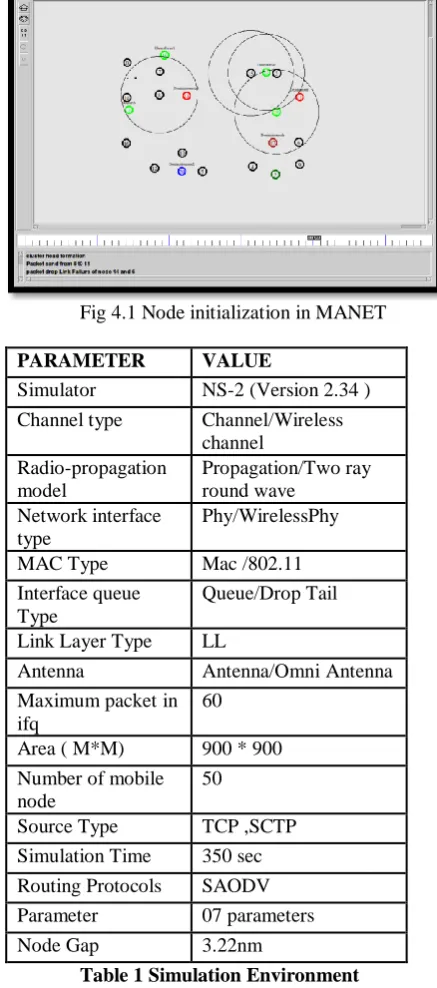
2218 Fig 4.1 Node initialization in MANET
PARAMETER VALUE
Simulator NS-2 (Version 2.34 ) Channel type Channel/Wireless
channel Radio-propagation
model
Propagation/Two ray round wave
Network interface type
Phy/WirelessPhy MAC Type Mac /802.11 Interface queue
Type
Queue/Drop Tail Link Layer Type LL
Antenna Antenna/Omni Antenna Maximum packet in
ifq
60 Area ( M*M) 900 * 900 Number of mobile
node
50
Source Type TCP ,SCTP Simulation Time 350 sec Routing Protocols SAODV Parameter 07 parameters
Node Gap 3.22nm
Table 1 Simulation Environment 4.1 Simulation Methods
The analysis carried out with NS2. The following QoS parameters are considered for analysis.
1. Throughput 2. End-to-End Delay 3. Packet Delivery Ratio 4. Network Overhead 5. Control Overhead 6. Jitter
1. Throughput
The throughput is used to measure the number of packets delivered to destination within seconds. The throughput can be defined as:
Throughput =
Kbps
2. Packet delivery Ratio
The packet delivery ratio is calculated as the ratio of the number of packets sent to the number of packets to the receiver. The packet delivery ratio can be defined as:
Packet delivery ratio= Received packets / Generated packets * 100
3. End-to-End delay
The End-to-End delay defines the difference between each packet to transmit from source to destination. Delay depends on network speed, routing protocol and packet size. The delay can be defined as:
Delay=Packet Received Time – Packet Send Time
4. Network Overhead
The Hello packet, which is used to check whether the neighbor node is active. Both, network and data packets have to share the same network bandwidth most of the time, and hence network packets are considered to be an overhead in the network. This overhead is called network overhead. The network overhead can be defined as:
Network overhead=Bandwidth / Total no of packets
5. Control overhead
Routing overhead is the number of routing packets required for network communication. Routing overhead is calculated using AWK script which processes the trace file and produces the result. The Control overhead can be defined as:
Routing overhead= Sum of routing packets / Sum of data packets
6. Jitter
Jitter is the delay between the adjacent packets. The Jitter can be defined as:
Jitter (i) = Delay (i+1) – Delay (i)
4.2 Analysis
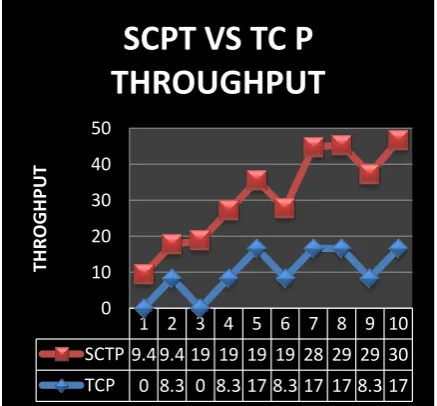
2219 Fig 4.2 (a) SCTP vs TCP throughput
Fig 4.2 (b) SCTP vs TCP packet deliver ratio.
Fig 4.2 (c) SCTP vs TCP End-to-End delay
Fig 4.2 (d) SCTP vs TCP Network overhead
Fig 4.2 (e) SCTP vs TCP Control overhead
2220
Fig 4.2 (f) SCTP vs TCP Jitter 5. CONCLUSION
The performance of SAODV protocol is analyzed with TCP and SCTP protocol. In general, the TCP protocol is behaving well in terms of overhead. But the with respect to speedy delivery and throughput the SCTP protocol is behaving well along with SAODV in MANET. This is because of the characteristics of TCP like [9] Frequent path break, high error rate, low bandwidth. The SCTP protocol is well performing in Ad-Hoc Wireless Networks because of the following reasons: Multistreaming facility and Multihoming facility. From the analysis it is observed that SAODV is behaving well with SCTP than TCP. The TCP protocol provides high packet loss in Ad-Hoc Wireless Networks.
REFERENCES
[1] Ishu Vaishnu and Shahjahan Ali (2017), “Study on MANET: Concepts, Features and Applications” Elk Asia Pacific Journal of Computer Science and Information System, ISSN2349-9392
(Online);DOI;10.16962/Eapimrm/issn. 2349-9392/2015; Vol. 3,issue 2 (2017).
[2] K. Geetha and N. Sreenath (November, 2013), “A General study on the transfer of multimedia messages over in mobile ad-hoc networks”, International Journal of Computer Applications (0975-8887), vol. 81, no 9, November 2013.
[3] Ashwini Kumar, Lillykutty Jacob and A.L. Anada, “SCTP vs TCP: performance comparison in MANET’s”, IEEE International Conference on Local Computer Networks (LCN’04), 0742-1303/04.
[4] Antonios Argyriou and Vijay Madisetti, “Performance Evaluation and optimization of SCTP in Wireless Ad-Hoc Networks”, IEEE International Conference on Local Computer Networks (LCN’03), 0742-1303/03, 2003. [5] Durgesh Wadbude and Vineet Richariya
(2012), “An Efficient secure AODV routing protocol in MANET”, International Journal of Engineering and Innovative Technology, ISSN: 2277-3754, vol. 1, issue 4, pp.274-279, April 2012.
[6] Manel Guerrero Zapata, “Secure Ad-Hoc On-Demand Distance Vector Routing”, Mobile Computing and Communication Review, vol. 6, number 3, pp.106-107.
[7] Behrouz A. Forouzan, “Data Communication and Networking”, 2nd ed. New Delhi: Tata McGraw Hill,2009.
[8] R. Stewart, Q. Xie, et al. RFC 2960: Stream Control Transmission Protocol. Standards track, Network Working Group, The Internet Society, 2000.
[9] C. Siva Ram Murthy and B.S. Manoj, “Ad-Hoc Wireless Networks Architecture and Protocols”, Pearson ed. India: Pearson Education, 2004.
-100 -50 0 50 100 150
1 2 3 4 5 6 7 8 9