Recognising Nested Named Entities in Biomedical Text
Beatrice Alex, Barry Haddow and Claire Grover School of Informatics
University of Edinburgh 2 Buccleuch Place Edinburgh, EH8 9LW, UK
{balex,bhaddow,grover}@inf.ed.ac.uk
Abstract
Although recent named entity (NE) annotation ef-forts involve the markup of nested entities, there has been limited focus on recognising such nested struc-tures. This paper introduces and compares three techniques for modelling and recognising nested entities by means of a conventional sequence tag-ger. The methods are tested and evaluated on two biomedical data sets that contain entity nesting. All methods yield an improvement over the baseline tag-ger that is only trained on flat annotation.
1 Introduction
Traditionally, named entity recognition (NER) has focussed on entities which are continuous,
non-nested and non-overlapping. In other words, each
token in the text belongs to at most one entity, and NEs consist of a continuous sequence of tokens. However, in some situations, it may make sense to relax these restrictions, for example by allowing en-tities to be nested inside other enen-tities, or allowing
discontinuous entities. GENIA (Ohta et al., 2002)
and BioInfer (Pyysalo et al., 2007) are examples of recently producedNE-annotated biomedical corpora where entities nest. Corpora in other domains, for example the ACE1data, also contain nested entities. This paper compares techniques for recognising nested entities in biomedical text. The difficulty of this task is that the standard method for convert-ing NER to a sequence tagging problem with BIO-encoding (Ramshaw and Marcus, 1995), where each
1http://www.nist.gov/speech/tests/ace/ index.htm
token is assigned a tag to indicate whether it is at the beginning (B), inside (I), or outside (O) of an en-tity, is not directly applicable when tokens belong to more than one entity. Here we explore methods of reducing the nestedNERproblem to one or moreBIO problems so that existingNERtools can be used.
This paper is organised as follows. In Section 2, the problem of nested entities is introduced and mo-tivated with examples from GENIA and our EPPI (enriched protein-protein interaction) data. Related work is reviewed in Section 3. The proposed tech-niques enablingNERfor nestedNEs are explained in Section 4. Section 5 details the experimental setup, including descriptive statistics of the corpora and specifics of the classifier. The results of comparing different tagging methods are analysed in Section 6, with a discussion and conclusion in Section 7.
2 Nested Entities
The majority of previous work onNERis conducted using data sets annotated either with continuous, non-nested and non-overlapping NEs or an annota-tion scheme reduced to a flat annotaannota-tion of a similar kind in order to simplify the recognition task. How-ever, annotated corpora often contain entities that are nested or discontinuous. For example, the GENIA corpus contains nested entities such as:
<RNA><DNA>CIITA</DNA>mRNA</RNA>
GENIA EPPI
Count Nesting Count Nesting
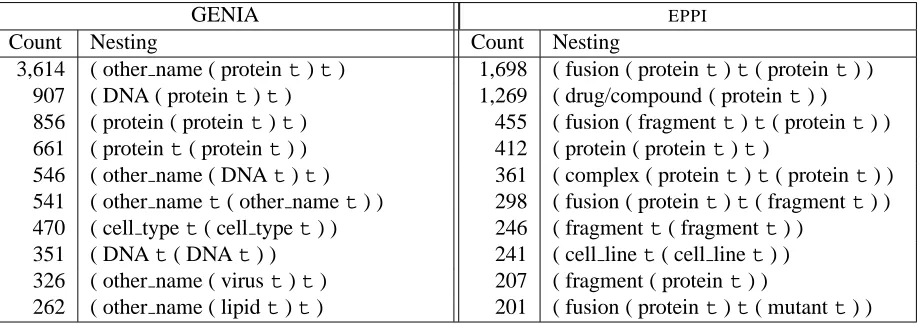
3,614 ( other name ( proteint)t) 1,698 ( fusion ( proteint)t( proteint) )
907 ( DNA ( proteint)t) 1,269 ( drug/compound ( proteint) )
856 ( protein ( proteint)t) 455 ( fusion ( fragmentt)t( proteint) )
661 ( proteint( proteint) ) 412 ( protein ( proteint)t)
546 ( other name ( DNAt)t) 361 ( complex ( proteint)t( proteint) ) 541 ( other namet( other namet) ) 298 ( fusion ( proteint)t( fragmentt) ) 470 ( cell typet( cell typet) ) 246 ( fragmentt( fragmentt) )
351 ( DNAt( DNAt) ) 241 ( cell linet( cell linet) )
326 ( other name ( virust)t) 207 ( fragment ( proteint) )
[image:2.612.75.536.51.213.2]262 ( other name ( lipidt)t) 201 ( fusion ( proteint)t( mutantt) )
Table 1: 10 most frequent types of nesting in the GENIA corpus and the combined TRAINand DE-VTESTsections of theEPPIdata (see Section 5.1), wheretrepresents the text.
containing nested structures focus on recognising the outermost (non-embedded) entities (e.g. Kim et al. 2004) , as they contain the most information, including that of embedded entities (Zhang et al., 2004). This enables a simplification of the recog-nition task to a sequential analysis problem.
Our aim is to recognise all levels of NE nesting occurring in two biomedical corpora: the GENIA corpus (Version 3.02) and theEPPIcorpus (see Sec-tion 5.1). The latter data set was collected and an-notated as part of the TXM project. Its annotation contains 9 different biomedical entities. While the GENIA corpus contains nested entities up to a level of four layers of embedding, the nested entities in theEPPI corpus only have three layers. Table 1 lists the ten most frequent types of entity nesting occur-ring in both corpora. In the remainder of the paper, we differentiate between:
embeddedNEs: contained in otherNEs
non-embeddedNEs: not contained in otherNEs
containingNEs: containing otherNEs
non-containingNEs: not containing otherNEs
The GENIA corpus is made up of a larger per-centage of both embedded entity (18.61%) and con-taining entity (16.95%) mentions than theEPPIdata (12.02% and 8.27%, respectively). In both corpora, nesting can occur in three different ways:
1. Entities containing one or more shorter
embed-ded entities. Such nesting is very frequent in both
data sets. For example, the DNA “IL-2 promoter” in the GENIA corpus contains the protein “IL-2”. In
theEPPI corpus, fusions and complexes often con-tain nested proteins, e.g. the complex “CBP/p300”, where “CBP” and “p300” are marked as proteins.
2. Entities with more than one entity type. Al-though they occur in both data sets, they are very rare in the GENIA corpus. For example, the string “p21ras” is annotated both as DNA and protein. In the EPPI data, proteins can also be annotated as drug/compound, where it can be clearly established that the protein is used as a drug to affect the func-tion of an organism, cell, or biological process.
3. Coordinated entities. CoordinatedNEs account for approximately 2% of allNEs in the GENIA and EPPI data. In the original corpora they are anno-tated differently, but for this work they are all con-verted to a common format.2 The outermost anno-tation of coordinated structures and any continuous entity mark-up within them is retained. For exam-ple, in “human interleukin-2 and -4” both the con-tinuous embedded entity “human interleukin-2” and the entire string are marked as proteins. The markup for discontinuous embedded entities, like “human interleukin-4” in the previous example, is not re-tained, as they could be derived in a post-processing step once nested entities are recognised.
3 Related Work
In previous work addressing nested entities, Shen et al. (2003), Zhang et al. (2004), Zhou et al. (2004), Zhou (2006), and Gu (2006) considered the GENIA
2Both corpora are represented in XML with standoff
corpus, where nested entities are relatively frequent. All these studies ignore embedded entities occur-ring in coordinated structures and only retain their outermost annotation. Shen et al. (2003), Zhang et al. (2004), and Zhou et al. (2004) all report on a rule-based approach to dealing with nested NEs in the GENIA corpus (Version 3.0) in combination with a Hidden Markov Model (HMM) that first recognises innermost NEs. They use four basic hand-crafted patterns and a combination thereof to generate nest-ing rules from the trainnest-ing data and thereby derive NEs containing the innermostNEs. The experimen-tal setup of these studies differs slightly. While Shen et al. (2003) and Zhang et al. (2004) report results testing on 4% of the abstracts in the GENIA corpus, Zhou et al. (2004) report 10-fold cross-validation scores. Zhou (2006) applies the same rule-based method for dealing with nested entities to the out-put of a mutual information independence model (MIIM) combined with a support vector machine (SVM) plus sigmoid. His results are based on 5-fold cross-validation on the GENIA corpus (Version 3.0). In each of the studies, the rule-based approach to nested entities results in an improvement of between 3.0 and 3.5 points inF1 over the baseline model.
However, as explicitly stated by Shen et al. (2003) and Zhang et al. (2004), this evaluation is limited to non-embedded (i.e. top-level and non-nested) enti-ties. The highest overall F1-score reported for all
entities in the GENIA corpus is 71.2 (Zhou, 2006), which again only appears to reflect the performance on non-embedded entities.
Zhang et al. (2004) also compare the rule-based method with HMM-based cascaded recognition that extends iteratively from the shortest to the longest entities. Their basic HMM model is combined with HMM models trained on transformed cascaded an-notations. During training, embedded entity terms are replaced by their entity type as a way of unnest-ing the data. Durunnest-ing testunnest-ing, subsequent iterations rely on the tagging of the first recognition pass and are repeated until no more entities are recognised. However, this method only results in an improve-ment of 1.2 points inF1over their basic classifier.
Gu (2006) reports results on recognising nested entities in the GENIA corpus (Version 3.02) when training an SVM-light binary classifier to recognise either proteins or DNA. Training with the outermost labelling yields better performance on recognising
outermost entities and, conversely, using the inner labelling results in highest scores for recognising in-ner entities. The best exact matchF1-scores of 73.0
and 47.5 for proteins and DNA, respectively, are ob-tained when training on data with inner labelling and evaluating on the inner entities.
McDonald et al. (2005) propose structured multil-abel classification as opposed to sequential lmultil-abelling for dealing with nested, discontinuous, and overlap-pingNEs. This approach uses a novel text segment representation in preference to the BIO-encoding. Their corpus contains MEDLINE abstracts on the inhibition of the enzyme CYP450 (Kulick et al., 2004), specifically those abstracts that contain at least one overlapping and one discontinuous anno-tation. While this data does not contain nestedNEs, discontinuous and overlappingNEs make up 6% of allNEs. The classifier performs competitively with sequential tagging models on continuous and non-overlapping entities forNERand noun phrase chunk-ing. On discontinuous and overlapping NEs in the biomedical data alone, its best performance is 56.25
F1. As the corpus does not contain nested NEs, it
would be of interest to investigate the algorithm’s performance on the GENIA corpus.
4 Modelling Techniques
As large amounts of time and effort have been de-voted to work on non-nested NER using the BIO-encoding approach, it would be useful if this work could be easily applied to nestedNER. In this paper, three different ways of addressing nested NERwill be compared: layering, cascading, and joined
la-bel tagging. All techniques aim to reduce the nested
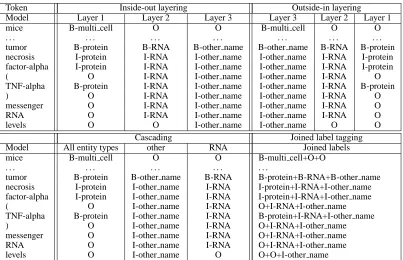
NERproblem to one or more BIO problems, so that existingNERtools can be used. Table 2 shows an ex-ample representation for each modelling technique of the following two non-nested and nested entity annotations found in a GENIA abstract:
<multi cell>mice</multi cell>. . .
<other name><RNA><protein>tumor necrosis factor-alpha</protein>
(<protein>TNF- alpha</protein>)
messenger RNA</RNA>levels</other name>
Token Inside-out layering Outside-in layering
Model Layer 1 Layer 2 Layer 3 Layer 3 Layer 2 Layer 1
mice B-multi cell O O B-multi cell O O
. . . .
tumor B-protein B-RNA B-other name B-other name B-RNA B-protein
necrosis I-protein I-RNA I-other name I-other name I-RNA I-protein
factor-alpha I-protein I-RNA I-other name I-other name I-RNA I-protein
( O I-RNA I-other name I-other name I-RNA O
TNF-alpha B-protein I-RNA I-other name I-other name I-RNA B-protein
) O I-RNA I-other name I-other name I-RNA O
messenger O I-RNA I-other name I-other name I-RNA O
RNA O I-RNA I-other name I-other name I-RNA O
levels O O I-other name I-other name O O
Cascading Joined label tagging
Model All entity types other RNA Joined labels
mice B-multi cell O O B-multi cell+O+O
. . . .
tumor B-protein B-other name B-RNA B-protein+B-RNA+B-other name
necrosis I-protein I-other name I-RNA I-protein+I-RNA+I-other name factor-alpha I-protein I-other name I-RNA I-protein+I-RNA+I-other name
( O I-other name I-RNA O+I-RNA+I-other name
TNF-alpha B-protein I-other name I-RNA B-protein+I-RNA+I-other name
) O I-other name I-RNA O+I-RNA+I-other name
messenger O I-other name I-RNA O+I-RNA+I-other name
RNA O I-other name I-RNA O+I-RNA+I-other name
[image:4.612.103.506.49.309.2]levels O I-other name O O+O+I-other name
Table 2: Example representation of nested entities for various modelling techniques.
inside-out or outside-in. For inside-out layering, the
first layer is made up of all non-containing entities, the second layer is composed of all those entities which only contain one layer of nesting, etc. Con-versely, outside-in layering means that the first layer contains all non-embedded entities, the second layer contains all entities which are only contained within one outer entity, etc. Both directions of layering can be modelled using a conventionalNEtagger.
Cascading reduces the nested NER task to sev-eral BIO problems by grouping one or more entity types and training a separate model for each group. Again, the output from individual models is com-bined during tagging. Subsequent models in the cas-cade may have access to the guesses of previous ones by means of a GUESS feature. The cascaded method is unable to recognise entities containing en-tities of the same type, which may be a drawback for some data sets. Cascading also raises the issue of how to group entity types. This is dependent on the types of entities that nest within a given data set and would potentially require large amounts of experi-mentation to determine the best combination. More-over, training a model for each entity type lengthens training time considerably, and may degrade perfor-mance due to the dominance of theOtags for
infre-quent categories. It is possible, however, to create a cascaded tagger combining one model trained on all entity types with models trained on entity types that frequently contain other entities.
Finally, joined label tagging entails creating one tagging problem for all entities by concatenating the BIO tags of all levels of nesting. A conventional named entity recogniser is then trained on the data containing the joined labels. Once the classifier has assigned the joined labels during tagging, they are decoded into their original BIO format for each in-dividual entity type. Compared to the other tech-niques, joined label tagging involves a much larger tag set, which can increase dramatically with the number of entity types occurring in a data set. This can result in data sparsity which may have a detri-mental effect on performance.
5 Experimental Setup
5.1 Corpora
GENIA (V3.02), a large publicly available biomedi-cal corpus annotated with biomedibiomedi-calNEs, is widely used in the text mining community (Cohen et al., 2005). This data set consists of 2,000 MEDLINE ab-stracts in the domain of molecular biology (⋍0.5m
reported here are based on the GENIA ontology, published in Ohta et al. (2002). It contains the fol-lowing classes: amino acid monomer, atom, body part, carbohydrate, cell component, cell line, cell type, DNA, inorganic, lipid, mono-cell, multi-cell, nucleotide, other name, other artificial source, other organic compound, peptide, polynucleotide, protein, RNA, tissue, and virus. In this work, protein, DNA and RNA sub-types are collapsed to their super-type, as done in previous studies (e.g. Zhou 2006). To the best of our knowledge, no inter-annotator agreement (IAA) figures on the NE-annotation in the GENIA corpus are reported in the literature.
The EPPI corpus consists of 217 full-text papers selected from PubMed and PubMedCentral as con-taining protein-protein interactions (PPIs). The pa-pers were either retrieved inXMLorHTML, depend-ing on availability, and converted to an internalXML format. Domain experts annotated all documents for NEs and PPIs, as well as extra (enriched) in-formation associated with PPIs and normalisations of entities to publicly available ontologies. The en-tity annotations are the focus of the current work. The types of entities annotated in this data set are: complex, cell line, drug/compound, experimental method, fusion, fragment, modification, mutant, and protein. Out of the 217 papers, 125 were singly annotated, 65 were doubly annotated, and 27 were triply annotated. The IAA, measured by taking the
F1 score of one annotator with respect to another
when the same paper is annotated by two different annotators, ranges from 60.40 for the entity type mutant to 91.59 for protein, with an overall micro-averagedF1-score of 84.87. TheEPPIcorpus (⋍2m
tokens) is divided into three sections,TRAIN (66%), DEVTEST (17%), andTEST (17%), withTEST only to be used for final evaluation, and not to be con-sulted by the researchers in the development and fea-ture optimisation phrase. The experiments described here involve theEPPI TRAIN andDEVTEST sets.
5.2 Pre-processing
All documents are passed through a sequence of pre-processing steps implemented using the LT-XML2 andLT-TTT2tools (Grover et al., 2006) with the out-put of each step encoded inXMLmark-up. Tokeni-sation and sentence splitting is followed by part-of-speech tagging with the Maximum Entropy Markov Model (MEMM) tagger developed by Curran and
Clark (2003) (hereafter referred to as C&C ) for the CoNLL-2003 shared task (Tjong Kim Sang and De Meulder, 2003), trained on the MedPost data (Smith et al., 2004). Information on lemmatisa-tion, as well as abbreviations and their long forms, is added using the morpha lemmatiser (Minnen et al., 2000) and the ExtractAbbrev script of Schwartz and Hearst (2003), respectively. A lookup step uses on-tological information to identify scientific and com-mon English names of species. Finally, a rule-based chunker marks up noun and verb groups and their heads (Grover and Tobin, 2006).
5.3 Named Entity Tagging
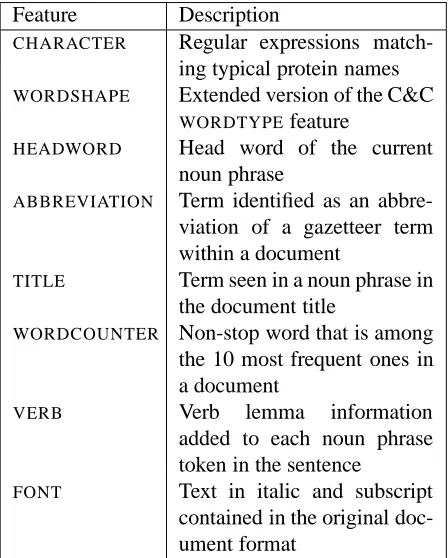
The C&C tagger, referred to earlier, forms the basis of theNERcomponent of theTXMnatural language processing (NLP) pipeline designed to detect entity relations and normalisations (Grover et al., 2007). The tagger, in common with manyML approaches to NER, reduces the entity recognition problem to a sequence tagging problem by using the BIO en-coding of entities. As well as performing well on the CoNLL-2003 task, Maximum Entropy Markov Models have also been successful on biomedical NERtasks (Finkel et al., 2005). As the vanilla C&C tagger (Curran and Clark, 2003) is optimised for performance on newswire text, various modifica-tions were applied to improve its performance for biomedical NER. Table 3 lists the extra features specifically designed for biomedical text. The C&C tagger was also extended using several gazetteers, including a protein, complex, experimental method and modification gazetteer, targeted at recognising entities occurring in the EPPI data. Further post-processing specific to theEPPIdata involves correct-ing boundaries of some hyphenated proteins and fil-tering out entities ending in punctuation.
en-Feature Description
CHARACTER Regular expressions
match-ing typical protein names WORDSHAPE Extended version of the C&C
WORDTYPEfeature
HEADWORD Head word of the current
noun phrase
ABBREVIATION Term identified as an abbre-viation of a gazetteer term within a document
TITLE Term seen in a noun phrase in
the document title
WORDCOUNTER Non-stop word that is among the 10 most frequent ones in a document
VERB Verb lemma information
added to each noun phrase token in the sentence
FONT Text in italic and subscript
contained in the original doc-ument format
Table 3: Extra features added to C&C .
tity models according to performance or entity fre-quency in the training data, ranging from highest to lowest. Cascading is also carried out on groups of entities (e.g. one model for all entities, one for a specific entity type, and combinations). Subsequent models in the cascade have access to the guesses of previous ones via a GUESS feature. Finally, joined label tagging is done by concatenating individual BIOtags from the innermost to the outermost layer.
As in the GENIA corpus, the most frequently an-notated entity type in theEPPIdata is protein with al-most 55% of all annotations in the combinedTRAIN and DEVTEST data (see Table 5). Given that the scores reported in this paper are calculated as F1
micro-averages over all categories, they are strongly influenced by the classifier’s performance on pro-teins. However, scoring is not limited to a particular layer of entities (e.g. only outermost layer), but in-cludes all levels of nesting. During scoring, a correct match is achieved when exactly the same sequence of text (encoded in start/end offsets) is marked with the same entity type in the gold standard and the sys-tem output. Precision, recall andF1are calculated
in standard fashion from the number of true positive, false positive and false negativeNEs recognised.
[image:6.612.71.295.51.330.2]6 Results
Table 4 lists overall cross-validation F1-scores
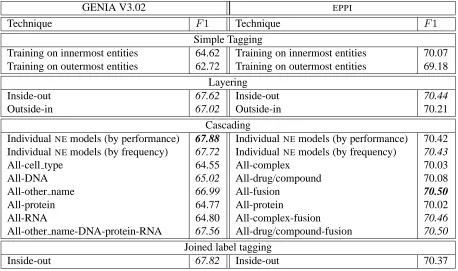
cal-culated for allNEs at all levels of nesting when ap-plying the various modelling techniques. For GE-NIA, cascading on individual entities when order-ing entity models by performance yields the high-est F1-score of 67.88. Using this method yields
an increase of 3.26 F1 over the best simple
tag-ging method, which scores 64.62F1. Joined label
tagging results in the second best overall F1-score
of 67.82. Both layering (inside-out) and cascading (combining a model trained on allNEs with 4 mod-els trained on other name, DNA, protein, or RNA) also perform competitively, reaching F1-scores of
67.62 and 67.56, respectively. In the experiments with theEPPI corpus, cascading is also the winner with anF1-score of 70.50 when combining a model
trained on allNEswith one trained on fusions. This method only results in a small, yet statistically sig-nificant (χ2,p≤0.05), increase inF1of 0.43 over
the best simple tagging algorithm. This could be due to the smaller number of nestedNEs in theEPPIdata and the fact that this data contains many NEs with more than one category. Layering (inside-out) per-forms almost as well as cascading (F1=70.44).
The difference in the overall performance be-tween the GENIA and the EPPI corpus is partially due to the difference in the number of NEs which C&C is required to recognise, but also due to the fact that all features used are optimised for theEPPI data and simply applied to the GENIA corpus. The only feature not used for the experiments with the GENIA corpus is FONT, as this information is not preserved in the originalXMLof that corpus.
7 Discussion and Conclusion
According to the results for the modelling tech-niques, each proposed method outperforms simple tagging. Cascading yields the best result on the GE-NIA (F1=67.88) andEPPIdata (F1=70.50), see
GENIA V3.02 EPPI
Technique F1 Technique F1
Simple Tagging
Training on innermost entities 64.62 Training on innermost entities 70.07
Training on outermost entities 62.72 Training on outermost entities 69.18
Layering
Inside-out 67.62 Inside-out 70.44
Outside-in 67.02 Outside-in 70.21
Cascading
Individual NEmodels (by performance) 67.88 IndividualNEmodels (by performance) 70.42 Individual NEmodels (by frequency) 67.72 IndividualNEmodels (by frequency) 70.43
All-cell type 64.55 All-complex 70.03
All-DNA 65.02 All-drug/compound 70.08
All-other name 66.99 All-fusion 70.50
All-protein 64.77 All-protein 70.02
All-RNA 64.80 All-complex-fusion 70.46
All-other name-DNA-protein-RNA 67.56 All-drug/compound-fusion 70.50
Joined label tagging
[image:7.612.75.533.51.322.2]Inside-out 67.82 Inside-out 70.37
Table 4: Cross-validationF1-scores for different modelling techniques on the GENIA andEPPIdata. Scores
in italics mark statistically significant improvements (χ2,p≤0.05) over the best simple tagging score.
Despite the large number of tags involved in us-ing joined label taggus-ing, this method outperforms simple tagging for both data sets and even results in the second-best overallF1-score of 67.72 obtained
for the GENIA corpus. The fact that joined label tagging only requires training and tagging with one model makes this approach a viable alternative to cascading which is far more time-consuming to run.
Inside-out layering performs competitively both for the GENIA corpus (F1=67.62) and theEPPI
cor-pus (F1=70.37), considering how little time is
in-volved in setting up such experiments. As with joined label tagging, minimal optimisation is re-quired when using this method. One disadvantage (as compared to simple, and to some extent joined label tagging) is that training and tagging times in-crease with the number of layers that are modelled.
In conclusion, this paper introduced and tested three different modelling techniques for recognising nested NEs, namely layering, cascading, and joined label tagging. As each of them reduces nested NER to one or more BIO-encoding problems, a conven-tional sequence tagger can be used. It was shown that each modelling technique outperfoms the
sim-ple tagging method for both biomedical data sets. Future work will involve testing the proposed techniques on other data sets containing entity nest-ing, including the ACE data. We will also determine their merit when applying a different learning algo-rithm. Furthermore, possible solutions for recognis-ing discontinuous entities will be investigated.
8 Acknowledgements
The authors are very grateful to the annotation team, and to Cognia (http://www.cognia. com) for their collaboration on the TXM project. This work is supported by the Text Mining Pro-gramme of ITI Life Sciences Scotland (http:// www.itilifesciences.com).
References
K. Bretonnel Cohen, Lynne Fox, Philip V. Ogren, and Lawrence Hunter. 2005. Corpus design for biomedical natural language processing. In Proceedings of the ACL-ISMB workshop on linking biological literature, ontologies and databases: mining biological semantics, pages 38–45.
GENIA V3.02 EPPI
Entity type Count P R F1 Entity type Count P R F1
All 94,014 69.3 66.5 67.9 All 134,059 73.1 68.1 70.5
protein 34,813 75.1 74.9 75.0 protein 73,117 76.2 82.1 79.0
other name 20,914 60.0 67.2 63.4 expt. method 12,550 74.3 72.4 73.3
DNA 10,589 64.2 57.5 60.6 fragment 11,571 54.5 41.7 47.3
cell type 7,408 71.2 69.2 70.2 drug/compound 10,236 64.9 37.7 47.7
other org. compound 4,109 76.6 57.8 65.9 cell line 6,505 68.3 53.4 59.9
cell line 4,081 66.3 53.8 59.4 complex 6,454 62.5 32.2 42.5
lipid 2,359 76.9 65.6 70.8 modification 5,727 95.4 94.2 94.8
virus 2,133 76.0 73.4 74.7 mutant 4,025 40.7 23.2 29.6
[image:8.612.73.537.51.222.2]multi-cell 1,784 72.5 60.1 65.7 fusion 3,874 56.6 36.0 44.0
Table 5: Individual counts and scores of the most frequent GENIA and allEPPI entity types for the best-performing method: cascading.
Jenny Rose Finkel, Shipra Dingare, Christopher D. Manning, Malvina Nissim, Beatrice Alex, and Claire Grover. 2005. Exploring the boundaries: Gene and protein identification in biomedical text. BMC Bioinformatics, 6(Suppl1):S5.
Claire Grover and Richard Tobin. 2006. Rule-based chunking and reusability. In Proceedings of LREC 2006, pages 873– 878.
Claire Grover, Michael Matthews, and Richard Tobin. 2006. Tools to address the interdependence between tokenisation and standoff annotation. In Proceedings of NLPXML 2006, pages 19–26.
Claire Grover, Barry Haddow, Ewan Klein, Michael Matthews, Leif Arda Nielsen, Richard Tobin, and Xinglong Wang. 2007. Adapting a relation extraction pipeline for the BioCre-AtIvE II task. In Proceedings of the BioCreBioCre-AtIvE Workshop 2007, Madrid, Spain.
Baohua Gu. 2006. Recognizing nested named entities in GE-NIA corpus. In Proceedings of the BioNLP Worshop, HLT-NAACL 2006, pages 112–113.
Jin-Dong Kim, Tomoko Ohta, Yoshimasa Tsuruoka, Yuka Tateisi, and Nigel Collier. 2004. Introduction to the bio-entity recognition task at JNLPBA. In Proceedings of JNLPBA 2004, pages 70–75.
Seth Kulick, Ann Bies, Mark Liberman, Mark Mandel, Ryan McDonald, Martha Palmer, Andrew Schein, and Lyle Un-gar. 2004. Integrated annotation for biomedical information extraction. In Proceedings of BioLINK 2004, pages 61–68.
Ryan McDonald, Koby Crammer, and Fernando Pereira. 2005. Flexible text segmentation with structured multilabel classi-fication. In Proceedings of HLT/EMNLP 2005, pages 987– 994.
Guido Minnen, John Carroll, and Darren Pearce. 2000. Robust, applied morphological generation. In Proceedings of INLG 2000, pages 201–208.
Tomoko Ohta, Yuka Tateisi, Hideki Mima, and Jun’ichi Tsujii. 2002. GENIA corpus: an annotated research abstract corpus in molecular biology domain. In Proceedings of HLT 2002, pages 73–77.
Sampo Pyysalo, Filip Ginter, Juho Heimonen, Jari Bj¨orne, Jorma Boberg, Jouni J¨arvinen, and Tapio Salakoski. 2007. BioInfer: a corpus for information extraction in the biomed-ical domain. BMC Bioinformatics, 8(50).
Lance Ramshaw and Mitch Marcus. 1995. Text chunking us-ing transformation-based learnus-ing. In Proceedus-ings of the 3rd Workshop on Very Large Corpora (ACL 1995), pages 82–94.
Ariel S. Schwartz and Marti A. Hearst. 2003. A simple algo-rithm for identifying abbreviation definitions in biomedical text. In Pacific Symposium on Biocomputing, pages 451– 462.
Dan Shen, Jie Zhang, Guodong Zhou, Jian Su, and Chew-Lim Tan. 2003. Effective adaptation of a hidden markov model-based named entity recognizer for biomedical domain. In Proceedings of the BioNLP Workshop, ACL 2003, pages 49– 56.
Larry Smith, Tom Rindflesch, and W. John Wilbur. 2004. Med-Post: a part-of-speech tagger for biomedical text. Bioinfor-matics, 20(14):2320–2321.
Erik F. Tjong Kim Sang and Fien De Meulder. 2003. Introduc-tion to the CoNLL-2003 shared task: Language-independent named entity recognition. In Proceedings of CoNLL-2003, pages 142–147.
Jie Zhang, Dan Shen, Guodong Zhou, Jian Su, and Chew-Lim Tan. 2004. Enhancing HMM-based biomedical named en-tity recognition by studying special phenomena. Journal of Biomedical Informatics, 37(6):411–422.
Guodong Zhou, Jie Zhang, Jian Su, Dan Shen, and ChewLim Tan. 2004. Recognizing names in biomedical texts: a ma-chine learning approach. Bioinformatics, 20(7):1178–1190.