Cryptography Algorithms – The Science of
Information Security: Review Paper
Monika Nayak 1, Deepak Rajput 2
Student, Department of Computer Technology and Application Gyan Ganga College of Technology, Jabalpur, India1
Professor, Department of Computer Technology and Application Gyan Ganga College of Technology, Jabalpur, India2
ABSTRACT: Cryptography is the study of techniques which is used to communicate, store information or data securely, without being intercepted by third parties. In the real world, there are so many organizations working on large databases over a public network. The security of data is the primary concern in the public network. Encryption is the most commonly used technique where transactions continuously take place between the users. Other cryptography techniques like digital time-stamping, digital signature, digital certificates etc., are also used for security purpose. In this paper, we have compared four Public-Key cr yptosystem i.e. RSA, Diffie -Hellman Key Exchange, Elgamal Cryptographic System, and Elliptical Curve Cryptography. This paper performs security analysis of the above public key cr yptosystem and concluded that ECC is the most efficient public-key cryptosystem. It provides high security solutions that do not impact performance even on constrained devices where storage, computing power and bandwidth are limited such as PDA sand cell phones.
KEYWORDS: Cryptography, Encryption, Decryption, Asymmetric Encryption, Symmetric Encryption.
I. INTRODUCTION
Cryptography is the process of encoding messages to make them non-readable for achieving security. In modern times, cryptography is considered to be a branch of both mathematics and computer science and is closely associated with information theory, computer security and engineering. Cryptography is used for the security of ATM cards, computer passwords and electronic commerce [14].
A cryptosystem is a five-tuple (P, C, K, E, D), satisfying the following conditions: (1) P is a finite set of possible plain text
(2) C is a finite set of possible ciphered xts (3) K,
the key space, is a finite set of possible keys (4) For each K ε k, there is an encryption rule eK ε E. and a corresponding decryption rule dK ε D. Each eK: P →C and dK: C → P are functions such
That dK(eK(x)) = x for every plaintext xt x ε P. The property 4 says that if a plaintext xt x is encrypted using eK,
The concept of PKC evolved from an attempt to attack two of the most difficult problem associated with symmetric encryption. The first problem is that of key distribution under symmetric encryption requires either:
(1) that two communicants already share a key, which has been distributed somehow to them;
(2) Or (2) the use of key distribution center. The public key cryptography process is described in Figure 1. From Figure 1, it is evident that asymmetric algorithms rely on one key for encryption and a different but mathematically related key for decryption. These algorithms have the following important characteristics. (as) It is computationally infeasible to determine the decryption key on the basis of knowledge of the encryption key and cryptographic algorithm.
(b) Either of the two related keys can be used for encryption with the other used for decryption [3] [14].
A secure public-key-cryptosystems depends on a cryptographic algorithm based on two related keys. The prime requirement of public-key-cryptosystem is the trap-door one-way function. A trap-door one- way function is easy to calculate in one direction and infeasible to calculate in other direction unless the certain additional information is known. With the additional information, the inverse can be calculated in polynomial time. A trap-door one-way function is a family of invertible function fk, such that [14]:
Y = fk(X) easy, if k and X are known X = fk-1(Y) easy, if k and Y are known X = fk-1(Y) infeasible, if Y is known, but k is not knownThus to give the practical dimension to public-key cryptosystem depends on
discovery of suitable trap- door one-way function. Public-key systems are characterized by the use of the cryptographic algorithm with two keys, one private and one public. Depending on the application, the sender’s private key or the receiver’s public key, or both are used by the sender, to perform some type of cryptographic function. The use of public-key cryptosystems can be classified into three categories [14]:
Encryption/Decryption: The sender encrypts a message with their recipient’s public key
Digital signature: The sender “signs” a message With its private key. Signing is achieved by a cryptographic algorithm applied to the message or to a small block of data that is a function of the message
Key exchange: Two sides cooperate to exchange a session key. Several different approaches are possible ,involving the private key(s) of one or both parties
II. ASYMMETRIC KEY ALGORITHMS
A. RSA
It was developed in 1977 by Ron Rivest, Adi Shamir, and Adleman at MIT and first published in 1978. The RSA scheme is a block cipher in which the plain text xt and cipher text are integers between 0 and n-1 for some n. A typical size for n is 1024 bits, or 309 decimal digits, that is, n is less than 21024. RSA makes use of an e expression with e exponentials. Plain text xt is encrypted in blocks, with each block having binary value less than some number n. Encryption and decryption are of the following form, for some plain text xt block M and ciphered xt block C[14].
For Encryption C = Me mod n For Decryption M = Cd mod n = (Me)d mod n = (M)ed mod n Algorithm
1.Choose two large prime numbers p and q
2.Compute n = p *q
3.Choose the public key e such that gcd(ϕ(n),e) = 1; 1<e<ϕ(n) 4.Select the private key d such that d*emodϕ(n)=1
A
X
B.Diffie-Hellman Key Exchange
The purpose of the algorithm is to enable two users to securely exchange a key that can then be used for subsequent encryption of messages. The Diffie -Hellman algorithm depends for its effectiveness on the difficulty of computing discrete logarithms. For this scheme, there are two publically known numbers: a prime number q and an integer α that is a primitive root of q. Suppose the users A and B wish to e exchange a key. User A selects a random integer XA < q and computes YA = αX mod q. Similarly, user B independently selects
a random integer XB < q and computes YB = α X mod
q. Each side keeps the X value private and makes the Y value available publicly to the other side. User A computes the key as K = (YB)X mod q and user B computes the key as K = (YA)X mod q. By the rules of modular arithmetic these two calculations produce the same result[14].
K = (YB)X mod q
= (αX mod q) A mod q
C. Elgamal Cryptographic System
In 1984, T. Elgamal announced a public key scheme based on discrete logarithms. The Elgamal cr yptosystem is used in Digital Signature Standard (DSS). The global elements of Elgamal are a prime number q and α, which is a primitive root of q. User A generates a private/public key pair as follows[14]:
1.Generate a random integer XA,suchthat1<XA<q–1
2.Compute YA = α X mod q
3.A’s private key is XA: A’s public key is {q, α, YA }
Any user B that has access to A’s public key can encrypt a message as follows:
1. Represent the message as an integer Min the range 0 <= M <= q -1.
2. Choose a random integer k such that 1 <= k <= q – 1.
3. Compute a one-time key K = (YA )K mod q.
4. Encrypt M as the pair of integers (C1, C2) where
C1 = αk mod q ; C2 = KM mod q
User A recovers the plaintext as follows:
1. Recover the key by computing K =(C1)
2. A mod q
3. Compute M = (C2 K-1) mod q
D.Elliptic Curve Cryptography (ECC)
The idea of using Elliptic curves in cryptography was introduced by Victor Millerand N. Koblitz as an alternative to established public-key systems such as DSA and RSA. An elliptic curve E(F p) over a fin it e field F p is defined by the parameters a, b ∈ Fp (a, b satisfy the relation 4a3 + 27b2 ≠ 0), consists of these to f points(x,y)∈Fp, satisfying the equation y2 = x3 + a x + b. The set of points on E(F p) also include point O, which is the point at infinity and which is the identity element under addition . Elliptic Curve Encryption/Decryption algorithm can be described as[14]:
kPB - nB(kG) = Pm + k(nB G) – nB(kG)=Pm
III. LITERATURE REVIEW
Kute et al. [7] discussed the performance attribute of public key cryptosystems. The algorithms studied and compared are RSA, ECC. Algorithms were implemented in Java in order to perform software tests to gain insight into the relative performance of each algorithm. Each algorithm is tested for key generation and encryption/decryption of ordinary but large files. Fr om the implementation of RSA and ECC algorithms, it was concluded that operations in ECC are comparatively slower than RSA. Key generation and encryption are faster in RSA, whereas decryption is slower. On the other hand, key generation and encryption are slower in ECC, whereas the decryption is faster. It was concluded that RSA is faster, but it is said that security wise ECC is stronger than RSA.
Kumar et al. [6] proposed a new encryption algorithm using Elliptic Curve over finite fields. In the proposed encryption algorithm, the communicating parties agree upon to use an elliptic curve and a point C on the elliptic curve. The security of the Elliptic Curve Cryptography depends on the difficulty of finding the value of k, given kP where k is a large number and P is a random point on the elliptic curve. This is the Elliptic Curve Discrete Logarithmic Problem. The elliptic curve parameters for cryptographic schemes should be carefully chosen in order to resist all known attacks of Elliptic Curve Discrete Logarithmic Problem (ECDLP). Hence, the method of encryption proposed here provides sufficient security against cryptanalysis at relatively low computational overhead.
Shankar et al. [12] discussed the basic idea of ECC and its implementation through co-ordinate geometry for data encryption. An overview of ECC implementation on two- dimensional representations of plaintext xt coordinate systems and data encryption through Elgamal Encryption technique has been discussed. In this study brief overview of elliptic curve cryptography was provided and developed an alphabetical table for ECC data encryption and decryption in a suitable manner. The strength of encryption depends on its key and if the alphabetical table is used then there will be no impact on strength and runtime performance. Runtime will be faster by this process, i.e. . the use of alphabetical table will provide better performance in this regard. Moreover, Public key is used for message encryption in the case of socket layer security. It is clearly evident from the above that the alphabetical table described here can be used as a reference to build elliptic curve cryptography software for providing socket layer security.
Kumar et al. [5] gave an introduction to the public key cryptography and its use in applications such as Key Agreement, Data Encryption and Digital Signature. The main emphasize is on some public key algorithms such as RSA and ECC along with the idea how ECC is better and more secure method of encryption in comparison to RSA and other asymmetric cryptosystems. It was concluded that ECC is a stronger option than the RSA and discrete logarithm systems in the future. Thus, it can be said that ECC is an excellent choice for doing asymmetric cryptography in portable, necessarily constrained devices right now. As an example: a popular, recommended RSA key size for most applications is 2,048 bits. For equivalent security using ECC, a key of only 224 bits is needed. In short, to make a device with a smaller band, make them run longer on the same battery, and produce less heat, the most elegant and most efficient asymmetric cryptosystem that scales for the future is ECC.
Pallipamu et al. [10] performed a security analysis of Digital Signature schemes; RSA, DSA and ElGamal. In this paper the concept of Cryptography including the various digital signature schemes of a system based on the kind of key and a few algorithms such as RSA, DSA and ECDSA. The mathematical foundations of various algorithms for generation of keys and verification of digital signatures and also their security strengths were analyzed.
are used in the field of Cryptography & Network Security. It was concluded that RSA algorithm is important to Network Security because they are the components (i.e. Encryption & Decryption key) which interact with the Security system. Without them the system will be useless as RSA are used to fire a particular Encryption & Decryption keys process because of which Security system is build. The attacks made against the underlying structure of the RSA algorithm, which e exploit weaknesses in the choice of values for the encryption and decryption keys, and their relation to the RSA modulus N were described.
Shan muga lakshmi et al. [13] made a comparison between ECC and other cryptography algorithms and explained their role in the network security. ECC’s uses with smaller keys to provide high security, high speed in a low bandwidth. In this paper a comparative study between ECC and RSA, ECC’s advantages and some application of ECC like ECDSA was made. A detailed study of ECDSA was done for our verification. The security, performance and future enhancement of ECC were discussed. Alese et al. [1] made a comparative analysis of ElGamal Elliptic Curve Encryption algorithm, RSA Encryption algorithm, and Menezes-Vanstone Elliptic Curve Encryption algorithm. These elliptic curve which are analogues of ElGa mal Encryption scheme were implemented in Java, using classes from the Flexi provider library of ECC. The RSA algorithm used in the comparison is the Flexi provider implementation. The performance evaluation of the three algorithms based on the encryption and decryption algorithms, time lapse for their Key generation and encrypted data size was compared. The results showed that elliptic curve-based implementations are more superior to the RSA algorithm on all parameters which are used for evaluation. The future of ECC looks brighter than that of RSA as today’s applications (smart cards, pagers, and cellular telephones etc) cannot afford the overheads introduced by RSA. Finally, both systems can be considered as good given the low success rate associated with attacking them.
Lamba et al. [8] studied and analyzed various enhancement schemes in the basic Diffie- Hellman algorithm. In order to provide more security to Diffie -Hellman algorithm, different approaches have been followed till date. One is the mechanism of group keys in which only the group members know the secret key. Another approach is the one in which the key size has been increased. The comparison between the two DH algorithms was done according to the key size generated, which shows that the generated key size from the modified method is greater than the classical one. Attacking the methods shows that the time needed to compute the private key for the modified algorithm is greater than the classical one. Therefore, the modified method is more secure as more time is needed to crack the key. The more recent approach used is the inclusion of a mathematical function to make the key harder and the time required to crack the key here is even more than previous approaches, therefore, is more secure.
IV. NEED OF STUDY
Encryption of data is mostly done by Private Key Cryptography because of its speed. Advanced Encryption Standard (AES) which has tremendously fast encryption speed and efficiency is the most widely used today. But AES is unsuitable for the mobile commerce environment applications due to certain shortcomings.
Key Management Problem: The wireless user must be capable of doing business with a large number of different enterprises, instead of only one. Therefore, communication on a public network is done by many users interacting with each other, rather than confining it to one-on-one. If n is s mall, n(n- 1)/2 private keys are to be generated for a network of n-users and if n is large, the number of private keys become unmanageable [Koblitz 2008]. When one has to generate such a large number of keys, the task of generating the keys and finding a secured distribution channel becomes a difficult task on networks.
No Digital Signatures Possible: An electric analogue for a hand written signature is digital signature. If Bob got an encrypted message from Alice, then Bob must be able to make sure that the received message is from Alice, with the help of Alice’s signature. This capability is not a feature of Private Key Cryptography.
requires just 64-bits while RSA, the most widely user public key algorithm that supports encryption and digital signatures, requires at least 1024-bit keys [11].
V. OBJECTIVES OF THE STUDY
The objective of the study is to analyze the various Asymmetric encryption algorithms: RSA, Elliptic Curve, Diffie-Hellman, and DSA. However the specific objectives are:
1. To have a deeper understanding of cryptography.
2. To perform a comparative analysis of asymmetric encryption algorithms of cryptography.
VI. ANALYSIS
Cryptography provides the information security services of confidentiality, authentication, integrity, and no -repudiation. Confidentiality is provided by private key cryptography (Symmetric Key Cryptography or SKC)
by the encryption and decryption operations. The four security services can be provided by Public Key Cryptography (PKC), but this kind of cryptography is mainly used to provide the authentication and no-repudiation services by implementing the concept of digital signatures. The hash functions are cryptographic primitives often used along with public or private key algorithms to provide the integrity service. Examples of hash functions, public key and private key algorithms are given in Table 1:
Kind of
Cryptography
Example s
Hash Functions MD4-5,
SHA-0-1-2, RIPDEM
Symmetric Key
Cryptography
DES, AES, 3DES, RC4
Public Key
Cryptography
ECC, RSA, DSA, ElGamma l
Table1 : Different Kind of Cryptographic Algorithms
SKC and PKC algorithms rely on the use of a key or a pair of keys. A key is a n-bit string that is used to transform data. The size in bits of the key is an important security parameter in the cryptographic algorithms. Table 2 shows the key sizes for different SKC and PKC cryptographic algorithms with equivalent security level.
rivate key size (bits)
Public Key Size (bits) MIPS To
attack
Protection Lifeti me
ECC RSA/DH/DSA
80 160 1024 1012 Until
2010
224 2048 1024 Until
2030
128 256 3072 1028 Beyon
d 2031
192 384 7680 1047
--256 512 15360 1066
Another important point of analysis is whether public-key encryption is more secure from cryptanalysis than symmetric encryption. In fact, the security of any encryption scheme depends on the length of key and the computational work involved in breaking a cipher. There is nothing in principle about symmetric or public -key encryption that makes one superior to another from the point of view of resisting cryptanalysis. The following table compare between the Elliptic Curve Cryptography and RSA, A 160 bit key in ECC is considered to be secured as 1024 bit key in RSA. The key size relationship between the ECC and the RSA, and the appropriate choice of the AES key size is as given in Table.
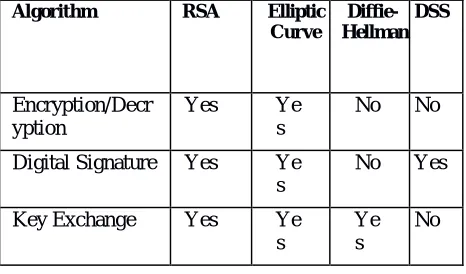
Some public-key algorithms are suitable for all the three applications (i.e. Encryption/Decryption, Digital Signature, Key Exchange) whereas others can be used only for one or two of these applications. Table 6 describes the applications supported by the algorithms discussed in this paper.
Algorithm RSA Elliptic
Curve
Diffie- Hellman
DSS
Encryption/Decr yption
Yes Ye
s
No No
Digital Signature Yes Ye s
No Yes
Key Exchange Yes Ye s
Ye s
No
Table 3: ECC and RSA Key Comparison
From Table 6 it can be analyzed that RSA and Elliptic Curve algorithm are suitable for all the three applications. It was also analyzed that the Elliptic Curve Cryptography takes more computation but reduced key size in the term of encryption/decryption of messages.
General–purpose use. Also public-key system depends on some sort of invertible mathematical function .The complexity of calculating these functions may not scale linearly with the number of bits in the key but grow more rapidly than that. Due to above facts, public-key encryption is currently confined to key management and signature applications. Only a few algorithms (RSA, Elliptic curve, Diffie-Hellman, DSS) have received widespread acceptance in the several decades since the concept of public-key cryptography was proposed. In truth, Public and Private Key Cr yptography work best together. Private Key Cryptography is best suited for ensuring confidentiality like encrypting data and communication channels whereas Public Key Cryptography is most suited for ensuring data integrity, key distribution and management, providing authentication and non-repudiations which are the most important objectives that play a vital role in any cryptographic application.
It is also found that, the key length for secure RSA use has increased over recent years, and thus put a heavier processing load on applications using RSA. This burden has ramifications, especially for electronic commerce sites that conduct large number of secure transactions. A competing system challenges RSA: elliptic curve cryptography (ECC). The principal attraction of ECC compared to RSA, is that it appears to offer equal security for a smaller key size, thereby reducing processing overhead. Thus there is a computational advantage to using ECC with a shorter key length than a comparably secure RSA. Although the theory of ECC has been around for some time, it is only recently that products have begun to appear and that there has been sustained cryptanalytic interest in probing for weaknesses. However, the confidence level in ECC is not yet as high as that in RSA.
cryptosystem implementation is much more complicated and requires deeper mathematical understanding than the other cryptography implementation (for example RSA), makes it more susceptible to errors. Certainly, ECC systems solved some major problems which exist in others. The future scope of our study is to study the mathematical theory of elliptic curves in detail, and make it more practicable to be used in designing secure Public-Key Cryptosystem. IEEEtran.bst files, whereas the Microsoft Word templates are self-contained.
REFERENCES
[1]. Alese, B. K., Philemon E. D., Falaki, S. O., “Comparative Analysis of Public-Key Encryption Schemes”, International Journal of Engineering and T echnology, Volume 2, No. 9, September2012.
[2]. Chandel Gagendra Singh, Singh Prabhat Kumar , “A Literature Review of Various Variants of RSA Cryptosystem”, International urnal of Advanced Research in Computer Science and Software Engineering, Volume 4, Issu e 2, February 2014.
[3]. Forouzan Behrouz A., “Data Communications & Networking”, Fourth Edition, 2008, New Yo rk: Tata McGraw- Hill.
[4]. Giripunje Lokesh, Nimbhorkar Sonali, “Comprehensive Security System for Mobile Network Using Elliptic Curve Cryptography over GF(p)”,International Journal of Advanced Research in Computer Science and Software Engineering, Volume 3, Issue 5, May2013. [5]. Kumar Arun, Tyagi Dr. S.S., Rana Manisha, Aggarwal Neha, Bhadana Pawan, “A Comparative Study of Public Key Cryptosystem based on ECC and RSA”, International Journal on Computer Science and Engineering (IJCSE), Vo lume 3, No. 5, May 2011.
[6]. Kumar D.Sravana, Suneetha CH., ChandrasekharA. “Encryption Of Data Using Elliptic Curve Over Finite Fields”, International Journal of Distributed and Parallel Systems (IJDPS), Volume 3, No.1, January2012.
[7]. Kute vivek B., Paradhi P.R., Bamnote G.R., “ A Software Comparison of RSA and ECC” , International Journal of Computer Science And Applications, Volume 2, No. 1, April/May 2009.
[8].Lamba Ekta, Garg Lalit, “ Review on Diffie Hellman Algorithm”, International Journal of Advanced Research in Computer Science and Software Engineering, Volume 4, Issue 3, March2014.
[9]. Markan Ruchika , Kaur Gurv inder, “ Literature Survey on Elliptic Curve Encryption T echniques”, International Journal of Advanced Research in Computer and Communication Engineering, Volume 3, Issue 9, September2013.
[10].Pallipamu Venkateswara Rao, K Thammi Reddy, P Suresh Varma , “A Survey On Digital Signatures”, International Journal of Advanced Research in Computer and Communication Engineering, Vo lume 3, Issue 6, June 2014.
[11].Schneier B., “Applied Cryptography”, John Wiley & Sons Publication, New York, 1994.
[12].Shankar Tarun Narayan, sahoo G., “ Cryptography with Elliptic Curves”, International Journal of Computer Science And Applications, Volu me 2, No. 1, April/May 2009.
[13].Shanmugalakshmi Dr.R., Prabu M., “ Research Issues on Elliptic Curve Cryptography and Its applications”, International Journal of Computer Science and Network Security, Volume 9, No.6, June 2009.