ISSN(Online): 2320-9801
ISSN (Print) : 2320-9798
I
nternational
J
ournal of
I
nnovative
R
esearch in
C
omputer
and
C
ommunication
E
ngineering
(A High Impact Factor, Monthly, Peer Reviewed Journal)
Website: www.ijircce.com
Vol. 6, Issue 3, March 2018
Currency Note Recognition using Speeded Up
Robust Features for the Blind
Sariya Khan 1, Aditi Vedalankar 2
P.G. Student, Department of Electronics & Telecomm. Engineering, M.G.M’s College of Engineering Nanded,
Maharashtra, India1
Associate Professor, Department of Electronics & Telecomm. Engineering, M.G.M’s College of Engineering Nanded,
Maharashtra, India2
ABSTRACT: Visually impaired people face difficulty to know the value of the currency they are holding, as of the banknotes are approximately identical in size. We develop a camera-based system to recognize banknotes to assist visually impaired people. This system is able to recognize banknotes in various real-world environments such as cluttered background, occlusions, illumination variance, different viewpoints and wrinkled banknotes. It incorporates a camera which will scan the image of currency note and the SURF (Speeded Up Robust Features) algorithm will process the image.
KEYWORDS: Banknote recognition; visually impaired; speeded up robust features
I. INTRODUCTION
Blind people face a number of challenges when interacting with the environments, one particular difficulty that a blind person would face is to recognize the value of the currency. Currently printed denominations of Indian currency are Rs. 2000, Rs. 500, Rs. 100, Rs. 50, Rs. 20 and Rs. 10. As the Indian banknotes are approximately identical in size, it is a challenging task for them to recognize the denomination of banknotes. Some latest designed money has been issued with the features aiming guidance for these people. However, it may take years to issue currency notes with additional blind-friendly features. Though a number of studies on banknote recognition have been published, they are restricted to specific and standard environment; for example, the whole banknote must be visible without occlusion or wrinkles. An automatic banknote recognition system must be able to recognize notes in real-world environments as well as to provide the feedback.
Fig.1. System diagram of Currency Recognition for the blind
Fig. 1 shows our system diagram. First, monetary features of each query image are extracted by SURF. These features are then matched with the pre-computed SURF features of reference regions of the ground truth image in each banknote category. The numbers of matched features are compared with automatic thresholds of each reference region to determine the banknote category. Furthermore, the spatial relationship of matched features is employed to avoid
Query image
SURF descriptors
Matching with each class
SURF descriptor
of ref. regions
Recognition output (audio) Matching with
ISSN(Online): 2320-9801
ISSN (Print) : 2320-9798
I
nternational
J
ournal of
I
nnovative
R
esearch in
C
omputer
and
C
ommunication
E
ngineering
(A High Impact Factor, Monthly, Peer Reviewed Journal)
Website: www.ijircce.com
Vol. 6, Issue 3, March 2018
false recognition with negative images and provide aiming guidance to blind users for bill image capture. Then, the system outputs the recognition result[1].
II. RELATED WORK
Lee et al. [2] proposed a method to extract features from specific parts of Euro banknotes representing the same color. In order to recognize banknotes, they used two key properties of banknotes: direction (front, rotated front, back, and rotated back) and face value (5, 10, 20, 50, 100, 200, and 500). They trained five neural networks for insert direction detection and face value classification. Reiff and Sincak [3] used SIFT detector and descriptors to classify Slovak banknotes in a well-controlled environment. Symmetrical masks have been used by Vila et al. to consider specific signs in a paper currency [4]. In their method, the summation of non-masked pixel values in each banknote is computed and fed to a neural network. This method considers images of both the front and back of the paper currency, but only the front image is used for recognition. In the approach in [5], the patterns of an edge on a banknote are used for recognition, and the image of a banknote is vertically divided into a number of equal small parts. Then, the number of pixels associated with edges detected in each part are counted and fed to a three-layer back propagation neural network for recognition. Hassanpour and Farahabadi [6] proposed a hidden Markov model (HMM)-based method. By employing the HMM, the texture characteristics of paper currencies are modeled as random processes and can be extended to distinguish paper currency from different countries.
III.PROPOSED METHOD
A. Components based framework:
We proposed a component-based framework to handle a variety of conditions, which offers the following contributions to the recognition of banknotes:
a) It will be more effective to use more class-specific components in the recognition process as class-specific information is not evenly distributed on an image;
b) A component-based model focuses on local and stable parts, which vary less than the pattern of an entire banknote under the geometric changes;
c) Local image features are much less than that from the entire image. This accelerates the matching process; d) This model is unaffected to partial occlusions and clutters in background.
B. Component Generation:
In our banknote recognition system, images for both front side and back side of each category of the Indian banknotes are first collected under optimal conditions. Some specific regions are named as components that are the reference regions for each category. For example, in the Rs.50 banknote, the distinguish information in the front side is the number “50”, the words “RESERVE BANK OF INDIA” and the face picture of Mahatma Gandhi. Similarly, on the back side of the Rs.50 banknote, the number “50”, the word “FIFTY RUPEES”, and the picture of Parliament are the most discriminative regions. For each category of banknote, these features are extracted and saved for matching with the query images in recognition process.
IV.FEATURE DETECTION AND DESCRIPTION
The function of detectors is to localize interest points with stable regions in a scale space and descriptors build the representation of the regions provided by detectors. The detector here focuses its attention on blob‐like structures in the image.
A. Integral Image
ISSN(Online): 2320-9801
ISSN (Print) : 2320-9798
I
nternational
J
ournal of
I
nnovative
R
esearch in
C
omputer
and
C
ommunication
E
ngineering
(A High Impact Factor, Monthly, Peer Reviewed Journal)
Website: www.ijircce.com
Vol. 6, Issue 3, March 2018
IƩ (x)∑ ∑ ( , ) eq.
The sum of intensity within any rectangular area is calculated as: S= A-B-C+D. Hence, the calculation time for calculation of image intensity is independent of its size.
B. Hessian Matrix based Interest Points
Hessian matrix describes the 2nd order local image intensity variations around the selected interest point. Blob-like structures are detected at locations where the determinant is maximum. We rely on the determinant of the Hessian also for the scale selection. Given a point x = (x, y) in an image I, the Hessian matrix H in x at scale σ is defined as follows:
H(x,σ) = ( , )( , ) ( , )( , ) eq.
where, ( , ) is the convolution of the Gaussian second order derivative, with the image I, in point x and similarly for ( , ) and ( , ).
For any square matrix, the determinant of the matrix is the product of the eigen values. The determinant of this matrix is calculated as:
det (H) = ( , )× ( , ) –( ( , )) eq.
The Gaussian kernels used for the hessian matrix are optimal for scale-space analysis, but in practice they have to be
discretised and cropped before we can apply them. This leads to a loss in repeatability under the image rotations. This weakness holds for Hessian-based detectors[7]. The SURF algorithm approximates these kernels with box filters. The approximated determinant of the Hessian represents a blob response in the image at location x. These responses are stored over different scales in a blob response map and then local maxima are detected. Approximated determinant of Hessian is:det (Η ) = D × D –(wD ) eq.
where, w = relative weight w of the filter responses, needed for the energy conservation between the Gaussian kernels and approximated Gaussian kernels.
C. Interest Point Description
The purpose of a descriptor is to provide a robust and unique description of a feature. A strong descriptor can be generated based on the spatial information of the area surrounding an interest point. The detector- descriptor scheme is implemented in three steps:
1) Orientation Assignment: To achieve invariance to image rotation, we identify a reproducible orientation for the interest points. For that purpose, we first calculate the Haar wavelet responses in x and y direction within a circular neighborhood of radius 6s around the interest point, with s, the scale at which the interest point was detected. The sampling step is scale dependent and chosen to be s. The size of the wavelets is dependent on scale and set to a side length of 4s. Therefore, we can use integral images for fast filtering. Once the wavelet responses are calculated and weighted with a Gaussian (σ=2s) centered at the interest point, the responses are represented as points in a space with the horizontal response strength along the abscissa and the vertical response strength along the ordinate. The dominant orientation is estimated by calculating the sum of all responses within a sliding orientation window of size π/3. The horizontal and vertical responses are summed within the window. The two summed responses then yield a local orientation vector. The longest such vector over all windows defines the orientation of the interest point[7].
ISSN(Online): 2320-9801
ISSN (Print) : 2320-9798
I
nternational
J
ournal of
I
nnovative
R
esearch in
C
omputer
and
C
ommunication
E
ngineering
(A High Impact Factor, Monthly, Peer Reviewed Journal)
Website: www.ijircce.com
Vol. 6, Issue 3, March 2018
up regularly into smaller 4×4 square regions. This preserves important spatial information. For each sub-region, Haar wavelet responses at 5×5 regularly spaced sample points are computed. We represent the Haar wavelet responses in horizontal vertical direction as dx and dy respectively. To increase the robustness towards localization errors and geometric deformations, the responses dx and dy are first weighted with a Gaussian (σ=3.3s) centered at the interest point. Then, the wavelet responses are summed up over each sub-region and form the first set of entries in the feature vector. To get the information about the polarity of the intensity changes, we also extract the sum of the absolute values of the responses, ǀdxǀ and ǀdyǀ. Hence, each sub-region has a 4D descriptor vector v for its underlying intensity structure v = (Ʃdx, Ʃdy, Ʃǀdxǀ, Ʃǀdyǀ). Concatenating this for all 4×4 sub regions, results in a descriptor vector of length 64. Thus for the descriptor, SURF focuses on the spatial distribution of gradient information.
3) Matching Feature Vectors: Minimal information is required to speed-up the rate at which matching between correspondence points occurs, without reducing the descriptor performance. This information is the sign of the Laplacian or the trace of the Hessian matrix. It differentiates between bright blob response on dark background and dark blob response in bright background for the underlying interest point[8].
Sign of Laplacian = Lxx + Lyy eq. (5)
It gives positive response for dark blobs and negative response for bright blobs. Correspondence points are found in matching stage when comparing the points with the same type of contrast. The candidates are considered as
valid if they have same contrast otherwise they are not taken into account
V. PERFORMANCE EVALUATION
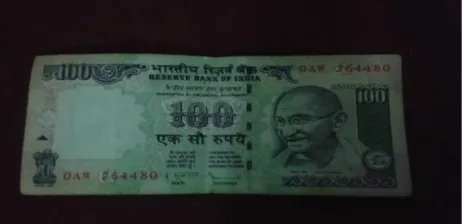
We have collected images of both front and back of banknote for database. The output is checked under various circumstances like illumination variance, scale changes, rotation, partial occlusion, cluttered background and wrinkles. Each category of banknote images covers all of the conditions of real world environment. Below shown are some of the testing dataset of banknote images taken under different conditions.
ISSN(Online): 2320-9801
ISSN (Print) : 2320-9798
I
nternational
J
ournal of
I
nnovative
R
esearch in
C
omputer
and
C
ommunication
E
ngineering
(A High Impact Factor, Monthly, Peer Reviewed Journal)
Website: www.ijircce.com
Vol. 6, Issue 3, March 2018
Fig. 2(c) partial occlusion Fig. 2(d) rotation
Fig. 2(e) torn and wrinkled Fig. 2(f) scale change
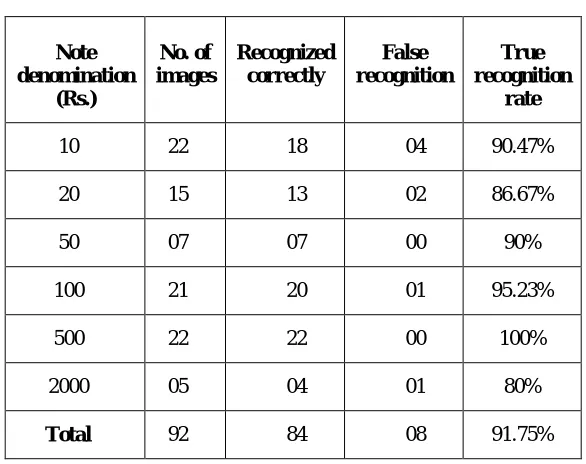
The experimental results have shown the effectiveness of the features of currency notes extracted by SURF for banknote recognition. In the recognition experiments, the proposed algorithm achieves 92% true recognition accuracy for all six categories of Indian banknotes Table below shows the evaluation results for each category.
TABLE I. RECOGNITION RESULTS FOR SIX CATEGORIES OF BANKNOTES
Note denomination
(Rs.)
No. of images
Recognized correctly
False recognition
True recognition
rate
10 22 18 04 90.47%
20 15 13 02 86.67%
50 07 07 00 90%
100 21 20 01 95.23%
500 22 22 00 100%
2000 05 04 01 80%
ISSN(Online): 2320-9801
ISSN (Print) : 2320-9798
I
nternational
J
ournal of
I
nnovative
R
esearch in
C
omputer
and
C
ommunication
E
ngineering
(A High Impact Factor, Monthly, Peer Reviewed Journal)
Website: www.ijircce.com
Vol. 6, Issue 3, March 2018
VI.CONCLUSION AND FUTURE WORK
In this work, a robust banknote recognition system for blind people is developed using SURF. Regions with descriptive features for each banknote category are selected as reference regions to match with query images. The proposed method has been evaluated by dataset to a variety of conditions like cluttered background, occlusion, rotation, illumination change, viewpoint variation and worn or wrinkled currency notes. Our approach achieves 92% accuracy. Further, the 64-dimensional feature vector of SURF is reduced by applying data reduction technique.
This system cannot recognize the banknote images captured under motion blur condition as the SURF is not able to extract accurate image features that are the basis for feature matching. So, an extension of our study is to integrate deblurring techniques into our system and provide a simple process to familiarize blind users with the device to reduce motion blur.
REFERENCES
1. Faiz M. Hasanuzzaman, Xiaodong Yang, and YingLi Tian, “Robust and Effective Component-Based Banknote Recognition for the Blind”, IEEE Trans. Syst., Man, Cybern. C, Appl. Rev., vol. 42, no. 6, pp. 1021-1030, 2012.
2. J. Lee, S. Jeon, and H. Kim, “Distinctive point extraction and recognition algorithm for various kinds of euro banknotes”, Int. J. Control, Autom., Syst., vol. 2, no. 2, pp. 201–206, 2004.
3. T. Reiff and P. Sincak, “Multi-agent sophisticated system for intelligent technologies”, IEEE 6th Int. Conf. Comput. Cybern., pp. 37–40, 2008.
4. A. Vila, N. Ferrer, J. Mantecon, D. Breton, and J. Garcia, “Development of a fast and non-destructive procedure for characterizing and distinguishing original and fake euro notes”, Analytica Chimica Acta, vol. 559, pp. 263–273, 2006.
5. E. Zhang, B. Jiang, J. Duan, and Z. Bian, “Research on paper currency recognition by neural networks”, in Proc. Int. Conf. Mach. Learning Cybern., pp. 2193–2197, 2003.
6. H.Hassanpour and P. Farahabadi, “Using hidden Markov models for papercurrency recognition”, Expert Syst. Appl., vol. 36, pp. 10105–10111, 2009.
7. H. Bay, T. Tuytellars, and L. Gool, “SURF: Speeded up robust features”, Computer Vision and Image Understanding, 110(3), pp. 346– 359, 2008,.
8. Bassem Sheta, Mohamed Elhabiby, and Naser El-Sheimy, “Assessments of different SURF algorithm resolution for pose estimation of UAV”, Int. J. Comp. Sci. & Engg. Survey (IJCSES), Vol.3, No.5, 2012.