University of Windsor University of Windsor
Scholarship at UWindsor
Scholarship at UWindsor
Electronic Theses and Dissertations Theses, Dissertations, and Major Papers
9-26-2018
Senior Chinese English as a second language (ESL) learners on
Senior Chinese English as a second language (ESL) learners on
their learning expectations and needs in a
their learning expectations and needs in a
communicative-approach-based program in Windsor: A case study
approach-based program in Windsor: A case study
Man Xu
University of Windsor
Follow this and additional works at: https://scholar.uwindsor.ca/etd
Recommended Citation Recommended Citation
Xu, Man, "Senior Chinese English as a second language (ESL) learners on their learning expectations and needs in a communicative-approach-based program in Windsor: A case study" (2018). Electronic Theses and Dissertations. 7587.
https://scholar.uwindsor.ca/etd/7587
This online database contains the full-text of PhD dissertations and Masters’ theses of University of Windsor students from 1954 forward. These documents are made available for personal study and research purposes only, in accordance with the Canadian Copyright Act and the Creative Commons license—CC BY-NC-ND (Attribution, Non-Commercial, No Derivative Works). Under this license, works must always be attributed to the copyright holder (original author), cannot be used for any commercial purposes, and may not be altered. Any other use would require the permission of the copyright holder. Students may inquire about withdrawing their dissertation and/or thesis from this database. For additional inquiries, please contact the repository administrator via email
Senior Chinese English as a second language (ESL) learners on their learning
expectations and needs in a communicative-approach-based program in Windsor: A case
study
By
Man Xu
A Thesis
Submitted to the Faculty of Graduate Studies
through the Faculty of Education
in Partial Fulfillment of the Requirements for
the Degree of Master of Education
at the University of Windsor
Windsor, Ontario, Canada
2018
Senior Chinese English as a Second Language (ESL) Learners on their Learning
Expectations and Needs in a Communicative-Approach-Based Program in Windsor: A
Case Study
by
Man Xu
APPROVED BY:
______________________________________________
K. Quinsey
Department of English Language, Literature & Creative Writing
______________________________________________
C. Smith
Faculty of Education
______________________________________________
T. Sefton, Advisor
Faculty of Education
iii
DECLARATION OF ORIGINALITY
I hereby certify that I am the sole author of this thesis and that no part of this
thesis has been published or submitted for publication.
I certify that, to the best of my knowledge, my thesis does not infringe upon
anyone’s copyright nor violate any proprietary rights and that any ideas, techniques,
quotations, or any other material from the work of other people included in my thesis,
published or otherwise, are fully acknowledged in accordance with the standard
referencing practices. Furthermore, to the extent that I have included copyrighted
material that surpasses the bounds of fair dealing within the meaning of the Canada
Copyright Act, I certify that I have obtained a written permission from the copyright
owner(s) to include such material(s) in my thesis and have included copies of such
copyright clearances to my appendix.
I declare that this is a true copy of my thesis, including any final revisions,
as approved by my thesis committee and the Graduate Studies office, and that this
thesis has not been submitted for a higher degree to any other University or
iv ABSTRACT
This study probes into the learning milieu of a cohort of Chinese senior immigrants
in order to inquire into their learning needs and expectations in a
communicative-approach-based program. The participants, who acknowledged the importance of
learning English as a second language (ESL), nevertheless expressed pessimism
about their English learning outcomes. The elderly ESL students expect the
curricula to adopt Chinese and English as classroom languages and present more
senior life-related topics. A moderate learning pace integrated with recurrent
learning cycles is considered appropriate for Chinese elderly ESL learners.
Key words: Learning needs, learning expectations, English as a second language
v
DEDICATION
To the holy grace of God,
to my hubby,
to my parents,
to my advisor,
vi
ACKNOWLEDGEMENTS
My primary gratitude goes to my thesis advisor, Dr. Terry Sefton, for her
continuous support of my research throughout the year. Her academic
meticulousness, professional guidance as well as constant encouragement finally
take me here.
I would like to thank the rest of my thesis committee: Dr. Clayton Smith
and Dr. Katherine Quinsey. I would like to thank Dr. Clayton Smith, my program
reader, who provide critical suggestions for my thesis writing. I would like to
thank Dr. Katherine Quinsey, who attended my final oral defense and gave me
suggestions.
I would also like to say thank you to my participants, a cohort of adorable
Chinese seniors, for joining my research program, which contribute to the
vii
TABLE OF CONTENTS
DECLARATION OF ORIGINALITY ... iii
ABSTRACT ... iv
DEDICATION ... v
ACKNOWLEDGEMENTS ... vi
LIST OF TABLES ... ix
LIST OF FIGURES ... x
CHAPTER Ⅰ ... 1
INTRODUCTION ... 1
Background and Context of the Study ... 1
General Statement of the Problem ... 4
Research Standpoint... 7
Purpose of the Study ... 8
Research Questions ... 9
CHAPTER Ⅱ ... 11
LITERATURE REVIEW ... 11
English as a Second Language (ESL) for Adult Learners ... 11
Chinese Senior Immigrants’ ESL Learning in Canada ... 20
Communicative Language Teaching (CLT) ... 22
Task-Based Language Teaching (TBLT) ... 27
ESL Learners’ Expectations and Needs ... 31
CHAPTER Ⅲ ... 46
METHODOLOGY ... 46
viii
The Program ... 49
Data Collection ... 54
Data Analysis ... 56
Validity and Reliability ... 57
Ethical Concerns ... 58
Definition of Terms... 59
CHAPTER Ⅳ ... 61
RESULTS ... 61
Mid-way Focus Group Seminar Findings ... 62
Interview Findings ... 79
CHAPTER Ⅴ ... 87
FINDINGS, DISCUSSIONS, IMPLICATIONS AND CONCLUSION ... 87
Research Findings ... 87
Discussions ... 93
Reflections ... 95
Suggestions for Future Research ... 96
Significance of the Study ... 97
Limitations ... 98
Conclusion ... 98
REFERENCES ... 100
APPENDICES ... 107
Appendix A: Mid-way focus group seminar questions ... 107
Appendix B: Semi-structured interview questions ... 108
Appendix C: Recruitment notice ... 109
Appendix D: Consent to participate in research ... 110
Appendix E: Program syllabus ... 114
ix
LIST OF TABLES
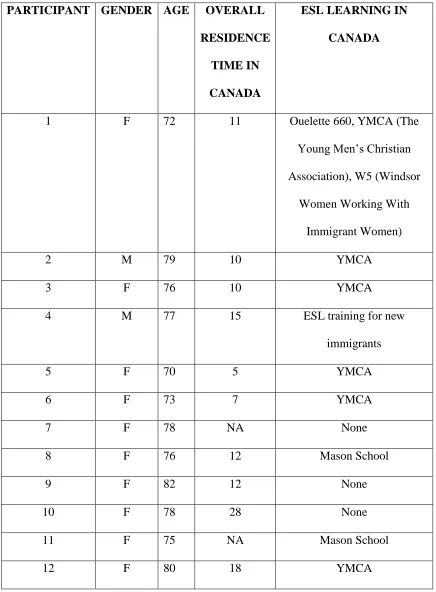
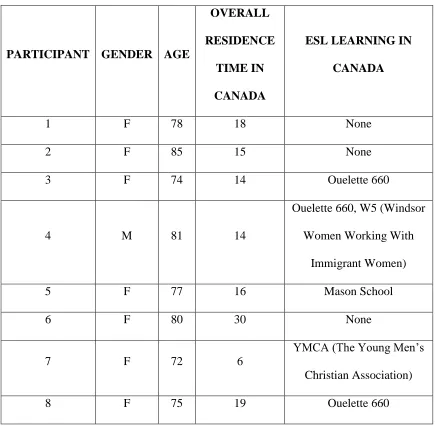
Table 1: Student Profile Table (Data taken in the 2017 fall ESL program) ……...48
Table 2: Rankings of ESL Topics among Senior Participants (Data taken in the
2017 fall ESL program) ………...51
x
LIST OF FIGURES
Figure 1: Vocabulary – Lesson Classware of Seeing the Doctor ………...…64
Figure 2: Conversation - Lesson Classware of Seeing the Doctor ……….65
Figure 3: Program Lesson Classroom Instructions (English to Chinese) ………..71
Figure 4: Vocabulary - Lesson Classware of Travelling ………76
Figure 5: Gap-filling Exercise - Lesson Classware of Travelling ………..78
Figure 6: Conversation - Lesson Classware of Travelling ……….95
1
CHAPTER Ⅰ
INTRODUCTION
Background and Context of the Study
Canada has become a multicultural country with a swelling aging population in
recent years. According to the Canada’s 2016 Census, 7.5 million foreign-born people
came to Canada through the immigration process, representing 21.9% of the national
population (Statistics Canada, 2017b). From 2011 to 2016, the population of people aged
over 65 years rose by 5.0% to 5,935,635, composing 16.9% of the national
demographics. Furthermore, a large proportion of the growing population of older adults
in Canada are immigrants. The population of immigrant seniors above 65 years old is 1,
684, 890, comprising 28.4% of all Canadians over 65 years of age (Statistics Canada,
2017a).
China is the third most popular birth country of recent immigrants (Statistics
Canada, 2017b). An increasing number of Chinese immigrants choose to settle in
Windsor, a city situated in southern-western Ontario. For decades Chinese immigrants
have chosen to settle in Windsor and now the population has reached 3, 800 (Statistics
Canada, 2017b). In Windsor, 17.2% of the population is aged above 65 (Statistics
Canada, 2017a).
As the global status of the English language is enhanced in every aspect of life,
English has been the communication language for many parts of the world. In Canada,
English and French are the official languages. Obviously, the ability to communicate in
2
language skills not only increase their participation in the Canadian society but also
alleviate their uneasiness in the assimilation into the mainstream culture. Not including
Quebec, 90.8% of Canadian immigrants use with English as their language of choice.
Thus, a mastery of the English language comes top priority for the majority of the
immigrant population.
Although Chinese immigrants rank the third most popular birth country of recent
immigrants, the language abilities of Chinese immigrants are far from competent.
According to IELTS Test Taker Performance 2016, the overall score for test participants,
whose place of origin is China, reaches 5.73, and the overall score for test participants
whose first language is Chinese reaches 5.8. These scores fall below the qualification for
competent user (band of 6.0), as stated by Cambridge English Language Assessment
(IELTS, 2016).
Due to low intercultural communication sensitivity, it is challenging for Chinese
migrants to improve their language competence to a significant extent during their stay in
Canada. Chen & Starosta (1997) define intercultural communication sensitivity as a vital
ability to understand and respect cultural diversity so as to generate positive
communicative interaction (as cited in Mao, 2015, p. 118). Guo & De Voretz (2006)
summarize that language has virtually become a barrier for some Chinese migrants’
immersion into the country, which is the result of their habits of acquiring common
knowledge and information in Canadian society (as cited in Mao, 2015, p. 125). Many
Chinese migrants prefer to seek social resources from Chinese channels even if the
3
discovered that older Chinese migrants feel more secure and comfortable to communicate
in English (p. 127).
Mui, Kang, Kang, & Domanski (2007) state that lack of competence to
communicate in English can cause a variety of psychological and social problems, such
as separation from community and a sense of insecurity. They reveal that Chinese
immigrant elders’ underperformance of English yields unsatisfactory health conditions
(p. 125). Mui, in 1996, found that Asian senior immigrants are reluctant to consult
medical service (as cited in Mui, Kang, Kang, & Domanski, 2007, p. 119). Taylor et al.
(2008) emphasize the sustainability of delivering health-related content within the
language program for Chinese immigrants (p. 223). Several studies carried out between
1990 and 2004 found that women face particular challenges and that immigrant women’s
low language proficiency, together with their feelings of impotence, generate social
isolation and a low sense of self-appreciation (Nimmon, 2007, p. 382). Language
incompetence and unease with acculturation also impacted immigrant women’s health
conditions (Nimmon, 2007, p. 383).
Second language acquisition is a time-consuming process that involves linguistic
attainment and cognitive transformation. In addition to the linguistic differences between
English and Chinese, Chinese learners also tend to perceive their surroundings in a
holistic and relational way, while English native speakers are inclined to organize the
4
Hu (2002) argues that it is important for ESL teachers to reflect on their current
teaching pedagogies, and how they might adapt their teaching approach to better serve
Chinese learners (p. 103). He also suggests that:
…it is necessary to conduct an audit of the sociocultural factors at work in the
language classroom and the philosophical assumptions underlying a pedagogical
innovation of foreign origin so as to identify culturally proper points of interface. In
the final analysis, it is important for educational policymakers and teachers to take a
cautiously eclectic approach and make well-informed pedagogical choices that are
grounded in an understanding of sociocultural influences. (p. 103)
General Statement of the Problem
Many immigrant-receiving countries, such as the United States and Australia, attach
importance to English language proficiency in the process of migration. Portes and
Rambaut maintain that nationally official languages “provide a counterweight to offset
the centrifugal force of immigration and its accompanying diversification of cultures,
religions, and ethnic backgrounds” (as cited in Hou & Beiser, 2006, p. 155).
The previous statistical data indicates that aging immigrants have been increasing by
a significant amount over the previous decade. Despite the growth in population of
Chinese seniors, inadequate studies have been conducted to inquire about their needs of
life. The language curriculum that is specially designed for senior immigrants is far from
effective. In 2003, Citizenship and Immigration Canada launched the Enhanced
Language Training, an annual language service, in order to provide professional language
5
Employment and Immigration Commission (CEIC) launched Language Instruction for
Newcomers to Canada (LINC) whose aim is to contribute to the integration of
immigrants. According to the 1994 report of the Department of Citizenship and
Immigration Canada (CIC), integration is explained as
Integration implies a political desire and commitment to encourage newcomers to
adapt to Canadian society and to be received by Canadians and their institutions
without requiring newcomers to abandon their cultures to conform to the values and
practices of the dominant group, as long as the adherence to immigrants’ cultures
does not contravene Canadian laws. (as cited in Guo, 2013, p. 32)
Fraser (2009) points out that adult ESL policies and programs are severely mediocre
in that although the adult ESL policies support the perspective of integration, these
policies and programs are superficially implemented with insufficient understandings, or
even biases of that notion (as cited in Guo, 2013, p. 24-32). Guo (2013) states that a
number of adult ESL programs emphasize educating Canadian values and disregard the
complicated cultural backgrounds of most new immigrants (p. 23).
A large number of the ESL (English as a Second Language) courses are currently
available for either new immigrants or young adults; furthermore, many senior ESL
programs turn out to be solely travelling activities with little focus on language training.
When enrolled in language courses, mature students, compared with younger or newer
students, are usually neglected by instructors during class interaction and remain
6
Chinese elderly immigrants are negatively impacted by their poor language
proficiency as well as low intercultural communication sensitivity. This impact inevitably
clashes with their on-going fulfillment in every aspect of life and, thus, deters them from
actively integrating into the social mainstream.
In Canada, a remarkable number of immigrants attend ESL classes. In some of these
classes students are able to meet with medical professionals when learning about health
problems. In 2007-2008, Taylor and her co-researchers launched the ESL programs for
Chinese immigrants in Vancouver to address divergent health issues such as Hepatitis B
and physiology. These ESL programs were designed to improve Chinese immigrants’
knowledge about Hepatitis B as well as physical exercises. Warm-up, vocabulary cards,
information-gap, video, jigsaw, guided discussion, and problem/advice cards were
implemented in the curriculum, which provides an example for the education of other
health issues.
Samuel, in 1987, reveals that new settlers attend language classes on a part-time
basis and, on average, are not likely to stay longer than half a year (as cited in Hou &
Beiser, 2006, p. 158). Complaints focus on mixing students in the same classroom with
divergent levels, implementing ineffective teaching pedagogies, adopting worthless
learning materials and failing to offer smaller classes (Hou & Beiser, 2006, p. 158). Hou
& Beiser (2006) maintain that the overall unsatisfactory effect of ESL programs in
developing attendants’ language competence is supposed to be analyzed with expertise
and delicacy (p. 157). In addition, more micro-level components should be investigated
7
Although abundant literature on teachers’ attitudes towards CLT exists, only a small
number of researches explore learners’ needs and expectations (Asassfeh, Khwaileh,
Al-Shaboul, & Alshboul, 2012; Savignon, & Wang, 2003; Al-Jamal, 2007). Fewer studies
choose to focus on senior learners’ needs and expectations of their ESL learning. The
inconsistency between teacher perspectives and learner expectations impacts learning
outcomes and needs to be addressed. According to Savignon (1997), “if all the variables
in second language (L2) acquisition could be identified and the many intricate patterns of
interaction between learner and learning context described, ultimate success in learning to
use a second language most likely would be seen to depend on the attitude of the learner”
(as cited in Savignon & Wang, 2003, p. 225). The discrepancy between student
expectations and classroom realities may be an indicator that instructors have failed in
communicating learning goals to students or that they need to consider redesigning
curriculum (as cited in Savignon & Wang, 2003, p. 239). ESL educational practitioners
must recognize what content mature learners expect to learn, as well as their specific
requirements in different stages of learning process.
Research Standpoint
Education has been my lifelong passion since the very moment I entered the
university as a freshman. I have been working as a language tutor and participated in
language service volunteering jobs since 2007. Providing language tutorials to people
with different ages, jobs and backgrounds, compose my extensive work experiences.
Having accumulated a series of ESL teaching experience for five years, I was
8
to the latest development within this sphere; so in 2016 I entered the Master of Education
Program.
In my view, the aim of education is to change this world into a better place to live.
Education is the future for younger generation, and provides infinite possibilities for the
senior. I believe, no matter how the world corrupts, education will be the light that dispel
the darkness in human beings’ hearts.
Bearing this motto in mind, I’ve been working towards becoming an international
educator who distills relevant advancements from research and passionately recovers the
mysteries from my personal teaching experiences in this field of study.
The idea of researching into this area occurred to me when I delivered ESL lessons
to Chinese senior residents in Windsor. In the fall of 2017, I received an invitation from
Windsor Chinese Senior Service Association (WCSSA) to deliver a senior ESL oral class
on a weekly basis. There I met with a cohort of senior people, the majority of whom were
of an age where they had fulfilled their contributions to society and retired from either
career responsibilities or family burdens as well.
This group of people migrated to Canada to accompany their children who now live
here. However, most of them were presently not able to communicate in English in their
daily lives. They felt isolated and lonely from time to time. They get lost and discouraged
in the process of seeking life-related possibilities. I want to work as a torch that lights the
path before them.
9
This study aims to investigate the present situation of elderly Chinese migrants’ ESL
learning in a communicative-approach-based program in Windsor, Ontario, Canada, in
order to find their learning expectations and needs. From the perspective of that exclusive
community, this research hopes to provide insights for both language instructors and
administrators into their future ESL curriculum design and policy-making.
Research Questions
This research paper will inquire into the issues of senior Chinese immigrants’ ESL
learning, in order to discover the fundamental needs and expectations towards future
language curricula. I formulate these four sub-questions:
1. How do elderly Chinese immigrants perceive their ESL learning in Canada?
Specific questions will be asked in order to discern whether they think their
learning experiences have contributed to their English or not. Participants will be
invited to recall their past ESL learning experiences in Canada: when they attended
ESL lessons, where the language program took place, how long the training
continued.
2. What are the learning needs of elderly Chinese immigrants in the pre-course,
in-course and post-in-course phase of ESL learning?
I intend to understand difficulties that impede senior Chinese residents from
achieving satisfactory learning outcomes before learning, in the course of learning
and after learning. These learning obstacles may relate to the following aspects: the
proportion of native to non-native teachers, the use of first language (L1) and second
10
accuracy, the percentage of form-focused instruction (FFI) and meaning-oriented
instruction (MOI), the adoption of language learning strategy (LLS), learning anxiety
and learner reticence, and their perspectives of group work as well as class size.
3. How are the expectations towards ESL curriculum of elderly Chinese immigrants
distinctive?
In the light of the qualitative data collected from participants, I hope to discover
their particular expectations towards ESL training, which may distinguish them from
other ethnic groups, and give a detailed account of what they anticipated.
4. What problems or misunderstandings may occur in the process of ESL learning
for elderly Chinese immigrants?
By launching the study, I expect to reveal possible pitfalls that lie in the course of
their ESL learning. I possess curiosity about their misperceptions which may reflect their
distinct thoughts about ESL learning acquisition.
These four questions will be asked in order to explore the current milieu of senior
Chinese immigrants’ ESL learning. I hope to understand how this particular group thinks
about their ESL learning experiences in Canada, what they actually demand in divergent
ESL learning phases, how their anticipations differ and what probable confusions they
11 CHAPTER Ⅱ
LITERATURE REVIEW
English as a Second Language (ESL) for Adult Learners
A mastery of language accelerates economic growth, social assimilation and
benefits immigrants’ lives. A deficiency in the learners’ understanding of the receiving
country’s official language creates a prominent challenge in the process of immigration.
Language deficiency prevents new settlers from establishing networking connections,
accessing financial benefits, and integrating into mainstream culture (Dustmann &
Fabbri, 2003; Shields & Wheatley-Price, 2002; Ying & Miller, 1992, as cited in Hou &
Beiser, 2006, p. 135). Chiswick and Miller, in 1995, and Dustmann and Fabbri, in 2003,
believe that language inadequacy wastes the receiving country’s immigrant human
resources. As for Chinese senior immigrants, language underperformance dramatically
impedes their process of assimilating into mainstream society. Furthermore, migrants
suffering from language underperformance are probable to return to their country of birth
(Espinosa & Massey, 1997, as cited in Hou & Beiser, 2006, p. 141).
Hou and Beiser (2006) uncover the drawbacks of existing research overdependence
on national census results that merely manifest data on a macro perspective and do not
present accurate immigrants’ language level on their arrival (p. 136). Senior immigrants’
ESL learning is affected by multiple variables, such as age, length of residence, language
aptitude, personal investment, opportunities, and incentives. This section will take a
12
The overriding concern related to age in second language (L2) ultimate attainment is
the Critical Period Hypothesis (CPH), i.e. a critical or a sensitive length of time for
language obtainment, as cited in Munoz and Singleton (2011); which corresponds to the
concept that the manifested area of late L2 acquisition differs from that of first language
(L1). During this sensitive period, mature L2 learners’ linguistic acquisition is
automatically activated to the fullest, which is neurolinguistically correlated with the
Broca’s area in the brain (p. 21). In the process of language learning, L1 grammar is
achieved innately and moderated by the human inborn mechanism that is only operated in
the critical period, however, the L2 grammar, in the post-critical period, is obtained
explicitly from instructional practices and shown in the left area, together with L1 and L2
lexicon (p. 21).
Any version of the CPH that claims that adults lose the ability to acquire syntax, for
example, in the way children do, is forced to take the position that apparent L2
knowledge of target syntactic properties absent from or different in the L1 were
learned explicitly and are therefore represented differently in the brain. (Rothman, as
cited in Munoz & Singleton, 2011, p. 6)
Researchers, who favour Chomsky’s Universal Grammar (UG) theory, explain the
essential divergence between young L2 learners and mature L2 learners in terms of the
biological accessibility where they obtain inborn linguistic acquisition mechanism
(Munoz & Singleton, 2011, p. 6). Chomsky asserts that, UG is innately responsible for
language acquisition and that child L2 learners are endowed with access to UG while late
L2 learners are not; however, no empirical evidence has justified its reliability (as cited in
13
that UG either develops for a short time in post-childhood or keeps dynamic over the
entire life (Munoz & Singleton, 2011, p. 6).
Hyltenstam and Abrahamsson, in 2000, found that late L2 learners are not able to
reach nativelike proficiency in their second language communication; a subtle gap exists
between early L2 learners and native speakers who converse only in their mother tongue
(as cited in Munoz & Singleton, 2011, p. 4). In 1996, Flege holds that L2 pronunciation
of adult immigrants is more affected by the accent of their L1 in comparison with the
cases of child immigrants (as cited in Munoz & Singleton, 2011, p. 8). Within the recent
two decades, a number of studies have proved that early L2 beginners appear less
linguistically competent than monoglot native speakers in terms of lexis, grammatical
rules and phonology (as cited in Munoz & Singleton, 2011, p. 4).
Several L2 researchers propose that divergent language aspects have distinctive
critical periods, which is definitely possible, but opposes the perspective of a solitary
critical period. Johnson & Newport, in1989, Long, in 1990, state that the critical period
begins to terminate around six or seven (as cited in Munoz & Singleton, 2011, p. 8).
Hyltenstam and Abrahamsson (2005) state that the critical period for phonology ceases
within the first year after infants are born, that of syntax concludes after four years old,
and that of semantics terminates around fifteen or sixteen (as cited in Munoz &
Singleton, 2011, p. 8). After that, Hyltenstam and Abrahamsson become skeptical about
CPH and theorize that the innate structure of human language learning is genetically
programmed to degrade at a high speed after birth. On that account, they assert that it is
impossible to acquire native-speaker proficiency in L2 learning (as cited in Munoz &
14
There has been considerable controversy and uncertainty about the ending of the
critical period. Researchers have placed the termination point of the critical period at
various ages, anywhere from infancy to adolescence (Munoz & Singleton, 2011, p. 8).
Green’s convergence hypothesis challenges the CPH in terms of divergent linguistic
areas in the brain. Abutalebi (2008) states that L2 obtainment occurs within an innately
particularized language mechanism and the manifestations of L1 and L2 will neutrally
converge (as cited in Munoz & Singleton, 2011, p. 22). As a consequence, the
improvement in L2 proficiency will gradually narrow (probably to zero) the gap between
native speakers and L2 acquirers neutrolinguistically (as cited in Munoz & Singleton,
2011, p. 22).
The “elbow-shaped” speculation explains that L2 learning competence declines as
the age increases under the theoretical framework of CPH (Bialystok & Hakuta, 1999;
Flege, 1999; Birdsong, 2006). Johnson & Newport, in 1989, report a steep decline in L2
learners’ linguistic achievement in the pre- or post- critical period ending point.
Similarly, in 2010, DeKeyser, Alfi-Shabtay and Ravid investigate an abrupt drop at
eighteen accompanied with a stable period of plateau in terms of morphosyntactic
capacities (as cited in Munoz & Singleton, 2011, p. 10). In 2005, Bialystok et al. discover
a steady linear decrease on L2 learners’ language competence while age increases, but no
signs of remarkably steep decline at any specific moment (as cited in Munoz &
Singleton, 2011, p. 10). Flege, in 1999, detects a similar decrease on L2 accent in relation
to the age of acquisition (AoA). Birdsong, in 2006, agrees that a linear relation exists
15
that this age-related decline is more connected with human’s cognitive degradation (as
cited in Munoz & Singleton, 2011, p. 10).
Munoz & Singleton (2011) comment that L2 acquisition is influenced by the
complicated interaction of various factors, including AoA. For that reason, it is
unreasonable to simply regard this linguistic process as the deterioration of any faculty
(p. 10).
In 1972, Selinker describes the concept of fossilization as a widely spread fact that
the majority of L2 learners cannot achieve equivalent outcomes as their L1. Selinker and
Lamendella, as cited in Wei (2008), clarify fossilization as the following:
…a permanent cessation of interlanguage learning before the learner has attained
target language norms at all levels of linguistic structure and in all discourse domains
in spite of the learner’s positive ability, opportunity, and motivation to learn and
acculturate into target society… The most interesting phenomena in interlangauge
performance are those items, rules and sub-systems which are fossilizable in terms of
the five processes: Language transfer, transfer of training, strategies of second
language learning, strategies of second language communication, and
overgeneralization of target language linguistic material. (p. 127)
According to Wei (2008), fossilization is composed of phonological, morphological,
syntactic, semantic and pragmatic fossilizations (p. 128) and is presented in many forms,
such as error repetition and the cessation of one’s linguistic capability (p. 127).
Temporary fossilization captures extensive attention from linguistics researchers.
16
termination that prevents the occurrence of specified target-language characteristics (as
cited in Wei, 2008, p. 127).
Fossilization plays a vital role in the language performance of adult L2 learners. By
and large, almost all of the studies relevant to language fossilization focus on adult L2
learners. Long, in 2013, reports that no research on fossilization is conducted from the
perspective of children. In the same year, Han, uncovers that fossilization is likely to
happen at any moment in the learning process of L2 learners (as cited in Xie, 2014, p.
26). Xie (2014) notes that when ESL instructors provide instant feedback to senior
learners’ language errors, phonological fossilization diminishes (p. 29).
Tittle (1986) holds that female migrants possess greater advantage over
vocabulary than their male counterparts, which might make their language learning
relatively easier. Hou and Beiser (2006) state that English tutoring and working with
language are more rewarding for immigrant women (p. 152). Nevertheless, according to
the findings of CTFMH, in 1988, and Dustmann and Fabbri, in 2003, male immigrants
achieve on average higher language competence. This inconsistency in research is
generated by South-East Asian women’s traditionally inferior position in social ranking,
finance and education before migration, and their unequal employment treatment,
together with unfair language training opportunities (as cited in Hou & Beiser, 2006, p.
138). Hou and Beiser (2006) indicate that marriage prior to immigration negatively
impacts language performance (p. 148).
Despite the prominent role of age in the sphere of adult L2 acquisition, an increasing
17
Bylund, in 2009, claims that considerable language aptitude prevents linguistic stagnation
on L2 learners (as cited in Munoz & Singleton, 2011, p. 5). Hyltenstam and Abrahamsson
in 2008 documented a group of late L2 learners, who were born with a remarkable gift
for language, and are perceived to be indistinguishable from native speakers. Therefore,
they argue that achieving the linguistic competence of native speakers is fundamentally
determined by high language aptitude which should not be regarded as an opposition to
CPH. In addition, they invite a more specific definition of language aptitude and advocate
future research into the ties between L2 nativelike proficiency acquisition in post-mature
period and human’s inborn language biological apparatus.
No adult learners should be found who are entirely nativelike in the L2 without
having a high level of language aptitude and – we may add – without having worked
professionally and successfully with the target language for a significant period of
their lives. (as cited in Munoz & Singleton, 2011, p. 4)
Dozens of studies prove that officially acknowledged educational backgrounds, as
well as language learning experiences, smooth the second language learning process (as
cited in Hou & Beiser, 2006, p. 140). Carliner, in 2000, de Vries and Vallee, in 1980,
Dustmann and Fabbri, in 2003, Mesch, in 2003, concur that the length of residence (LoR)
in the receiving country is positively related to migrants’ language proficiency (as cited
in Hou & Beiser, 2006, p. 141). Hou and Beiser (2006) reveal that employment hours
contribute to linguistic mastery (p. 152). However, they also state that the vast
improvement, which is influenced by demographic features and pre-migration
18
Chiswick and Miller, in 2001, Espinosa and Fu, in 1997, and Mesch, in 2003,
highlight the increasing significance of individual investment, as well as chances and
motivations to immigrants’ language achievement, especially in the long term after
migration (as cited in Hou & Beiser, 2006, p. 140). Studies have affirmed that receiving
formal education, learning with a personal linguistic instructor, communicating over
social media, possessing family members, purchasing private property, and acquiring
nationality in the receiving country affect immigrants’ second language learning (as cited
in Hou & Beiser, 2006, p. 140). Hou and Beiser (2006) note that settlers’ language
competence in the long term is remarkably intertwined with raising children at home,
holding jobs and working in multicultural contexts; they maintain that migrants receiving
formal education in Canada possess a significantly higher possibility of linguistic mastery
than those without Canadian studying experiences (p. 155).
Contextual variables play an increasingly essential role in adult L2 attainment. Jia
and Aaronson, in 2003, suggest that even identical LoR is possibly intertwined with
vastly distinctive quantities and intensity of L2 immersion and communication.
Compared with the basic calculation of residence in L2 contexts, an examination of
language communication (i.e. the usage of L2/L1 besides LoR) appears more reasonably
appropriate (as cited in Munoz & Singleton, 2011, p. 12). Flege and Liu, in 2001,
uncover that length of residence (LoR) is closely interrelated with L2 acquisition
performance of participants who are university students but not remarkably associated
with the language obtainment of participants who do not communicate frequently in
English at work. Flege, in 2009, reveals that the distinctions of LoR yield no dramatically
19
Moyer, in 2005, emphasizes the importance of examining the efficacy of L2
communicative experiences outside the class and extent of those interactive activities (as
cited in Munoz & Singleton, 2011, p. 12).
As for adult L2 learners, either the number of classroom instruction time or the
number of L2 use out of the classroom is important to consider. Freed, Dewey and
Segalowitz, in 2004, propose that foreign adult L2 acquirers, who reside in the target
language speaking country, benefit more from investigating their length of L2 immersion,
as well as weighing the actual use of L2 to L1 (as cited in Munoz & Singleton, 2011, p.
12). In 2010, Llanes reports that adults spend as little a quarter of the time as children do
in interacting with L2 native speakers in the foreign country. Long, in 2005, Birdsong, in
2006, and Munoz, in 2008, maintain that L2 obtainment does not actually take place until
learners are thoroughly immersed into their target language environment and conduct
meaningful communications (as cited in Munoz & Singleton, 2011, p. 14).
Munoz and Singleton (2011) contend that it is unreasonable to equate the age of
acquisition (AoA) to the age of arrival in the foreign country, and this has undermined the
validity of research outcomes of relevant studies afterwards (p. 14). Hellman (2008)
interprets AoA as the moment when participants initiate meaningful communications
with native speakers. In this vein, AoA would differ vastly in foreign country and home
country. Under the former circumstance, it often takes some L2 acquirers who are
stay-at-home parents a long time to start daily exchange with local people (perhaps when their
children attend school), and AoA is not identical with the age of arrival; while in the
20
delivered in L2, and exposure is optimized when instructed by native speakers (as cited in
Munoz & Singleton, 2011, p. 14).
Abundant studies have addressed the significance of analyzing different linguistic
aspects in which the L2 is applied. A review of literature by Munoz and Singleton (2011)
revealed that communicative exchange is more effective for oral improvement instead of
writing and that mature L2 learners who live with native speakers are more likely to show
greater linguistic competence in the long run (p. 12).
Chinese Senior Immigrants’ ESL Learning in Canada
Over the recent thirty years, the immigrant demographic in Canada has dramatically
changed from previous European re-settlers to current Asian migrants. Elderly Chinese
immigrants, an important sub-group, are confronted with linguistic barriers in every
aspect of life. Poor language competence inhibits senior Chinese migrants’ daily
commute to utilize government programs as well as social services, and deteriorates the
uneasiness from social isolation: They have established broad social networks in China
for years, however they solely depend on their children to go around after migration to
Canada (Tam and Neysmith, 2006, p. 147). Learning English as a second language (ESL)
has been perceived as important socio-cultural challenges by senior Chinese immigrants
(Tieu and Konnert, 2015, p. 42). Being vulnerable, older Chinese immigrants have
frequently encountered language problems that prevent them from accessing public
services.
A large proportion of the literature throughout Canada focuses on the health
21
mental health treatments, are constantly implemented. However, few studies have
explored the ESL learning of this particular demographic. The participants in my study
are adult learners, who started learning English as their second languages after maturity.
Due to the exclusiveness of their ethnic community, most senior Chinese immigrants are
not likely to learn English. Linguistic separation sets migrant elders apart from their
second-generation offspring, and even from the whole society (Beiser, 1999, as cited in
Hou & Beiser, 2006, p. 158).
Age plays a role in language performance for immigrants. Hou and Beiser (2006)
report that senior re-settlers not only have lower language levels than youth, but also fall
behind in language learning (p. 152). According to Hou and Beiser, extensive research
has found that immigrant elders obtain language over a prolonged period compared to
younger learners. This disadvantage of senior L2 learners is generated by their reduced
short-term working memory and lack of interest due to limited motivations from their
stages in life (p. 138). Unlike children or youngsters, senior immigrants do not receive
formal education in the receiving country, which inhibits extending their social
connections with local people and acquainting themselves with mainstream culture.
Low language proficiency is statistically connected to self-reported poor health
among elderly female immigrants (Pottie, Ng, Spitzer, Mohammed & Glazier, 2008, p.
508). In Canada, seventy-five percent of the family re-settlers are female, whereas, the
same percentage of economically-independent immigrants are male (Simich, Beiser,
Mawani, 2003, as cited in Pottie et al., 2008). Hou and Beiser (2006) argue that, for new
settlers, the negative influence of age and gender gradually dwindles within the first
22
language sufficiency over time (p. 152). In the long run, the language underperformance
of the elderly and females is mainly prompted by inadequate access to a dominant
language environment after immigration (p. 155).
Chow (2012) argues that senior centers providing services including language
training programs play an essential role in the lives of community-based elderly Chinese
residents in Canada (p. 352). Mui, Kang, Kang and Domanski (2007) recommend that
professional language training service is needed to upgrade senior Chinese immigrants’
quality of life (p. 125). According to Munoz and Singleton (2011), there is no ambiguity
in the argument that successful late L2 learners demand an extensive amount of language
input and practice (p. 5). Derwing and Munro, in 2009, suggest that it is more significant
to enhance senior elderly ESL learners’ comprehension of their second language (as cited
in Xie, 2014, p. 17). Xie (2014) mentions in her thesis:
As for elderly Chinese L2 learners who are the research subject of this project, their
success in SLA does not mean a complete mastery of English or achieving
native-like proficiency. Such proficiency is unnative-likely attained at their age. Rather, the
success for them is defined as acquiring some basic English, and speaking
comprehensible English so that they can simply interact with native speakers and
meet their daily needs, such as going shopping, traveling on their own or dining out.
(p. 17)
Communicative Language Teaching (CLT)
Communicative Language Teaching (CLT) has had a presence in the field of English
23
The overarching feature of CLT is communicative competence, which is regarded as the
goal of language teaching. In 1980, Canale and Swain put forward the theory that
communicative competence includes four domains of competence: grammatical,
sociolinguistic, discourse and strategic.
The researchers found that, although with deficiency in language knowledge,
language learners are expected to produce meaningful communication in various contexts
with different purposes. The superficial transmission of linguistic knowledge to learners
is not the prominent teaching objective in the present classrooms, but holistically united
with social and pragmatic functions in order to be reconciled with divergent
communicative purposes.
According to Rao (2002), linguistic competence is the foundation of communicative
competence, i.e. with the absence of linguistic competence, there is no meaning to
address communicative competence at all; however, it is important to tell that linguistic
competence does not yield communicative competence by itself (p. 98).
CLT strongly encourages teacher and students to apply the target language in the
process of language teaching and learning, in order to maximize student-student and
teacher-student communications in the classroom. Students are engaged in meaningful
classroom activities based on a series of authentic life contexts, furthermore, their
language errors, which have been regarded as a necessarily natural part of the acquisition
procedure, are not inhibited. As a consequence, learners are able to communicate with
24
Klapper (2003) recommends two versions of CLT: the strong version insists on
students’ learning autonomy and opposes teacher dominance in the process of learning;
while sharing the same teaching goals, the weaker version acknowledges that modest
teacher interference in terms of well-organized, meaningful classroom activities is
necessary for increasing students’ comprehension and language competence (as cited in
Butler, 2011, p. 37).
Derived from a wide range of principles on both language itself and language
teaching and learning, CLT broadly entails sociolinguistic, pragmatic, discourse and
psychological terms, which, in contrast, develops its generalizability and ambiguity in
terms of methodology. Harmer (2003) argues that the concept of CLT suggests divergent
notions to different people (as cited in Littlewood, 2014, p. 350). Similarly, Ho and
Wong (2004) agree that CLT has been interpreted and implemented in a variety of ways
by different practitioners (as cited in Littlewood, 2006, p. 246). This is supported by the
prevalence of two lasting uncertainties among English teaching professionals found by
Thompson (1996) and C.Y. Li (2003): CLT is merely composed of abundant oral
activities; grammar teaching is basically excluded (as cited in Littlewood, 2006, p. 246).
Jacob and Farrell (2003) argue that CLT posits a paradigm shift in the field of
language teaching and learning (as cited in Richards, 2006, p. 25). Over the past decades
in People’s Republic of China (PRC), although CLT was adopted into the syllabus of
public schools by the State Education Development Commission in 1992, its
implementation was confronted with multiple unexpected obstacles in practice (Nunan,
2003, p. 596). Large class sizes hinder student-centeredness, which is an important part
25
language teaching (drilling, repetition, etc.) to be effective in English classrooms (p. 91).
On the other, the traditional English language teaching method, which is nonetheless
evident in classroom reality, is unsuccessful in building up the communicative
competence of millions of Chinese learners. As Hu (2002) claims in his article:
The traditional approach to ELT in the PRC has been a curious combination of the
grammar-translation method and audio-lingualism, which is characterized by
systematic and detailed study of grammar, extensive use of cross-linguistic
comparison and translation, memorization of structural patterns and vocabulary,
painstaking effort to form good verbal habits, an emphasis on written language, and a
preference for literary classics. (p. 93)
With the increasingly widespread implementation of CLT all over the world, a series
of varying criticisms emerged to challenge its practicality. Littlewood (2006) summarizes
five practical unsettled problems regarding CLT pedagogy: ineffective “classroom
management”, “avoidance of English”, “minimal demand on language competence”, “in
compatibility with public assessment demands” and “conflicts with educational values
and traditions” (p. 244-245). When engaged in communicative activities in class, learners
tend to get immersed into the communication with their partners to the extent that
teachers find it difficult to draw their attention back to the lesson at a certain moment.
This phenomenon is particularly evident when inadequate human resources as well as
materials, and institutional challenges (teachers deal with large class sizes but there is
limited time for giving instructions in class) occur. Meanwhile, students are more likely
to refer to their mother tongue (L1) as the medium of communication when they are stuck
26
output. Obsessed with the completion of communicative activities, learners choose to
focus on limited language exchange which merely contributes to the task achievement. In
that way, their communicative competence is not developed to a possibly exhaustive
level. Learning outcomes of CLT are not consistent with the rubrics of national
educational examinations that have long determined student’s future. CLT advocates
student-centered learning and the mastery of target language by using it in appropriate
contexts. These perceptions greatly contrast with traditional educational concepts derived
from cultures where teachers exercise absolute control over the class most of the time and
learning is considered to be knowledge transmission as well as accumulation.
Despite the adoption of CLT into national curricula for years, teachers possess
insufficient understanding of what the CLT practically entails and how the
communicative activity is used in the classroom at all. Communicative activities
conducted by teachers are not actually communicative but a hybrid of grammar
translation and audio-lingual approach (Prapaisit de Segovia & Hardison, 2009, p.158). A
general lack of consistent training, professional support and veteran mentors make it
difficult for teachers to design effective communicative activities that really develop
students’ communicative competence. Moreover, current educational resources and
materials are characterized with limited authenticity. According to Butler (2011), “What
is perceived to be authentic often means materials and activities that accurately reflect the
actual use of language and activities in English-speaking countries” (p.41). The contents
included in a number of learning materials, such as textbooks and language publications,
27
Savignon (2005) redefines CLT to a more accurate degree by proposing “what CLT
is not” (p. 645): CLT does not simply focus on training speaking skills, nor is it
characterized with small group work, nor does it exclude grammar teaching (as Butler
cited, 2011, p. 41).
Cortazzi and Jin in 1996 and Hu in 2005 argue that CLT presents a dispute of
West-East pedagogical values (as cited in Aubrey, 2010, p. 9). Samimy and Kobayashi in 2004
reveal the cultural incompatibility between CLT and traditional Japanese educational
principles and suggest more attention to the process of language learning instead of the
construction of extensive problematic learning materials (as cited in Aubrey, 2010, p. 9).
Xue (2013) describes that the divergence of West-East educational pedagogies arouses
student’s initial disapproval of classroom communication with peers (p. 7). Having been
brought up under Chinese educational system which values independency rather than
collaboration, Chinese students assume the teaching method characterized of
lecture-orientation and teacher-centeredness to be priority, or the mere way of teaching (Xue,
2013, p. 8). Students undergo a period of cultural transfer in order to get accustomed.
Nonetheless, Littlewood in 2000 maintains that Asian learners hold positive views of
CLT and are interested in making detailed inquiries both independently and with their
peers (as cited in Aubrey, 2010, p. 9); and they “do not, in fact, wish to be spoonfed with
facts from an all-knowing 'fountain of knowledge’’ (as cited in Aubrey, 2010, p. 42).
Audrey (2010) conducts study and makes similar conclusions (p. 42).
28
Despite the tremendously various definitions of “task” in literature, they agree to
the point that a pedagogical task contains the use of communicative language.
Furthermore, these definitions cast special importance to the receipt of meanings rather
than merely grammatical forms. According to Nunan (2004), real-life missions or “target
tasks or real-world tasks” (p. 1) are modified into classroom tasks or “pedagogical tasks”
(p. 1). These transformative proceedings are accompanied with the change to the
real-world tasks. Richards et al. (1986) define a pedagogical task as:
. . . an activity or action which is carried out as the result of processing or
understanding language (i.e. as a response). For example, drawing a map while
listening to a tape, listening to an instruction and performing a command may be
referred to as tasks. Tasks may or may not involve the production of language. A task
usually requires the teacher to specify what will be regarded as successful
completion of the task. The use of a variety of different kinds of tasks in language
teaching is said to make language teaching more communicative . . . since it provides
a purpose for a classroom activity which goes beyond the practice of language for its
own sake. (p.289) (as cited in Nunan, 2004, p. 2)
Nunan (2004) suggests a task in language classroom settles learners’ attention on
negotiating meanings instead of handling pointless language forms by simultaneously
requiring them to apprehend, utilize and communicate in the target language; he,
nonetheless, acknowledges that meaning and form are closely interdependent because
divergent meanings are conveyed in the forms of appropriately grammatical expressions
29
the reality for the reason that they are designed in order to stimulate learners’ integrated
language skills, which in fact optimizes their language acquisition outcomes (p. 20).
Based on the previous literature of task components, Nunan (2004) summarizes that
communicative tasks are comprised of more than goals, input and procedures,
underpinned by teacher/learner’s roles and settings (p. 41). Goals are indistinct basic aims
embedded in the tasks and regarded as functional when they are established from the
perspectives of students and evaluated by visible achievement. Arising from massive
amounts of research, input refers to the oral, printed, and visual information provided to
learners during their process of task fulfilment. Procedures deal with the missions that are
clearly defined for learners to perform with the assistance of input.
Tasks aimed to build up oral skills are sorted congruently with various exchange
functions. The first recording of task types exist in the Bangalore project in the 1980s,
where three categories of communicative tasks were presented: information gap,
reasoning gap and opinion gap. Simultaneously, Pattison (1987) proposes seven task
types: questions and answers, dialogues and role plays, matching activities,
communication strategies, pictures and picture stories, puzzles and problems, discussions
and decisions (as cited in Nunan, 2004, p. 56). Richards (2001) enlarges pedagogical
classification by adding jigsaw tasks, information-gap tasks, problem-solving tasks,
decision-making tasks, opinion exchange tasks (as cited in Nunan, 2004, p. 58). In
addition, communicative tasks can be categorized into cognitive, interpersonal, linguistic,
affective and creative according to the language strategies in which they are rooted
30
Put forward by Wilkins in 1976, task-based language teaching is developed from
“analytical approach”, a pedagogical approach in which students analyze the language on
the whole and thus acquire their learning (as cited in Nunan, 2006, p.13).
Roles refer to the part that teachers and learners are supposed to act in the process of
completing the task. Learner and teacher roles are closely interrelated. An active
approach of learner roles advocates that learners are no longer the knowledge receivers
but take initiatives for their learning (Nunan, 2004, p. 67). Breen and Candlin in 1980
express that teachers are expected to facilitate the communication, participate in the
process at any given time, observe the ongoing learning, and gain novel knowledge and
understanding (as cited in Nunan, 2004, p. 67). Clarke and Silberstein in 1977 write about
teacher roles:
The teacher as teacher is necessary only when the class is attempting to resolve a
language problem, for it is only in this situation that the teacher is automatically
assumed to possess more knowledge than the students. This role can be minimized if
the students’ attack strategies and reading skills have been effectively developed. If
the task is realistic and the students have learned to adjust their reading strategies
according to the task, there should be little need for teacher intervention (as cited in
Nunan, 2004, p. 68).
McCarthy and Walsh (2003) introduce the classroom context mode that highlights
the moderation of teacher interference in the course of classroom conversational
31
unpleasant, and controversial points that might be brought into the lesson (as cited in
Nunan, 2004, p. 69).
Setting indicates the classroom environment where the task is deployed. Zhang and
Hung (2013) report that, compared with participants who receive traditional language
teaching methods, students are likely to take on more favourable attitudes towards
language learning and achieve more impressive learning attainments in a task-based
language classroom (p. 698).
Due to the extensively heated discussion of CLT over recent years, Littlewood
(2014) proposes the Communication-Oriented Language Teaching (COLT) as a
substitute (p. 7). As a result of the phase where their interlanguage and learning
environment remain and context where their indigenous culture blossoms, Chinese
learners’ communicative strategies are rather limited to translation and repetition (Wang,
Lai & Leslie, 2015).
ESL Learners’ Expectations and Needs
Second language learning is fundamentally a learner-oriented process. Learners are
thus vital in determining the success of CLT on account of its learner-centered teaching
objective. In recent years researchers witnessed the increasing attention on the part of
learner in language learning activity in the field of ESL. Among the abundant studies,
“learner perspectives on language learning” captures tremendous focus from educational
scholars. A thorough understanding of learner attitudes and perceptions towards CLT
improves practitioners’ comprehension of how this educational pedagogy navigates
32
missions teaching professionals face in the sphere of TBLT is to decide “how learners
perceive and treat the formal and functional properties of language learning tasks” (as
cited in Hadi, 2013, p. 300). As for teachers and curriculum developers, it is significant to
base curriculum design on learners’ needs and expectations. Savignon (2007) points out
that this area of study has not achieved much attention as most research focused on
learners’ perceptions of language teaching on the whole instead of specific instructional
classroom reality (p. 225).
Addressing learners’ expectations and needs, there are eight aspects to consider:
learners’ attitudes towards native & non-native teachers, their needs of the use of L1 &
L2, learners’ expectations of fluency & accuracy, their attitudes towards form-focused
instruction (FFI) & meaning-oriented instruction (MOI), their expectations of language
learning strategy (LLS), learning anxiety & learner reticence, learners perspectives of
group work as well as class size.
The number of native teachers worldwide is much less than that of non-native
teachers in the English teaching field. Canagaraiah (1999) calculates that a mere 20% of
global English language teachers are native teachers (as cited in Wu, 2010, p. 184). By
and large, both groups of teachers possess distinctive characteristics of their own.
According to Wu (2010), native teachers gain popularity among students as they provide
a “foreign model” and create an authentic language context where learners apply English
in an effective way; though non-native teachers are not able to give a real model for
language learners to follow, they succeed in setting themselves as a “learner model”. This
foresees the difficulty from the perspective of students and encourages learners (p.
33
into qualified ESL teachers if they are equipped with mastery of the learners’ mother
tongue (L1) or the English language respectively (as cited in Wu, 2010, p. 181). Either
group plays an indispensable role in assist the learning outcome. The co-teaching and
instructional collaboration between native and non-native teachers is hence advocated in
order to improve students’ learning (Wu, 2010, p. 184).
There has been controversy about the proportion of L1 and L2 in language teaching
process for years. Krashen, in 1982, presents that adequate and maximized input of the
target language lessons fossilization (as cited in Wei, 2008, p. 130). Lightbrown (1991)
argues that L2 is important to language learners so instructors are supposed to use as
much L2 in teaching as possible. However, Swain and Lapkin (2002) claim that the use
of L1 eases the difficulty for students in the learning process (as cited in Wu, 2010, p.
183). Auerbach in 1993 notes that using L1 accelerates student learning (as cited in Xie,
2014, p. 23). Savignon & Wang (2003) notes that senior high school students prefer
teachers to use Chinese (L2) when giving classroom instructions (p. 230). Xie (2014)
suggests that Chinese is necessary in senior Chinese ESL student learning in that it assist
their comprehension of the lesson (p. 23). Rao (2002) discovers students, even with low
proficiency, prefer the English explanation of grammatical items in class; English
teaching is preferred no matter when it is needed in the process of language teaching (p.
93). Wu (2010) points out it is essential for teaching professionals to coordinate the
proportion of L1 based on students’ needs (p. 183).
With regard to language fluency, students hold expectations of the level they will
achieve by the end of the learning process. The term “fluency” remains a tricky notion for
34
“effectiveness of language use within the constraints of limited linguistic knowledge” and
is utilized to “assess how well learners use their knowledge to achieve their linguistic and
communicative goals.” (p. 183) Discussions about the balance between language
accuracy and language fluency has attracted increasing attention. Wei (2008) notes that
the overemphasis of fluency with ignorance of accuracy will lead to the fossilization of
leaner language mistakes (p. 129). Krashen in 1985 and Truscott in1999 insist that
teaching should focus on meaning instead of form and no correction should occur in
language learning (as cited in Wu, 2010, p. 183). Brumfit (1984) states that accuracy and
fluency are not contradictory but interdependent (as cited in Nunan, 2004, p. 56).
Ellis (1994) puts forward the “recast” method which corrects the learners’ mistakes
and in the meantime realizes the purpose of meaning orientation (as cited in Wu, 2010, p.
183). Wei (2008) argues that excellent language learning includes both form and
meaning. He describes that well-performed learners tend to regard the language as a
holistic system and utilize it with flexibility (p. 130). Savignon (1991) uncovers “the
integration of form-focused exercises with meaning-focused experience” and asserts that
grammar is best acquired in meaningful effective communications (as cited in Wu, 2010,
p. 183). In his book Task-Based Langauge Teaching, Nunan (2004) voices that basic
language learners can utter form-based expressions which have been accessible to them
from different channels (teachers, audios, textbooks, etc.) and they are not capable of
producing language that has not been acquired in the process of learning (p. 22). Wu
(2008) concludes that CLT should be regarded as an educational pedagogy that embraces
35
There has been increasing awareness among educators that students maximize their
language acquisition in terms of meaningful communication. Meaning-oriented
instruction (MOI), which is a prominent characteristic of CLT, highlights the significance
of developing communicative competence. Williams (1995) states that MOI encourages
learners to produce language, interact and negotiate with others by focusing on the
authenticity and proficiency of language (as cited in Asassfeh, Khwaileh, Al-Shaboul &
Alshboul, 2012, p. 526).
Although students are held in form-focused instruction (FFI) in their English
learning, they desire a communication-oriented approach to appear in the language
classroom. Savignon & Wang (2003) state that participants express intense preferences
for meaningful classroom activities and detest excessive explanation of grammatical
items (p. 230); they reveal learners approval for meaning-oriented pedagogy and extreme
dislike of form-based teaching (p. 232). In addition, most of the participants feel the
communicative approach, which values meaning instructional practice, satisfies their
learning needs to the highest extent (p. 239). Al-Jamal (2007) discovered the fact that
there is incompatibility between teachers’ instructional practice and students’ learning
preferences, and she noted that an overwhelming majority of participants expect an
advanced teaching approach (as cited in Asassfeh, Khwaileh, Al-Shaboul & Alshboul,
2012, p. 531). Al-Jamal found that language learners expressed intense demand for
developing fluency and communicative teaching pedagogy despite their
acknowledgement of the weight of grammar and linguistic knowledge (as cited in
Asassfeh, Khwaileh, Al-Shaboul & Alshboul, 2012, p. 533). Baleghizadeh (2010) claims