Smart Tollgate Systemization through
Pico-Barcode
M.K.Kumbar 1, Shubhangi B. Kolapkar2, Shubhangi B. Babar2, Savitri M. Kadam 2
Asst. Professor, Dept. of I.T., JSPM’s BSIOTR, Pune, Savitribai Phule Pune University, Maharashtra, India1
B. E Student, Dept. of I.T., JSPM’s BSIOTR, Pune, Savitribai Phule Pune University, Maharashtra, India2
ABSTRACT: The main problem of the existing toll booth system is it is time consuming. The theft vehicle detection system is also not proper working. In the previous work the number plate of theft vehicle can be removed from the vehicle or it can be replace by other number plate, it makes very difficult to detect the theft vehicle to the police. We have proposed new technique on the Pico-Barcode based vehicle detection system in which code is generated. When camera capturing the image of the Pico-Barcode. The captured image would be send to Pico-Barcode decoding process, automatically barrier is open that means Pico-Barcode is correct and that person’s number plate is authenticate. After recognize the string from Pico-Barcode it will perform the task of transaction. The amount of toll tax reduced from account number registered with vehicle at the time of vehicle registration, if the vehicle is unauthorized that time message sent to RTO.
The code is not removable from the vehicle. The vehicle not having Pico-Barcode is considered a theft vehicle. Any other person cannot change the Pico-Barcode because he does not have knowledge about the data present in the code. In this system we studied how to make effective and accurate toll collection system which is based on Pico-Barcode. To avoid the crowd from the tollgate we developing the system in which toll will be reducing from account automatically and nobody will have wait on tollgate for pay toll. In our system if vehicle stolen then entry has been
made in central database by police and if this vehicle entered in specific tollgate silent alarm would buzz which would
indicate the operator at the toll booth that the vehicle is a stolen vehicle. In our system we also detect the polluted vehicle using PUC and the vehicle which used for crime.
KEYWORDS: Pico-Barcode, QR-code, theft.
I. INTRODUCTION
QR Code Stands for Quick Response Code is a type of 2D Barcode which it is presently was first used in designing automotive Industry. Popular as it is very fast readable and has large storage capacity as the code consists of black modules arranged in a compared to the barcode invented by the Toyota subsidiary Denso Square pattern on a White Board. It was Wave in 1994 to track vehicles during the manufacturing process. In recent designed to allow its contents to be decoded at high speed, years consumers have grown used to seeing the min consumer advertising and packaging, because the dissemination of smart phones & has put a for commercial, barcode reader is available in every ones pocket for the first time. Hardware scanners available in several technologies no more expensive for causal use, software generators and then other barcode scanners. Readers are available for free in the Internet and many Apps for PC and Mobile.
QR Code has started in India since 2 years. Indian Commercial Companies use QR code in their advertisements to promote their Product .QR code is scanned through the mobile and it is decoded online and gives a fast response. QR Code is encoded in 4 Types. Numeric characters are encoded to 10 bit length. In theory, 7089 characters or less can be stored in a QR code. Alphanumeric characters are encoded to 11 bit length. In theory, 4296 characters or less can be stored in a QR code. 8bit byte data- In from of 0 & 1In theory, 2953 characters or less can be stored in a QR code. KANJI - A KANJI Character (this is multi byte character) is encoded to 13bit length. In theory, 1817 characters or less can be stored in a QR code.
In this study we focus on collecting toll according to vehicle and generate real time application which is to scan
strong system in the real world transport system. In this application we focus on providing safe, secure, effective, reliable toll collection system. Earlier vehicle users have to wait on tollbooth for pay toll, long time wait to collect toll
to collector. Thus many problems created like traffic congestion, pollution, people’s frustration. Our proposed system
help to avoid traffic congestion avoid unnecessary delay of collection of toll and also focus on stolen vehicles and vehicles which are harming the environment. Automated toll collection is fast becoming a globally accepted. For
effective and fast collection of toll on toll plaza we developed Pico-Barcode based toll collection system. When vehicle
passing from the tollbooth there is no need to stop in queue and collect the toll instead of that amount of toll will be automatically reduced from vehicle owners account.
II. LITERATURE SURVEY
Title 1:- Automated Toll Gate System Using RFID And GSM Technology. Authors: - T. ArunPrasath, M.S.Dhanabal...
Year of Publication: - 2013.
ATCS is an Automated Toll Collection System used for collecting tax automatically. [2]RFID cards simulate a credit card in a capacity and pattern, the tag usually contains an embedded microprocessor. Normally the Intelligent control system does not allow the unauthorized entry of any person into the control areas. If suppose the illegal entry through gate is observed, then it will be registered and providing the warning sound. [4]Each vehicle will hold an RFID tag and
its contains unique identification number assigned. The assigning process will be done by RTO or traffic governing
authority And the Reader will be strategically placed at toll collection center. Whenever the vehicle passes the toll booth, the tax amount will be deducted from his prepaid balance. New balance will be updated. In case if one has
insufficient balance, his updated balance will be negative one. To tackle this problem, we are alarming a sound, which
will alert the authority that this vehicle doesn’t have sufficient balance and that particular vehicle can be trapped. As
vehicles don’t have to stop in a queue, it assures time saving, fuel conservation and also contributing in saving of money. This system is used by vehicle owners, system administrator. Other general advantages for the motorists include fuel savings and reduced mobile emissions by reducing or eliminating deceleration, waiting time and
acceleration. By considering this all it has some draw back also this draw backs are it require particular frequency range
module to communicate it alarms sound when vehicle doesn’t have sufficient balance and it require costly hardware that are RFID tag and RFID reader.
Title 2:- Automated Automated Toll Collection System Using NFC And Theft Vehicle Detection. Authors:-SarikaBharambe, PriyankaKumbhar, PragatiPatil, KavitaSawant
Year of Publication: - 2015
This paper [1] gives an important guideline for Automated Toll Collection System (ATCS) Using NFC and Theft
Vehicle Detection. ATCS emerges as a converging technology where time and efficiency are important in toll
collection systems nowadays. [3] In this, NFC tag will be placed by toll authority having unique identification number
(UIN) and user details. Active NFC tag will be attached to the RC (Registration Certificate) Book or Smart card. When
vehicle passes through the tollbooth system, data on NFC will be read by NFC Reader and also sent to the server for verification. Server will check details and toll amount will be deducted from user’s account. [4] Theft Vehicle Detection is done with the help of various algorithms such as OCR and BLOB Detection. By excluding this point it has some drawback it has short range i.e. 10cm it work only in Android phone. It also require NFC tag and NFC reader for reading and scanning purpose
Title 3:- Automated Toll Booth Reduction And Theft Vehicle Detection Using HC2D Barcode. Authors:-Jadhav Jyoti, Kamble Pooja , Karpe Jayshri ,Wakchaure Manoj.
Year of Publication: - 2015
In this system [5] we studied how to make effective and accurate toll collection system which is based on hc2d barcode.
III. PROPOSED SYSTEM
A. ARCHITECTURAL DIAGRAM
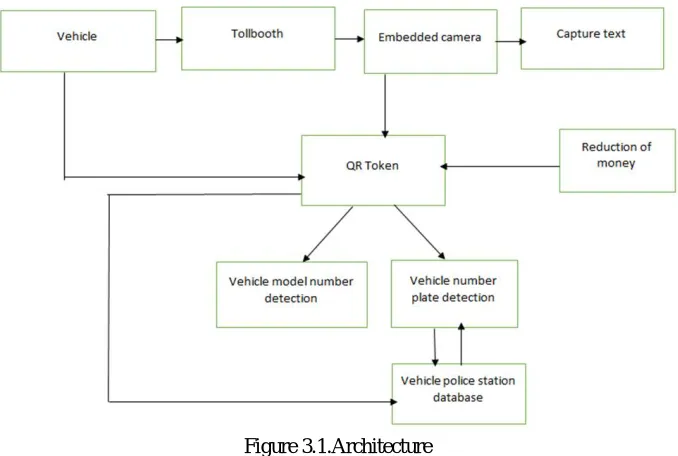
In Architectural chart as shown in figure 3.1 we have attempted to clarify our framework in detail. So when vehicle will enter is the Toll stall Embedded Camera will caught the vehicle number plate and model number. Catching picture and the procedure it with the assistance of QR-Token. We as of now talked about in the above part that it will check all the content in its organization.
This framework will likewise the check the stolen vehicle all the database which is caught by Camera gone to be coordinated with the police headquarters vehicle stolen database .If any case is there than further move will be made and if not that it will just deduct measure of cash from the proprietor account. The Advantage of the framework it will spare time decrease activity by and large in toll corner and devours fuel. Furthermore, if the vehicle is enrolled or stolen then it will be effortlessly recognized by this proposed framework.
Our proposed system help to avoid traffic congestion avoid unnecessary delay of collection of toll and also focus on
stolen vehicles and vehicles which are harming the environment. Automated toll collection is fast becoming a globally
accepted. For effective and fast collection of toll on toll plaza we developed Pico-Barcode based toll collection system.
When vehicle passing from the tollbooth there is no need to stop in queue and collect the toll instead of that amount of toll will be automatically reduced from vehicle owners account.
In Architectural chart as shown in figure 3.1 we have attempted to clarify our framework in detail. So when vehicle will entered is the Toll stall Embedded Camera will caught the vehicle number plate and model number. Catching picture and the procedure it with the assistance of QR-Token.we as of now talked about in the above part that it will check all the content in its organization.
This framework will likewise the check the stolen vehicle all the database which is caught by Camera gone to be coordinated with the police headquarters vehicle stolen database .If any case is there than further move will be made and if not that it will just deduct measure of cash from the proprietor account. The Advantage of the framework it will spare time decrease activity by and large in toll corner and devours fuel. Furthermore, if the vehicle is enrolled or stolen then it will be effortlessly recognized by this proposed framework.
Our proposed system help to avoid traffic congestion avoid unnecessary delay of collection of toll and also focus on
stolen vehicles and vehicles which are harming the environment. Automated toll collection is fast becoming a globally
accepted. For effective and fast collection of toll on toll plaza we developed Pico-Barcode based toll collection system.
When vehicle passing from the tollbooth there is no need to stop in queue and collect the toll instead of that amount of toll will be automatically reduced from vehicle owners account.
Embedded camera
Figure 3.1.Architecture
QR-Token are additionally used to output instant messages if human individual data on the off chance that it is at the hazard than close field is utilized for instalment reason. The QR comprise of square specks that is known as dark modules orchestrated in white foundation we can be caught by the Embedded Camera. These data can handled by utilizing read Solomon mistake until the picture is deciphered appropriately. Information is then extricated from the example in the both even and vertical segment of the picture.
E-Tolling system
Electronic toll road payment system by referring to other electronic payment such as E-Toll .E-Toll card is a smart prepaid card and contactless smartcard whose function is as a substitution for toll cash payment transaction. E-Toll balance is refillable. There are still weaknesses in E-Toll practice that make users worried such as the card read two times by the reader, the payment fraud on the toll gate staff, and the unreadable card. However, the time required for E-Toll use is only about 4 sec which is efficient enough.E-E-Tolling is for automatically reducing the correct value from tollbooth and image processing technique is used for guessing the particular vehicle number.
B. METHODOLOGY
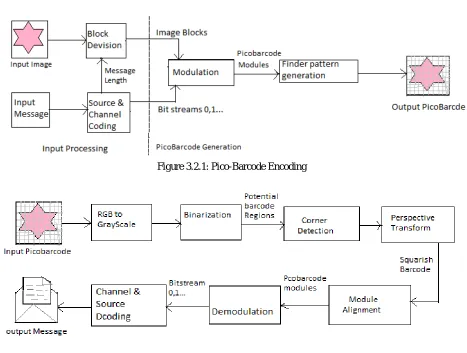
Figure 3.2.1: Pico-Barcode Encoding
Figure 3.2.2 Pico-Barcode Decoding
1. Encoding
1. The Pico-Barcode encoding process as shown in fig 3.2.1 can be divided into two parts the input processing
and the Pico-Barcode generation.
2. In the first part, the input message is converted into a bit stream with source coding and channel coding to
improve the efficiency and robustness of the encoded message.
3. The input image is then divided into a 2D grid of image blocks according to the users input on the number of
modules per dimension. Each block consists of k x k pixels.
4. In the Pico-Barcode generation part, the pixels in each image block are modified by the proposed adaptive
modulation scheme so that each image block conveys a bit 0 or 1. 4. Finally, a layer of finder pattern of one
module wide is added to the exterior of the modulated 2D grid of image blocks to form the Pico-Barcode.
5. The goal of channel coding is to protect the information bits against errors after the demodulation step.
2. Decoding.
1. First, the captured Pico-Barcode image as shown in Fig. 3.2.2 is converted to grayscale and is binarized to facilitate the search for the potential barcode regions which are then checked against the detection criterion.
2. If the check is passed, the four corners are obtained; otherwise, the image will be rejected and the decoding
process will be re-initiated with another image frame.
3. Based on the barcode corner locations, the perspective distortion is then estimated and compensated on the
4. For the module alignment step, the region for each Pico-Barcode module is obtained based on broken line parts of the finder patterns.
5. The demodulation process is the reverse of the modulation process by inspecting the intensity differences
between the inner and outer parts of each module. The modulated bit in each module is retrieved by the demodulation operation.
6. Finally, the message is obtained by applying channel and source decoding to the demodulated bits. In this part,
we mainly cover the corner detection, module alignment and demodulation steps which reflect our major
contributions.
IV. CONCLUSION AND FUTURE WORK
Thus, a system for Image Processing Based Automatic Toll Booth provides a mean for highly secured, efficient, and reliable services. It will overcome all the drawbacks of the existing system such as time management, man power effort, tagging system. This system helps to detect the stolen vehicle and also vehicles’ which are older. As our proposed system is easy to handle, as if it uses QR Code which is common now a day’s anywhere and also requires moderate internet bandwidth for information processing. The Major advantage of this system is to break on environment pollution that is happening due to consumption of fuel at traffic signals, toll booths as if vehicle is not in running stage.
In future we are going to make this system with add of features based on android application such as Accident management, GPS tracking system; identification of sensor based proper working of machines in the vehicle.
REFERENCES
1. Sarika Bharambe,Priyanka Kumbhar,Pragati Patil,Kavita Sawant,Automated Automated Toll Collection System Using NFC And Theft Vehicle
Detection, International Journal Of Engineering And Computer Science ISSN:2319-7242,Volume – 5 Issue-04 April, 2015.
2. YuhuaGuo, Hong Li, Zhao Li, The Application of RFID SIM in Electronic Toll Collection System, International Conference on Computational
and Information Sciences 2011.
3. E. Ohbuchi, H. Hanaizumi, and L. Hock, Barcode readers using the camera device in mobile phones, in International Conference on
Cyberworlds, Nov 2004, pp. 260265.
4. ISO/IEC JTC 1/SC 31/WG 1,Information technology Automatic identification and data capture techniques QR Code 2005 bar code symbology
specification, ISO/IEC 16022.
5. Ahmad Zubair, SouravMahmoodSagar, Pran Kanai Saha, and ShaikhAnowarul Fattah.A Design for Low Cost Electronic Toll Collection