Vol. 5, Issue 6, June 2017
A Framework for Preservation of Cloud
User’s Data Privacy
Pankaj Singhai1, Prof. Saurabh Sharma2
Research Scholar, Dept. of Computer Science, Gyan Ganga College of Technology, Jabalpur, Madhya Pradesh, India1
Assistant Professor, Dept. of Computer Science, Gyan Ganga College of Technology, Jabalpur,
Madhya Pradesh, India2
ABSTRACT: Cloud computing is a new generation technology which resourcefully support the client oriented services. Now in these days there are a number of applications which consumes the cloud storage service for storing and retrieving information. In such conditions the data owner management and privacy preservation cryptographic techniques are utilized frequently. But due to cryptographic technique of security implementation the data leave their own format and converted into other unreadable format. Due to this retrieval of required information becomes complex. Therefore in this work we proposed solution have as a feature the hash table encryption and salted md5 techniques which may facilitate for encrypting user data and identifying the user data and privacy.
KEYWORDS: Cloud computing, MD5, Cloud storage, Salted MD5, Hash key
.
I. INTRODUCTION
Vol. 5, Issue 6, June 2017
II. AUTHENTIC ATION METHODS
The n today’s world to access critical resources authentication is required. To secure our critical resources more secure authentication is necessary. Authentication is process in which authorized user (i.e user which has rights to access particular resource) will be given access to resource. During authentication only authorize user will get access to resources. There are various types of methods available for authentication. These methods basically classify into following 3 types.
1. Knowledge based authentication 2. Token based authentication 3. Biometric authentication
In knowledge based authentication password is used for authentication. There are two types of password for authentication, alphanumeric password and Graphical password. Alphanumeric password is sequence of alphabets, numbers and special characters. So in alphanumeric password characters are used to create password. This password should not guessable. But alphanumeric password which is not guessable is hard to remember. For example most people combines there name with some number related to them. Such passwords can be easily guessed. To solve this problem pictures are used for password such passwords are called as graphical passwords. Graphical passwords are easy to remember. But shoulder surfing attack is possible in graphical password [1].
In token based authentication user has token which is used for authentication. For example Credit card, ATM card. Disadvantage of this method is when token is lost or stolen.
In biometric authentication user is authenticated using user’s physical and behavioural properties which are unique for each user. Face recognition, Fingerprint, voice recognition etc. are example of biometric authentication. Biometric authentication is costly as it requires hardware device for recognition of physical property of user [2].
Each above method has some disadvantage to overcome these disadvantages combination of more than one technique of authentication is used to authenticate user. This phenomenon called as multi-factor authentication. Multi-factor authentication uses the combination of more than one type of authentication. More than one form of authentication used in multi-factor authentication that’s why multi-factor authentication. Multi-factor authentication provides extra layer of authentication which minimises risk in risk based authentication.
III. AUTHENTICATION ATTACKS IN CLOUD
Research studies reveal that any authentication mechanism related to web applications and cloud should provide high security, easy to use interface and support user mobility. The customers prefer to access their applications from different locations and different devices such as desktop, laptop, PDA, smart phones, cell phones etc. Those needs pose significant requirements to the security of applications. The broad range of user requirements introduces wide range of attack vectors in the cloud that makes the security of cloud applications a thought provoking matter. Cloud service providers need to ensure that only legitimate user are accessing their services and this points out to the requirement of a strong user authentication mechanism. But there exists numerous attacks that can create loop holes in the authentication mechanism and hence identifying the most secure authentication mechanism with high user acceptability is a big challenge in the cloud environment.
Vol. 5, Issue 6, June 2017
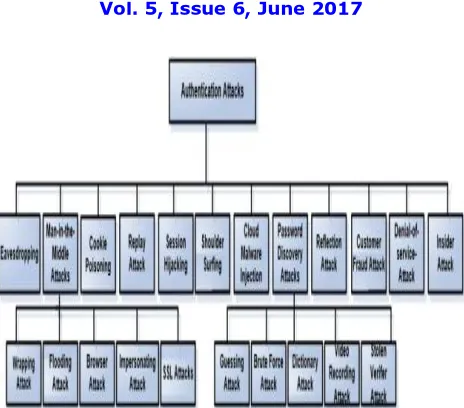
Fig 1.1 Classification of Authentication Attacks in the Cloud Environment
3.1 Eavesdropping: Eavesdropping involves the act of listening to the communication channel established between two authorized users. In a cloud environment, a traffic eavesdropper passively intercepts the data transferred within a cloud by loading a bit of code on a cloud server [7] or listens to data moving from a cloud consumer to provider and makes an unauthorized copy of the message [8]. The attacker can use the illegally gathered information to get valid credentials of an authorized user which can be user to launch impersonating attack. Eavesdropping attack, in a cloud environment which results in information disclosure can be minimized by enforcing proper authorization procedures and by transmitting the data over a secure connection such as HTTPS. Encrypting the transmitted data and attaching a signature to the same can help the destination to ensure the integrity and authenticity of data. Adopting privacy- enhancing protocols which minimize the requirement of transmitting identity credentials from the cloud service user to the verifier will discourage the illegal activity of eavesdroppers. Authentication Protocols that protect secrets, ensures user anonymity and Password Authenticated Key exchange (PAKE) protocols are much preferred in a multi-tenant cloud environment.
3.2 Man-in-the-Middle Attack (MITM): Since the inception of Web 2.0, MITM has become quite popular in the SaaS environment. Here the attacker intercepts the communication channel established between legitimate users and modifies the communication between client and server without their knowledge [9]. The following paragraphs discuss the various types of MITM attacks.
i) Wrapping Attack: A XML Signature wrapping attack applicable to web services is applicable to cloud as well, since cloud consumers use web services as a tool to access cloud services. This attack is launched by duplicating the credentials in the login phase by modifying the Simple Object Access Protocol (SOAP) messages exchanged between the browser and the server during communication set up [10]. The attacker modifies the signed request of a legitimate client by moving the original message body to a newly inserted wrapping element inside the SOAP header. A new body containing the unauthorized operation the attacker wants to perform with the original sender’s authorization is inserted in the position of original message. The service executes the modified request since it contains the signature of a legitimate user. As a result, the adversary is able to intrude in the cloud and can run a malicious code to interrupt the usual functioning of the cloud servers.
Vol. 5, Issue 6, June 2017
requests to starve, and as a result the server will offload its jobs to another server, which will also eventually arrive at the same situation. The adversary is thus successful in engaging the whole cloud system, by attacking one server and propagating the attack further by flooding the entire system. Flooding attack can be handled by organizing all the servers providing a specific cloud service as a fleet and these servers communicating among themselves regarding the incoming requests by message passing [17]. Again a hypervisor can be used to schedule the requests among the fleets, determine the authenticity of the requests and prevent the fleets from being overloaded with bogus requests from an adversary.
This attack can be controlled by data transfer throttling, fool proof authentication mechanisms and mechanisms that filter out bogus requests.
iii) Browser Attack: This attack which results in data stealing is committed by sabotaging the signature and encryption during the translation of SOAP messages in between the web browser and web server, causing the browser to consider the adversary as a legitimate user and process all requests, communicating with web server [10]. For authenticating the clients, current web browsers rely upon SSL/TLS as they are not able to apply WS-Security. Nevertheless, SSL/TLS only supports
Point-to-point communications and this makes the authentication process insecure. Also SSL/TLS has been broken by Marlin Spike using “Null-Prefix Attack” and attackers are able to perform this technique in order to request services from cloud systems without a valid authentication [7].
iv) Impersonating Attack: Here the adversary pretends to be a valid server or user valid entity to reveal the authenticating credentials which in turn is used to gain unauthorized access to the resources. Verifier Impersonation attack, Phishing attack etc. can be categorized as impersonation attacks. Most of the times, in Phishing attacks the users are made to believe that they are communicating with valid server by creating a web page that look similar to the valid server page. In verifier impersonation attack, the attacker pretends to be the verifier and lure the customer to share the authentication keys or data, which may then be used to authenticate falsely to the verifier.
v) SSL Attacks: Secure Socket Layer (SSL) is a fundamental security mechanism that encrypts the information transmitted between client and server. SSL provides an authenticated environment for running a cloud service by verifying the identity of the communication parties [14].
3.3 Cookie Poisoning: In cookie poisoning, the identity related credentials stored in the cookies of an authorized user are modified by the attacker to gain unauthorized access to resources. Cookie poisoning attacks in cloud can be mitigated to a certain extent by using Intrusion prevention products that examines each HTTP request sent to the web server [16]. This attack which involves tampering with data can be handled by attaching the hash values of the data stored in the cookies and recalculating the same at the destination. Use of Message authentication codes, tamper resistant protocols and Digital signatures can also aid in the detection and prevention of modifying the cookies.
Vol. 5, Issue 6, June 2017
IV. PROPOSED WORK
In the past section we bring examine the issue that presently every last one of cloud suppliers would utilizing the idea of absolute encryption strategy methods they treating every last one of data On lesquerella secured way and entire data secured with solitary security algorithm. By utilizing this strategy we are overcoming starting with the idea about solitary encryption technique if those specific data really obliged that helter skelter security system. Thereabouts Concerning illustration an answer for this problem, we are proposing an idea for double encryption routines once again will back once data. Here we furnished security around data with two different encryption systems and each classification data are secured with two security algorithm for two diverse keys.
To our recommended worth of effort we bring arrange those data under Exceptionally secured data classification. To our work the Exceptionally secured system connected naturally intends those clients compelling reason not to detail those security technique. The purpose behind making will be that each client ought to kick their data better secured. Client just knows that out of their data. And the client also get opportunity of which data he need to secured without picking At whatever security.
This section includes involved work and identified issues in system in addition to that an optimum solution is also provided. The cloud environment provides support for efficient computing and enables to provide the storage solutions at the remote end. The main aim is to address the following issues in the existing cloud storage.
Data security: the data is placed on the cloud which is not much secured due to third party access and treads therefore the data security in cloud storage is required
Data owner and client privacy management: the data owner and client in not distinguishable using the data additionally the privacy on such data is access is required.
Searchable data space: the cryptographic manner of data security converts the formats and not a bit of data recovered during the information retrieval.
We have discussed above, about the issues and challenges now we will provide the solution steps that are described below. In order to provide end to end solution for the cloud storage the following solution steps are included.
Authentication management: in authentication management the system and user attributes are recovered additionally the one time password is included to manage the secure authentication.
Cryptographic data security: in this phase the salted MD5 cryptographic algorithm is consumed for providing the security.
V. IMPLEMENTATIONS AND RESULTS
Vol. 5, Issue 6, June 2017
2. When the user choose “Upload File” option for uploading the file, he redirect to Upload Page where user choose
the file and upload the file with provide secure features of protection to file.
3. After the successfully uploading data in the cloud the user again redirect to Welcome Page and choose “Download
File” to display the data and redirect to Download Page.
Vol. 5, Issue 6, June 2017
5. After inserting OTP correctly file will be downloaded otherwise have to insert OTP again.
VI. COMPARISONS OF EXISTING AND PROPOSED SYSTEM
Blowfish Furthermore DES need aid both symmetric-key 64-bit square encryption algorithms. That's virtually those end for their likenesses. Blowfish is speedier What's more a greater amount secure over DES. (Then again, virtually anything will be speedier Furthermore a greater amount secure over DES.
DES will be more by available, on account of its been around more drawn out Furthermore in light no one official thinks In you execute DES.
Des is those of age "data encryption standard" from the seventies. Its magic extent will be excessively awful short for best possible security (56 successful bits; this camwood make brute-forced). also, DES utilization 64-bit blocks, which raises exactly possibility issues At encrypting a few gigabytes of data with the same key (a gigabyte may be not that enormous nowadays).
Blowfish will be An piece cio recommended Eventually Tom's perusing bruce Schneier, Furthermore deployed clinched alongside A percentage softwares. Blowfish could utilization tremendous keys Furthermore may be accepted secure, but for respects to its square size, which will be 64 bits, simply like DES also 3DES. Blowfish is proficient On software, in any event with respect to some product platforms (it employments key-dependent lookup tables, henceforth execution relies around how those stage handles memory What's more caches).
Vol. 5, Issue 6, June 2017
VI. CONCLUSIONS AND FUTURE WORK
Cloud computing may be those rising technology, also because of the expanding duration of the time it also get growing. As stated by the time, those clients in the cloud is likewise expands and with this significant test will be those security of the data put away in the cloud server. In our work we have talked about those security algorithms in DES, Blowfish for that correlation the middle of them. Eventually Tom's perusing experience every last one of outcomes also graphs of the suggested work, we could reason that our work will be an productive What's more successful mystery built framework builds execution of the cloud surroundings What's more also lessens those transforming run through. Likewise according the prerequisite of the data, they get that kind for security. Those schema reveals to that our recommended worth of effort provide the superior security Likewise contrasted with others.
As An and only what's to come worth of effort particular with our suggested worth of effort that this might be improved with better security algorithms such as deviated algorithm with superior execution time, new systems also systems utilized to giving work to exceptional security of the data, different lifestyle data order camwood Additionally make utilized which upgrade the framework. Likewise delicate registering strategies could make utilized which give acceptable the programmed data order Furthermore superior systems for the secrecy and integument of the data.
REFERENCES
[1] S. Subashini and V.Kavitha, “A Survey on Security Issues in Service Delivery Models of Cloud Computing,” Journal of Network and Computer Applications , vol. 34, ,no.1, pp. 1 -11, 2011.
Vol. 5, Issue 6, June 2017
and Information Engineering. pp. 214-216, 2011.
[3] A. Bakshi and B.Yogesh,“Securing Cloudfrom DDOS Attacks using Intrusion Detection System in VM,” in Proc. IEEE Second Int. Conference on Communication Software and Networks., pp. 260-264,2010.
[4] N.S Chauhan and A.Saxena,“Energy Analysis of Security for CloudApplication,” in Proc. Annual IEEE India Conference, pp. 1-6, 2011. [5] W.Liu, “Research on Cloud Computing Security Problem and Strategy,” inProc. IEEE 2nd Int. Conference on Consumer Electronics, Communications and Networks, pp. 1216-1219, 2012.
[6] X. Yu and Q. Wen, “A view about Cloud data security from data life cycle, (2010),” in Proc. IEEE Intl. Conference on Computational Intelligence and Software Engineering, pp. 1-4, 2010.
[7] Larry Hardesty,“Thwarting the Cleverest attack”, May 1,[online]web.mit.edu/newsoffice/2012,thwarting - eavesdropping-data-0501.html,2012. [8] Maventek, CloudSecurity Consulting [WWW] Available from:www.maventek.com/services/Cloud - security-consulting, 2012.
[9] M.Misbahuddin,“Secure Image Based Multi-Factor Authentication (SIMFA): A Novel approach for Web Based Services, Ph.D Thesis, Jawaharlal Nehru Technological University, [Online], http://shodhganga.inflibnet.ac.in/handle/10603/3473, 2010
[10] B.Meena and K.A. Challa , ”Cloud Computing Security Issues with possible solutions,” Int, Journal of Computerr Science and Technology, vol.2, Issue: 1, Jan–March, 2012
[11]Kazi Zunnurhain and Susan V. Vrbsky,,“Security Attacks and Solutions in Clouds, [Online] http://salsahpc.indiana.edu/CloudCom2010/Poster/cloudcom2010_submission_98.pdf, 2010
[12] Danish Jamil & Hassan zaki, “ Security Measures in Cloud computing and Counter measures”, International Journal of Engineering Science and Technology(IJEST), Vol.3 No.4 ,2011
[13 19]Y.Andree,”Implications of Salesforce Phishing Incident”,
[Online]http://www.ebizq.net/blogs/security_insider/2007/11/implications_of_salesforce_phi.php, 2007
[14] Abel Wike, “SSL Encryption –A Protocol that Authenticate Cloud Computing”, [Online] comluv.com/ssl-encryption-a-protocol-that- authenticate-Cloud-computing, Feb 5, 2013.
[15] Larry Seltzer,[Online] Spoofing Server-Server communication: How can you prevent it” https://otalliance.org/resources/EV/SSLStrip_Whitepaper.pdf, 2009.