Enhanced Traffic Signal Duration Control
Using Image Segmentation
Nithika Bhasi,
Chithra. V
Assistant Professor, Dept. of E.C.E., DSCE, Anna University, Coimbatore, Tamil Nadu, India
ABSTRACT: In this current era the rapid growth in vehicle population in all developed and developing countries requires a major improvement in the present traffic signaling system. The current traffic system uses a simple signalling system, which operates on time basis which is inefficient for today’s rapid traffic flow.Poor traffic management system is the main reason for extended periods of traffic congestion throughout the world. This poor management of traffic system causes people to wait in front of traffic signal junction for hours, which results in time wastage and fuel consumption. Thus a need for density based time saving traffic signal control unit aroused, and if the information on the traffic condition is available to the vehicles approaching the junction in advance, it will be very helpful for them to choose a safe and comfortable route. This will help them to get rid from unnecessarily getting stuck in between the heavy traffic jam. The time saving control system can be used in all frequently congested junctions. The vehicle density in the junction is estimated by capturing the traffic condition using digital cameras and processed by MATLAB programming. Based on the captured and processed information on Vehicle density the signal durations can be increased or reduced using microcontrollers. Then the information about the traffic signal, density and duration of the signal is transmitted to the vehicles that are approaching the junction, so that they can choose an alternative route which will be more comfortable for them.
KEYWORDS:traffic density estimation, traffic control, information transfer, duration estimation, ostus algorithm.
I. INTRODUCTION
The traffic density in developing countries are increasing at an alarming rate which results in the need for replacing the conventional time based signalling system with the intelligent traffic system. When the number of vehicle on the road increases, the speed of traffic stream decreases which results in congestion. This makes the whole population in the cities to stand still in the middle of the heavy traffic jam daily. This paper is proposing a method to estimate vehicle density, control the traffic signal duration and transmit the traffic junction condition to the vehicles which are approaching the junction. Traffic congestion causes so many problems such as waiting in front of the signal for hours for the green signal which leads to time wastage. So if the information on the traffic condition is known to the vehicles before itself it will help them to select a easy route. Cities are mainly affected by it which results in delays, increased fuel wastage and monetary losses.There are so many methods used for controlling traffic signal and for knowing the traffic condition in the road. One of the methods used for controlling traffic signal was the
use of timers [1]. It presets the time in the traffic signal for the red light and green light. It works according to the timing and not on density of the vehicle. The main drawback of this method is it does not monitor the traffic density and it does not control the traffic signal timing which causes the vehicles to wait on the junction for hours till the signal becomes green. Manual controlling of traffic signal is one of the oldest technique which requires man power to control the traffic [5]. At different countries, traffic polices are allotted for a particular area or city to control the traffic manually. These traffic polices carry different devices to control the traffic such as sign board, sign light and whistles.
Another method is the manual controlling where a person controls the traffic using signs. This becomes difficult for a traffic police to control large amount of traffic in a four way junction as a result of which congestion increases. Another technique used for traffic controlling was with the help of sensors, which will be buried inside the road to detect the number of vehicle. The main drawback in this method is it does not detect low weight metals [6]. These are some of the oldest and the existing methods used for traffic signal controlling.
are by using sensors such as accelerometer, gyroscope etc [1]. These sensors are installed into the smart phones and they collect the traffic data such as how smooth the road is, what is the density of vehicles etc as they travel. The main drawback of this system is it requires a smart phone which is not affordable by everyone, it consumes lot of power and it is applicable only in a short distance. There are so many methods for estimating the road and traffic condition using mobile phones and sensors but these methods have so many drawbacks.
To optimize the problems faced in the existing methods, an intelligent traffic control and information system is introduced. In the proposed method the time period for green and red light is assigned on the basis of the density and accordingly controlling the traffic signal and transmitting the information of traffic condition to the vehicles that are approaching the junction. It can provide more time to a junction that is having heavy traffic. It can also help the drivers from unnecessarily getting stuck in middle of the traffic jam, and if they are in emergency they can choose other comfortable and less congested route.
The vehicle density is estimated using digital image processing and using zigbee wireless transmission system the data is transmitted to the control section, from where the glowing period of the signal is estimated and passed to the traffic section using zigbee transmitter. The zigbee transmitter at the traffic signal with the help of GPS, transmits the information to the zigbee receiver present in the vehicles such as the traffic density, duration of signal at the junction and the traffic signal.
The main advantage of this method is in reducing the duration of green light in the junction were the traffic density is low. In cases, where the junction will be empty and still the green light will be lighted causes vehicles of other junction to wait without any reason, these problems can be solved using this method and the vehicles can get the information on traffic condition according to which they can wisely choose easy and less congested route.
II. RELATED WORK
With the advancement in technology, so many techniques have developed to control the traffic signals and to collect the traffic information while driving the vehicle. So far many techniques and methods are used for this. Some of the methods are Triangulation method, Vehicle re- identification, GPS based methods, Smart phone based rich monitoring and Bluetooth detection.
Traffic information system is very essential for solving a traffic problem effectively. Almost all the traffic information systems in India are based on some fixed infrastructure, where data’s are collected from fixed sensors such as surveillance cameras and Inductive loop detectors. it takes a great effort to install sensors in such kind of systems. In many cases, the road surfaces are digged to implant the sensors underneath it, which requires a large man power and lots of time. Not only that it is even much expensive to install sensors in a large area such as metropolitan cities. Moreover, maintenance of these fixed sensors is also difficult [1].
So many methods have been introduced for sensing the traffic conditions.
Triangulation method: In many developed and developing countries many vehicles have one or more mobile
phones. These phones transmit their presence continuously to the mobile phone network even when there is no voice connection. By measuring and analyzing the network data using the triangulation method the traffic flow information can be obtained. This method does not require any infrastructure to be built on the roads, only the mobile phone network is needed. It will be complicated to implement practically which is its disadvantage.
Vehicle re-identification: In this method set of detectors are mounted along the road. From each location a serial
number is detected from the vehicle. The speed and the travelling time is detected by comparing these data using set of sensors. These can done using RFID and MAC address. This technique can be expensive and complicated.
GPS based methods: Various vehicles are equipped with GPS which provides communication with the traffic
information providers. Using this method the vehicle speed can be estimated by reading the position from these vehicles. But GPS is a power consuming sensor, which can be a major drawback.
Smart phone based rich monitoring: Smart phones have various sensors which can be used for tracking traffic
Traffic condition estimation is essential for easy and safe travel. So many methods were adopted so far for the traffic condition estimation. Some of the related works related with traffic estimation is mentioned.
III. OVERVIEW
The fast moving world in which we live is facing severe problems due to increasing traffic congestion day by day. The main reason behind this increase in congestion is the population expansion and its need for high volume of vehicles. The traffic jams causes frustration to the drivers and results in road rage, because of which safety measures are discarded and violated intentionally. Thus an intelligent traffic information system is designed. With the help of the new system more time can be given to light the green signal at junctions which experience heavy traffic and these datas about the traffic junction can be successfully transmitted to the junction approaching vehicles. Our system can be used in all frequently congested road junctions. It is having 2 sections : Traffic signal section and Vehicular section.
There are mainly five units in this system they are:
Microcontroller Unit.
Power Supply Unit.
Display unit.
Communication Unit.
Software Unit.
Microcontroller is mainly used for controlling the traffic signal and duration estimation .The condition about he traffic density which is captured by using camera is processed. It is processed through digital image processing and is send to the microcontroller at the control section.
Fig 1. Block diagram of Traffic section Fig 2. Block diagram of Vehicular section
In the control section the controller estimates the duration for which each signal is to be lighted on the basis of the received data about the density. The microcontroller at the traffic section is used to control the traffic signal light. Second, the Power supply unit working can be explained. The supply of 230V AC is converted to 12V DC which is given to the system. For this purpose a step down transformer is used.Supply is converted from AC to DC because the microcontrollers will support only DC supply, which is done by using bridge rectifiers. The rectifier output will have so many ripples, so for filtering out those ripples 2200uf capacitors are used. The filter output is given to the 7805 voltage regulator which will convert the 12V DC again into 5V DC. The output of the regulator will be filtered by using the capacitor. As a result of this we will get a pure 5V DC as power supply unit output. Here microcontroller which we are using is capable of using the supply of 5V DC. Power supply unit is very important for the proper and effective working of our system.
communication standard. It is IEEE 802.15.4 standard for low cost WPANS. As it is having low latency it reduces the average current. Zigbee operates in the ISM radio bands that is (Industrial, scientific and medical) which is 2.4GHz.Its data rate varies from 20kbit/s to 250kbit/s.The software units in the method used are: Proteus and MATLAB. Proteus is stimulation software where the microcontroller stimulation is performed. The program which is debugged in the controllers are executed in the MpLab. In the MATLAB the digital image processing operation takes place to estimate whether the traffic is heavy or low. Otsu’s algorithm is used here.
The main blocks involved in the system are: Block 1: Camera
Block 2: PIC 16F877A Microcontrollers Block 3: Max232
Block 4: Zigbee Block 5: LCD Block 6: GPS
The camera is used for capturing the images of the vehicles which are waiting at the traffic junction. Afterwards these captured images are processed by using digital image processing.The Zigbee module which is used acts as both transmitter and receiver[3]. The transmitting and receiving pins of 8051 controllers are connected to the same pins of Zigbee respectively. The signal from the microcontroller is transmitted serially to other controller at the traffic section by using Zigbee module via UART port. The Zigbee is a transceiver that transmits and receives data or information simultaneously. GPS is Global Positioning System used for tracking the position of the objects in our system we are using it for tracing or for obtaining the position of the vehicles. These blocks altogether compute the proposed system. The main operation or the working of our proposed method is:
The camera is placed on the top of the traffic signal to obtain the clear view of vehicles present at the junction. The traffic level is estimated before entering the traffic section by using MATLAB. The traffic signals are controlled by two methods, automatic and manual method. In automatic mode the camera is used to capture the traffic image and the data is processed by using MATLAB process to identify the vehicle density. This information that is traffic level is transmitted to the control section through zigbee. The estimation of timing duration and controlling is performed by the microcontrollers. Based on the vehicle density, green signal can be lighted for more duration on the junction which has more number of vehicles and the congestion can be reduced. At the same time green signal can be lighted for short period of time, if the density of the vehicles at the junction is less. Thus the traffic signal lights are automatically controlled based on the density of vehicles on corresponding roads. Then the information such as traffic density, signal and the duration of the signal at the junction is transmitted to the Vehicles using Zigbee and GPS. The zigbee receiver at the vehicle receives the information and is displayed on the LCD.
IV. SYSTEM ARCHITECTURE
In this architecture first the camera is placed at the top of the signal in order to get a clear view of the traffic junction. The camera will capture the image of the junction so that the count of vehicles at the junction can be determined. Using this obtained count the density of vehicle can be found.
1.Density Measurement
A. Source Image
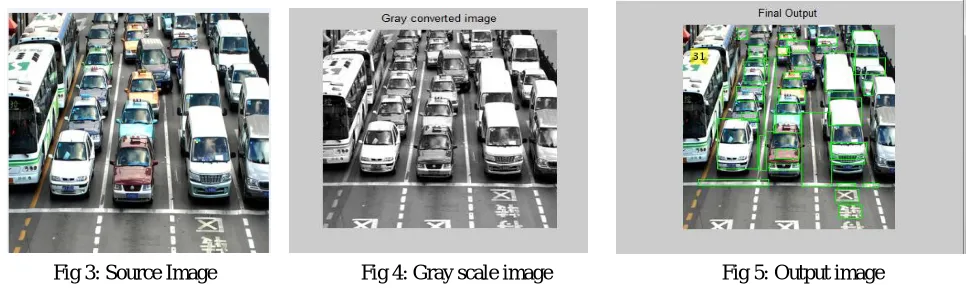
The source image here is the RGB image which is given an input by the user, from which the count of the vehicle can be obtained.
Fig 3: Source Image Fig 4: Gray scale image Fig 5: Output image
B. Grayscale image
The source image is converted to grayscale image which displays the image into black and white. Here the RGB image is converted to gray. The gray scale image carries only intensity information’s.
C. Output image
In the output two screens will be shown in the first screen the vehicles will be boxed to count the number and in the second screen the number of vehicles present will be displayed. By using the output image the density of the vehicle present at the road can be determined. This information’s are passed on to the next section using wireless communication devices.
I. Duration Control And Transmission System
In this section the controlling of duration and transmission of information to the vehicle section takes place. The vehicle count is transmitted to the control section through serial port.
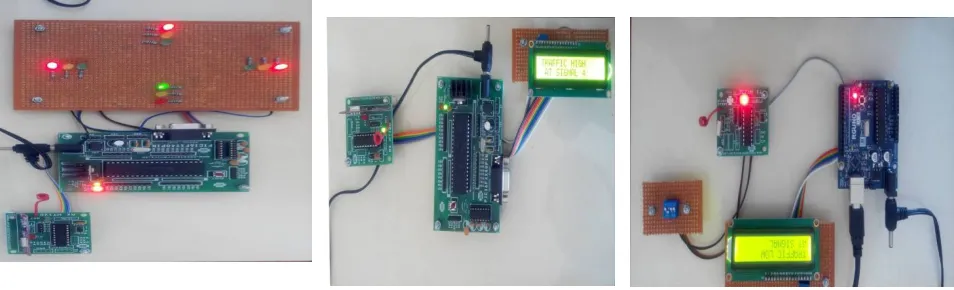
Fig 6: Simulation of control section
Fig 7: Simulation of traffic section Fig 8: Simulation of vehicular section
If the information about the traffic junction is known to the vehicles approaching that junction in advance, it will be helpful for them to prefer an easy route.This information from the traffic section is passed to the vehicular section using Zigbee transceivers. The duration can and the density will be continuously displayed on the LCD which will be installed inside the vehicle.
V. EVALUATION AND RESULT
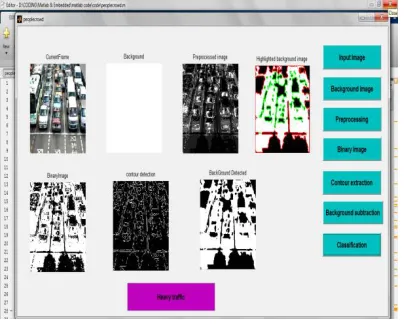
The proposed scheme is simulated on MATLAB and Proteus. The capturing and processing of traffic image is performed in digital image processing domain, and the stimulation of image processing is done in MATLAB. The algorithm used for this stimulation is Otsu’s algorithm. By using this, the vehicle density is determined, that is whether the vehicles present at the junction is heavy or low. The image captured in the traffic signal is processed and converted into grayscale image then its threshold is calculated based on which the contour has been drawn for determining the number of vehicles present at the junction.
Fig 3: MATLAB output
Fig 4: Control Section Fig 5: Traffic Section. Fig 6: Vehicular Section
V. CONCLUSION
In this paper, instead of using the old methods for controlling and estimating the traffic signal and density, a new method is proposed in which the traffic is controlled by estimating the density of vehicles present in the junction and the information is transmitted to vehicles. This proposed method helps in reducing the problems related to the heavy traffic congestion at the traffic signal junction which is continously increasing with the passing days. The present world is too busy that it doesnot want to waste there valuable time in the middle of crowded junctions. As a result of this the proposed system is introduced which is a time saving traffic signal control unit, based on density.This paper covers the methodology of implementing the traffic signal control system based on the density of vehicles on road and transferring valuable information to the vehicles. The main objective of this paper is to estimate the density of vehicles and to transmitt information using digital image processing, embedded system and wireless communication. The paper thus gives a method to reduce congestion on road, save fuel and valuable time and to choose a less congested, safe and easy route.
REFERENCES
1. Amrita Rai and Govind Singh Patel. “Muliple Traffic Control Using Wireless Sensor and Density Measuring Camera” Sensors & Transducers
Journal Vol.94, Issue 7, July 2008, pp. 126-132.
2. H.R Kashani and G.N.Saridis “Intelligent Control for Urban Traffic Systems” International Federation of Automatic Control Automatica,
Vol.19, May 2014.
3. L. Wu, “Experimental study on vehicle speed estimation using accelerometer and wheel speed measurements,” in Proc. IEEE International
Conference on Mechanic Automation and Control Engineering, Jul. 2011.
4. Manoj Kanta Mainali & Shingo Mabu “Evolutionary Approach for the Traffic Volume Estimation of Road Sections” IEEE pp100-105, May
2010.
5. Mohit Dev Srivastava, Prerna, Sumedha Sharma, “Smart Traffic Control System Using PLC and SCADA” International Journal of Innovative
Research in Science, Engineering and Technology Vol.1, Issue 2, December 2012.
6. Mrs. Ligi K, “Vehicle Density Estimation using GPS and Zigbee”,International Journal of Engineering Research & Technology (IJERT), Vol. 3
Issue 3, March – 2014.
7. Ms Promila Sinhmar, “Intelligent Traffic Light and Density Control Using IR Sensors” International Journal of Advanced Technology &
Engineering Research(IJATER), Vol.2, Issue 2, March 2012.
8. R. Bhoraskar, N. Vankadhara, B. Raman, and P. Kulkarni, “Wolverine: Traffic and road condition estimation using smartphone sensors,” in Proc. IEEE International Conference on Communication Systems and Networks, Jan. 2012.
9. Sooksan Panichpapiboon, Member, IEEE, and Puttipong Leakkaw,“Traffic Sensing Through Accelerometers”,June 2015.
10. Vivek,Tyagi, Senior Member IEEE, Shivakumar Kalyanaraman, Fellow, IEEE, and Raghuram Krishnapuram, Fellow, IEEE “ Vehicular
Traffic Density State Estimation Based On Cumulative Road Acoustics” in IEEE Transaction On Intelligent Transportation System. Vol.23. No.23 September 2012.
11. Wanjing MA and Xiaoguang YANG “Design and Estimation of an Adaptive Bus Signal Priority System Based on Wireless Sensor Network”
BIOGRAPHY
Nithika Bhasi is an Assistant Professor in ECE department at Dhanalakshmi Srinivasan College of Engineering,
Coimbatore, Tamil Nadu. She received Master of Engineering in 2016 from Anna University, Chennai.