Analysis Parameter of MIMO-OFDM System
for IEEE 802.16 Systems
Chandrakant Mishra, Prof. Sonu Lal
M. Tech Research Scholar, IES College, Bhopal, India
Assistant Professor, IES College, Bhopal, India
ABSTRACT: This paper investigates the multiple input multiple output (MIMO) space-time coded wireless systems. MIMO-OFDM system to improve the reliability of the WiMAX (IEEE 802.16) system. This paper discusses the model building of MIMO-OFDM using MATLAB R2012b version. This model is a using tool for BER (Bit Error Rate), PAPR (Peak Average Peak Ratio) and transmits spectrum performance evaluation for signal & multiple input output port by the WiMAX (IEEE 802.16) system. In this paper, transmitter and receiver model are analysis according to the parameters established by the standards, to evaluate the performance parameter.
KEYWORDS: WiMAX, OFDM, RAYLEIGH CHANNEL, MIMO-OFDM, BER, PAPR
I. INTRODUCTION
Wireless communications is a rapidly growing part of the communications field, with the believable to provide high-speed and high-quality information swap between portable devices located anywhere in the world. It has been the topic of study since last two decades the terrific development of wireless communication technology is due to several factors. The demand of wireless connectivity is exponentially increased. Second, the dramatic progress of VISL technology has enabled small-area and low-power implementation of sophisticated signal processing algorithm and coding algorism. Third, wireless communication standards, like CDMA, GSM, TDMA, make it possible to transmit voice and low volume digital data. Further, third generation of wireless communications can offer users more advanced service that achieves greater capacity through improved spectral efficiency [1].
Potential applications enabled by this technology include multimedia cell phones, smart homes and appliances, automated systems, video teleconferencing and distance learning, and autonomous sensor networks. However, there are two significant technical challenges in supporting these applications first is the phenomenon of fading the time variation of the channel due to small-scale effect of multi-path fading, as well as large-scale effect like pass loss by distance attenuation and shadowing by obstacles. Second,since wireless transmitter and receiver need communicate over air, there is significant interference between them [2].
Overall the challenges are mostly because of limited availability of radio frequency spectrum and a complex time-varying wireless environment (fading and multipath).
The OFDM system of the WiMAX adopts abruptly deliver mode, reliability, good efficiency and High data rate is achieved between the transmitter and the receiver if they are ideally synchronized [3-4]. However, there usually exists a small timing and frequency offset whose exists will dramatically degrade the performance of the whole OFDM systems. Hence, before signals can be demodulated, OFDM symbols have to be time-synchronized and carrier frequency offset compensated. This puts forward very high request to the mode piece of the synchronization system. In order to realize the synchronization, it must adopt synchronization algorithm of smaller calculation quantity. In the meantime, it should have higher examination of the first moment [5].
This paper is organized as follows: In section II, the orthogonal frequency division multiplexing (OFDM) system and multiple input multiple output OFDM (OFDM-MIMO) system is formulated. Space time block code is introduced in section III. In sectionIV discussed about previous and proposed model and simulation result. Finally, the conclusions are given in section V.
II. OVERVIEW OF OFDM AND MIMO SYSTEM
o OFDM
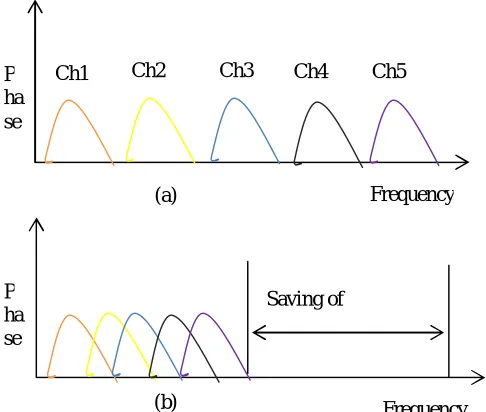
Orthogonal frequency-division multiplexing (OFDM) is a method of digital modulation in which the data stream is split into N parallel streams of reduced data rate with each of them transmitted on separate subcarriers. In short, it is a kind of multicarrier digital communication method. OFDM has been around for about 40 years and it was first conceived in the 1960s and 1970s during research into minimizing interference among channels near each other in frequency [2].OFDM has shown up in such disparate places as asymmetric DSL (ADSL) broadband and digital audio and video broadcasts. OFDM is also successfully applied to a wide variety of wireless communication due to its high data rate transmission capability with high bandwidth efficiency and its robustness to multi-path delay[7-8].
The basic principle of OFDM is to split a high data rate streams into a number of lower data rate streams and then transmitted these streams in parallel using several orthogonal sub-carriers (parallel transmission). Due to this parallel transmission, the symbol duration increases thus decreases the relative amount of dispersion in time caused by multipath delay spread. OFDM can be seen as either a modulation technique or a multiplexing technique.
(a)
(b)
o MIMO
MIMO has been developed for many years for wireless systems. One of the earliest MIMO to wireless communications applications came in mid-1980 with the breakthrough developments by Jack Winters and Jack Saltz of Bell Laboratories [9]. They tried to send data from multiple users on the same frequency/time channel using multiple antennas both at the transmitter and receiver. Since then, several academics and engineers have made significant contributions in the field of MIMO. Now MIMO technology has aroused interest because of its possible applications in digital television, wireless local area networks, metropolitan area networks and mobile communication. Comparing to the Single-input-single-output (SISO) system MIMO provides enhanced system performance under the same
Ch1 Ch2 Ch3 Ch4 Ch5
Frequency a(a( () P
ha se
P ha se
Frequency Saving of
bandwidth
transmission conditions. First, MIMO system greatly increases the channel capacity, which is in proportional to the total number of transmitter and receiver arrays. Second, MIMO system provides the advantage of spatial variety: each one transmitting signal is detected by the whole detector array, which not only improved system robustness and reliability, but also reduces the impact of ISI (inter symbol interference) and the channel fading since each signal determination is based on N detected results. In other words, spatial diversity offers N independent replicas of transmitted signal. Third, the Array gain is also increased, which means SNR gain achieved by focusing energy in desired direction is increased.
o MIMO-OFDM
OFDM reduces BER performance and ISI with using multiplexing and modulation techniques to get higher data rate over wireless channels, the use of multiple antennas at both ends of the wireless link provide better performance. The MIMO technique does not require any extra transmission power and bandwidth. Therefore, the promising way to increase the spectral efficiency of a system, the combination of MIMO and OFDM is used over fading channels [10-11].
III. SPACE TIME BLOCK CODE
Multiple-Input Multiple-Output uses multiple antennas at both sides which provides transmit diversity and receiver diversity. It’s applicable in every kind of networks like PAN, LAN, WLAN, WAN, MAN. MIMO system can be applied in different ways to receive either a diversity gain, capacity gain or to overcome signal fading.
Space-frequency coding basically extends the theory of space-time coding for narrowband flat fading channels to broadband time-variant and frequency-selective channels. The application of classical space-time coding techniques for narrowband flat fading channels to OFDM seems straightforward, since the individual subcarriers can be seen as independently flat fading channels. However, it was shown that the design criteria for space-frequency codes operating in the space-time and frequency domain are different from those for classical space-time codes for narrowband fading channels as introduced in. When operating in frequency selective fading channels, the application of conventional decoding algorithms results in a significant performance decrease [12]. This is due to the fact that the equivalent channel matrix is no longer orthogonal. Consequently, independent decoding of the two transmitted symbols, as in conventional decoding algorithms, is no longer appropriate.
IV. SIMULATION RESULT
Simulation experiments are conducted to evaluated the transmit spectrum, BER, PAPR reduction performance of the proposed scheme and the OFDM scheme. In addition, it is assumed that the data are QPSK, BPSK, 16-QAM modulated and are transmitted using N=256 sub-carrier.
The following subsection presents the simulation results using the OFDM and MIMO-OFDM model in figure 2, 3, 4, 5, 6 and 7 for WiMAX IEEE 802.16. Figure 2& 3, shows the transmit spectrumWiMAX OFDM with QPSK, QAM-16 and BPSK and transmit spectrum WiMAX MIMO-OFDM 2*2 respectively.
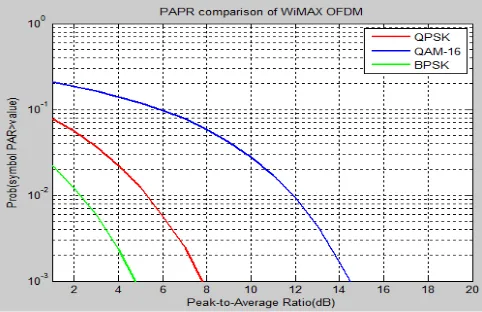
In figure 4 the CCDF plot for SISO OFDM system of WiMAX (IEEE 802.16e) is shown. This research performs a series of simulations to evaluate PAPR performances of the OFDM system. The simulations assume the data were QPSK, QAM-16 and BPSK modulated and the systemcontained N-256 sub-carriers. The BPSK modulation technique is better than other technique, because the error performance of BPSK is better than other technique as we can see in figure 4.
The CCDF is generally used to evaluate the performance of PAPR reduction on MIMO-OFDM system (IEEE 802.16e)
signals for a statistical pair of view. The CCDF is defined as the probability that the PAPR as in equation (1) and PAPR0
as shown in the following:
( { })
max arg } {
,... 3 , 2 , 1
k N
k
Y PAPR Y
PAPR
T
(1)
Where
Y
k,k
1
.
2
.
3
...
N
T represents the time-domain transmitted signal of the k-th antenna}) {
} { Pr(
)
(PAPR 0 PAPR Y PAPR 0
CCDF
(2)
Figure 2: Simulation result of QPSK, QAM-16 and BPSK modulation in transmit spectrum WiMAX OFDM
8002.16e). Figure 5 present the CCDF of PAPR for STBC algorithm in the condition described above.
Figure 5 presents the CCDF graph of PAPR for the MIMO-OFDM 2×1& MIMO-OFDM 2*2 system of WiMAX (IEEE The green line curve corresponds to the MIMO-OFDM 2*1 BPSK signal and blueline curve corresponding to the MIMO-OFDM 2*2 BPSK signal. MIMO-OFDM 2×1 system is better resultcompare to the MIMO-OFDM 2×2 system.
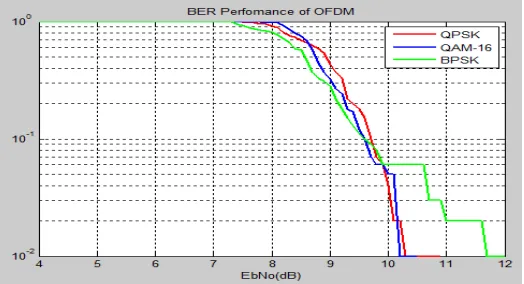
Figure 6: Simulation result of QPSK, QAM-16 and BPSK modulation in BER Performance of WiMAXOFDM Figure 3: Simulation result of QPSK and QAM-16 modulation in transmit spectrum WiMAX MIMO-OFDM 2*2.
V. CONCLUSION
We know that a tradeoff between peak power peak ratio (PAPR) and bit error rate for WiMAX IEEE 802.16. In this paper presented low-complexity transmitter architecture for STBC MIMO-OFDM system. The proposed SBTC MIMO-OFDM 2*1 and MIMO-OFDM 2*2 scheme could offer good PAPR reduction, which is almost the same as that of OFDM system. The previous scheme used only single input single output. However, the proposed scheme designs for multiple inputs and multiple outputs. Therefore, the proposed SBTC MIMO-OFDM scheme has better bandwidth efficiency and BER performance compared with the previous scheme.
REFERENCES
[1] Kumar, “Introduction to Broadband Wireless Networks” in Mobile Broadcasting with WiMAX: Principles, Technology and Applications, New York, USA: Focal Press, 2008, pp. 24-50.
[2] C. Eklund, R. B. Marks, K. L. Stanwood and S. Wang, “IEEE Standard 802.16: a Technical Overview of the WirelessMAN Air Interface for Broadband Wireless Access,” IEEE Commun. Mag., vol. 40, pp. 98-100, Jun 2002.
[3] S. J. Vaughan-Nichols, “Mobile WiMAX: The Next Wireless Battleground,” in IEEE Comp. Soc. Mag.
[4] L. Koffman and V Roman, “Bradband wireless access solution based in IEEE 802.16,” IEEE communication Magazine, vol. 40, pp 4, Apr. 2004pp 96-103.
[5] K. Y. Cho, B. S. Choi, Y. Takushima, and Y. C. Chung, B25.78-Gb/s operation of RSOA for next-generation opticalaccess networks,[ IEEE Photon. Technol. Lett., vol. 23, no. 8, pp. 495–497, Apr. 2011.
[6] J. Zhang and N. Ansari, BToward energy-efficient 1G-EPON and 10G-EPON with sleep-aware MAC control and scheduling,[ IEEE Commun. Mag., vol. 49, no. 2, pp. s33–s38, Feb. 2011.
[7] A. Islam, M. Bakaul, A. Nirmalathas, and G. E. Town, BMillimeter-wave radio-over-fiber system based on heterodynedunlocked light sources and self-homodyne RF receiver,[ IEEE Photon. Technol. Lett., vol. 23, no. 8, pp. 459–461,Apr. 2011.
[8] M. Daneshmand, C. Wang, and W. Wei, BAdvances in passive optical networks,[ IEEE Commun. Mag., vol. 49, no. 2,pp. s12–s14, Feb. 2011.
[9] Different Modulation Techniques used in WiMAX , International Journal of Emerging Technology and Advanced Engineering, Volume 3, Issue 4,April 2013.
[10]PrabhakarTelagarapu,PrabhakarTelagarapu,K.Chiranjeevi, “Analysis of Coding Techniques in WiMAX”, International Journal of Computer Applications ,Volume 22– No.3,May 2011.
[11]Performance of Coding Techniques in Mobile WiMAX Based System” International Journal on Recent and Innovation Trends in Computing and Communication,Volume: 1 Issue: 1,2009.